
Specs are compiled from manufacturer listings and verified buyer reviews and can change over time — please confirm the key details on the product page before buying.
If your power dies in a storm, the only question that matters is whether the generator you own can actually carry your house. This guide is about the heavy hitters — machines that run near or above 11,000 watts and can keep a furnace, a well pump, a refrigerator and a few rooms of lights alive at once. One honest note before you read: this list uses flexible matching for 11,000-watt output or higher, so a few picks here are 12,000W or 13,000W of the same generator type. Not every pick is the exact number you searched, but the nearest same-type size serves the same job, and we say so plainly.
I’m Mohammad Maruf — the founder and writer behind KitchPrep. This guide is built by comparing the manufacturers’ published specifications and the patterns across verified customer reviews, so you get each pick’s real strengths and trade-offs instead of marketing spin.
You will learn how running watts differ from peak watts, why fuel choice changes everything about a long outage, and which machine fits your house. A 9500- to 10500-running-watt machine in this class carries a furnace, a fridge and a few rooms of lights through a multi-day outage.
Our Picks at a Glance


How To Choose The Best 11000 Watt Generator
Buying in this class is really two decisions: how much power you need to start, and what fuel you can actually keep feeding the machine for days. Get those two right and everything else — outlets, noise, weight — sorts itself out.
Running watts versus peak watts
Peak watts are the short surge a motor draws in its first second — a fridge compressor or a furnace fan kicking on. Running watts are what the machine must hold steady for hours. A 12,500-watt peak unit may only run 10,000 watts continuously, so add up what you need to keep running, then check the surge your largest motor demands.
Fuel type decides your outage endurance
A gasoline-only machine means hauling cans in a storm. Propane lets you run off a tank you may already have. Natural gas, where a line exists, means you never refuel at all — though output usually drops on the lower-energy fuels, so check the ratings for each fuel separately.
Quick Comparison
| Model | Best For | Running Watts (Gas) | Fuel Types | Peak Watts | Amazon |
|---|---|---|---|---|---|
| Westinghouse 12500 Peak Watt Home Backup★ Best Overall | Balanced whole-home backup | 9500 | Gasoline | 12500 | Amazon |
| DuroStar DS13000MX 13,000-WattBest Value | Dual-fuel value | 13000 (peak rated) | Gasoline, Propane | 13000 | Amazon |
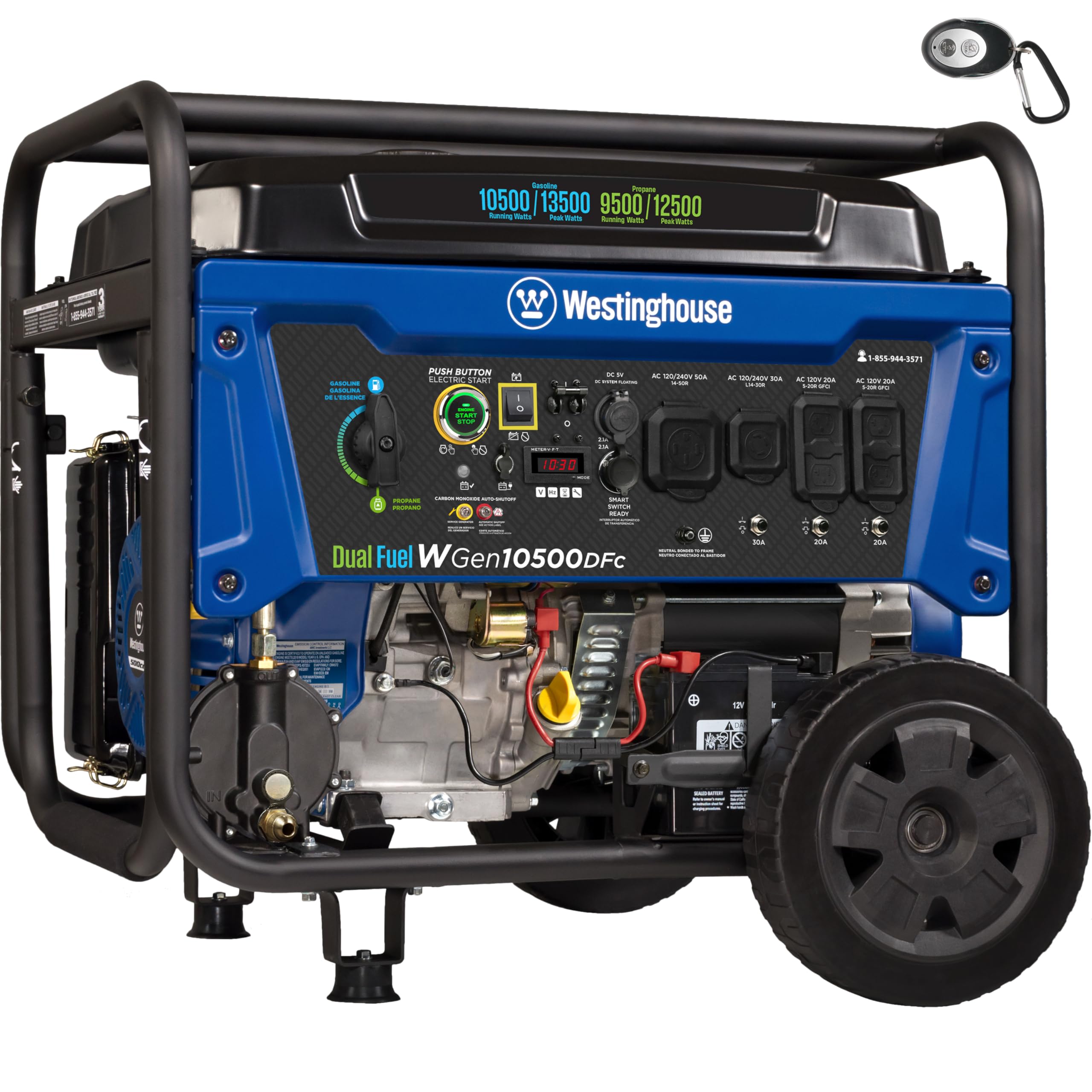
| Westinghouse 13500 Peak Watt Dual FuelLongest Run Time | Longest run time | 10500 | Gasoline, Propane | 13500 | Amazon |
| Champion 12,500-Watt Tri Fuel | Natural gas convenience | 10000 | Gas, Propane, Natural Gas | 12500 | Amazon |
| DuroMax XP13000HXT | Whole-home on any fuel | 13000 (peak rated) | Gas, Propane, Natural Gas | 13000 | Amazon |
| Champion 11,000-Watt Wireless Remote Inverter | Quiet neighborhood backup | 9000 | Gasoline | 11000 | Amazon |
| DuroMax XP15000HXT | Heaviest loads | 15000 (peak rated) | Gas, Propane, Natural Gas | 15000 | Amazon |
In‑Depth Reviews
1. Westinghouse 12500 Peak Watt Home Backup Portable Generator
Our pick — over 4.5★ from 500+ verified ratings; the strongest balance of quality and price.
The most-reviewed pick here — buyers report running a whole house for 48+ hours below 32°F.
The number that earns this pick its spot is 9500 running watts with 12500 peak watts, which is the difference between “it turns on” and “it starts your air conditioner without tripping.” That gap matters most in the first second a compressor kicks on, when demand spikes far above what the machine holds all day. Owners have used that headroom hard: as owners mention, one machine “Ran entire house 48+ hrs during outages below 32°F, including 5-ton inverter heat pump, electric oven at 450°F, shower.” That is a heat pump, an oven and a shower on one portable unit.
Refueling during an outage is the part nobody thinks about until it is dark and raining. This one holds 6.6 gallons and Westinghouse rates it for up to 12 hours of run time, though the reviews tell you real-world load stretches that window differently depending on what you leave on. Remote start with the included key fob means you are not pulling a cord in the cold, and both electric and recoil starting are on the panel. Two GFCI household outlets, a transfer-switch-ready 30A outlet, an RV-ready 50A outlet and two USB ports cover phones as well as appliances.
Beyond the wattage, customers note it fires on the first pull or button press season after season. A heavy-duty 457cc four-stroke engine with a cast-iron sleeve does the work, automatic low-oil shutdown protects it, and a digital hour meter lets you track maintenance instead of guessing. It is 212 pounds with wheels and a folding handle, so one person can roll it to the side of the house. The recurring gripe is the wheels themselves — after about a year, they can work loose. The other honest catch is noise and upkeep: this is a big open-frame machine, and it rewards the owner who changes oil on schedule and runs a stabilizer.
Where it delivers
- 12500 peak watts for hard motor starts, 9500 running for steady loads
- Remote key fob plus electric and recoil start — three ways in
- CO shutdown and low-oil shutdown guard the two most common failure modes
- 6.6-gallon tank, up to 12 hours of run time keeps refueling manageable
What to plan around
- Wheels can loosen after roughly a year of use
- 212 pounds — rollable, but not carried upstairs
- Open-frame noise is expected for this engine size
Built for: the household that wants one proven machine to carry essentials and a big load through a multi-day outage.
Look past it if: you need natural gas — this one burns gasoline only, so pick the Champion or a tri-fuel Westinghouse instead.
2. DuroStar DS13000MX 13,000-Watt 500cc Dual Fuel Portable Generator
A 500cc dual-fuel workhorse that starts with a button and carries a whole house on gasoline or propane.
Buyers looking at their first serious backup machine usually land here, and the pull is the fuel flexibility. You get 13,000 rated watts from a 500cc engine, and the front-facing selector lets you switch between gasoline and propane without tools. On a long outage, that means you can run propane off a tank you refill without pouring liquid fuel in the dark. It is also physically smaller than it looks on paper — 29.75 by 27.5 by 25.75 inches, a bit chunkier than the 27.2 by 26.1 by 26.5-inch Westinghouse above, so it still fits on a patio pad or beside a shed.
The push-button electric start and included remote do the heavy lifting in bad weather, and the 50A heavy-duty outlet is what makes transfer-switch hookup realistic for a whole home. Reviewers point out it handles a full house including a 1.5-ton AC, a split unit, fridge, stove, microwave, TVs and a water heater, with only slight strain when the main air conditioner kicks in. Assembly is genuinely quick — wheels, handle and battery — and the control panel stays readable when your hands are cold and wet.
Owners consistently praise the 500cc engine and heavy steel frame. The dual-fuel selector lets you switch to propane without tools when the gasoline runs out. The honest notes are smaller: the moving handles could be sturdier, and the oil drain tube sits close to the tire, so keep an eye on it and tuck it clear before you roll the unit. A small number of units have thrown a CO alert that shut the engine down; that is a safety feature doing its job, and most buyers never see it.
On the control side: CO alert, low-oil shutdown and electric start are all standard, so safety and convenience are not separate purchases.
Where it fits: the buyer who wants tri-fuel thinking on a dual-fuel budget, and who values a machine that feels like equipment rather than a gadget.
Reach for this if: you want dual-fuel flexibility and a heavy, confidently built frame you can trust for years of seasonal starts.
skip it if: natural gas is your plan — there is no NG hookup here, so the Champion tri-fuel is your better route.
3. Westinghouse 13500 Peak Watt Dual Fuel Home Backup Portable Generator
The endurance champion of the Westinghouse line — a 9.5-gallon tank and up to 19 hours on one fill.
If your outage scenario is a storm that lasts three days, the fuel tank is the spec that changes your life. This machine holds 9.5 gallons versus the 6.6 gallons on the 12500 above — that is 44% more fuel — and Westinghouse rates it for up to 19 hours of run time against that unit’s 12 hours. The 500cc engine also displaces 500 cubic centimeters versus 457 on the 12500, a 9% bump that feeds the extra output: 10500 running watts on gasoline and 13500 peak, against 9500 running on the smaller model. In plain terms, you refuel far less often, and on propane the machine still turns out 12500 peak and 9500 running watts.
Owners rate the build extremely highly, and the pattern in the reviews is that it works the first time every time — remote start from the included key fob, digital hour meter for tracking hours, and a CO sensor and automatic low-oil shutdown that protect the engine. Two GFCI household outlets, the transfer-switch-ready 30A outlet and the RV-ready 50A outlet cover everything from a well pump to a travel trailer. At 230 pounds it is heavier than the 12500 by 18 pounds, but that is a wheel-and-handle difference, not a reason to rule it out.
Some owners get lucky beyond the spec sheet — several report Westinghouse upgrading their dual-fuel order to tri-fuel at no charge, which adds a natural gas option they did not pay for. That is not a promise, but it says something about how the brand treats this product. The honest caveat with any machine this size is maintenance: hour meter, oil changes, and a fuel stabilizer before storage are how you keep it starting years from now.
Biggest reason to buy: the combination of 19-hour run time and 10500 running watts means fewer fuel runs during the worst weeks of the year.
Keep in mind: 230 pounds and open-frame noise — plan a permanent spot near a vented area and treat it as semi-stationary.
Best for: the household that has lived through a long outage and never wants to refuel in the dark again.
Not the one if: you want inverter-grade clean power for sensitive electronics — this is an open-frame unit, so the Westinghouse inverters below are the better match.
4. Champion 12,500-Watt Electric Start Tri Fuel Home Backup Portable Generator

Runs on gasoline, propane or natural gas from the start, with both hoses in the carton.
Natural gas is the quiet advantage in this class — no cans, no runs to the station, no fuel going stale in the tank. This Champion is tri-fuel and ships with both the LPG and NG hoses, so on a home with a gas line you can hook up and run indefinitely. The trade is output: gasoline gives you 12,500 starting watts and 10,000 running watts, propane gives you 11,250 starting and 9000 running, and natural gas gives you 10,000 starting and 8000 running. Check those numbers against your load before you commit to the gas line.
What owners talk about most is how fast and how simply it starts. The 500cc engine fires off the rocker switch with a battery included, and the assembly is a short list — shipping brackets off, wheels and stands on, battery and oil in. The Intelligauge is the sleeper feature: it tracks voltage, frequency, session run time and total run time, so you can watch your load and schedule oil changes without a separate meter. CO Shield adds an automatic carbon monoxide shutoff.
Two small things show up in the reviews. One owner found the bottom frame slightly bent near the wheel bracing and the wheel turning a touch off-straight, and another had the operator panel work loose mid-break-in — both assembly-quality quirks rather than performance failures, and both fixed with a wrench. If you want the convenience of never refueling during a storm, this is the practical pick.
Why it works: three fuel options plus the Intelligauge mean you can match the machine to whatever you actually have access to on the worst day.
Weigh first: output drops noticeably on natural gas — confirm 8000 running watts still carries your essentials before you rely on the gas line.
Pick it if: you have a natural gas line and want to stop thinking about fuel during an outage.
Consider something else if: you need the highest running watts on gasoline — the Westinghouse 13500 or the DuroMax HXT below deliver more.
5. DuroMax XP13000HXT 13,000-Watt 500cc Tri Fuel Portable Generator
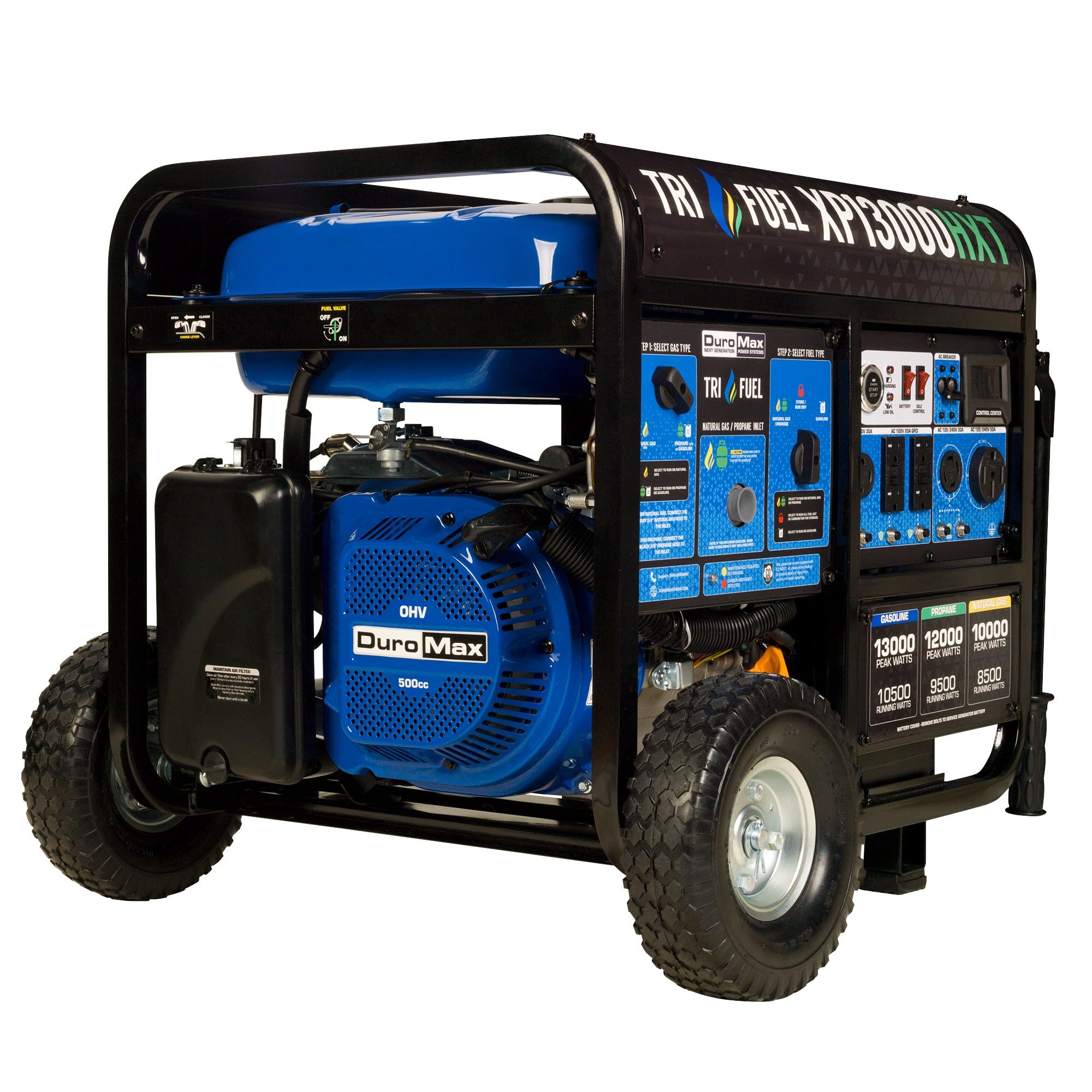
A 13,000-watt tri-fuel unit that runs a whole home off your existing gas line and still takes gasoline or propane.
The detail that separates this machine for home backup is the 50-amp transfer-switch-ready outlet. In practice, a bigger outlet lets the generator start a smaller air conditioner or a furnace fan that a 30-amp panel would stall on, which is the difference between “backup” and “maybe.” A powerful 500cc OHV engine supplies the watts, and the front-facing interface lets you change fuels in seconds without tools. Controls are push-button and remote, so both starting paths are covered.
What makes it a genuine tri-fuel machine is that it runs on gasoline, propane or natural gas, and the carton includes the connection hardware — a 15-foot 3/4-inch natural gas hose, a propane regulator and a full set of plugs. Owners who normally keep a hardwired standby for whole-home coverage report that this does the same work at a fraction of the install, especially when they already have a gas line. The digital display shows your load so you can see how close you are to capacity before you add another appliance.
The reviews separate into two honest camps. Owners who feed it what it wants, follow the manual and never run it indoors are overwhelmingly happy — one ran it a full week during an outage, tracked a steady gasoline burn of about ten gallons a day at moderate demand, and considered the research validated. The complaints cluster around the startup learning curve: the machine may take a handful of cranks to prime on a new fuel, the fuel knob is stiff, and there is no included oil in some configurations. None of that is a performance flaw, but first-time owners should expect to read the manual twice before storm season.
Strong points
- Tri-fuel on gasoline, propane or natural gas — no single point of fuel failure
- 50-amp transfer-switch outlet for real whole-home hookup
- Remote and push-button start with a front-facing fuel selector
- Digital load display so you can watch capacity in real time
Worth knowing
- Stiff fuel knob and a priming ritual on a new fuel source
- Heavy at 240 pounds — wheel it, do not lift it
- Power cord kit for hardwiring is a separate purchase
Worth choosing if: you want one generator to cover gasoline, propane and natural gas without buying a hardwired system.
Look elsewhere if: you want the simplest possible first-time experience — the Westinghouse 12500 above starts more forgivingly on gasoline alone.
6. Champion 11,000-Watt Wireless Remote Start Portable Inverter Generator

A 64 dBA inverter that keeps the neighborhood happy while it runs your essentials.
Choosing between an open-frame generator and an inverter usually depends on two things: noise and whether sensitive electronics can handle the power. This Champion runs at 11,000 starting watts and 9000 running watts, but the real story is that it holds output near 64 dBA at 23 feet — conversational volume, not a lawnmower. That is the spec that matters most when your machine has to sit near a bedroom window or a neighbor’s fence. It runs up to 15 hours on a full tank of gasoline.
The inverter side matters for anything with a chip in it — a modern furnace board, an OLED TV, a laptop brick. Owners describe running an entire house for a five-hour break-in through the 50-amp connection and reporting solid voltage and frequency, with fridges and freezers all fine. Others have used it for RV camping and trades, and the low-noise operation is what they mention most. The 459cc Champion engine with battery-included electric start and Cold Start Technology means cold-weather starts are covered.
The honest catch is that this is a gasoline-only machine. No propane, no natural gas — everywhere else in this class offers at least one alternative, so if fuel flexibility is on your wishlist, this is not the pick. There is also no breaker on the 37.5A outlet, which is note for anyone pushing the panel hard. But if noise is your blocker with neighbors or a campground, this machine solves the problem cleanly.
Best attribute: inverter power plus 64 dBA means you can run it in places a traditional open-frame generator would be unwelcome.
The trade: gasoline only — you will be hauling cans in a storm.
Choose it for: quiet neighborhood backup, campground use and RV trips where inverter-grade power and low noise are the priorities.
Turn to the tri-fuel picks if: being tied to gasoline is a dealbreaker for your outage plan.
7. Westinghouse iGen12000DFc 12000 Peak Watt Dual Fuel Inverter Generator
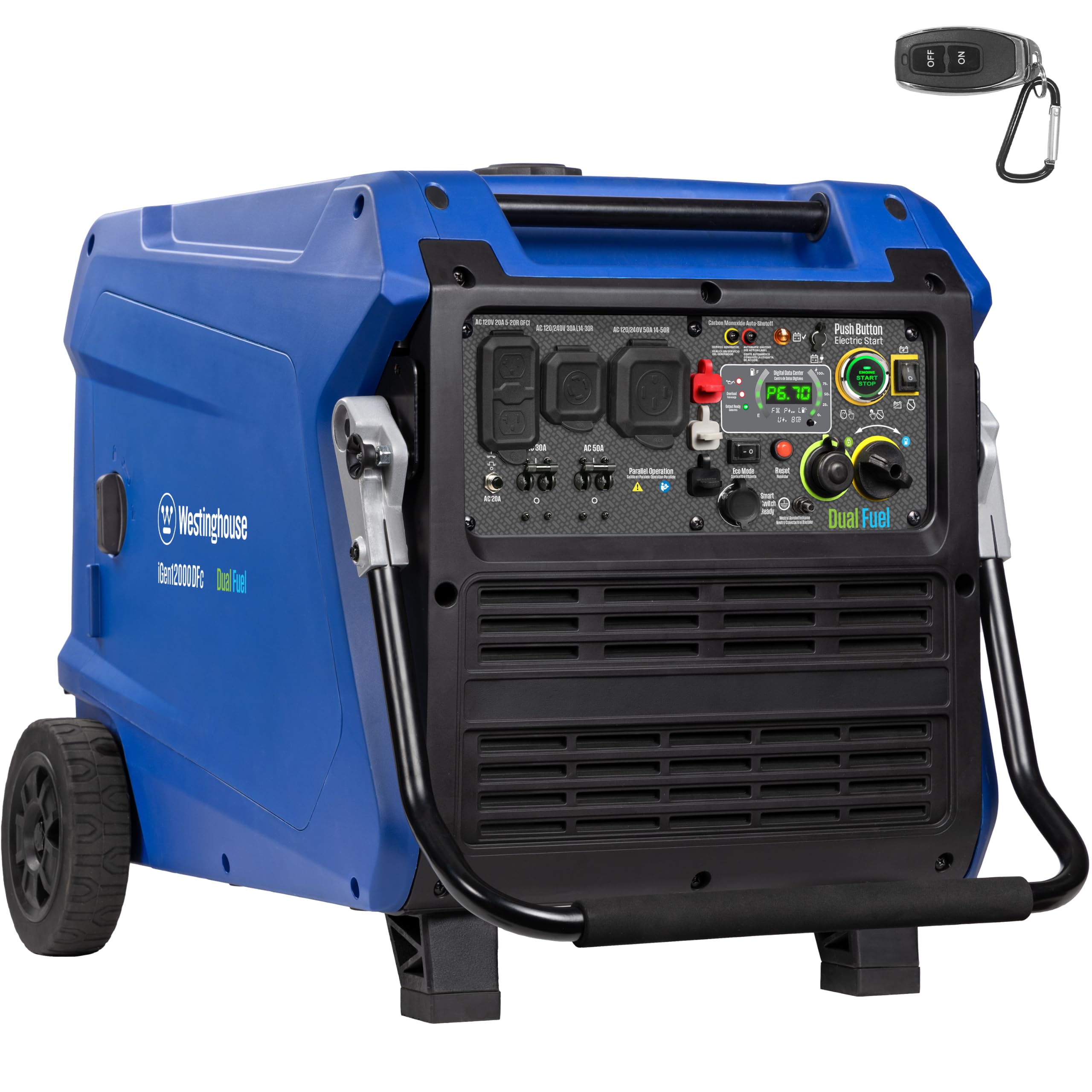
Whole-home backup with inverter-grade power that will not cook your electronics.
If your house has a modern furnace, a heat-pump, or a home office fulmeasures 26 by 19 by 24 inches, the smallest machine in this guide, and still manages 11,000 watts peak with sub-3% THD. The oversized 8.7-gallon tank is rated for up to 21 hours of run time on the lower fuel setting, the longest advertised figure here. It runs on gasoline, propane or natural gas with a dial-start fuel selector, and it ships with the LPG and NG hose kit so you can hook up immediately.
What separates it from the smaller-brand crowd is the panel. It has a dedicated ATS port for automatic transfer switch integration, a 50A 14-50R outlet for larger RVs, a 30A L14-30R 240V outlet for home backup, and waterproof rubber covers with GFCI protection on all the outlets. Push-button electric start with a remote covers the start sequence, and there is a manual pull as a backup. It also comes with a 3-year limited warranty and a dust cover.
The honest note is that this is a young brand with a small review base, so the long-term reliability picture is still forming — owners who have put hours on it describe easy setup, quiet operation, helpful oil-drain and carburetor-bowl tubing for storage, and confident tri-fuel flexibility. One owner reported that if you push past roughly 5500W, fuel consumption climbs sharply. That is simply the physics of running a compact inverter hard, and worth knowing before you plan to run it near the top of its range.
Smallest footprint, big features: ATS port, 50A and 30A outlets and a hose kit are all included — a lot of capability in 26 by 19 by 24 inches.
Be realistic: run it within sensible load limits, especially if fuel economy matters to you during a long outage.
Best suited to: the buyer who wants tri-fuel flexibility in the tightest space, especially for an RV or a small shed with an automatic transfer switch.
Hold off if: you want a decade of proven reliability data — the big-name Westinghouse and Champion inverters are safer bets.
8. DuroMax XP11000iH 11,000-Watt Dual Fuel Inverter Generator
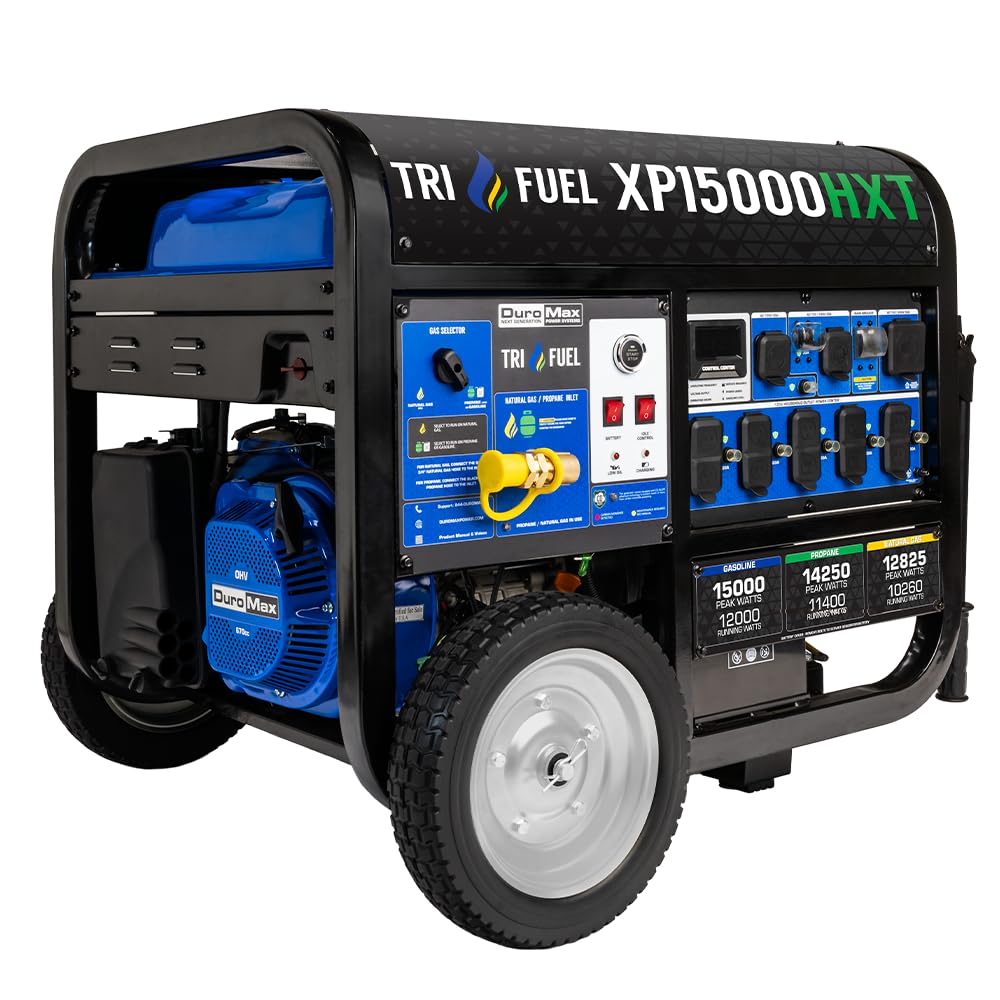
A 15,000-watt tri-fuel giant for homes that want to run the whole panel, not just the essentials.
The appeal of this one is headroom. At 15,000 watts peak, with a 670cc engine and 100% copper windings, it is the kind of machine you buy when your plan is “everything, all at once” — not “the fridge and the furnace.” Tri-fuel operation covers gasoline, propane and natural gas, so you can pick whichever fuel is easiest for your location on the day. A transfer-switch-ready 50-amp outlet handles whole-home hookup, and the panel includes 4 120V 20A GFCI outlets, 1 120V 30A twist lock, 1 120/240V 30A twist lock, and the 50A heavy-duty outlet.
The control panel is upgraded with a large LED display that shows gas gauge, load gauge, voltage, frequency and time, so you can see what you are using at a glance. Push-button and remote start are both included, and CO Alert shuts the machine down if it detects harmful fumes. The carton ships with a 15-foot 3/4-inch natural gas hose, a propane regulator and a full plug set, so the hookups are covered from day one. Owners regularly note it runs an 1800-square-foot home with a full basement — including central air — without complaint.
The honest note is that reliability splits in the review pile. A long list of owners mention successful multi-day outages on natural gas with HVAC running, but a smaller group reports a propane intake issue or a unit that failed at 60 hours. That is an honest mixed picture, not a deal breaker, and the strong positive pattern lives on the power output side — owners love how much it carries. Buy from a seller with clear return terms and you have a low-risk path to a very capable machine.
What the spec really delivers: 15,000 watts peak from a 500cc OHV engine with 100% copper windings — enough capacity to plan “whole panel” instead of “essential circuits.”
Plan around this: reliability experience varies in the reviews — a few units have had fuel-intake or early-hour failures, so keep your return path clean and consider an extended route.
Best for: the household that wants maximum wattage on three fuel options and is ready to hook up a 50-ampfeed to the panel.
Cold feet if: you want the smoothest first-owner experience — this is the pick with the most polarized long-term reliability notes in the reviews.
Understanding the Specs
Peak Watts Vs. Running Watts
Peak watts are the brief surge a machine can deliver for one or two seconds, usually when a motor starts. Running watts are what the generator can carry continuously, hour after hour. A machine rated 12,500 peak and 10,000 running is rated for the surge and for the steady load separately. Always size your generator by running watts, then check that peak handles the biggest motor start in your house.
Tri-Fuel And Fuel Switching
Tri-fuel means the generator runs on gasoline, propane or natural gas. Each fuel changes output, because natural gas and propane carry less energy per unit than gasoline. Ratings drop as you switch — for example, one machine rated 12,500 starting watts on gasoline delivers 11,250 on propane and 10,000 on natural gas. Pick the fuel you can actually supply for multiple days, not just the one with the biggest number.
Transfer Switch Ready Outlets
A transfer switch or interlock kit lets you feed your home’s panel safely instead of running extension cords through a window. A 50-amp outlet is what makes the biggest loads — a bigger AC, a well pump, a furnace — realistically startable through the panel. A 30-amp outlet covers more modest loads. If whole-home backup is the goal, look for a 50-amp transfer-switch-ready or interlock-ready outlet on the panel.
CO Sensor And Automatic Shutdown
Carbon monoxide is the leading hazard with portable generators. A CO sensor monitors for it and shuts the engine down automatically if levels rise, which is why the feature appears on every serious machine in this class. Pair that with a low-oil shutdown and an hour meter, and you have the three safety and maintenance features to insist on before you buy.
FAQ
What size generator do I need to run my whole house during an outage?
Does the generator run on gasoline and propane the same way?
Can I plug a generator directly into my house panel without a transfer switch?
How long will a full tank actually last during an outage?
Is inverter power different from regular open-frame power?
How loud is a machine in this class?
What kind of maintenance keeps a large portable generator reliable?
Can I run a generator in a shed or garage during a storm?
Final Thoughts: The Verdict
If you want one dependable pick, the 11000 watt generator winner is the Westinghouse 12500 Peak Watt Home Backup because it does the job owners actually ask about — one machine that starts reliably, carries a real house through a multi-day outage, and comes with CO sensing, remote start and the outlets you need from day one. If natural gas is your fuel plan and you want inverter-grade clean power, grab the Westinghouse iGen12000DFc or its tri-fuel sibling. And for the commercial or very-high-power buyer who needs 15,000 to 16,000 watts with a 50-amp panel hookup, the DuroMax XP15000HXT is the one to reach for — with a firm return policy in place, because those are the machines with the most polarized review records here.
The one honest nudge: the most-reviewed pick here earns its following. The top pick carries the highest rating and largest review base in this guide, and its recurring complaint is wheels that loosen after a year — fixable with a wrench and a spare bolt. Spend the extra attention on your fuel plan and your transfer switch wiring, and whichever pick you choose here will keep your lights on when it matters.
How We Picked
We do not accept paid placement. Every pick is matched to a real buyer and a real use-case; we do not hands-on test units.
Sources & Methodology
Specifications: manufacturer listings and product documentation. Review insights: verified customer reviews, as of September 2026. Pricing: not shown on this page (it changes often); check the current price via the retailer link.
As an Amazon Associate, KitchPrep earns from qualifying purchases. This does not affect which products we feature.
Related Guides
