
Specs are compiled from manufacturer listings and verified buyer reviews and can change over time — please confirm the key details on the product page before buying.
Finding a welder that actually runs on a standard household outlet — and still lays a solid bead on quarter-inch steel — is the whole game here. You do not need a 240-volt shop circuit to repair a gate, patch a trailer, or fix a rusted floor pan. The picks below all run on 110-volt power (or switch between 110 and 220 for extra punch), and every one of them has been filtered for real ownership experience on home wiring. The short answer: the ARCCAPTAIN MIG200 leads because it gives you six welding processes and dials in the settings for you, but if you want the most-reviewed machine in this group, the YESWELDER 160A has earned the deepest track record at home-shop use.
I’m Mohammad Maruf — the founder and writer behind KitchPrep. This guide is built by comparing the manufacturers’ published specifications and the patterns across verified customer reviews, so you get each pick’s real strengths and trade-offs instead of marketing spin.
MIG welding on low voltage is a different animal from 240-volt shop welding, and the machines that hold their arc on a 20-amp household circuit are the ones worth your money. This guide breaks down the best 110 volt mig welder options by what each one actually does on household power.
Our Picks at a Glance

How To Choose The Best 110 Volt MIG Welder
Choosing a 110-volt MIG welder depends on three things: your breaker size, the thickness of the metal you actually weld, and how much setup work you want to do before your first bead. Every machine on this list runs on household voltage, but the ones with synergic control and automatic wire-feed matching save a beginner a lot of guesswork on day one.
Match the machine to your household circuit
A 110-volt welder draws current through the same 15- or 20-amp circuit as your garage lights. Machines that pull too hard on that circuit will trip the breaker mid-bead. The models here that are rated at 110V and described as working without tripping breakers are the safest bet for a standard garage setup. If you can plug into a 220V outlet for heavier work, a dual-voltage or multi-voltage machine gives you more headroom without the extra equipment cost.
Synergic control versus manual mode
Synergic control means the welder automatically sets the recommended voltage and wire-feed speed once you select your wire diameter and material. That takes most of the guesswork out of starting out. As you gain experience, manual mode lets you dial voltage and wire-feed independently for finer control over your bead profile. Most of the machines here offer both.
The wire format that suits your environment
Flux-core wire is gasless and handles wind and outdoor conditions, which makes it the right choice for repairs on a fence or trailer. Solid wire needs a shielding gas setup — usually argon or a CO2 mix — and produces cleaner, lower-spatter welds. If you weld indoors with a gas kit, solid wire is the preferred format. If you weld outdoors or in a garage with a draft, flux-core is more forgiving.
Quick Comparison
| Model | Best For | Input Voltage | Max Output | Weld Processes | Amazon |
|---|---|---|---|---|---|
| ARCCAPTAIN MIG200★ Best Overall | All-around home shop | 110V / 220V | 200A | 6-in-1 | Amazon |
| PrimeWeld MIG180Top Performer | Professional-grade results | 120V / 240V | 180A | MIG / Flux / Stick / Spool Gun | Amazon |
| ARCCAPTAIN MIG250Big Aluminum Capability | Thick steel and aluminum | 220V (110V adapter included) | 250A | 6-in-1 | Amazon |
| FEMEROL 250A MIG250PRO | Maximum power budget | 110V / 220V | 250A | 6-in-1 | Amazon |
| Lincoln Electric Weld-PAK 90i | Portable job-site welding | 120V | — | MIG / Flux Core | Amazon |
| AZZUNO 200A MIG200F | Budget-heavy multi-process | 110V / 220V | 200A | 4-in-1 | Amazon |
| YESWELDER 160A YWM-160 | Reliable workhorse for home and fab | 110V / 220V | 160A | 4-in-1 | Amazon |
| Bestarc 145A MIG145 | RV and field repairs | 110V / 220V | 145A | 4-in-1 | Amazon |
| GZ GUOZHI 145A MIG-145LCD | Thin sheet metal and auto work | 110V | 145A | 3-in-1 | Amazon |
| BESTMIG 135A FLUX-135 | First welder with full kit | 110V | 135A | 3-in-1 | Amazon |
| FEMEROL 140A MIG140R | Beginners on a tight budget | 110V | 140A | 3-in-1 | Amazon |
In‑Depth Reviews
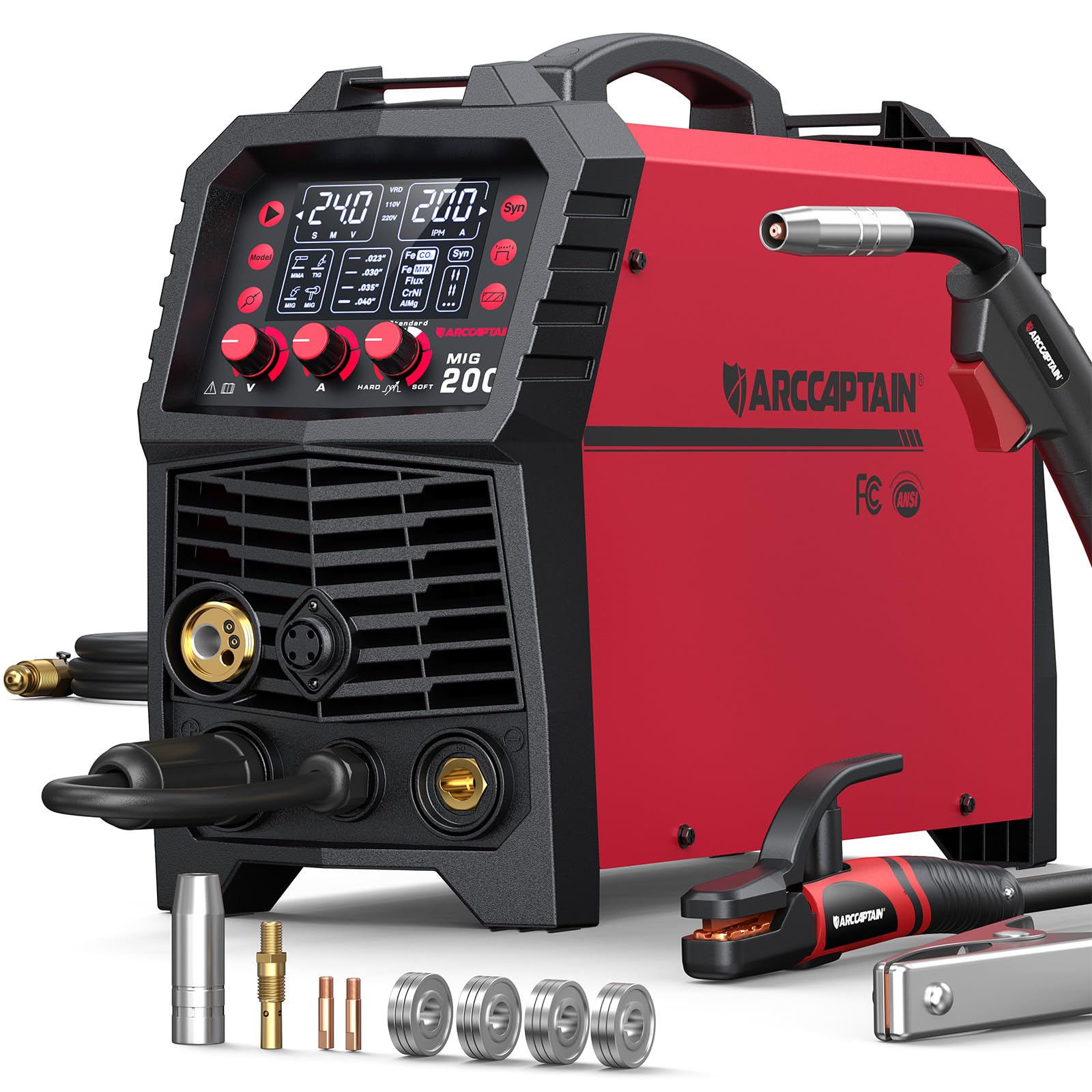
1. ARCCAPTAIN 200A MIG Welder 110V 220V 6 in 1 Welding Machine MIG200
Our pick — over 4.5★ from 950+ verified ratings; the strongest balance of quality and price.
Six welding processes on household voltage, and a screen you can read without flipping up your helmet.
You get Gas MIG, Gasless Flux Core MIG, Stick/MMA, Spot welding, Lift TIG, and a spool gun connector in one box — so the same machine that fixes a bumper can also run a stick rod on a broken bracket. At 3.54 x 2.36 x 2.76 inches the unit itself is tiny compared to the BESTMIG 135A at 14.8 x 9.8 x 6.6 inches, which makes it easier to tuck onto a shelf or carry to a job. The 2-year manufacturer warranty backs it up, and it ships with a shoulder strap so you can move it around the shop without a cart.
The synergic control is what makes this the easiest pick to recommend for someone new to MIG. You pick the wire diameter and the gas material, and the welder sets the recommended current and wire-feed speed automatically — you can still nudge the current up or down to match your own habits. That alone keeps beginners from wasting spools of wire on a bad first setting. The large LED display shows your parameters in real time, which is a real convenience when you are tacking a joint and need to glance at the numbers without lifting the helmet.
The cons are worth knowing before you order. The power cable runs warm quickly on higher loads, and the unit should never be switched between 110V and 220V while the screen is still on — wait for it to go dark first. The synergic mode still requires you to set a baseline amperage (roughly 1 amp per 0.001 inches of thickness), and the door chart is not always accurate, so many owners use a Miller Multimatic 200 chart instead. It will not reliably feed 0.025 bronze wire, so if you are doing bronze repairs look elsewhere.
What owners keep praising
- Works on both 110V and 220V for flexibility in garage versus shop
- 10 preset memory slots so you can jump between saved settings fast
- Fan runs only when needed, so no constant buzz in the shop
- Spot weld and pulse mode help on thinner sheet metal
Where it asks for care
- Power cable gets warm during sustained heavy use
- Must power off completely before switching voltage
- Won’t feed 0.025 bronze wire reliably
Best for: The home fabricator who wants one machine that covers MIG, stick, and TIG with automatic setup help.
Look elsewhere if: You want zero guesswork on the settings from the start, since this one still asks you to dial in a baseline amperage yourself.
2. PrimeWeld MIG180 Mig Welder, 180 Amp Wire Feed with Dual Voltage 220v and 110v
A MIG welder that runs on 110 volts for home work and steps up to a shop-grade arc when you plug it in.
If you want one welder to carry you from a beginner’s first flux-core bead to pro-level aluminum work, the MIG180 is the pick. It handles GMAW solid wire, FCAW flux-core, DC stick (MMA), and aluminum via spool gun in one unit. The 55-pound machine is heavier than most picks here, but that weight reflects the transformer and gun hardware — and it takes standard Tweco consumables, so replacement tips and liners are easy to source at any welding supply counter.
Buyers report running two full 10-pound wire reels through it without issues, and the spool gun feeds aluminum far more easily than pushing wire through a Teflon liner. Duty cycle — the percentage of a 10-minute window the machine can weld before it needs to cool — never became a problem in real use, even on heavier projects. The MIG180 also comes with a settings chart and guide that make dialing in your parameters much less painful than the bare-bones manuals some budget competitors ship.
Two things to keep in mind: if you are welding 5/16-inch or thicker stock, owners recommend adding the optional 200A MIG torch, since the stock torch is not the bottleneck for that material. And while the machine is rated for dual voltage, most of the satisfied ownership stories here are from 220V work — the extra headroom makes a visible difference on thick stock.
The honest trade-off: This is the most expensive machine on the list, and it is heavier than every budget option. But the aluminum-capable spool gun, dual voltage range, and US-based customer support make it the pick for someone who expects to weld for years, not months.
Reach for this if: You want professional-quality aluminum and steel welding and you have access to a 220V circuit for the heavy work.
Try something lighter if: You only weld light-gauge sheet metal and don’t need aluminum capability.
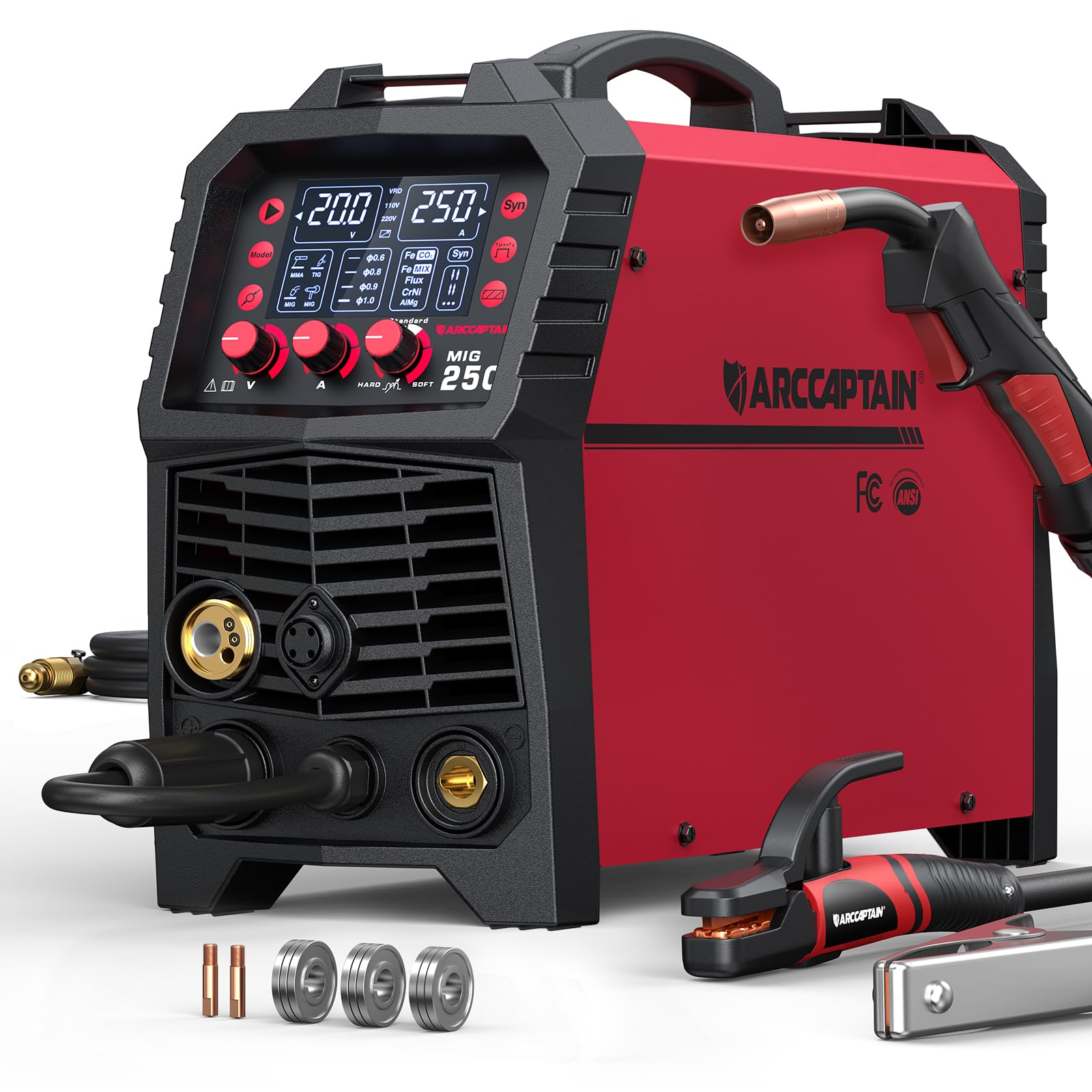
3. ARCCAPTAIN 250A MIG Welder 110V 220V 6 in 1 Aluminum Welding Machine MIG250
Two hundred fifty amps of output and a digital brain that keeps the arc steady on thick steel and aluminum alike.
This is the only machine in this roundup rated to handle half-inch-thick steel in real owner reports, thanks to 250 amps of output and a fully digital MCU controller (the welder’s onboard computer that manages arc stability) that keeps the current consistent as the metal heats up. At 14.9 x 5.3 x 9.7 inches the chassis is more compact than the Lincoln Electric Weld-PAK 90i at similar working weights. The package includes an MIG torch, earth clamp, stick holder, contact tips in.030″ and.035″, three wire-feed rollers, and a 220V-to-110V adapter — so you can plug it in almost anywhere.
Synergic MIG handles the auto-setup side: pick your wire diameter and the machine matches current and feed speed for you. Manual MIG is there for experienced users who want to dial in custom settings. Adaptive crater, burn-back adjustment, and pre/post flow are all useful when you are finishing a bead cleanly on a joint, because they reduce the crater at the end of your weld and control the wire tip. The intelligent fan spins up to manage heat and backs off when the machine is cool, which helps with an arc that stays consistent across a longer session.
The catch is the workflow it requires — never power on until the screen goes dark and the fan stops. That is a real safety rule for this machine because the digital controller needs a clean start. The Lift TIG torch and spool gun are both sold separately, so plan for those if you want full aluminum or TIG coverage. The 220V native input means the 110V adapter mode comes with some compromise on maximum output, so heavy 1/2-inch work is best done on 220 volts.
Choose this if: You need 250 amps of output on thick steel or aluminum, and you already have a 220V feed or a heavy-duty household outlet.
Wait on this if: You were hoping the included 110V adapter gives you full 250A performance — it doesn’t.
4. FEMEROL 250A MIG Welder, 6 in 1 Gas/Gasless Flux Core/Stick/Lift TIG/Spot, 110V/220V MIG250PRO

A 250-amp multiprocess machine that handles aluminum, steel, and stainless without needing a second welder.
Owners regularly report running 1/4-inch and heavier steel plate with this machine in flux-core and MIG mode, and the 60% duty cycle rating (meaning 6 minutes of continuous welding out of every 10 before a cool-down) is one of the more generous in this price range. It welds mild steel up to 14mm plate, stainless, and aluminum via either a Teflon wire-feed liner or the optional spool gun. Six processes across Gas MIG, Gasless Flux Core MIG, Stick, Lift TIG, spot welding, and spool gun aluminum cover nearly every home-shop task.
Real feedback also flags the manual’s thin coverage of settings — the machine ships without a printed parameter chart, so beginners will want to watch a setup video before their first weld. The included 0.8mm contact tips run tight on some flux-core wire and can cause birdnesting, which is a jam at the drive rolls, but owners swap in Harbor Freight Vulcan tips and the problem goes away. The fan runs constantly and pulls real volume, so it is not the quietest machine to run indoors.
The two-year manufacturer warranty is one of the longer ones in the value tier. The inductance control, 2T/4T trigger modes, and pre/post gas adjustments are features you usually see on bigger money machines. The wire feeder is metal rather than plastic, which holds up better over the long run — that is the kind of detail you appreciate after a few months of regular use.
At this price point: Very few welders offer this much power and process coverage without costing several hundred dollars more. The trade-offs are a loud fan, a thin manual, and contact tips that need swapping — none of which keep it from welding well.
Best matched to: The DIY welder who wants maximum output and process coverage on a mainstream budget.
skip it if: You need a quiet machine or want a fully written setup guide before your first bead.
5. Lincoln Electric 90i MIG and Flux Core Wire Feed Weld-PAK Welder, 120V, K5256-1

A 15-pound inverter welder in a metal case, built to plug into any 120V outlet and pack up between jobs.
If your welding happens on the move, the Weld-PAK 90i makes the most sense — a metal case protects it from weather and shop dust, a shoulder strap lets you carry it to a job site, and the whole unit weighs just 15 pounds. It runs on 120V household power and delivers flux-core welding up to 1/4-inch thick and solid MIG wire up to 3/16-inch. Two knobs handle wire speed and voltage, so the control surface is as simple as it gets.
The inverter power source inside is what gives this machine smoother arc characteristics than traditional transformer welders, according to Lincoln’s design notes. The package is generous: welding gun, nozzles, contact tips in.25,.030, and.035, dual-track drive rolls for both MIG and flux wire, a Harris gas regulator, and a ground clamp with 6 feet of cable. Owners have built full 5×10 utility trailers with this unit, including one who ran it on 150 feet of extension cord — 100 feet of 10-gauge plus 50 feet of 12-gauge — without problems.
What you give up for the compact size is thick-metal capability. The 90i is a 1/4-inch flux and 3/16-inch MIG machine — it is not the welder for 3/8-inch plate. The carrying strap gets mixed feedback on comfort during long hauls. And the value tier varies: some owners call it the right balance of price and performance, while a handful feel the price is high for what you get compared to cheaper imports with more features. If all you weld is sheet metal and small structural repair, the extra cost does not buy you much beyond the Lincoln name and metal case.
The strongest arguments
- Metal case protects internals from shop dust and weather
- Inverter design produces smoother arc than transformer welders
- Comes with a full accessory kit including Harris regulator
- Only 15 pounds with a shoulder strap for easy transport
The limits to plan around
- Maximum 1/4-inch on flux core and 3/16-inch on solid MIG
- Carrying strap comfort gets mixed feedback
- Priced higher than comparable import welders with more features
Made for: Mobile welders, maintenance techs, and DIY users who want a branded, protected welder they can throw in a truck bed and plug into any 120V outlet.
Not the right call if: Your projects regularly need to weld 3/8-inch or thicker steel — this one stops well short of that.
6. YESWELDER 160A MIG Welder, 110V/220V MIG/Flux Core/Lift TIG/Stick, YWM-160
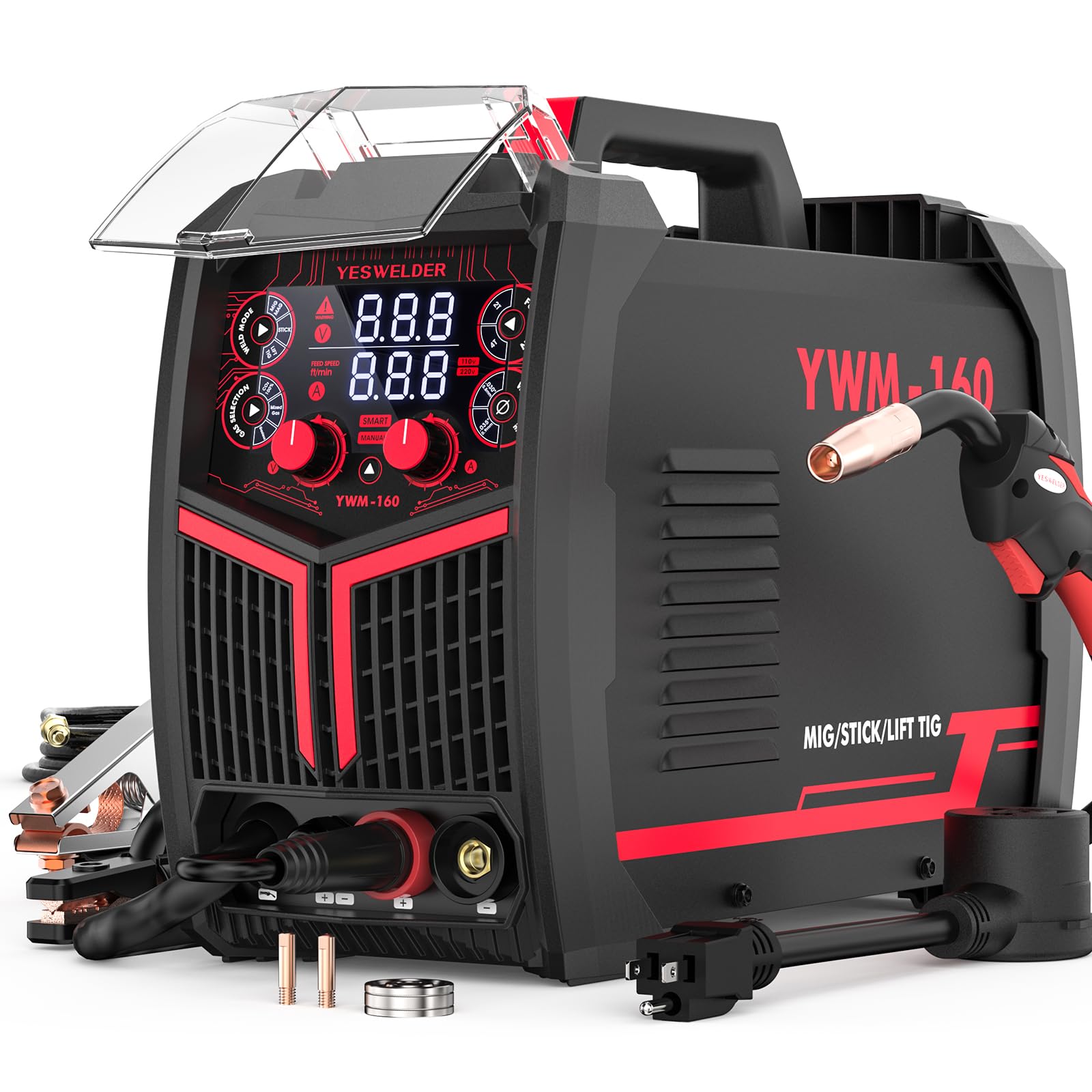
A 160-amp four-process machine that holds its arc on both household and shop voltage, from flux core to stick.
Owners running this welder for over two years on home fabrication and light construction report smooth arc quality with the synergic setup handling most of the settings. It covers Gas MIG, Gasless Flux Core, Lift TIG (with an extra torch), and Stick welding, with synergic control that automatically matches voltage and wire-feed speed to your selected material thickness. Manual control is there when you want to dial in finer parameters.
Long-term owners mention welding 1/4-inch steel cleanly with flux core when the machine has enough power.
The honest trade-offs: the gun liner is thin and can melt under sustained heat, the power wheel on the wire feeder slips unless you overtighten it, and the screen washes out in direct sunlight. Stick welding with 6011 electrodes is described as inconsistent by owners comparing it to dedicated stick welders. And while the 220V adapter is included, customers note the machine performs noticeably better on native 220 volts — using the 110V adapter caused circuit breaker trips on some household circuits during heavy loads.
What stands out most: The synergic control and dual voltage option make this an ideal starter machine for someone who wants to grow into stick and TIG without buying a second welder. For the money, the four-process coverage is hard to match elsewhere in this category.
Suits this buyer: The hobbyist or light-commercial welder who wants MIG, flux core, stick, and Lift TIG in one dual-voltage package.
Not for this buyer: Someone welding exclusively on a standard 15-amp household circuit who needs full performance without ever touching a 220V outlet.
7. Bestarc 145A MIG Welder, Flux Core/Gas MIG, Stick, Lift TIG, 110/220V, MIG145-9GEN
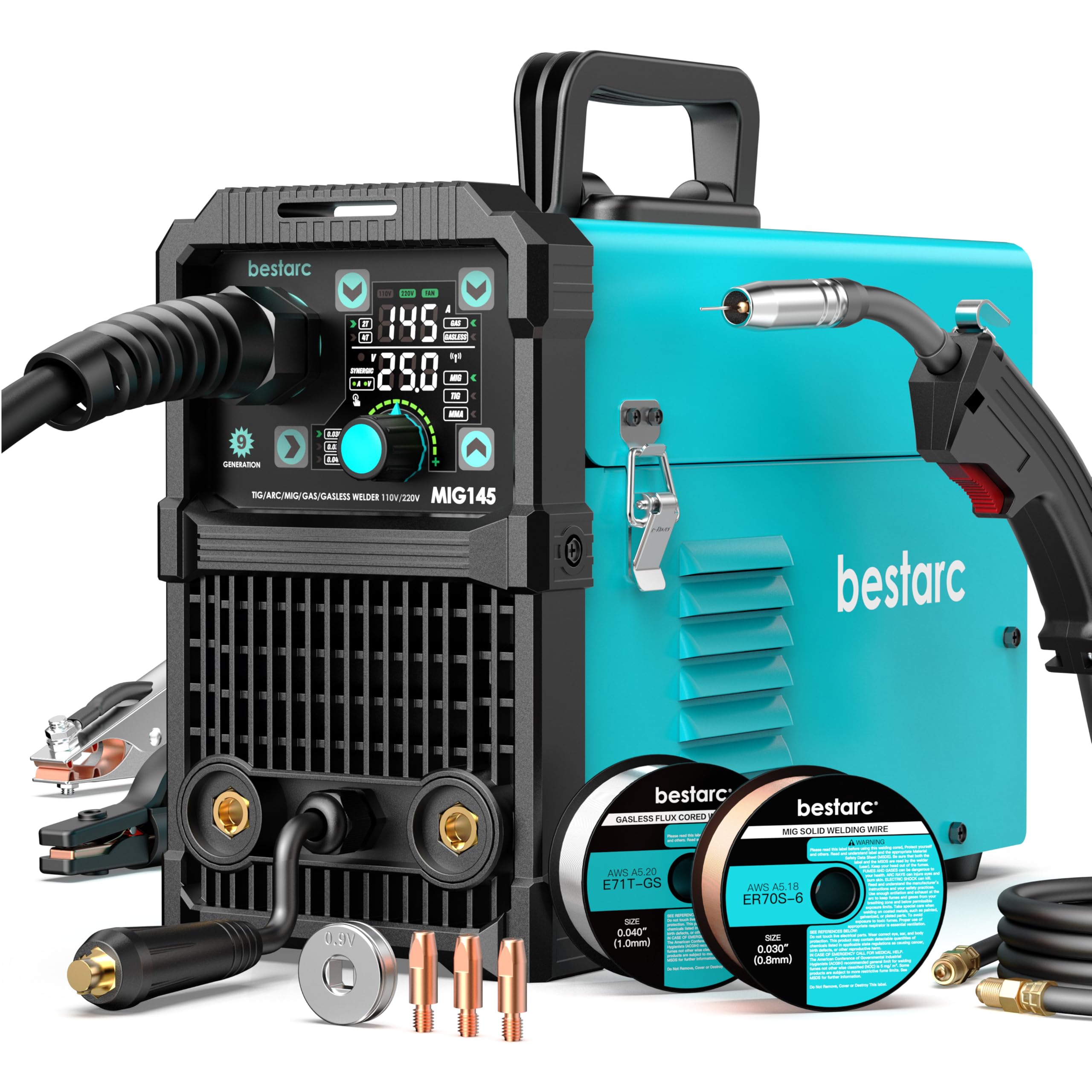
The 13.7-pound four-in-one built for RV owners and field repairs, with a shoulder strap for hauling to the job.
RV owners are the core audience for the Bestarc MIG145, and it is not hard to see why — 110V and 220V input means one machine covers everything from a campground 110V hookup to a home shop 220V breaker. It supports Gas MIG, Gasless Flux Core MIG, Lift TIG, and Stick welding, so you can match the process to the job without buying extra equipment. The voltage fine-tune range of -3V to +3V gives you a little extra precision on your arc, and the front panel clearly displays which input voltage the machine detects.
Owners welding RV frames, garage projects, and stainless steel report strong, clean welds and an easy switch between flux core and solid wire modes. The synergy settings help non-professionals get a good weld right from the start. A 0.040-inch flux-core spool and a 0.030-inch solid wire spool are both included, along with a generous accessory kit and a 220V-to-110V adapter. The 5.5-foot gun lead is the biggest gripe — it feels short for reaching around bulky frames or welding inside an RV compartment.
Two more things worth knowing: the machine ships with only V-groove drive rolls, which is fine for solid wire but needs knurled rolls for reliable flux-core feeding. And the spool tension is not adjustable, which can occasionally cause wire slippage on smaller spools. Both are simple upgrades that owners regularly make. The large LED display and top-load wire design make setup and spool swaps easier than most machines in this range.
What buyers factor in
- Dual 110V / 220V input makes it useful in a campground or a shop
- Compact 13.7 lb build with a shoulder strap for field repairs
- Voltage fine-tune range of -3V to +3V for precision arc control
- Top-load wire design simplifies spool changes
What to expect going in
- 5.5-foot gun lead is short for reaching around bulky frames
- Only V-groove drive rolls included — needs knurled rolls for flux core
- Non-adjustable spool tension can cause occasional wire slippage
A good fit for: RV owners, field repair techs, and DIY users who need a portable four-process welder with dual voltage for wherever they park.
Consider a different pick if: You want a long gun lead from the start or plan to do most of your welding on large, awkward frames.
8. AZZUNO 200A MIG Welder, 110V/220V 4 in 1 Gas/Flux Gasless MIG/Lift TIG/Stick, MIG200F

Two hundred amps and four welding modes for the price of a mid-tier single-process machine.
If you want MIG welding without paying for the brand name, the AZZUNO 200A is the value play. It handles Gas MIG, Gasless Flux Core MIG, Lift TIG, and Stick in one machine, with synergic control that auto-sets voltage and wire-feed speed once you pick your amperage or wire diameter. It welds mild steel up to 5/16-inch (8mm) thick, which is genuinely impressive for a 110V/220V machine in this tier. It also runs 2-pound and 10-pound wire spools and supports.030″ through.040″ wire.
Two aspects of ownership surface repeatedly across reviews. First, owners who have used this for over two years say it is easy to learn, powerful, and free from wire-feed problems on MIG and flux core. The stick mode gets specific praise for welding 3/16-inch 7018 rods, no small feat for a combo machine. Second, the manual and the documentation are consistently called out as weak — the feed rate is listed in meters per minute instead of inches per minute, and there is no setup chart for wire sizes. Owners upgrade the ground clamp, electrode holder, and cables themselves to get better results.
The gas inlet is a non-standard fitting, so you will need an adapter if you plan to run solid MIG wire with shielding gas. The membrane keypad works but takes time to learn. And durability after several months has more mixed feedback than the other picks here — a small number of owners have reported motherboard issues after heavy use, though many owners have run the machine for years without problems. Overall the 200A delivers on its spec for the price.
The value story: For the money, few machines give you 200 amps, four processes, and dual voltage at the same time. Just plan to upgrade the ground clamp, keep the manual handy for troubleshooting, and use the included accessories as a starting point rather than a final setup.
Worth picking up if: You want serious multi-process capability and 200 amps of output without spending hundreds more for a premium brand.
Better to look past if: You need a machine that comes fully ready from the start with a clear manual and upgraded accessories.
9. GZ GUOZHI 145A MIG Welder, 3 in 1, 110V Flux MIG/Lift TIG/ARC with Large LCD Screen, MIG-145LCD
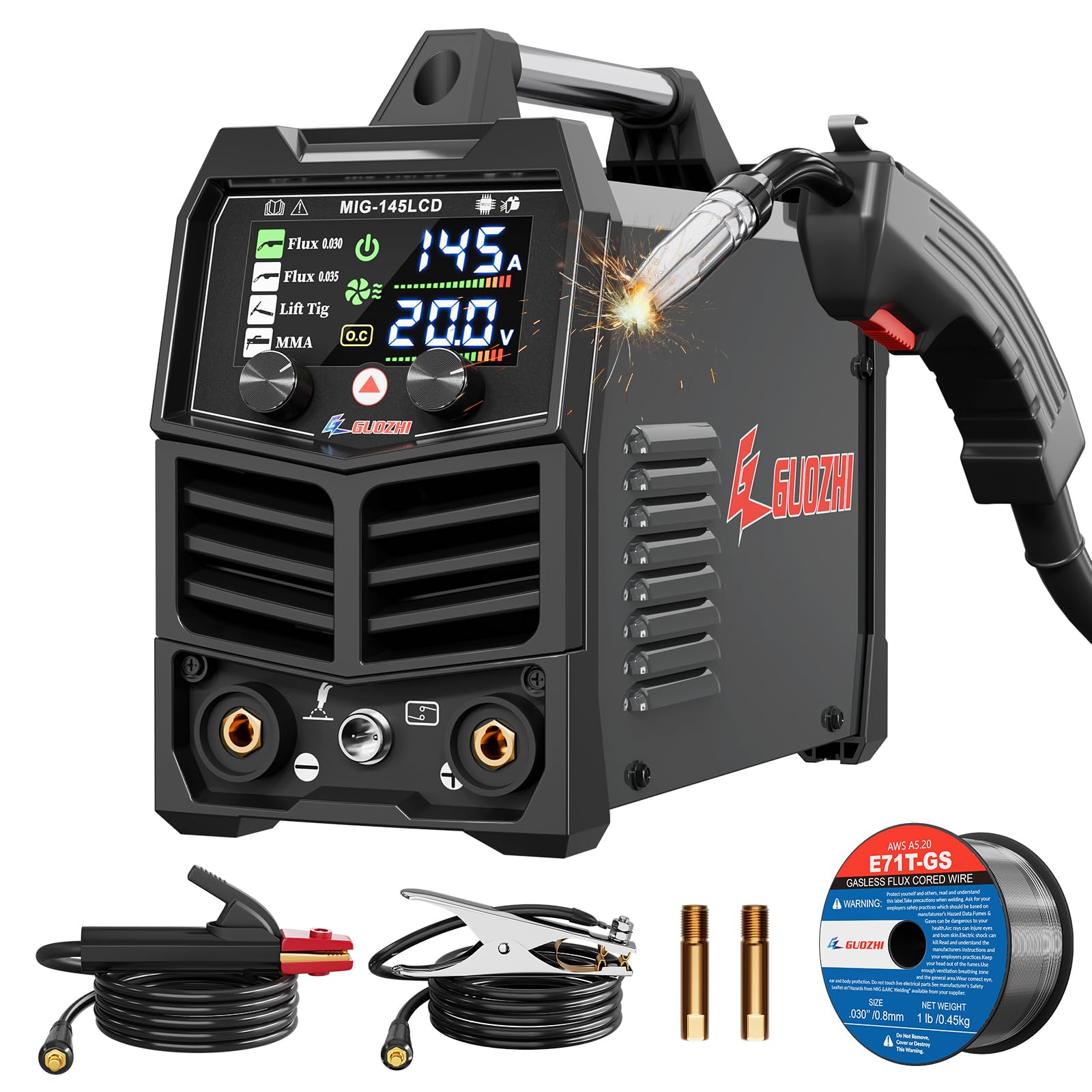
Built for thin sheet metal and voltage that fluctuates — designed to weld down to 0.8mm without burning through.
The distinguishing feature here is the wide-voltage design, which accepts 90V to 140V input and keeps the arc stable even when household voltage sags, such as when a refrigerator or dryer kicks on mid-weld. It welds low-carbon steel, stainless, and other steel materials as thin as 0.8mm, making it one of the few machines here that can handle car panels and appliance shell repairs without blowing holes in the metal. It also supports Stick welding with rods up to 1/8-inch, and it operates normally at temperatures as low as -15°C.
For a 15-pound machine, the power-to-size ratio is solid, and the synergic control on this welder automatically adjusts voltage and wire-feed speed when you change the amperage. Owners using it for boat alternator bracket repairs, car restoration, and general fabrication praise the smooth wire feed and synchronized voltage/amperage settings. The large LCD display is visible in a range of lighting conditions, and the package includes a MIG gun, electrode holder, earth clamp, and a spool of flux-core wire.
Two points to plan for. First, the machine runs best on a dedicated breaker — owners who ran it on a shared household circuit tripped the breaker during heavy welding. Second, the documentation is minimal: there is no wire-loading instruction sheet and no voltage/amperage chart matching wire sizes to settings, so beginners will need to look up a good starting chart online. One owner also reported premature failure after some hours of use — worth knowing, though the overall experience data is solidly positive for home use.
Ideal match for: Weekend car restorers and thin-sheet fabricators who need a 110V machine that tolerates voltage fluctuation and won’t burn through 0.8mm panels.
Better suited elsewhere if: You need a fully documented setup guide or plan to weld off a shared household circuit.
10. BESTMIG 135A MIG Welder, 3-in-1 Flux Core/MIG/Lift TIG/Stick, 110V with Helmet and Gloves, FLUX-135
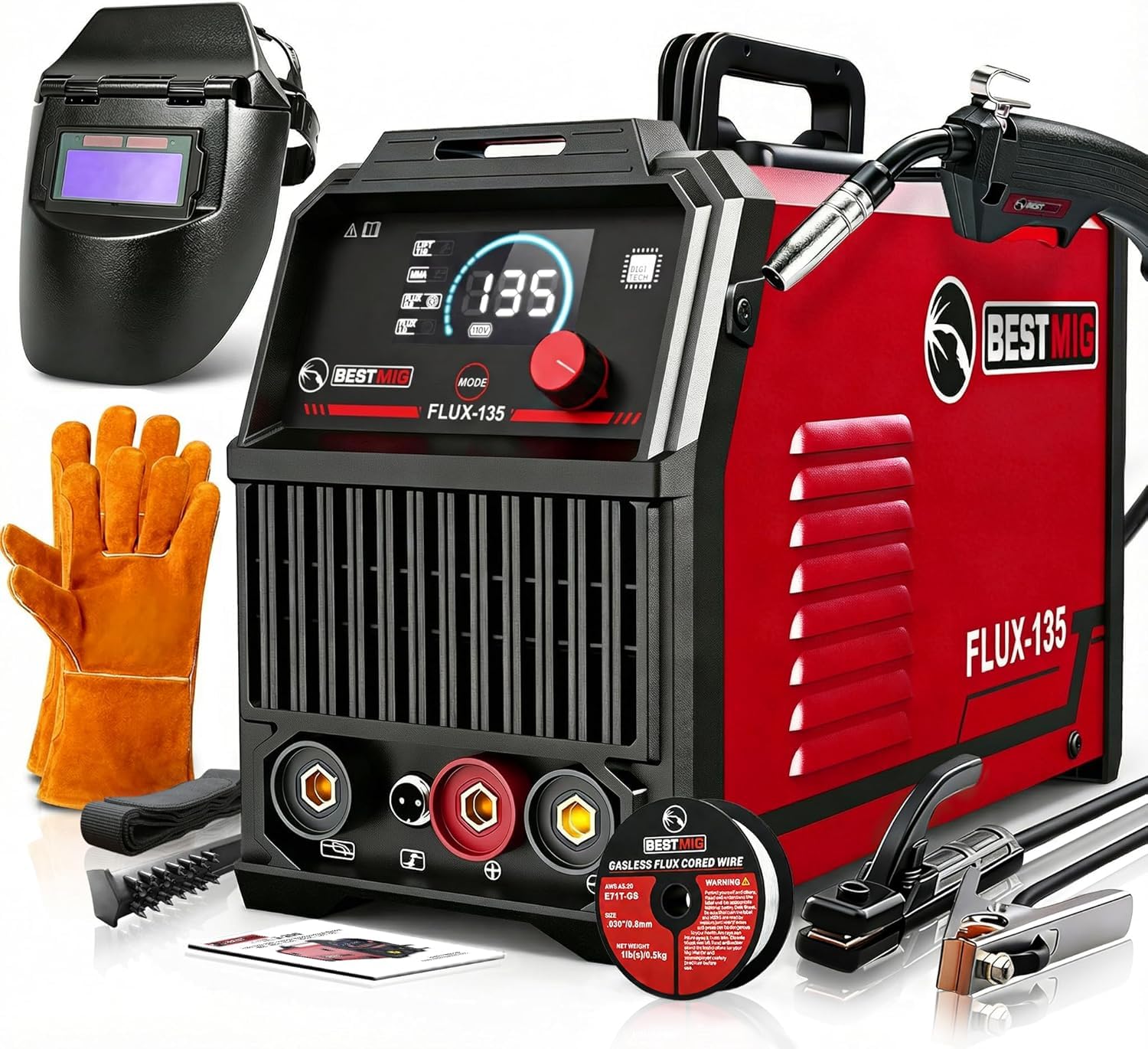
A complete 135-amp starter kit that ships with everything a first-timer needs except the wire brush.
For the person who has never welded before, the BESTMIG FLUX-135 is the most complete package on this list. The box includes the welder, a 14AK torch with cable, an electrode holder, an earth clamp, a wire brush, flux-core wire, a pair of welding gloves, auto-darkening welding glasses, and an auto-darkening welding helmet — so you can start welding on day one without ordering extra safety gear. The 135A output welds materials up to 1/8-inch thick, which covers most home repair and light fabrication work.
At 10.71 pounds it is one of the lighter machines here, and the all-in-one digital control automatically adjusts parameters based on your current settings, which takes a lot of the guesswork out of a first weld. The full-color LED display shows your parameters in real time, and the integrated wire feeding system automatically adjusts voltage and feed speed for cleaner welds with less spatter. It supports gasless flux-core MIG wire from 0.030″ to 0.040″ and can also run Lift TIG and Stick with the right accessories (note: the TIG torch is not included).
The honest limit is on heavier work. One owner described it this way: “This actually surprised me and passed my expectations. I wouldn’t build a trailer with it, but great around the home/garage and for smaller jobs.” That is a fair summary — this is a home-shop repair welder, not a structural steel machine. The size — 14.8 x 9.8 x 6.6 inches — makes it larger than the ARCCAPTAIN MIG200 at 3.54 x 2.36 x 2.76 inches, so the footprint is not tiny when you factor in the accessory kit, though it is still compact for a home shop shelf.
What you get for the price
- Full accessory kit with helmet, gloves, torch, and ground clamp
- 10.71 lb portable build fits easily on a home workbench
- Automatic parameter adjustment based on your settings
- Full-color LED display for real-time parameter monitoring
The honest limits
- Caps at 1/8-inch thickness — lighter than the multi-process options
- TIG torch not included despite the Lift TIG capability
- Only supports flux-core MIG wire, not solid MIG with gas
Start here if: You are a total beginner who wants everything in one box and plan to weld metal up to 1/8-inch thick on household power.
Stretch your budget if: You need to weld heavier stock or want solid MIG wire with shielding gas from the start.
11. FEMEROL 140A 3 in 1 MIG Welder, Flux Core/MIG/Lift TIG/Stick, 110V, MIG140R
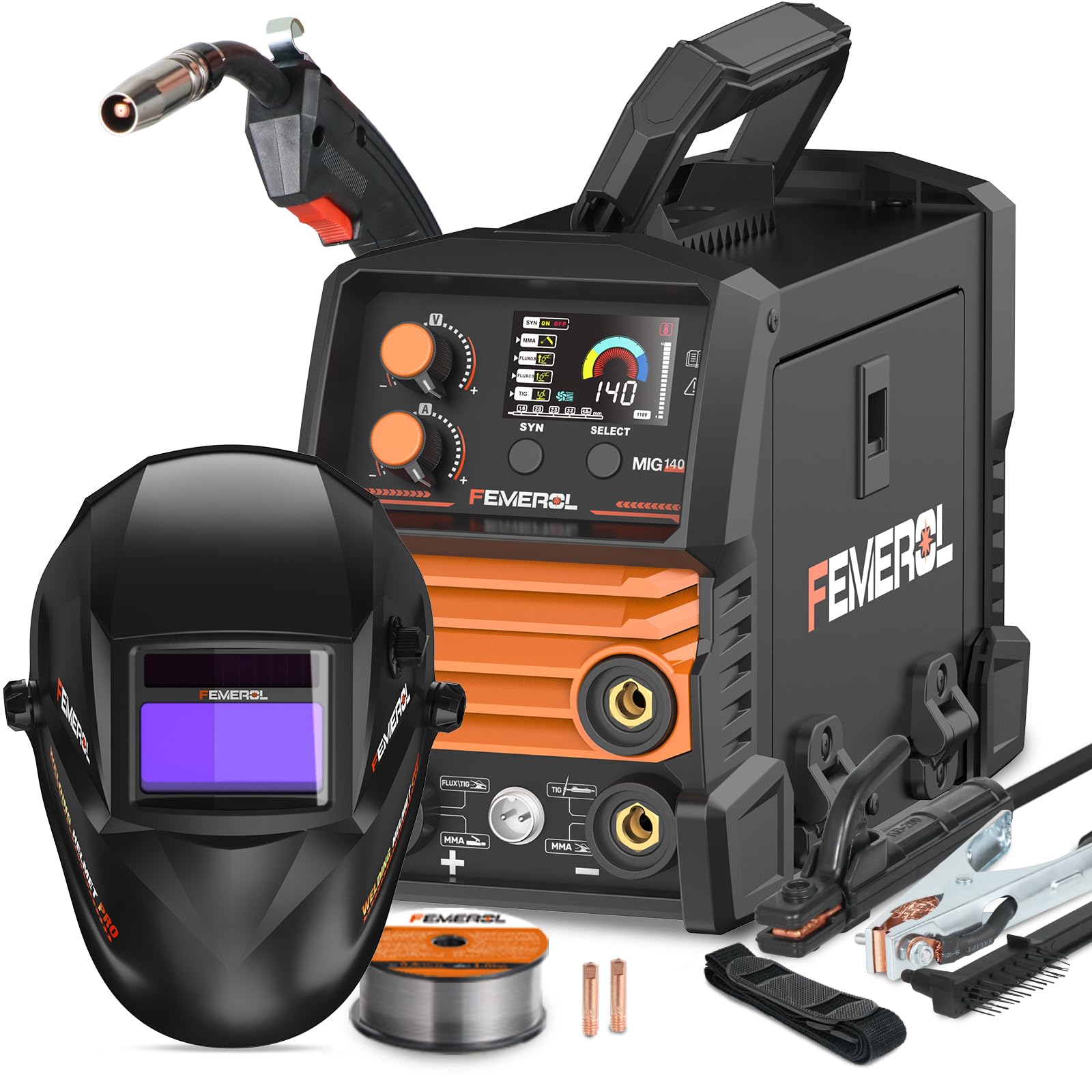
At 8.9 pounds this is the lightest machine in the roundup, and it still delivers 140 amps of output.
The FEMEROL MIG140R weighs just 8.9 pounds — lighter than any other welder here, including the 10.71-pound BESTMIG 135A and well under the 19.4-pound YESWELDER 160A — and it comes with a handle and shoulder strap so you can carry it anywhere without strain. It handles Carbon Steel, Stainless, and thicker metals with flux-core wire from 0.030″ to 0.040″, and in MMA mode it accepts E6011, E6013, and E7018 electrodes. That range of stick rod options is more than most 110V machines offer at this output level.
For the synergic control setup, the welder automatically matches voltage and wire-feed speed after you select the wire diameter, which is what makes this a usable machine for beginners. Manual mode is also available for experienced welders who want to dial inthe voltage and amperage independently. The LED digital display shows voltage, current, and parameters so you can make adjustments without lifting your helmet. The included kit covers a ground clamp, electrode holder, welding torch, a.030″ flux-cored wire spool, nozzles, contact tips, and an auto-darkening welding helmet — the essentials for a first weld with no add-on shopping.
The machine draws on a 110V household circuit, and in real use it clears small repairs and farm equipment fixes without trouble. Owners welding go-kart frames, tractor decks, and steering shafts report the machine runs cool, with the fan keeping the arc stable through a session instead of the machine shutting down. Where a bit of caution applies, one owner noted the machine caused indoor lights to flicker when run on a long extension cord, though the breaker never tripped on the household fuse. Pairing it with a higher-amperage outlet removes that issue.
Where it earns its place: This is a real beginner’s welder in the best sense — no guesswork on the settings, an auto-darkening helmet included, and a weight that makes it easy to move from job to job.
Where it asks for setup: Bring a dedicated 110V circuit if you can, and be ready to look up an electrode chart online since the machine ships with minimal paper documentation.
Reach for this if: You weld around the home and shop and want a light, beginner-friendly 110V machine with synergic control and a helmet included.
Look elsewhere if: You need to weld anything thicker than 1/8 inch or want full MIG with gas from the start.
Understanding the Specs
Amperage Output and What It Welds
Output amperage is the number most often compared between machines, but on 110 volts the more important figure is how thick a plate that output can actually weld. A 135A machine welds up to 1/8 inch, a 145A machine handles similar thickness with slightly more headroom, and a 200A machine can reach 5/16 inch when run on 220 volts. On 110 volts the same machine will not reach its full-rated maximum — voltage directly limits the arc energy the machine can deliver to the joint.
Duty Cycle and Why the Fan Runs
Duty cycle is the share of a 10-minute window a welder can run continuously before it needs to cool down. A machine at 60% duty cycle can weld for six minutes and then needs a four-minute break to protect its internals. On 110-volt input the actual duty cycle is usually gentler than the rating states, because the machine cannot draw the same current a 220-volt outlet provides. The cooling fans built into these machines spin up as internal temperature rises and back off when the machine cools — hearing the fan kick in is a normal part of operating on household power.
FAQ
Can a 110V MIG welder really weld 1/4 inch steel?
Will a 110V MIG welder trip my household breaker?
What is the difference between synergic and manual MIG control?
Do I need shielding gas to weld with an 110V MIG welder?
Can I weld aluminum with a 110V MIG welder?
How long does an 110V MIG welder last?
What size wire should I use for 110V flux-core welding?
Can I run a 110V MIG welder on an extension cord?
Is 220V welding better than 110V for MIG?
Do these welders come with a welding helmet?
Final Thoughts: The Verdict
For most home fabricators, the best 110 volt mig welder winner is the ARCCAPTAIN MIG200 — it runs on both 110V and 220V, covers six welding processes, and has a synergic control system that gets a beginner producing decent beads on the first spool rather than the fifth. If welding aluminum or heavier steel is on your list, the PrimeWeld MIG180 is the pick with a spool gun included and a two-year manufacturer’s backing. And for someone buying their absolute first welder who wants everything in one box — helmet, gloves, torch, ground clamp, and wire — the BESTMIG 135A FLUX-135 starts you welding on day one without a single extra order. Whatever you choose, match the machine to the thickest metal you actually plan to weld: a home repair and a trailer build do not ask for the same welder.
How We Picked
We do not accept paid placement. Every pick is matched to a real buyer and a real use-case; we do not hands-on test units.
Sources & Methodology
Specifications: manufacturer listings and product documentation. Review insights: verified customer reviews, as of September 2026. Pricing: not shown on this page (it changes often); check the current price via the retailer link.
As an Amazon Associate, KitchPrep earns from qualifying purchases. This does not affect which products we feature.
Related Guides
