
Specs are compiled from manufacturer listings and verified buyer reviews and can change over time — please confirm the key details on the product page before buying.
Buying a 10×16 shed kit is a big, once-a-decade purchase, and the single thing that decides whether you love it or hate it is not the price tag — it is how the panels join and how long the build actually takes. A cheap steel kit means a weekend of caulking every bolted seam, while a heavier-gauge frame goes up square and stays dry through the first storm. This guide walks you through seven real 10×16 sheds, what each one is genuinely good at, and where each one will make you work.
I’m Mohammad Maruf — the founder and writer behind KitchPrep. This guide is built by comparing the manufacturers’ published specifications and the patterns across verified customer reviews, so you get each pick’s real strengths and trade-offs instead of marketing spin.
If you just want the short answer: match the material to your climate before you fall in love with a photo. Steel kits are the fastest to ship and the most affordable, but they demand careful sealing at every seam. Resin models resist rust and never need paint, though they go together like a giant precision puzzle. Wood gives you the strongest frame and the most customization, but the panels arrive unfinished — flooring, paint, and shingles are separate. The right 10×16 shed kit depends on your foundation, your patience, and how much wind your yard takes.
Our Picks at a Glance
How To Choose The Best 10X16 Shed Kit
A 10×16 shed kit is a permanent structure you assemble yourself, and the material you pick decides almost everything that follows — how it handles weather, how long the build takes, and how much extra you spend after the pallet lands. Here is what separates a kit you keep for fifteen years from one you regret by autumn.
Steel, Resin, or Wood — Pick Your Failure Mode
Every material has one weak spot, so choose the one you can live with. Galvanized steel panels resist rust and cost the least, but they ship as many bolted plates, and every seam is a place water can find. Resin (thickened polypropylene plastic) never rusts and never needs paint, and it typically arrives as large molded panels — fewer fasteners, bigger pieces, and a build that feels like assembling a giant jigsaw. Wood gives you the strongest ground-to-peak frame and the freedom to run wiring or insulation later, but the panels arrive bare, and the listing often excludes flooring, paint, and shingles. Match the material to your climate: humid coastal air rusts steel, high-wind zones flex light resin, and wet ground demands a real foundation under any of them.
Check the Foundation Requirements Before You Buy
Almost every 10×16 kit needs a flat, level base, and the size you build is usually bigger than the shed itself. A steel kit that sits directly on soil flexes at the door frame; a wood kit typically wants a concrete pad or a treated platform you can screw into. Build the foundation first and let it settle — assembling on an uneven surface misaligns bolt holes and leaves doors sticking.
Door Width and Eave Height Decide What Actually Fits
Square footage tells you the floor area; door width in inches tells you whether a riding mower fits through it. A riding mower, a wheelbarrow, or a stacked set of tires needs a genuinely wide opening, so compare door width in inches side by side rather than trusting the 10×16 label. Eave height matters just as much if you store ladders or tall rakes upright.
Quick Comparison
| Model | Best For | Floor Area | Door Width | Frame Material | Amazon |
|---|---|---|---|---|---|
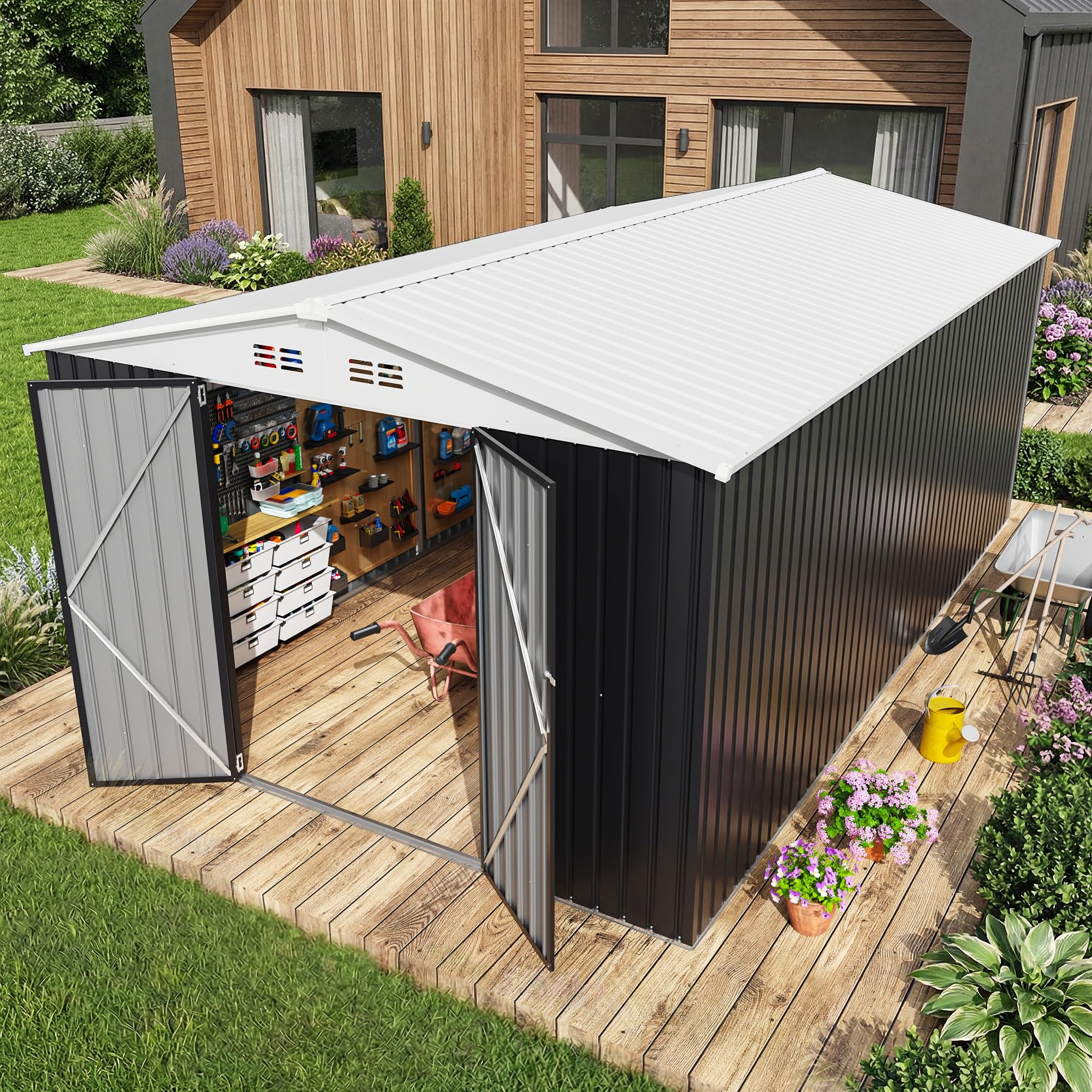
| AirWire 10×16 FT Outdoor Metal Storage Shed★ Best Overall | Budget backyard storage | 160 square feet | 47.24 inches | Galvanized Steel | Amazon |
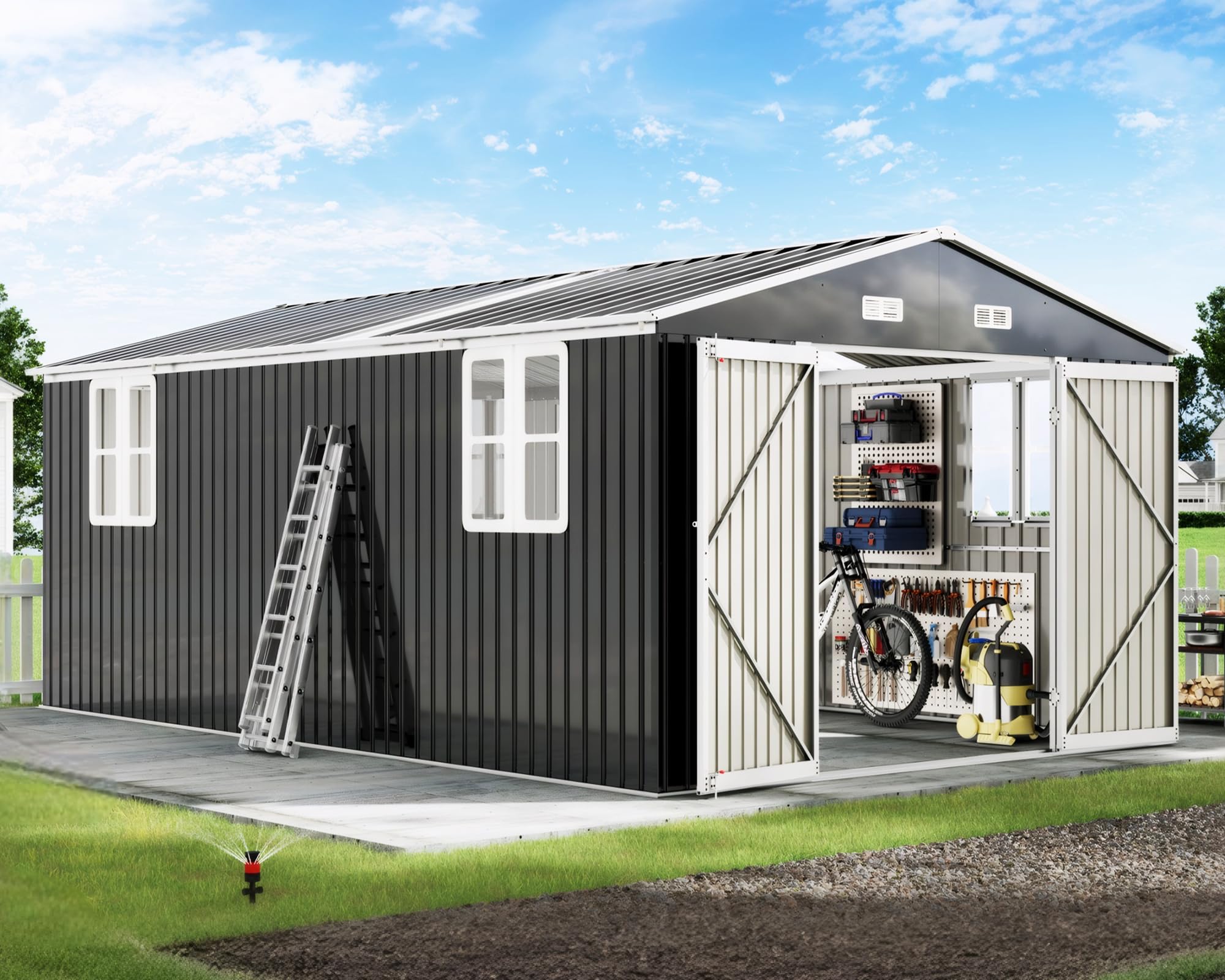
| AMERLIFE 10x16x7 FT Outdoor Storage Shed with 2 Transparent PanelsAlso Great | Bright workshop and wide-door access | 163 square feet | 60 inches | Alloy Steel | Amazon |
| WACASA 10×16 FT Military-Grade Metal Storage Shed with Skylight | Storm-prone yards that need anchoring | — | 4.61 feet | Metal | Amazon |
| Patiowell 10×10 FT Resin Outdoor Storage Shed with Floor, Beige | Rust-proof resin in wet climates | 97.2 square feet | 54.7 inches | Resin | Amazon |
| Devoko 10×12 FT Resin Outdoor Storage Shed with Floor, Beige | No-paint, no-rust resin storage | 120 square feet | — | Resin | Amazon |
| Handy Home Products Rookwood 10×16 Wooden Storage Shed | Custom wood builds on a slab | 160 square feet | 64 inches | Wood | Amazon |
| Handy Home Products Scarsdale 10×16 Wooden Storage Shed with Floor Kit | Pre-hung doors and included floor | — | 64 inches | Aluminum, Wood | Amazon |
In‑Depth Reviews
1. AirWire 10×16 FT Outdoor Metal Storage Shed
The entry-level steel kit that stores a lawnmower and bulky gear without emptying a savings account.
If your budget is the tightest it will ever be and you just need a dry place for the mower, this galvanized-steel kit is the cheapest way onto the list. The whole structure covers 160 square feet of floor, with a footprint that measures 192.91 inches deep by 117.32 inches wide — plenty of room to line up garden tools, bins, and outdoor gear along the walls. The panels are galvanized steel, which means they are rust-proof and corrosion-resistant rather than painted bare metal, so the frame resists the weather instead of flaking.
Two details matter for daily use. The door opening is 47.24 inches wide and 66.54 inches tall, and the sloped roof sheds rain rather than pooling it. Four vents keep air moving inside so damp air does not sit against your tools, and the lockable door keeps casual hands out. There is also a smart safety touch: each steel plate ships with a protective plastic film, and the corner guards are shaped so you do not slice your hand on an edge mid-build.
Here is the honest trade-off, and it is the one that shows up most in the reviews. This is a budget steel structure, and the panels join with bolts rather than sealing watertight on their own — buyers report one owner needed three people and seven hours to assemble. The realistic fix is to treat every seam as a job: run silicone caulk along the joins as you bolt the plates together, and set the frame on a solid base rather than bare soil, because the same kit feels sturdy when it sits into the ground properly. A couple of owners also noted the roof panel can dent, so use a step stool instead of climbing on the roof.
Where this kit earns its keep
- 160 square feet of floor on a genuinely entry-level budget
- Galvanized steel resists rust without any painting
- Sloped roof, four vents, and a lockable door included
- Protective film and corner guards reduce scrapes during the build
The seams are your job
- Panels need caulk at the joints to stay fully water-tight
- Assembly is a multi-person job, not a solo afternoon
- Thin roof panels dent if you stand on them
- Sits best on a proper base, not directly on soil
Reach for this if: you want maximum storage for minimum outlay and are willing to seal the joints yourself.
Look elsewhere if: you expect to unbox it and have a watertight shed by dinner — this one rewards careful prep.
2. AMERLIFE 10x16x7 FT Outdoor Storage Shed with 2 Transparent Panels
The wide-door steel shed that swallows a riding mower whole — plus daylight from two panels and four windows.
Start with the number that decides your back: this is the widest opening on the list. The double doors measure 60 inches across against the AirWire’s 47.24 inches, and the whole structure lays out 163 square feet of floor — the largest in this lineup — on a footprint of 195.66 inches deep by 120 inches wide by 84 inches tall. That extra width is why a lawn tractor, a wheelbarrow, or a stack of bikes rolls in without a wrestling match, and the reinforced tube gantry frame (a heavier internal skeleton that carries the load from the ground up to the peak) is what keeps the walls steady under a roof that size.
What wins people over, once the build is done, is how bright it stays inside. Two transparent roof panels and four side windows pull in daylight, so you can spot a tool on a shelf without dragging a flashlight out, and four vents keep the air moving so dampness does not settle on stored gear. The drainage holes in the frame and the galvanized-steel panels (steel coated in zinc so it fights rust) mean the structure shrugs off rain and wind rather than soaking it up. The maker suggests an 11×17.5 ft foundation — a base bigger than the shed itself, because the frame needs to sit fully supported on level ground.
The catch is the build, and it is worth saying plain: this is not a two-hour project. The maker estimates roughly 10 hours with three people, and one owner who went it alone logged three days at about five hours each. A few builders reported the wall panels want a helper until braces #22-24 go on, and that the doors have very little clearance, so they can drag if the frame is not perfectly square. Get a second set of hands, start every screw in a panel before tightening any of them, and the finished shed is far steadier than its panel count suggests — buyers doing the slow, correct sequence reported all holes lining up.
Why it leads: a 60-inch door plus 163 square feet is the best combination of easy access and usable floor area here — you get a riding mower through and still have wall space left over.
Plan for it: budget a full weekend and at least one helper. The frame rewards a square, level foundation with straight walls and doors that glide instead of stick.
The best all-rounder here: it suits anyone storing big wheeled equipment who wants real daylight inside and a build that ends solid.
One honest note: assemble it alone on an uneven base and the tight-tolerance doors will rub — this shed wants prep and patience.
3. WACASA 10×16 FT Military-Grade Metal Storage Shed with Skylight
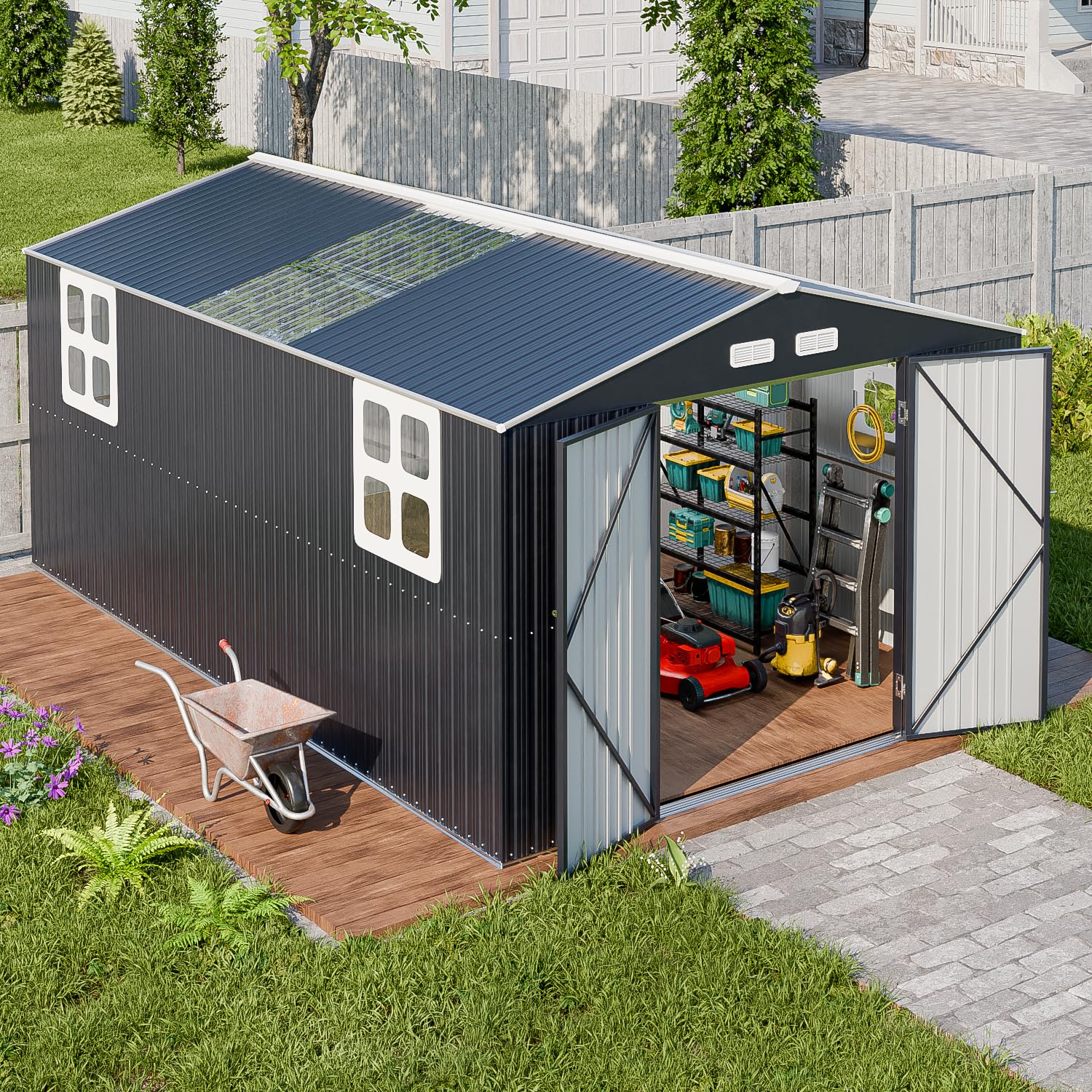
A steel shed engineered for brutal weather — if you anchor it right, it will hold where lighter kits bend.
This is the kit you buy when your property takes real wind. The frame runs on an ultra-thick 20-gauge structural support track with 30-gauge panels, and the maker rates it for a 50 PSF snow load (pounds of snow per square foot the roof is built to carry) and winds over 120 MPH once it is anchored. Two crisp polycarbonate skylight panels flood the interior with daylight so dark corners disappear, and dual vents pull heat and moisture out during the summer. Standing 120.02 inches tall, it gives you headroom to walk in and stand up straight, and the wide lockable double doors take most push mowers, grills, and medium outdoor gear with room to spare.
Quality is the thread that ties the reviews together, and the multi-layer powder-coated frame is a big part of it — the coating shields the steel from salt spray, acid rain, and scrapes, and the maker states a rust-free service window of 5-10 years. The weight tells the same story: at 360 pounds it comes in lighter than the AMERLIFE at 392.7 pounds, but the panels arrive in three separate heavy boxes that may land on different days, so clear a staging area before you start. Do not skip the anchoring step — the maker is blunt that achieving the wind rating requires bolting to concrete, deck screws into a deck, or 30-36 inch auger anchors in soft ground, and unanchored it will not hold in a storm.
The one thing you have to forgive is the paperwork. Instructions drew the sharpest criticism of any part of this shed, and a few builders hit stripped or missing screws, thin panels that dent, and roof trim sequence errors that cost time. The pattern in the reviews points one way: a perfectly level base turns fights with panel alignment into a straightforward job, and a handful of buyers reported the skylight and the customer service made the whole thing worth keeping. There is one more honest note — at least one buyer measured the delivered structure smaller than the listing, so verify dimensions against your foundation before assembly day.
Built for the elements: a 20-gauge frame, a 50 PSF snow rating, and 120+ MPH wind resistance when anchored make this the sturdiest steel pick here.
The trade-off: shipping comes in three boxes on separate days, and you will want a helper and a clear level base to get past the imperfect instructions.
Best for: yards exposed to serious wind or snow where a lighter shed would not survive a bad storm.
Not for you if: you want a shed you can anchor on soil and forget — this one demands a properly secured, level foundation.
4. Patiowell 10×10 FT Resin Outdoor Storage Shed with Floor, Beige
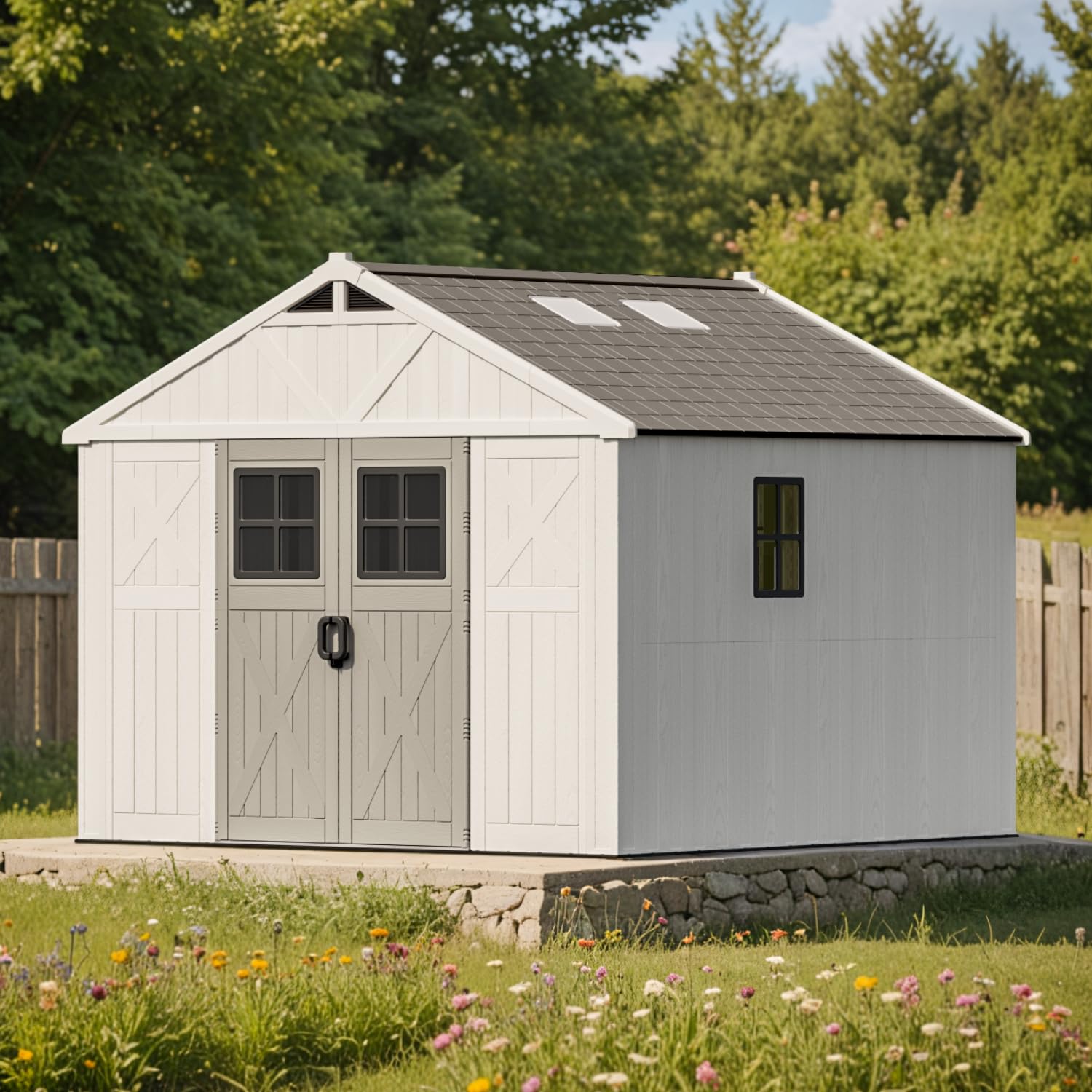
A rust-proof resin shed with a built-in floor — the pick for wet yards where steel quietly dissolves.
If you have watched a metal shed rust from the ground up, this is the answer. It is molded from thickened double-layer polypropylene resin with double UV protection, a material that never rusts and never needs paint, and the corrosion-resistant smooth shell keeps water out instead of sitting in the joints. The floor comes included — a real advantage, since it lifts your stored items off the ground and stops water pooling underneath — and it covers 97.2 square feet of floor area inside a 110-inch-deep, 110-inch-wide, 68.9-inch-high interior chamber. Lockable double doors 54.7 inches wide give you easy access to ladders, bikes, and garden gear.
The clever part is the assembly system. Rather than bolting hundreds of plates, this design minimizes screw count with a snap-together mounting system, which saves time compared with a traditional steel build. Daylight is handled by a multi-window layout — you can glance through the door windows and see a tool’s handle without opening anything — and vents push humidity out during the rainy season so dampness does not build inside. It is a real option as a pet house or a general tool store, so long as your community allows it; the maker advises checking HOA rules before you buy.
Be clear-eyed about the assembly though. The build is a genuine project: pieces ship in 10 numbered packages that may arrive separately, and while the parts are well-labeled, the picture-heavy instructions drew heavy criticism, so the finish rewards a methodical builder. The panels are plastic — solid once it is all together, and strong when it sits on a flat, level foundation, but not stiff enough to forgive an uneven base. One other thing owners flag: the back wall can feel light, and a few added braces from the hardware store firm it up. Treat it as a puzzle with a clear finished picture and the payoff is a maintenance-free shell that shrugs off damp air.
Why a resin shed wins here
- Double-layer polypropylene resin will not rust or need paint
- Floor panel keeps stored items off damp ground
- Snap-together system cuts screw count versus steel kits
- Multi-window layout and vents keep it bright and dry
What it asks of you
- Picture-heavy instructions frustrate less patient builders
- Back wall benefits from extra bracing for rigidity
- Ships in 10 packages that may arrive across several days
- Wants a dead-level foundation to assemble cleanly
Suits: humid or wet yards where a steel shed would rust out within a few seasons.
Think twice if: you want a quick weekend build — this one is a multi-stage puzzle best done slowly on a level base.
5. Devoko 10×12 FT Resin Outdoor Storage Shed with Floor, Beige
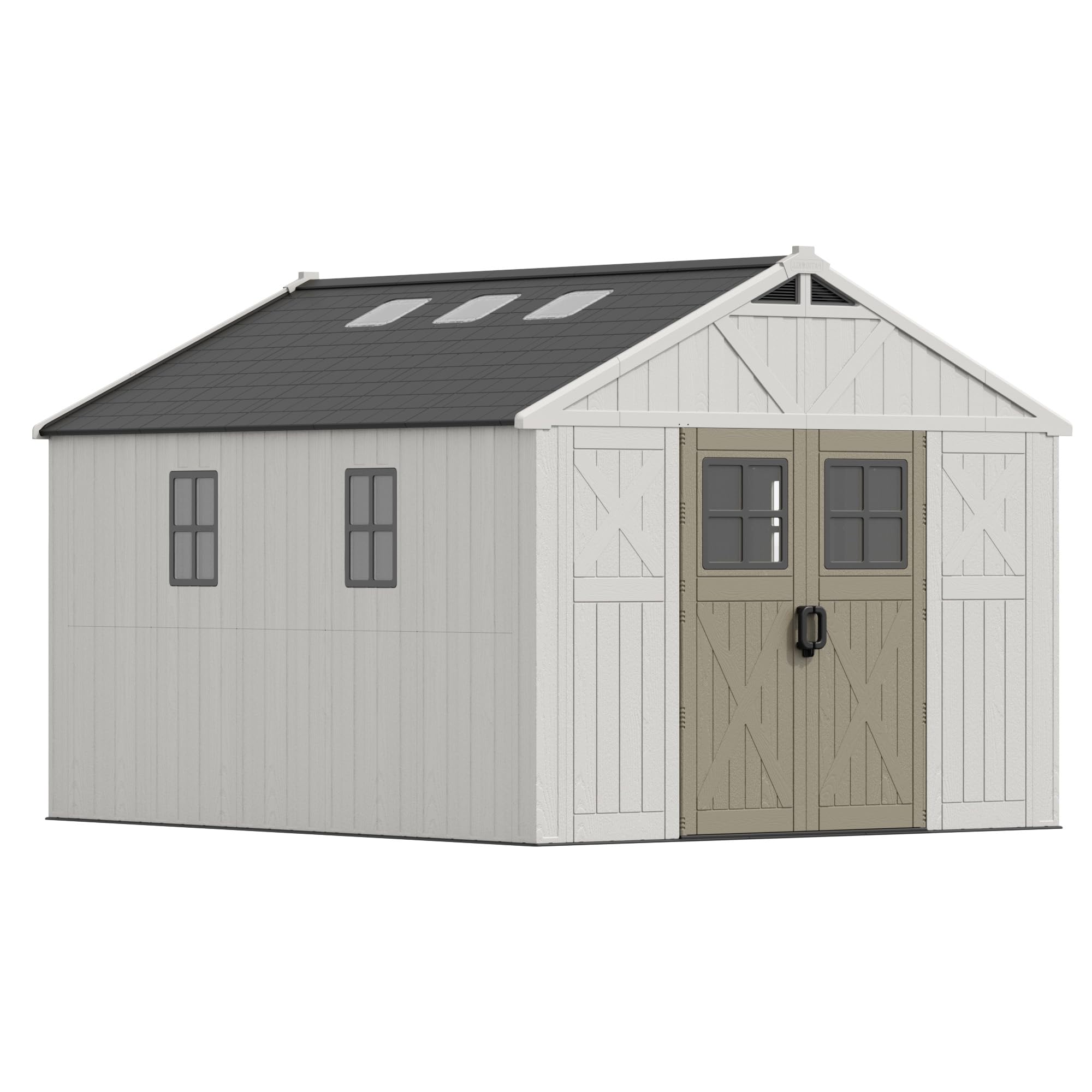
A compact resin shed that holds mowers, bikes, and tires without taking over the whole yard.
When space is tight but you still need real storage, this 10×12 resin model is the compact choice. It delivers 120 square feet of floor area inside dimensions of 144.3 inches deep by 118.5 inches wide by 100.8 inches tall, which is enough for yard tools, a gas push mower, and a spare set of tires without devouring the entire patio. The resin walls are double-layer thickened (two bonded layers of plastic that resist bending and puncture better than a single skin), and the material carries UV protection so the beige shell resists fading over the seasons and never requires painting.
It is built around ease of setup. The “kick-it” installation system snaps panels into place with far fewer screws than a steel frame needs, and the maker notes this shortens build time compared with a traditional shed. The double sloping roof (a peak that falls away on both sides) sheds rainwater and snow instead of letting it collect, and the thickened floor panel keeps the interior off the ground and blocks water creeping in at the base. For light inside, six square skylights and small windows on both sides bring in daylight, and the air vents keep moisture from building up on stored gear.
Where it stumbles is the wind — worth knowing before you commit. It is a solid, weather-neutral store once assembled, but it is not built for gusty country: in a strong storm, resin can flex and pull apart. In a sheltered, low-wind backyard it holds up fine, and it is genuinely good value for the covered floor area when you catch it well-priced. Assembly still involves multiple boxes delivered over a few days, and the pictogram-only instructions (no written steps) leave a few builders guessing, so a level base and a cordless driver on low torque make the build far smoother. Anchor the floor panel down first and the rest squares up more easily.
The draw: a compact, no-rust resin shed with skylights and a floor — ideal when you need storage without a full 10×16 footprint.
The honest limit: not a shed for high-wind areas; it needs a sheltered spot and a level base to stay tight through the seasons.
Pick this if: your yard is small and sheltered and you want a low-maintenance resin store with no painting.
Skip this if: you live somewhere that takes serious gusting winds — resin walls flex where anchored steel would hold.
6. Handy Home Products Rookwood 10×16 Do-It-Yourself Wooden Storage Shed
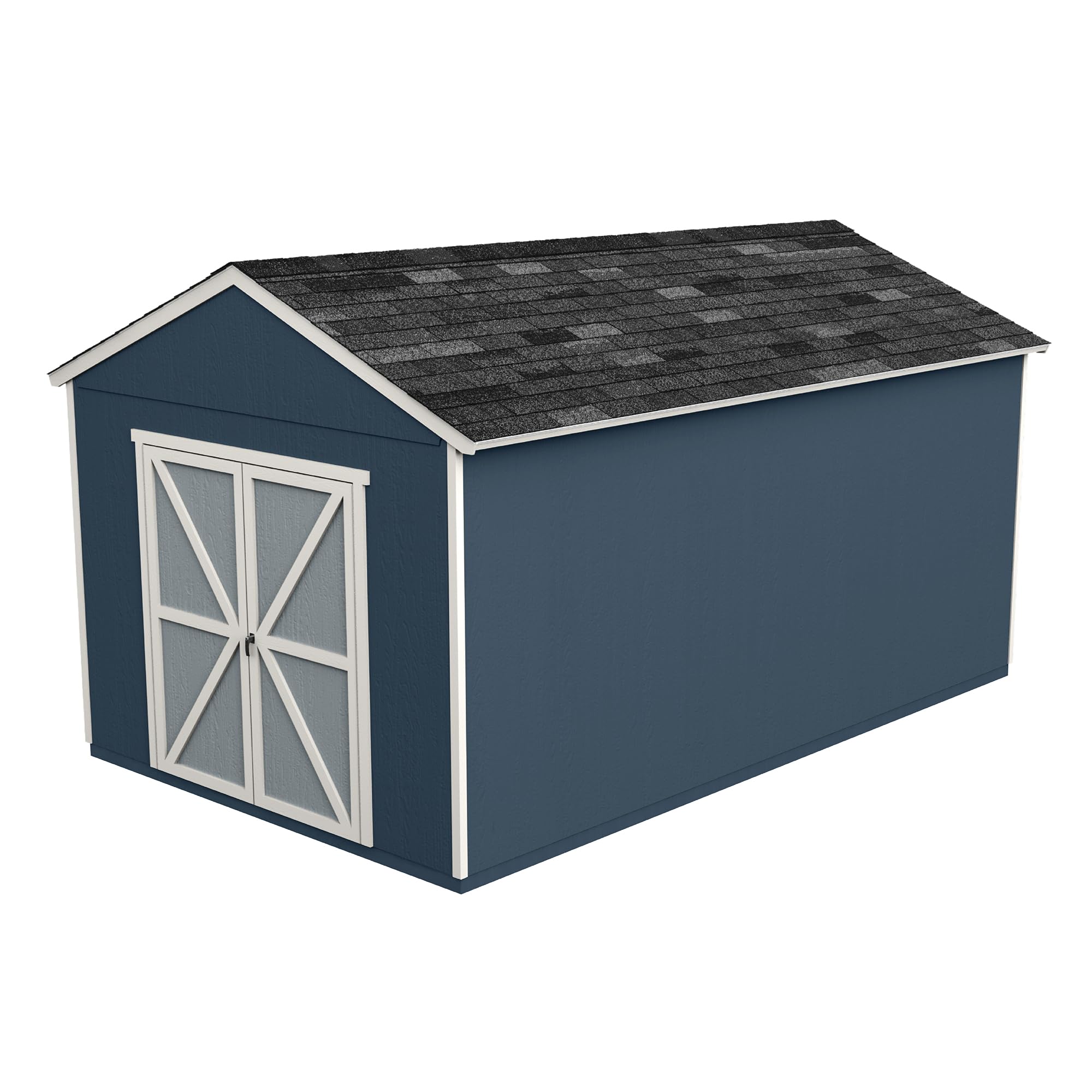
The wood-framed option for people who want a real building — and are ready to finish it themselves.
If you have been renting or paying for a steel shed and keep wishing it felt like an actual structure, this is the jump to wood. Premium 2×4 framing runs ground-to-peak, giving the shed a rigid skeleton that steel panels cannot match, and it stands 7 feet at the side walls with a 9′-6″ peak — enough vertical room to stand ladders, rakes, and shovels upright instead of leaning them. The extra-large doors measure 5′-4″ wide and ride on continuous galvanized steel hinges, so they swing open wide and hold their alignment far longer than a bolted-on hinge. The whole kit lays out 160 square feet of floor on a footprint of 192.69 inches deep by 133.5 inches wide by 114 inches tall.
What buyers rave about most, though, is the look — this is the wood shed that reads as a finished building, not a metal box. One recurring comparison owners make is that it resembles the kind of shed you might otherwise pay a builder heavily for, and the beach-style colors and flat siding panels land well in a backyard. There is also a lot of truth to the “customizable” angle: the floor is deliberately not included, which frees you to pour a cement pad or build a platform exactly the way you want, and the panels arrive pre-cut so you never measure or rip boards yourself.
The trade-offs are real and you should go in ready for them. The floor, paint, and roofing shingles are sold separately, so budget for those beyond the kit, and the wood arrives unfinished — a few builders sorted through the pallet and set aside a couple of warped studs, replacing them with fresh 2x4s. The instruction manual covers multiple shed sizes at once, which can get confusing, so read a full stage ahead before you swing a hammer. Realistic timelines vary: two experienced people finished in about four hours on a flat slab, while a solo weekend builder takes considerably longer. Also note it is not sold in Florida because of weather restrictions, so check availability for your state before you order. Build it on a level slab with treated sill plates and anchored down, and the finished shed is considerably sturdier than the flat-pack pallet suggests.
The wood advantage: 2×4 ground-to-peak framing, a 9′-6″ peak for upright storage, and 5′-4″ doors on continuous steel hinges make this the sturdiest structure here.
What to plan around: floor, paint, and shingles are extra, and the multi-size manual rewards a slow, careful builder.
Suits: a buyer who wants a genuine wooden building on a slab and is happy to finish and paint it over weekends.
Not for you if: you want a floor and complete roofing in the crate — this kit is the frame and walls, and the finish is on you.
7. Handy Home Products Scarsdale 10×16 Do-it-Yourself Wooden Storage Shed with Floor Kit

The wood shed that arrives with its floor and pre-hung doors — the most complete build here.
For the buyer who has already priced out flooring and doors separately and winced, this Scarsdale kit bundles both. It includes a premium treated floor backed by a 10-year warranty and arrives with pre-assembled, pre-hung double doors, so you skip two of the fiddliest jobs in a wood build. It sits on LP SmartSide siding (an engineered wood panel that resists weather better than plain boards) and stands on 7-foot sidewalls, tall enough to stow ladders and rakes upright. At 1614 pounds it is the heaviest kit here — heavier than the Rookwood at 1521 pounds — because the included floor and pre-hung doors add real material. The big doors measure 64 inches wide and 72 inches tall, the tallest opening on this list, and the row of windows in the package pulls daylight in so you can grab what you need and go.
The design gives you flexibility that bolted steel never can: the fully customizable profile lets you mount the double doors on either end of the building, so you can aim the entrance at your yard path or at the driveway. The kit is honest about what it does not include — paint and roofing shingles are sold separately, and a couple of buyers noted the photos show a completed roof that does not ship in the crate. So plan for a siding finish and a shingle top before you start, and understand that the price of the kit is the frame, walls, floor, and doors.
Beyond the missing shingles, the main friction is assembly time and lumber quality. The kits ship with a lot of wood pieces on a pallet, and some owners reported bowed lumber requiring fresh 2x4s, plus unlabeled pallets that are easier to stack if opened in numbered order. Several found the included instructions easy to follow, while others found the multi-size manual confusing, so a walkthrough before you start helps. Two builders with experience finished in moderation once they had the pieces sorted. If you go in expecting a real carpentry project with the tedious parts already handled for you, this is the most complete wood build of the group.
Where this kit leads
- Treated floor kit and pre-hung doors included, unlike the Rookwood
- LP SmartSide siding resists weather better than plain boards
- Reversible doors let you point the entrance at either end
- Tallest doors here, 72 inches, for easy equipment moves
Set your expectations
- Paint and roofing shingles are not included
- Some pallets arrive with bowed lumber needing replacement
- It is the heaviest kit here and needs a solid base
- Multi-size manual confuses some builders
Ideal for: the buyer who wants wood but would rather not source a floor and hang doors themselves.
The honest caveat: you still supply paint and roofing, so budget for the finish on top of the kit.
Understanding the Specs
Door Width and Height
The door opening decides what you can actually get in and out, which matters more than total floor area for anyone storing a riding mower or wheelbarrow. On this list the openings range from 47.24 inches on the AirWire up to 60 inches on the AMERLIFE and 64 inches on the two wood kits, so a wider door means less wrestling equipment through at an angle. Height matters too: a 66.54-inch opening suits most push equipment, while the 72-inch doors on the Scarsdale give you standing clearance to walk gear straight in rather than lifting it high.
Frame Material and Gauge
The frame material sets how the shed ages: galvanized steel resists rust but needs sealed seams, resin never rusts but flexes in wind, and wood stays rigid but arrives unfinished. Galvanized steel and alloy steel resist rust without paint but demand sealed seams, and gauge numbers describe the thickness of that steel — a stronger frame like the WACASA’s 20-gauge structural track carries more roof load than thinner paneling. Resin sheds such as the Patiowell and Devoko use double-layer polypropylene that cannot rust at all but flexes in high wind. Wood framing gives the most rigid structure and the freedom to add wiring or insulation later, but it arrives unfinished and needs a floor and paint put on top.
FAQ
How long does a 10×16 shed kit take to assemble?
Do I need to build a foundation before installing a 10×16 shed kit?
Is a metal shed or a resin shed better for a wet climate?
What actually fits inside a 10×16 shed?
Do 10×16 shed kits come with a floor and roof shingles?
Can a metal storage shed handle high winds?
Why do reviews mention gaps and leaks on steel sheds?
Do I need a permit or HOA approval for a 10×16 shed?
How tall is the door opening on a 10×16 shed kit?
Is a wood shed kit worth it over steel?
Final Thoughts: The Verdict
For most people shopping a 10×16 shed kit, the winner is the AMERLIFE 10x16x7 FT Outdoor Storage Shed because its 60-inch doors and 163 square feet of floor are the best mix of easy access and usable space here. If your yard takes real weather, grab the WACASA 10×16 FT Military-Grade Metal Storage Shed and anchor it properly — its 20-gauge frame and 120+ MPH rating are built for storms. And if you want a genuine wooden building with the floor and doors already handled, the Handy Home Products Scarsdale 10×16 is the most complete wood kit of the group. Whichever you choose, build the foundation first and caulk the seams as you bolt them — the shed you seal carefully is the one you keep for years.
How We Picked
We do not accept paid placement. Every pick is matched to a real buyer and a real use-case; we do not hands-on test units.
Sources & Methodology
Specifications: manufacturer listings and product documentation. Review insights: verified customer reviews, as of September 2026. Pricing: not shown on this page (it changes often); check the current price via the retailer link.
As an Amazon Associate, KitchPrep earns from qualifying purchases. This does not affect which products we feature.
Related Guides
