
Specs are compiled from manufacturer listings and verified buyer reviews and can change over time — please confirm the key details on the product page before buying.
A 100W foldable solar panel is the difference between rationing your phone battery at a campsite and running a mini fridge all weekend. This guide walks you through the panels that actually deliver on their wattage promises and explains what to look for so you are not left with a heavy, underpowered mat. Just know that this list matches panels in the 90–110W range, so a few picks are close neighbors of the exact 100W number, and they serve the same purpose.
I’m Mohammad Maruf — the founder and writer behind KitchPrep. This guide is built by comparing the manufacturers’ published specifications and the patterns across verified customer reviews, so you get each pick’s real strengths and trade-offs instead of marketing spin.
Ready to keep your devices humming off-grid? Here is the inside track on the 100w foldable solar panel, from feather-light travel models to rugged all-weather workhorses.
Our Picks at a Glance


How To Choose The Best 100W Foldable Solar Panel
Before you click buy, you need to know your power station’s input limit and its connector type. A great panel feeding a station that only accepts 60W will only ever give you 60W, no matter how bright the sun is.
Match the connector to your station
Every power station brands its solar input differently, and the cables matter. Look for a panel whose cable kit includes the specific plug for your brand — XT60 for EcoFlow, DC8020 or Anderson for many Jackery models, and DC7909 for older Bluetti units. A true multi-connector kit covers most bases.
Efficiency and cell type
The conversion efficiency tells you how much sunlight becomes electricity. Higher efficiency — think 23% to 25% — means a smaller panel surface that still delivers strong power, so it matters if you are short on roof space or pack space. Monocrystalline cells are the standard for portable panels.
Waterproofing and durability
Check the IP rating to know what weather it can survive. IP65 resists splashes and dust, which is fine for most camping. IP67 adds short-term immersion in water, and IP68 is the toughest of the three, handling deeper or longer submersion.
Quick Comparison
| Model | Best For | Weight | Efficiency | Waterproof | Amazon |
|---|---|---|---|---|---|
| ZOUPW 100W★ Best Overall | All-around camping power | 9.5 lbs | 23.5% | IP67 | Amazon |
| SOKIOVOLA 100WUltralight Pick | Feather-light travel | 4.6 lbs | High Efficiency | IP68 | Amazon |
| FlexSolar 100W (Upgraded)Top Performer | Laptop and direct charging | 8.4 lbs | 24% | IP67 | Amazon |
| Luvknit 100W | Crowd-proven value | 8.2 lbs | 24% | IP65 | Amazon |
| DOKIO 100W Suitcase | Direct 12V battery charging | 10.1 lbs | — | — | Amazon |
| FlexSolar 100W (Light) | Minimal pack weight | 4.1 lbs | 23%+ | IP67 | Amazon |
| EBL 100W | Budget-friendly performance | — | 23% | IP65 | Amazon |
| GRECELL 100W | Expandable system builders | 6.1 lbs | 23.5% | IP65 | Amazon |
| Renogy 100W | High-efficiency all-rounder | 7.3 lbs | 25% | IP65 | Amazon |
| BLUETTI 100W | Brand-matched Bluetti setups | 12.6 lbs | 23.4% | IPX67 | Amazon |
| Jackery SolarSaga 100W Air | Bifacial light power | 7.1 lbs | 23% | IP68 | Amazon |
In‑Depth Reviews
1. ZOUPW 100W Portable Solar Panel
Our pick — over 4.5★ from 700+ verified ratings; the strongest balance of quality and price.
The crowd favorite that turns late-afternoon sun into a meaningful top-up for your power station.
This is your do-everything panel, thanks to a true 5-in-1 cable that covers 99% of power stations — DC8020 for Jackery’s newer models, XT60 for EcoFlow, Anderson, DC7909, and DC5521 for generic batteries. No extra adapters needed, which is exactly what owners rave about when they praise the included accessories. It is heavy at 9.5 pounds, but the magnetic handle makes carrying it simple. Buyers report “Receiving over 60w of charge in the late afternoon sun,” a payoff that shows up again and again in the quality and charging-performance praise.
Build quality here wins people over fast, with 114 owners calling it out. The ETFE coating shrugs off rain and splashes, and the IP67 rating means a passing storm is no emergency. The two kickstands angle the panel to 45° to capture up to 25% more sunlight than flat laying, so you get noticeably more from limited daylight. It folds down to a compact 24.13 x 21.06 x 1.77 inches, and setup is genuinely seconds.
Real-world output runs a wide gamut, from nearly 100W to just 20–25W depending on conditions, so treat the bold claims with some patience. The built-in controller adds 1x USB-C (PD 15V/3A) and 2x USB-A (QC3.0) ports, letting you charge a phone or GPS directly without a power station. One owner found it outperformed older panels at 60W on a cloudy day versus the usual 25W, a theme of stronger low-light performance.
Why It Wins
- True 5-in-1 cable matches nearly every major power station brand
- Rugged IP67 ETFE build that handles rain and dust
- Direct USB-C and USB-A ports for charging gadgets with no station
What To Weigh
- 9.5-pound carry weight is on the heavy side for hiking
- Kickstands lack fine adjustment, limiting precise sun angles
Your best daily driver: If you want one panel that pairs with any power station you own or might buy, this is it.
Hold off if: You plan to backpack miles with it, since the heft is geared toward car camping and RV life.
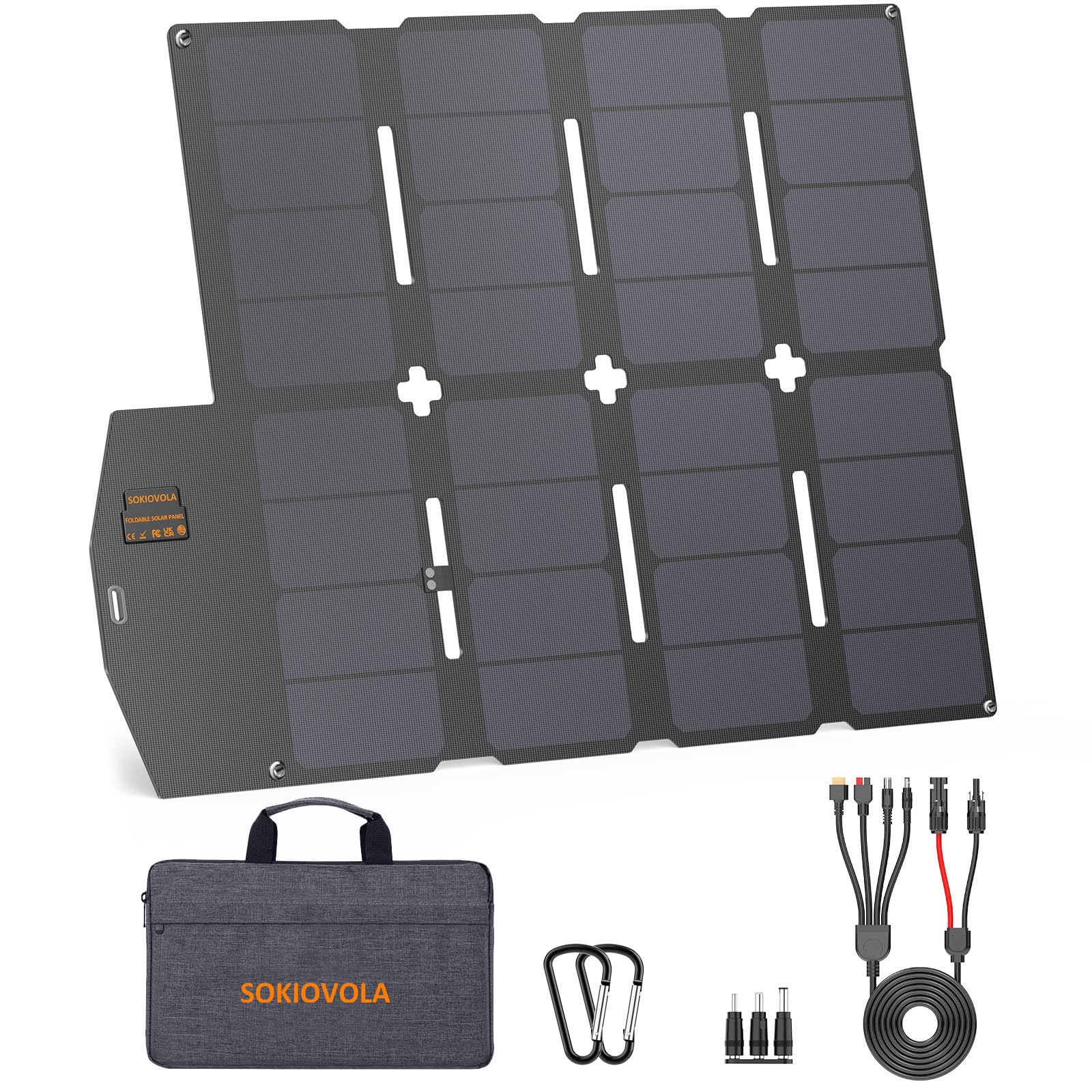
2. SOKIOVOLA 100W Foldable Solar Panel
A 4.6-pound featherweight that disappears into a pack and still recharges your station for days.
When every ounce counts, this panel is your pick. At 4.6 pounds, it is barely half the burden of the ZOUPW above — a 2.1x gap in carry weight — yet it still delivers a higher amperage capacity of 5.56 A versus the ZOUPW’s 4.96 A, a 12% edge in current flow. Owners call its compact folded size — 14.69 x 8.67 x 1.78 inches — easy to stow, and the build quality gets consistent praise as solid and travel-worthy.
Performance is the headline, with the most owner praise centered on how well it charges. Owners mention it recharged a Jackery running a ham radio for five full camp days without ever firing up a gas generator, keeping communications alive the whole trip. Its ETFE material hits 95% light transmittance, and the IP68 waterproof and dustproof rating is the strongest protection here, so sudden weather is rarely a worry.
The honest catch is that there is no kickstand. Owners note you must lay it flat or hang it at an angle, which means ground placement is inefficient unless you prop it up yourself. The included 7.2ft 4-in-1 cable (XT60/DC5521/DC8MM/Anderson) covers most portable stations, but a few owners wished the cable were longer for easier positioning.
Built To Travel
- 4.6-pound carry weight with 5.56 A output power
- IP68 rating beats most rivals for wet-weather durability
- Compact fold fits easily into a daypack or luggage
Keep In Mind
- No built-in stand, so expect to prop or hang it
- Multi-panel design needs a flat or slanted surface for best output
Reach for this if: Light packing is your priority and you can rig a simple angle toward the sun.
Look elsewhere if: You want a self-standing panel that snaps open anywhere on the ground.
3. FlexSolar 100W Portable Solar Panel (Upgraded)
The rare foldable that can fast-charge a laptop directly from its USB-C port in full sun.
What sets this FlexSolar apart is the USB-C PD port running 20V at 3A — a full 60W. Customers note it fast-charges a 45W laptop from 50% to full in about 35–45 minutes in direct sun. That makes it a genuine laptop companion, not just a power station feeder, and the convertible 4-in-1 M-C-4 connector (XT60, Anderson, DC5521, DC7909) keeps it compatible with EcoFlow, Jackery, Bluetti, and Anker stations.
At 24% conversion efficiency using A+ grade monocrystalline cells, it edges out many rivals on cloudy days, and owners confirm it keeps a steady charge even when overcast, just slower. The ETFE coating resists scratches, rain, sand, and dust, earning an IP67 rating, and the aluminum frame adds rigidity. Two built-in kickstands let you adjust the angle any time.
Weighing 8.4 pounds, it is not backpacking gear — owners call it large but light, ideal for camping or vehicle use. It folds from 47.1 x 22.8 x 0.2 inches down to 22.8 x 23.4 x 1.6 inches, so it needs cargo space, not a hip pocket. from the start it delivered 62W to a BLUETTI EB3A on a sunny 2 p.m., a strong real-world result, though clouds still drop it to the 20–30W range.
The Standout Bits
- 60W USB-C PD output charges laptops directly
- 24% efficiency delivers strong cloudy-day performance
- Adjustable kickstands with a sturdy aluminum frame
Before You Buy
- 8.4 pounds and a wide fold make it car-camping only
- No power storage, so it only works in direct sunlight
Pick it for: Anyone who wants to skip the power station and plug a laptop or tablet straight into the sun.
Think twice if: Your trips are on foot, where the footprint and weight become a burden.
4. Luvknit 100W Portable Solar Panel

A proven, well-reviewed panel that pairs massive connector variety with solid 24% efficiency.
The Luvknit earns its value status with the most complete adapter kit in this lineup. You get a DC5521 to Anderson/DC/XT60 cable plus 4 extra DC5521 adapters — to 8020, 7909, 5525, and 5315 — so it mates with nearly every power station. Owners love the interchangeable plugs and report it charges a Jackery quickly, with One family liked it so much they bought a second for a son-in-law.. The magnetic closure and storage pouch for attachments add everyday convenience.
Real-world output is honest: owners measure around 55W in practice versus the 100W lab rating, with occasional peaks near 96W in ideal sun. One owner sustained 60W input to keep a Jackery 240 running a stream for 7 hours even in heavy cloud, which shows strong low-light behavior. The 24% efficiency cells and rugged foldable build with IP65 water resistance handle campsite life well, and it opens easily with adjustable back supports.
The weakness is the kickstand. Owners describe the legs as flimsy cardboard that fails in a 10MPH wind, so plan to weight it down at breezy sites. At 8.2 pounds it is mid-pack for weight, and the foldable design needs a flat spot to deploy properly.
Where It Shines
- Widest adapter variety for cross-brand compatibility
- Strong cloudy-day performance per owner reports
- Magnetic closure and storage pouch for tidy packing
Fair Warning
- Legs are too flimsy for gusty conditions
- Sustained output usually lands near 55–60W, not 100W
Grab it for: A budget-friendly panel with the best chance of fitting whatever station you already own.
skip it if: Your campsites are consistently windy, since the legs need extra staking or propping.
5. DOKIO 100W Foldable Solar Panel Suitcase
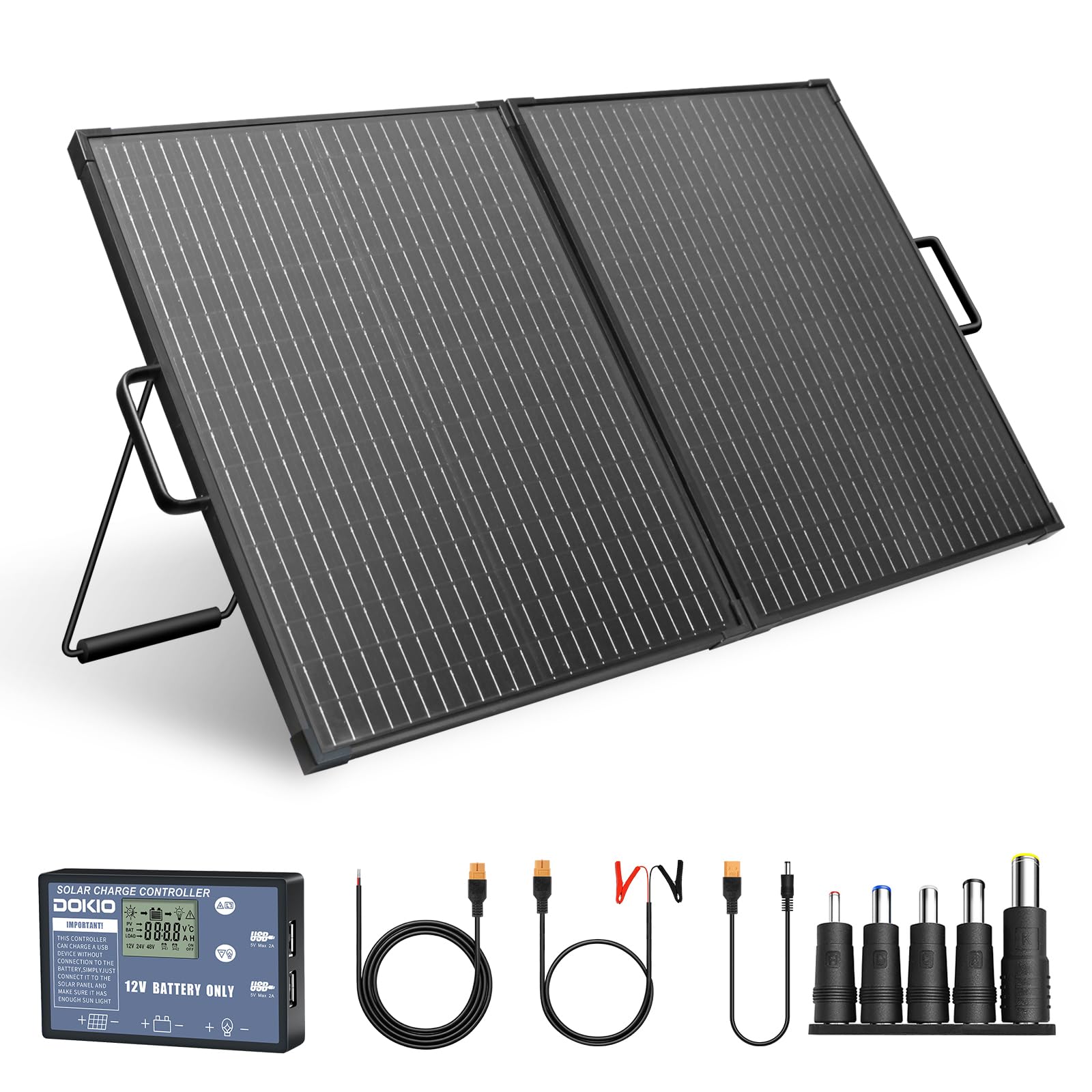
An all-in-one suitcase that clips straight onto a 12V battery to keep your RV topped up all season.
This is a different breed: a solar suitcase built to charge 12V batteries directly. Simply connect the alligator clips by polarity and it starts working, with the built-in smart PWM controller protecting against reverse polarity, overcharge, short circuit, and reverse current. Unfolded it measures 38.8 x 23.8 x 0.7 inches and folds to a 1.3-inch-thick package with a metal grip, and owners call it an all-in-one setup that packs down into its own case.
Durability is the defining trait. The N-type battery cells sit in a corrosion-resistant aluminum frame with reinforced corner guards, rated to work from -40°F to 185°F and resist 5400Pa snow load and 2400Pa wind. A 10-year power output warranty backs that claim. It also adds an integrated 5V 2A USB port for direct phone charging, and the detachable LCD charge controller gives you live readouts.
There is a 9.8ft extended cable for free sun tracking, and the 30° adjustable bracket helps aim it. Owners who charge lithium batteries report it working from the start at 13.4V, and beach campers ran phones, a fan, and a mini fridge off it all weekend. The trade-off is weight and legs — at 10.1 pounds it is the heaviest here, and the legs are on the wobbly side. The bag also lacks padding, so a few owners added foam for protection.
Why It Stands Out
- Built-in PWM controller with full battery protection
- Rugged aluminum frame rated for extreme temperatures
- 10-year power output warranty for long-term confidence
The Trade-Offs
- 10.1 pounds makes it the heaviest pick in this list
- Legs and carry bag need gentle handling
Choose it if: Your goal is maintaining RV or boat batteries with a set-and-forget solar controller.
Pass on it if: You are feeding a modern power station rather than a raw 12V battery bank.
6. FlexSolar 100W Foldable Portable Solar Panel
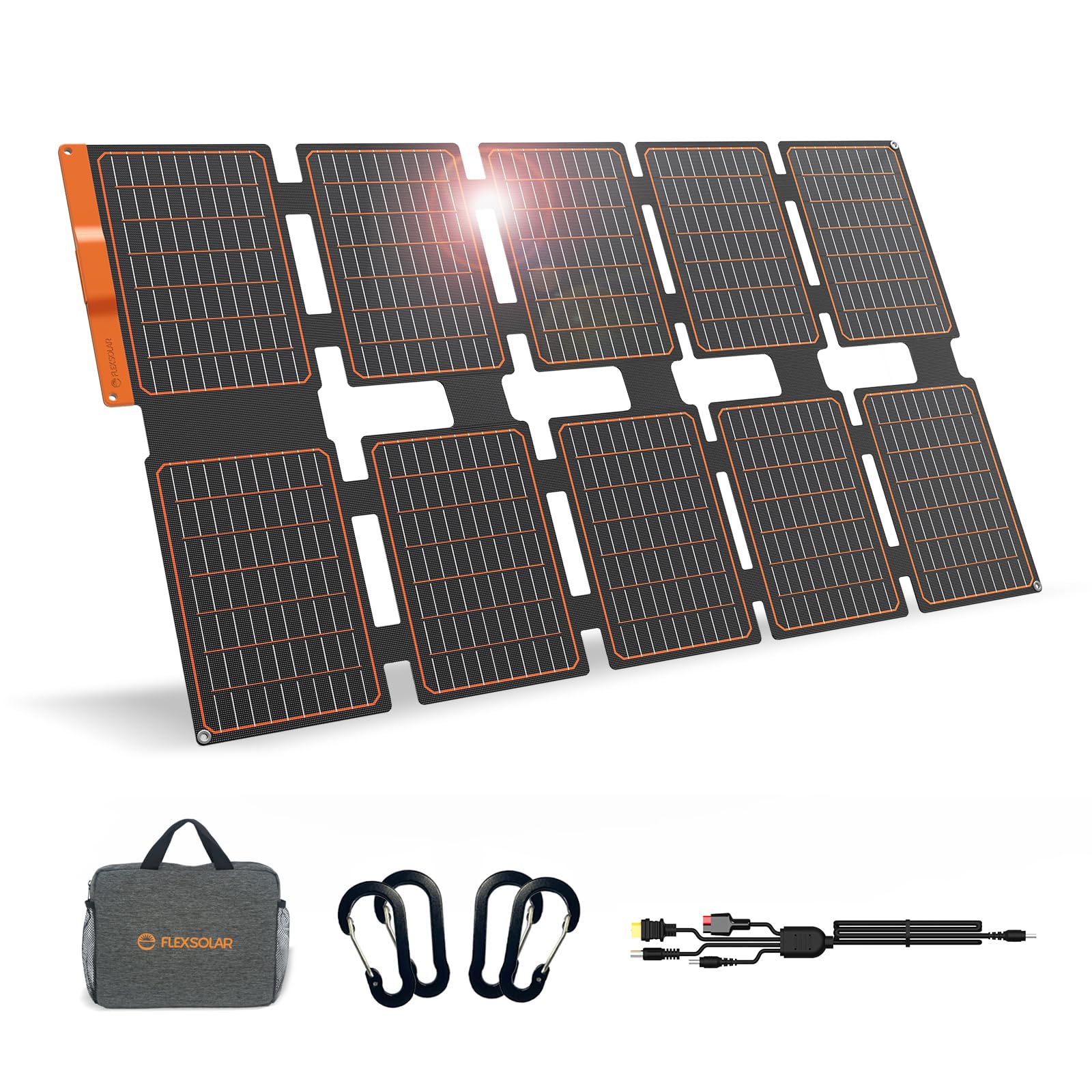
A notebook-sized folder at 4.1 pounds that still matches rigid 100W panels on power output.
Owners describe its output as comparable to rigid 100W panels, and One owner measured 70W+ output laid flat in a Maine July.. The padded carry bag and carabiners make hanging and transport simple, and Reviewers point out filling a 300Wh power bank in about 3.5 hours..
This version trades some weight for output ports. It delivers PD 3.0 45W USB-C, 18W USB-A, and a 100W DC output, so you can run several devices at once. The included 4-in-1 cable (DC5521, DC7909, Anderson, XT60) covers most stations, and a DC cable attachment lets owners charge laptops directly. That is the stronger pick for gadget-heavy travelers, while the ZOUPW leads on connector count and raw build.
The 23%+ efficiency on monocrystalline cells with E-Film lamination handles overcast days ably, though owners note the orange circuit part gets hot above 60W. Rain is a real caveat: one owner found the USB connector corrodes in wet weather, causing failure until the pins are cleaned, which chips away at the IP67 claim. There is also no MC4 connector, so check your station’s input before relying on it.
Why It’s a Great Lightweight
- 4.1-pound weight and notebook-sized fold are class-leading
- 45W USB-C PD plus 18W USB-A for direct device power
- Output rivals rigid panels per owner testing
Watch Out For
- USB port corrosion reported after rain exposure
- No MC4 connector limits some power station hookups
Best for: Minimalist travelers who want rigid-panel power without the rigid-panel bulk.
Not ideal if: You camp in steady rain, given the reported USB corrosion.
7. EBL Solar Panel 100W
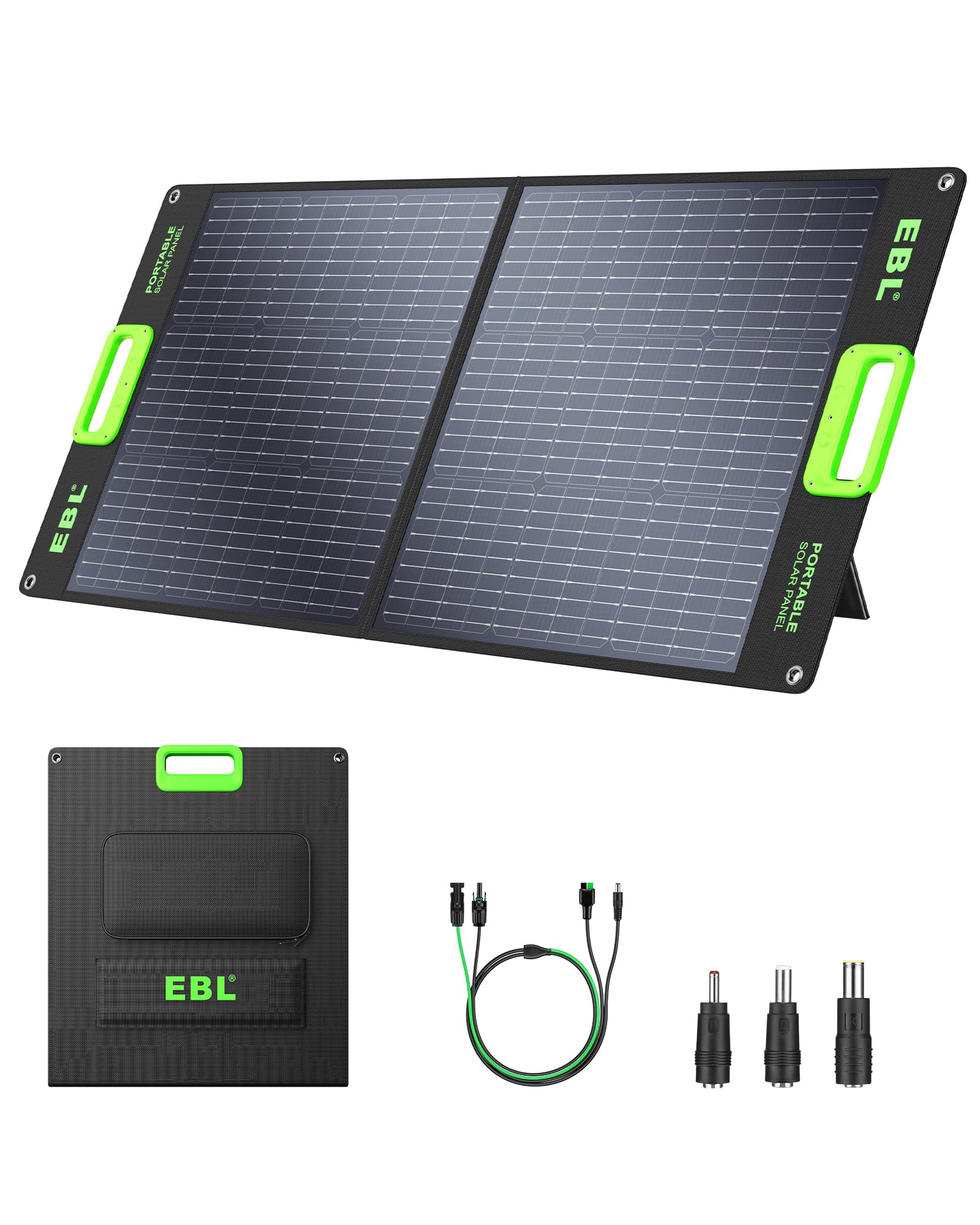
An affordable dual-kickstand panel with surprising peak output in good sun.
If your budget is tight, the EBL delivers more than its price suggests. Shoppers say it powered a 75qt fridge and, in one striking case, maxed out around 191W — well past its 100W label — with One buyer was so impressed they bought a second unit.. The 23% high-efficiency upgraded monocrystal cells perform strongly in direct sunlight, and the Smart IC adds overcharging, overheating, and short-circuit protection.
Portability is a real strength. Two kickstands angle the panel to 45°, capturing up to 20% more sunlight than flat laying, and a magnetic handle with a soft rubber grip makes folding and storage easy. Owners note the cables and connectors store neatly in the back pocket, and the IP65 water-resistant ETFE build shrugs off splashes — but not full rain, so set it up under cover or take it down before a storm.
Honest expectations matter here. The actual output can disappoint in less-than-perfect conditions, with owners measuring around 65W in ideal Florida sun rather than the advertised 100W, and clouds or shadow can drop it to as little as 1–2W. The 6ft cable is on the short side, and there’s no built-in charge controller, so it pairs best with a power station rather than a raw battery.
The Upside
- Reported peak power far above its rating in strong sun
- 45° dual kickstands boost daily energy capture
- Compact build with easy cable storage
The Downside
- Real output can land near 65W, not the full 100W
- Not rated for rain, so it needs shelter in weather
Ideal for: Budget buyers with a small power station who camp mostly in clear, sunny conditions.
Look past it if: You need consistent cloudy-day output or plan to leave it out in the rain.
8. GRECELL 100W Portable Solar Panel
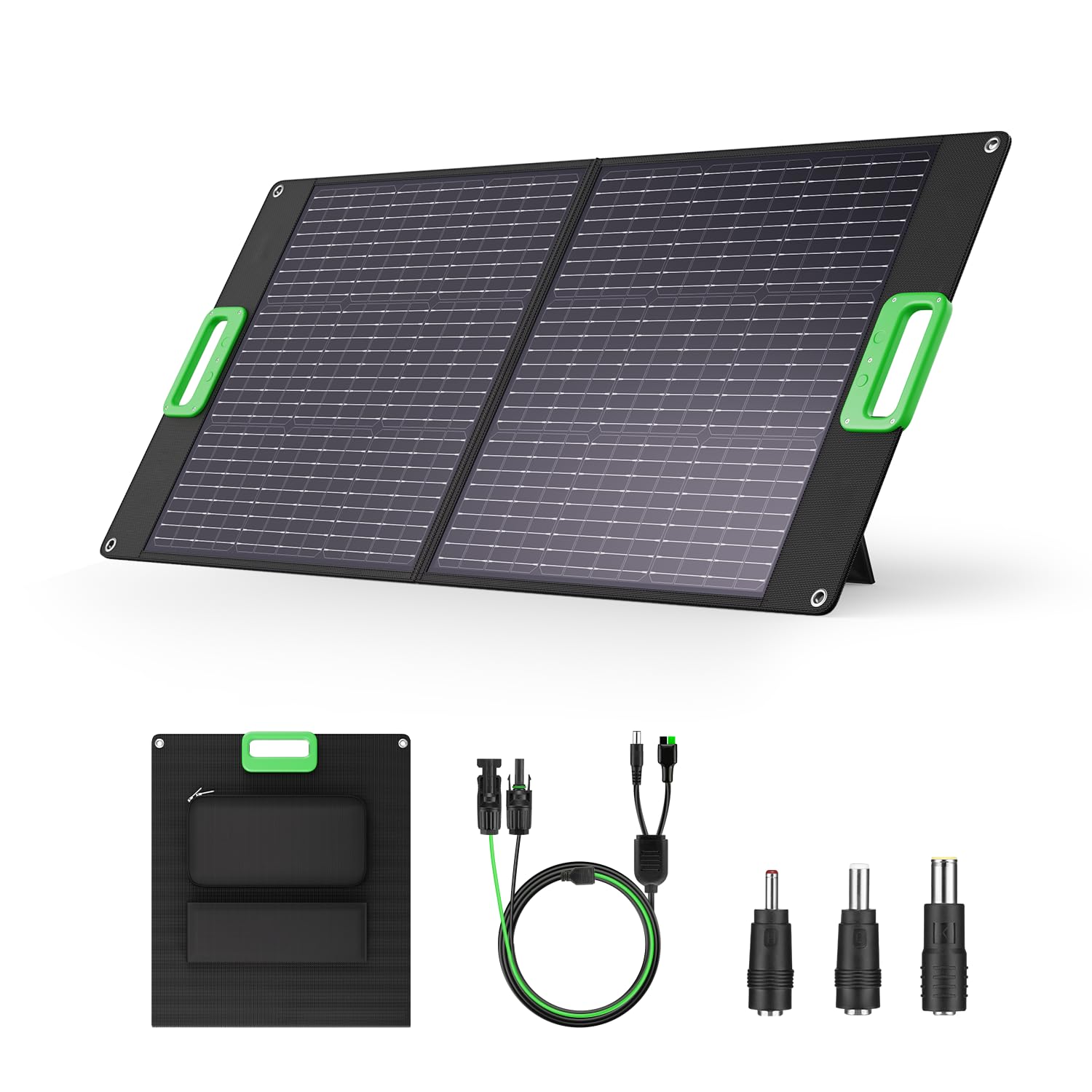
A light 6.1-pound briefcase that daisy-chains into a 200W system as your power needs grow.
The GRECELL is built for upgraders. It supports series and parallel connections, so you can link two units and double your output to 200W — a path owners actually use to charge larger stations faster. In full sun One owner recorded 125–138W in full sun, well above the 100W rating., and the briefcase-style fold with a sturdy handle fits easily into trunks and RV storage at just 6.1 pounds.
The 23.5% efficiency monocrystalline cells sit under ETFE lamination with a durable Oxford cloth backing, and the IP65 rating handles splashes, dust, and high temperatures. Setup takes about 30 seconds with the built-in adjustable kickstands, and four reinforced corner grommets let you mount it on an RV, tent, or tree. A zippered accessory pouch keeps the MC4-to-multi-connector cable kit organized and within reach.
That cable kit is broad — Anderson, DC5521, 8mm, 5.5 x 2.5mm, 5.5 x 2.1mm, 3.5 x 1.35mm, and 7.9 x 0.9mm — so it claims compatibility with 95% of power stations. The catch is the kickstands lack a locking mechanism, so owners warn about stability in a breeze. It also has no built-in controller for direct device charging, so route it through your station first. Rain protection is splash-only, not submersion-proof.
What Makes It Special
- Series and parallel support doubles output to 200W
- 6.1-pound weight with a wide multi-connector kit
- Reported real output exceeding 125W in full sun
Know The Limits
- Kickstands lack a locking mechanism for stability
- No built-in controller for direct gadget charging
Buy it for: Future-proofing — start with one and scale to 200W when your power station grows.
Avoid if: You want a self-contained panel with USB ports for charging phones directly.
9. Renogy 100W Portable Solar Panel

The efficiency leader at 25% that packs down to backpack size with a magnetic closure.
Renogy pushes the efficiency ceiling here with 16BB N-Type cell technology hitting 25% conversion — clearly above the standard 9BB 22.5% found in many rivals like the GRECELL and EBL. Owners confirm it delivers 100W in full sun, with real-world peaks up to 96W of rated output, and it charges Bluetti and Anker stations in roughly 2 hours. The magnetic closure replaces snaps or Velcro, making setup and storage genuinely quick.
At 7.28 pounds it is light for its class, and the fold packs down to 22.99 x 22.54 x 1.57 inches — backpack size by owner accounts, easily stowed behind a seat or in a closet. The quadfold design includes four kickstands with 3-angle adjustment (40°/50°/60°) for optimal sun capture, plus a built-in accessory pouch. For direct charging, it offers 1x USB-C PD (45W max) and 2x USB-A ports (18W and 15W), enough for three gadgets at once.
The honest limit is that peak output usually lands around 87–96W, not a clean 100W, and the 3ft MC4 cable comes with no adapters, so you must match your own station’s input. Owners say the legs are weak enough that they prop the panel against a car, tire, or chair, and staking is wise in wind. The IP65 rating and UL 61730 certification give strong safety and dust-and-splash confidence.
Leading Points
- Best-in-list 25% efficiency with N-Type cells
- Magnetic closure and 4-kickstand design for quick setup
- UL 61730 certified with 2-year workmanship warranty
Mind The Caveats
- Short 3ft MC4 cable arrives with no adapters
- Legs are weak; owners prop it against solid surfaces
Reach for Renogy if: Maximum power-per-square-inch matters and you already own the right MC4 adapter.
Think twice if: You need a cable kit that works with every brand straight from the start.
10. BLUETTI 100W Portable Solar Panel

The natural pairing for Bluetti stations, with reported real output that sails past its 100W rating.
If you own a Bluetti power station, this is the frictionless choice. It is explicitly built to pair with models like the EB3A, AC2A, AC50B, AC70, AC180, and AC200L, and buyers report it exceeds its rating — One owner measured 122W in January and 125–129W by May; another charged a Bluetti 600W from 39% to 100% in about 2 hours on a cloudy day.. The monocrystalline cells convert up to 23.4% of sunlight, keeping power flowing even in bad weather.
It pushes a hefty 6.1 A of current, the highest amperage here, which translates to faster top-ups for larger battery banks. The IPX67 waterproof and dustproof rating means rain and storms are not a reason to stop charging, and owners describe the adjustable kickstand as stable — one panel held firm against a wind that blew over 15 others. The foldable design measures 23.4 x 22.2 x 1.2 inches folded.
The hidden cost is weight and completeness. At 10.9 to 12.6 pounds depending on configuration, it is among the heaviest panels here, and owners note the connector cable is not included — you will order it separately unless your station came with one. The feet are described as flimsy, and like most foldables, it can flip in strong wind without added weight. It is built for vehicle-based camping and RV use, not for carrying far from the car.
Why It’s a Strong Match
- 6.1 A amperage leads this list for fast charging
- Reported output exceeds 120W in good sun
- IPX67 rating handles rain and storms confidently
What To Plan For
- Heavy 12.6-pound carry weight
- Connector cable sold separately
Choose BLUETTI if: You want a guaranteed smooth hookup with your BLUETTI station and you drive to your campsite.
Pass if: You hike with your gear or you need every cable included in the box.
11. Jackery SolarSaga 100W Air Solar Panel
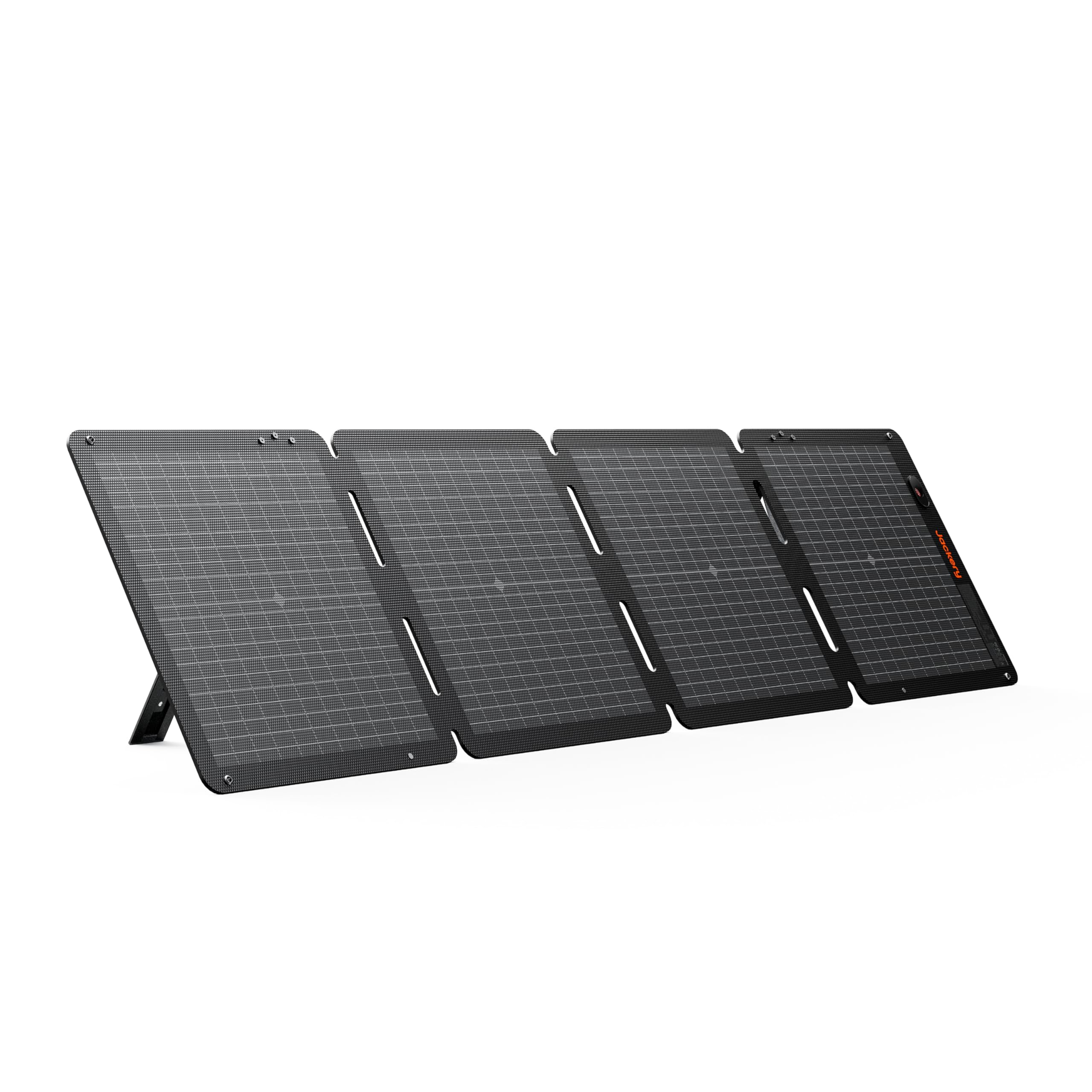
Jackery’s bifacial wonder that pulls sunlight from both faces to squeeze power out of dawn and dusk.
This is the cleverest design in the lineup: bifacial generation means its PERC cells at 23% efficiency harvest light from both the front and rear faces. Owners praise it for producing strong power even in lower light, and it is engineered to generate more at dawn, dusk, or on cloudy days than a standard one-sided panel. A sun indicator helps you find the perfect angle — an exclusive touch that keeps you pointed correctly without guesswork.
At just 7 pounds, Jackery says it is 27% lighter than standard 100W panels, and the W-fold design collapses smaller than A2 paper for storage, with a carrying bag included. The IP68 rating is the second-strongest here, operating from -4°F to 149°F, and it is certified to IEC TS 63163 after 18 tests including drops, humidity, bending, and 4,000 fold cycles — so this panel is built to be folded over and over without failing. Owners describe it as compact, lightweight, yet durable, with fast setup and a real sense of quality.
The dual USB ports each deliver 100W, letting you charge three devices simultaneously. But the fine print matters: it is not compatible with the Explorer 300 or 300 v2 series — using them together can trigger an F7 input voltage error. The price also carries a premium, and some owners note other brands of the same wattage cost less, though Jackery recommends using its own panels with its stations. One buyer praised its power for boondocking from a motorhome without firing up the generator.
What Makes It Special
- Bifacial cells capture extra light from both sides
- 7-pound weight folds smaller than A2 paper
- IP68 rating with 4,000 fold-test durability
Before You Commit
- Not compatible with Explorer 300 series stations
- Premium pricing over comparable wattage rivals
Pick it for: Jackery owners who want the brand’s best light-capturing tech and a panel built to fold thousands of times.
Look elsewhere if: You run an Explorer 300 series or you want maximum watt-per-dollar.
Understanding the Specs
Conversion Efficiency
This percentage tells you how much of the sunlight hitting the panel becomes usable electricity. A 25% panel like the Renogy converts more sun into power per square inch than a 23% panel, which matters most when your roof space or pack space is tight. Higher efficiency also helps on cloudy days when light is weaker.
IP Waterproof Rating
The IP code tells you how well the panel resists dust and water. The first digit covers solid particles, and the second covers moisture: IP65 handles splashes and dust, IP67 survives brief immersion in water, and IP68 is the most rugged, tolerating deeper or longer submersion. It is the single best predictor of whether your panel survives an unexpected downpour.
FAQ
Why does my 100W foldable panel only output 60W in full sun?
Will a 100W foldable panel charge my Jackery or EcoFlow power station?
What is the difference between a suitcase panel and a foldable mat panel?
Can Ileave a 100W foldable solar panel out in the rain?
How long does it take to charge a power station with a 100W panel?
What is a bifacial solar panel and why does it matter?
Is a 100W foldable panel good for running a mini fridge or CPAP?
How do I know which connector my power station needs?
Can I connect two 100W panels together for more power?
Final Thoughts: The Verdict
For most buyers, the 100w foldable solar panel winner is the ZOUPW 100W because its 5-in-1 cable, rugged IP67 build, and strong real-world performance make it the most versatile single panel for any power station owner. If you want the lightest possible carry weight, grab the SOKIOVOLA at 4.6 pounds. And for direct laptop charging or the highest efficiency, the FlexSolar 100W (Upgraded) and the Renogy 100W are the ones to reach for.
How We Picked
We do not accept paid placement. Every pick is matched to a real buyer and a real use-case; we do not hands-on test units.
Sources & Methodology
Specifications: manufacturer listings and product documentation. Review insights: verified customer reviews, as of September 2026. Pricing: not shown on this page (it changes often); check the current price via the retailer link.
As an Amazon Associate, KitchPrep earns from qualifying purchases. This does not affect which products we feature.
Related Guides
