
Specs are compiled from manufacturer listings and verified buyer reviews and can change over time — please confirm the key details on the product page before buying.
A 10000W generator keeps a fridge, furnace, well pump, and a few lights running through an outage. The short answer on which to buy: the Westinghouse 12500 Peak Watt Dual Fuel is the best overall pick, and the Champion 12,500-Watt Tri Fuel is the best value for anyone who wants to run a house on natural gas without hauling cans of gasoline. Everything else on this list earns its spot for a specific job — an RV, a jobsite, a cabin, or a whole-home transfer switch.
One thing to know before you buy: this list uses flexible, human-like matching for 10000 watt output or higher. That means not every pick is the exact number you searched — the nearest same-type wattage or size serves the same purpose and often fits your panel better.
I’m Mohammad Maruf — the founder and writer behind KitchPrep. This guide is built by comparing the manufacturers’ published specifications and the patterns across verified customer reviews, so you get each pick’s real strengths and trade-offs instead of marketing spin.
You will see running watts versus peak watts, fuel types, and transfer-switch readiness explained in plain terms. The goal is simple: you find the right 10000w generator for your home, cabin, or jobsite without guessing. Weigh fuel type against outlet layout before you choose.
Our Picks at a Glance


How To Choose The Best 10000W Generator
Buying at this power level is really about three decisions: what fuel you can get, how much surge your biggest motor needs, and how the generator connects to your panel. Get those wrong and even a 15,000-watt machine will not carry your panel.
Running watts versus peak watts
Running watts are what the generator delivers hour after hour. Peak (or starting) watts are the short burst it can supply for a second or two when a compressor or motor first kicks on. An air conditioner, a well pump, and a furnace blower all draw a big spike at startup. That spike, not the steady load, is usually what trips a generator. Always add up the running watts of everything you want on at once, then check the peak number against your hardest-starting appliance.
Fuel type changes everything about how you live with it
Gasoline gives you the most watts and the simplest refueling, but it goes stale and needs stabilizer plus a rotation schedule. Propane stores almost forever and burns cleaner, and it gives up a slice of output in exchange. Natural gas is the only fuel you never have to refuel — if you already have a gas line and a quick-connect, you can run indefinitely. Tri-fuel units give you all three and let you pick per outage.
Why the outlet panel matters more than the badge
A 50-amp, 120/240-volt outlet is what lets you feed a transfer switch and power a whole panel instead of running extension cords through the kitchen. A 30-amp twist-lock covers a large RV, a welder, or a sub-panel. GFCI household outlets handle the small stuff. Count the outlets you actually need for your setup — a 50-amp outlet plus four 120-volt receptacles covers most homes, and the RV crowd wants the twist-lock as well.
Quick Comparison
| Model | Best For | Running Watts (Gas) | Peak Watts (Gas) | Fuel Type | Amazon |
|---|---|---|---|---|---|
| Westinghouse 12500 Peak Watt Dual Fuel★ Best Overall | Whole-home backup | 9500 | 12500 | Gasoline, Propane | Amazon |
| Green-Power America 10000 WattBudget Champion | Budget emergency power | 7500 | 10000 | Gasoline | Amazon |
| DuroStar DS13000MXTop Performer | Heavy-duty whole home | — | 13000 | Gasoline, Propane | Amazon |
| WEN TF-1450X Tri-Fuel | Tri-fuel flexibility | 11500 | 14500 | Gas, Propane, Natural Gas | Amazon |
| Champion 12,500-Watt Tri Fuel | Natural gas backup | 10000 | 12500 | Natural Gas, Propane, Gasoline | Amazon |
| Westinghouse 14500 Peak Watt Dual Fuel | Large homes and jobsites | 11500 | 14500 | Gasoline, Propane | Amazon |
| Generac 12,500 Watt Tri Fuel EFI | Fuel-injected efficiency | — | 12500 | Gas, Propane, Natural Gas | Amazon |
| FIRMAN H08051 Dual Fuel | Large RV and ranch | 8000 | 10000 | Gasoline, Propane | Amazon |
| GENMAX GM10500iETC Tri Fuel | Quiet whole-home backup | 8500 | 10500 | Gas, LPG, Natural Gas | Amazon |
| DuroMax XP15000HXT | Maximum home output | — | 15000 | Gasoline, Propane, Natural Gas | Amazon |
| DuroMax XP16000iH | Mobile business and jobsite | 13000 | 16000 | Gasoline, Propane | Amazon |
In‑Depth Reviews
1. Westinghouse 12500 Peak Watt Dual Fuel Home Backup Portable Generator
Our pick — over 4.5★ from 800+ verified ratings; the strongest balance of quality and price.
The dual-fuel workhorse that carries a whole house on a 457cc engine and a key fob.
For a homeowner who wants one machine to cover the house, the trailer, and the tailgate, this is the pick. It puts out 9500 running watts and 12500 peak watts on gasoline, and it drops to 8500 running and 11200 peak on propane — a real number to plan around, since propane gives up output in exchange for fuel that stores indefinitely. The 457cc Westinghouse engine uses a cast iron sleeve, which is the part that takes the wear.
What wins people over is raw performance — the generator simply does the job it was bought for, running entire houses and even 41-foot trailers off the 50-amp outlet. Setup is the second thing buyers talk about, and it stays easy because the box arrives with a key fob, 12V battery charger, oil, and a funnel. You get four GFCI 120V 5–20R household receptacles, one 120V L14-30R for a transfer switch, and one 120/240V 14–50R for a 50-amp connection, all with rubber covers. On a 6.6-gallon tank with a fuel gauge, it runs up to 12 hours.
The recurring trade-off is sound. Some find it quieter than they feared and others find it loud, which is what a 212.1-pound open-frame unit at this output does. An automatic CO sensor shuts the engine down if carbon monoxide builds up, and low-oil shutdown protects the engine. The honest catch before you buy is the unboxing: the wheels and feet arrive unattached, the unit is heavy enough that two or three people should move it before the wheels go on, and the manual is dense — read both booklets before first start.
What earns its keep
- 9500 running / 12500 peak watts on gasoline, and 8500 / 11200 on propane — whole-home capability with fuel choice
- 50A 14-50R and 30A L14-30R outlets make transfer-switch and RV hookups straightforward
- Remote key fob start plus electric and recoil starting means no bending over a pull cord in the rain
- Up to 12 hours of runtime on the 6.6-gallon tank with a built-in fuel gauge
Where it asks for patience
- 212.1 pounds is a two-person lift before the wheels are mounted
- Sound is the one split verdict — fine for most, loud for anyone who expected whisper-quiet
- Wheels and feet ship unattached and the documentation is thick, so budget real assembly time
The call: the right generator for anyone who wants one machine to cover the house, the RV, and the jobsite without running two units. It is also the crowd favorite — 4.7 stars across 800+ ratings — and it carries a three-year limited warranty.
Rethink it: if you need it to move often and alone, or you want silence more than you want output.
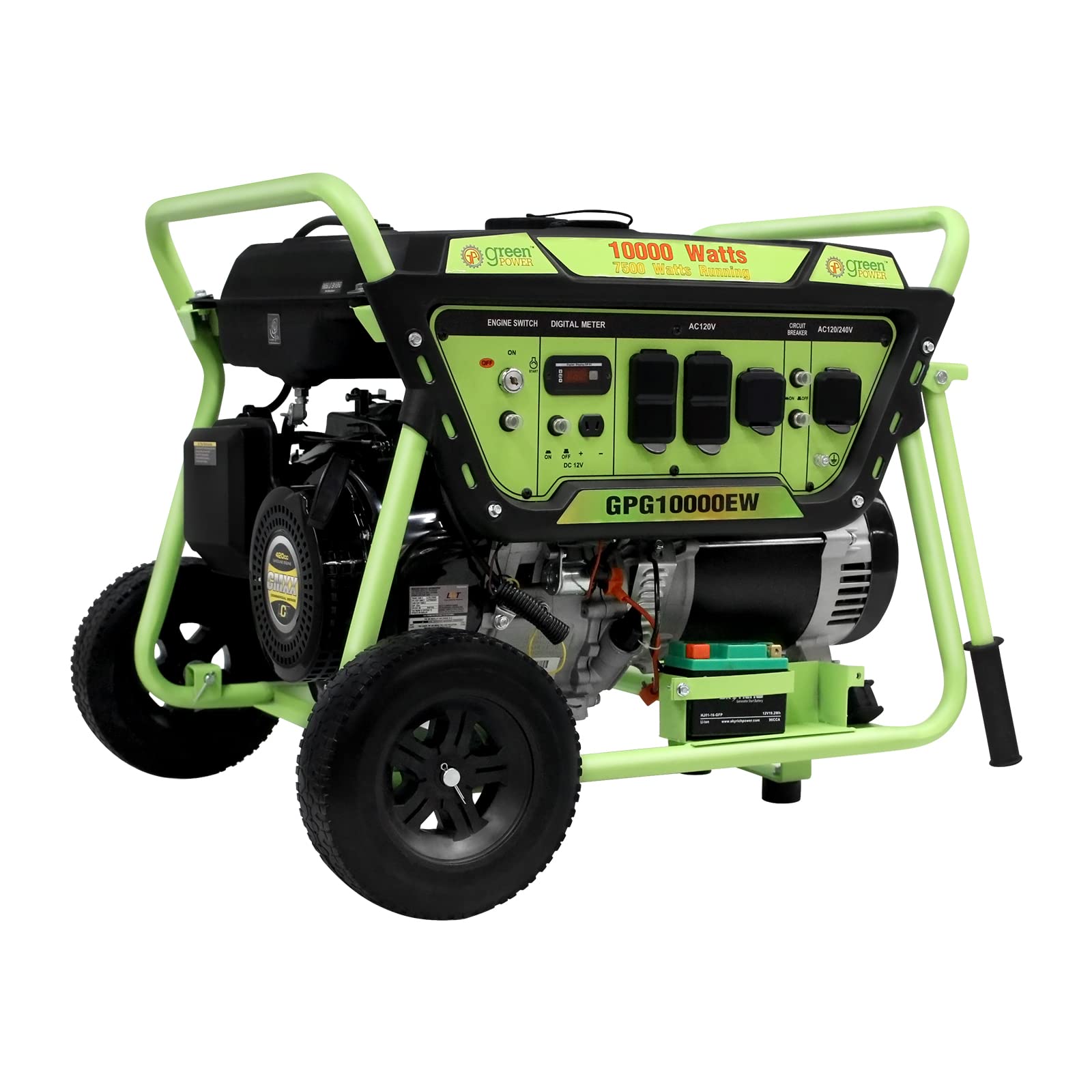
2. Green-Power America 10000 Watt Gasoline Powered Generator
Six covered outlets and a 420cc engine at the entry-level end of this power class.
This is the budget pick, and it earns the label by covering the basics properly. The GPG10000EW delivers 7,500 watts of continuous running power with 10,000 starting watts off a 15HP 420cc LCT engine. On a 6.6-gallon tank it runs 9 hours at half load. The engine is EPA certified, though the model is not sold in California — if you live there, shop the tri-fuel units instead.
The outlet spread is the reason this one stays useful: four 120V/20A NEMA 5-20R receptacles, one 120V/30A twist-lock, one 120/240V/30A twist-lock, and a 12V/8.3A DC outlet, all with weather covers. A 3-in-1 LED indicator shows voltage, frequency, and hours so you are not guessing. Ten-inch solid wheels and fold-away handles help once it is assembled, and a built-in fuel gauge tells you when to top up. Its 420cc engine is the smaller of the two in this article — the DuroStar runs a 500cc and the gap between them is real.
Reliability is what carries this one, and buyers report it starting on the first try every time, with enough output to run an entire 2k+ square-foot home. The factory runs central A/C for plenty of owners. The honest caveat is the flat-bottom gas tank, which can let the engine starve on an uneven surface because fuel does not slope toward the carburetor — a genuinely uncommon issue, but something to know. Startup instructions are thin, and moving it before the wheels go on takes a second set of hands.
Where it fits: a homeowner on a tight budget who wants a first generator that starts reliably and has enough outlet variety to handle a house, a camper, or a tailgate. The low-oil automatic shutoff protects the 420cc engine from damage if the oil runs dry.
Reach for this if: you want the lowest-cost way into 10,000-watt-class backup and you mostly run gasoline. Look elsewhere if: you need propane storage or you plan to run natural gas, since both are off the menu here.
3. DuroStar DS13000MX 13,000-Watt 500cc Dual Fuel Portable Generator
A 500cc steel-framed bruiser that takes a whole house on gas or propane.
The DS13000MX runs on gasoline or propane, and it runs 13,000 watts of power through a heavy-duty build with a CO alert that shuts the unit down if fumes build up. It brings a 50-amp outlet for a transfer switch, plus a push-button electric start and a front-facing fuel selector so you can flip between fuels without tools. Its 500cc engine is the larger displacement versus the Green-Power America’s 420cc, which is the underlying reason it leads on raw output.
Quality is what owners talk about most with this one, and it holds up under that scrutiny — the steel frame and reinforced power panel are built to take weather and heavy use. It starts quickly, assembles with clear instructions, and runs on gasoline or propane without fuss. What makes it a natural whole-home machine is the combination of the 50A outlet and the transfer-switch readiness; hook it up and the panel takes over. Dual fuel gets consistent praise here for exactly the reason you would expect — you store the propane for months and only run gasoline when you need the maximum wattage. The included kit covers the oil funnel, spark plug wrench, tool set, wheel and handle kit, propane regulator, and a remote control.
One limitation is the CO alert itself. A few owners mention the sensor short-cycling and shutting the unit down within 20 minutes even with the generator positioned away from the house on open ground. That is rare but real enough to buy the CO sensor as a safety feature with a learning curve, not a flaw. Noise splits verdicts the same way it does for every open-frame unit at this output. Size up your space before you commit; this is not a throw-it-in-the-truck machine.
The standout: a retired emergency manager with 40-plus years in public safety runs one as whole-house backup — the sort of buyer who does not gamble on reliability. Also worth knowing: the CO sensor short-cycle is the one issue that recurs, and it is worth testing your placement on day one.
Buy this one if: you want maximum watts for a stationary whole-home install and you plan to run it largely on propane. skip it if: you need something you can single-handedly lift into a truck bed.
4. WEN 14,500-Watt 120V/240V Tri-Fuel Generator (TF-1450X)
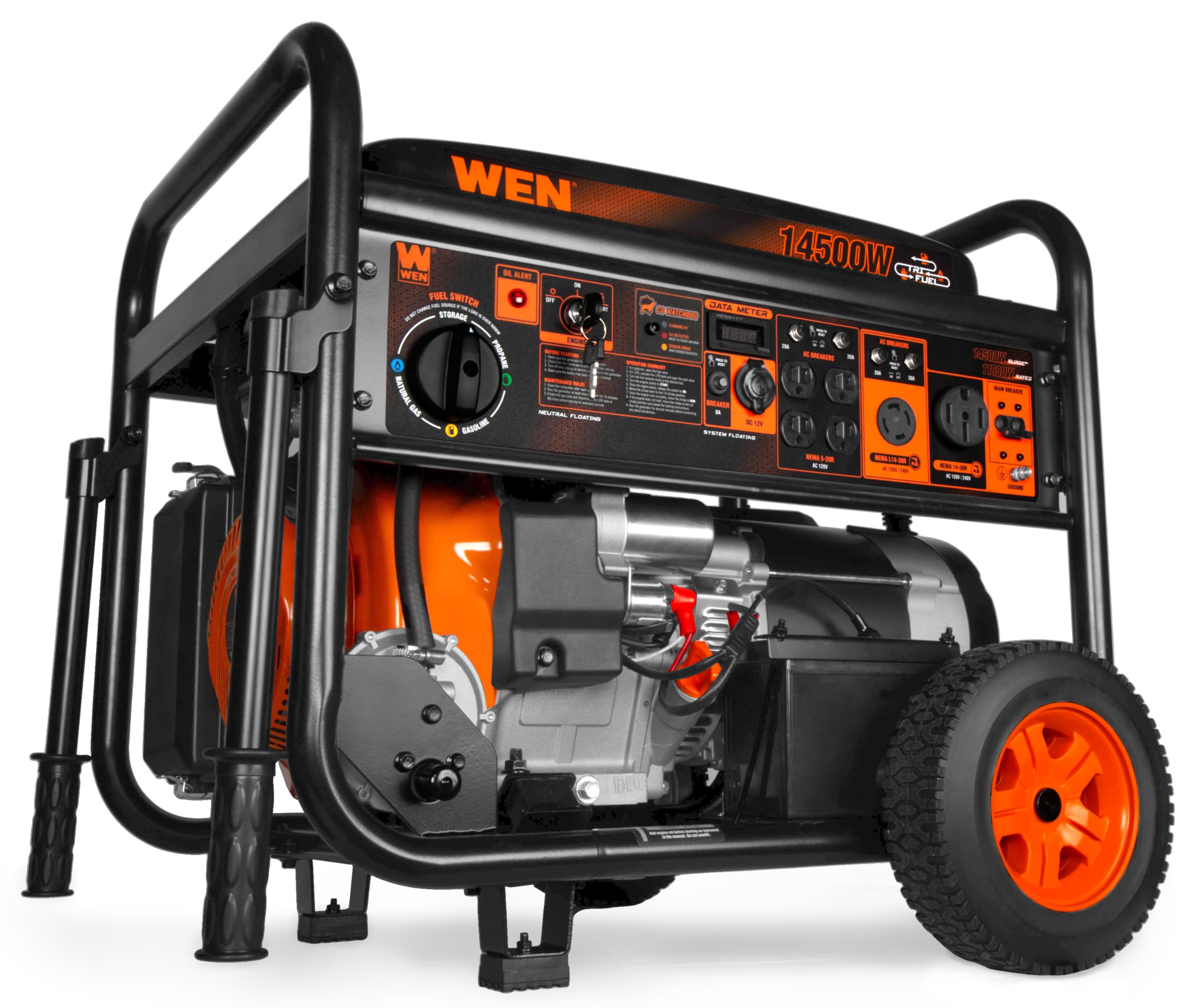
Three fuels, one dial, and clean enough power to run a whole house on natural gas.
The TF-1450X is the tri-fuel answer to a city-line outage: gasoline gives it 14500 surge and 11500 running watts, propane gives 12500 surge and 10300 running, and natural gas delivers 10500 surge and 8750 running. A simple turn of the selection dial moves between all three, and each fuel comes with its own dedicated outlet run at 120V and 240V for a transfer switch. The natural gas hookup is what makes it worth the extra tier — long outages are no problem if you’re running on your home’s gas line.
The engine is a 500cc 4-stroke OHV with a keyed electric start and an 8.2-gallon tank that stretches to a claimed 12 hours at half load. The WEN Watchdog CO sensor shuts the generator off automatically if carbon monoxide levels rise — the safety feature buyers increasingly demand on a portable machine that idles next to a house. The box is generous: four 120V 5-20R outlets, a 120V/240V transfer-switch-ready NEMA L14-30R, a 120V/240V transfer-switch-ready NEMA 14-50R, and a 12V DC automotive outlet, plus oil, a 6-foot LPG hose, and an NG quick-connect adapter. Those two transfer-switch-ready outlets, at 30 amp and 50 amp, are what let you wire this into a panel rather than run cords.
The one part of ownership people warn about is setup tolerance. Follow the instructions properly and the 8-hour oil break-in is not optional; the machine wants it. The bottom bump stops and brackets have caused a few buyers to pause during assembly because a bracket seems to block a hole until you realize the red shipping brackets are meant to come off first. And even at this output, the 50-amp outlet is 50 amps — that is the ceiling on what you can pull from the panel. If your load is bigger than 50A or includes two heavy motor starts at once, you need to think about load management, not more generator.
Settle here if: you want tri-fuel flexibility — gasoline for peak, propane for storage, natural gas for an indefinite outage — and you value a quiet, correct assembly over speed. Look past it if: you want a machine that comes with a battery charger, because this one does not ship with one.
5. Champion 12,500-Watt Electric Start Tri Fuel Home Backup Portable Generator

A tri-fuel home backup with a 500cc engine and hoses for gas, propane, and natural gas in the box.
This is the value play for a household that wants three-fuel flexibility without the top-of-list price. The rating is 12,500 starting watts and 10,000 running watts on gasoline; propane drops it to 11,250 starting and 9000 running; natural gas lands at 10,000 starting and 8000 running. The 500cc Champion engine fires with a rocker-switch electric start and the battery is included, and the box ships with both the LPG and NG hoses so it is ready to run on any of the three fuels with no extra shopping.
Starting time is what earns the most praise here, and it shows up in the writing: the electric start usually fires on the first press, and one owner tapped natural gas as the winning feature because it lets you install the unit at a fixed spot and skip refueling entirely. The Intelligauge tracks voltage, frequency, session run time, and total run time, which is exactly what you need to schedule maintenance. A CO Shield system shuts the unit down automatically if carbon monoxide rises. Load-wise it runs a mini-split AC, a refrigerator, lights, and fans at once, and it carries a 3-year limited warranty with lifetime technical support.
The one recurring gripe is cosmetic: the bottom frame arrives slightly bent near the wheel bracing on some units, and the wheels can turn a touch out of true. It does not affect how the machine runs. Noise sits in the middle of the range and gets mixed reviews — it does the job but will not be mistaken for an inverter. If you want quieter operation and do not need three fuels, the Westinghouse inverter above stays your pick.
Best for homes with an existing NG line: connect the natural gas hose and you are running when the grid goes down. Think twice if you are noise-sensitive: it lands louder than the inverter units at normal load.
Choose it if: value plus tri-fuel capability plus natural gas backup is the combination you need. Pass on it if: your panel needs more than 50 amps at once — this tops out there.
6. Westinghouse 14500 Peak Watt Dual Fuel Home Backup Portable Generator
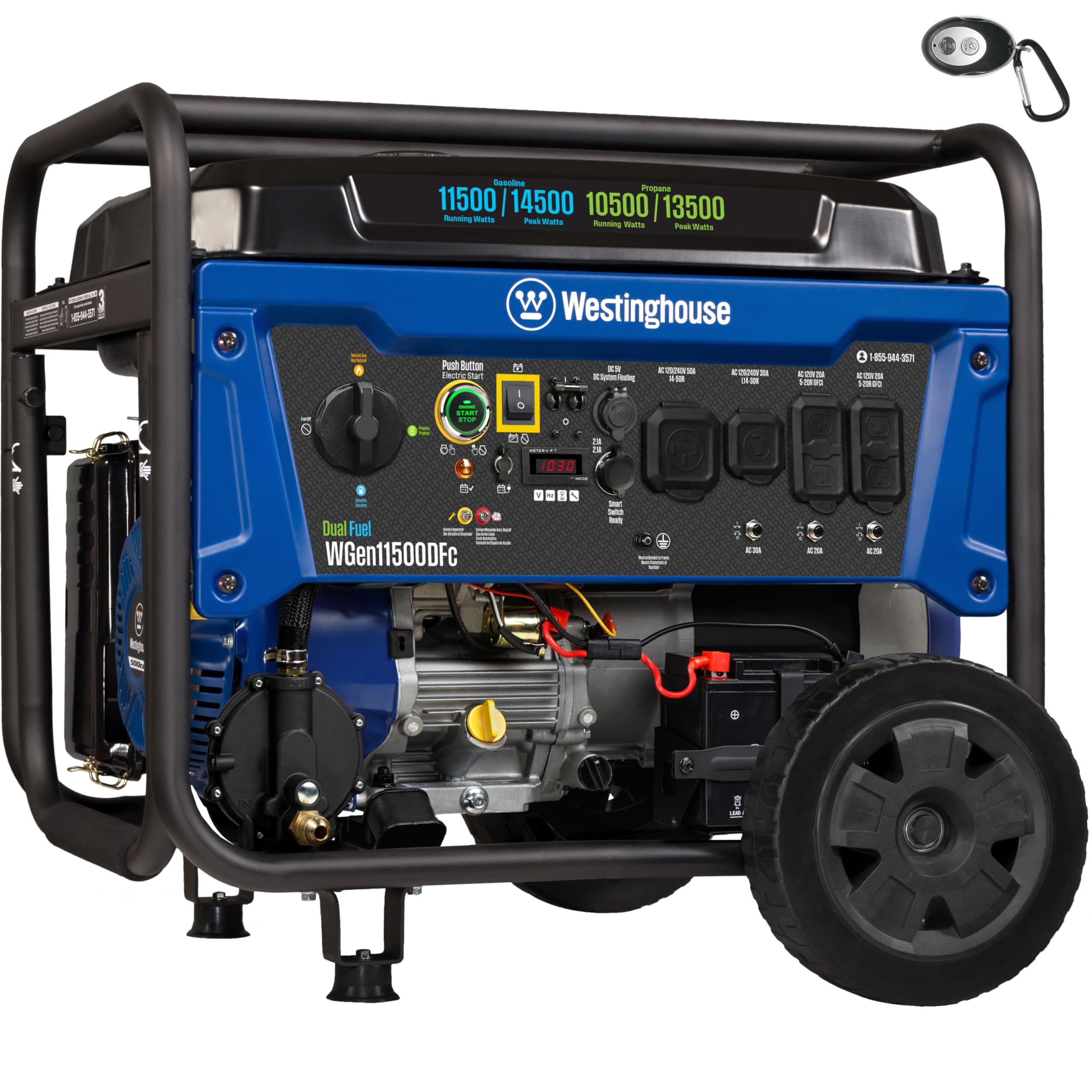
The 550cc upgrade that carries a whole house and a pool on one tank of gas.
This is the largest dual-fuel machine on the list: 14,500 peak and 11,500 running watts on gasoline, dropping to 13,500 peak and 10,500 running on propane. The 550cc 4-stroke OHV engine with cast iron sleeve is the biggest displacement of any Westinghouse here, and that is what lets reviewers point out running five mini-splits, a duplex fridge, a chest freezer, and lights at the same time. Running power quietly extends to low THD, so phones, computers, and TVs stay safe on it.
Runtime is the headline when you are riding out a multi-day outage: up to 19 hours on the 9.5-gallon tank with a built-in fuel gauge, or up to 7 hours on a 20-pound propane tank. Copper windings — unlike aluminum — are the heat-conducting material here, which helps the unit run cooler and stay in service longer. Hookup is straightforward; the 50-amp transfer-switch-ready outlet is the one to use if you have an existing switch installed on the panel. Buyers describe the connection as easy and confirmed it powers the whole house and pool.
Weight and noise are the trade-offs to accept. At 230 pounds, the wheels and handle are what make it manageable at all. Sound gets mixed feedback — some say quiet, others say loud — which tracks with what an open-frame unit at this output does when a big load kicks in. There is one easy trap: the fuel cutoff switch is a second switch that the manual does not stress well, and owners have pulled the cord repeatedly before discovering it. If the unit will not start, check that cutoff before assuming anything is wrong.
Best for: large homes or jobsite use where a big load runs at once and you want the runtime that makes a long outage bearable. Plan for: a two-person move and a quick read of the fuel-cutoff instruction before first start.
7. Generac 12,500 Watt Tri Fuel Generator with EFI and Electric Start
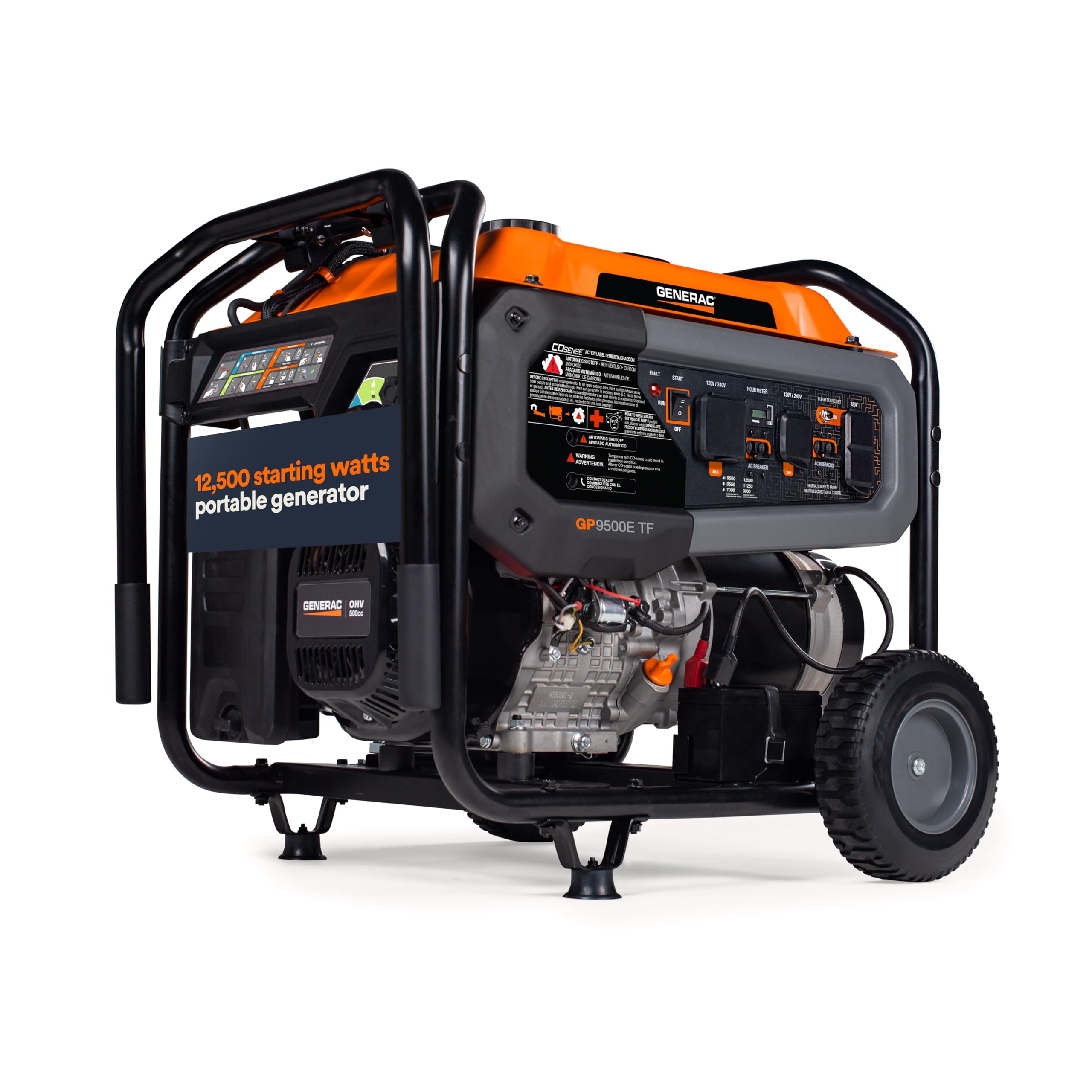
Electronic fuel injection and a dial that switches fuels without shutting down.
The standout spec here is the electronic fuel injection system. EFI meters fuel more precisely than a carburetor, which cuts maintenance and keeps performance steady as load changes — no choke to manage, no float bowl to gum up. The unit runs on gas, liquid propane, or natural gas, and the dial switches between them without shutting the unit down. Propane delivers 8,550 running watts and natural gas delivers 7,000 running watts when gasoline is unavailable. A rocker-switch electric start handles routine startups, with recoil backup if the battery is out, and the 12V 9Ah battery ships in the box.
Runtime and safety round out the package. On a 7.5-gallon tank the machine runs up to 14 hours at 25% load or 10.5 hours at 50% load on gasoline; a 20-pound propane tank attached via hose delivers up to 6 hours at 25% load, and there is a built-in fuel gauge to watch levels. The COsense system continuously monitors carbon monoxide, sounds an audible alert, and shuts the generator down before concentrations build. The control panel gives you one 120V 20A GFCI duplex outlet, one 120/240V 30A L14-30R twist-lock, and one 120/240V 50A NEMA 14-50R for large loads or a transfer switch. Nine-and-a-half-inch never-flat wheels and a 1.25-inch steel-tube cradle let one or two people move the 227-pound unit across uneven ground. It carries a 3-year residential and 2-year commercial limited warranty.
The honest caveat is that this machine has had a couple of first-unit failures reported — a unit that would not start on gas or propane and had to go in for warranty repair. Every brand at this tier has outliers, and the practical note is that the machine is not light and shipping it back is a hassle. If you have a dealer nearby, buy through them; if you are strictly mail-order, know that any engine issue means the unit is going back on a pallet.
Where EFI pays off: no choke, cleaner combustion, and easier cold starts. What to know: the CO sensor tries to keep you alive, and if the unit acts up, your fix runs through the warranty channel.
Consider it if: you want EFI and a tri-fuel dial in one machine and you value low-maintenance fuel delivery. Look at the Westinghouse 14500 instead if: you want more running watts and a 19-hour gasoline runtime.
8. FIRMAN H08051 Dual Fuel Portable Generator, 120V/240 VAC Electric Start
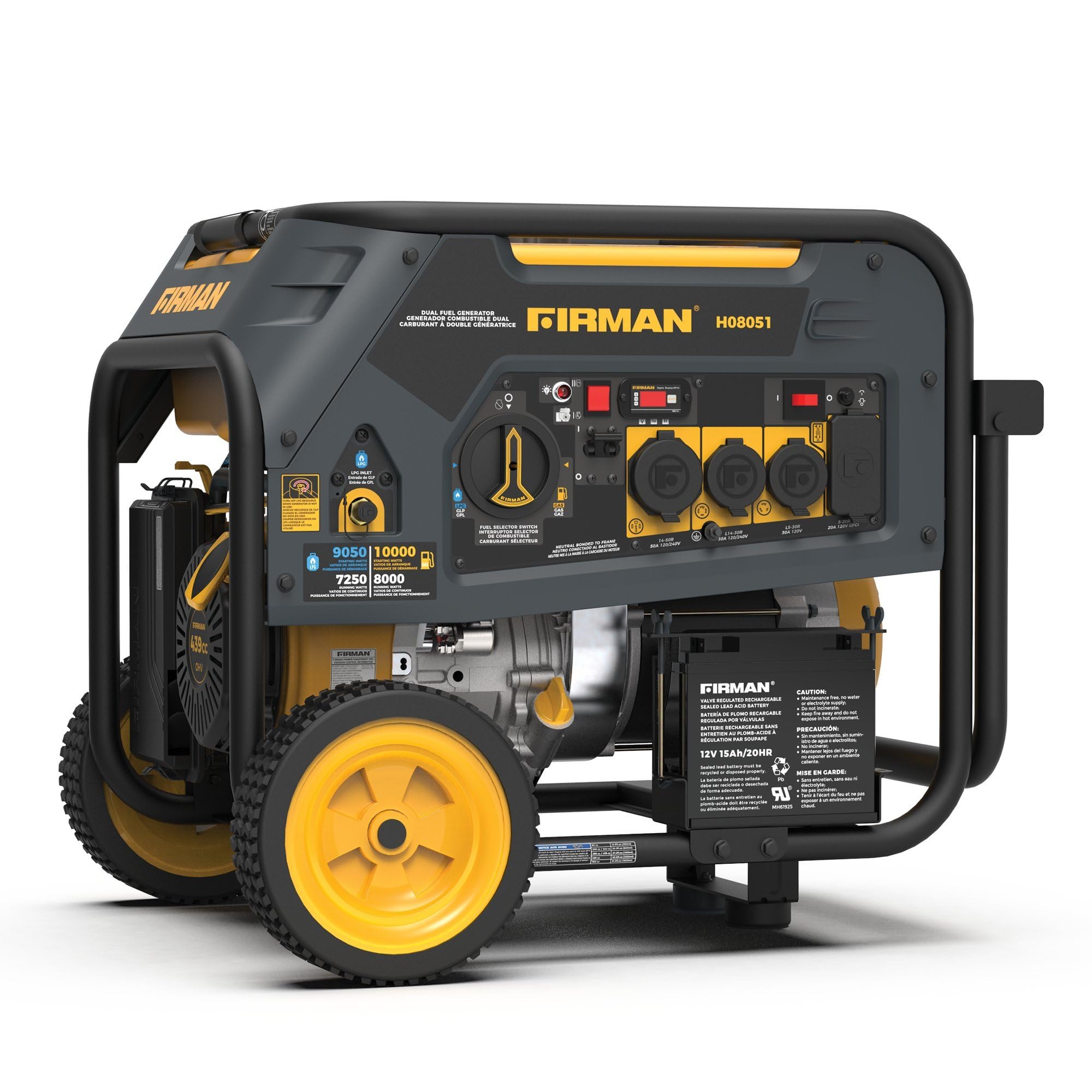
True 30A and 50A output for big RVs, buses, and ranch work.
Where the H08051 stands apart is its claim to deliver true 30A and 50A power — the exact numbers that matter on a large RV or bus, where air conditioning needs a steady, honest 30 or 50 amps rather than a peak-watt rating that only holds for a second. On gasoline it starts at 10000W and runs at 8000W; on propane it starts at 9050W and runs at 7250W. The 439cc engine uses an 8-gallon tank with up to 12 hours of run time, and it comes with a 5.5-foot propane hose and an ergonomically padded handle.
Owners run this one for large-RV duty and for farm or ranch power, and the electric start plus dual-fuel capability are the two things people highlight most. Assembly is quick — about 20 minutes — and one owner has it running full time on an off-grid property with propane fed from a 200-gallon tank. A second buyer wired it to a dedicated low-pressure outlet fed from a 500-gallon tank and runs whole-house backup through a manual panel lockout with zero issues. The compact tubular roll cage frame holds up to that kind of use. On gasoline one owner reports roughly 10 hours per tank.
Weight is the honest hurdle. It is a 439cc dual-fuel machine on an 8-gallon tank, so it is heavy and wants two people or a truck bed for transport, though the folding handle and tires help significantly. It is also loud at full load, and several shoppers say the machine is fine on a lawn but not something you want beside the bedroom window. Short of the noise and the heft, the FIRMAN is a well-reviewed value for anyone doing RV or ranch work.
The RV angle: the true 30A and 50A output is what lets a big rig run both ACs and the fridge at once. Do note: propane depletes faster than gasoline on this unit, and the initial shipment sometimes has less oil than the first crankcase fill needs — buy a quart before your first startup.
Its balance: a large RV, a bus, or a ranch property that needs big honest amperage and easy propane hookup. Not for: anyone who wants quiet — the 439cc open-frame design puts its sound on the record.
9. GENMAX GM10500iETC Tri Fuel Generator

A quiet tri-fuel inverter with an honest wattage chart for every fuel.
The GM10500iETC runs 8500 watts and starts at up to 10500 watts on gasoline, drops to 8000 running and 9500 starting on LPG, and 6800 running and 8400 starting on natural gas. THD is under 3%, which is the spec that matters if you run computers, phones, or other sensitive electronics. It is the quietest unit on this list, and that quiet operation is the aspect owners mention most. Wattage is engraved on the control panel for each fuel — a courtesy not every brand extends.
The control panel is what earns this one its place: a remote one-button start, electric start, and ATS automatic control, plus one 120/240V 30A L14-30R outlet, a 12V DC cigarette lighter outlet, one 120/240V 50A 14-50R outlet, four 120V 20A 5-20R outlets, a CO alarm, parallel connectors, a battery charging port, overload reset switch, and an LED light. A voltage transfer switch lets you use 120V and 240V at the same time, and the neutral is floating from the factory — which is what makes it easy to bond to a house, but the portable-use bonding plug is sold separately, so plan for it if you will run it standalone.
Protection is thorough: overload, thermal, overvoltage, undervoltage, overcurrent, short circuit, and overspeed protection are all built in, plus low-oil shutdown and a rain cover in the box. The reliability story is the one thing to check carefully. Some buyers report it running great, and others report issues — including a fuel selector knob that stripped after the machine sat for a while, and a unit that would not start on gasoline after running on propane. This is not a defect you can count on avoiding, but it is worth keeping the warranty and the seller’s contact close at hand if you buy this one.
Why buy it: the quiet inverter design and full tri-fuel capability make it a natural whole-house backup for a buyer who needs the machine to sit close to the house. The catch: reliability has both satisfied owners and frustrated ones, so check the warranty terms before purchase.
If quiet is non-negotiable: this is the pick to run. If you want the lowest-risk reliability story: the Westinghouse 12500 above or the Champion tri-fuel are easier calls.
10. DuroMax XP15000HXT 15,000 Watt Tri Fuel Portable Generator
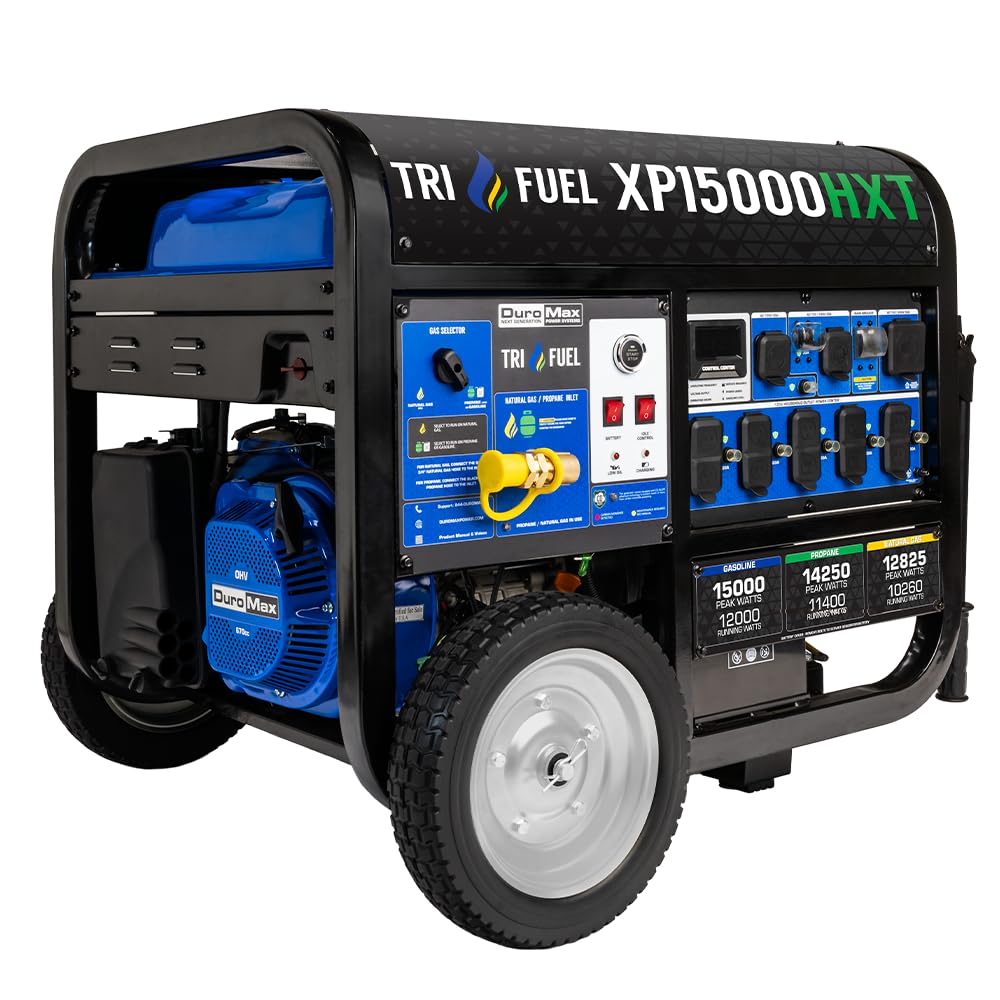
The biggest wattage on the list and a 670cc engine to drive it.
If your load is large or your appliances are electric and hungry, the XP15000HXT’s 15,000 watts and a 670cc OHV engine built from 100% copper windings make it the top of the pile. Tri-fuel flexibility covers gasoline, propane, and natural gas, and a front-facing interface lets you switch fuel types in seconds. The 50-amp transfer-switch-ready outlet runs whole-home backup, and a push button plus remote start means you can fire it from indoors.
The XP15000HXT is the one to buy if you want power output above everything else, and the reviews back it. A 1,800-square-foot house with a full basement runs on this machine without trouble, and a natural gas setup has run HVAC at full load for 3.5 hours without complaint. The panel is fully loaded: four 120V 20A GFCI outlets, one 120V 30A twist lock, one 120/240V 30A twist lock, and one 120/240V 50A heavy-duty outlet. A large LED display shows gas gauge, load gauge, voltage, frequency, and time. A CO alert shuts it down if fumes build. The included kit covers oil funnel, spark plug wrench, tool set, wheel and handle kit, a 15-foot 3/4-inch natural gas hose, propane regulator, and remote control.
Two honest trade-offs. One is the warranty handling: a machine that failed at 60 hours had to run through a certified shop with a long wait time, and that experience left a bad taste. If you buy, register and test early so any trouble surfaces inside the coverage window — DuroMax machines ship with a three-year limited warranty, and you want that clock running while the unit is fresh. The other is size and weight: this ships at a 670cc engine displacement in a large frame, so it wants a permanent or semi-permanent spot and a good hand truck for the first setup.
Buy this if: your home is all-electric, you have a 50A transfer switch, and nothing else on the list would carry the load. Buy the smaller machine instead if: you only need to cover essentials and can accept 8,000 to 9,000 watts of running output.
11. DuroMax XP16000iH 16,000-Watt Dual Fuel Portable Digital Inverter Generator
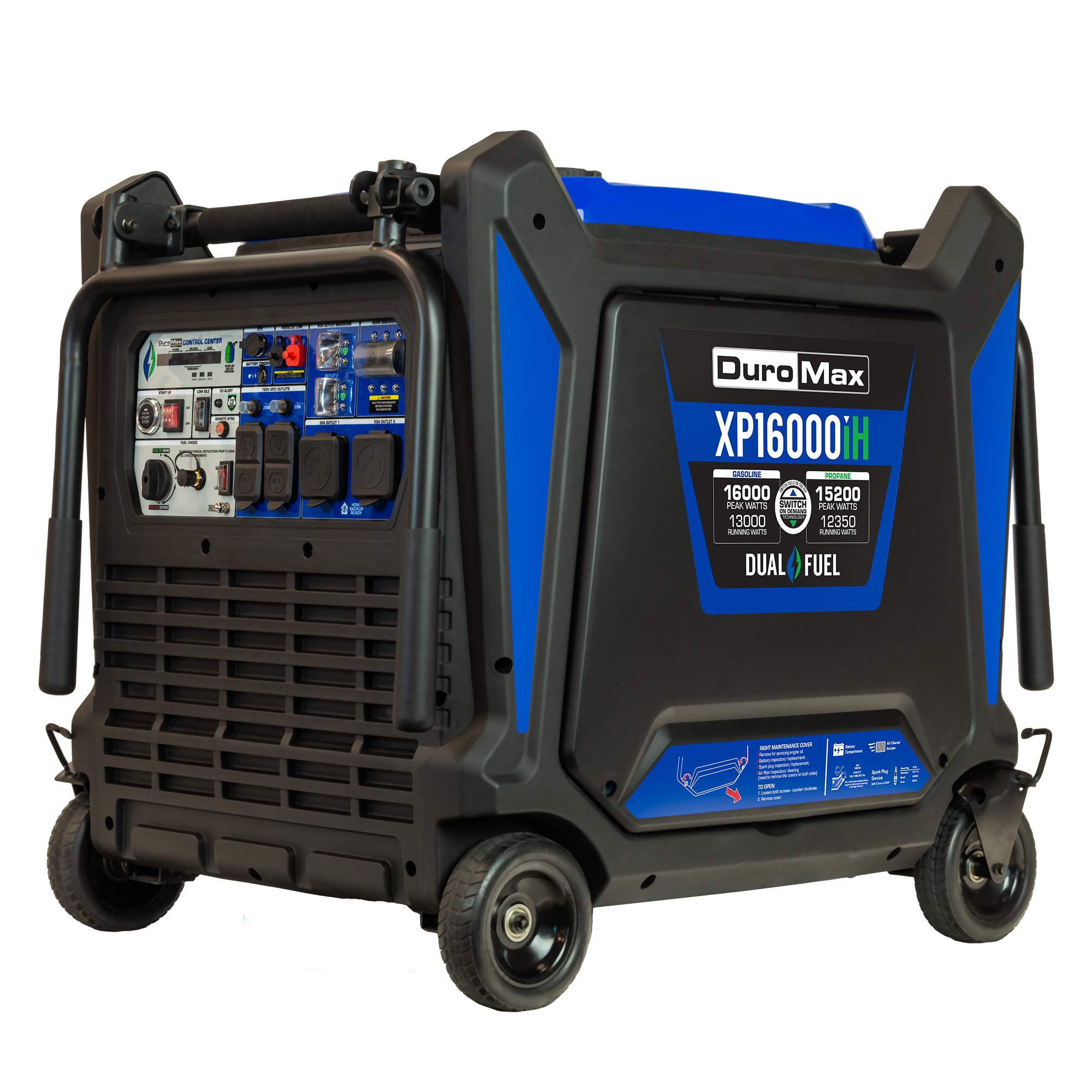
A 16,000-peak-watt inverter built for running a business, not just a house.
This is the biggest machine on the list by peak watts, with 16,000 peak and 13,000 running watts on gasoline and a dual-fuel option for propane. The inverter design provides clean, stable power for sensitive electronics including televisions and computers, which is what makes it the one to reach for if your load includes a register, a POS system, or a broadcast rig alongside compressors and fridges. The Digital Control Center shows hours run, voltage output, and load level on an LCD, and a battery tender keeps the starting battery charged for the moment you need it.
What owners use it for is uninterrupted business. One buyer needed a strong, durable, quiet generator to run a mobile sports bar and reports it running 8 to 12 hours non-stop without a skip — that is the use case this unit was made for. The low-oil shutoff protects the engine automatically, and the package includes the generator, an oil funnel, a spark plug wrench, a tool set, a remote control, a battery tender, a propane regulator, and the owner’s manual. It is dual-fuel, so you can run gasoline when you need the peak watts and switch to propane for storage.
Be honest with yourself about the risk here. This model carries a lower rating than the rest of the list, and the reviews tell the story: a machine that struggled to maintain RPM with metal in the oil during break-in, a starter that died in under 50 hours and had to be replaced, and one unit that sparked and smoked during the break-in run with nothing plugged in. That record is not a reason to avoid the machine outright — the buyers who land a good unit praise it — but it is a reason to buy carefully, register immediately, and run the break-in at light load on the day it arrives. Paid support is available if something does go wrong. At 368 pounds it is also the heaviest unit here, which makes returns a genuinely serious project rather than a trip to the post office.
Where it delivers
- 16,000 peak and 13,000 running watts on gasoline — the largest peak output on the list
- Inverter design delivers clean power for TVs, computers, and business equipment
- Battery tender keeps the starting battery topped up between uses
- Dual-fuel capability lets you choose gasoline or propane per outage
What you accept
- 368 pounds makes it a two-person move at best and a return-shipping headache at worst
- Quality control failures have appeared in multiple reviews, so test the unit hard during the warranty window
- Frequency rated at 60 hertz and its propane output is not published on the listing
Worth it if: you run a mobile business, jobsite, or large-events setup and you want the top peak watts plus clean inverter power in one unit. Look at the 15,000-watt DuroMax on gasoline instead if: you need tri-fuel capability or you want a non-inverter unit that is easier to service.
Understanding the Specs
Running Watts vs. Peak Watts
Running watts are the power a generator can supply continuously, and they are the number you add up when you plan what runs at the same time. Peak watts, also called starting watts, are the short burst the generator can deliver for a second or two when a motor or compressor first kicks on. That surge is what usually blows a circuit or trips a generator, not the steady draw. Air conditioners, well pumps, and furnace blowers all spike on startup, so check that your peak number covers the hardest-starting appliance plus everything else that is already running.
THD and Why It Matters
Total harmonic distortion, usually written THD, measures how clean the waveform is that comes out of the outlets. Lower is better for sensitive electronics. Inverter generators typically publish a THD number, often around 3%, and standard open-frame units generally have higher distortion. If you are powering laptops, a home office, or newer appliances with sensitive control boards, a low-THD unit protects those devices from erratic power. If your load is mostly lights, a fridge, and a well pump, THD is less of a concern and you can shop on output and price alone.
Fuels and Their Trade-offs
Gasoline delivers the highest wattage and is easy to find after a storm, but it goes stale in storage and needs stabilizer and a rotation schedule. Propane stores almost indefinitely and burns cleaner, and it gives up a slice of output in exchange. Natural gas is the only fuel you never refuel — if you have a gas line and a quick-connect, the generator runs for as long as the line feeds it. Tri-fuel units give you all three, and the front-facing fuel selector on models here lets you switch fuels without tools.
Transfer Switch and Outlet Readiness
A transfer switch is the panel that safely disconnects your house from the grid before the generator feeds it, which keeps utility workers safe. A generator marked transfer-switch ready includes the outlet the switch needs, usually a 50-amp or 30-amp connector. Without one, you are running extension cords through doorways and only powering what those cords reach. If you want a whole-home install, confirm the generator has the 50A outlet before you buy, then call an electrician to install the switch on the panel.
FAQ
What size generator do I need to run a whole house?
Can I run a 10000W generator on natural gas?
Can I hook a portable generator directly to my house panel?
How long can a 10000W generator run on one tank of gas?
Is a dual fuel generator better than a gasoline-only one?
What does CO sensor or CO alert mean on a generator?
How heavy is a 10000W generator and can one person move it?
Can I run a well pump and air conditioner at the same time?
Do I need a special oil and how often should I change it?
Does a 10000W generator work for an RV or a food truck?
Final Thoughts: The Verdict
For most buyers the 10000w generator winner is the Westinghouse 12500 Peak Watt Dual Fuel because it blends whole-home output, dual-fuel flexibility, and a transfer-switch-ready 50-amp outlet into one machine — and because it holds a 4.7-star rating across 800+ verified reviews. If tri-fuel is the must-have and you want the best value for natural gas backup, the Champion 12,500-Watt Tri Fuel is the pick to beat on price. And for an all-electric home or a big jobsite load, the DuroMax XP15000HXT is the one to reach for, with the DuroMax XP16000iH the outlier pick for anyone who needs clean inverter power at the top end of the range.
How We Picked
We do not accept paid placement. Every pick is matched to a real buyer and a real use-case; we do not hands-on test units.
Sources & Methodology
Specifications: manufacturer listings and product documentation. Review insights: verified customer reviews, as of September 2026. Pricing: not shown on this page (it changes often); check the current price via the retailer link.
As an Amazon Associate, KitchPrep earns from qualifying purchases. This does not affect which products we feature.
Related Guides
