
Specs are compiled from manufacturer listings and verified buyer reviews and can change over time — please confirm the key details on the product page before buying.
A 10000-watt inverter runs the whole-home or off-grid loads that smaller units cannot, and the wrong one shows up as flickering lights, dead batteries, or a unit that quits in month fourteen. This guide separates the eight models that hold up under real loads from the ones that only look good on a spec sheet, and it uses flexible matching — a few picks here output 12,000W or 8,000W instead of exactly 10,000W — because the nearest same-type inverter serves the same job.
I’m Mohammad Maruf — the founder and writer behind KitchPrep. This guide is built by comparing the manufacturers’ published specifications and the patterns across verified customer reviews, so you get each pick’s real strengths and trade-offs instead of marketing spin.
What follows is a straight comparison of waveform, battery voltage, surge headroom, and charger capacity, so you can match a unit to your battery bank before you spend a single dollar. 10000-watt inverter shopping gets much easier once you know which spec drives every other decision.
Our Picks at a Glance

How To Choose The Best 10000-Watt Inverter
A 10000-watt inverter is a big purchase with real consequences, so you want to match three things before anything else: the waveform it puts out, the battery voltage it runs on, and the continuous power rating it can hold all day. Get those three right and the rest — charging modes, communication ports, parallel capability — is fine-tuning.
Continuous watts versus surge watts
Continuous power is what the inverter can deliver hour after hour, and it is the number that decides what you can actually run. Surge power is the brief burst it handles when a motor starts, like a refrigerator compressor kicking on. One pick here carries a 30,000W peak rating on top of its 10,000W continuous figure, which tells you it was built to absorb heavy start-up spikes rather than just idle loads.
Battery voltage drives everything downstream
A 48V bank pulls far less current than a 12V bank to make the same watts, which means thinner cables, less heat, and fewer connection problems. One model here runs on 12 volts and still claims 8,000W continuous, so the current draw through those cables is much higher than on any 48V unit in this list. If you are wiring a permanent system, 48V is the calmer path; if you already own a 12V truck or RV bank, you work with what you have.
Pure sine wave or modified sine wave
Pure sine wave output mirrors the smooth curve of household AC power, so motors run cooler and electronics behave normally. Modified sine wave output is a stepped approximation — fine for raw heating and power tools, but it can make some electronics buzz or misbehave. Every hybrid solar unit in this guide is pure sine wave; the two Wagan units are modified sine wave, which is worth knowing before you plug in anything with a circuit board.
Charger size and solar input
The built-in charger is what refills your battery bank from the grid, a generator, or solar panels. A 200A charger refills a large lithium bank much faster than a 120A unit. Dual MPPT solar controllers let you run two separate arrays at their own peak voltage, so partial shade or mismatched panels on one side do not drag the other side down.
Quick Comparison
| Model | Best For | Waveform | Input Voltage | Continuous Output | Amazon |
|---|---|---|---|---|---|
| SUNGOLDPOWER SPH10048P★ Best Overall | Whole-home off-grid systems | Pure Sine Wave | 48 volts | 10000W | Amazon |
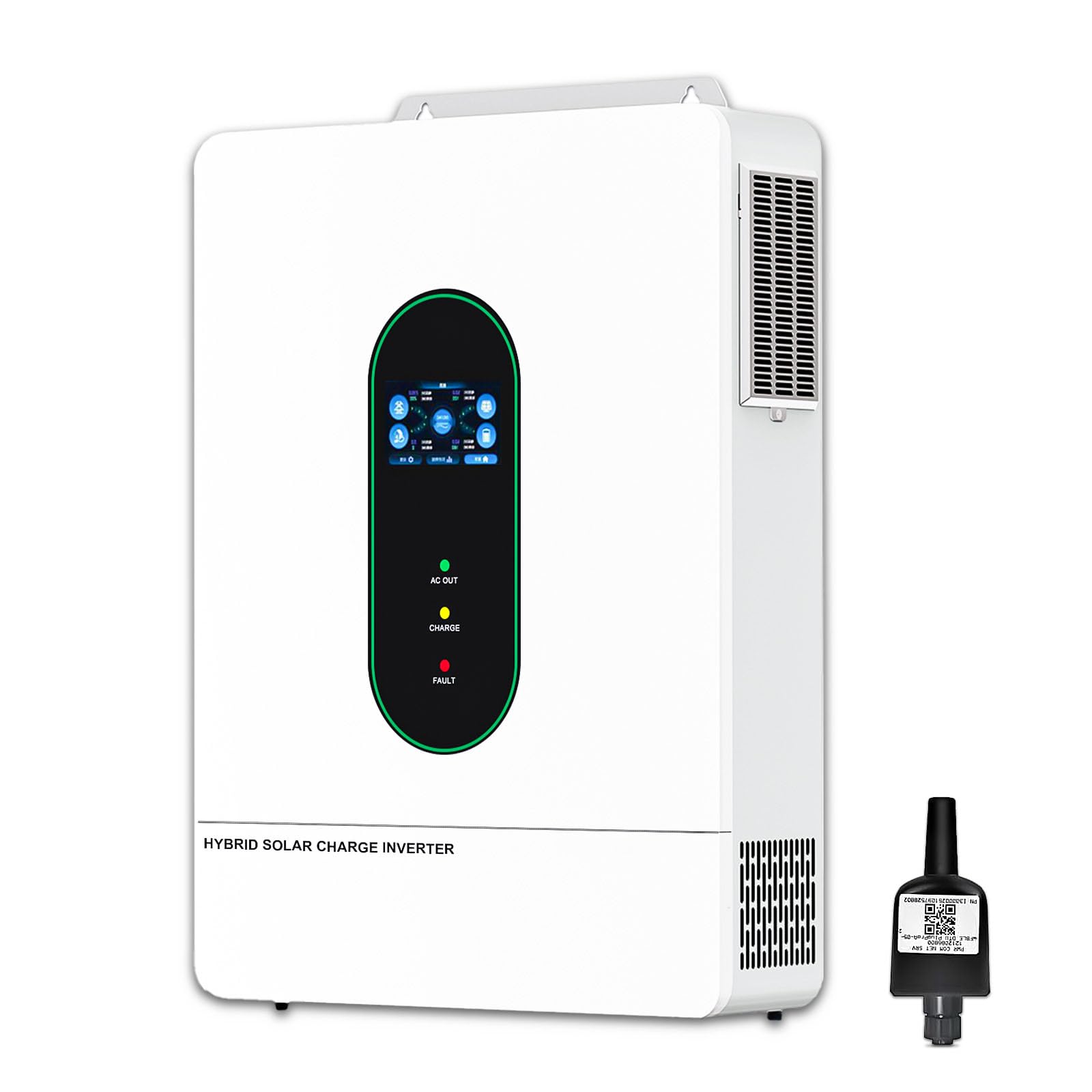
| 12000W All in One Solar Hybrid InverterMost Scalable | Scalable multi-unit solar builds | Pure Sine Wave | 48 volts | 12000W | Amazon |
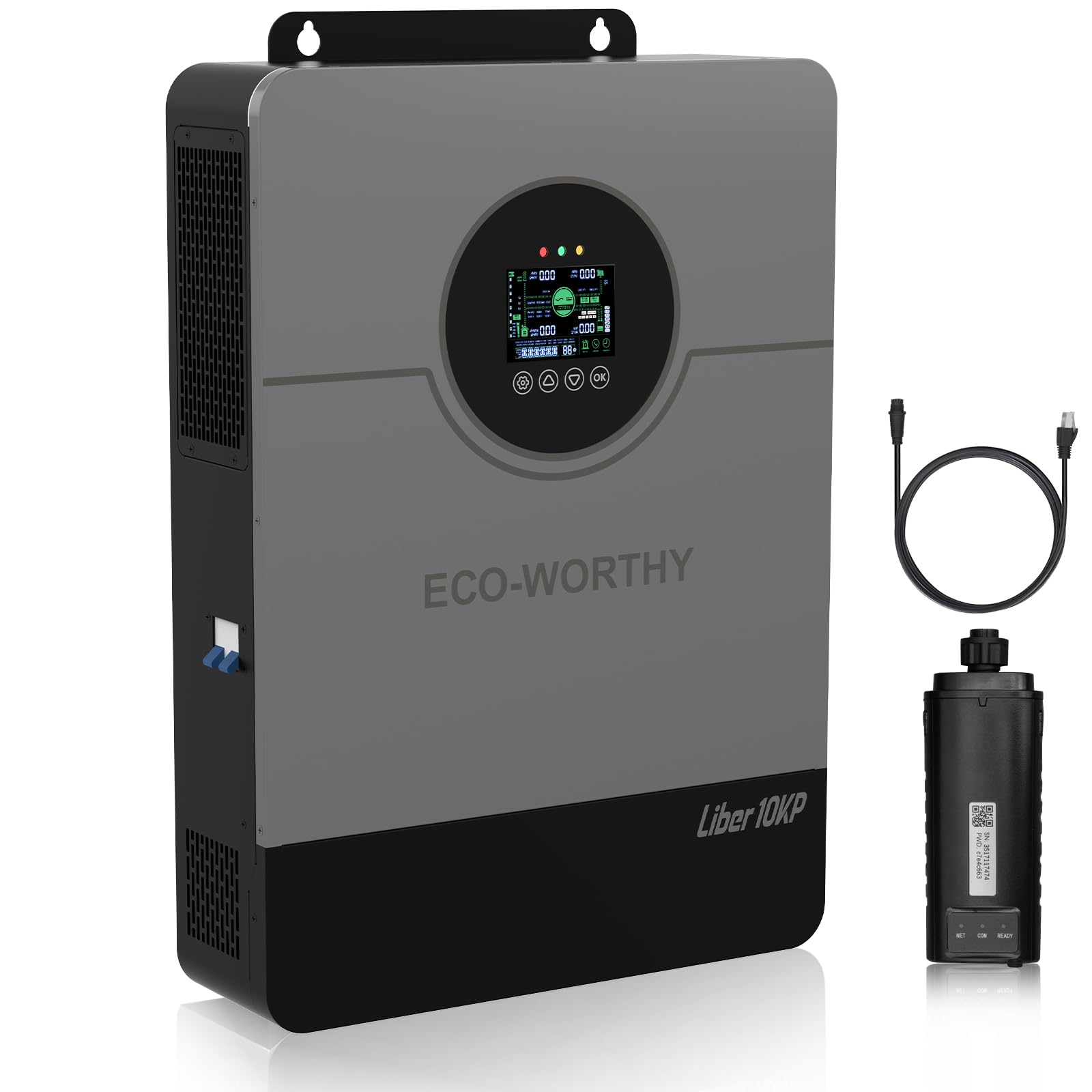
| ECO-WORTHY Liber 10000WBest for Off-Grid Living | Off-grid homes and cabins | Pure Sine Wave | 48 volts | 10000W | Amazon |
| PowMr 10000W Split Phase 48V | Time-of-use rate savings | Pure Sine Wave | 48 volts | 10000W | Amazon |
| PowMr 10000W Solar Inverter 48V | Single-unit whole-home power | Pure Sine Wave | 48 volts | 10000W | Amazon |
| Wagan EL3748 | Vehicle and RV power conversion | Modified Sine Wave | 12 volts | 10000W | Amazon |
| Wagan EL3746 | Lowest-cost raw power | Modified Sine Wave | 12 volts | 8000W | Amazon |
In‑Depth Reviews
1. SUNGOLDPOWER 10000W 48V Solar Inverter SPH10048P
Our pick — 4.5★ from 100+ verified ratings; the strongest balance of quality and price.
The whole-home workhorse that runs eight batteries and a food truck without blinking.
If you are building a permanent off-grid system and want one box to do the inverter, the charger, and the solar controller work, this is the pick to beat. It runs on a 48-volt battery bank — the calmer, lower-current way to make big watts — and combines a 10,000W pure sine wave inverter with a maximum 200A battery charger and two built-in MPPT solar controllers. That combination means your panels, your grid feed, and your batteries all land in a single unit instead of three separate boxes on the wall.
The sheer installed base tells the story here. Owner after owner runs this thing as a full home supply, and the crowd favorite rating sits at 4.5 stars across 100+ owners — genuinely earned for a piece of power equipment. Buyers report running a large food truck with “eight 51.2V/100Ah batteries at 7-10kW” with no trouble after eight months, which is about as demanding a real-world test as an inverter faces. The peak rating of 20,000W and a loaded motor capacity of 6HP mean refrigerator compressors and air conditioners start without dragging the lights down.
The catch is that this is not a plug-and-play box. A 26″L x 17.9″W x 4.9″H chassis weighing 53.5 pounds and split-phase 120V/240V wiring take real planning, and installation is the mixed bag here — some find it straightforward, others find it demanding. The AC input and output terminals are on the tight side for stiff 6-gauge wire, so feeding thick cable takes patience. Idle battery drain is another honest trade-off: this unit can pull down a 48V 100Ah bank over several days on standby, so it rewards a large bank and a charger you actually use.
What wins people over is the performance — by a wide margin the most-discussed strength of this unit, with the quality of the output right behind it. It delivers stable pure sine wave power and handles multiple appliances at once. Just compare it to the Wagan EL3746: the SungoldPower wants a 48-volt input where the Wagan asks for 12 volts, and at 53.5 pounds against 18.9 pounds the SungoldPower is clearly the heavier, more permanent installation.
What earns the top spot
- All-in-one build: 10000W pure sine wave output, 200A charger, and two MPPT solar controllers in one chassis
- 20,000W peak power and 6HP loaded motor capacity handle hard motor starts
- Split-phase 120V/240V output runs whole-home circuits instead of just a subpanel
- Runs eight 51.2V/100Ah batteries at 7-10kW with no faults reported over eight months
Where it asks for patience
- Setup and wiring are the mixed part — not a beginner job
- AC input/output terminals are cramped for stiff 6-gauge wire
- Idle draw can drain a 48V 100Ah bank over a few days of standby
- Downward cooling airflow is a design choice that gathers dust
Buy this if: you have a 48V battery bank and want one unit to invert, charge, and juggle solar simultaneously.
Think twice if: you want a screwdriver-and-go install, since the split-phase wiring and tight terminals ask for a patient hand.
2. 12000W All in One Solar Hybrid Inverter with WiFi
Twelve thousand watts now, seventy-two thousand later, stacked one unit at a time.
Here is the head-to-head that matters: this unit outputs 12000W continuous against the SungoldPower’s 10000W — that is the extra 20% in black and white. For a home that keeps adding loads, that headroom matters. But the real reason it earns the number-two slot is the parallel support: you can wire up to 6 units together for a combined 72kW, which is a scale no other pick in this list matches.
You get two independent MPPT solar controllers with up to 99% real-time efficiency, a 500Vdc maximum PV open-circuit voltage, and a maximum PV input current of 22A x2. The peak rating is 18,000VA, and it delivers split-phase 120V/240V or single-phase 120V output. There are four charging modes (Solar-Only, Grid-First, Solar-First, and Hybrid Solar+Grid) plus four output modes, so you can decide whether the grid or the panels feed the house first.
The touch screen is the detail you notice first in daily use — a tap-sensitive panel with LED indicators showing system data and live status, and you can adjust battery charging current and load priorities right from the LCD menu. For someone managing a solar system, that turns a chore into a couple of taps. The built-in Time-of-Use scheduling is the other quiet win: it lets you shift grid draw to cheap hours and save what the spec sheet calls energy savings from cutting grid dependence.
What the numbers do not soften: a one-star review reports the max power falls short of the 12K claim, and the included WiFi dongle did not control the unit for that buyer. On the positive side, the performance and reliability aspects both draw the most consistent praise, and the value-for-money read is positive too. One real install runs a 3-bedroom Costa Rica home completely off-grid with the inverter supplying five or more appliances at once and clean output confirmed by an electrician. The recurring gripe is fan noise, which is the honest trade on this unit.
Straight comparison: against the SUNGOLDPOWER, this one gives you a higher 12000W continuous figure and the parallel path to 72kW — but the SungoldPower runs cooler on idle and handles slightly more peak surge.
Pick it if: you plan to grow your system and eventually stack several units.
skip it if: you want a single quiet unit and do not care about parallel expansion, because the fans here run loud.
3. ECO-WORTHY Liber 10000W DC 48V UL1741 Solar Inverter
Built for the cabin with no utility line: a full inverter, charger, and dual MPPT in one box.
Read this first, because it changes who should buy it: this unit is off-grid use only and cannot feed power back to the utility. That is not a flaw, it is the design brief — it is made for cabins, RVs, backup systems, and independent solar setups where there is no grid connection at all. If you want to sell power back to the utility, this is the wrong tool. If you want a self-contained system, it is a strong one.
The package bundles a pure sine wave inverter with an inverter charger and two independent MPPT solar controllers. It supports dual 5500W PV input for 11,000W total, up to 200A maximum battery charging (AC 120A / PV 200A / Hybrid 200A), and a 500VDC maximum open-circuit voltage that gives you flexibility in how you wire your array. Communication runs through CAN, USB, and RS485 ports.
Parallel support goes up to 6 units for 60KW total output, and it plays nicely with 48V AGM, Gel, Flooded, and Lithium batteries. Built-in Time-of-Use charging and discharging scheduling lets you lean on stored power during peak rate hours and recharge during off-peak, which is the practical way to squeeze more out of a solar array. The LED display shows system status at a glance, and the unit carries UL1741 certification for North American safety standards plus what the maker lists as 14 protection functions covering short circuits, overloads, and voltage swings.
Owners describe it as strong construction that easily powers a whole house — including an old dryer — with efficient idle consumption and good pairing with server-rack batteries. A couple of friction points are worth knowing. Setup is confusing with vague manual setting descriptions, and the Android app cannot adjust settings remotely. WiFi connection is difficult and the app can sit stuck “searching for Bluetooth” because the unit uses an external Data Logger rather than internal WiFi.
Real-world read: the honest trade here is software, not hardware — the power side earns its keep, but the app and manual leave you doing detective work during setup.
Best matched to: an off-grid home or cabin owner who wants expandable parallel capacity and real solar charging muscle.
Not the one for: anyone expecting a slick companion app, because the external Data Logger setup asks more of you than the hardware does.
4. PowMr 10000W Split Phase 48V DC to 100V AC~240V AC Solar Inverter

The rate-shifting specialist that turns off-peak power into peak-hour savings.
Owners of this unit are not usually trying to go fully off-grid — they are trying to stop paying peak rates. The use case that keeps surfacing is running the whole house on batteries from 6-10pm when rates climb, with one owner reporting peak rates quoted at 22¢ versus 4.2¢ per kWh off-peak and describing a 2-year return on a 15.5kWh bank. The unit doubles as a home UPS, so when the grid drops, the house keeps running.
That behavior comes from the four AC output modes and four charging modes. On the output side you get PV priority, utility priority, inverter priority, and solar-and-utility hybrid. On the charge side it is solar only, utility priority, solar priority, and utility-and-solar hybrid. The dual 100A MPPT controller runs at 99.9% efficiency with up to 22A per circuit, for a maximum PV input of 11KW at 5500W per MPPT input, 500V DC, and a PV starting voltage of at least 150V.
Continuous output is 10000W with surge up to 20000W, and a single unit puts out both 120V and 240V through separate connections — no stacking required for split-phase. Here is the difference between this and the other PowMr on this list: this one does not support parallel connections, so it is a single-unit answer, not an expandable one. It works with 48V lead-acid batteries in Seal, AGM, Gel, and Flooded types plus lithium, and it can run batteryless. Communication ports cover CAN, USB, RS485, and dry contact.
Honest trade-off territory: the manual is confusing, though support replies the next day. A couple of owners hit a solar-charging hiccup from the start that took several days of parameter tuning and array adjustment to sort out — and one buyer got the unit running beautifully after that. Feedback on running temperature and long-term reliability is mixed, so a simple, well-cooled install gives you the best odds.
Who it’s for: anyone on a time-of-use tariff who wants to arbitrage cheap hours and keep the lights on through outages.
One thing to note: no parallel support means one unit is the ceiling — if you need to scale, look to the ECO-WORTHY or the 12000W above.
Great fit if: you want split-phase 120V/240V from a single box and a home UPS that pays you back through rate shifting.
Look elsewhere if: you plan to parallel units later, since this one allows only a single-unit install.
5. PowMr 10000W Solar Inverter 48V to 120/240V Split-Phase Output

One box, one hundred twenty and two forty, no second unit required.
You can run a whole house off one inverter here, including the loads that scare most off-grid setups. An owner running 6KW of solar with a 30KW LiFePO4 battery bank describes it powering the entire house — heat pump HVAC, water heater, microwave, and dryer — after swapping out two smaller 3K inverters that kept coming up short. The same setup ran through two hurricanes and even powered a neighbor’s refrigerator.
The reason one unit goes so far is the combination of a built-in 200A MPPT controller with a 10KW pure sine wave inverter. Continuous output is 10000W with 20000W surge, and switchover time is 10ms — quick enough that household equipment does not notice a grid drop. Maximum PV input runs to 11KW (5500×2), with a 500Vdc maximum PV input voltage and 22A maximum PV input current. The PV starting voltage threshold is above 150V and it takes 10AWG PV wire.
It supports four voltage levels per phase — 100Vac, 105Vac, 110Vac, and 120Vac — and works with AGM, Gel, Lead acid, Lithium-ion, and LiFePO4 batteries, and it can even run without a battery at all. There are four charging modes and two output modes with an uninterrupted power supply function. Communication runs over CAN, USB, and RS485. Parallel support covers up to 6 units, and the maker notes that starting January 2026 all new models will support 6-unit parallel operation.
What you should know going in: the reliability reports here are genuinely mixed. Weight comes in at 63.8 pounds, and the chassis measures 25.67″L x 17.52″W x 5.24″H, so plan a sturdy mounting surface. A five-star owner had a rough start with a misreading unit and slow email-only support, while others had no issue at all — so buy from a seller with a clean return path and get your parameters right early.
The summary: strong single-unit power delivery with a 10ms switchover, softened by support that is slow when you need it most.
Reach for this if: you want the whole house — HVAC, water heater, dryer — on one 48V unit with real expansion room later.
Leave it if: you need fast, phone-based support and would rather not troubleshoot by email.
6. Wagan EL3748 12V 10000 Watt Power Inverter

Ten thousand watts of raw 12-volt muscle for trucks, boats, and jobsites.
If your power source is a 12-volt vehicle system rather than a 48-volt solar bank, this is the big-output option. It delivers 10000W continuous and 20000W peak surge as a modified sine wave inverter — the stepped waveform that suits raw power needs like motors and heating elements rather than sensitive electronics. The physical build is heavy and solid at 21.5 pounds, and four 120V AC outlets plus a high output terminal block give you both plug-in points and hardwired connection.
The real-world applications owners run are demanding ones. It powers shop tools including a welder and a 20-amp squirrel fan from two 12.8V 200Ah batteries with 600W of solar. On a commercial plumbing truck it handles a 1HP electric snake pulling 7500W surge and 500W running, though the owner notes that took three deep cycle batteries and heavy 1/0 AWG cables with 250A breakers on each — which is the honest reality of moving this much power at 12 volts.
Safety hardware is thorough for a unit of this class: overload protection, overvoltage shutdown, overheat protection, a cooling fan, short circuit and reverse polarity protection, and a low battery alarm with automatic power off. A remote control is included and there is a dedicated remote control port, plus input and output LEDs, cooling vents, mounting points, and NTG true ground. It carries CE and RoHS listings.
Where to watch your step: the remote cable is short enough that owners mention it, and the cables you’ll need to feed this unit are heavy and genuinely expensive at 12 volts. The power output and overall build quality aspects both come with mixed owner feedback — meaning plenty run it happily for years, while a few units arrive faulty or die early. Buy from a seller with a clear return path and size your battery cables generously.
Quick verdict: a solid work-truck performer if you accept that 12V wiring, not the inverter, is the hard part.
Compare it: against the Wagan EL3746 at the bottom of this list, this model carries the higher 10000W continuous rating and a larger 20000W surge, where the EL3746 steps down to 8000W continuous and 16000W surge — both run the same 12-volt modified sine wave approach.
Matches best with: tradespeople and RV owners converting a 12V system who need to run tools and appliances.
Choose differently if: you want pure sine wave output for delicate electronics or a lighter install — this is a purpose-built raw-power tool.
7. Wagan EL3746 12V 8000 Watt Power Inverter with Remote Control

The lightest entry into big-watt 12-volt power, for buyers who want raw output on a tighter budget.
At 8,000 watts continuous with 16,000 watts of peak surge, this is the smallest of the big-watt group — a deliberate step down from the exact 10000W number, and the nearest same-type size for someone who does not need to run the whole house at once. It is also the lightest serious option here at 18.9 pounds, and at 12″L x 9″W x 5″H it is by far the most compact of the group, which matters if you are fitting it into a vehicle, van, or small equipment bay.
That compact footprint is genuinely appealing for a mobile install. It runs on a 12-volt input, so it pairs with the battery system you already have in a van or truck rather than demanding a 48-volt bank. The unit delivers modified sine wave output through four 120V AC outlets and one high output terminal block, has a remote control included, and carries overload protection, overheating protection, and low battery automatic shutdown to look after itself.
The circuit design is built around an SMT board with MOSFET transistors, which the maker ties to efficiency and reliability, and it holds up in professional settings — industrial users running 110v electric motors and pumps have good experiences with it. Where the honest caveat sits is durability track record. One owner reports they went through 2 of these in about 16 uses and now would “not recommend this inverter to anyone,” and owners mention a mix of long service histories and early failures.
Compare the physical and electrical readouts to the Wagan EL3748, and the two-unit picture is genuinely interesting — the EL3748 carries 10000W continuous and 20000W peak, while this one runs 8000W continuous and 16000W peak. That said, this unit asks for substantially less physical space and weight: 18.9 pounds against 21.5 pounds, in a 12″L x 9″W x 5″H package compared to the EL3748’s larger frame.
What earns it a place
- 8000W continuous and 16000W peak surge for job-site and vehicle loads
- Compact and light: 18.9 pounds in a 12″L x 9″W x 5″H package
- Four 120V AC outlets plus a high output terminal block
- Overload, overheating, and low battery auto shutdown protections included
The honest trade
- Lower continuous rating than the other Wagan, so fewer big loads at once
- Owner feedback suggests real variance in how long each unit lasts
- Modified sine wave is not ideal for sensitive electronics
Fits best: budget-minded van, RV, and jobsite buyers who want serious wattage in a compact 12V package.
Not for you if: you need the full 10000W continuous power or pure sine wave output for electronics — the Wagan EL3748 above is the bigger brother for that.
Understanding the Specs
Continuous watts versus peak surge watts
Continuous power is the rating you can hold all day — it is what actually determines whether an inverter runs your loads. Peak surge is the short burst it can swallow when a compressor or motor first starts. An inverter with 10000W continuous and a 30000W peak is engineered for hard motor starts, while a unit with 8000W continuous and a 16000W peak suits lighter, intermittent duty. Match this number to the machines you plan to run, not the label.
Why 48V beats 12V for big systems
Running a high output on a low input voltage pushes enormous current through your cables, which means thicker copper, more heat, and more voltage sag. A 48-volt design splits that current into a much lighter load on the wiring and hardware. Wagan’s 12V 8000W and 10000W units need heavy 1/0 AWG cables to deliver the same raw output as the 48-volt units like the SungoldPower, which feeds the same wattage at a lower current.
FAQ
Can a 10000-watt inverter run a whole house?
What is the difference between 12V and 48V inverter input?
Do I need pure sine wave or modified sine wave?
How much solar panel input can these inverters accept?
Can I parallel multiple 10000W inverters for more power?
How long does installation take for a 48V hybrid inverter?
What size battery bank does a 10000 watt inverter need?
Can these inverters charge batteries and run loads at the same time?
Will a 10000 watt inverter run a well pump or air conditioner?
Why does my inverter draw battery power while idle?
Final Thoughts: The Verdict
The strongest all-round pick in this list of 10000-watt inverter options is the SUNGOLDPOWER 10000W 48V Solar Inverter, because it bundles a 10,000W pure sine wave inverter with a 200A charger and two MPPT controllers in one chassis, backed by one of the strongest owner track records here. And if you want more output headroom plus a path to stacking units later, the 12000W All in One Solar Hybrid Inverter is the one that grows with you. Wire it once, size your battery bank generously, and either of these will carry your house or your job site for years.
How We Picked
We do not accept paid placement. Every pick is matched to a real buyer and a real use-case; we do not hands-on test units.
Sources & Methodology
Specifications: manufacturer listings and product documentation. Review insights: verified customer reviews, as of September 2026. Pricing: not shown on this page (it changes often); check the current price via the retailer link.
As an Amazon Associate, KitchPrep earns from qualifying purchases. This does not affect which products we feature.
Related Guides
