
Specs are compiled from manufacturer listings and verified buyer reviews and can change over time — please confirm the key details on the product page before buying.
Here’s the short answer before you scroll: for most home kitchens, a Suehiro Cerax 1000 is the 1000-grit whetstone worth buying. It is a ceramic water stone built for a long soak before each session, and it is the pick that keeps the biggest share of its owners happy. This guide exists because the label on the box is not the whole story — a few of the picks below are listings that offer 1000 grit as one selectable option or pair it with a second grit, rather than being a stone that is only 1000. As a heads-up, this list uses flexible, human-like matching for that exact requirement, so not every pick is the literal number you searched — the nearest same-type stone serves the same job. Every pick here is real and verifiable, and each one fills the 1000-grit slot in a sharpening kit.
I’m Mohammad Maruf — the founder and writer behind KitchPrep. This guide is built by comparing the manufacturers’ published specifications and the patterns across verified customer reviews, so you get each pick’s real strengths and trade-offs instead of marketing spin.
You will see soaking times, grit pairings, base setups, and the honest trade-offs owners describe after months of use. Whether you are new to water stones or rebuilding a kit, this is a straight look at the best 1000-grit whetstone options for a home kitchen.
Our Picks at a Glance


How To Choose The Best 1000-Grit Whetstone
A 1000-grit stone is the workhorse of any sharpening setup — fast enough to reset a dulled edge, fine enough to leave a clean, sliceable finish. The number tells you how coarse the abrasive particles are, so it sets the speed and how polished the result looks. The part most first-time buyers miss is that two stones stamped “1000” can behave nothing alike. Below is what actually separates a good one from a frustrating one.
Soak or splash — and how long you are willing to wait
Water stones are porous, and they need water between the abrasive particles to carry away the metal dust and keep the cut clean. Some stones want a full soak before they are ready — the Suehiro Cerax 1010 asks for roughly a 10-15 minute soak. Others, like the Shapton GlassStone and the Naniwa, work as splash-and-go, meaning a splash of water on the surface is enough to start sharpening. If you want to sharpen on a whim, a splash-and-go stone saves the wait. If you do not mind a short soak and want a slightly softer, more forgiving feel, a soaking ceramic is a fine choice.
Dishing, flattening, and why hardness matters
Every water stone wears a little each time you sharpen, and when the middle hollows out you lose the flat surface your edge needs. Softer stones dish faster and need a flattening stone — often a diamond plate — more often; harder, denser stones resist hollowing and hold their surface longer. A 1000-grit stone you use weekly is the one that wears the quickest, so build a flattening tool into your plan no matter which pick you choose. That said, the finer side of a dual-grit stone and a soft 1000 side wear at different rates, which is worth remembering when you maintain them.
Quick Comparison
| Model | Best For | Grit | Water Style | Weight | Amazon |
|---|---|---|---|---|---|
| Suehiro Cerax 1010 Grit #1000 Sharpening Stone★ Best Overall | Most home kitchens | 1000 | Soak | 0.06 kg | Amazon |
| Sharp Pebble Whetstone Knife Sharpener – 1000/6000 Grit Sharpening StoneBest Kit for Beginners | First-time sharpeners | 1000/6000 | Soak | 2.1 pounds | Amazon |
| King KDS Whetstone 1000/6000 Grit, Double-Sided (Stone Only)Best for One-Stone Kits | One stone, both jobs | 1000/6000 | Soak / splash | 2 pounds | Amazon |
| SHAPTON GlassStone 1000 11micro class TYPE WA 50202 | No-soak convenience | 1000 | Splash | 360 g | Amazon |
| 1,000 Grit Super Ceramic Water Stone with a Base (Japan Import) | Hard-steel knives | 1000 | Splash | 0.9 kg | Amazon |
| Complete Knife Sharpening Stone Kit, Double-Sided Grit400/1000 & 3000/8000 | Complete starter kit | 400/1000 & 3000/8000 | Soak | 16 ounces | Amazon |
| Knife Sharpener & Sharpening Stone Set: 1000/6000 Grit Dual-Sided Whetstone | Tight budgets | 1000/6000 | Soak | 1.5 pounds | Amazon |
| Wood Carving Sharpener, 1000 Grit Whetstone with Multiple Grooves | Gouges & chisels | 1000 | Splash | 1.7 pounds | Amazon |
| King Medium Grain Sharpening Stone- #1000 – XL | Heavy, daily use | 1000 | Soak | 4300g | Amazon |
In‑Depth Reviews
1. Suehiro Cerax 1010 Grit #1000 Sharpening Stone
Our pick — over 4.5★ from 600+ verified ratings; the strongest balance of quality and price.
The ceramic stone that turns kitchen knives sharp enough to shame a brand-new factory edge.
If your drawer is full of everyday kitchen knives — chef’s knives, santokus, a paring knife or two — this is the stone that earns its place as the everyday workhorse. It is a medium 1000-grit ceramic water stone from Suehiro, a Japanese maker, and its surface measures 8.07 inches long by 2.87 inches wide. That generous length is the quiet hero here: on a stone this long you can pull a full-size chef’s knife through a complete stroke without running off the end, which is what keeps your angle the same pass after pass.
What wins people over is the sharpening itself. Owners keep coming back to how fast this stone raises an edge — one notes it draws a burr (the thin lip of metal that tells you the edge is ready to be refined) in as little as five to ten minutes. The ceramic cuts fast, gives clear feedback through your fingertips, and leaves a finish that belies its grit rating; more than one owner says the edge feels more like a 2000 or even 3000-grit stone. It also outlasts the bargain-stone shelf, with owners describing it as a durable stone that has served them for months of regular use. There is a real head-to-head here: place it beside the King KDS and the Suehiro leads on surface area — 8.07 inches long against the King’s 8 inches, but a full 2.87 inches wide against the King’s 1 inch.
Do not expect it to be a rinse-and-go stone. It is an immersion type, which means it wants a real soak before it is ready — buyers report a 10-15 minute soak is typical, and some say it is slow to build a slurry (the muddy paste of abrasive and water that helps the stone cut) without a separate nagura stone. One owner rates it a touch below the pricier Chosera and Shapton stones, though better than the classic King. That is a fair read: this is excellent ceramic for the money, not the top of the market. For everything from a dull weeknight blade to a full kitchen re-edge, it is the dependable answer most people are looking for.
What owners gush about
- Long, wide ceramic surface keeps long knives flat through a full stroke.
- Fast cutting that raises a burr in about five to ten minutes for many owners.
- An edge finish that feels finer than the 1000 rating suggests.
Where you adapt
- Needs a 10-15 minute soak, so it is not a quick-touch-up stone.
- Building a thick slurry takes effort without a nagura stone.
- Harder to master if your knives need the very top-tier finish.
Your call: Best for the home cook with a drawer of everyday kitchen knives who wants one reliable ceramic stone.
Think twice if: You want to sharpen the second the mood strikes — the soak wait gets in the way.
2. Sharp Pebble Whetstone Knife Sharpener – 1000/6000 Grit Sharpening Stone
The starter kit that holds your hand — an angle guide does the hard part so you do not have to.
Angle control is the single thing that scares people away from water stones, and this kit solves it directly. It is a dual-grit corundum stone — coarse 1000 on one side for repairing a dull or chipped edge, fine 6000 on the other for polishing to a finish — paired with a bamboo base and, crucially, an angle guide that locks your blade at a set position as you glide across the stone. Set it on the stone, set the blade in the guide, and match your strokes. That single addition is why newcomers get results on the first try instead of a rounded edge.
At 7.25 inches by 2.25 inches, the stone itself is compact but still comfortable for standard kitchen knives. Its weight — 2.1 pounds for the set — keeps it planted once you press it onto the non-slip bamboo base, so the whole thing stays put on your countertop. For everyday home sharpening, the 1000 side is the one you will use most, and the 6000 side finishes the job on the knives you care about. The whole kit is water-based, so there is no honing oil to buy and no oily mess to clean up afterward. Just soak it, sharpen, rinse, and move on.
The honest catch is a practical one: a few buyers point out the stone does not seat perfectly into the included rubber mat and base, though it does not change the sharpening angle. A common-sense note from the review pages: soak the stones in water before you start, and give yourself a session or two to get the hand feel — the guide helps, but it does not do the work for you. For a beginner building a first setup with everything in one box, this is a sensible launchpad.
Setup in one box: Stone, bamboo base, and angle guide arrive together, so you are not sourcing parts before your first session.
The honest fit: The base holds the stone a touch loosely, but the angle guide keeps your blade consistent regardless.
Best for: A first-timer who wants beginner-proof results with a guided angle.
Skip if: You already sharpen freehand and just want a bare stone.
3. King KDS Whetstone 1000/6000 Grit, Double-Sided (Stone Only)
One Japanese stone, two jobs — the classic do-it-all pick for a single-stone kit.
If you would rather own one stone than a collection, this King KDS covers most of the work in one block. It is a made-in-Japan double-sided stone with a 1000-grit face for sharpening and a 6000-grit face for honing and finishing the edge. The 1000 side is the one you reach for to reset a dull knife or a tired tool, and the 6000 side is the final polish that takes a sharp edge to a clean, finished one. For a kitchen, that pairing handles nearly everything you will run into without needing a third grit.
The size is where this stone earns its keep. At 8 inches long, it gives you a longer stroke than many compact stones, and that extra runway makes consistent angle control noticeably easier — especially when you are still learning. Feedback is another strong suit: the stone tells you through your hands and ears what is happening at the edge, which is exactly the signal a new sharpener needs to develop muscle memory. Owners describe it as a fine first stone, patient with beginners yet capable of a genuinely refined finish on the 6000 side.
Almost every worthwhile sharpening stone asks something of you in return, and this one is no exception: it is on the softer side, so it wears down where you sharpen most and will need flattening with a flattening tool to stay true. Expect to soak it before use, and to keep a flattening stone or diamond plate in your kit. Those are normal costs of doing business with a water stone. What you get for that upkeep is a made-in-Japan stone that does two grits in one and is genuinely kind to a beginner’s hands.
Why it holds up
- Double-sided 1000/6000 means one stone handles sharpening and finishing.
- 8-inch length gives a longer, steadier stroke than compact stones.
- Made in Japan with clear feedback that helps beginners learn feel.
What to plan for
- It is on the softer side, so it dishes and wants periodic flattening.
- It is stone only — no base or guide included, so budget for those.
- Best results come with a soak before each session.
Take this if: You want one compact do-everything stone and do not mind keeping a flattening stone on hand.
Look elsewhere if: You want a base and angle guide in the box.
4. SHAPTON GlassStone 1000 11micro class TYPE WA 50202

No soaking, no waiting — this is the stone you reach for when you want to sharpen right now.
This is the pick for the sharpener who is done with buckets of water and soaking schedules. The Shapton GlassStone 1000 is a splash-and-go water stone: wet the surface, start sharpening, and stop the moment you are finished. No 10-minute soak, no tub, no planning ahead. The working face measures 8.27 inches long by 2.76 inches wide — long enough for full-size kitchen knives and wide enough that most of your blade stays in contact through a stroke. Shapton grades its abrasive particles tightly, which is what you feel when the stone cuts evenly and refuses to grab.
Owners say it finally made sharpening click — one calls it the one stone they would keep if they could only have one, its 1000-grit face producing razor edges on everything from soft stainless to hard steel rated around 58 HRC (a hardness scale where a higher number means tougher steel). Others note it takes only a few minutes to lap flat with a diamond plate, and that the glass backing keeps it stable despite a slim profile. That slimness is the one trade worth naming: this stone is thin, so heavy commercial or high-volume use could wear it out faster than a thick stone. For a home kitchen, it is a non-issue — most owners expect years of service.
Here is a direct read against another pick: unlike the King KDS, which needs soaking and only then delivers its feedback, this Shapton splits the difference — no soak, immediate water retention, clear feel under the blade. If you have ever abandoned a sharpening session because the hands-on part took too long to set up, this is the one that removes that friction entirely.
No-wait sharpening: Splash water on and go — a genuine change for anyone who dislikes soaking stones.
The trade: It is a thin stone, so if you run through hundreds of knives a week you may outwork it.
Reach for this if: You want the fastest possible path from dull knife to sharp edge without a soak.
Not for you if: Your sharpening volume is heavy enough that a thick stone would serve longer.
5. 1,000 Grit Super Ceramic Water Stone with a Base (Japan Import)

A dense Japan-import ceramic that stays flat and feels silky under expensive steel.
For anyone sharpening high-end or hard-steel kitchen knives, this Naniwa ceramic water stone is the pick that respects the blade. It is a 1000-grit medium stone, made in Japan, and it ships with a base already attached plus a dressing stone (the small block you rub across the surface to clean it and refresh the cut). The stone itself measures 8.27 inches long by 2.76 inches wide and 0.98 inches thick — a solid, substantial slab that stays put on the counter and gives you a stable working surface for long blades.
Owners lean on the feel above all else. This stone is splash-and-go, so there is no soaking wait — splash water and sharpen — and it is hard and slow-wearing, which means it holds its flat surface far longer than softer stones. It also feels smooth and silky as the blade glides across, the kind of tactile feedback that helps you sense the edge forming. Owners call this line legendary, hard enough to last years, and it arrives with the dressing stone and base ready to go.
If you are building a set, a smaller detail rings true — this stone pairs well with a coarser 400-grit stone before it and a finer 3000-grit stone after it, which makes it a natural middle step. One quirk owners note: the slurry the stone generates is dark and can stain your fingers, so keep a pair of gloves handy if that bothers you. Otherwise, the story here is straightforward — a hard, dense, fast-cutting 1000-grit ceramic that treats serious knives the way they deserve.
Why sharpening pros keep it
- Hard, slow-wearing ceramic holds its flat face far longer than softer stones.
- Splash-and-go means no soaking — wet it and start sharpening.
- Smooth, silky feedback makes it easy to feel the edge forming.
Minor notes to keep in mind
- The dark slurry can stain your fingers — gloves help.
- The base is fixed to the stone, so you cannot flip it to use both faces.
- It is premium-tier, so it costs more than an entry stone.
Suits you if: You sharpen serious or hard-steel kitchen knives and want a hard stone that stays flat.
Not the match if: You want a low-cost entry stone or you dislike wearing gloves while you sharpen.
6. Complete Knife Sharpening Stone Kit, Double-Sided Grit400/1000 & 3000/8000

Four grits and a full accessory set — the everything-you-need kit for a fresh start.
If you are starting from zero and want the whole bench in one purchase, this Goodjob GB-12 kit is built for exactly that. It contains two double-sided corundum whetstones — a 400/1000 stone and a 3000/8000 stone — which together cover the full range from repairing a badly chipped or dulled blade on the coarse 400 side up through polishing on the 8000 side. Your everyday sharpening runs on the 1000 face, which is why the 400 grit is the one owners single out as perfect for setting a new edge on a dull blade. The stones are fired at high temperature in 20 processes, per the manufacturer’s process description, which is the maker’s way of saying the abrasive is fused hard and durable.
The kit is as much about the accessories as the stones. It ships with a bamboo base and a silicone non-slip pad to hold everything steady, a cut-resistant glove, a honing guide and angle guide to help beginners hold the correct angle, plus two leather strops and a green compound for polishing. Everything lives in a compact package — the whole kit weighs 16 ounces — so it stores easily in a cabinet or drawer. For someone who wants to learn the full process without sourcing parts, that completeness is the real value here.
Because it is a kit at this level, a couple of owners note the stones can vary a bit from block to block — a few found their stones needed flattening before first use, and the wooden stand can slip on a smooth countertop. Treat the included guides as a starting crutch rather than a permanent solution and you will get the most from them. On balance, this is a feature-rich starter kit that covers four grits and the full accessory set for the price of some single premium stones.
Four grits, one box: 400 and 1000 handle repair and sharpening; 3000 and 8000 handle finishing and polishing.
Factor this in: Some stones arrive needing a quick flattening, and the wooden stand benefits from a non-slip mat underneath.
The pick for you if: You want four grits plus a strop, base, and guides in a single purchase.
Pass if: You only ever sharpen kitchen knives and prefer to keep your kit minimal.
7. Knife Sharpener & Sharpening Stone Set: 1000/6000 Grit Dual-Sided Whetstone
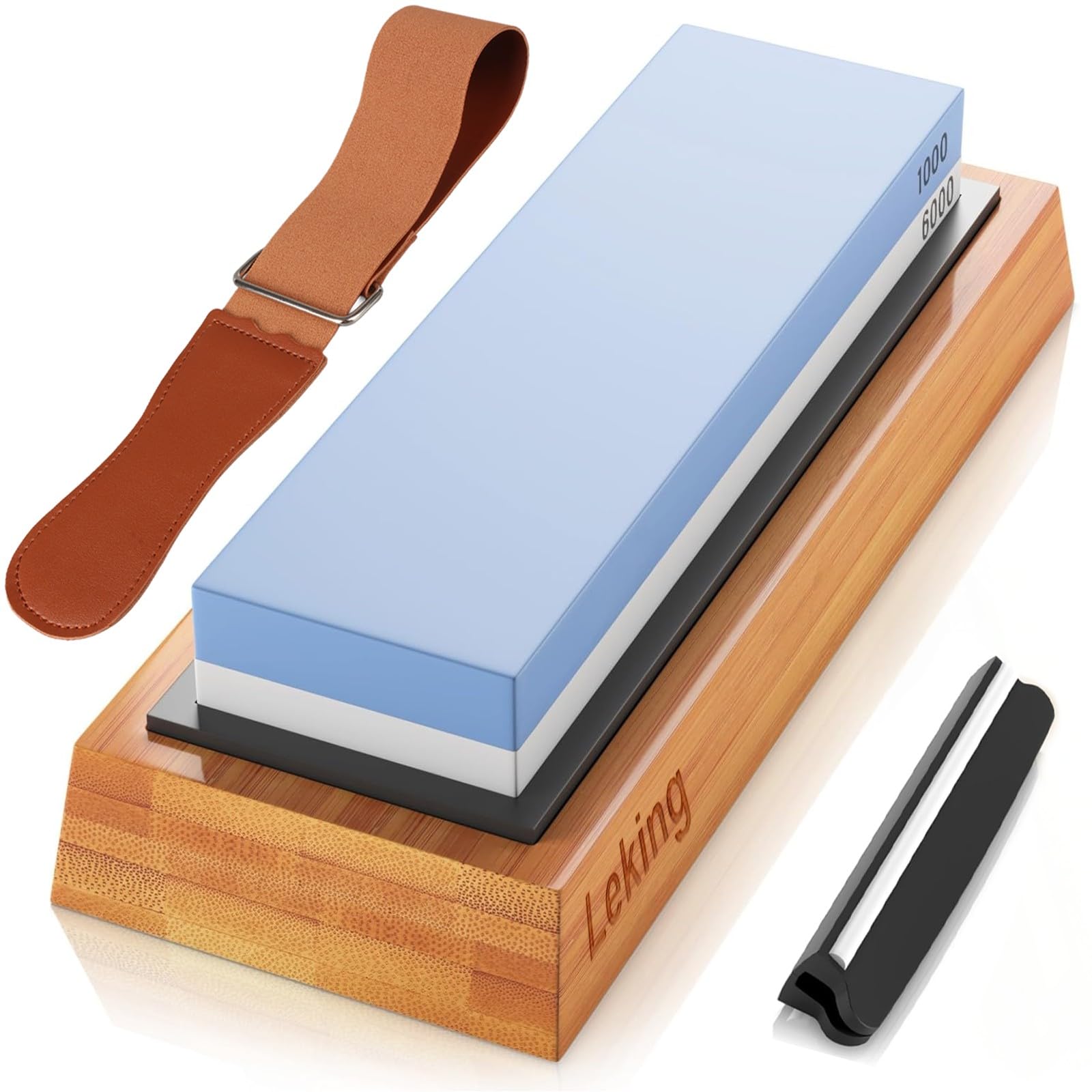
A five-piece -class starter that gets dull knives sharp without the fuss.
For a first setup on a tight budget, this Leking kit punches well above its entry-level price. It is a dual-grit 1000/6000 stone — the 1000 side for the daily job of refreshing a dull edge, the 6000 side for a final polish — and it arrives as a five-piece set with a bamboo base, a non-slip silicone holder, an angle guide, and a leather strop. That means you get the stone plus the stability and guidance accessories in one go, rather than buying them piecemeal.
For its size, the set has a reassuring heft: the whole kit weighs 1.5 pounds, which is a touch lighter than the Wood Carving Sharpener & Grooves stone at 1.7 pounds, but still enough that the base keeps the stone from skating across the counter when you press down. The included angle guide is the standout convenience — clip it onto your blade and it holds a steady angle so a beginner gets a consistent, even edge without having learnt to feel the angle by hand. That is exactly what a first-time sharpener needs, and it is the part owners praise most.
The one honest caveat is fit, not function: a few owners note the stone does not seat perfectly into the included rubber mat and base, though it does not affect the sharpening angle. And the standard advice applies to any water stone — soak it in water before you sharpen, and you will get a cleaner cut from the first stroke. Treat it as a friendly, low-cost way into water-stone sharpening and it will serve you well.
What makes it a smart first buy
- Five pieces — stone, bamboo base, silicone holder, angle guide, and leather strop.
- The angle guide keeps a consistent edge angle for beginners.
- Dual 1000/6000 grits cover sharpening and polishing in one stone.
What to expect
- The stone does not seat perfectly into the included mat, though the angle stays true.
- It needs a soak before use, like any water stone.
- Entry-tier stone, so do not expect the finish of a premium ceramic.
Grab it if: You want a complete, guided water-stone kit without spending much.
Look up if: You sharpen often and want a stone that holds its flat face longer.
8. Wood Carving Sharpener, 1000 Grit Whetstone with Multiple Grooves

The grooved stone built for curved gouges — not just flat kitchen knives.
Most whetstones are flat slabs, and that is the problem if you own chisels or gouges with curved edges. This DDF iohEF stone solves it differently — it is cut with multiple grooves in a range of contours, so you can match the profile of a gouge or chisel to the groove that fits it and sharpen the curved edge on the correct curve instead of fighting it on a flat surface. It is a 1000-grit corundum stone, and its dimensions are 6.69 inches long by 5.12 inches wide by 1.46 inches high, so it is shorter but much wider than a typical bench stone.
That extra width is not decoration. Because this stone is 5.12 inches wide, it gives you a broad, stable surface to rest a tool on while working a groove, and it is what lets the multiple contours sit side by side rather than crammed into one edge. At 1.7 pounds, it is the heaviest pick in this group apart from the XL King, which keeps it planted while you work. Owners appreciate the versatility most — that one stone covers wood carving tools, chisels, and gouges — and many use it as their go-to for maintenance and polishing on already-shaped edges.
Here is the fair warning on this one: several owners note the grit runs finer than a true 1000, so it behaves more like a polishing and maintenance stone than an aggressive edge-resetter. If you are trying to take a badly damaged tool down to a fresh bevel, start on a coarser grit first. And if your sharpening is mostly kitchen knives on flat ground edges, a flat bench stone will serve you better than this grooved design. For woodworkers with curved edges to maintain, though, it is the one stone in this list made specifically for the job.
Right tool for curved edges: Multiple grooves match different contoured gouges and chisels, which a flat stone cannot do well.
Set expectations: It grinds finer than its name suggests, so treat it as a maintenance and polishing stone rather than a fast edge-resetter.
Made for you if: You sharpen curved carving tools, gouges, or chisels and want the right contour in one stone.
Wrong pick if: You only sharpen flat kitchen knives — a standard bench stone is a better match.
9. King Medium Grain Sharpening Stone- #1000 – XL

A slab you will not wear out — the oversized King built for daily professionals.
At 9.06 inches long by 3.94 inches wide by 3.15 inches high, this King XL is a substantial block — several times the physical volume of a standard bench stone. That extra surface area is the entire point. It is a 1000-grit medium stone, made by Matsunaga Stone Co., and a working block this large means a professional or high-volume sharpener can work for a long time before the surface hollows out and needs flattening. For a chef sharpening daily, that durability is the headline feature: the larger working face resists dishing far longer than a thin stone because you are spreading the wear across much more surface.
Owners use it exactly that way. One owner reports a sushi chef sharpens his gyutou, tako, deba, and santoku knives on this at 1000 grit daily — the top face for large knives, the sides for smaller ones. The stone forms a generous ‘mud’ (the thick slurry of abrasive and water) with light pressure, which is the sign of a stone that is cutting well and ready to work. That same mud is exactly what you want for coffee-colored slurry lines, and it is the reason this stone feels alive under the blade. With light pressure it leaves a sharp, toothy edge on kitchen knives.
The ‘mud’ comes with a trade-off — because it is a soft stone, it is messy to use and not built for hard woodworking tools, so it fits a cook far better than a woodworker. Expect to soak until the bubbles stop, and to re-wet as you work to keep it cutting clean. Pack your own protection on arrival, though: a few owners note it ships in minimal packaging, so a stone this size arriving with a dinged corner is possible, not a guaranteed outcome. This is a professional-grade sharpening surface for the cook who uses one every day.
Why the size is the feature
- A 9.06 by 3.94 inch face spreads wear across more surface and resists dishing.
- Forms a generous mud easily, a clear sign it is cutting cleanly.
- Top used for large knives and sides for smaller knives — one slab, multiple working zones.
Worth noting
- Soaking it is heavy and takes time — plan to soak until bubbles stop.
- It is a soft, messy stone, not the match for hard woodworking tools.
- Arrives in minimal packaging, so corners are worth checking on delivery.
Built for you if: You sharpen daily and want a huge stone that resists dishing.
Overkill if: You sharpen a few times a month — a standard bench stone handles that fine.
Understanding the Specs
Grit Rating — What 1000 Really Means
Grit is a measure of how coarse or fine the abrasive particles in the stone are. A 1000-grit water stone (a stone you use with water, not oil) sits squarely in the medium range — coarse enough to reset a dull edge reasonably quickly, but fine enough to leave a clean cutting finish. It is the grit most home cooks actually use, because a fully polished, mirror edge is not necessary for the cutting board. Where the rating gets slippery is that the number is a target, not a guarantee: some stones cut finer or coarser than their label, so behaviour matters more than the printed figure.
Soak vs Splash — and Surface Hardness
Water stones need water to cut. Some are porous enough that they want a soak — often around 10-15 minutes — while others are dense enough that a splash on the surface is enough to start. Harder, denser stones tend to hold their flat surface longer and dish more slowly, but softer stones cut faster and give more tactile feedback. Either way, a used 1000-grit stone eventually hollows in the middle and needs flattening — a diamond plate or a dedicated flattening stone is the tool that brings the surface back to flat.
FAQ
What does 1000 grit actually do for a kitchen knife?
Do I have to soak a 1000-grit whetstone before sharpening?
Is a higher grit better for my knives than a 1000-grit stone?
Will a 1000-grit stone work on hard-steel knives?
How do I keep a whetstone flat over time?
Do I need a base or a holder for my whetstone?
Can a 1000-grit stone sharpen woodworking tools like chisels and gouges?
What is the difference between a soaking stone and a splash-and-go stone?
Is a 1000-grit stone enough on its own for a full sharpening setup?
How long should a good 1000-grit whetstone last?
Can I sharpen serrated or curved blades on a 1000-grit whetstone?
Will I damage my knife using a 1000-grit stone?
Final Thoughts: The Verdict
For most people, the winner is the Suehiro Cerax 1010 Grit #1000 Sharpening Stone — a long, wide ceramic that cuts fast, leaves a finish finer than its grit suggests, and holds up to months of regular use. If you want the convenience of no soaking, grab the SHAPTON GlassStone 1000 — a splash-and-go stone that skips the wait entirely. And for serious or hard-steel knives that deserve a hard, flat stone, the Naniwa Super Ceramic Water Stone is the one to reach for. The Suehiro is the crowd favorite — 4.8 stars across 600+ ratings — so if you are unsure, start there and add a flattening stone to keep it cutting true.
How We Picked
We do not accept paid placement. Every pick is matched to a real buyer and a real use-case; we do not hands-on test units.
Sources & Methodology
Specifications: manufacturer listings and product documentation. Review insights: verified customer reviews, as of September 2026. Pricing: not shown on this page (it changes often); check the current price via the retailer link.
As an Amazon Associate, KitchPrep earns from qualifying purchases. This does not affect which products we feature.
Related Guides
