
Specs are compiled from manufacturer listings and verified buyer reviews and can change over time — please confirm the key details on the product page before buying.
If you are running a mower, a snow blower, or a table saw far from the nearest outlet, the cord you pick decides whether the motor gets full power or slowly cooks itself. The short answer: you want a 12-gauge (or thicker 10-gauge) cord that is 100 feet long, rated for outdoor use, and built to stay flexible when the temperature drops. Thin 14- and 16-gauge cords drop voltage over distance, and that sag is what heats motors and damages tools. This guide walks through nine cords that actually carry the amps they promise, explains what the numbers on the jacket mean in plain words, and points you to the one that fits your yard, garage, or jobsite.
I’m Mohammad Maruf — the founder and writer behind KitchPrep. This guide is built by comparing the manufacturers’ published specifications and the patterns across verified customer reviews, so you get each pick’s real strengths and trade-offs instead of marketing spin.
If you need to run power across a long driveway or yard, the cord you pick depends on three things: wire thickness (gauge), how many outlets it has, and how well the outer jacket handles cold. One heads-up before you scroll: this list uses flexible matching on length, so a pick may be the nearest sold size from the same product line rather than the exact number you typed in — it serves the same job. By the end you will know exactly which 100 ft heavy duty extension cord suits your tools.
Our Picks at a Glance

How To Choose The Best 100 Ft Heavy Duty Extension Cord
Buying a long cord feels simple until you read the jacket and realize two cords that both say “100 ft” behave completely differently under load. For a run this long, the wire thickness inside matters more than almost anything else, because thin wire loses voltage the farther the power has to travel. Losing voltage means your motor works harder, runs hotter, and wears out sooner. So the first question is not how long, but how thick.
Match the gauge to the tool, not the price tag
Gauge is a backwards number: lower means thicker wire. A 12-gauge (often printed as 12/3, meaning three conductors of 12-gauge wire) cord handles the job most homeowners and contractors need over 100 feet. A 10-gauge cord is thicker still and is the safer pick for the biggest draws, such as a welder or a large air conditioner, because it stays cooler and loses less voltage across the run. If you are powering a mower, snow blower, or circular saw, 12-gauge is the floor — not 14-gauge.
Check the outdoor rating and the temperature range
Look for SJTW on the jacket (a code for a weather-resistant thermoplastic outdoor cord) if the cord will sit on grass, concrete, or pavement. Cold matters too: a cord that stiffens into a board at freezing temperatures is hard to coil and easy to trip over. Cords rated down to -40°F stay workable in winter, which is exactly when you are running a snow blower. If the cord will meet rain, snow, or a sprinkler, prioritize the waterproof or weatherproof wording and the IP rating where it is listed.
Decide if you need extra outlets on the end
Some of these cords end in a single female socket, while others split into three outlets so you can run a tool and work light from one run. Multi-outlet ends save you a second cord, but they add a small bulkier block at the business end. If you rarely plug in more than one device, a single-outlet cord is simpler to drag around. If you are lighting a yard or running a mower plus a trimmer, the triple ends earn their place.
Quick Comparison
| Model | Best For | Gauge | Length | Outlets | Amazon |
|---|---|---|---|---|---|
| PLUGTUL 100Ft 12 Gauge with 3-Outlets★ Best Overall | Best overall for yard and garage work | 12 AWG | 100 ft (1200 in) | 3 | Amazon |
| UBOORY Outdoor 100 FT 12/3 SJTWBest Value | Best value 12-gauge run | 12 AWG | 100 ft | 1 | Amazon |
| Thonapa 100 Ft Outdoor 12/3 YellowMost Visible | Best for snowy driveways and visibility | 12 AWG | 100 ft | 3 | Amazon |
| PLUGTUL 12 Gauge 100FT Lighted End | Best single-socket jobsite cord | 12 AWG | 100 ft | 1 | Amazon |
| ISLEWIRE 100 FT with Multiple Outlets | Best low-light multi-tool cord | 12 AWG | 100 ft | 3 | Amazon |
| GEARit 100 Ft 12 Gauge SJTW OFC | Best long-run jobsite cord | 12 AWG | 100 ft (1200 in) | 1 | Amazon |
| PlugSaf 100ft 10 Gauge Lighted End | Best single-outlet 10-gauge cord | 10 AWG | 100 ft (1200 in) | 3 | Amazon |
| PlugSaf 100 FT 10 Gauge Multiple Outlets | Best triple-outlet 10-gauge cord | 10 AWG | 100 ft (1200 in) | 3 | Amazon |
| Southwire Extra Heavy Duty 10 Gauge | Best for the heaviest tools and welders | 10 AWG | 100 ft (1200 in) | 1 | Amazon |
In‑Depth Reviews
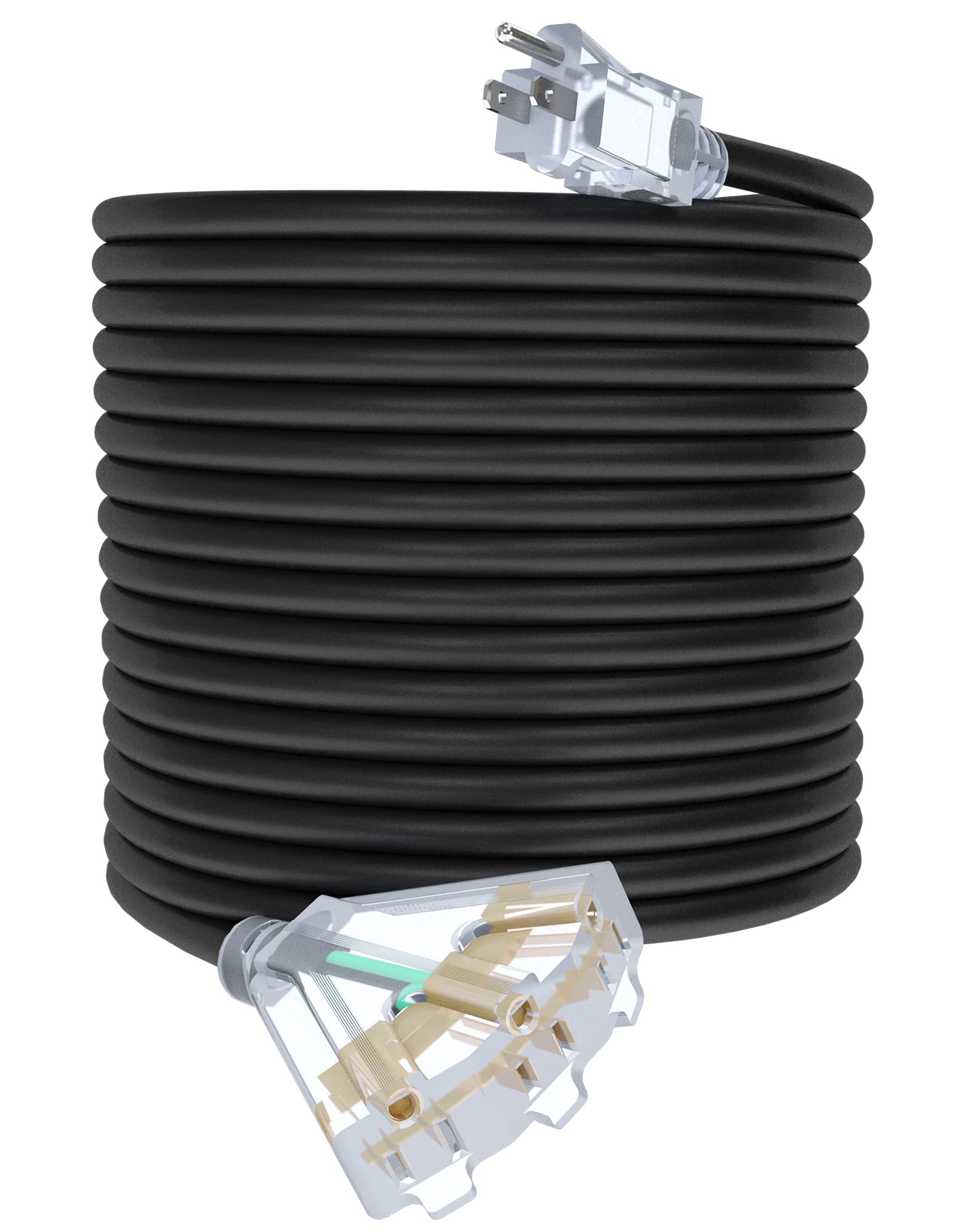
1. PLUGTUL 100Ft 12 Gauge Extension Cord with 3-Outlets
Our pick — over 4.5★ from 900+ verified ratings; the strongest balance of quality and price.
The one cord that ends the run for three tools without you hauling a second reel.
If your yard work or garage project keeps stalling because you are short on outlets, this is the cord to start with. It runs the full 100 feet (1200 inches) of 12-gauge wire, and that thickness is what keeps a mower, trimmer, or saw from choking on low voltage at the far end of the run. The headline feature is the three outlets stamped into the female end, so you can plug a hedge trimmer and a leaf blower into one cord instead of hunting for a second socket. Both plug ends sit in translucent plastic, and the female end carries an LED indicator light that glows the moment power reaches the cord — so you know instantly whether the problem is your tool or your outlet.
What wins people over is the build. Owner feedback leans hard on how solid the cord feels in hand, with durability the next thing they notice, and there is a clear theme of owners trusting it with power-hungry gear without it breaking a sweat. Buyers report the cord runs cool under load rather than heating up the way thin wire does, which is exactly what you want when the entire point of buying 12-gauge is avoiding heat. It is rated 15A, 125V, and 1875W, and it carries ETL listing, so it has been through a recognized safety check. The three-conductor construction uses pure copper wire, and the waterproof jacket is a flexible PVC that shrugs off rain, sunlight, and the abrasion that comes from dragging a cord across concrete.
The honest catch is the jacket material. PVC is durable and weather-ready, but the maker notes it should not be left soaking in water for long stretches, so treat it as rain-and-splash-ready rather than something to leave submerged in a puddle all season. The hook-and-loop strap included for repacking is a small thing that saves real annoyance when the job is done. And when you compare it to the entry-level pick below, this one leads on outlet count while matching the same 12-gauge rating — the difference is you get three things plugged in at once.
Where it earns its keep
- Three outlets on one 100 ft run, so multiple tools share a single cord
- 12-gauge, 15A, 125V, 1875W, ETL listed for the loads that matter
- Lighted female end shows power is live before you troubleshoot the tool
- Flexible waterproof PVC jacket handles rain, sun, and gravel drag
What to plan around
- PVC jacket is water-resistant, not for long-term submersion per the maker
- Three-outlet end is bulkier than a plain single-socket plug
Grab this one if: you want one cord to power several tools across a long yard or garage.
Think twice if: you only ever plug in one device and prefer a lighter, slimmer end.
2. UBOORY Outdoor Extension Cord Waterproof 100 FT, 12/3 SJTW
Cold-resistant insulation that still bends at freezing, and a price that undercuts its own class.
You get full 12-gauge power here without paying premium-tier money for it. The 100-foot run is rated 15A, 125V, and 1875W — the same electrical ceiling as the higher-priced picks — so the value is real, not a downgrade in disguise. The jacket is SJTW (a weather-resistant outdoor cable), rated cold-resistant down to -50°C, so it stays flexible on a frozen morning when you uncoil it to run a snow blower or a block heater. A long strain relief at the connector is rated by the maker for 5000+ repeated bends, so it survives being yanked and coiled. There is no outlet count to fuss over; it is a clean single-ended cord for a single tool.
Owners describe this as a heavy-duty cord regardless of what it costs, and the value angle comes up again and again. Owners mention that if you need a cord that truly carries amps for tools, this is it — the note being that thinner 14- or 16-gauge cords cannot do the same job and tend to heat up. This 12-gauge is heavier as a result, and that weight is the tell that you are getting the right wire. The 100% copper three-prong construction plus the insulation layer is designed to stay efficient and resist the heat buildup that can damage your equipment.
It sits one notch below the top pick on extras — there is no triple-outlet end here, just the standard male-to-female connection — but it matches the same 12-gauge, 15A rating for less. If your priority is a long, cold-weather-capable run for one tool at a time, this is the smarter spend. Want outlets? Step up to the cord above it.
Built for the cold: -50°C cold-resistance means the jacket does not turn rigid on a winter jobsite, so coiling and storage stay easy when it is below freezing.
What it holds back on: no multi-outlet end, so running two devices means a second cord or a splitter of your own.
The smart money pick: ideal if you want genuine 12-gauge, 15A power and winter-ready flexibility without paying more.
Not for you if: you need to plug several tools into one run.
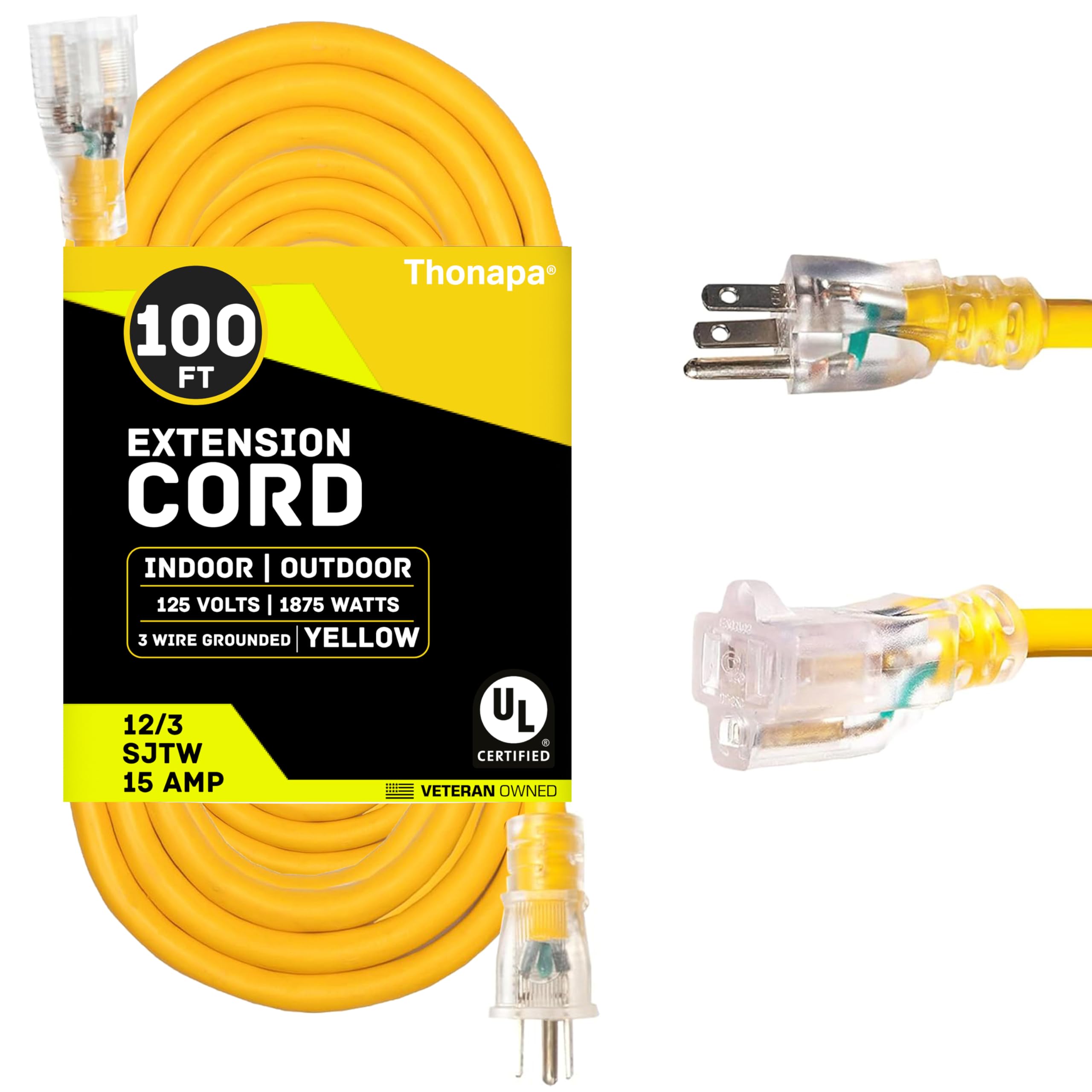
3. Thonapa 100 Foot Outdoor Extension Cord – 12/3 Heavy Duty Yellow
Bright yellow you can spot against snow, and lit ends for when the job runs past dusk.
If you work in a snowy driveway or a bright-sumlight yard, the single most useful thing a cord can do is stay visible — and the yellow jacket here does exactly that. It is a 12-gauge SJTW cable rated 15A, 125V, and 1875W, with three grounded conductors and a three-outlet female end so you can power more than one appliance from a single run. The standout is the temperature window: the maker rates it flexible from -40°F up to +140°F, staying pliable in freezing conditions instead of stiffening into a trip hazard. The nickel-coated blades resist corrosion and resist bending or breaking, and there is a slip-resistant, strain-relieved connector designed to stay plugged in rather than wiggling loose mid-job.
The reliability story here is strong. Owner feedback centers on quality and dependability, with several noting there is no power loss across the run — the exact failure that thin cords suffer. Customers note using it for a 120V 15 amp Greenworks snow blower, saying it worked as expected, and one owner noted it would also handle an electric log splitter that needs a cord capable of carrying the amps. The light at the plug end earns repeated mention as a genuine convenience, telling you at a glance whether power is reaching the far end while you work in the dark or in sun glare.
The trade-off worth knowing: an occasional unit has been flagged for a crimp-only connection at the female end rather than a crimped-and-soldered one, so if you routinely run it at its maximum amperage, inspect the connector when it arrives. It shipped from a U.S. veteran-owned company that stands behind the construction. Compared to the value pick above, this adds the three-outlet end and the bright-yellow visibility, which is why it climbs a tier.
Made for winter runs: the -40°F flexibility rating applies specifically to how easy it is to coil and drag in freezing conditions, not just a spec on a list.
The small caveat: a rare unit has shown up with a crimp-only female connector, so give it a quick check if you plan to push maximum amps.
Pick this for: snow-blower duty, high-visibility yards, and any job where three outlets on one run saves a second cord.
Look elsewhere if: you want the absolute lowest cost and never need the extra sockets.
4. PLUGTUL 12 Gauge Extension Cord 100FT with Lighted End
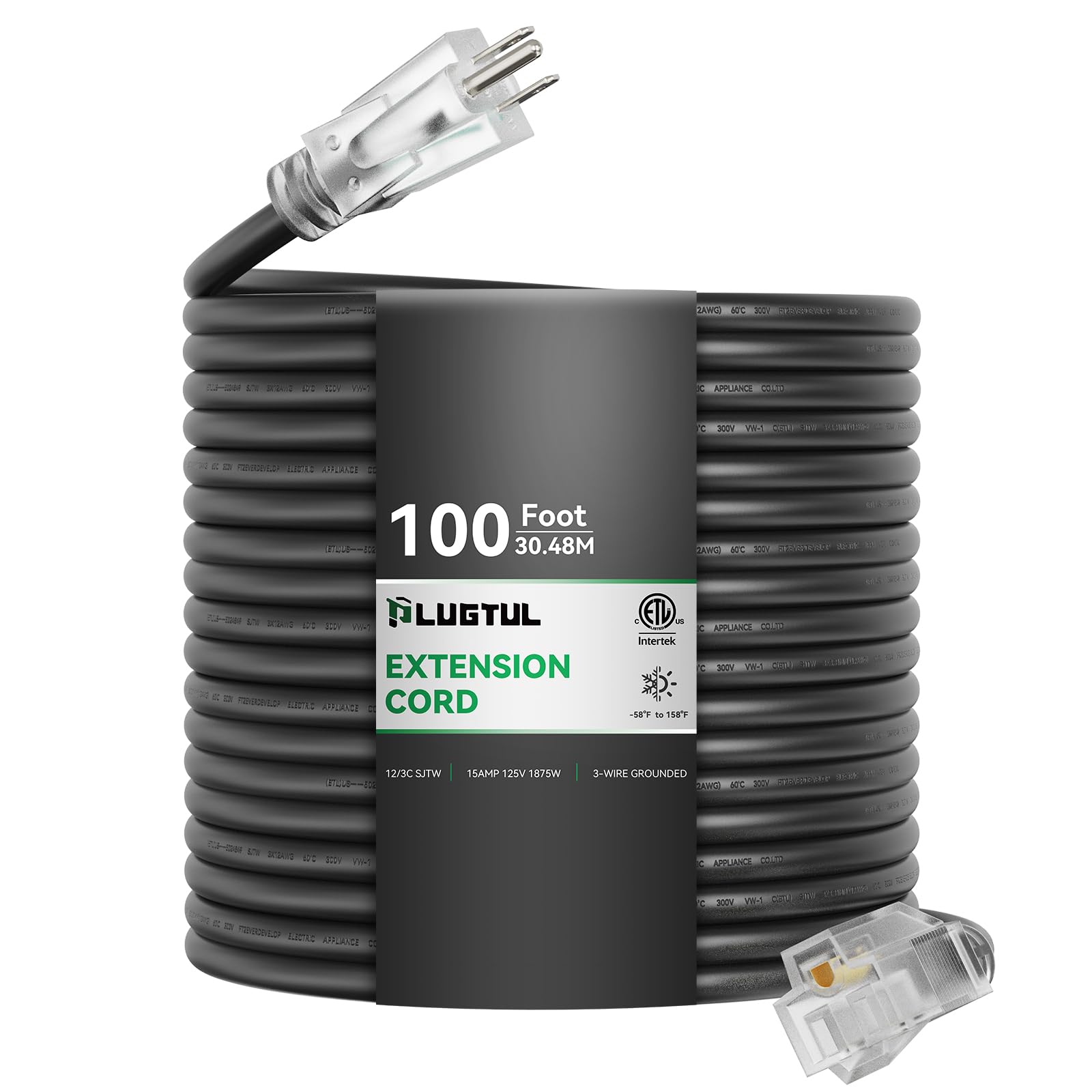
A single-socket 12-gauge built to feed high-draw gear like a car charger without complaint.
Here is a cord for the person who needs one reliable 100-foot line, not a party of outlets. It is 12-gauge SJTW rated 125V, 15A, and 1875W, ETL listed, and it uses the same pure copper conductor count as its three-outlet sibling — it just ends in a single female socket instead of a triple block. What you get for that simplicity is a cleaner, less bulky end to drag around. The female end lights up when power flows, so in a darkened garage or after sunset you know the cord is live without hunting for a lamp. The maker also textures the female plug to add grip, which helps when your hands are cold or wet and you are trying to seat the connector squarely.
This is the pick for big loads on a single device. Reviewers point out running it to an EV charger and finding it well-made and able to handle high power without issue — a serious vote of confidence for a cord at this level. The lighted ends come up as the everyday favorite, since knowing the power is on saves you from blaming the appliance. A recurring observation is that the jacket feels a little stiff when new, which is common on thick 12-gauge wire and eases as it warms and flexes with use.
When you weigh it against the top overall pick, this one trades the three outlets for a slimmer single connector — the same 12-gauge muscle, just aimed at one device. If your load is a single high-current appliance rather than several small tools, this is the tidier choice. The weather-resistant PVC jacket handles rain, sun, and abrasion, with the same maker note that it is not meant to soak in water for long periods.
Strong points
- 12-gauge, 15A, 1875W, ETL listed for high-draw single devices
- Lighted female end confirms live power at a glance
- Anti-slip textured plug for a firmer, more secure grip
- Slimmer single-socket end is easy to route and store
Things to accept
- Jacket runs a bit stiff when brand new
- One outlet only, so no splitting the run between tools
Right for a single load: a strong fit for an EV charger, a portable AC, or one large tool at the end of a long run.
Wrong for a crowd: if you plan to run several tools at once, a three-outlet cord serves you better.
5. ISLEWIRE 100 FT Outdoor Extension Cord with Multiple Outlets
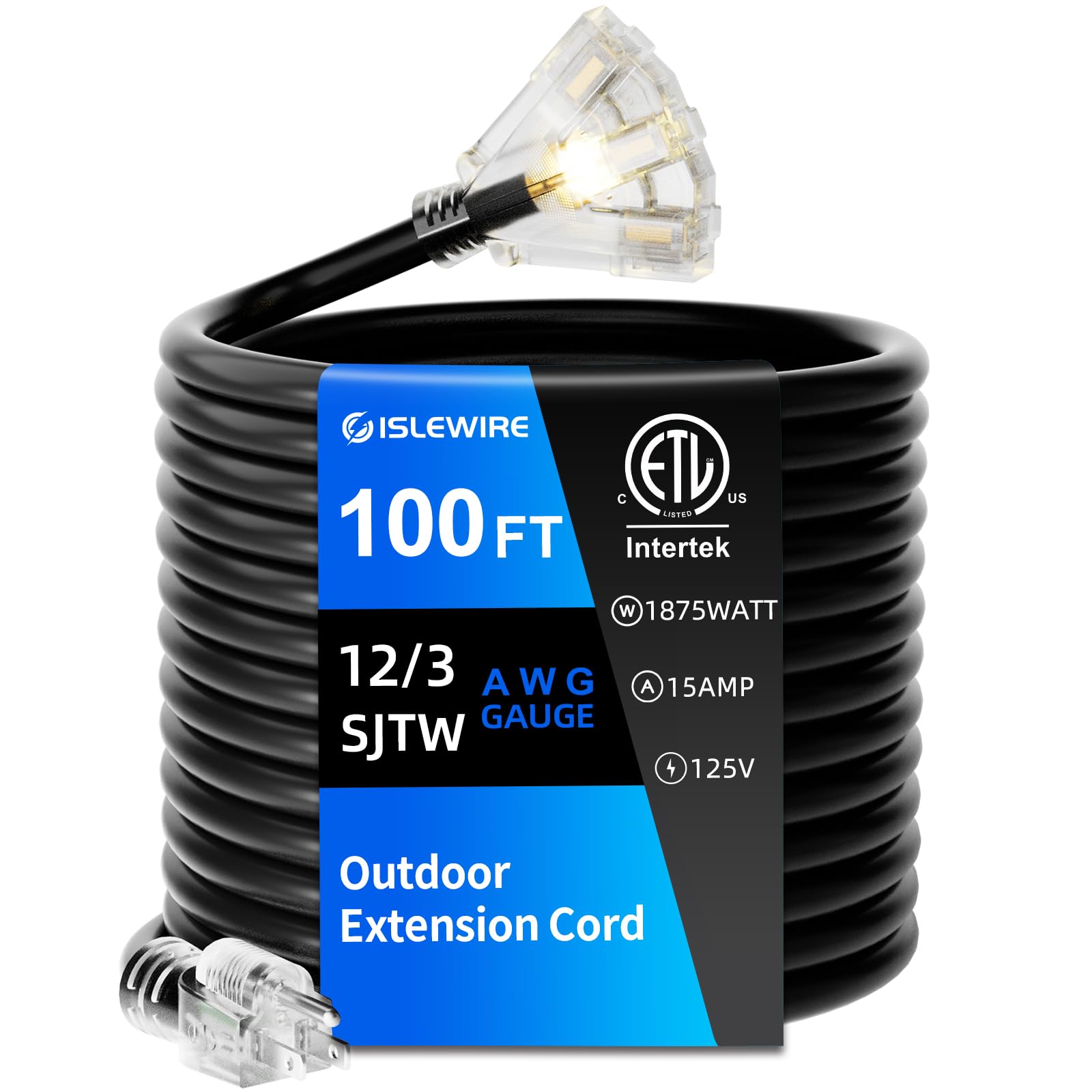
Three angled outlets and a light you can read from across the yard in the dark.
For anyone who works in the evening or on overcast days, this cord answers the practical headache of plugging gear in where you cannot see. Three grounded outlets sit at different angles on the female end, so chunkier plugs do not block each other and you can run a tool and a work light from one connection. It is a 12-gauge SJTW cord rated 15A, 125V, and 1875W, ETL certified, and built to stay flexible between -40°F and 140°F (so it will not stiffen into a hazard in the cold). The high-density PVC jacket resists breakage during the constant dragging and stretching a long-run cord endures.
The functionality angle is what owners bring up most, right after build quality, and the multi-outlet design shows up as a genuine convenience rather than a gimmick. Shoppers say it works well even in snowy conditions, and the light at the end is described as bright enough to confirm live power from across a large yard. One owner put it to work as a garage-heater cord, using it to solve a limited-outlet problem with a ceiling plug, and noted the lights show live power at either end. It also carries a 3-year replacement and return guarantee plus free lifetime technical support, more coverage than most cords here.
A caveat worth sizing honestly: one owner felt it was better suited to protected or indoor use than to being left fully exposed, despite the outdoor rating, so plan on storing it in a dry spot when it is not in use. That fits the broader pattern that these cords want care, not neglect. If you value a readable indicator light and the ability to run multiple devices, this is the low-light champ — and it beats the entry-level pick on that illuminated, triple-outlet ending.
Where it shines: the bright, readable LED at the end plus three angled outlets make it the friendliest cord to use after dark or in poor visibility.
The thing to know: it is rated for outdoor use, but one owner still prefers to keep it out of full exposure, so treat a dry storage spot as part of the plan.
A natural fit for: evening yard work, garage projects, and any job where you need to see the cord is live.
skip it if: you want the lowest price and rarely plug in more than one device.
6. GEARit 100 Ft 12 Gauge Extension Cord SJTW OFC Copper
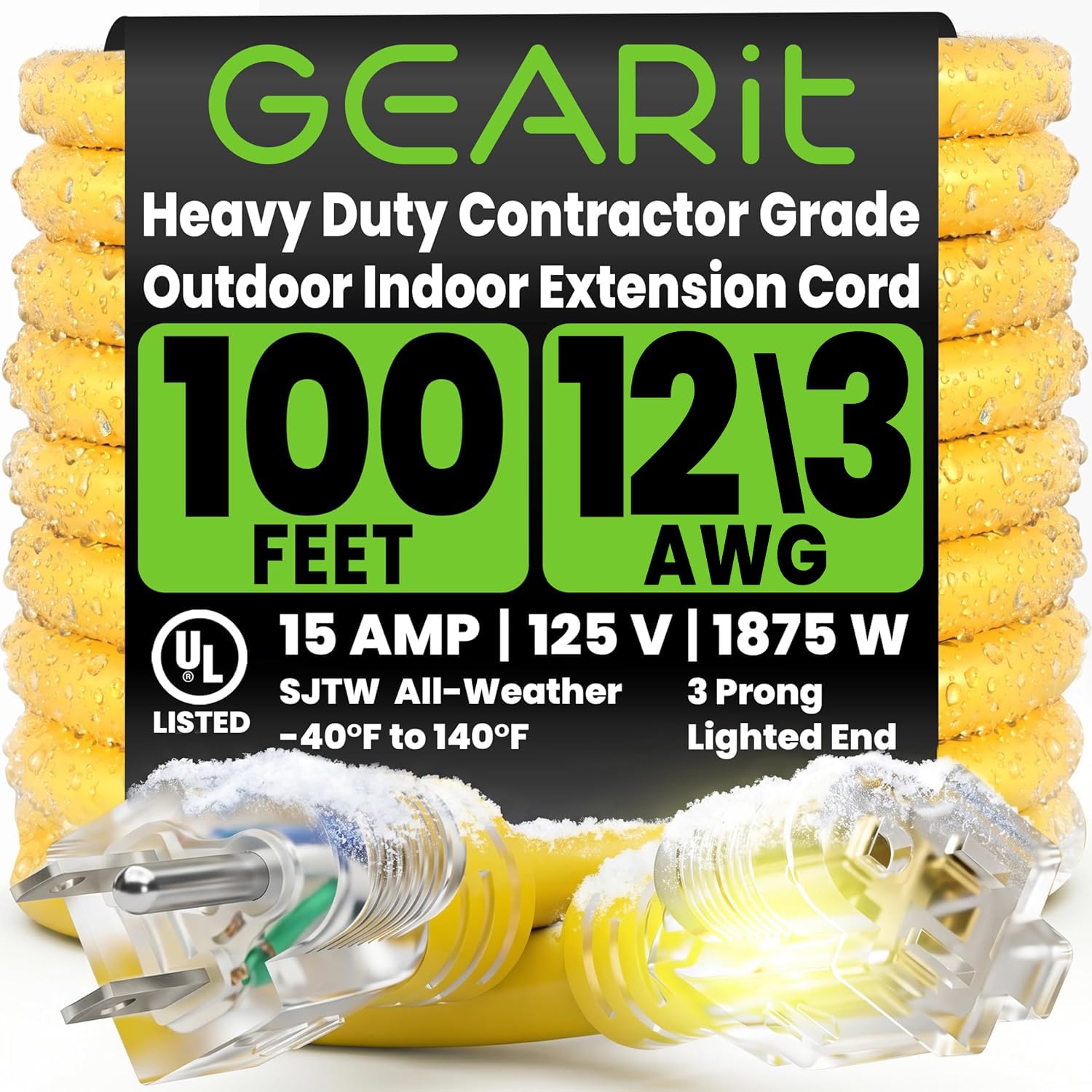
The contractor-grade run built for saws and pressure washers over a full 100 feet.
If your work happens at the far end of a lawn or a jobsite, this is a cord designed around that exact scenario. It is 12/3 gauge, 100 feet (1200 inches), 15A — and the thicker 12-gauge conductors are the reason it is meant for compatible electric lawn mowers, pressure washers, circular saws, and miter saws over that distance. The bright yellow jacket is easy to spot across grass, concrete, and garage floors, and the lighted female end shows power has arrived so you are not second-guessing a dead tool. The grounded three-prong male-to-female connection keeps the equipment properly earthed. It carries a lifetime warranty, longer backing than most cords here.
The durability feedback is telling. Owners note it holds up well to UV rays — real sun exposure on a cord left out season after season — and the lit ends come up as a troubleshooting saver. Buyers report using it for long-distance power tools, with the lit ends confirming power and cutting down on the time spent figuring out where the problem is. There is a strong, practical safety point owners raise: for the 100-foot runs that pull high amps, a 12-gauge cord is the safe requirement, because lighter gauges overload and overheat. In testing a 1750-watt load, one owner reported no heat from the stretched-out cord, with heat building only on a coiled section. That is exactly the behavior you want from heavy wire.
The honest trade-off is weight and stiffness. At 12.7 pounds, this is a cord you feel when you carry it, and owners describe it as heavy and stiff on the coil — a fair cost of the thick copper inside. Weigh that against the reliability: the value pick above is lighter and cheaper, while this one leans industrial with its UV resistance and lifetime warranty.
Why contractors like it
- 12/3 gauge over a full 100 feet for saws, mowers, and pressure washers
- UV-resistant jacket and lighted end for long outdoor exposure
- Backed by a lifetime warranty, a longer backing than most picks here
- Handles high wattage without the cord itself heating up
The cost of that build
- At 12.7 pounds, it is heavy to carry and to coil
- Runs stiff, which the thick 12-gauge wire makes unavoidable
Made for the trades: a strong choice for contractors and homeowners running big tools across a long yard or jobsite.
Less ideal if: you want a light cord to flick out for quick, small jobs.
7. PlugSaf 100ft 10 Gauge Waterproof Outdoor Extension Cord Lighted End
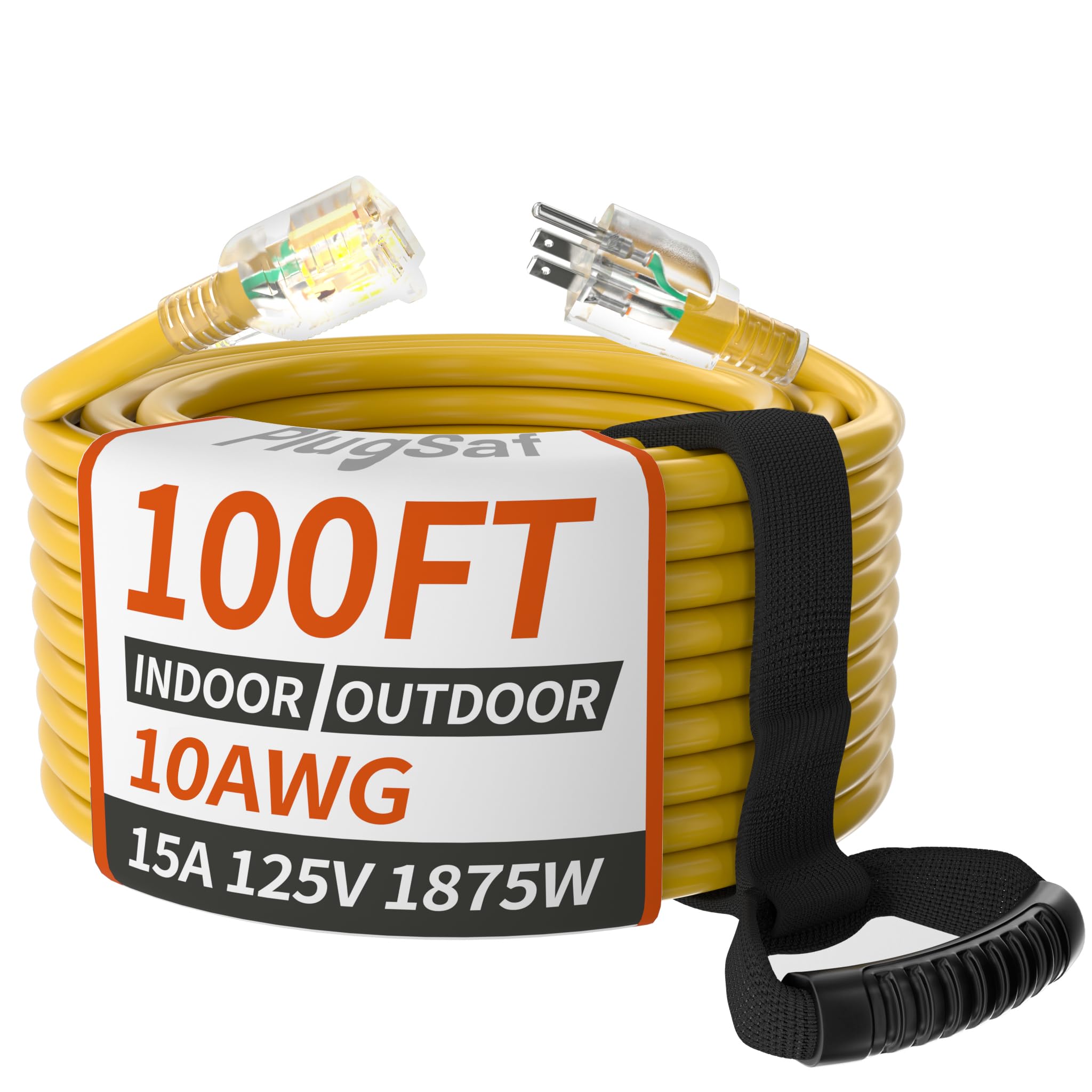
A 10-gauge step up that keeps voltage up and heat down on the longest, heaviest runs.
When a 12-gauge cord starts feeling like it is working too hard, the answer is thicker wire, and this is it. The 10-gauge conductors here are meaningfully beefier than the 12-gauge cords above, which is why it is the pick for keeping voltage steady and heat low across a long stretch. It is rated 15A, 125V, and 1875W, ETL and cETL listed, and comes with three outlets on the female end. The yellow jacket is IP65 waterproof (a rating meaning it stands up to water spray and splashes), weather-resistant, and heat-resistant to 100°C, staying flexible down to -40°C so it will not fight you when you coil it in winter. The connector is rated for 20000-plus bending cycles, and every cord gets a 1500V high-voltage test before shipping.
The performance story is all about that thicker wire. Owners running high amp loads report the 10-gauge makes a real difference in limiting voltage drop over a long run, which is the entire reason to buy 10-gauge in the first place. It comes up as well-built and durable, and it earns a particular following for block heaters and marine use — cold, wet environments where reliability is non-negotiable. The storage straps and attached carry handle make repacking easy, and owners mention it is easier to roll up and store than its thickness might suggest.
The one honest knock: this is a stiff cord, and at 10-gauge it has to be, so expect some wrestling when you wind it up — a fair trade for the voltage it holds. If your runs are long and your loads are heavy, that premium buys real electrical headroom over the 12-gauge cords above.
For demanding runs: the 10-gauge copper is the reason to pick this over every 12-gauge cord here — steadier voltage and cooler running when the load is high.
Know before you buy: 10-gauge wire is stiff by nature, so coiling it takes a little more effort, and the carry handle helps more than you would expect.
Best suited to: block heaters, pool pumps, marine setups, and any long run where you want the extra copper of 10-gauge.
Probably overkill if: you are only powering a small tool that a 12-gauge cord already handles fine.
8. PlugSaf 100 FT 10 Gauge Outdoor Extension Cord with Multiple Outlets
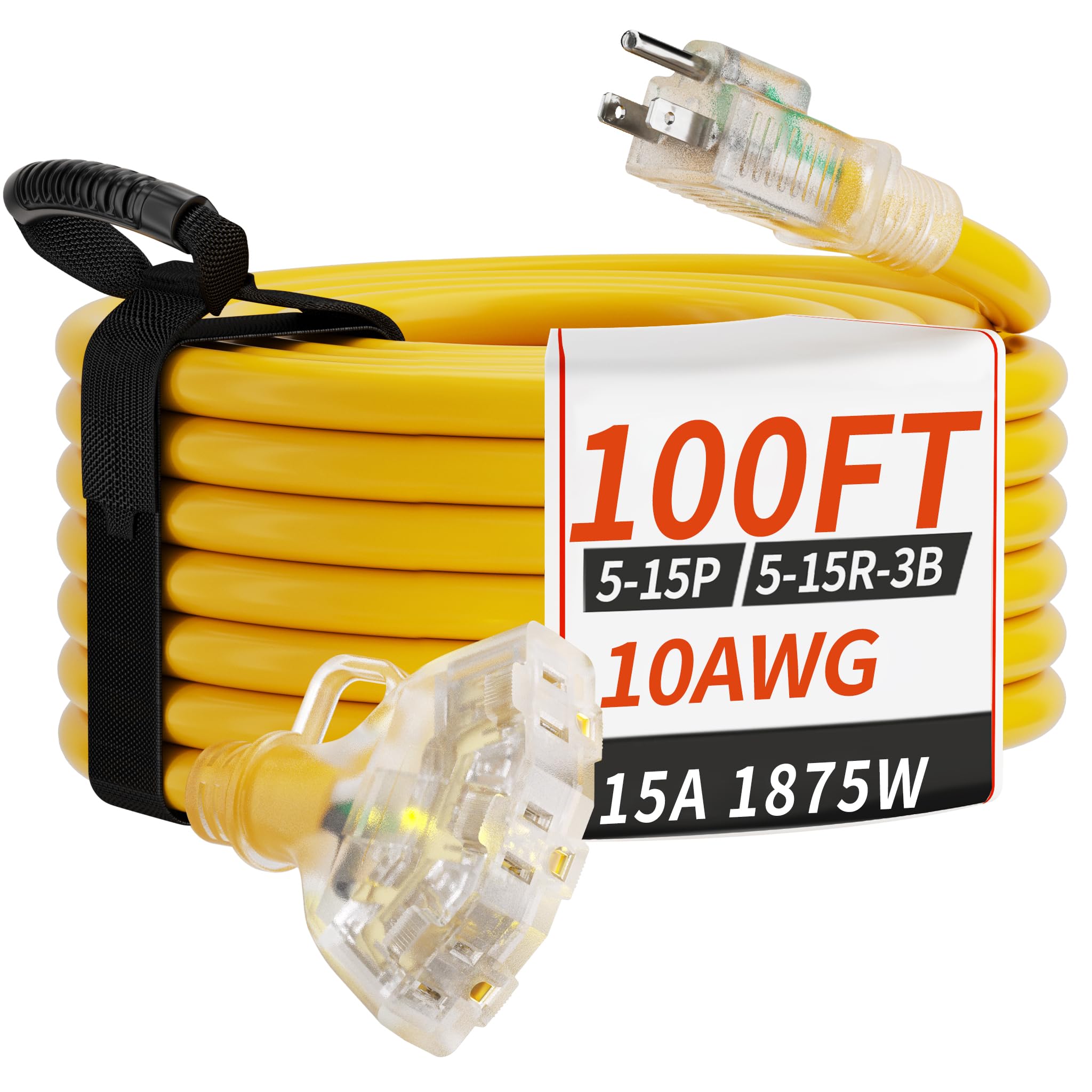
Thick 10-gauge copper plus a three-way split — the heaviest-duty do-it-all here.
This cord combines the two things that matter most on a hard run: genuinely thick 10-gauge wire and the ability to power several appliances from one lead. It is rated up to 15A, 125V, and 1875W, ETL and cETL listed, with a three-way plug on the female end that lets you run multiple appliances at once. The SJTW jacket survives temperatures from -40°F to 140°F and carries an IP65 waterproof rating (resistant to water spray and splashes), and the body stays soft and flexible rather than brittle. The tail is rated to bend 20000 times without breaking, and each cord is 1500V high-voltage tested before shipping. A hook design keeps it neat when stored, and the bright yellow sheath plus end light make it easy to spot in the dark.
Owner experience here is overwhelmingly about quality and function together. Customers note using it for a hot tub pump and heater, and for trailer camping where power is scarce — the multi-outlet end lets them run several 120V appliances off one cord. It is described as rugged, durable, and able to power three devices at once, with the lit indicator giving confidence that power is flowing. Owners repeatedly note it does not heat up in use, which is the payoff of the 10-gauge build. One reviewer put it plainly, calling it a cord that “punches well above its price point,” handling a generator and grill without overheating.
Caveat to weigh: this is the highest-cost cord in the lineup, and its weight and flexibility, while better than you would expect for 10-gauge, still reflect thick wire. But for the buyer who wants one cord to run several appliances off a long lead in any weather, the combination of 10-gauge, IP65, and a three-way end is hard to match. Where the single-outlet 10-gauge above asks you to pick one device, this one lets the whole job draw from a single run.
Where it wins
- 10-gauge copper plus a three-way end for multiple appliances on one run
- IP65 waterproof and flexible across -40°F to 140°F
- Tail rated to bend 20000 times; each cord 1500V high-voltage tested
Worth knowing
- Highest-cost pick in this lineup
- Thick 10-gauge wire and a triple-outlet end add bulk to carry
The do-it-all heavyweight: perfect for hot tubs, generators, and campsites where several devices share one long, weatherproof run.
Not the budget answer: if one tool is all you power, the slimmer 12-gauge picks do that job for less.
9. Southwire Extra Heavy Duty Extension Cord, 100Ft, 10 Gauge

A 10/3 jobsite workhorse with a lighted end and a reputation for lasting years.
For the heaviest tools on your list, this is the cord that prioritizes raw capacity and construction over portability. It is a 10-gauge, three-conductor cord at 100 feet (1200 inches), built as an extra-heavy-duty outdoor cord with a lighted end so you can see when power is live. The thick 10/3 wire is the reason it is suited to large tools and high-demand jobsite conditions, and the heavy-duty jacket is made to take the punishment of a working yard or workshop. If your equipment pulls serious current, this is the grade of cord that keeps voltage from sagging.
Durability is the throughline in owner feedback, with it described as solid for outdoor use and built to last for many years. Reviewers point out it working well with high-demand electric tools, and one owner even used it with a 140-amp MIG welder without experiencing power loss — a fair sign of how much current this gauge can move cleanly. Another buyer used a 10/3 cord of this type to charge a Prius Plug-In at 15A and up, reporting no voltage-drop trouble over a year of use. The neon power-indicator lights show up as a small but appreciated touch, confirming live power when you need it. The consistency here is why it is a cord people replace old ones with, not a cord they replace.
The two things to plan around are both tied to that heavy build: it is a genuinely heavy cord to lug and coil, and it is on the pricier end of the lineup, which is fair for 10/3 wire. Owners themselves note the 100-foot version is very heavy and suggest a shorter length if you do not truly need the distance. If your runs are long and the loads are big, the extra copper here holds voltage steady and runs cooler.
Why it lasts
- 10-gauge, three-conductor build for high-current tools and welders
- Lighted end; neon power indicator shows live power
- Reliable voltage-holding for long runs, per owner experience
Trade-offs
- Genuinely heavy to carry and to coil at 100 feet
- On the higher-priced end of this group
The one for heavy tools: ideal if you run welders, large motors, or big-draw equipment and want a cord that holds voltage for years.
Reconsider if: you only stretch a cord a short distance — this much copper is more than a small job needs.
Understanding the Specs
Gauge (AWG) and why lower is thicker
Gauge is measured in AWG (American Wire Gauge), and the number runs backwards: a 12-gauge wire is thicker than a 14-gauge, and a 10-gauge is thicker still. Thicker wire carries more current with less voltage drop, so your tool gets the power it expects instead of a weakened trickle. Over a full 100-foot run, that difference matters — a 12-gauge cord is the sensible floor for tools like mowers and saws, and a 10-gauge cord is the safer choice for the biggest draws, such as a welder. If you see 12/3 or 10/3, the second number means three conductors: a live wire, a neutral, and a ground for safety.
Amp, volt, and watt ratings explained
Amp (amperage) is the amount of current the cord can pass, volt is the pressure pushing that current, and watt is the total power those two combine to deliver. These cords are rated 15A at 125V for 1875W, which tells you the maximum load they are built to handle continuously. The plain-English version: match the cord’s watt rating to your tool’s watt draw, and if your tool pulls close to the limit, choose a thicker gauge so the cord stays cool. Running a cord above its rating is what causes heat, and heat is what damages tools and creates a hazard — which is why the gauge, not the price, is the number to check first.
FAQ
Is 12-gauge heavy enough for a 100-foot run to a mower or saw?
What does 12/3 or 10/3 mean on an extension cord?
Can I leave a heavy duty extension cord outside in the rain or snow?
Will a 100-foot cord lose power over that distance?
Do I need a 10-gauge cord instead of a 12-gauge one?
What does SJTW mean, and does it matter outdoors?
How heavy is a 100-foot 10-gauge cord to carry?
Can I run two tools at once from a cord with multiple outlets?
Is a lighted end just a gadget or actually useful?
Why do owners pay more for a 10-gauge cord over a 12-gauge one?
Final Thoughts: The Verdict
For the strongest all-rounder in the 100 ft heavy duty extension cord group, the PLUGTUL 100Ft 12 Gauge with 3-Outlets wins because it pairs full 12-gauge power with three outlets and a lighted end that make a long outdoor run genuinely convenient. If your priority is the lowest cost per foot of honest 12-gauge performance, the UBOORY 100 FT 12/3 SJTW is the value stand-out with its cold-resistant jacket. And when the load gets serious — welders, big motors, or running several appliances at once — step up to the PlugSaf 100 FT 10 Gauge with Multiple Outlets, whose thicker copper and triple outlets give you voltage headroom on the heaviest runs. Whichever you choose, match the gauge to your tool’s draw, and the cord will keep it running at full strength for years.
How We Picked
We do not accept paid placement. Every pick is matched to a real buyer and a real use-case; we do not hands-on test units.
Sources & Methodology
Specifications: manufacturer listings and product documentation. Review insights: verified customer reviews, as of September 2026. Pricing: not shown on this page (it changes often); check the current price via the retailer link.
As an Amazon Associate, KitchPrep earns from qualifying purchases. This does not affect which products we feature.
Related Guides
