
Specs are compiled from manufacturer listings and verified buyer reviews and can change over time — please confirm the key details on the product page before buying.
Most buyers of this size are trying to get riding mowers, ladders, bikes, and seasonal gear out of the garage and into a structure that survives wind, snow, and summer heat. This guide sorts seven real options by material, footprint, and the honest trade-offs owners run into during assembly.
I’m Mohammad Maruf — the founder and writer behind KitchPrep. This guide is built by comparing the manufacturers’ published specifications and the patterns across verified customer reviews, so you get each pick’s real strengths and trade-offs instead of marketing spin.
Metal, resin, and wood each solve a different problem, and the right one depends on your climate, your foundation, and how much weekend you are willing to give up. Whether you are replacing a rusted-out steel box or building your first backyard workshop, this breakdown of the best 10 X 16 Shed options covers the sizes, materials, and assembly realities.
Our Picks at a Glance
How To Choose The Best 10 X 16 Shed
The most common surprise among shed buyers is that the advertised dimensions and the delivered structure are not the same number. A shed labeled 10 x 16 often arrives with a length and width a few inches shorter than the label, and the wall-to-wall interior shrinks again once the frame sits inside the footprint. If you are pouring a concrete pad or building a wooden base first, measure the actual panel dimensions, not the marketing size, or you will be pouring a slab a few inches too small.
Metal, Resin, or Wood: Pick Your Trade-Off
Galvanized steel panels resist rust well, but thin metal dents and gaps at the seams let air and moisture through unless you seal them. Resin and polypropylene sheds do not rust at all, hold up to sun fading with UV protection, and often arrive with a floor included that keeps stored items off wet ground. Wood gives you the strongest structure and the most insulation, but it costs more, takes longer to assemble, and usually ships without a floor, paint, or roof shingles.
Climate, not budget, should drive the material choice. In heavy snow regions, a shed rated for a specific snow load per square foot (the weight of snow it can hold before bending) is safer than an unrated one. Any shed claiming wind resistance needs a real foundation — a concrete anchor, deck screws, or ground augers (screw-in earth anchors). None of these are the same as setting panels on bare dirt.
Why Your Foundation Matters Most
Nearly every assembly problem traces back to an unlevel base. A sloped pad throws off panel alignment, makes holes miss their backing, and leaves gaps at the bottom where water enters. Build on a flat, screw-down surface — a concrete slab, a 2×4 grid with plywood, or the reinforced floor kit sold with your chosen shed — and the panels line up far more easily.
Assembly Time Is the Hidden Cost
Two people is a minimum for most 10 x 16 builds, and some kits recommend three to four adults. Budget a full weekend for steel and resin, and longer for a wood shed if you are doing it without help. A cordless drill with a sensitive clutch protects thin plastic and metal panels from stripped screws, and it is worth buying the correct hex or cap screws ahead of time rather than substituting whatever is in the toolbox.
Quick Comparison
| Model | Best For | Floor Area | Material | Door Size | Amazon |
|---|---|---|---|---|---|
| AirWire 12×16 FT Outdoor Storage Shed Black★ Best Overall | Maximum square footage on a tight budget | 192 square feet | Alloy Steel | 63.3″ W x 68.1″ H | Amazon |
| AMERLIFE 10x16x7 FT Outdoor Storage ShedBest for Daylight | Daylight and easy access for a workshop | 163 square feet | Galvanized Steel | 60″ W x 67.2″ H | Amazon |
| WACASA 10×16 FT Military-Grade Metal Storage Shed | Wind and snow exposure where anchoring is possible | — | Metal | 4.61′ W x 5.7′ H | Amazon |
| Patiowell 10×10 FT Resin Outdoor Storage Shed | Floor-included storage with zero rust risk | 97.2 square feet | Resin | 54.7″ W x 67″ H | Amazon |
| Devoko 10×12 FT Resin Outdoor Storage Shed | Largest resin floor area for a small yard | 120 square feet | Resin | Single Hinged | Amazon |
| Handy Home Products Rookwood 10×16 Wooden Shed | Custom foundations and vertical storage | 160 square feet | Wood | 64″ W x 64″ H | Amazon |
| Handy Home Products Scarsdale 10×16 Wooden Shed | Pre-cut wood build with floor kit included | — | Wood | 64″ W x 72″ H | Amazon |
In-Depth Reviews
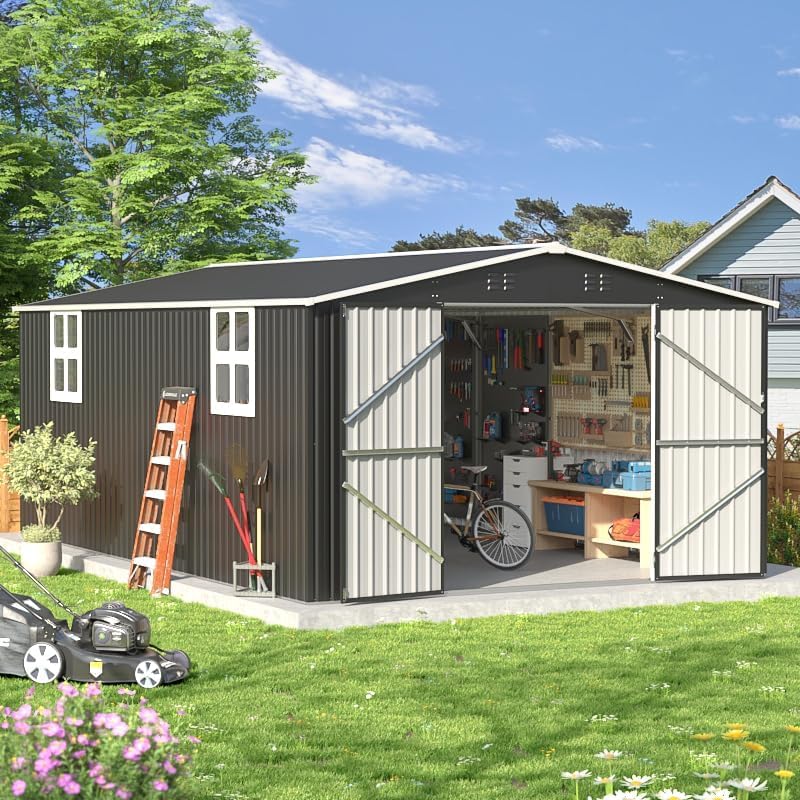
1. AirWire 12×16 FT Outdoor Storage Shed Black
The biggest footprint on this list by a clear margin, if you can handle the build.
If square footage is your priority, this is the pick. That extra floor is why it tops this list despite its mixed reputation.
A rust-resistant galvanized steel panel set over a steel tube frame is the core here, and the sliding doors — 63.3 inches wide and 68.1 inches tall — save swing space in a tight side yard. Both door dimensions beat the AMERLIFE’s 60-inch by 67.2-inch openings, which means a wider cart or tub slides in without angling. The sloped roof sheds rain runoff, and integrated vents keep the interior from turning damp and musty during humid months.
The thing everyone loves about this shed is the space itself, and interior brightness is a genuine bonus too. What you should plan for is the build. Buyers report “It took 3 people 7 hours to assemble (2 of whom have construction backgrounds)” — so line up help before the pallet lands. Some owners also note the panels need extra sealing, since the seams are not watertight straight from the start; a tube of spray foam is a common fix.
Where It Wins
- 192 square feet of floor area — the most storage space in this lineup
- Widest doors here at 63.3 inches, so bulky gear rolls straight in
- Galvanized steel panels resist rust and hold up to weather
- Sliding doors save the swing clearance a hinged door needs
What to Plan For
- Needs three people and roughly a full day to build, per owner reports
- Not watertight at the seams without extra sealing and spray foam
- Thin metal panels can dent, so handle them carefully during assembly
Reach for this if: you need the largest storage footprint available and you have a Saturday plus two helpers on standby.
Look elsewhere if: you want a shed that arrives weatherproof without any extra sealing work.
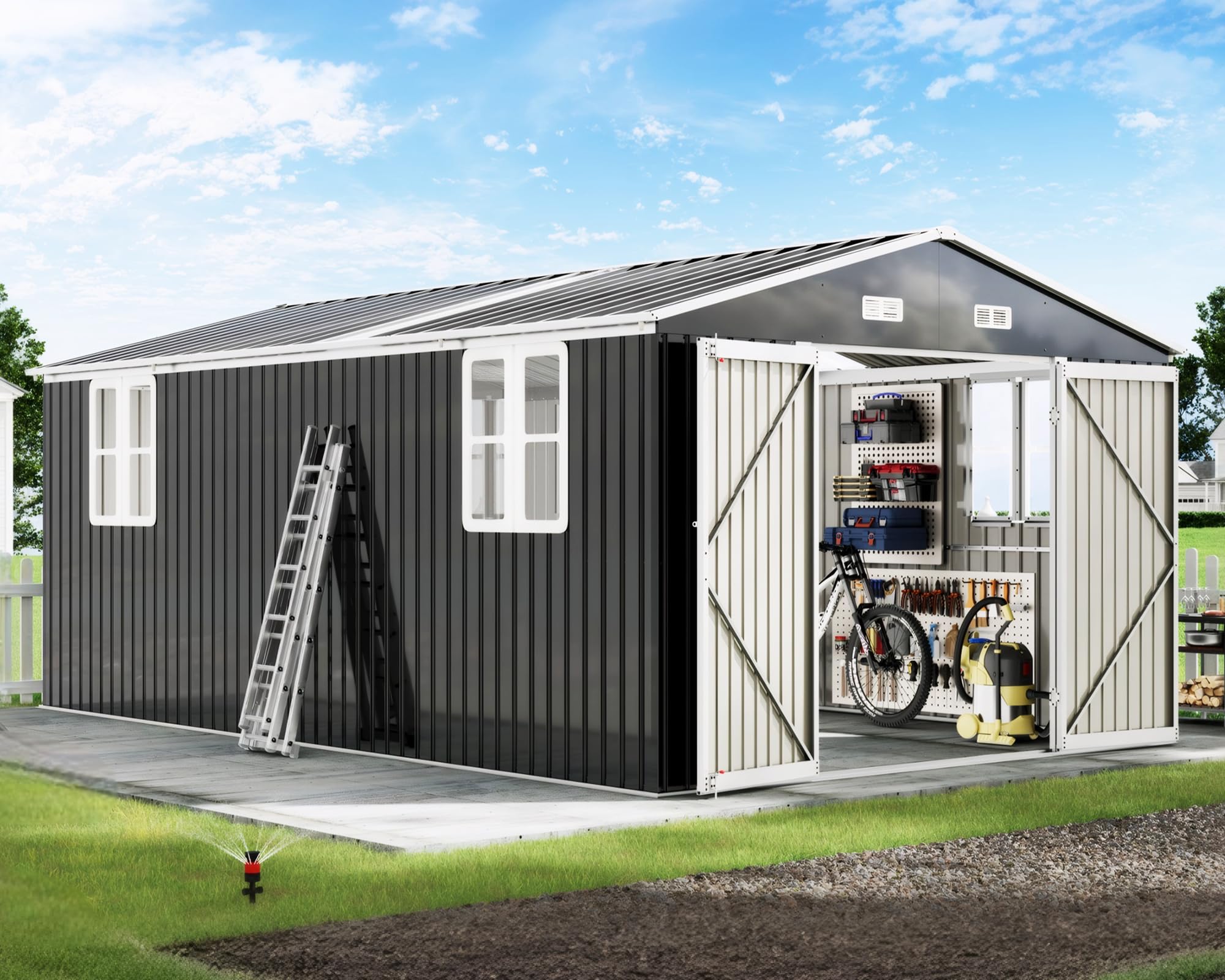
2. AMERLIFE 10x16x7 FT Outdoor Storage Shed with 2 Transparent Panels
Two transparent panels and four windows turn a steel box into a working space.
Most 10 x 16 sheds are dark inside, which is why you should look at the AMERLIFE if your goal is a workshop rather than pure storage. Two transparent roof panels plus four side windows flood the interior with natural daylight, and four vents pull fresh air through so dampness cannot settle into your tools. At 163 square feet, it gives up 29 square feet to the AirWire above — a trade that buys light and airflow.
The frame is galvanized steel with an upgraded reinforced tube gantry frame plus drainage holes, which is the combination that resists rust and wind over years. Double hinged doors at 60 inches wide let you wheel in carts and bikes, and they lock for security. The dimensions land at 120 inches wide and 84 inches tall, giving you seven feet of interior height for ladders and tall gear.
Assembly is the honest sticking point here. The build takes about 10 hours with three people, and a wooden 11 x 17.5 foot foundation is recommended before you start. What buyers value most about this shed is the combination of cost and space — the storage it provides for what you pay is genuinely hard to argue with. One owner’s total build stretched across three days at five hours each, so plan for a full weekend with help rather than a quick afternoon.
Worth knowing: the panels arrive with a thin protective film you should peel before final assembly, and it will save you serious scrubbing later.
This one earns its spot if: you want to actually work inside your shed without running an extension cord for a lamp.
Think twice if: you were hoping for a one-person build — the 10-hour, three-person estimate is realistic, not padded.
3. WACASA 10×16 FT Military-Grade Metal Storage Shed with Skylight
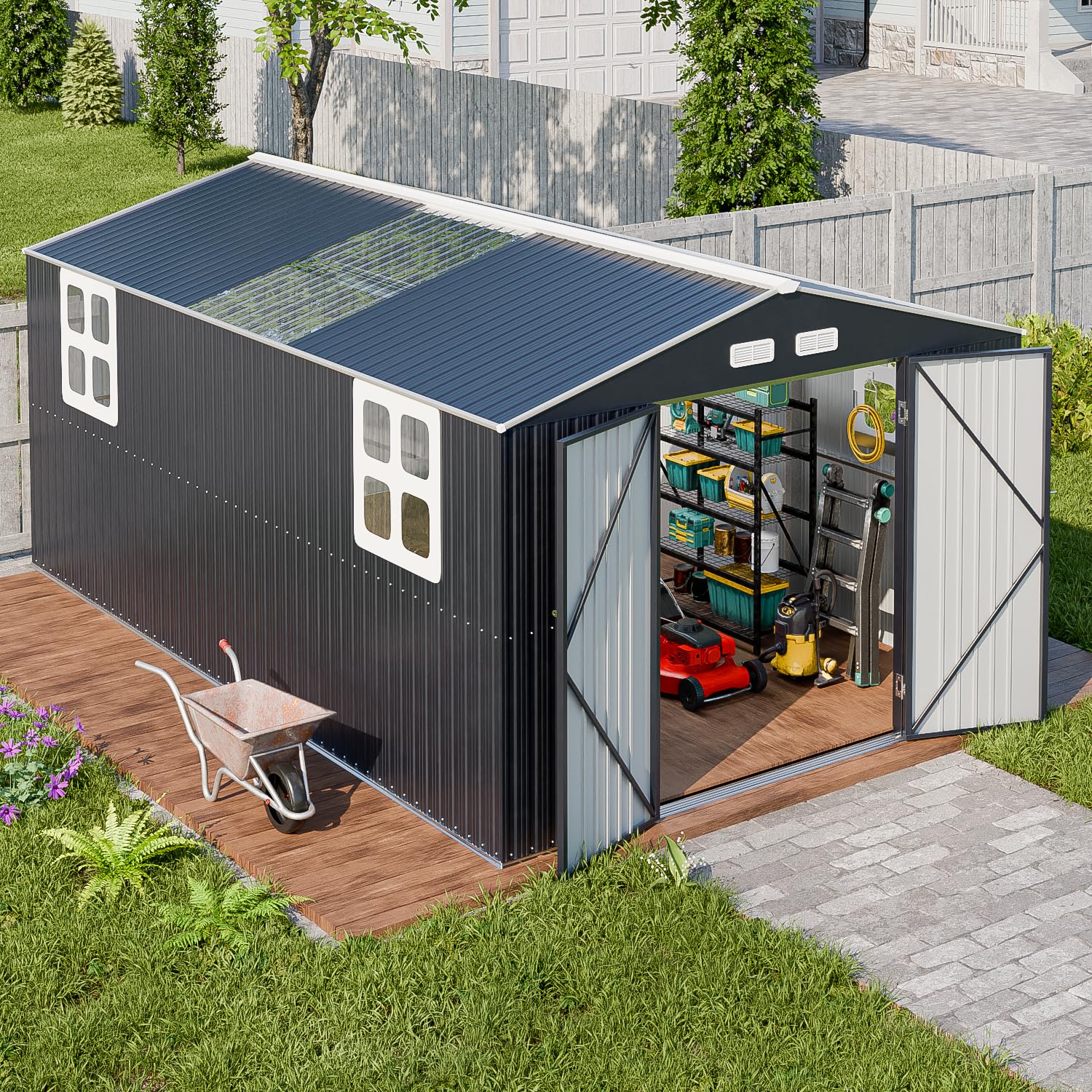
A thick-frame steel build rated for the kind of weather that flattens cheaper kits.
If your yard takes real wind or snow, this is the specification to study. The WACASA uses an ultra-thick 20-gauge structural support frame with 30-gauge panels, and it is rated for a 50 PSF snow load and 120+ MPH winds — provided you anchor it properly. That rating is the whole pitch: a permanently secured frame rated for those conditions is meaningfully different from a lightweight kit that flexes in a storm.
You get daylight inside without running power, thanks to two crisp polycarbonate roof panels (clear plastic that lets light through). Dual integrated vents push heat and moisture out. Wide lockable double doors let a riding mower pass with room to spare. The multi-layer powder-coated frame (a baked-on paint finish) resists salt spray, acid rain, and scratches, so rust stays away over a long service life.
Here are the real-world caveats. Owners mention the build quality is excellent — the assembled shed feels solid — but the instructions are the weak link, and the panels are thin enough to dent if you rush the roof alignment. The deluxe build needs three to four adults over five to eight hours. It ships in three separate heavy boxes that may arrive on different days. You must anchor it properly: bolts into concrete, deck screws into a deck, or 30-36 inch auger anchors for soft ground. Skip the anchoring step and you forfeit the wind rating entirely.
The honest read: the reinforcement is real and the weather ratings are the strongest in this lineup, but the fit-and-finish of individual panels is inconsistent enough that you should inspect every box within the return window.
Suits you best if: you live where storms are a real threat and you are willing to anchor to concrete or a deck properly.
Skip it for now if: you cannot secure to a solid base — the wind rating only exists once the shed is bolted down.
4. Patiowell 10×10 FT Resin Outdoor Storage Shed with Floor, Beige
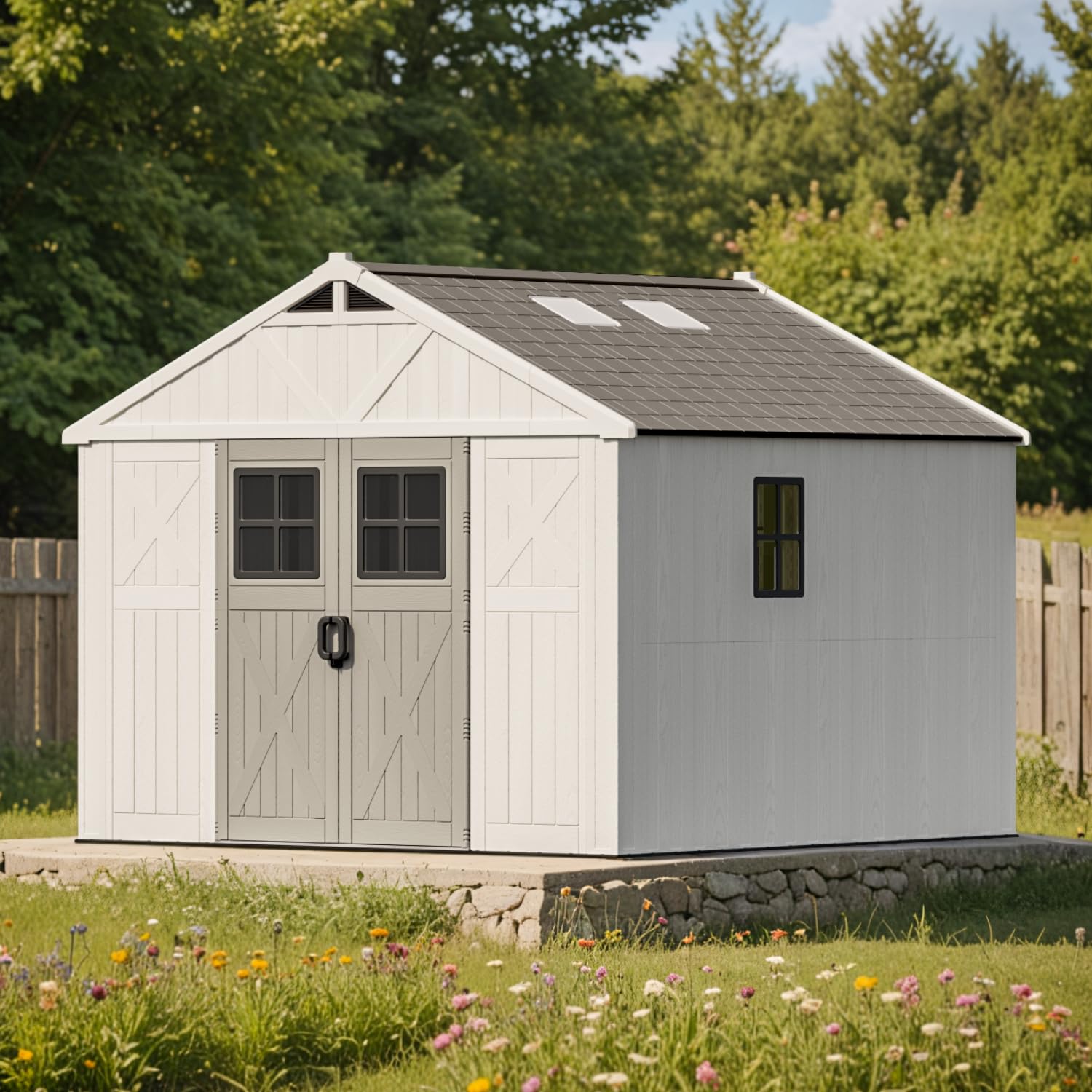
A plastic shed with its own floor, so moisture never reaches what you store.
Here is the size reality check: despite the 10-foot label, this Patiowell tops out at 97.2 square feet of floor area — the smallest footprint in this lineup. If you were picturing the full 160 square feet of a true 10 x 16, look at a different pick. What this shed offers instead is a different material experience: thickened double-layer polypropylene resin (a tough plastic) with double UV protection, so it cannot rust, will not fade in the sun, and arrives with a smooth waterproof structure that includes the floor.
You can use the inside without a light, thanks to a skylight and four windows. Circulation vents cut humidity in the rainy season. The doors have their own windows, so you can spot what is stored from outside without opening up. The lockable double doors measure 54.7 inches wide and 67 inches tall. Check twice: confirm your HOA rules before ordering, and expect the shed to ship in as many as ten packages that may arrive in batches.
Assembly is the mixed part. A screw-minimizing mounting design speeds things up, but some owners found the walls need extra bracing and the pictogram-heavy manual can be hard to follow for the wall and roof sections. The verdict from experience is to build a flat, level foundation first — a 2×4 grid with plywood works — and use a cordless driver with a sensitive clutch so you do not strip the plastic screw posts.
The trade is straightforward: you give up floor area compared to the steel sheds above, and in return you get zero rust risk and a floor that keeps gear dry even in soggy ground.
One adjustment owners make is adding a few washered screws to stiffen the floor panels and a brace on the back wall if it feels flexy.
Best for: coastal or humid climates where steel eventually rusts and you want an all-in-one shell with its own floor.
Not ideal if: you need the full 160 square feet — this one is 97.2 square feet of actual floor area.
5. Devoko 10×12 FT Resin Outdoor Storage Shed with Floor, Beige
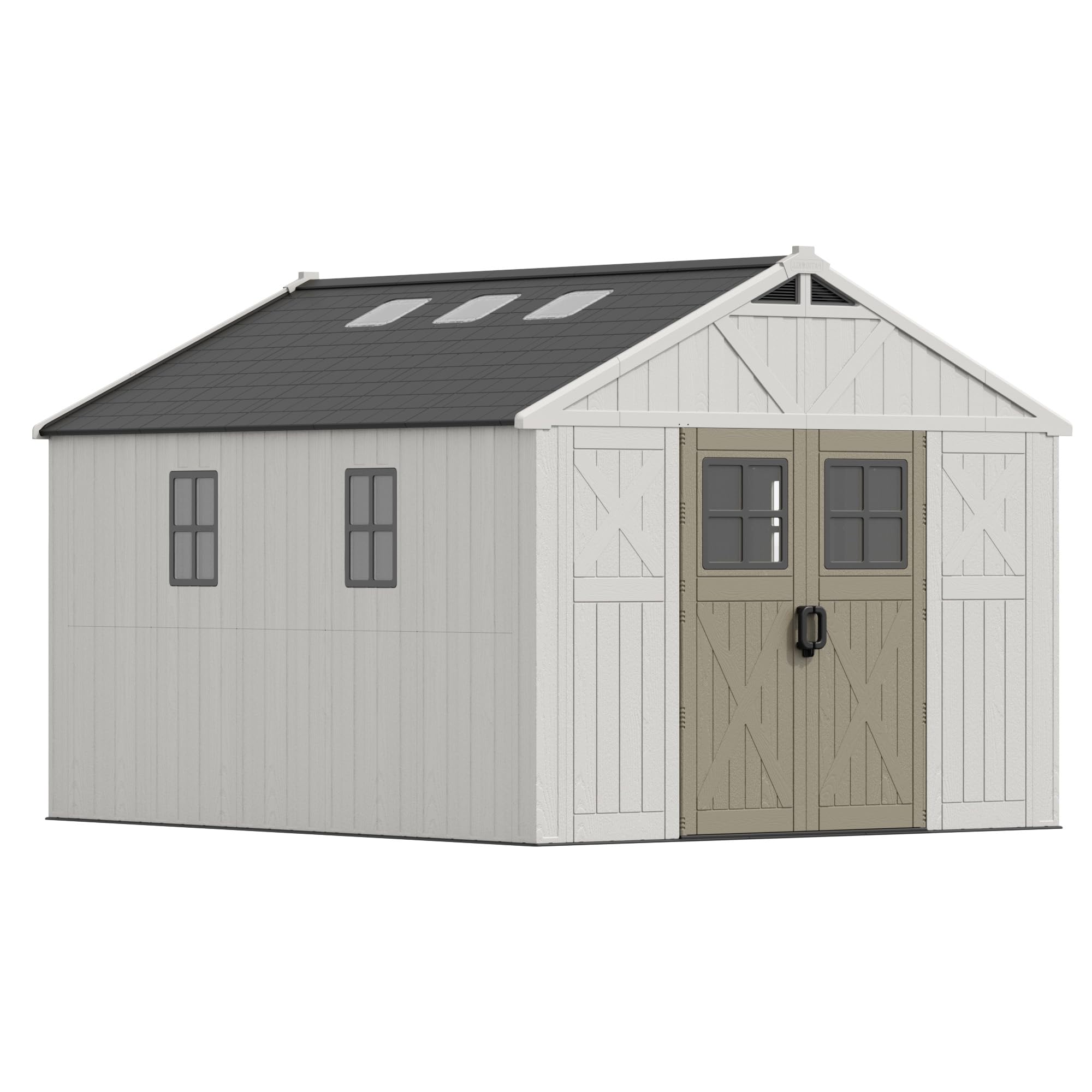
The bigger resin option, with sloped roof drainage and a floor that blocks ground moisture.
The material is a double-layer thickened resin built to resist UV fading, and unlike metal it cannot rust, dent, or warp the way thin steel panels can.
The design choices that matter here are the double sloping roof — which sheds rain and prevents snow accumulation — and the thickened floor that both stiffens the structure and keeps water from seeping in at the base. A secure lock protects what is inside. Natural light arrives through a skylight plus windows on both sides, with vents to move moisture out during humid months.
The assembly system is the part most owners either love or fight with. A foot-kick installation system dramatically reduces the number of screws compared to traditional sheds, but the manual is pictogram-only with no text. Some customers note hardware scattered across multiple boxes, which made the build slower than the pictures suggested. A level base is non-negotiable — anchor the floor first, then work up — and use a low-torque cordless drill so the plastic joints survive the build. Owners note the panels feel light individually, but the structure firms up considerably once fully assembled and locked together.
Plan for this: the shed ships divided into 12 packages, and they can arrive on different days — so do not schedule your build weekend until every box is on site.
Pick this one if: you want the largest resin footprint available and value a no-screw, faster-connect build system.
Consider the WACASA instead if: you need steel-grade wind and snow ratings and can anchor properly.
6. Handy Home Products Rookwood 10×16 Do-It-Yourself Wooden Storage Shed
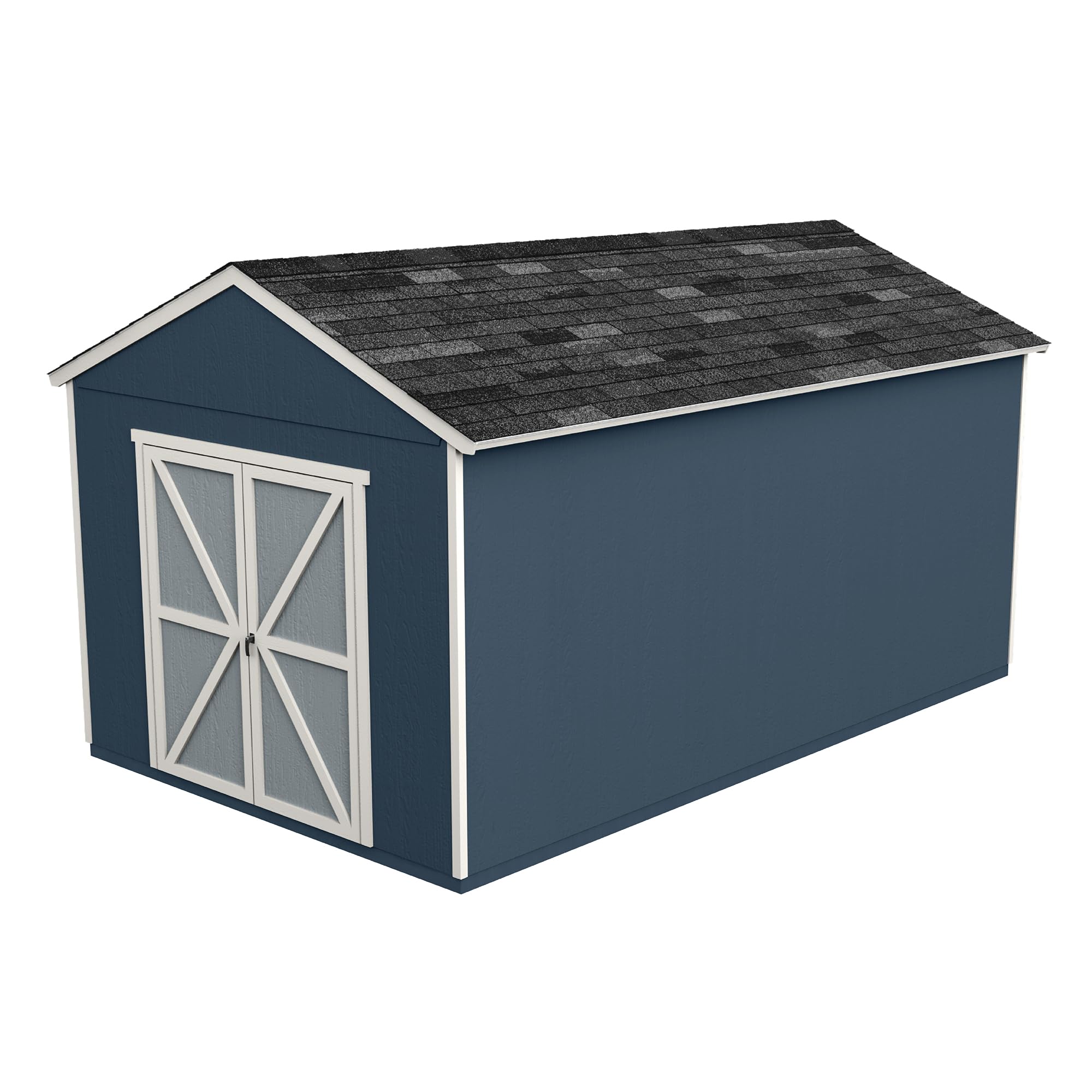
Real lumber and premium framing — but bring your own floor, paint, and shingles.
The Rookwood is the pick for anyone who wants the feel and strength of wood rather than metal or plastic. Premium 2×4 framing runs ground-to-peak, and 7-foot side walls with a 9-foot-6-inch peak give you the vertical clearance to store ladders, rakes, and shovels upright instead of leaning them. Extra-large 5-foot-4-inch doors with continuous galvanized steel hinges make moving equipment in and out easier than a standard double-door opening.
One detail to confirm before ordering: this shed is not available in FL due to weather restrictions, and the price does not include a floor kit, paint, or roofing shingles — all of which are sold separately. That is intentional. It allows you to build on a custom foundation such as a concrete pad rather than committing to a pre-cut floor. It is 160 square feet of floor area once you supply the base.
What buyers appreciate most about this build is the appearance — owners consistently say the finished shed looks far more expensive than what they paid, with a substantial, solid presence once assembled. What you should go in knowing is that the manual covers multiple shed sizes, which makes it confusing, and one owner’s experience was that lumber lengths arrived inconsistent with a couple of warped 2x4s. Budget for replacement studs, treat the sill plates, and read the whole manual before starting. If you hire the build out to experienced contractors, the process goes far more smoothly.
what separates it: you get vertical storage from 7-foot walls plus a 9-foot-6-inch peak — no other shed in this lineup gives you that ceiling height combined with a full wood frame.
What you will spend extra on: screws, cement, sealers, and the occasional replacement board bring real material cost beyond the shed itself.
Right for you if: you want a wood structure with custom foundation flexibility and tall storage for ladders and long tools.
Reconsider if: you are in Florida or you want a complete build-it-and-forget-it kit with floor and shingles in the box.
7. Handy Home Products Scarsdale 10×16 Do-it-Yourself Wooden Storage Shed with Floor Kit

The wood shed that arrives closer to complete, with a floor kit and pre-hung doors.
Take the Rookwood’s concept and add the pieces most buyers have to source separately, and you get the Scarsdale. This shed includes the floor kit that the Rookwood omits, backed by a 10-year warranty on the premium treated floor, plus a charming window package that brings in natural light. LP SmartSide siding and pre-cut wooden components mean you spend less time measuring and cutting and more time assembling. The double doors are pre-assembled and pre-hung — a genuine time-saver — and the doors can be positioned on either end depending on your yard layout.
You get 7-foot high sidewalls, so tall equipment stores vertically. Door height comes in at 72 inches, taller than the Rookwood’s 64-inch doors, and door width is 64 inches. What it still does not include is paint or roofing shingles, both sold separately, so plan for those in your budget even at this tier.
The honest picture from owner experiences is mixed. Assembly involves a lot of time, especially for a first-time builder, and some owners found that not every pre-cut piece lined up perfectly, calling it more puzzle than kit. Others found the instructions easy to follow and the boards cut correctly and straight. The verdict is that this is a genuine do-it-yourself project best approached with patience, a helper, and realistic time expectations — and the quality you end up with largely reflects the care you put into it.
Where it pulls ahead: the included floor kit and pre-hung doors remove two of the most annoying steps of building a wood shed from scratch.
Watch the roof: shingles are not in the box, and one owner specifically flagged the roof as something to budget for before you start.
Reach for this if: you want a wood shed but you would rather not source a floor kit and doors separately.
Go with the Rookwood instead if: you want custom foundation flexibility and the lower entry point into a wood shed.
Understanding the Specs
Floor Area vs. Advertised Size
What matters is floor area in square feet, not the label on the box. A shed advertised as 10 x 16 can deliver anywhere from 97.2 square feet of usable floor up to 192 square feet, depending on the true panel dimensions. Ask for the actual floor area before you pour a concrete pad. If the shed arrives a few inches smaller than the label — which happens — a pad built to the label size will be larger than the shed, and the gap at the base is where water and pests get in. Always build a foundation to the delivered panel dimensions, not the marketing size.
Material Choice Changes Everything Else
Metal, resin, and wood each fail differently. Galvanized steel resists rust but dents and needs seam sealing. Resin cannot rust, resists UV fading, and often ships with a floor, but can flex if not braced. Wood gives the strongest frame and the best insulation but requires paint, shingles, and a custom floor in most kits. Your climate picks for you: coastal humidity favors resin, wind and snow exposure favors a thick steel frame with proper anchoring, and a stable inland yard with a concrete pad favors wood.
Snow Load, Wind Rating, and Anchoring
A snow-load rating tells you the structure is engineered to carry a specific weight of snow per square foot before it deforms. A wind rating tells you the assembly is rated for a specific speed, provided you secure it. Both are meaningless without anchoring. Concrete anchor bolts, deck screws, or ground augers are the three options — a frame sitting loose on gravel will lift in the first serious storm regardless of its rated numbers. Confirm you can secure the unit to a solid base before you order a shed whose rating depends on it.
Assembly Time and Skill Needed
Realistic assembly runs from about 10 hours for a well-organized steel kit up to multiple days for a wood shed. The difference is not just panel count — it is the number of bolted connections, whether the manual matches the parts, and whether your foundation is truly level. Line up two or three helpers, buy the correct fasteners in advance, use a cordless drill with a sensitive clutch so you do not strip screw posts, and read the entire manual before the first panel goes up.
FAQ
Do I need a concrete pad for a 10 x 16 shed, or will gravel work?
Why does my 10 x 16 shed arrive smaller than the label?
Are these sheds watertight from the start?
How many people do I need to assemble a 10 x 16 metal shed?
Does a metal shed rust in coastal or humid climates?
What is a snow load rating and do I need one?
Can I store a riding mower in a 10 x 16 shed?
Do these sheds include a floor kit?
How long does a 10 x 16 metal shed last?
Do I need a permit or HOA approval to install a 10 x 16 shed?
Final Thoughts: The Verdict
For most buyers, the best 10 X 16 Shed is the AirWire 12×16 FT Outdoor Storage Shed because it delivers 192 square feet of floor area at an accessible price. That extra 29 square feet over the next-largest pick is real usable space for equipment, not just marketing. If daylight and ventilation are your priority, the AMERLIFE 10x16x7 FT Outdoor Storage Shed leads on both. And for anyone in a windy or snowy climate who can anchor properly, the WACASA 10×16 FT Metal Storage Shed is the one to reach for. Before you buy, measure your real space, confirm your HOA rules, and line up two or three helpers — those three steps save more grief than any single spec on this page.
How We Picked
We do not accept paid placement. Every pick is matched to a real buyer and a real use-case; we do not hands-on test units.
Sources & Methodology
Specifications: manufacturer listings and product documentation. Review insights: verified customer reviews, as of September 2026. Pricing: not shown on this page (it changes often); check the current price via the retailer link.
As an Amazon Associate, KitchPrep earns from qualifying purchases. This does not affect which products we feature.
Related Guides
