
If there’s one pan that quietly earns its keep every single day, it’s a simple 10‑inch skillet. It’s the size you reach for when you’re frying eggs, crisping hash browns, searing a steak, or throwing together a quick one‑pan pasta after work.
This guide is built to help you choose a best 10 inch skillet that actually fits your life: nonstick pans that make eggs and pancakes effortless, stainless workhorses that can follow you from stovetop to oven, and cast‑iron classics that will outlive the rest of your cookware.
We’ll walk through the key differences between nonstick, ceramic, stainless steel, and cast iron, then dive into fifteen carefully researched 10‑inch skillets you can order on Amazon today—from sub‑$20 bargains to premium tri‑ply stainless pans that behave like restaurant gear.
In this article
- How to choose the Best 10 Inch Skillet for your stove and recipes.
- Quick comparison table of fifteen standout skillets.
- In‑depth reviews of each pan, with real‑world pros and cons.
- What a 10‑inch skillet actually gets you (and when to size up or down).
- Answers to common skillet questions, plus final buying tips.
How to Choose the Best 10 Inch Skillet for Your Stove and Style
Before you fall in love with any single pan, it helps to think through how you actually cook. A little planning here is the difference between a skillet you truly use every day and one that gathers dust in the cabinet.
1. Start with what really happens in your kitchen
Run through a few quick questions:
-
What lives in your skillet most often?
If it’s eggs, pancakes, grilled cheese, quesadillas, and quick sautés, an easy‑release nonstick or ceramic‑nonstick surface will feel like magic on hectic mornings. -
Do you regularly sear meat or finish dishes in the oven?
Steaks, chops, skin‑on chicken, cornbread, and frittatas all benefit from pans that can take high heat—think cast iron or tri‑ply stainless that’s oven‑safe at serious temperatures. -
One‑pan meals or small tasks?
A 10‑inch skillet can absolutely handle a two‑to‑three‑person one‑pan dinner, but if you frequently cook for four+ with lots of veggies and starches, you might eventually pair it with a 12‑inch pan.
2. Pick your material: nonstick, ceramic, stainless, or cast iron
Each material has a personality. Choose the one that matches yours:
-
Traditional nonstick (usually PTFE‑based)
Super slick, forgiving, and fantastic for delicate foods. With good care, most nonstick skillets last somewhere in the two‑to‑five‑year range before they lose their easy‑release surface. After that they still cook, just not as “nonstick”, and you’ll eventually want to replace them. -
Ceramic / “stone” nonstick
Brands like Blue Diamond, GreenPan, Carote, and SENSARTE use ceramic‑style or “granite” coatings that are marketed as PFAS‑free and more eco‑friendly. They feel great to cook on, but usually don’t last quite as long as the slickest PTFE coatings, especially if overheated or scrubbed with abrasive tools. -
Tri‑ply stainless steel
This is restaurant territory. A stainless interior fused to an aluminum core gives fast, even heat and gorgeous browning. There’s a learning curve (preheat properly, use enough fat, don’t fuss with food before it releases), but once you get the hang of it you can build deep fond, deglaze with wine, and slide the whole pan into a hot oven without worrying about coatings. -
Cast iron
Heavy, tough, and almost impossible to kill. A well‑seasoned cast‑iron skillet is naturally nonstick‑ish, holds heat like a champ, and goes from stovetop to campfire. You’ll hand it down someday—but you do need to accept the weight, hand‑washing, and seasoning maintenance.
3. Make sure it plays nicely with your stove
Before you add any skillet to your cart, double‑check compatibility:
- Induction – Not all nonstick pans work on induction. Look for a magnetic stainless base or “induction compatible” in the specs. All the stainless and cast‑iron picks here work; several of the aluminum pans have induction‑ready bases too.
- Oven and broiler safety – If you love frittatas, skillet pizzas, or reverse‑seared steaks, pay attention to maximum oven temperatures and whether the pan can handle the broiler. Some ceramic coatings top out around 350–430°F, while stainless and cast iron can usually go hotter.
- Glass‑top stoves – Look for flat, smooth bases. Super‑rough cast iron can work but needs a gentle touch so you don’t scratch the glass.
4. Think about weight, handle comfort, and pan shape
Pans can be technically excellent and still annoying if they don’t feel good in your hand. A few details to check:
- Weight vs. wrist strength – Cast iron and some tri‑ply stainless pans are heavy. Great for searing, less great if lifting a full pan hurts your wrist or arthritis.
- Handle angle & grip – A long, slightly angled handle is easier to maneuver, especially if it stays cool on the stovetop. Wood‑look bakelite and silicone sleeves tend to stay cooler than bare metal.
- Side walls – Straight sides are great for searing meat and shallow‑frying; taller, slightly flared sides shine for stir‑fries, saucy dishes, and one‑pan pastas.
- Pour spouts & lids – Small details, big impact. Spouts make draining fat and pouring pan sauces easier; a tight‑fitting lid turns your skillet into a mini Dutch oven.
5. Be realistic about nonstick lifespan (and safety)
No coated pan is forever. With typical home use, even good nonstick skillets tend to hold their “like new” slipperiness for a few years, not decades. Ceramic coatings can lose slickness faster if run screaming‑hot or scrubbed with rough sponges, while traditional PTFE often lasts longer if you keep heat moderate and avoid scratching.
A smart strategy is to think in pairs: keep one coated skillet for eggs, crepes, and ultra‑sticky jobs, and back it up with a stainless or cast‑iron pan for high‑heat tasks and anything that involves metal utensils or aggressive scrubbing. That way, when your nonstick eventually wears down, the rest of your cooking doesn’t miss a beat.
Quick Comparison: Fifteen Best 10 Inch Skillet Picks
Here’s a bird’s‑eye view of the fifteen skillets we’ll be reviewing. They’re sorted roughly from lowest price to highest, so you can match your budget first, then drill into the details that matter most.
On smaller screens, swipe or scroll sideways to see the full table.
| Pan | Type | Material / Surface | Best match | Amazon |
|---|---|---|---|---|
| Blue Diamond 10" Ceramic | Ceramic nonstick | Aluminum, diamond‑infused ceramic | Budget PFAS‑free eggs & pancakes | Amazon |
| CAROTE Granite 10" (Skillet) | Granite nonstick | Aluminum with “granite” coating | Everyday budget nonstick workhorse | Amazon |
| CAROTE Granite 10" with Lid | Granite nonstick | Aluminum, glass lid | One‑pan meals & saucy dishes | Amazon |
| Lodge 10.25" Cast Iron | Cast iron | Pre‑seasoned bare cast iron | Lifetime searing & oven bakes | Amazon |
| GreenPan Rio 10" | Ceramic nonstick | Aluminum, PFAS‑free ceramic | Lightweight, healthy‑leaning pick | Amazon |
| SENSARTE Granite 10" | Granite nonstick | Cast aluminum, Swiss coating | Everyday omelettes & sautés | Amazon |
| Blue Diamond Hybrid 10" Stainless | Hybrid nonstick | Tri‑ply stainless, raised texture | High‑heat searing with easier cleanup | Amazon |
| Tramontina Professional 10" | Restaurant nonstick | Heavy‑gauge aluminum, PTFE | Pro‑style everyday workhorse | Amazon |
| Tramontina Tri‑Ply 10" Stainless | Tri‑ply stainless | 18/10 stainless, aluminum core | All‑round stainless upgrade | Amazon |
| SENSARTE Deep 10" with Lid | Granite sauté pan | Deep, lidded nonstick | One‑pan family dinners | Amazon |
| Cuisinart Chef’s Classic 10" | Stainless | Disc‑bottom stainless | Budget stainless for learning technique | Amazon |
| GreenPan Paris Pro 10" | Ceramic nonstick | Hard‑anodized, diamond‑reinforced | PFAS‑free nonstick that feels premium | Amazon |
| Cuisinart FusionPlus 10" | Hybrid ceramic | Stainless with raised ArmorGuard | Metal‑utensil‑tolerant nonstick | Amazon |
| OXO Enhanced 10" Ceramic | Ceramic nonstick | Hard‑anodized, diamond‑reinforced | Test‑kitchen darling for everyday use | Amazon |
| Cuisinart MultiClad Pro 10" Nonstick | Tri‑ply + nonstick | Fully clad stainless with PTFE | Premium feel for serious home cooks | Amazon |
In‑Depth Reviews: Fifteen Standout 10‑Inch Skillets
Now let’s zoom in on each pan. Use these reviews to match specific strengths—like nonstick performance, durability, compatibility with your stove, and overall feel—to what actually matters most in your kitchen.
1. Blue Diamond 10" Nonstick Frying Pan – Ceramic Slickness on a Tight Budget

If you want a lightweight, PFAS‑free nonstick pan under $20, this Blue Diamond skillet hits a sweet spot. The diamond‑infused ceramic coating is impressively slick out of the box—perfect for eggs, pancakes, and quick reheats— and the pan heats quickly thanks to its aluminum body.
Why you’ll like it
- Very easy to use: foods like scrambled eggs and crepes slide out with minimal oil when the pan is properly preheated.
- Heats up fast and evenly for a budget pan, so you’re not waiting forever for breakfast.
- Oven and broiler safe to high temperatures, which is unusual in this price range.
- Comfortable stainless handle stays relatively cool on the stovetop and feels more premium than the price suggests.
Good to know
- Ceramic coatings are more sensitive to high heat and cooking sprays—run this pan on low to medium, not full blast.
- Long‑term reviewers report that nonstick performance can fade after a year or two of heavy use, especially if scraped with metal tools.
- No lid included; you’ll want a universal 10" lid if you simmer or steam often.
Ideal for: renters, students, and anyone who wants a very affordable PFAS‑free pan dedicated to eggs and other delicate foods, knowing they’ll eventually replace it when the coating wears down.
2. CAROTE 10" Granite Skillet – Lightweight, Super Slick, Crazy Easy to Clean

CAROTE’s “granite” pans have become Amazon darlings for a reason: they’re extremely nonstick, very forgiving, and don’t feel cheap in the hand. This 10" version is a classic everyday skillet—deep enough for small one‑pan meals, light enough to flip eggs and pancakes one‑handed.
Why you’ll like it
- Food release is genuinely impressive: fried eggs, omelettes, and sautéed veggies glide around with just a touch of oil.
- Induction‑compatible base works on pretty much any stove, which isn’t always true of budget nonstick.
- Rivet‑free interior means there are no little metal bumps collecting gunk—wiping it clean takes seconds.
- Handle stays cool and feels secure; some buyers even appreciate that CAROTE ships it detached to reduce damage in transit and includes a screwdriver for easy assembly.
Good to know
- The light interior on some colorways can stain if you frequently cook deeply browned foods—purely cosmetic but worth noting.
- Like any coated pan, the surface will slowly lose slickness after heavy daily use; treat it as a high‑value consumable, not a forever pan.
- Hand‑washing and silicone or wooden tools will noticeably extend its life compared to dishwashers and metal spatulas.
Ideal for: anyone who wants a very user‑friendly daily pan on a small budget—especially if you’re replacing a scratched old nonstick and want something that just works without babying.
3. CAROTE 10" Granite Skillet with Lid – Nonstick Pan That Doubles as a Mini Pot

Take everything people love about the basic CAROTE skillet and add a well‑fitting glass lid and slightly deeper walls. Suddenly your “egg pan” becomes a surprisingly capable all‑rounder for pasta dishes, rice, braises, and saucy one‑pan dinners.
Why it’s so useful
- Deep enough for stir‑fries, small curries, and boxed pasta meals, especially if you’re cooking for two or three.
- The lid helps control splatter and speeds up simmering and steaming—great for dumplings or covered omelettes.
- Nonstick performance is excellent out of the box; many owners basically stop using their older pans once this arrives.
- All‑in‑one handle design (no exposed rivets) makes cleaning around the handle area very straightforward.
Good to know
- Heavy daily use—especially at higher heat—can wear the coating down in under two years; that’s pretty normal for this price point.
- White interiors look gorgeous but will discolor if browned food sits unwashed for long; prompt cleaning keeps it looking fresher.
- Not designed for broilers or super‑high oven temps—keep it under the rated limit to protect the handle and coating.
Ideal for: small households that want one affordable nonstick pan that can fry eggs in the morning and simmer a skillet dinner at night without a pile of dirty pots.
4. Lodge 10.25" Cast Iron Skillet – The Classic Pan You’ll Hand Down

If you’ve ever seen a perfectly seared steak with a crust that looks like it came from a steakhouse, there’s a good chance it was cooked in a pan like this. Lodge’s 10.25" skillet is a genuine classic—made in the USA, pre‑seasoned with vegetable oil, and capable of going from stovetop to oven to campfire without blinking.
Why it belongs in almost every kitchen
- Incredible heat retention and evenness once preheated, which means better searing and browning than most thin pans can dream of.
- Truly multi‑fuel: works on induction, gas, electric, in the oven, under the broiler, and on a grill or campfire.
- Seasoning improves with use; after a couple rounds of bacon and burgers, it develops a natural easy‑release surface.
- Almost impossible to destroy—if you somehow rust it, you can strip and re‑season it rather than throwing it away.
Good to know
- It’s heavy, and the handle gets ripping hot. You’ll want a mitt or silicone handle cover anytime it’s been on heat.
- Cast iron isn’t “wash and forget”. You need to dry it fully and wipe on a thin layer of oil after cleaning.
- It’s not the go‑to for acidic tomato sauces or wine reductions; those are better in enameled or stainless pans.
Ideal for: home cooks who want restaurant‑level searing, love the idea of a pan that lasts decades, and don’t mind a bit of maintenance in exchange for phenomenal performance.
5. GreenPan Rio 10" – Easygoing Ceramic Pan with a Smaller Learning Curve

GreenPan helped popularize ceramic nonstick pans, and the Rio line is their approachable, budget‑friendly series. It’s lighter than many competitors, heats quickly, and uses their Thermolon coating, which is marketed as PFAS‑free and safe even if overheated.
Why it’s appealing
- Very slick surface when new, especially pleasant for eggs, pancakes, and cheesy quesadillas.
- Stays relatively light in the hand, which is a plus for anyone who finds cast iron or tri‑ply stainless too heavy.
- Simple, comfortable handle stays cool on the stovetop and makes the pan easy to maneuver.
- Good “starter” ceramic pan if you’re curious about PFAS‑free nonstick but don’t want to spend top dollar.
Good to know
- Ceramic slickness fades faster if you cook on high heat or use spray oils; treat this as a medium‑heat, gentle‑tool pan.
- Oven‑safe only to 350°F, so it’s not the best choice for high‑heat finishing or pizza‑style bakes.
- Long‑term owners report that performance after several years can be hit‑or‑miss, which is typical for ceramic in this price tier.
Ideal for: cooks who want a light, easy‑to‑handle 10" pan that leans into “clean” marketing and is primarily used for low‑to‑medium‑heat everyday jobs.
6. SENSARTE 10" Granite Skillet – Deep‑Sided, Highly Rated Everyday Pan
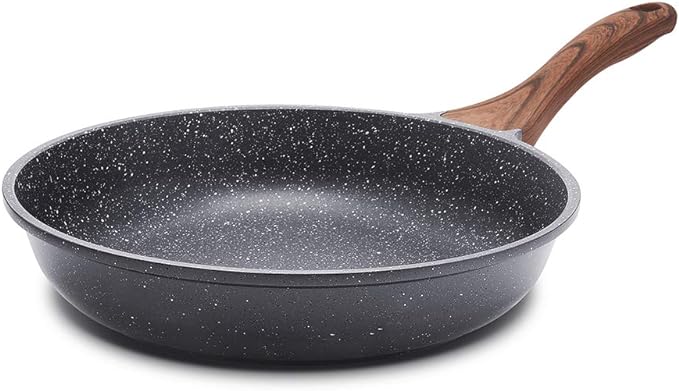
SENSARTE’s granite‑coated pans have quietly built a huge fan base. This 10" skillet has slightly taller sides than some competitors, a very slick ILAG coating, and a faux‑wood handle that feels comfortable and stays cool while you cook.
Where it shines
- Fantastic for breakfast: omelettes, fried eggs, and hash browns release cleanly and cook evenly when you heat it gently.
- Works on induction thanks to its magnetic stainless base, which isn’t a given in this price band.
- Deep sides mean fewer splatters and more flexibility for tossing veggies or cooking saucy dishes.
- Most owners mention how easy it is to wipe clean—often just a quick rinse and a soft sponge.
Good to know
- The handle screws on with a bolt; it’s solid, but you may tighten it once in a while (the included screwdriver makes this painless).
- Like other granite‑style coatings, it’s still a nonstick surface that will eventually wear—don’t treat “stone” as literal rock.
- Not designed for super‑high oven temps; treat it as a stovetop‑first pan with the occasional low‑temp oven finish.
Ideal for: home cooks who prioritize easy breakfasts, want induction compatibility, and prefer a slightly deeper skillet that can pull double duty for small one‑pan meals.
7. Blue Diamond Hybrid 10" Stainless – Sear Like Steel, Release Like Nonstick

This hybrid Blue Diamond pan is interesting: under the hood it’s a tri‑ply stainless skillet, but the cooking surface has a raised stainless “grid” and a ceramic nonstick coating in the valleys. The idea is to give you more searing power and durability than a typical slick‑bottomed nonstick pan, while still making cleanup easy.
Why it stands out
- Tri‑ply construction gives you fast, even heating across the whole surface, including the sides.
- Textured surface lets you get real color on steaks, chops, and chicken while still helping food release more easily than bare steel.
- Rated for extremely high oven and broiler temps, so you can blast‑finish steaks or roast vegetables without babying it.
- Sturdy, stay‑cool handle feels very secure when you’re moving a full pan in and out of the oven.
Good to know
- The raised texture feels different under a spatula; some cooks love it, others prefer a completely smooth surface.
- Despite being tough, it’s still a coated pan—avoid metal tools if you want the ceramic layer to stay nice for years.
- Heavier than aluminum‑only pans; great for searing, but it won’t feel featherlight in the hand.
Ideal for: home cooks who want a nonstick‑leaning pan that can legitimately sear meat and survive high‑heat oven use, but aren’t ready to jump to full stainless for everything.
8. Tramontina Professional 10" – The Classic Restaurant‑Style Nonstick

If you’ve ever peeked into a diner kitchen and seen a silver pan with a brightly colored handle flying around, it was probably something like this Tramontina. Food & Wine, Cook’s Illustrated, and other test kitchens have called it out repeatedly as one of the best bang‑for‑buck nonstick skillets on the market.
What makes it special
- Heavy‑gauge aluminum base heats quickly and evenly, with fewer hot spots than many cheap pans.
- Nonstick coating holds up unusually well for the price, especially if you avoid metal utensils and high heat.
- Long, comfortable handle with removable silicone sleeve: grippy on the stovetop, bare metal for oven use.
- NSF certification and widespread restaurant use give confidence that it can handle real‑world abuse.
Good to know
- Not induction compatible; it’s designed for gas and electric burners.
- Like any PTFE‑based coating, it will eventually wear—think years, not decades, of heavy use.
- The red handle cover can get slippery over time if you cook with a lot of oil; it’s removable for cleaning.
Ideal for: people who cook a lot on gas or electric stoves and want a serious, restaurant‑style nonstick pan that can handle constant breakfasts and weeknight dinners without drama.
9. Tramontina Tri‑Ply Clad 10" – All‑Clad‑Style Performance for Less

Tramontina’s tri‑ply clad pans are cult favorites among cooks who want All‑Clad‑style performance without the All‑Clad price. You get 18/10 stainless steel inside and out with an aluminum core running up the sides—ideal for even searing and pan sauces.
Why stainless nerds love it
- Heats very evenly and responds quickly to changes in burner temperature.
- Works beautifully on induction, gas, and electric; oven‑safe to 500°F for finishing steaks or frittatas.
- Interior is tough enough for metal utensils and scouring pads once you’re done cooking.
- NSF certification and a lifetime warranty at this price make it one of the strongest stainless values out there.
Good to know
- There’s a learning curve if you’re coming from nonstick; you need to preheat, add enough fat, and let proteins release before flipping.
- Food will stick if you crank the heat to max or move things around too early—but that’s true of all stainless.
- For mirror‑polished looks, you’ll want a gentle stainless cleaner like Bar Keeper’s Friend once in a while.
Ideal for: cooks who want a serious stainless skillet for searing, deglazing, and oven work, and are willing to trade a few early sticky eggs for performance that only gets better with practice.
10. SENSARTE Deep 10" Sauté Pan – Skillet, Saucepan, and Wok in One

Think of this as the “weeknight dinner pan.” It’s deeper than a standard skillet, comes with a glass lid, and has a pour spout for draining off soup or excess oil. If you’re trying to simplify your cookware, this kind of high‑sided 10" pan can replace a couple of pots and a shallower fry pan.
Why it’s so versatile
- 3.5‑quart capacity comfortably handles stews, pasta, fried rice, and skillet lasagna for a family of four.
- Induction‑compatible base and die‑cast aluminum body heat quickly and evenly, even when the pan is fully loaded.
- Pour spouts on the side make it easy to drain fat or ladle broth without dripping everywhere.
- Tempered glass lid lets you keep an eye on things without losing heat or moisture.
Good to know
- Because the walls are taller, it’s a little less convenient for classic “flip the egg” maneuvers; use a spatula instead.
- Takes up more cupboard space than a low‑sided skillet—though it can replace other pots if you let it.
- As with its shallower sibling, treat the granite coating gently for longest life.
Ideal for: small kitchens, minimalists, or anyone who loves one‑pan meals and wants a single pan that can shallow‑fry, stir‑fry, simmer, and sauté.
11. Cuisinart Chef’s Classic 10" – Affordable Stainless for Learning the Craft

Cuisinart’s Chef’s Classic line is a long‑running favorite for people stepping up from thin, no‑name stainless. An encapsulated aluminum disc in the base helps spread heat, and the polished stainless interior lets you build fond and deglaze like you see on cooking shows—without spending a fortune.
Why it’s a smart starter
- Solid, oven‑safe construction with a mirror‑polished exterior that still looks good after plenty of use.
- Cool‑grip handle feels secure and stays comfortable even for longer cooking sessions.
- Excellent for learning stainless technique on proteins, veggies, and pan sauces.
- Backed by a lifetime warranty, which is wild at this price.
Good to know
- The aluminum is only in the base, not fully up the sides, so you may see slightly hotter spots at the center on powerful burners.
- Eggs will stick if you treat it like nonstick; this is more for searing and sautéing than for naked scrambled eggs at 6 a.m.
- Doesn’t come with a lid, though many Cuisinart saucepan lids fit if you own the set.
Ideal for: cooks who want to dip their toes into stainless without committing to a whole premium set yet—and who like the idea of one pan that can go from stovetop to screaming‑hot oven without worrying about coatings.
12. GreenPan Paris Pro 10" – PFAS‑Free Nonstick That Feels Grown‑Up

The Paris Pro line is where GreenPan leans into more serious construction: a hard‑anodized aluminum body for better heat distribution, and an upgraded Thermolon ceramic coating that’s reinforced and rated safe with metal utensils. It feels noticeably more substantial than many cheaper ceramic pans.
Why it feels a cut above
- Excellent out‑of‑box nonstick performance with very little oil—great for eggs, fish, and delicate crepes.
- Hard‑anodized exterior is tougher and more scratch‑resistant than plain aluminum finishes.
- Oven and broiler safe to high temperatures, opening up frittatas, gratins, and finishing steaks.
- Many long‑term users report better durability here than on entry‑level ceramic lines, especially with moderate heat and gentle cleaning.
Good to know
- Despite metal‑utensil marketing, babying the surface with silicone or wood is still the safer bet for longevity.
- Heavier than thin ceramic pans; if weight is a concern, the Rio or CAROTE pans feel lighter.
- No included lid—pair it with a universal 10" lid if you braise or steam often.
Ideal for: home cooks who want a PFAS‑free nonstick that feels closer to pro cookware, and who are willing to spend a bit more upfront for a pan that can legitimately replace a lot of day‑to‑day cooking.
13. Cuisinart FusionPlus 10" – Stainless Body, Raised Armor, Ceramic Surface
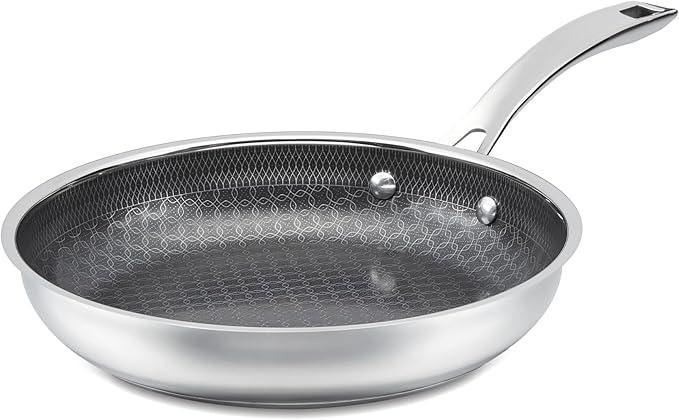
FusionPlus is Cuisinart’s modern answer to “I want nonstick, but I’m tired of babying it.” The stainless interior has tiny raised “peaks” (ArmorGuard) that take the brunt of abuse, while a ceramic nonstick coating lives in the valleys. The idea is to make a pan that’s scratch‑resistant, induction‑friendly, and still slick enough for eggs.
Why it’s interesting
- Stainless construction with an aluminum‑encapsulated base gives good heat distribution on all stovetops, including induction.
- The textured interior helps protect the coating if you accidentally scrape with a metal utensil.
- PFAS‑free ceramic surface appeals to cooks who want to avoid traditional PTFE coatings.
- Dishwasher‑safe and oven‑safe, so cleanup and finishing dishes are both straightforward.
Good to know
- The pan really wants a proper preheat at medium‑low and a bit of oil; skip those steps and foods like eggs may stick.
- Some reviewers expecting “Teflon‑level” slipperiness are disappointed—this is more of a hybrid stainless pan with easier release, not a super‑slick egg pan.
- The straight, relatively tall sides make flipping food with a wrist flick a little tougher than in more flared pans.
Ideal for: cooks who like the idea of stainless but want something friendlier for sticky foods, and who don’t mind following the preheat instructions to get the best out of the pan.
14. OXO Enhanced 10" Ceramic – Widely Recommended, Incredibly Easy to Live With

OXO’s nonstick skillets have been darlings of serious testing sites for years, and this updated ceramic version brings that same “just works” feeling to a PFAS‑free coating. Food & Wine and other outlets regularly highlight it as a top non‑toxic nonstick: slick, well‑balanced, and genuinely pleasant to cook with.
Why it’s a top pick
- Diamond‑reinforced ceramic coating is very slick and releases foods cleanly with minimal oil when you stay at medium heat.
- Hard‑anodized body gives you better heat conduction and scratch resistance than basic aluminum pans.
- Comfortable stainless handle feels secure and stays cool enough to grip without a mitt under normal stovetop use.
- Dishwasher‑safe, but also so easy to hand‑wash that you may not bother loading it.
Good to know
- As with other ceramic pans, long‑term durability depends heavily on how you treat it—avoid high heat and aerosol sprays.
- Some recent buyers note that the coating seems slightly less long‑lived than older OXO PTFE pans; that’s the trade‑off for a PFAS‑free surface.
- Rated to 430°F in the oven, so it’s fine for frittatas and casseroles but not for ripping‑hot broiler sessions.
Ideal for: home cooks who want a non‑toxic‑leaning, well‑reviewed nonstick skillet from a brand with a strong track record in independent tests—and who are happy to respect the “no max heat” rule.
15. Cuisinart MultiClad Pro 10" Nonstick – Tri‑Ply Performance with a Forgiving Surface

Cuisinart’s MultiClad Pro line is often described as “the budget All‑Clad,” and that’s not far off. You get a fully bonded tri‑ply body—stainless inside and out with an aluminum core—for fast, even heat, plus a high‑quality nonstick interior to keep eggs and delicate foods stress‑free.
Why serious home cooks love it
- Heats very evenly across the whole cooking surface, including the side walls, which makes searing and simmering feel more controlled.
- Works on all stove types, including induction, and is oven‑ and broiler‑safe to high temperatures.
- Handle stays impressively cool for a stainless pan and has a nice thumb rest for control when tilting and pouring.
- Exterior looks and behaves like other pro‑level tri‑ply pans, so it fits seamlessly into a stainless cookware lineup.
Good to know
- The nonstick interior is still a coating; even though the body might last decades, the slick surface will eventually need replacing.
- Some owners report discoloration if they repeatedly blast it on max gas or electric heat—medium‑high is usually all you need.
- On the heavier side for a 10" nonstick; that’s part of what makes it feel stable and “pro,” but it’s noticeable if you’re used to thin pans.
Ideal for: enthusiastic home cooks who want one pan that behaves like high‑end tri‑ply stainless but still gives them the ease of nonstick for trickier foods, and who are happy to invest in something that feels truly premium.
What a 10‑Inch Skillet Actually Gets You (and When to Size Up or Down)
“10 inches” doesn’t sound very descriptive until you put the pan on your stove and start cooking. Here’s how this size behaves in real life, plus a few tips for getting the most from whatever material you choose.
Why 10 inches is the sweet spot
- Big enough for real meals – You can easily cook 3–4 fried eggs, two good‑sized chicken breasts, or a full grilled‑cheese lineup without crowding.
- Small enough to heat evenly – On typical home burners, a 10" base sits nicely over the flame or element, so you don’t end up with stone‑cold edges and a scorched center.
- Friendly with standard lids – Many 10" skillets share lid sizes with common saucepans and Dutch ovens, which makes covering and simmering easier.
- Practical for storage – It stacks easily and doesn’t hog half a cabinet the way 12–14" pans can.
Most people find that a 10" skillet quietly does 80% of their daily cooking. If you already own a tiny 8" egg pan and a hulking 12" searing pan, the 10" size is the “just right” option that bridges the gap.
Getting the best from your chosen material
- With nonstick and ceramic – Keep heat in the low‑to‑medium range, avoid aerosol sprays, and let the pan preheat for a minute before adding eggs or pancakes.
- With stainless steel – Preheat dry until a drop of water skitters, then add oil and food. Don’t force food to move until it naturally releases.
- With cast iron – Give it time to come up to temp, use a bit more fat, and resist the urge to constantly adjust the heat; the pan holds heat for a long time.
- For all pans – Avoid shocks (like rinsing a screaming‑hot pan in cold water), which can warp bases and stress coatings.
Once you understand how your material wants to be treated, the size becomes the easy part: a 10" skillet is simply big enough to be useful every day, but small enough to heat well on the kind of burners most of us actually own.
FAQ: 10‑Inch Skillets, Answered
Is a 10‑inch skillet big enough for a family?
How long should a good nonstick skillet last?
Are ceramic and “granite” coatings really safer?
Do I actually need both nonstick and stainless or cast iron?
What’s the best way to clean and care for these pans?
Final Thoughts: Picking Your Best 10 Inch Skillet Partner
You don’t buy a skillet just to admire it—you buy it so everyday cooking gets easier. Quicker breakfasts on busy mornings, steaks with real crust instead of a gray shrug, fewer stuck eggs, and fewer pans to scrub at the end of the night all add up to a quieter, happier kitchen.
Here’s a quick way to turn this whole guide into a decision:
- Want the simplest, most affordable PFAS‑free nonstick? Start with Blue Diamond’s 10" ceramic pan or the lightweight GreenPan Rio.
- Want a budget‑friendly everyday nonstick that feels solid? Look hard at CAROTE’s basic 10" skillet, the lidded CAROTE with glass top, or either of the SENSARTE granite pans.
- Want restaurant‑style performance from nonstick? Go for the Tramontina Professional 10" or the hybrid Blue Diamond stainless hybrid.
- Want a “forever pan” for serious searing? Choose Lodge’s cast‑iron classic for maximum heat retention, or the Tramontina Tri‑Ply or Cuisinart Chef’s Classic if you prefer stainless.
- Want premium, but still want nonstick? Step up to GreenPan Paris Pro, OXO’s Enhanced 10" ceramic, or the fully clad Cuisinart MultiClad Pro nonstick.
- Want one deep pan that does almost everything? The lidded SENSARTE deep sauté is hard to beat for one‑pan weeknight cooking.
Any of the pans above can easily become your best 10 inch skillet once you match their strengths to your stove, your cooking habits, and your budget.
Measure your burner, think honestly about what you cook most, decide whether you want maximum ease or maximum lifespan—and then pick the pan that makes you a little happy every time you reach for it. After that, it’s just a matter of heating, seasoning (or not), and letting your new favorite skillet quietly upgrade every meal you cook in it.
