
Specs are compiled from manufacturer listings and verified buyer reviews and can change over time — please confirm the key details on the product page before buying.
If your miter saw sounds fine but your trim still comes out fuzzy, the blade is the problem — not the saw. Almost every 10 inch blade mounts on the same 5/8-inch arbor, so the real choice is tooth count and grind, not brand loyalty. Here is what actually matters for the cuts you make most often, and which blades handle them cleanly.
I’m Mohammad Maruf — the founder and writer behind KitchPrep. This guide is built by comparing the manufacturers’ published specifications and the patterns across verified customer reviews, so you get each pick’s real strengths and trade-offs instead of marketing spin.
A blade with more teeth leaves a smoother finish but feeds slower, while a low-tooth blade rips fast and rough. Match the tooth count to your material and you stop sanding every cut. This breakdown of the best 10 inch miter saw blade options covers tooth count, kerf and hook angle.
Our Picks at a Glance


How To Choose The Best 10 Inch Miter Saw Blade
Every blade below fits the same saw — a 10-inch diameter with a 5/8-inch arbor, the hole in the middle that slides onto your saw’s spindle. So the differences that decide your cut are the ones you can read straight off the label. Work through these four before you pick.
Tooth count sets your finish
More teeth means each one shaves a thinner sliver, so the cut comes out cleaner and needs less sanding. A 24-tooth blade clears material fast but leaves a rougher edge on crosscuts, while a 60 or 80-tooth blade is built for finish work like trim and cabinet parts. High tooth counts also feed slower, so let the blade do the work and don’t force it through hardwood.
Kerf and hook angle
Kerf is the width of the slot the blade cuts, and a thin kerf takes less material out and puts less drag on the motor — which matters if you run a smaller saw. Hook angle is the tilt of each tooth. A negative hook angle pushes the work down, which helps control a sliding miter saw or radial arm saw, while a positive angle bites in and pulls the work toward the table.
Wood, metal or both?
Blades meant for wood and blades meant for metal are not interchangeable jobs. Wood blades have fewer, more aggressive teeth; metal-cutting blades run a triple chip grind and a shock-resistant brazing so they survive slicing aluminum and steel. Buy for the material you cut most, then get a second blade if you split your work evenly.
Quick Comparison
| Model | Best For | Teeth | Kerf | Max RPM | Amazon |
|---|---|---|---|---|---|
| Diablo D1080N★ Best Overall | Cutting aluminium and plastic cleanly | 80 TCG | 0.094″ | 6000 | Amazon |
| Luckyway 60T TCTBest Value | Budget fine-finish crosscuts | 60 | 0.098″ | 5,350 | Amazon |
| DEWALT DW3112Budget Ripping Pick | Fast rips and rough framing cuts | 24 | — | — | Amazon |
| Benchmark Abrasives TCT | Metal and steel cutting | 80 | — | — | Amazon |
| Makita A-93675 | Smooth crosscutting on laminates | 60 | 0.091″ | 5,870 | Amazon |
| CMT 255.080.10 | Ultra-fine trim and finishing | 80 | 0.110″ | — | Amazon |
| Oshlun SBW-100060N | Sliding miter and radial arm saws | 60 | — | — | Amazon |
| Makita B-66977 | Cordless miter saw efficiency | 80 | — | — | Amazon |
In‑Depth Reviews
1. Diablo Saw Blade – 10″ Diameter, 80 TCG Teeth, 5/8″ Arbor
Our pick — over 4.5★ from 750+ verified ratings; the strongest balance of quality and price.
The non-ferrous specialist that slices aluminium without melting it
If you cut aluminium extrusion, plastic or brass on a miter saw, this is the blade to start with. Its 80 triple chip grind teeth (a flat-topped tooth with angled corners that shears material instead of grabbing it) leave a burr-free edge that often needs no rework. That single design choice is why it takes the top spot here. The crowd agrees — 4.7 stars across 700+ ratings.
What wins people over is the cutting performance, and it is clearly the headline: this is the most-praised trait by a wide margin. Buyers report it crosscuts splintery plywood, melamine and 1/16-inch aluminium with no melting and no chipping. One owner put it plainly: “Diablo D1080N 80T TCG cuts 0.093 ABS (no melting), splintery plywood crosscut, melamine, and 1/16 aluminum perfectly.” The 0.094-inch kerf is thinner than the Luckyway’s 0.098-inch kerf, so it takes less material out of every pass.
At 0.071-inch plate thickness and 1.5 pounds, it runs light on the arbor. The Perma-SHIELD non-stick coating keeps gum and heat from building up, and the laser-cut stabiliser vents trap noise to cut vibration. The trade-off: this is a non-ferrous blade, so it is not the one for cutting hardwood trim — for that, look at the Makita 60-tooth below. It also demands a slow, steady feed and a rigid saw; rushed passes on a flexible setup leave wavy cuts.
What it gets right
- 80 TCG teeth deliver burr-free cuts on aluminium, brass, copper, plastic
- 0.094″ kerf and 1.5 lb weight keep drag low on the motor
- Perma-SHIELD coating resists heat, gumming and corrosion
- Tri-Metal brazing survives metal cutting without losing teeth
Where it asks more of you
- Not built for hardwood trim — that needs a wood-cutting blade
- Wants a rigid saw and a slow, consistent feed to stay square
- Packaging insert lists wood materials, so confirm the stamp on the blade
Reach for this if: you cut aluminium, plastic or brass and want a finish that needs no sanding.
Look elsewhere if: your work is mostly hardwood crosscuts — a wood-specific blade will serve you better.
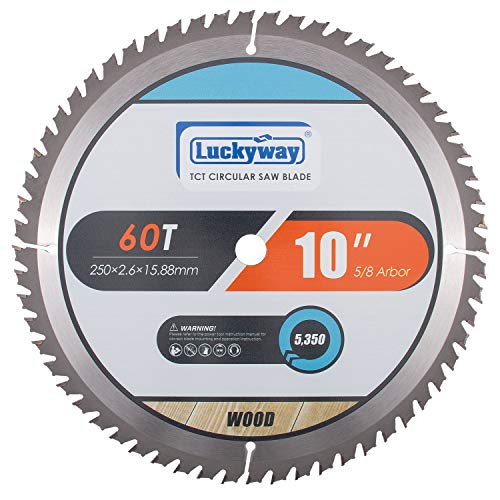
2. Luckyway 10 Inch Table/Miter Saw Blade 60T Fine Finish with 5/8 Inch Arbor
A 60-tooth finish blade that punches well above its entry-level price
This is the blade you buy when you want cleaner crosscuts without spending much, and it holds a strong 4.6 stars across 800+ ratings to prove it. The 60 tungsten carbide teeth and 0.098-inch kerf produce smooth cuts in wood and alloy steel, and its thin plate feeds faster than a heavier full-kerf blade. A 40-year furniture maker called it “razor sharp through 2″ hard ash,” with a feed that just glides.
What owners praise most is blade quality, and value for money runs right behind it — a rare pairing at this level. The kerf is a touch wider than the Diablo’s 0.094-inch, which means slightly more material removed per cut, but that same thin plate is what lets it feed so quickly. For plywood and trim work it comes out tear-out free in both directions, with and across the grain.
The honest catch is durability, where feedback splits. A thin plate cannot shed heat like a thick one, so it tolerates only one resharpening before it is done, and the small teeth dull faster under heavy production runs. Treat it as a thin-kerf consumable: excellent for home shops and weekend projects, less suited to a cabinet shop running it all day. Owners who understand that get remarkable performance for the money.
The value case: A 60-tooth finish cut at an entry-level price, with 0.098-inch thin kerf feeding faster than a full-kerf blade in ash and plywood.
The honest limit: Durability is the mixed spot — thin plate, small teeth, and realistically just one resharpening before it gives out.
Buy it for: budget-conscious home shops that want glass-smooth crosscuts in wood and occasional aluminium.
Pass if: you need a blade that survives daily production and repeated sharpening.
3. DEWALT 10-Inch Miter / Table Saw Blade, ATB, Thin Kerf, 5/8-Inch Arbor, 24-Tooth (DW3112)
A 24-tooth workhorse that eats through stock fast
Fewer teeth means faster feeding and less heat, which is exactly why this 24-tooth blade is the pick for ripping and rough crosscuts. With 24 teeth instead of the Diablo’s 80, it clears material fast — but the finish is rougher, so it is a framing and rough-work blade, not a trim finisher. It holds 4.7 stars across 300+ ratings.
What owners call out most is cutting performance, with value for money close behind. It has been reported to cut through 4x4s like butter, and a contractor building exotic hardwood items rated these “best value blades,” saying they outperform more expensive ones and hold a glue-line cut without drag. That is a genuine surprise at this price, and the wedge-shoulder design puts more steel behind each tip for durability.
The trade-off is finish quality: 24 teeth leave a rough edge on crosscuts, so it is the wrong tool for trim or cabinet work. It is also heavier than the finer blades here at 1.7 pounds — the DEWALT runs 1.7 pounds against the Diablo’s 1.5 pounds, so if arm fatigue on a long day matters, note the difference. For pure stock removal, none of that slows it down.
Where it earns its keep: 24 teeth rip fast, run cool and hold a glue-line cut — one contractor reported 6+ months of daily use on a portable saw.
Where it stops: Rough finish makes it a poor fit for trim, and at 1.7 pounds it is the heavier of the finer blades here.
Ideal for: framing, decking and heavy stock removal where speed beats a fine finish.
skip it if: your cuts need to come off the saw trim-ready.
4. Benchmark Abrasives TCT 10 Inch Circular Saw Blade, 80 Teeth

Built to chew through steel, stainless and cast iron
This is a metal-cutting blade first and foremost, and it is tuned for that work rather than wood. Its 80 tungsten carbide tips slice cast iron, steel, stainless steel, titanium and wrought iron, fitting most 10-inch miter and circular saws from Evolution, Dewalt, Milwaukee, Makita and others. It sits at 3.8 stars across 200+ ratings — the lowest score on this list, and the reviews explain why.
When it works, it works well. Owners mention cutting 1/8-inch steel with fewer sparks and chips than Evolution blades, cutting panel roofing like butter with no grinder cleanup needed, and trimming aluminium railing through 50+ cuts with no visible wear. The blade quality and value are the strongest themes in the feedback.
The problem is consistency. Longevity is where reviews split hardest — some units dulled after as few as four cuts of 16-gauge galvanised tubing, while others last dozens of cuts on the same job. Go slow, watch for chatter and let the blade do the work, as the metal-cut veterans advise, and it treats you better. If you cut metal every day, plan on a premium metal blade; for occasional metal jobs, this one delivers its cuts.
The strong side: Each cut is clean enough to skip the grinder — 1/8-inch steel, panel roofing and aluminium railing finish with no cleanup.
The honest variable: Longevity swings widely between cuts-per-blade reports, so it works best as a light-use metal blade rather than a daily production tool.
Worth it when: you cut metal occasionally and want clean results across steel, stainless and aluminium.
Think twice when: metal is your daily trade — a premium metal blade will last longer between changes.
5. Makita A-93675 10-Inch 60 Tooth Micro Polished Mitersaw Blade
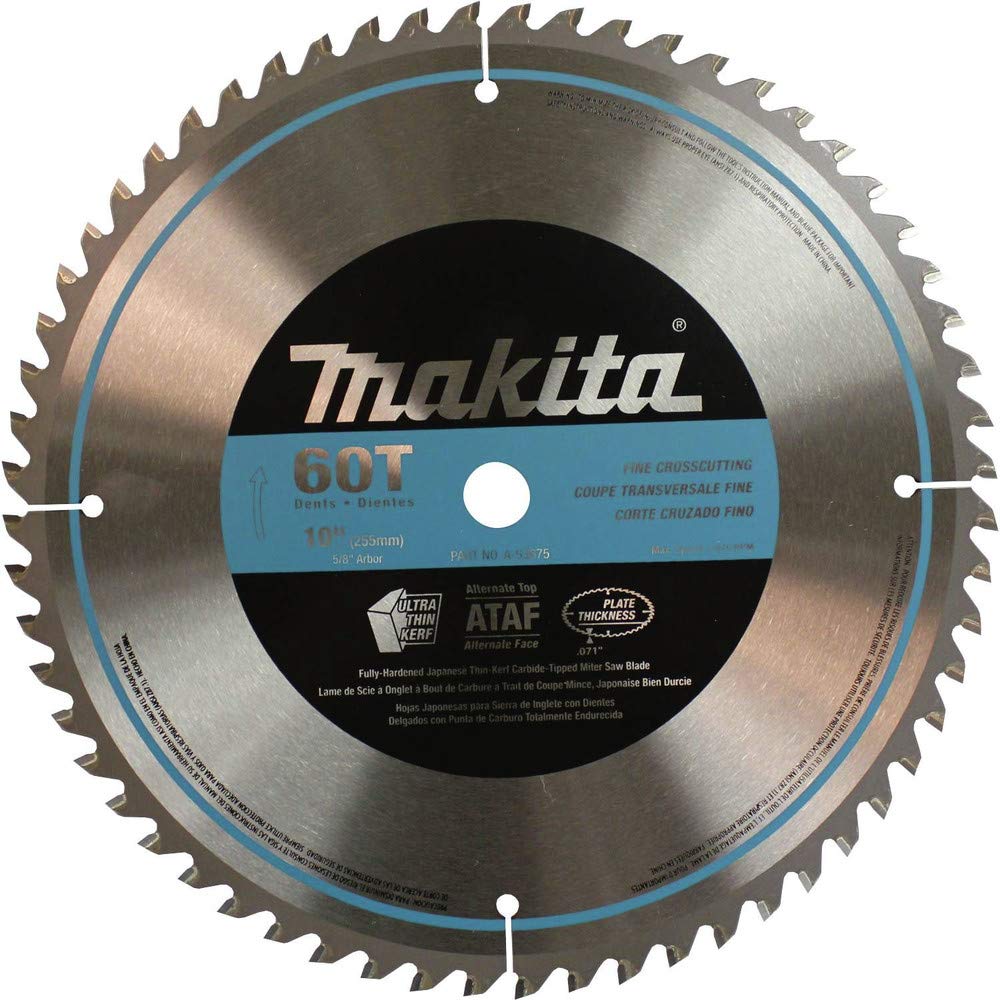
A mirror-polished crosscutter that leaves a 180-grit finish
If smooth crosscuts on laminate and particle board are your priority, this 60-tooth blade is the one to shortlist. Its micro-grain carbide teeth are honed to up to 600 grit for a mirror finish on each tip, and the fully hardened, hand-tensioned plate runs true. At 0.091 inches it has the thinnest kerf of anything on this list — even thinner than the Luckyway’s 0.098-inch — so it removes the least material and glides through with minimal resistance. It earns 4.7 stars across 200+ ratings.
What owners praise most is sharpness, with value for money a close second. It goes through hardwood and plywood without walking, and it allows 180 to 220-grit sanding right after the cut on end grain. One pro trim carpenter called it the best blade owned, saying it beats WKW, Freud and Amana blades in performance. The 5,870 RPM rating clears any standard miter saw’s top speed with room to spare. Against the CMT’s 0.110-inch kerf it slips through with noticeably less drag.
The catch is that this is a wood blade, full stop — its intended materials are particle board and laminates, so it will not help you cut aluminium. It is also on the premium side of mid-range pricing for a 60-tooth blade, though the store of reviews calling it money well spent suggests it holds up to the cost. If your shop is a mix of wood and metal, budget for two blades rather than expecting one to do both jobs.
Why it earns a place
- 0.091″ kerf is the thinnest on this list, cutting the least material
- 600-grit honed teeth leave a finish that sands at 180–220
- 5,870 RPM ceiling clears standard miter saw speeds
- Runs true through walnut and maple without slowing the blade
What you trade for it
- Wood-only, so not suitable for aluminium or metal
- Premium-leaning cost for a 60-tooth blade
- You need a second blade if you also cut metal
Right for: cabinet and trim work where the cut needs to come off the saw ready to sand.
Wrong for: anyone who wants one blade to handle wood and metal both.
6. CMT Orange Tools 255.080.10 Ultra Fine Finishing Saw Blade
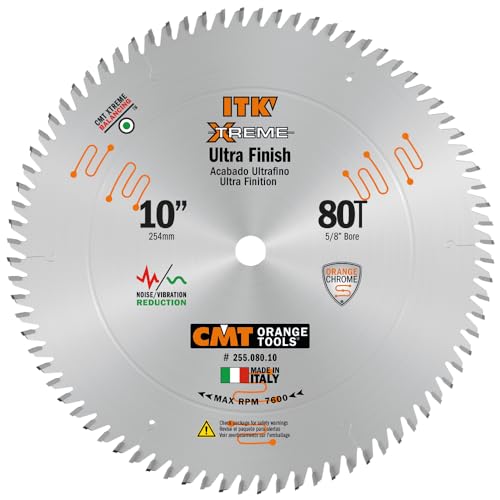
A trim-work specialist ground for tear-out control
Built for ultra-fine finishing, this 80-tooth blade uses a Hi-ATB 30° grind (a steep alternate-topped tooth profile) to reduce tear-out on engineered wood, glass and trim. It fits radial arm saws, miter saws and table saws, and its 0.110-inch kerf is the widest here — wider than the Makita’s 0.091-inch — which means it removes more material but runs with more stability. It earns 4.7 stars across 300+ ratings.
What owners call out most is blade quality, with cutting performance close behind. It is best known for very sharp, clean cuts with no tear-out on trim work, and one review noted it gliding through red oak with minimal splintering after replacing a stock blade on a cordless miter saw. On a baseboard job it is repeatedly singled out as a solid choice. The 0.071-inch plate keeps the body light on the arbor.
Where feedback splits is stability and burn resistance — some users report wobble during use, and the burn marking is inconsistent, with some seeing clean cuts and others marks around the edges. Neither is a hard fault, more a sign this blade rewards a well-tuned saw and steady feed. Long-term edge durability is also less settled than the short-term finish, so heavy users may see it wear before a full-kerf alternative. Compared to the Oshlun’s negative hook, its positive geometry suits fixed-head miter and table saws best.
What it nails: Tear-out control on trim — edge quality that lets you skip the sanding block on baseboard and oak.
What to watch: Stability and burn resistance came up as the mixed points, so tune your saw and feed it evenly.
Great match for: finish carpenters cutting baseboard, trim and laminate who want a clean edge.
Not for you if: you run a saw with known alignment slop or you cut metal as well as wood.
7. Oshlun SBW-100060N 10-Inch 60 Tooth Negative Hook Finishing Blade

The blade that stops a sliding saw from climbing the stock
If you run a sliding miter saw or radial arm saw, this blade solves the specific problem those saws create: the tendency to grab and climb through the board. Its negative hook angle tilts each tooth back, so the blade pushes the work down instead of pulling it forward. With 60 teeth and anti-vibration slots on a professional-grade C-4 carbide body, it earns 4.8 stars across 100+ ratings — the highest score on this list — and fits engineered wood.
What owners rate most is blade quality, with value second. It cuts bevels and crosscuts like a hot knife through butter, and the negative rake stops the saw from lunging forward on thick cuts. It leaves minimal chip-out, and it runs clean with very little splintering on pine and cedar. Against a positive-hook blade like the CMT above, the control here is the whole point — it is the difference between a smooth glide and a sudden grab.
The trade-off is noise. Some users report a heavy whine at speed, and one user heard a siren-like whine at 3600 RPM loud enough to need hearing protection. Full-kerf blades like this one are also heavier-cutting than thin-kerf options, so they favour a saw with enough power to drive them. It is worth it for the control on a sliding setup, less so on a small bench saw.
Its standout trick: The negative hook angle eliminates the climb and grab that sliding and radial arm saws are prone to, staying planted through thick crosscuts.
The honest note: It runs loud, with a whine that warrants hearing protection, and full-kerf cutting wants a saw with real power behind it.
Built for: sliding miter saw and radial arm saw owners who want the blade to stop climbing the work.
Less ideal for: small bench saws where a thin-kerf blade would feed more easily.
8. Makita B-66977 10″ 80T Carbide-Tipped Max Efficiency Miter Saw Blade

The battery-sipping crosscutter that makes tape obsolete
On a cordless miter saw, every cut draws from your battery, so a blade that removes less material and puts less load on the motor goes further. That is this blade’s design brief. Its thin kerf and special ATAFR (alternate top alternate face with raker) carbide tips reduce drag, and Makita claims up to 100% faster cutting and up to 30% more cuts per charge than standard blades.. It earns the joint-highest 4.8 stars across 200+ ratings.
What owners praise most is cutting performance, with blade quality close behind. It cuts through 8/4 and 12/4 stock without complaint and leaves a finish smooth enough that you can drop the painter’s tape you used to add on plywood crosscuts — the veneer stops splintering on its own. One cabinet installer working with maple said you cannot find a blade mark in the cut, calling this 80-tooth better than a 90-tooth Diablo for less gumming. The 80 teeth keep the finish well past what the DEWALT’s 24 teeth could manage.
One thing to check is fit: it is reported to be slightly larger in diameter than some 10-inch blades, and on at least one table saw model it interfered and could not spin. That is likely saw-specific rather than a defect, and returns were straightforward, but measure your clearance on a tight-arbour setup before committing. Otherwise it is a clean upgrade for anyone running cordless and chasing runtime.
The case for it: Its thin kerf and ATAFR tips cut drag on the motor, which is what backs Makita’s faster-cutting and more-cuts-per-charge claims.
The check before you buy: Its slightly-larger diameter tripped up a tight table saw fit, so confirm clearance on your saw first.
Go for it if: you run a cordless 10-inch miter saw and want longer runtime and cleaner crosscuts per charge.
Check first if: you run a table saw where blade diameter fit is tight.
Understanding the Specs
Tooth count and grind
Tooth count is the number of cutting tips around the rim, and it sets your ceiling on finish quality. More teeth means the blade shaves thinner slivers, leaving a smoother edge — 60 and 80-tooth blades suit trim and finish work. Fewer teeth clear material faster but leave a rougher cut, which is why a 24-tooth blade is for ripping, not trim. The grind is the shape of those teeth: a triple chip grind is built for metal and plastic, while an alternate-topped grind is for wood. The Makita 80-tooth above uses an alternate top alternate face with raker pattern to cut smoother and faster.
Kerf, hook angle and arbor
Kerf is the width of the cut, and it decides how much material you remove and how much drag the blade puts on your saw. A thin kerf like 0.091 inches cuts less material and feeds faster, which is a real advantage on a cordless saw — while a wider kerf runs more stably. Hook angle is the tilt of each tooth: a negative angle pushes the work down for control on sliding and radial arm saws, and a positive angle bites in harder. The arbor is the centre hole that mounts on your saw; every blade here uses the same 5/8-inch arbor, so they are interchangeable.
FAQ
Will a 10 inch miter saw blade fit my saw?
How many teeth do I need for smooth crosscuts?
Can I cut aluminium with a wood blade?
What does kerf mean on a saw blade?
What is a negative hook angle good for?
How long should a 10 inch miter saw blade last?
Is a thin kerf blade better than a full kerf?
Can one blade handle both wood and metal?
Do I need a special blade for cutting laminates and trim?
What is a triple chip grind used for?
Final Thoughts: The Verdict
For the woodworker who wants one confident answer, the Diablo D1080N is the best overall pick — the 80 tooth triple chip grind keeps aluminium, plastic and brass cuts burr-free, and it comes with a store of backing from owners who cut those exact materials. Its follow-up act is the Makita A-93675: if your work is wood crosscuts on laminate and particle board, that 0.091-inch ultra-thin kerf leaves a finish you can sand at 180 to 220 grit right off the saw.
Cutting on a tight budget? The Luckyway 60T delivers surprisingly fine crosscuts for an entry-level blade, so long as you accept its thin-plate lifespan. And if you run a cordless saw, the Makita B-66977 is the one built to stretch runtime per charge with its low-drag kerf and ATAFR tips. Match tooth count and material to the work you do, and any of these will earn its keep.
How We Picked
We do not accept paid placement. Every pick is matched to a real buyer and a real use-case; we do not hands-on test units.
Sources & Methodology
Specifications: manufacturer listings and product documentation. Review insights: verified customer reviews, as of September 2026. Pricing: not shown on this page (it changes often); check the current price via the retailer link.
As an Amazon Associate, KitchPrep earns from qualifying purchases. This does not affect which products we feature.
Related Guides
