
Specs are compiled from manufacturer listings and verified buyer reviews and can change over time — please confirm the key details on the product page before buying.
Before you buy a 10-inch blade for your miter saw, you need to know what metal you’ll cut most. Soft non-ferrous stock like aluminum needs a different blade than iron or steel, and picking the wrong one heats up, dulls fast, and turns a clean chop into a ragged tear. This guide sorts the best 10-inch options by the metal they actually handle, so you match the blade to your job.
I’m Mohammad Maruf — the founder and writer behind KitchPrep. This guide is built by comparing the manufacturers’ published specifications and the patterns across verified customer reviews, so you get each pick’s real strengths and trade-offs instead of marketing spin.
From fast aluminum blades to serious steel cutters, here is the honest breakdown of the best 10 inch metal cutting blade for a miter saw worth mounting on your arbor.
Our Picks at a Glance


How To Choose The Best 10 Inch Metal Cutting Blade for a Miter Saw
Before you click buy, you need to know that “metal cutting blade” is not one single product. It splits cleanly into two worlds: carbide-toothed blades that slice soft aluminum and plastic, and tougher steel-cutting blades made for iron, pipe, and roofing. Picking from the wrong world is how blades die early on the job.
Match the Blade to the Metal You Cut Most
A high-tooth-count blade with a Triple Chip Grind is the gold standard for aluminum, copper, brass, and plastics, leaving a burr-free edge. If your daily work is steel studs, rebar, or angle iron, you need a blade with fewer, tougher teeth built for ferrous material, and you should expect a rougher finish. The two are not interchangeable.
Know Your Saw’s Arbor and Speed Limits
Every 10-inch blade mounts on a 5/8-inch arbor, which nearly all miter saws use, but always double-check your arbor nut size and lock pin. Equally important is the max RPM stamped on the blade; running a metal blade faster than its rating is how blades fail dangerously, so match it against your saw’s no-load speed before you spin it up.
Quick Comparison
| Model | Best For | Teeth | Metal Type | Max RPM | Amazon |
|---|---|---|---|---|---|
| Diablo D1080N★ Best Overall | Clean aluminum & plastic cuts | 80 | Non-ferrous | 6000 | Amazon |
| MASTEC MTA1080Best Value | Budget aluminum chopping | 80 | Non-ferrous | — | Amazon |
| IVY Classic 40088-5Ferrous 5-Pack | Steel & iron cut-off | Abrasive | Ferrous | 6100 | Amazon |
| FOXBC FOX1080TCG | Value carbide for aluminum | 80 | Non-ferrous | — | Amazon |
| IVY Classic 35056 | Thin aluminum & siding | 200 | Non-ferrous | — | Amazon |
| TOMAX TMA10100 | Thin-wall aluminum | 100 | Non-ferrous | — | Amazon |
| BRSCHNITT BCO03254105R | Solid steel & rebar | 48 | Ferrous | 3000 | Amazon |
| Norske NCSBP216 | Steel roofing & siding | 72 | Ferrous | — | Amazon |
In-Depth Reviews
1. Diablo D1080N 10-Inch 80-Tooth
Our pick — over 4.5★ from 750+ verified ratings; the strongest balance of quality and price.
The aluminum whisperer that treats a 10-inch chop like a finishing tool
This is the blade that makes non-ferrous cutting feel like cheating. The 80-tooth Triple Chip Grind design leaves a mirror-smooth, burr-free finish on aluminum, copper, and brass, so you rarely reach for a file afterward. Owners rave about the cut quality so much that the recurring line is how it handles everything from 1/16-inch aluminum to plexiglass with zero melting or splintering, which is a rare trick for one blade.
Diablo backs the geometry with Tri-Metal Shock-Resistant Brazing and a Perma-SHIELD Non-Stick Coating, which fights heat, gumming, and corrosion on the job. You also get Laser-Cut Stabilizer Vents that trap noise and cut vibration, keeping the blade true through long runs of remodel and electrical work. It carries a 6000 RPM max rating and uses a.094-inch kerf with a -5 degree hook angle.
It takes the top spot for cutting performance and sheer reliability.
What wins people over
- Leaves clean, burr-free edges on 1/8-inch and 1/4-inch aluminum without rework
- Tri-Metal brazing holds up to heavy impact on the job site
- Non-stick coating resists gumming so it stays sharp longer
The honest trade-offs
- Premium price tag compared to entry-level 80-tooth blades
- Needs a rigid saw and steady feed to keep cuts square
Reach for it if: you cut aluminum, copper, or plastic often and want a factory-finish edge without cleanup.
Think twice if: your blade budget is tight and your cuts are rough stock anyway.
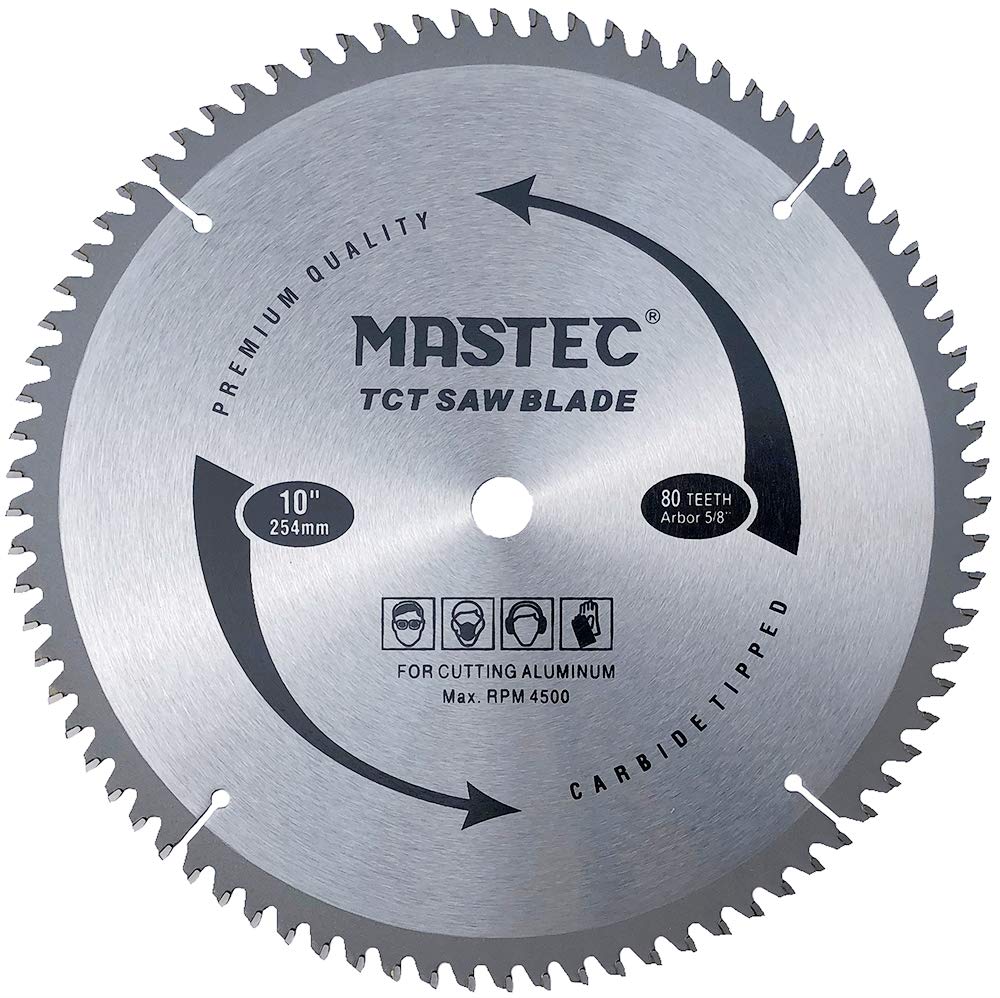
2. MASTEC MTA1080 80-Tooth TCG
A budget-friendly TCG that slices 6061-T6 aluminum like it was butter
A metal-cutting blade should not need a second mortgage, and this MASTEC delivers 80 carbide teeth that make clean work of aluminum, plexiglass, and other non-ferrous metals. It is a direct budget competitor to the Diablo above, and owners confirm it handles 3/8-inch thick wall 6061-T6 aluminum without complaint, even taking light facing cuts up the side of an angle. Cutting performance is the thing everyone raves about here, and it earns praise for leaving a nice, clean edge on angle stock and T-track without snagging.
It is built for the most common saws in a shop — miter saws, circular saws, and table saws — all on a standard 5/8-inch arbor. The Triple Chip Teeth geometry keeps the cut smooth through thin extrusions, and owners note it needs no filing after use, which speeds up production work considerably.
The honest caveat sits with durability, which reviews flag as mixed. Some buyers report carbide tips coming off over time, so this is a blade for lighter-duty and hobby use rather than non-stop industrial abuse. At this entry price, replacing it when it dulls is the plan most buyers accept.
For a first metal blade on a budget, this is the one to grab, and it holds its own against blades that cost double.
Why it earns a spot: it matches the cut quality of pricier 80-tooth TCG blades for a fraction of the cost.
Best for: home shop users cutting aluminum T-track, angle stock, and thin extrusions.
Keep expectations in check if: you plan to push it hard all day, since durability reviews are mixed.
3. IVY Classic 40088-5 Swift Cut 5-Pack
The abrasive workhorse for steel when you need five chances to get it right
This is not a carbide blade at all — it is a resin-bonded aluminum-oxide abrasive wheel, which is exactly what you want for cutting steel, angle iron, and sheet metal on a chop saw. It runs at a 6100 RPM max rating, and the blade is double reinforced with fiberglass mesh for durability and safety. Owners confirm it cuts through steel fence posts and 2×2-inch steel tubing with relative ease, though you should expect sparks and a rough edge that needs a quick pass with a file.
The genius here is the 5-pack format. Cutting ferrous metal chews through abrasive wheels fast, and the price works out so you can burn through a few without wincing. One honest owner note is that blades can vary — a first blade failed early on heavy tubing while the second finished the job — which is the nature of abrasive discs at this price point.
Because this is a Type 1 wheel for cutting only, it is not built for side grinding, and the heavy spark shower means you should work outdoors and protect your eyes and skin. The arbor is reinforced with metal for extra strength where the wheel meets the saw.
If your world is iron and steel rather than soft aluminum, this 5-pack is the budget-friendly way to keep cutting without downtime.
Choose this when: you cut steel tubing, angle iron, or fence posts and burn through blades regularly.
skip it if: your material is aluminum, which needs a toothed carbide blade instead.
4. FOXBC FOX1080TCG 80-Tooth

The dark-horse carbide blade that owners say competes fine with the big names
FOXBC is the blade that surprises people, with owners comparing it directly against the Diablo above and finding the cut quality comparable at a lower price. It brings 80 teeth in a Triple Chip Grind geometry, and owners mention it slices 3/8-inch acrylic with no tear-out or chipping, plus clean, smooth passes on 1/16-inch to 1/4-inch aluminum stock. Blade quality is the single most-praised trait, and it holds its own on a DeWalt 10-inch table saw without complaint.
The engineering mirrors the premium brands: laser-cut stabilizer vents to trap noise and vibration, and high-density tungsten carbide for toughness and wear resistance. It is compatible with DeWalt, Skil, Metabo, and Makita 10-inch miter, slide miter, and table saws.
The trade-off is that reviewers are honest about not yet testing long-term longevity — most projects so far are single-job runs. For the price, though, the value is hard to argue with, and several owners say they would repurchase without hesitation.
For a mid-range carbide blade that feels premium, this earns strong consideration.
The takeaway: owners call it a worthy rival to expensive brands for a fraction of the cost, with clean cuts to prove it.
Reach for this if: you want premium cut quality on aluminum and plastic without the premium brand premium.
Consider the alternative if: you need a proven long-haul blade with years of owner history behind it.
5. IVY Classic 35056 200-Tooth
A precision blade for feather-thin aluminum and siding where burrs are the enemy
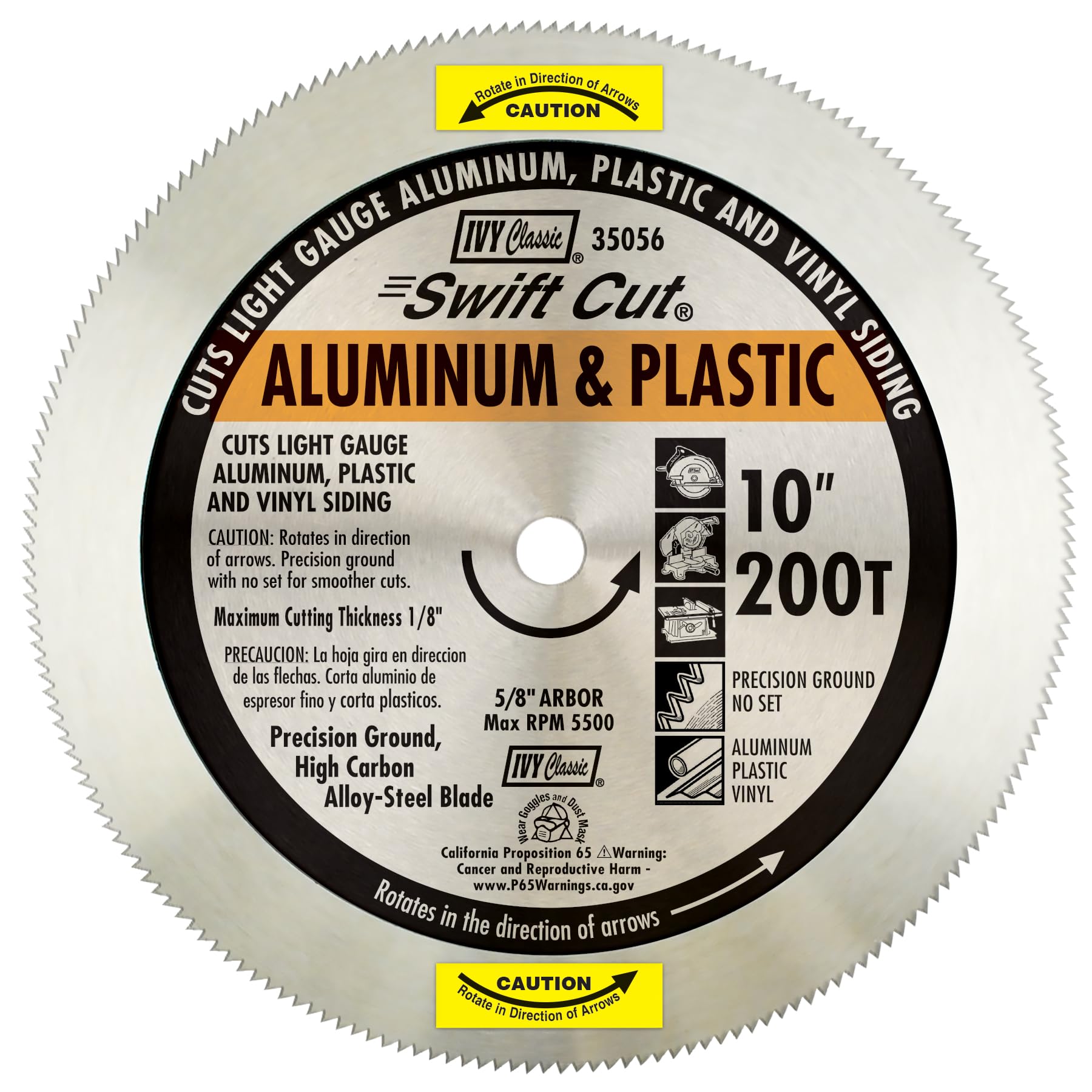
When your stock is light-gauge aluminum, plastic, or vinyl siding up to 1/8-inch thick, this 200-tooth blade is the specialist that delivers razor finishes. The high carbon-alloy steel body uses precision-ground teeth with no set, which means smooth, accurate cuts with almost no burr to clean up. Owners rave about the sharpness, with a standout use case being aluminum window screen frames that came out better than with a hacksaw.
Sharpness is the dominant praise here, and the blade shines on plexiglass and plastic picture-frame work on a table saw. The manufacturer is explicit that this blade is for material 1/8-inch thick or less; anything thicker should step up to a dedicated 80-tooth non-ferrous blade.
The honest downside is durability, which gets the most negative feedback. Several customers note the blade dulls faster than expected and can warp after heavier use, so treat it as a specialist for thin, clean work rather than an all-day steel eater. It also requires correct rotation — the blade must spin in the direction of the arrows, and at least one buyer found the arrow printed backwards on a unit.
For picture-frame plexi and window screen work, the finish quality justifies the price.
Where it excels
- Sharp 200-tooth edge leaves clean cuts on 1/8-inch plexi and vinyl
- Smooth, accurate finishes that rarely need sanding
- Great value for light-gauge specialty work
Know before you buy
- Only rated for material up to 1/8-inch thick
- Durability is the weakest point — it can dull or warp with heavy use
Best for: thin aluminum frames, vinyl siding, and plexiglass jobs demanding a burr-free edge.
Look elsewhere if: your metal is thicker than 1/8-inch or you need a blade for daily steel work.
6. TOMAX TMA10100 100-Tooth TCG

The thin-wall specialist that makes aluminum deck railing cuts feel easy
This TOMAX is engineered for one specific job: cutting thin aluminum and non-ferrous metal with wall thickness under 1/8-inch, and it executes that task flawlessly. The 100-tooth TCG grind produces a durable, smooth cut, and owners confirm it slices through.080-inch wall aluminum deck railings with a clean finish and no snagging. It also makes quick work of 1/8-inch aluminum plate, staying sharp through a dozen or more 24-inch cuts.
The blade uses construction-grade carbide teeth for maximum resistance and an electrophoretic coating that reduces rust and corrosion. Sharpness and cutting performance are equally praised, and it carries a limited lifetime warranty from TOMAX as a vote of confidence.
The clear caveat is that it is not for thick material — anything over roughly 1/8-inch wall is outside its design envelope. For the rain-gutter and thin-channel crowd, though, the smooth, noise-free cuts earn it a devoted following.
If you spend your days on aluminum extrusions and thin-wall channel, this is the specialist worth mounting.
The verdict: owners call it durable and sharp, with smooth cuts on aluminum railing and thin plate that justify the premium price.
Reach for it if: your stock is thin-wall aluminum tubing, gutters, or extrusions under 1/8-inch.
Pass on it if: you regularly cut solid bar, steel, or anything with thick walls.
7. BRSCHNITT 10-Inch 50-Tooth Steel Cutter
A tungsten-tipped iron eater that turns a portable saw into a steel cutter
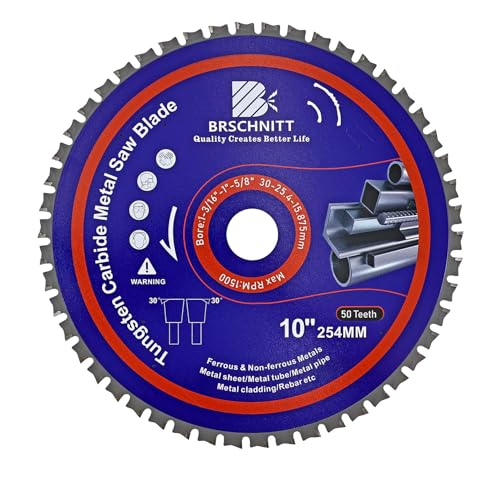
This BRSCHNITT is built for the jobs the aluminum blades above cannot touch — iron bars, angle iron, iron sheets, iron pipes, and rebar. It uses 48 tungsten carbide teeth on a high-quality steel matrix, and there is one critical spec to respect: the max RPM is 3000, with a recommended 1500 RPM for solid metal rods. Owners confirm it fits a Makita all day and turned a portable Bosch into a capable metal cutting machine, even slicing through a 100-gallon LP tank in half.
The blade base runs 1.8mm thick with 2.2mm TCT tips, giving it the stiffness to push through ferrous material within 50mm of thickness. The built-in warning is blunt: it is mainly for metal and should never be used on wood cutting.
The honest mixed note is that quality varies between units. While several reviewers point out it cuts steel like butter, one buyer had a blade fail on 0.016-inch stainless sheet, tearing the metal instead of cutting clean. Stainless steel is a brutal test for any blade, so consider this a strong choice for mild steel, rebar, and pipe rather than hardened alloys.
For serious iron work at a sensible price, this is the dedicated ferrous answer.
Choose this when: you cut rebar, angle iron, pipe, or steel panels and need a toothed blade instead of an abrasive wheel.
Proceed with care if: your material is thin stainless sheet, which has broken blades for owners here.
8. Norske Tools NCSBP216 72-Tooth

The steel roofing blade that cuts panels as if they were plywood
If your trade is steel roofing, metal siding, steel pipe, or steel studs, this Norske blade is a purpose-built performer. The 72-tooth design uses a 0° hook angle to reduce overfeeding, jamming, tooth breakage, and kickback, which is exactly what you want when feeding long, floppy panels through a miter saw. Shoppers say it cuts through metal roof panels “as if it were plywood” and tackled a 2,800-square-foot roof of stone-coated steel shingles without dulling or grabbing.
The modified triple chip grind allows for easier cutting, and the C6 micro-grain carbide tips hold an edge through serious production runs. It is noticeably quieter than a reversed blade or angle grinder for corrugated steel, though you should expect hot, flying metal shavings — double up on eye protection.
The honest caveat is blade life, which earns the most mixed feedback. One owner cut 1/4-inch aluminum easily but found it dulled in under 24 inches on 1/16-inch steel sheeting, while others report it lasting through entire roofs. Thin steel is brutal on carbide, so your mileage will depend heavily on the exact material gauge you feed it.
For roofing and siding pros, the cut quality on panels is the headline feature worth the price.
The headline strengths
- Cuts steel roof panels and shingles accurately without grabbing
- 0° hook angle controls feed and reduces kickback risk
- Quieter than a grinder on corrugated steel
What owners flag
- Blade life varies sharply on thin steel — some dull in a short run of cuts
- Produces hot flying shavings that demand serious eye protection
Reach for this if: you cut steel roofing panels, siding, and studs all day and want grinder-free accuracy.
Set expectations if: your work is razor-thin steel sheet, where carbide life fades fast for any blade.
Understanding the Specs
Tooth Count and Grind
More teeth generally mean a smoother finish, which is why 80-tooth and 100-tooth blades dominate the aluminum world. The grind — usually Triple Chip Grind (TCG) — determines how the cutting edge contacts the metal, with TCG leaving a flat, clean edge that resists chipping on soft non-ferrous stock. Ferrous steel blades use fewer, tougher teeth because hard iron needs more space to clear chips and a more aggressive bite.
Arbor Size and Max RPM
Your blade must fit your saw’s arbor—the hole in the center that mounts onto the spindle—and nearly every 10-inch miter saw blade uses the standard 5/8-inch arbor. Max RPM is the highest speed the blade is safe to spin, and it matters enormously for metal: running a carbide blade rated for 3000 RPM on a saw that spins 5000 RPM is how teeth let go. Always confirm your saw’s no-load speed is at or below the blade’s rating before cutting, so you avoid dangerous failures.
FAQ
Can I use the same 10-inch blade for both aluminum and steel?
What is the difference between a TCG blade and a regular carbide blade for metal?
Will a 10-inch blade with a 5/8-inch arbor fit my miter saw?
Why does my metal cutting blade have a max RPM rating that seems low?
How long does a carbide metal cutting blade last before it needs sharpening?
Should I use cutting fluid when cutting aluminum with a miter saw blade?
Is an abrasive cut-off wheel the same as a carbide metal cutting blade?
What safety gear do I need when cutting metal on a miter saw?
Final Thoughts: The Verdict
For most buyers, the winner for non-ferrous work is the Diablo D1080N because its 80-tooth TCG design delivers the clean, burr-free finish that owners consistently rave about. If you want the same cut quality on a tighter budget, grab the MASTEC MTA1080 instead. And for those whose work is steel and iron rather than soft aluminum, the IVY Classic Swift Cut 5-pack is the budget-friendly abrasive answer that keeps you cutting without downtime.
How We Picked
We do not accept paid placement. Every pick is matched to a real buyer and a real use-case; we do not hands-on test units.
Sources & Methodology
Specifications: manufacturer listings and product documentation. Review insights: verified customer reviews, as of September 2026. Pricing: not shown on this page (it changes often); check the current price via the retailer link.
As an Amazon Associate, KitchPrep earns from qualifying purchases. This does not affect which products we feature.
Related Guides
