
Specs are compiled from manufacturer listings and verified buyer reviews and can change over time — please confirm the key details on the product page before buying.
The hardest part of buying a 10-inch dual-bevel sliding miter saw is not the blade — it is the space behind the saw. A standard rail saw needs a clear back wall so the head can slide toward it, which is exactly why a saw that looks perfect in the store photo will not fit on a bench pushed against your garage wall. The picks below solve that problem in different ways, and each one is a real saw with a real track record you can check before you commit.
I’m Mohammad Maruf — the founder and writer behind KitchPrep. This guide is built by comparing the manufacturers’ published specifications and the patterns across verified customer reviews, so you get each pick’s real strengths and trade-offs instead of marketing spin.
Two things decide whether you will actually enjoy owning one of these: where the head travels when you pull the trigger, and whether the bevel lock sits where your hand naturally lands. Both are answered below, and the quick comparison table puts every saw side by side, so you can pick the right 10-inch dual-bevel sliding miter saw without guessing.
Our Picks at a Glance
How To Choose The Best 10-Inch Dual-Bevel Sliding Miter Saw
A dual-bevel sliding saw does two jobs at once. It slides forward to cut wide boards that a fixed chop saw cannot reach, and it tilts the blade both left and right so you can cut a bevel without flipping the workpiece. That second part is the reason trim carpenters pay more for dual bevel — flipping a long board inside a tight room is the worst part of the job.
Where the head travels when you cut
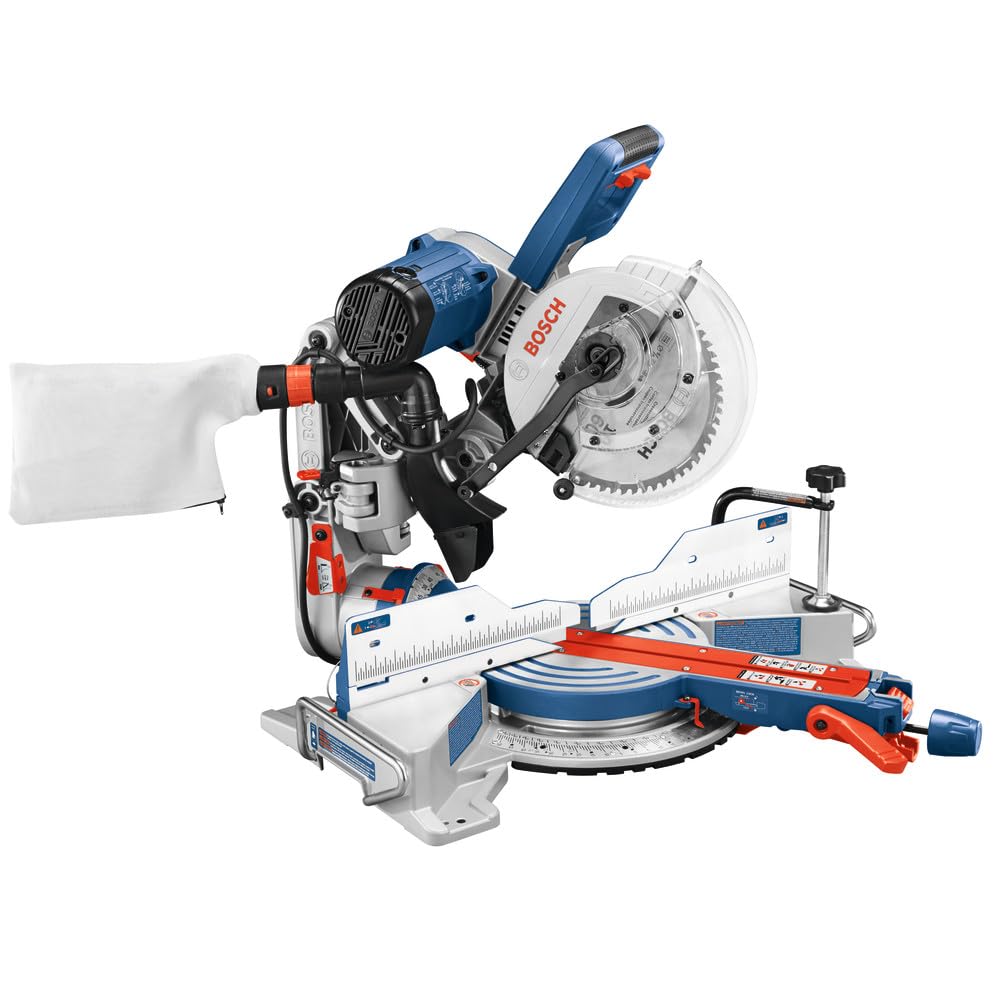
Every saw here is either a rail saw or a glide saw, and the difference is where the machinery moves. A rail saw slides the motor head forward and back on tubes that extend behind the tool, so you need open space behind the saw. A glide saw uses hinged arms that fold inward instead, so the whole assembly stays over the base and the saw can sit tight against a wall. Bosch’s CM10GD uses articulated hinge arms that cut front-to-back footprint by up to 10 inches versus similar-capacity slide saws, so it fits a bench backed against a garage wall.
Bevel and miter range, and where the controls sit
Bevel is the blade tilting sideways; miter is the table rotating the board under a vertical blade. Dual bevel means the blade tilts both directions, so you keep the board flat and the fence doing its job. Look at the range, not just the existence of the feature — several saws here tilt 45 degrees each way, the Bosch tilts 47 degrees each way, and the Ridgid miter table swings to a 70-degree capacity, which covers the steep cuts that trip up ordinary saws.
Then check where the bevel lock lever lives. Bosch puts the bevel lock and range selector up front so you are not reaching around the back of the tool, and owners of these saws tend to notice that detail fast once they start cutting baseboard in a corner.
Quick Comparison
| Model | Best For | Blade | Motor | Weight | Amazon |
|---|---|---|---|---|---|
| Bosch CM10GD★ Best Overall | Benches against a wall | 10 inches | 15 A, 4,800 RPM | 64 pounds | Amazon |
| MarvTool 12-Inch Dual-BevelBudget Champion | Home shops on a budget | 12 inches | 15 A, 3,800 RPM | 39.6 pounds | Amazon |
| VEVOR Double Bevel SlidingBeginner Friendly | Beginner trim and frames | 10 inches | 15 A, 5,000 RPM | 39.7 pounds | Amazon |
| WEN MM1015 | Cutting wide boards at home | 10 inches | 15 A | 48 pounds | Amazon |
| SKIL MS6305-00 | Trim, decking and PVC | 10 inches | 15 A, 4,800 RPM | 39.4 pounds | Amazon |
| Evolution R255SMS-DB+ | Cutting metal and wood | 10 inches | 15 A equivalent, multi-material | 44.8 pounds | Amazon |
| Ridgid R4210 | Steep angles and crown | 10 inches, 60-teeth | 15 A | 69.2 pounds | Amazon |
| Makita LS1019L | Jobsite accuracy and dust control | 10 inches, 60-teeth | 15 A, corded | 72.8 pounds | Amazon |
| Makita XSL06Z | Working where there is no outlet | 10 inches, 40-teeth | 36 V brushless, 4,400 RPM | 71.1 pounds | Amazon |
In‑Depth Reviews
1. Bosch CM10GD 15.0 Amp 10-Inch Dual-Bevel Glide Miter Saw
Our pick — over 4.5★ from 650+ verified ratings; the strongest balance of quality and price.
The glide-arm saw that lets you keep your bench pressed flat against the wall
If your workshop is a one-car garage with a workbench shoved against the drywall, this is the saw built for that exact spot. Bosch’s Axial-Glide System uses articulated hinge arms instead of side rails, cutting front-to-back footprint by up to 10 inches versus similar-capacity slide saws. Nothing needs to travel behind the tool, so the cut happens entirely over the base. That one design choice is why pro installers who work in finished rooms keep coming back to it.
The motor is a 15 Amp unit spinning the blade at 4,800 no-load RPM, which is how it chews baseboard and crown without stalling. Capacity is where the numbers get genuinely useful: a 12-inch horizontal cut width, 5-1/2 inches of vertical baseboard capacity cut against the fence, and 6 inches of crown nested against the fence at a 45-degree spring angle. The bevel swings 47 degrees left and 47 degrees right with detents at 0, 33.9, and 45 degrees each way, and the miter table locks at 0, 15, 22.5, 31.6, 45, and 60 degrees. The fences slide tall at 4-1/4 inches, which is what lets tall molding sit flat and steady.
What wins people over is the motion itself — the glide tracks with almost no resistance, and the accuracy crowd is just as loud about the cuts landing dead square. This is a huge tool at 64 pounds, and a flooring installer running it day in and day out still calls it a compact beast for tight spaces. A 60-tooth blade handles hardwood cleanly, and buyers report the detents hold accurately across the full 0-to-60 range.
Why owners keep it
- Articulated hinge arms cut front-to-back footprint by up to 10 inches, so the saw runs flush against a wall
- Upfront bevel lock lever and range selector mean no reaching behind the saw to change angles
- 47 degrees of bevel each direction with detents at 0, 33.9 and 45 degrees covers the angles you set most
- Tall 4-1/4-inch sliding fences hold crown and base molding steady during bevel setups
The honest catches
- At 64 pounds it is a two-person lift onto a truck bed, and it stays put once you set it down
- There is no laser and no soft start — the motor jumps when you squeeze the trigger
- Dust collection is the weak point; the stock nozzle wants a shop vacuum behind it to be useful
Made for: anyone cutting trim or furniture in a small shop who needs the saw tight to a wall and wants adjustments within arm’s reach.
Look elsewhere if: you need to carry one saw up three flights of stairs by yourself, or you want a laser line from the start.
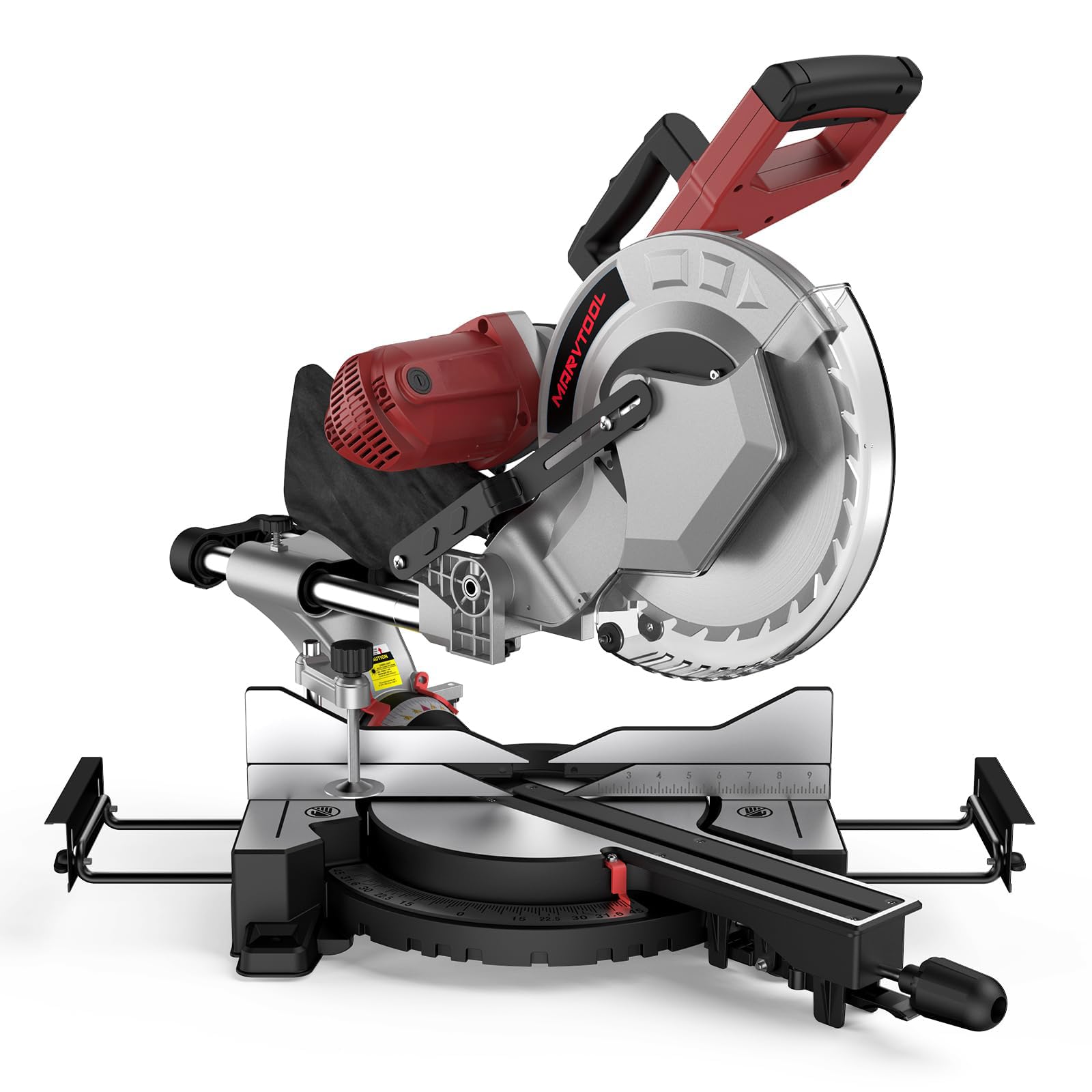
2. MarvTool 12-Inch Dual-Bevel Sliding Compound Miter Saw
A lighter, wider-cutting saw for the home shop that does not want a permanent bench fixture
Here is the trade you are making with this one: a bigger 12-inch blade and a roomier base, bolted onto a body that weighs 39.6 pounds — light enough that one person can carry it out of the shop and into the yard. The head locks down into the base with a release knob for storage, and the saw arrives with a 36-tooth TCT blade, two extension tables, and an Allen key. Bevel runs 0 to 45 degrees in both directions, and the base adjusts from 0 to 45 degrees on both sides too, which is what opens up compound angle cuts.
That 36-tooth blade spins at 3,800 RPM, and the 12-inch diameter is what allows those supported extension tables to hold long stock flat on both ends. If you are framing a basement or running baseboard around a room, that reach is the difference between one clean pass and battling a board that wants to dip off the end of the table.
The recurring gripe is durability rather than performance — a few owners have hit broken plastic pieces or had trouble tracking down replacement parts from the manufacturer. Set that against what the saw actually delivers for its price tier: smooth cuts through 4×4 stock, an accurate square cut, and a machine light enough to move easily between jobs. As owners put it, it “cuts accurately / square” and is “also very light weight, and easy to move.” The blade comes pre-installed, so first cuts happen within minutes of unboxing.
Where the value sits: a 12-inch blade, dual-bevel capability both directions, two extension tables, and a vise clamp for securing stock — all attached to a saw you can move alone.
What to plan around: there is no laser on this saw, and the durability side of the ledger is genuinely mixed. Think of it as a capable DIY and occasional-use machine, not a daily production saw in a cabinet shop.
Reach for this if: you want the widest cutting capacity for the money and you move the saw between spots instead of bolting it down.
Think twice if: you run a production shop where the tool works eight hours a day, every day.
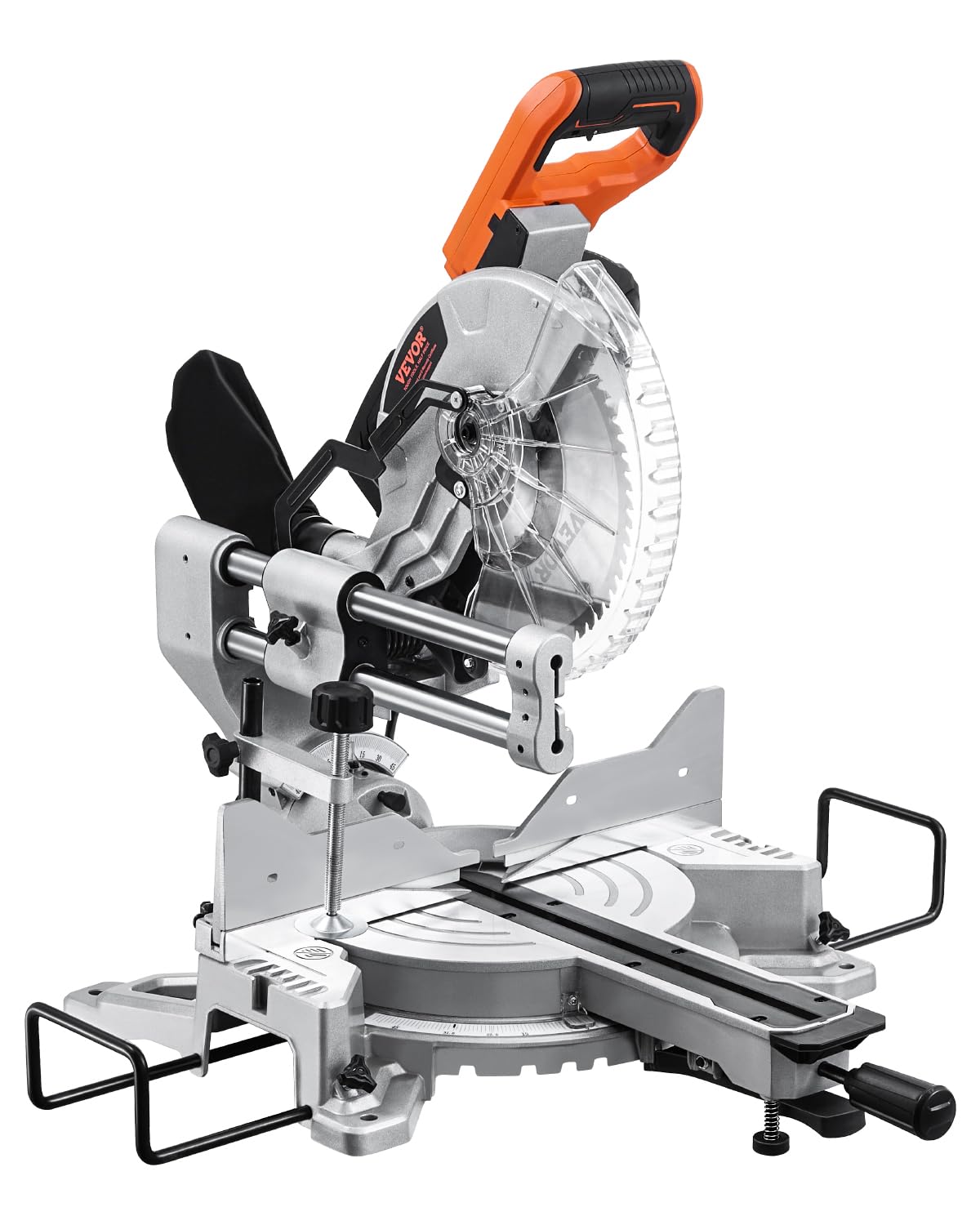
3. VEVOR 10-Inch Double Bevel Sliding Compound Miter Saw
The saw that shows you where the blade will land before you pull the trigger
Pull the head down on this one and an LED guide projects a crisp cut line onto the board, so you are lining up a lit mark instead of eyeballing a thin kerf. That is the feature that makes the first ten cuts of a new hobby go well. The specification sheet also puts numbers behind the cutting power: 2,300 watts for straight cuts, 2,800 watts for bevel cuts, and a 5,000 no-load RPM spindle speed with a 60-tooth blade — the fastest no-load speed in this roundup, and the 60-tooth count is 67 percent more teeth than the 36-tooth blade on the MarvTool above.
Two design choices make it pleasant to own. The axial sliding system moves the head forward and back on a carriage that keeps the saw small enough to mount against a wall, and an upgraded aluminum base is lighter than the cast iron bases on traditional saws, which is where the 39.7-pound overall weight comes from. Dual bevel tilts both directions, so frames and picture-style projects come together with the board kept flat.
Blade changes are the fiddly part — fitting the blade takes a little patience, and the included dust bag is small enough that a shop vacuum is the better answer. One owner noted that the saw does not take up rear room because the slide travels forward rather than backward, and a sheet of plexiglass or cardboard behind the bench catches what the bag misses. What wins people over is quality relative to the price — owners keep comparing it to a well-known yellow brand and calling it a near-match.
The precision angle: integrated scales and solid locking hardware let you set an angle once and trust it, which removes the guesswork that slows a new woodworker down on every joint.
Realistic expectations: plastic knobs are the wear point over years of use, and this is built for home and hobby work rather than all-day professional production.
Pick this if: you are learning to cut angles and want a lit cut line plus a 60-tooth blade to make clean edges on your first projects.
Pass if: you intend to run it hard in a professional shop where every component needs to survive years of daily use.
4. WEN MM1015 15-Amp 10-Inch Dual-Bevel Sliding Compound Miter Saw

Crosscuts boards a foot wide while sitting flush against the wall
Compromise normally follows the word “compact,” and WEN sidesteps it here. This machine crosscuts boards up to 12 inches wide and 3.75 inches thick, yet its dual-rail slide system runs the rails forward so the saw can sit flush against a wall instead of needing clearance behind it. For anyone who has ruled out a sliding saw because the workbench sits against a garage wall, that detail settles the whole question.
The 15 Amp motor spins a 40-tooth carbide-tipped blade on a 5/8-inch arbor, and the bevel tilts 45 degrees either way while the miter swings 49 degrees left and right across 9 miter stops. An onboard LED cutline guide lights the cut for you. You also get two adjustable support fences, a quick-clamp assembly, a dust port, a dust bag, and a carrying handle — plus a two-year warranty on the tool.
Accuracy from the start runs better than the price tier implies. Owners mention bevel and angle settings landing within 0.1 degrees, though the arbor nut arrives over-tightened on many units and needs real leverage to break loose the first time you swap the blade. Dust is the other honest note: the bag is a token effort, and this saw works far better plumbed into a dust collection tent or a vacuum line.
Worth knowing: the front-mounted rail design means no side deflection — the head glides straight through the cut instead of straining sideways, and one owner summarised the clean cut quality as the saw having “no side deflection unlike other front-slide-bar brands.”
Ideal for: home woodworkers who need to cut wide shelving and framing lumber and only have wall-adjacent bench space.
Less ideal if: you intend to run it in continuous daily shop production — the plastic components and modest dust bag suit part-time use.
5. SKIL MS6305-00 10-Inch Dual Bevel Sliding Compound Miter Saw

The lightweight saw that has quietly earned its place on more home jobsites than any other here
You can tell a saw is trusted by the way people stop talking about it and just use it — and this is the saw that keeps showing up. A 15 Amp motor drives the blade at 4,800 RPM, and the head cuts 2×12 lumber at 90 degrees and 2×8 at 45 degrees. The dual bevel stops at 48 and 45 degrees to the left, 0 degrees, and 45 degrees right, and the miter table turns up to 50 degrees left and right across 11 positive stops. Weighing 39.4 pounds, it is light enough to carry from the truck to the work zone without a second trip.
The LED shadow line is the standout feature. Instead of a laser beam that sits beside the kerf, it projects the blade’s own shadow onto the board, so what you see is exactly where the teeth will land. Once you cut with a shadow line, a laser line starts to feel approximate. The miter detents are firm, the fence is square, and the dual bevel saves you from flipping material — which is the entire point of paying for dual bevel in the first place.
Blade changes are the one friction point. The head lock pin can stick until the saw is clamped, and the arbor nut ships over-torqued on some units — a trip to the hardware store for a T-handle solves it, and the angles come out accurate from the factory once the blade is swapped. The other honest note is that the saw is built for trim, decking, PVC and framing rather than constant production cutting, so treat it as a capable DIY and small-shop machine.
What it does well
- LED shadow line shows the actual blade path for more precise alignment than a laser
- Cross cuts 2×12 at 90 degrees and 2×8 at 45 degrees
- Dual bevel with stops at 48° and 45° left, 0°, and 45° right
- Light 39.4-pound body that travels easily to the jobsite
Where you may hesitate
- Arbor nut is over-tightened from the start on many units — plan for a T-handle
- Head lock pin can stick until the saw is clamped
- Plastic components make this best for trim, decking and framing rather than production work
Best for: trim carpenters and deck builders who want shadow-line accuracy and a saw light enough to carry daily from vehicle to job.
Skip if: your work is constant production cabinet cutting, where the plastic parts and non-production build are the limiting factor.
6. Evolution R255SMS-DB+ 10-Inch Dual Bevel Sliding Miter Saw

One blade that slices through mild steel and wood without sparks flying
If your project involves a steel gate frame in the morning and hardwood shelving after lunch, this is the only saw here that does both with a single blade. The included TCT blade tackles wood, wood with embedded nails, composite decking, mild steel and plastic, and Evolution states the cut on mild steel is virtually spark-free with an instantly workable finish and no burrs. The bevel runs 45 degrees left and right; the miter swings 50 degrees each way.
The included multi-material blade earns real praise for aluminium and wood, and owners say it handles mild steel without complaint — one buyer describing it cutting steel “like butter.” There is a deliberate soft-start function that spins the blade up over roughly two seconds rather than slamming it to full speed, which makes the whole cut feel more controlled. Evolution also backs the saw with a 3-year warranty, and their customer support has a solid reputation among owners.
The catch here is blade longevity and speed on mild steel work. Owners cutting thick 16-gauge steel tube have reported the included blade giving out quickly, even though the saw itself held its squareness well. Then there is the tuning process: The soft-start and the blade changeover are part of living with this machine, and some users find the setup adjustments time-consuming before the saw settles. For a shop that cuts metal regularly, budgeting for a dedicated steel blade is the practical move.
The standout: the 50-degree miter each direction is more range than the Bosch CM10GD’s miter detent range and matches the SKIL, which matters when you are cutting complicated steel joinery with acute angles.
Right choice for: fabricators and mixed-material shops that need one saw to cut steel tube, decking, and wood without carting two tools to the job.
Not the pick if: you only ever cut wood, since the multi-material blade is better spent, and a wood-specific blade will outlast it on timber.
7. Ridgid R4210 15 Amp 10-Inch Corded Dual Bevel Sliding Miter Saw

The saw you buy when the job needs a 54-degree cut that your last saw refused to make
Most 10-inch sliding saws top out in the mid-forties on the miter table, which quietly rules out a whole category of cuts — bay window trim, acute picture frame corners, and structural joinery. This one swings to a 70-degree miter capacity, and that is exactly why owners buy it. An owner needing repeated 54-degree cuts summed it up: “Not many saws allow for this.” The adjustable miter and bevel detents include a bypass, so setting those unusual angles is quick rather than fiddly.
The rest of the machine is built for a jobsite. A 15 Amp motor powers through tough material, and Ridgid pairs that with an LED cut line plus a work light so you can see the mark even in a dim basement or a closet with the door shut. There is a built-in dust collection port that accepts common 1-1/4-inch wet/dry vacuum adapters, and crown stop mounting holes lined up to fit standard crown molding stops and Ridgid’s own stops. The blade is a 60-tooth unit running at 10 inches.
Weight is the thing to know before you buy. At 69.2 pounds this is a heavy saw, and while that weight translates into stability on a stand, it means you will not want to be lifting it onto a truck bed alone. If your saw stays mostly in place, this is fine. If your work is entirely on-the-go and you are hiking the tool up stairs, the lighter SKIL or VEVOR will suit you better.
what separates it: matched against the Bosch CM10GD and the Makita LS1019L, this is the only saw in the roundup rated for cuts past 50 degrees on the miter table, and that range is what owners came for.
Choose this if: your work involves steep-angle trim, intricate picture frames, bay windows, or joinery that runs past 50 degrees on the miter table.
Leave it on the shelf if: your cuts are all standard 45s and 90s, since the extra miter range is the reason to pay for this saw.
8. Makita LS1019L 10-Inch Dual-Bevel Sliding Compound Miter Saw with Laser

A 10-inch saw that carries the crown molding capacity of a 12-inch machine
Here is the number that changes what this saw can do: it cuts crown molding nested at 6-5/8 inches, which is the same capacity you would normally buy a 12-inch saw to get. For a trim carpenter working on tall oak crown, that alone justifies the price. The rail system is a linear ball bearing design, engineered to deliver dead-on cuts, and Makita’s direct drive gearbox adds 5-1/4 inches of vertical cutting capacity. The two-steel rail design also lets the saw run flush against a wall — a feature the Bosch approaches from a different angle with its glide arms.
Dust collection is the other story. A rear-facing dual-port shroud takes most of the sawdust before it hits the air, and one reviewer trimmed a shop vac adapter to fit and reported capturing 80-90 percent of the dust. Compare that with the Bosch CM10GD, whose dust collection one buyer described as roughly 50 percent of a competitor’s, and the difference becomes a real jobsite factor in a finished home.
A few design details will annoy you. The second safety switch can activate unintentionally during a normal grip, the rear dust port needs an aftermarket 12-inch adapter to work with common shop vacs, and the two-piece fence sits slightly proud of the base. A design batch also had blade carriage alignment problems that Makita addressed under warranty. Check out-of-box square, cut a test piece before committing, and you are buying among the most accurate saws on the market.
Quiet, accurate, smooth: as owners put it, “Slow start quiet running precise angles. Once you figure out all the releases and stops you will really be happy with this saw!” The 60-tooth micro-polished blade included in the box makes that first impression good.
Suits: trim carpenters cutting tall crown and base who need dust control inside finished homes and wall-flush placement on a jobsite.
Less suited to: portable-only work — at 72.8 pounds, this is a bench saw that comes with you occasionally, not a daily carry.
9. Makita XSL06Z 18V x2 LXT Brushless Cordless 10-Inch Dual-Bevel Sliding Miter Saw

The cordless saw that lets you cut trim in a finished room with no extension cord trailing the floor
Working on the third floor of a house with no nearby outlet is where a corded saw stops being an option. This saw runs on two 18-volt LXT batteries paired to deliver 36 volts, and Makita’s brushless motor spins at 4,400 RPM with automatic speed change technology that adjusts cutting speed and torque mid-cut. Because the motor has no carbon brushes to wear, it runs cooler and more efficiently over time — and it delivers enough runtime to make it practical rather than a novelty.
The runtime numbers make the case better than any marketing copy could. With two 5.0Ah batteries (sold separately), it makes up to 334 cuts per charge in 2×4 SPF and 192 in 2×12 SPF. That is a genuinely useful day of trim work on two charges, and it means the cord is the only thing you are not managing. The blade is a 40-tooth micro-polished miter saw blade on a 5/8-inch arbor, and the saw handles large timber rips through the sliding arm.
Two flaws surface in daily use. The laser has manual on/off with no auto-off, so leaving it on drains the battery over days or weeks. And like many cordless saws in this category, the dust bag is not the match for the port that the rest of the tool is. Both are manageable with a shop vac and a habit of switching the laser off. Our advice: buy the bare tool only if you already own LXT batteries, since it ships without them.
Where it earns its keep: matched against any corded saw in this roundup, this is the only one that operates entirely off extension cords and generators, and the 192 cuts per charge in 2×12 lumber is the number that makes it a working tool.
Right for: anyone cutting trim, framing or decking in locations without easy power — third-floor rooms, outdoor builds, remote sites.
Not for: someone with no Makita LXT batteries already in their kit, since this ships as tool-only and the batteries are a separate purchase.
Understanding the Specs
Bevel versus miter — what’s the difference?
Miter is the table turning the board underneath a vertical blade, and it handles the corners you see on flat trim. Bevel is the blade tilting sideways, which handles the angles on crown molding and sloped joints. Dual bevel means the blade tilts both left and right, which doubles your reach without flipping the workpiece. That matters most on long stock — a 10-foot piece of crown is awkward to turn over, and dual bevel eliminates the problem entirely. Look at the actual degree range, because several saws here run to 45 degrees each way, the Bosch CM10GD goes to 47 degrees each way, and the Ridgid R4210 swings a 70-degree miter capacity.
Why no-load RPM and amp rating both matter
No-load RPM is how fast the blade spins when it is not touching wood, and it tells you how the saw will behave in tough cuts. Higher RPM means the teeth strike the wood more times per second, which produces smoother cuts and reduces the chance of burning the edge. Amp rating is how much electrical current the motor draws under load — a 15 Amp motor is a common benchmark, and it is the number that predicts whether a saw will power through oak or stall in the middle of a cut. What actually matters is how those two figures work together: the SKIL MS6305-00 and Bosch CM10GD both run at 4,800 RPM on a 15 Amp motor, while the VEVOR hits 5,000 RPM. The Evolution R255SMS-DB+ uses a different system entirely — it runs on a soft-start that spins the blade up over roughly two seconds rather than slamming to speed, which is why the amp rating is not comparable.
FAQ
Will a 10-inch dual-bevel sliding miter saw cut 4×4 posts in one pass?
What is the difference between a glide saw and a sliding rail saw?
Can I cut metal with a 10-inch dual-bevel miter saw?
How heavy is a 10-inch dual-bevel sliding miter saw?
Do I need batteries for the Makita XSL06Z cordless miter saw?
What blade does a 10-inch dual-bevel sliding miter saw take?
Will a 10-inch miter saw handle crown molding?
Is a dual-bevel saw worth it over a single-bevel saw?
Can I use a shop vacuum with a sliding miter saw?
How much clearance do I need behind the saw for sliding cuts?
How long does a miter saw blade last before it needs replacing?
Final Thoughts: The Verdict
For most people looking for the 10-inch dual-bevel sliding miter saw that ends the search, the Bosch CM10GD is the right call — its Axial-Glide hinge arms cut front-to-back footprint by up to 10 inches, so it runs tight against a wall, and the upfront bevel lock means you never reach behind the tool to change an angle. If you cut steep angles past 50 degrees, grab the Ridgid R4210 with its 70-degree miter capacity. And if your project mixes mild steel with wood, the Evolution R255SMS-DB+ handles both with the one included blade.
One last thought on timing: the Bosch CM10GD sits in the crowd-favorite slot at 4.7 stars across 600+ ratings, and the SKIL MS6305-00 has been on more home jobsites than any other saw in this roundup. If you are ready to buy, the Saw alone will not cut anything — pair it with a shop vac for dust control and a good T-handle wrench for blade changes, and you will have the saw working inside the first hour.
How We Picked
We do not accept paid placement. Every pick is matched to a real buyer and a real use-case; we do not hands-on test units.
Sources & Methodology
Specifications: manufacturer listings and product documentation. Review insights: verified customer reviews, as of September 2026. Pricing: not shown on this page (it changes often); check the current price via the retailer link.
As an Amazon Associate, KitchPrep earns from qualifying purchases. This does not affect which products we feature.
Related Guides
