
Specs are compiled from manufacturer listings and verified buyer reviews and can change over time — please confirm the key details on the product page before buying.
If you want one answer fast: the Bosch CM10GD is the pick most woodworkers end up happiest with, and the Metabo HPT C10FCG2 is the one to grab if you mostly cut trim and need to carry the saw yourself. Everything below explains why those two sit where they do — and which of the other nine belongs in your shop instead.
I’m Mohammad Maruf — the founder and writer behind KitchPrep. This guide is built by comparing the manufacturers’ published specifications and the patterns across verified customer reviews, so you get each pick’s real strengths and trade-offs instead of marketing spin.
A 10-inch blade is the balance for trim carpenters, because it cuts through standard lumber without the bulk of a bigger saw. Here is everything worth knowing about the 10-inch compound miter saw.
Our Picks at a Glance

How To Choose The Best 10-Inch Compound Miter Saw
The blade diameter tells you the saw class, so a 10-inch machine sits between a compact trim saw and a heavy 12-inch slider. That middle ground is why so many trim carpenters and furniture builders land here. Read the four things below before you spend anything.
Start With Amps And No-Load Speed
The amp rating is how much electrical current the motor draws, and higher amps generally mean more cutting muscle through hardwood. Every corded saw on this list runs 15 amps, which is the standard for this size. No-load speed — the RPM the blade spins at with nothing in it — tells you how fast the blade moves when you are not cutting, and 4,800 to 5,000 RPM is typical here. If you cut hardwoods all day, both numbers matter more than any extra feature.
Single Bevel Or Double Bevel
A bevel is the tilt of the blade head, and it lets you cut an angled edge rather than a flat one. A single-bevel saw tilts one direction. A double-bevel saw tilts both ways, so you never have to flip your board to match a cut. If you build picture frames or crown moulding, double bevel saves real time; if you mostly cut baseboard square, single bevel is fine and costs less.
Sliding Versus Fixed Head
A sliding rail lets the blade head travel forward and back, which widens how far across a board you can cut in one pass. A fixed head only chops straight down. Sliders take up more space behind the saw and weigh more, while fixed saws stay compact enough to sit against a wall. Think about your bench before you pick.
Weight And Where The Dust Goes
A miter saw you cannot lift is a miter saw you will not take to a job site. Weight here ranges widely — one pick is 24.2 pounds and another is 64 pounds. Check whether the saw has a dust port sized for a shop vacuum, because the included dust bag on most of these fills quickly. A port that accepts a standard hose keeps your bench far cleaner.
Quick Comparison
| Model | Best For | Weight | Bevel Type | No-Load Speed | Amazon |
|---|---|---|---|---|---|
| Bosch CM10GD★ Best Overall | Precision trim and finish work | 64 lb | Dual bevel | 4,800 RPM | Amazon |
| Metabo HPT C10FCG2Best Value | Portable trim and framing work | 24.2 lb | Single bevel | 5,000 RPM | Amazon |
| Genesis GMS1015LCBudget Champion | Budget home projects | 16 oz (claimed) | Single bevel | — | Amazon |
| MarvTool JS-1013C4 | Occasional DIY angle cuts | 25.6 lb | Single bevel | 5,000 RPM | Amazon |
| DOVAMAN DMS01A | Multi-material home shop use | 17 kg | Single bevel | 5,000 / 3,200 RPM | Amazon |
| VEVOR J1G-ZP33-K255D | Beginner-friendly precision cuts | 39.7 lb | Dual bevel | 5,000 RPM | Amazon |
| Evolution R255SMS+ | Cutting metal and wood on one saw | 41.8 lb | Single bevel | — | Amazon |
| Makita LS1040 | Trim work on a tight budget | 25 lb (claimed) | Single bevel | 4,600 RPM | Amazon |
| DEWALT DCS714B | Cordless job site trim work | 34 lb (tool only) | Dual bevel | — | Amazon |
| Makita LS1019L | Full-shop precision with dust control | 72.8 lb | Dual bevel | — | Amazon |
| Milwaukee 2734-21HD | Cordless cutting all day on jobsites | 45 lb | Dual bevel | — | Amazon |
In‑Depth Reviews
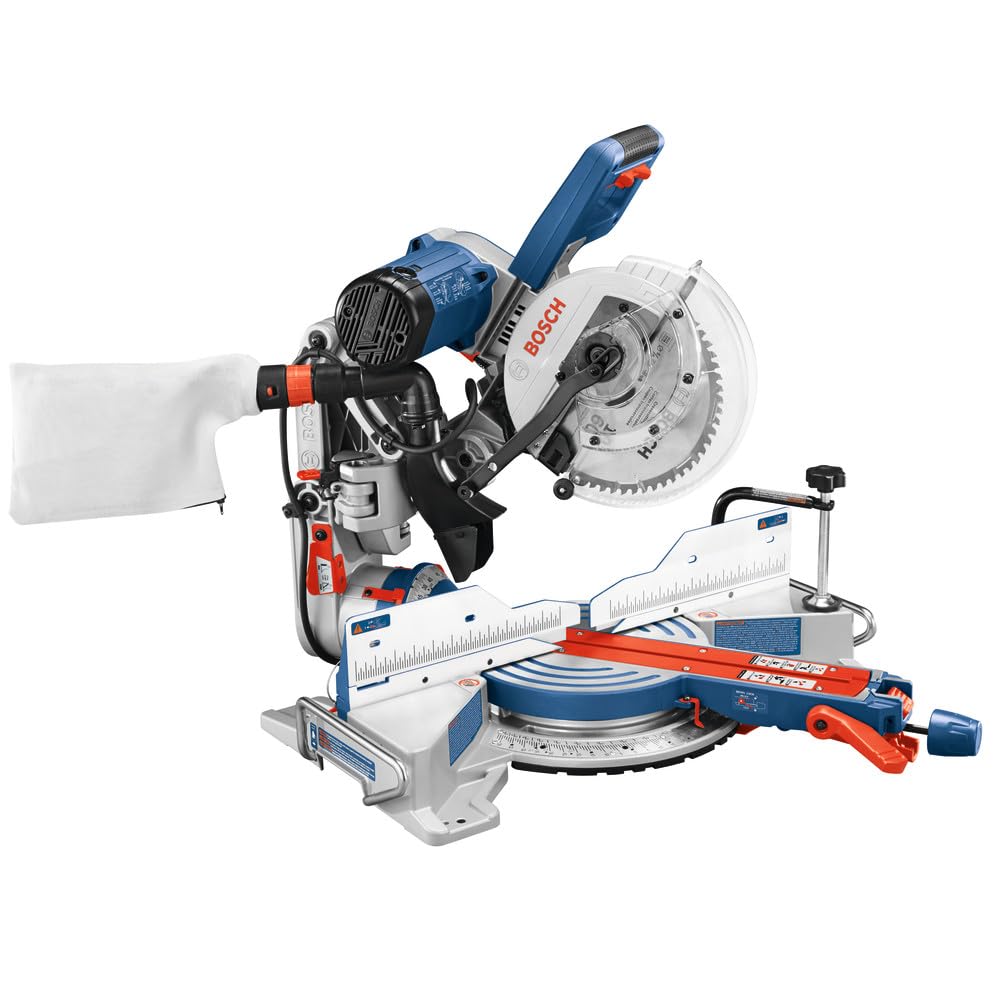
1. Bosch 15.0 Amp CM10GD 10 In. Dual-Bevel Glide Miter Saw
Our pick — over 4.5★ from 650+ verified ratings; the strongest balance of quality and price.
The arms that swing instead of rails that slide, so a 12-inch cut fits a bench with no room behind it.
This saw holds 4.7 stars across 688 ratings, and it sits at the top of this list because of one unusual design choice: it uses articulated hinge arms instead of sliding rails. That means the head swings forward on a hinge rather than travelling on rails behind the saw — and Bosch states those arms reduce the front-to-back footprint by up to 10 inches versus a slide saw with similar capacity. If your bench sits against a wall, that single difference is what lets you keep the saw there permanently and still make wide cuts.
The cutting numbers back the design up. Bosch rates the 15 Amp motor at 4,800 no-load RPM, with a 12-inch horizontal cut capacity, 5-1/2-inch vertical baseboard capacity against the fence, and a 6-inch crown cut capacity nested against the fence. One price-conscious buyer put it plainly, praising the 60-tooth blade for cutting hardwood cleanly and citing the accurate detents and bevel stops. What wins people over most, though, is the build itself — quality is the thing this saw is known for, with accuracy right behind it.
Stack it against the Metabo HPT above and the trade-off is blunt: 64 pounds versus 24.2 pounds. The Bosch is a bench saw, and it is 32 by 26.5 by 20.5 inches of footprint once you own it. As one professional installer summed up: the saw is precise and versatile, the arms ride smoother than standard rods, and every adjustment sits up front. Owners who treat it as a bench saw expect years of service.
What earns the top slot
- Articulated hinge arms cut the footprint by up to 10 inches versus comparable slide saws, so it fits tight benches.
- Wide 47-degree left and 47-degree right bevel capacity with detents at 0, 33.9, and 45 degrees for the angles you use most.
- Every control sits up front — the bevel lock lever and range selector sit where you can reach them without walking around the saw.
- Tall 4-1/4 inch sliding fences give extra crown and base moulding capacity.
What to accept going in
- At 64 pounds it needs a permanent bench or a rolling stand.
- No laser guide and no soft start, so the blade kicks on startup.
- The stock dust nozzle is weak enough that most owners rig their own deeper one.
Settle here if: your saw lives on a bench against a wall and you want trim-grade accuracy without a sliding rail eating your space.
Walk away if: you carry your saw between job sites — 64 pounds gets old fast, and the Metabo HPT weighs a fraction of that.
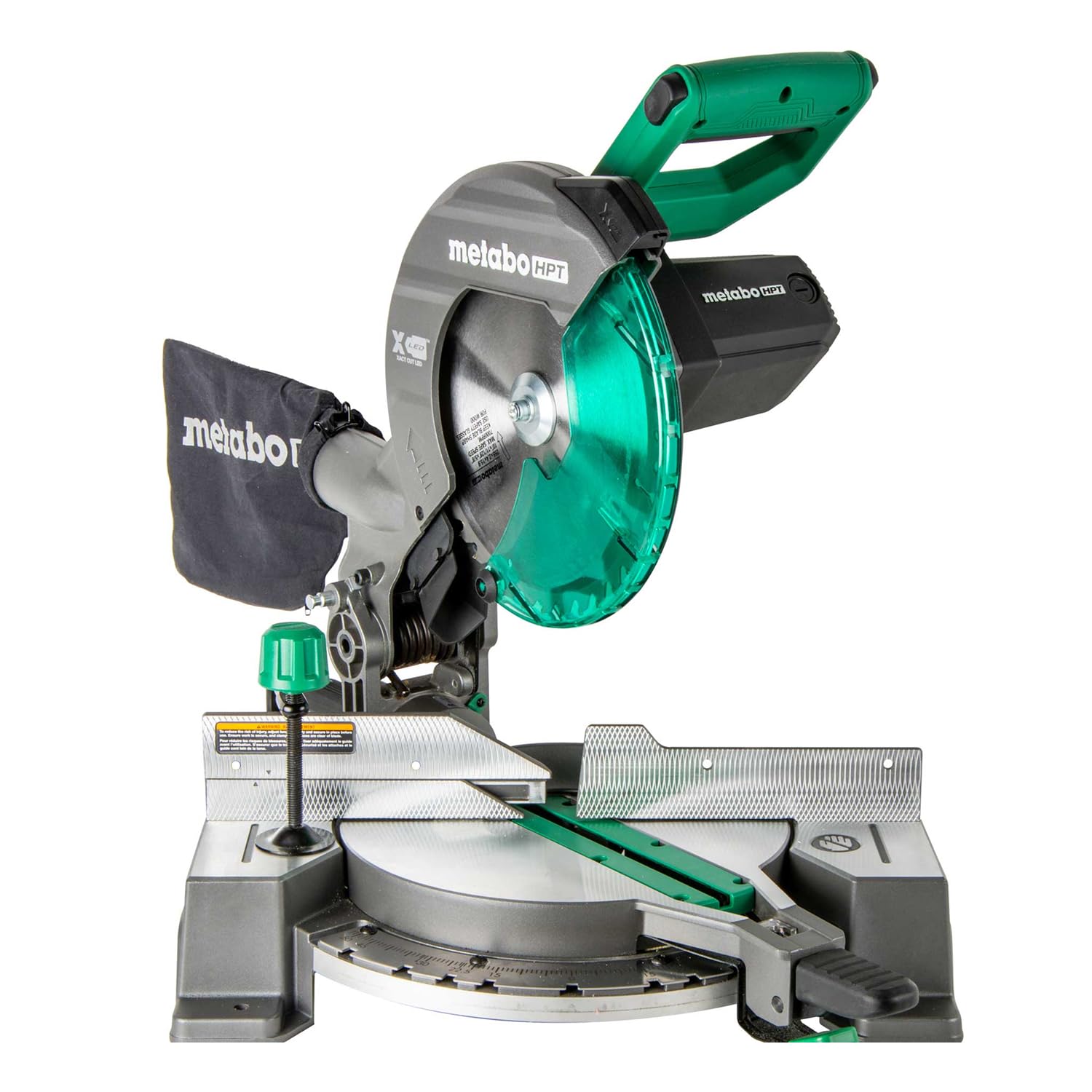
2. Metabo HPT 10-Inch Compound Miter Saw, 15-Amp, Single Bevel, C10FCG2
Twenty-four pounds and five thousand RPM — the trim saw you can carry in one hand and still trust on finish cuts.
This is the saw for the carpenter who drives a truck and never knows where the next job is. At 24.2 pounds it is dramatically lighter than the Bosch above, and Metabo HPT fits a 5,000 RPM no-load speed out of the same 15 Amp motor class — a fair bit faster blade than the Bosch’s 4,800 RPM. The 10-inch blade, tungsten carbide tip, and 0 to 52 degree miter range left and right cover the great majority of trim, baseboard, and framing cuts you will face on a house.
Where this saw separates itself is straight-line accuracy for the money. Buyers report it arrives well-calibrated, cuts clean on pine and oak with no tearing, and handles 2x4s, 2x6s, and 4x4s without complaint. Ease of use earns strong praise — the detents click positively, the electric brake stops the blade quickly, and a hold-down clamp comes in the box. It also carries a 5-year tool body warranty, which is unusually long for this price bracket.
The honest caveat is durability. The blade guard is the recurring weak point, and a few owners have had theirs break. Treat the guard with care — don’t drop the saw on it or lean on it — and this holds up. Do keep expectations honest on depth of cut too: one owner notes the depth adjustment handles small stock well but won’t cross a full 2×4 on a single pass.
The case for it: if you cut trim on site and want a saw that lives in your truck without wrecking your shoulder, this is the best combination of weight, speed, and price on the whole list.
Know before you buy: the single-bevel design means you will flip your workpiece when you need a cut that leans the other way — and the guard is the one component to baby.
Reach for this if: you cut 2x4s and baseboard on site and want a saw light enough to carry under one arm.
Look elsewhere if: you need double-bevel capability for picture frames and crown — a dual-bevel saw saves you the flip every time.
3. Genesis GMS1015LC 15-Amp 10-Inch Compound Miter Saw with Laser Guide
Nine locked miter stops and a laser that shows the cut line before the blade ever touches wood.
For anyone building window boxes, planters, and small shop furniture, the Genesis does the job at an entry-level price with a laser guide built in. The 15 Amp motor turns a carbide-tipped 60-tooth blade that comes installed, and you get nine positive detent stops that lock firmly so setup takes seconds. The electric brake stops the blade quickly, and an arbor lock makes blade changes painless. It also ships with a hold-down clamp, dust bag, and two extension wings.
The laser is the feature that earns its keep. It projects your cut line before the blade makes contact, which matters most when you’re trimming a piece you can’t afford to waste. Cutting performance is where owners are happiest — the saw handles 2x4s and 4x4s without hesitation, and the die-cast aluminum base helps it hold accuracy between cuts.
Where it shines: for beginners and home-project builders, this is the lowest-friction entry into compound cutting — a laser, detents, brake, and clamp all included.
Two things to plan for: it is genuinely loud (ear protection is not optional), and the clamp mounting has proven the weak point for some units. The 45-by-45 degree max cutting capacity of 1-3/8 inches high by 3-5/16 inches wide also limits how much material you can cut at once.
Land here if: this is your first miter saw and you’re building boxes, benches, and frames in a garage shop.
Steer past if: you plan to work on a job site or cut anything but wood — the housing won’t survive that, and the noise is a real issue indoors.
4. MarvTool 10-inch Sliding Compound Miter Saw, 5000RPM, 15 Amp
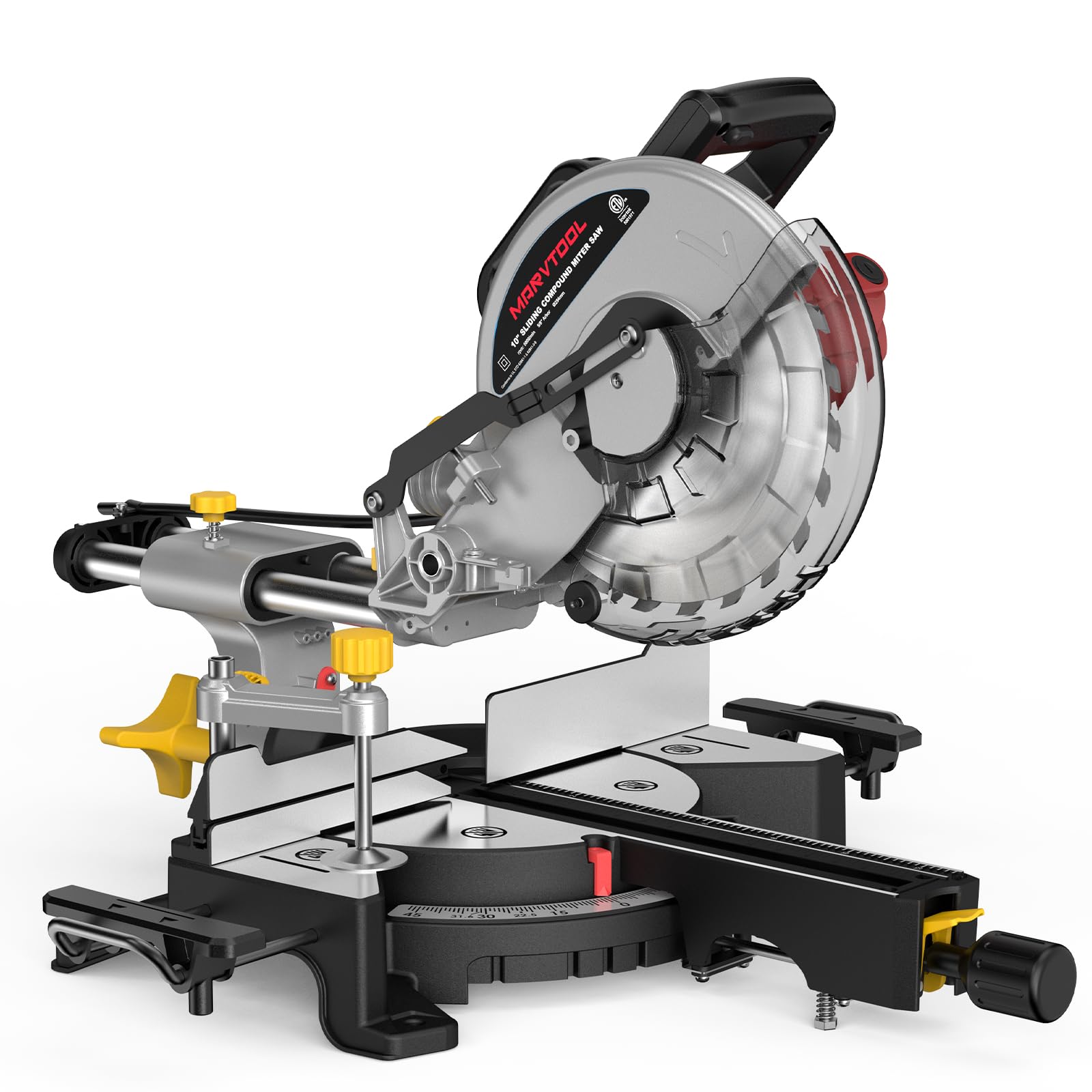
A sliding head on a 25.6-pound body, for the woodworker who needs crosscut width without a heavy machine.
Mass-market sliders tend to be heavy. This one is not — MarvTool fits a sliding rail system onto a 25.6-pound saw, and that head locks down into the base via a release knob for storage. You get the same 15 Amp class motor at 5,000 RPM that the light Metabo HPT runs, plus extension tables on both sides and a 36-tooth carbide-tipped blade already installed. The transparent blade guard keeps your line of sight clear while you cut.
For miter work, it handles 0 to 45 degrees on both sides for compound angles, which covers most crown, picture frame, and shadow box corners. A vise clamp holds the workpiece and an included dust bag manages the chips. For a saw this light, owners mention surprising stability on trim and basement framing cuts.
What stands out
- Sliding rails on a 25.6-pound body — most sliders in this class weigh far more.
- 15 Amp motor at 5,000 RPM matches the speed tier of heavier name-brand saws.
- Head locks down into the base for storage, so it tucks into a small shop.
Trade-offs to weigh
- No laser guide, so you line up cuts against the blade teeth.
- The included blade is rougher than a quality aftermarket one — a natural first upgrade.
- Support is thin if a part breaks; there’s no clear manufacturer contact channel.
Pick this if: you want a sliding head without paying a premium — and you’re handy enough to upgrade the blade and source your own parts.
Pass on it if: you want factory support and a laser built into the saw itself; neither is here.
5. DOVAMAN 10-Inch Sliding Miter Saw, Multi-Material, 2-Speed, 15A

Two speed settings and three blades in the box — one saw that handles wood, PVC, and soft metal.
The 10-inch blade rule is usually about cutting wood, but the DOVAMAN makes it a mixed-material tool. It runs two speeds — 5,000 RPM for fast wood cuts and 3,200 RPM for softer or thinner materials — and ships with two 40-tooth and one 48-tooth TCT blade. The rule of thumb is that the slower setting is what keeps heat down when you cross PVC or soft metal, and the tooth count matters because a finer blade leaves a cleaner edge than a coarse one. A 13-inch sliding rail and extendable side tables open the cut range to 4 by 13 inches, and the ambidextrous design means the controls work equally well whichever hand you favor.
Precision comes from the built-in laser guide, which lands the cut line before the blade moves. Customers note it cuts pressure-treated 2x12s, 4x4s, and composite fascia cleanly, and the 15 Amp pure copper motor doesn’t bog on those cuts. Three blades, two extension tables, and a pair of spare carbon brushes in the box make this an unusual amount of kit for the class.
The trade-off is real, though. The blades are the weak point — the included 40-tooth blade has shed carbide teeth in some units, and there is no blade brake. If you plan to cut hard material all day, budget for a better blade.
Step this way if: you cut wood, PVC, and light metal in the same shop and want to do it with one sliding saw and its included blade set.
Look past it if: your work is high-volume hardwood and you want a saw that arrives with a premium blade and reliable factory support.
6. VEVOR 10″ Double Bevel Sliding Compound Miter Saw, 15 Amp, 60-Tooth Blade
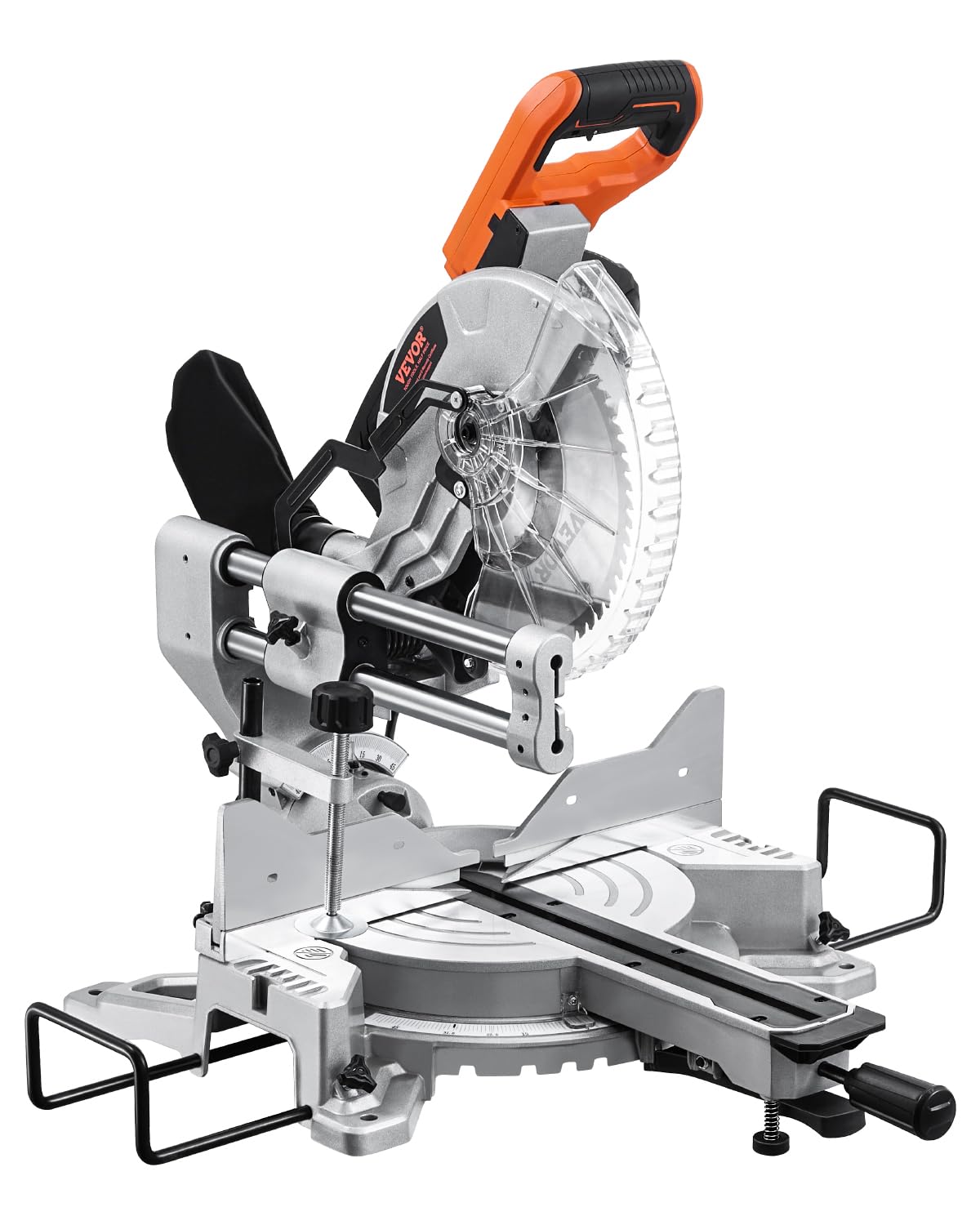
A double-bevel slider with an LED cut line, aimed at the woodworker who is still learning the angles.
Double bevel is the feature that makes crown moulding and picture frame work far simpler, since you never have to flip the board to mirror a cut. VEVOR pairs that with a 15 Amp motor rated 5,000 RPM, a 60-tooth blade, and an LED guide that projects a bright cut line so you can see exactly where the blade will land. The dual bevel range lets the head tilt both ways for compound cuts.
Where it earns its place is in tight shops. The axial sliding system moves forward and back so the saw can be mounted against a wall — no rail sticking out the back row of your bench. The aluminum base is lighter than a cast iron one for easier moving, and it runs steadier during extended cutting. Owners note the included 60-tooth blade cuts smoothly, and the dust collection port works with a standard shop vacuum.
The honest limit: this is not a professional-grade saw, and the plastic knobs will not take the abuse a full pro schedule throws at them. Blade installation is also fiddly for a first-timer, and the dust bag is small enough to fill fast. Handle it as a careful hobbyist’s saw and it serves well.
Why it fits beginners: double bevel, an LED cut line, and a mounting profile that respects a small workbench make this the easiest of the mid-tier sliders to warm up to.
The non-negotiables: the knobs and small dust bag are the parts to treat gently, and you will want a vacuum connection sooner than later.
Start here if: you’re building frames, small furniture, or trim and want double-bevel capability with a visible cut line.
skip it if: you’re running a production shop — the plastic fittings won’t survive day-in, day-out professional use.
7. Evolution Power Tools R255SMS+ PLUS 10-Inch Sliding Miter Saw

One TCT blade that goes through steel, wood, plastic, and composite decking without changing a thing.
Most miter saws in this class cut wood and nothing else. The Evolution is the outlier — a single 10-inch TCT blade rated for wood, wood with embedded nails, composite decking, mild steel, and plastic. Two things make that possible: the blade’s tooth geometry and Evolution’s claim that cuts run virtually spark-free and cool to the touch on mild steel, which is a safety benefit for anyone who has used an abrasive chop saw.
The +PLUS trim level adds genuine value — dual quick-release clamps, taller fences, a slide rail protector, a 3-metre cable, integrated carry handles, and a dust bag. The miter range is 50 degrees to 50 degrees, and the bevel goes 0 to 45 degrees, so you get more swing in the table than a standard saw. The soft start feature keeps the saw from tripping a weak breaker on startup, which matters for garage and jobsite power.
Where buyers get the best results is metal. Reviewers point out roughly fifty miter cuts through 3/16-inch angle iron with the blade still like new. The finishing blade on wood is a different story: on softer wood it leaves a rougher edge than a dedicated fine-cut blade would.
Why it earns its spot
- One blade cuts wood, mild steel, plastic, and composite decking, which collapses a two-saw shop into one.
- Soft start protects weak-breaker circuits, and the saw is covered by a 3-year warranty.
- 50 to 50 degree miter range adds swing beyond the standard 45s for uneven cuts.
Where it gives ground
- The included all-purpose blade leaves a rougher face on soft wood than a dedicated finishing blade.
- Much of the body is plastic, so it suits homeowner-level use more than production shop work.
- Laser accuracy is limited to the first few inches of the cut line.
Choose this if: metal furniture and mixed materials are your work, and you want one saw for all of it.
Leave it if: you need a bench saw that lives on a production floor — plastic parts and a rough wood finish are the limits.
8. Makita LS1040 10″ Compound Miter Saw

No slider, no laser, nothing else — just a 25-pound chop saw that trims houses for a living.
This is a fixed-head chop saw by design, and everything good about it comes from that choice. The 15 Amp direct-drive motor runs 4,600 RPM, the pivoting arm uses dual posts instead of rails, and there is no side-to-side play anywhere in the head. That translates to precise, repeatable cuts — the kind that matter when you’re running baseboard and crown around a whole room. Miter range is 45 degrees left and 52 degrees right, with nine positive stops at 15, 22.5, 30, and 45 degrees, plus 0.
The machined aluminum base and carbide-tipped blade in the box round out a package that owners describe as super accurate and built to last years. At 25 pounds it is one of the two lightest corded saws on this list, so truck-to-bench portability is genuinely easy.
Two things to accept up front. First, there is no soft start, and the motor starts with a real bang — you will want ear protection every time. Second, on deeper stock, the blade does not fully pass through a 1×6, leaving roughly 1/8 inch — you shim and clamp to finish the cut. That’s the trade-off of a compact non-sliding saw.
The trim pro’s pick: if your day is baseboard, casing, and crown at 90 degrees and 45 degrees, this is the saw that quietly outperforms bigger machines on setup speed and repeatability.
Adjust expectations: the bang on startup and the 1×6 depth limitation are inherent to the compact fixed-head design, not defects.
Buy this for: finish carpentry on site, where a light, dead-square fixed saw is exactly what the work calls for.
Move on if: you cut wide stock or need a sliding blade — the depth limit and the lack of a slider will cramp that work.
9. DEWALT 20V MAX XR 10 in. Double Bevel Fixed Miter Saw (DCS714B)
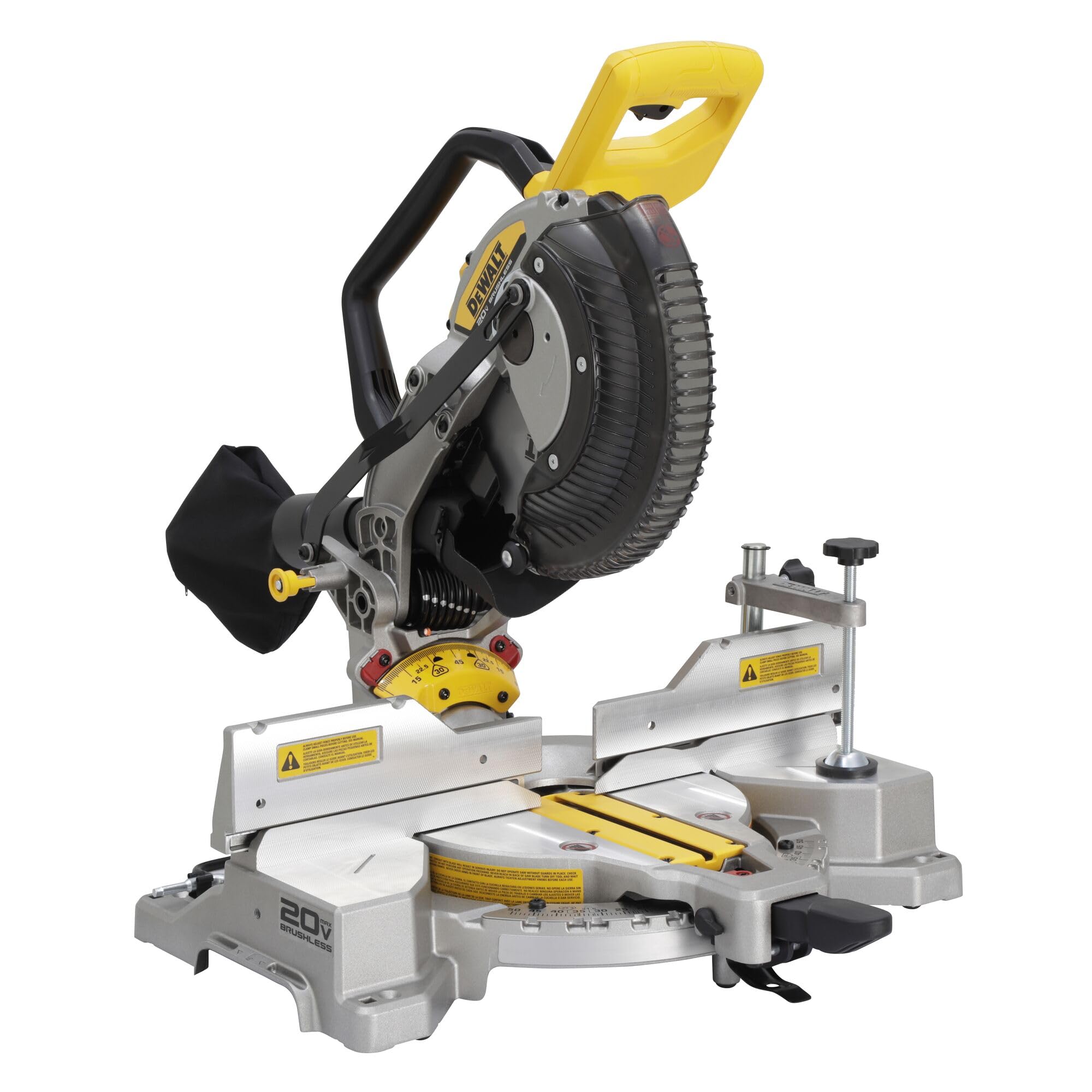
No cord, no outlet, no problem — a dual-bevel 10-inch saw that runs on batteries you already own.
If you already own DEWALT 20V MAX batteries, the DCS714B is the saw that turns them into a job-site miter saw. It is the first 10-inch miter saw DEWALT makes that works with the full line of 20V MAX and FLEXVOLT batteries, and DEWALT states it can make up to 434 cuts in 3-1/4-inch MDF base moulding on a charge, or up to 311 cuts in 2×4 SPF. The bevel gear transmission is tuned to minimize power loss so those numbers hold up under real work.
Cut capacity is generous for a fixed-head saw — 6 inches horizontally, 5-1/4 inches of baseboard vertically, and 5-1/4 inches of crown nested. The cutline blade positioning system gives a straight cut line with no adjustment needed, and bevel pawls set common angles like 22.5 and 33.9 degrees with one motion. At 34 pounds (tool only) and with a top carry handle, moving between work zones is manageable.
The catch is the batteries. This is listed as a tool-only item, so the price covers the saw — you bring your own pack and charger, and you will want a spare charged. As one owner put it: keep a second battery ready, because the saw tells you when the pack is overheating by flashing a light.
Where the value adds up
- Cordless design frees you from outlets on the job site — no extension cord to trip over or plug in.
- Double-bevel cutting throws both directions without flipping the workpiece.
- Dust collection captures up to 97% of dust per DEWALT’s spec, which keeps the work area noticeably cleaner than a bag-only saw.
What to know before you order
- Tool only — batteries and charger are not included, so factor those in separately.
- It will not cut as wide as a full sliding saw: 6-inch horizontal capacity is the ceiling.
- Battery runtime depends on which pack you pair it with.
Perfect for you if: you already run DEWALT 20V MAX tools and want to cut trim on a job site without hunting for power.
Look past it if: you don’t own the batteries yet — the total outlay climbs fast once you add a pack and charger.
10. Makita LS1019L 10″ Dual-Bevel Sliding Compound Miter Saw with Laser

A 10-inch slider that delivers the crown capacity of a 12-inch saw and stays flush against the wall.
The LS1019L earns its premium spot on one number: it cuts 6-5/8 inches of crown moulding nested, which is the capacity you would normally need a 12-inch saw for. Makita achieves that with an innovative direct-drive gearbox and guard system that increases the vertical cutting capacity to 5-1/4 inches, plus a linear ball bearing rail system on two steel rails for smooth, dead-on slides. The rail design also lets the saw run flush against a wall — no slide rails poking into the space behind your bench.
The front-mounted dual rails and laser guide are the ergonomic wins. The laser projects a bright line onto your workpiece so you can align the cut before the blade makes contact, and the vertical hold-down is quicker to set than a knob-and-thread clamp. Owners consistently praise the dust collection — one 50-year carpenter reports capturing 80 to 90 percent of the dust with a dual-port shroud and a 2-1/2 inch shop vacuum hose. Soft start keeps the saw from jerking at power-up, and the blade brake stops the blade quickly.
Two real caveats. At 72.8 pounds, it is the heaviest saw on this list, so plan the bench location carefully — this is not a saw you move often. And the miter angle can’t be locked between the preset detents, so custom angles depend on the pivot tension holding firm.
Why pros choose it: full 12-inch-saw crown capacity, a smooth ball-bearing slide, a laser, and top-tier dust capture, all in one machine.
The trade-off: 72.8 pounds and no way to lock a miter angle between detents — plan for a permanent bench spot and use the preset stops for the work that matters most.
This is your saw if: you cut crown and trim at volume and dust control plus slide smoothness are more important than mobility.
Choose differently if: you move the saw between sites — the 72.8-pound body is a two-person job to relocate regularly.
11. MILWAUKEE ELECTRIC TOOL 2734-21HD M18 FUEL Dual Bevel Sliding Compound Miter Saw
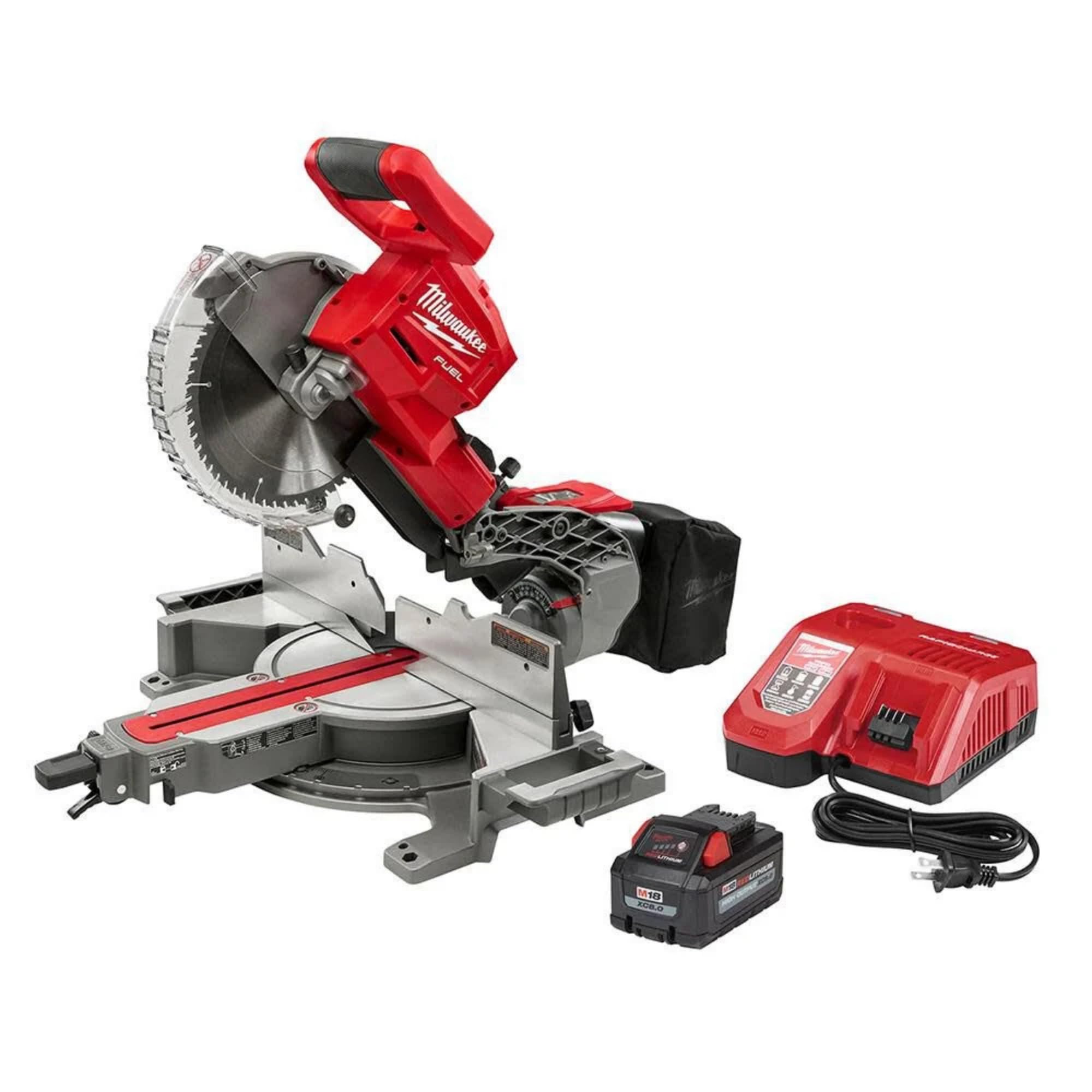
A cordless M18 slider at 45 pounds, built to cut all day on one pack and not feel like it’s running on batteries.
At the top of the range, this is the saw for a contractor already invested in Milwaukee’s battery platform. It runs a 10-inch blade, dual bevel, sliding compound head, and at 45 pounds is 20 pounds lighter than the Bosch CM10GD measured above — meaningful when you’re hauling it between trucks and jobsites. Side carrying handles make the lift easier. The company lists a durable design and more run-time as the headline traits.
Owners confirm the runtime claims. One reviewer reports all-day runtime on a single battery and the original blade still in use after a year. A commercial contractor owner reports using his on every job. Multiple owners say it’s hard to tell it’s battery-powered.
The cut-line light is a signature Milwaukee detail worth calling out. Rather than relying on a laser, the saw projects a bright illumination line onto your workpiece that shows exactly where the blade will land — which owners prefer for visibility in bright daylight. On the downsides, the price sits at the top of this list, and the value question comes up more frequently here than on any other saw. Dust collection with a shop vacuum is also an area some owners wish were tighter.
The cordless case: an M18 platform owner gets a 45-pound dual-bevel slider that genuinely performs like a corded saw, with a blade that outlasts typical expectations.
Budget honestly: this is the most expensive pick here, and if you do not already own M18 batteries, the total package cost grows fast.
Right saw for you if: you’re already on Milwaukee’s M18 platform and want cordless, dual-bevel, sliding capability on every job site.
Think twice if: you want the best cut quality per dollar — the market offers comparable cutting for noticeably less.
Understanding the Specs
Amp Rating And No-Load Speed
The amp rating tells you how much electrical current the motor pulls. In this category the standard for corded saws is 15 amps, and all the corded saws on this list use that rating. No-load speed is how fast the blade spins with nothing in the wood, and the range here runs from 4,600 to 5,000 RPM. Higher amperage helps the saw maintain speed under load — critical for hardwoods and dense composite materials. If you see a saw rated below 15 amps at 10 inches, it will tend to bog down in hard maple and pressure-treated lumber.
Miter Range And Cut Capacity
Miter range is how far the table swings left and right, expressed in degrees. A 0 to 45 degree range covers standard corners; a 0 to 52 degree range covers more acute angles and crown. The cut capacity tells you the largest stock you can safely crosscut — usually measured as horizontal width, vertical baseboard height, and crown capacity when nested against the fence. On a fixed-head saw, the horizontal capacity is the ceiling. On a sliding saw, a rail system extends that crosscut width forward and back, which is why sliders handle longer material in a single pass.
FAQ
What does 10-inch blade size mean in a miter saw?
Is a single-bevel or double-bevel miter saw better?
Do I need a sliding miter saw for home projects?
Is a cordless miter saw as powerful as a corded one?
How long does a 10-inch carbide blade last?
Can a 10-inch miter saw cut metal?
What miter angle range do I actually need?
How much does a 10-inch compound miter saw weigh?
Do I need a dust bag or a shop vacuum?
Can I cut crown molding with a 10-inch saw?
Is a miter saw the same as a chop saw?
Final Thoughts: The Verdict
For most woodworkers, the 10-inch compound miter saw that does the most, most reliably, is the Bosch CM10GD — its articulated arms deliver dead-accurate cuts without asking for bench space you don’t have, and it holds 4.7 stars across 688 ratings. If you need to carry your saw from truck to bench, grab the Metabo HPT C10FCG2: a 24.2-pound body with a 5,000 RPM motor is hard to argue with for trim work. And for cutting metal and wood with one blade on the same machine, the Evolution R255SMS+ is the one to reach for.
How We Picked
We do not accept paid placement. Every pick is matched to a real buyer and a real use-case; we do not hands-on test units.
Sources & Methodology
Specifications: manufacturer listings and product documentation. Review insights: verified customer reviews, as of September 2026. Pricing: not shown on this page (it changes often); check the current price via the retailer link.
As an Amazon Associate, KitchPrep earns from qualifying purchases. This does not affect which products we feature.
Related Guides
