
Specs are compiled from manufacturer listings and verified buyer reviews and can change over time — please confirm the key details on the product page before buying.
When the power goes out or the tap runs dry, the first thing you reach for is water — and a 10-gallon tank is the difference between a rough night and a manageable week. The catch is that “10-gallon” on the box rarely means the same thing twice, so this guide sorts the coolers, RV tanks, and portable totes by what they are actually built for, not just their label. You will see honest trade-offs on durability, portability, and temperature control so you can match the tank to your real scenario — a job site, a van build, a storm closet, or a tiny house.
I’m Mohammad Maruf — the founder and writer behind KitchPrep. This guide is built by comparing the manufacturers’ published specifications and the patterns across verified customer reviews, so you get each pick’s real strengths and trade-offs instead of marketing spin.
Note that this list uses flexible, human-like matching for capacity, so not every pick is the exact number searched; the nearest same-type size serves the same purpose. Here is how to judge a 10-gallon water tank on durability, portability, and heat retention before you buy.
Our Picks at a Glance


How To Choose The Best 10-Gallon Water Tank
Before you buy, know that a 10-gallon water tank comes in three very different forms: cold drinking water, pressurized RV storage, or hot water from a heater. Each pick below is built for exactly one of those jobs, so match the tank to your actual need first.
Match the material to the job
Most tanks here are either High Density Polyethylene (HDPE) or standard polyethylene (PE). HDPE is the tougher, more rigid plastic that resists chipping and rust — it is what job-site coolers and premium portable totes use. Standard PE is lighter and cheaper but more prone to flexing and cracks over time. For a tank you will bang around in a truck bed, HDPE is the safer bet.
Venting is non-negotiable
If a tank is labeled non-pressurized, it must be vented to let air in and out as water drains. Sealing a garden hose directly to a non-pressurized tank turns it into a pressurized one, and the manufacturer warns it can rupture. Look for tanks that either say “vented” or give you fittings you can leave open.
Think about how you will move it, not just fill it
A full 10-gallon tank weighs over 80 pounds — lifting it is a genuine strain injury risk. If you cannot place the tank where it will stay, a wheeled model with a handle is worth the extra cost. If it is a stationary cooler, the portability question disappears and heat retention becomes the priority.
Quick Comparison
| Model | Best For | Capacity | Material | Portability | Amazon |
|---|---|---|---|---|---|
| Igloo 400 Series Cooler★ Best Overall | Ice-cold water on job sites | 10 gal | HDPE | Carry handle | Amazon |
| Class A Customs T-1000 TankRV Workhorse | RV fresh & grey water | 10 gal | NSF plastic | No wheels | Amazon |
| Aguaprep 2-Tank Set | Emergency storage, closets | 5 gal each | Food-grade plastic | Stackable | Amazon |
| A.A 10 Gallon RV Tank | Camper replacements, OEM | 10 gal | Polyethylene | No wheels | Amazon |
| YITAHOME 10.6 Gal Tote | Camping & overflow hauling | 10.6 gal (40 L) | PP / HDPE | 2 wheels + handle | Amazon |
| CAMPLUX 10 Gal Heater | Hot water in tiny spaces | 10 gal | Porcelain enamel / steel | Floor mount | Amazon |
In‑Depth Reviews
1. Igloo 400 Series Water Cooler, 10 gal
Our pick — over 4.5★ from 200+ verified ratings; the strongest balance of quality and price.
The job-site classic that keeps water cold through a 14-hour shift and doubles as a brewer’s best friend.
This is the tank people reach for when cold water has to stay cold. The Igloo 400 Series holds exactly 10 gallons, and the Ultratherm insulation is the reason buyers report temperature drifting only 2-3°F even after hours — the stuff of a full workday of ice-cold pours. The High Density Polyethylene (HDPE) shell is the bulletproof outer layer that won’t chip, peel, buckle, or rust, so it shrugs off a truck bed and a hot parking lot equally.
The real surprise is who buys it. Beyond job sites, a huge slice of owners convert this into a homebrew mash tun, praising the sturdy build and the minimal heat loss — around 1°F per hour — for keeping grain mashes at temperature. It cleans up well, and the FDA-grade white inner liner makes that easy. Owners mention it has been a literal lifesaver during storms, with one describing it as “extremely useful” during Hurricane Helene and then handing it to family in Asheville after Milton.
It is not perfect for every job. The drain is a gravity spigot, so you will lift or tilt it to empty, and homebrewers note you need a false bottom and stainless valve for that use. But for the core promise — a rugged, insulated 10-gallon water tank that keeps water cold, clean, and available — this is the crowd favorite by a wide margin.
What earns the top spot
- Ultratherm insulation holds temperature within 2-3°F, verified across many owner reports
- HDPE shell resists chips, peeling, buckling, and rust on harsh sites
- Stellar heat retention for homebrew mash tuns — about 1°F loss per hour
Where it fits less
- Gravity spigot means tilt or lift to drain the last water
- Homebrew conversion needs extra parts: false bottom, stainless valve
- No wheels — this is a stationary cooler, not a tote
Reach for this if: you need ice-cold water that stays put on a job site, or a mash tun for 5-10 gallon batches.
Think twice if: you planned to wheel a full tank across a campsite — there are no wheels here.
2. Class A Customs T-1000 Fresh/Grey Water Tank
A purpose-built RV tank that sits on any side and gives you two sizes of built-in ports for plumbing freedom.
If your project is a van build, pop-up camper, or concession trailer, this is the tank engineered for exactly that. The Class A Customs T-1000 holds 10 gallons and is molded from NSF-approved materials, meaning the plastic itself is rated safe for fresh and drinking water — a spec you cannot assume on cheaper tanks. At 19 inches at its longest, it fits in tight spots, and because the tank can sit on any side you can rotate it to change height or width to match your under-counter space.
The built-in fittings give you real plumbing flexibility: two 1.5-inch female NPT fittings sealed and watertight (you cut the membrane with a razor knife to open them) plus two open 0.5-inch female NPT fittings. Owners praise the “high quality molding” and report easy installs under kitchen counters and bunks, with one van owner buying two to run fresh and grey water in tandem. It is made in Elkhart, Indiana, and cleaned before shipping. Customers note it works “like a charm” with a little fabrication for straps.
The honest caveats: this is a non-pressurized tank that must be vented — never seal a garden hose directly to it, or the maker warns it can rupture. And a few owners found plastic chips from the assembly process inside, so a rinse before first use is wise. Durability gets mixed feedback, though the build quality itself is widely rated high.
Why it wins for builders: NSF-rated plastic, four plumbing ports, and USA manufacturing make it the most versatile fresh/grey tank on this list.
One real trade-off: you own the venting responsibility — skip the hose clamp, use gravity fills.
3. Aguaprep 5-Gallon Stackable Containers (2-Pack)

Two 5-gallon cubes that stack into corners and closets, delivering 10 gallons without a single lift-your-back moment.
This pick reaches 10 gallons by pairing two 5-gallon tanks, and that split is exactly the point. At 12″L x 12″W x 15″H each, the square footprint tucks into closets, under beds, and in RV cabinets where a single tall tank never fits. The stackability is the most-praised feature — owners line them up like building blocks and still reach the spigot on top. Made in the USA from food-grade plastic with thick walls, they are built to sit and hold, not to haul.
Each tank ships with a screw-on lid for storage, a pour-through lid for filling, and a spigot for dispensing. All the lids screw on tightly, and the flat bottom keeps the tank stable while you pour. For short-term outages, owners say a set like this covers a week depending on rationing. As buyers put it, “the quality is exceptional and is a great value for the money.”
The recurring warning is physics: a filled 5-gallon tank weighs over 40 pounds, so moving it full is a back-strain risk. Owners advise pairing these with a separate dispenser or just planning to fill them in place. Leakage gets mixed feedback, so test the spigot seal before a crisis.
Best for: emergency kits and small-space storage where two manageable 5-gallon units beat one awkward 10.
Skip if: you wanted a single tank or plan to move water when full — these are meant to stay put.
4. A.A 10 Gallon RV Fresh/Gray Water Tank

This smooth rotomolded tank drops into campers and horse trailers with zero modifications, and it is the easiest swap on this list.
If you are replacing an old or failing RV water tank, the A.A 10-gallon is your direct swap. It is rotationally molded in one piece, so there are no seams to burst — the classic failure point on cheaper tanks. At 17″L x 14″W x 10″H, reviewers point out it fits designated camper spaces smoothly and installs without modifications, with several using it as a direct replacement for a larger leaking original. The polyethylene build resists stains, corrosion, and rust.
Plumbing is simple: one 1.25-inch water fill inlet and three 3/8-inch NPT connections, all threaded with plugs included. The BPA-free material makes it safe for fresh water, and being able to orient the tank different ways (height or rotated 90 degrees) helps when you are working around wheel wells. Quality is what owners praise most — the build feels sturdy and the fittings are “perfect” right from the start.
Two honest notes. First, it lacks internal baffles, so water sloshes more while you drive. Second, size feedback is mixed — most owners find it true to spec, but a few felt it ran smaller than advertised. As a non-pressurized tank it must be vented in use.
Why it is the value pick: the lowest-effort camper swap on this list, with smooth construction and all fittings included.
Know before you buy: no baffles means slosh, and verify your cutout measures 17 x 14 x 10 before ordering.
5. YITAHOME 10.6 Gallon Portable Water Tank

The rolling tote that lets anyone — including the elderly — move a full 40 liters without ever hoisting it.
This pick solves the weight problem nobody talks about: a full 10-gallon tank is too heavy to lift. YITAHOME bolted on two rolling wheels and a sturdy metal handle, and owners confirm the wheels “work well to pull a heavy load of liquid.” At 10.6 gallons (40 liters), it carries fresh water or sewage for camping, festivals, construction sites, or as an overland trailer’s primary clean-water tank.
No installation is required — you fill it, wheel it, and dispense. It ships with one flexible hose, a filling port, and a faucet, and the PP material keeps it odorless even when you empty grey water. Owners praise the easy pull, the sturdy metal handle attachment, and the zero-setup reality; many say they would repurchase. One overland owner even removed the wheels to mount it as a permanent trailer tank.
The trade-offs are real. A few owners found it smaller than expected, and leakage drew negative feedback from a handful — so a test fill before a trip is smart. Durability is mixed, with one report of a plastic hose cracking within a year. The cap detaches completely, which one owner worries could get lost.
Reach for this if: you haul water to a site — the wheels remove the single biggest hassle of a 10-gallon tank.
Look elsewhere if: you need a plumbed, stationary tank or you distrust that detachable cap.
6. CAMPLUX 10 Gallon Point-of-Use Water Heater
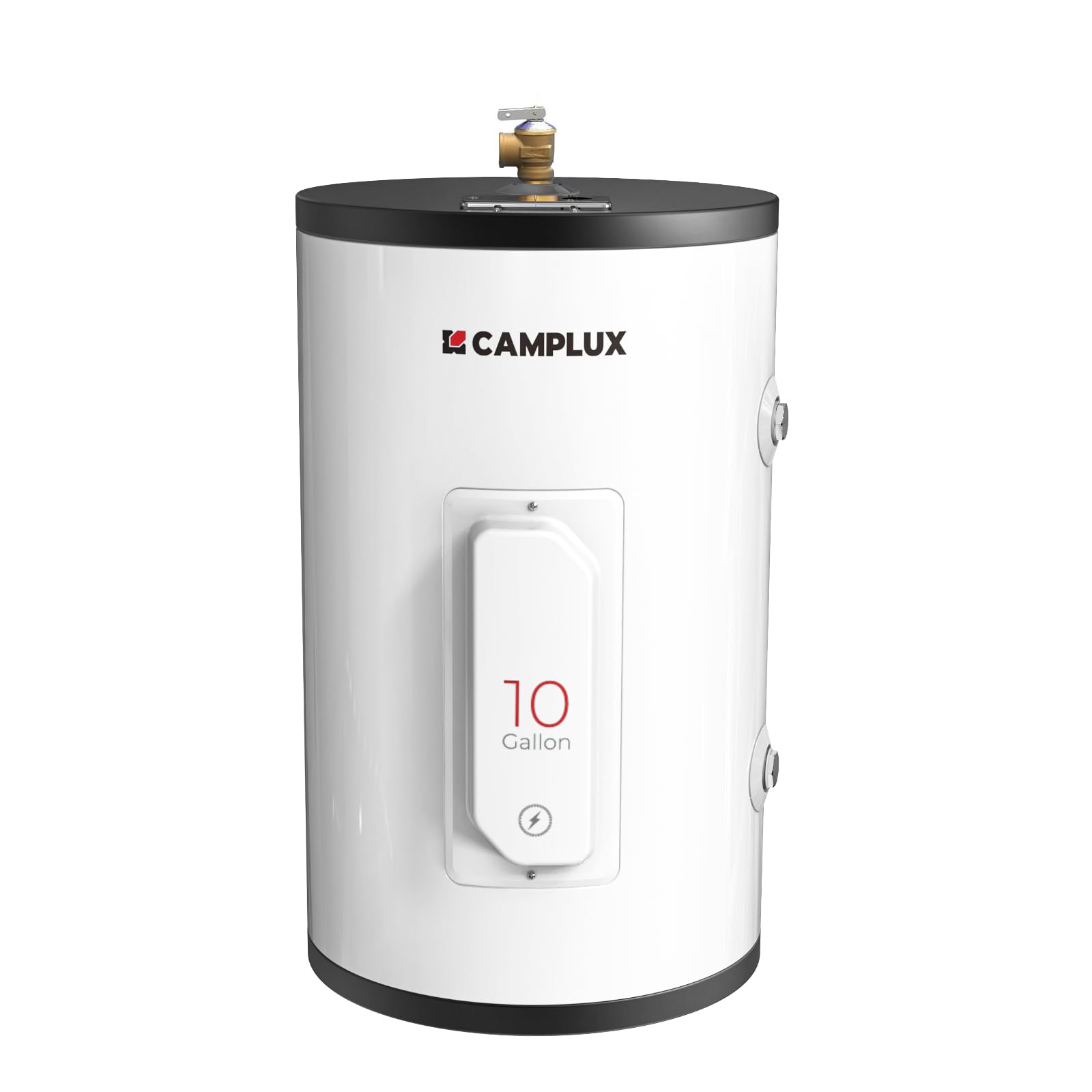
A 10-gallon tank that heats a full load in about 60 minutes and keeps it hot for a full day.
This is a completely different animal: a 10-gallon tank that makes hot water, not cold. The CAMPLUX point-of-use heater runs on 1500W at 120 volts, heating a full tank in roughly 60 minutes — and the advanced insulation holds that heat for up to 24 hours so you are not paying to reheat. It is UL Listed, and the built-in temperature & pressure (T&P) relief valve plus adjustable thermostat give you control and safety in one compact floor-mounted unit.
At 14.75″W x 24.5″H, it slides under a kitchen or bathroom sink, into an RV, or a tiny house. Owners use it as an RV replacement for old 6-gallon heaters, with one reporting it heats to 135°F and recovers fast enough to shower without blowing a 15-amp fuse. Another ran it in series with a main heater for instant hot water. The porcelain enamel and stainless steel construction resists corrosion, and the maximum pressure rating sits at 150 psi.
Know the limits before you commit. A few owners found it larger than expected and noted it only gets warm, not hot, when undersized — review the specs against your shower flow. It needs a dedicated 15A circuit or a shared dishwasher/disposal circuit. Leakage and durability drew negative feedback from a minority, and the relief valve must be connected to a drain.
What owners rave about
- Full 10-gallon tank heated in ~60 minutes at 1500W
- 24-hour insulation holds temperature, cutting energy use
- Compacts under a sink at 14.75″W x 24.5″H
What to plan around
- Needs a dedicated or shared 15A circuit
- T&P relief valve must run to a drain
- A few shoppers say it runs warm rather than hot for high-flow showers
Best for: tiny houses and RVs that already have plumbing and just need hot water on demand.
Not for: anyone who needs cold drinking water storage — this tank’s only job is heat.
Understanding the Specs
HDPE vs Standard Polyethylene
High Density Polyethylene (HDPE) is the tougher plastic — rigid, chip-resistant, and rust-proof — which is why job-site coolers and premium totes use it. Standard polyethylene (PE) is lighter and cheaper but flexes more and is more prone to cracks. For a tank that takes abuse, HDPE wins; for a stationary replacement tank, PE is fine.
Non-Pressurized & Venting
A non-pressurized tank relies on gravity to drain and must be vented so air can enter as water leaves. Sealing a hose directly to one creates pressure the walls were not built for, and the manufacturer warns it can rupture. Always use a fill dish or a gravity process, and keep a vent open.
Heat Retention & Insulation
If you want cold water, insulation is the spec that matters. The Igloo cooler’s Ultratherm insulation holds temperature within 2-3°F, and the CAMPLUX heater’s insulation keeps water hot up to 24 hours. A bare plastic tank with no insulation gains or loses temperature fast, so match insulation to if you need cold or hot.
Fittings & NPT Threads
National Pipe Thread (NPT) is the standard threading for plumbing fittings. You will see 1.5-inch, 0.5-inch, and 3/8-inch NPT options — larger threads move more water, smaller ones suit tight 3/8-inch lines. Sealed fittings arrive capped; you cut the membrane to open them. Never over-tighten plastic threads, as metal fittings can damage them.
FAQ
How much does a full 10-gallon water tank weigh?
Can I connect a garden hose directly to a non-pressurized tank?
Is a 10-gallon cooler the same as a 10-gallon RV tank?
What does NSF-approved mean for drinking water?
How long does a 10-gallon electric water heater take to heat up?
Can I use a 10-gallon cooler as a homebrew mash tun?
What is the difference between the 1.5-inch and 0.5-inch NPT fittings?
Why do some tanks need a T&P relief valve?
Are stackable 5-gallon tanks better than one 10-gallon tank?
How do I know if a 10-gallon tank will fit my RV or cabinet?
Final Thoughts: The Verdict
For most people, the 10-gallon water tank winner is the Igloo 400 Series Cooler because it pairs rugged HDPE construction with Ultratherm insulation that keeps water cold within 2-3°F — and it dominates as both a job-site cooler and a homebrew mash tun. If you want a plumbed RV fresh or grey tank, grab the Class A Customs T-1000 for its NSF-rated material and four built-in ports. And for hot water in a tiny house or RV, the CAMPLUX 10-gallon heater heats a full tank in about 60 minutes and holds it for a day.
How We Picked
We do not accept paid placement. Every pick is matched to a real buyer and a real use-case; we do not hands-on test units.
Sources & Methodology
Specifications: manufacturer listings and product documentation. Review insights: verified customer reviews, as of September 2026. Pricing: not shown on this page (it changes often); check the current price via the retailer link.
As an Amazon Associate, KitchPrep earns from qualifying purchases. This does not affect which products we feature.
Related Guides
