
Specs are compiled from manufacturer listings and verified buyer reviews and can change over time — please confirm the key details on the product page before buying.
A ten-gallon water heater holds forty litres of ready hot water. Before you pick one, answer one question: will you run it every day, or only now and then as a backup? That answer decides which of the seven picks below actually earns your money.
I’m Mohammad Maruf — the founder and writer behind KitchPrep. This guide is built by comparing the manufacturers’ published specifications and the patterns across verified customer reviews, so you get each pick’s real strengths and trade-offs instead of marketing spin.
Every pick below was chosen because it fits a specific real-world setup — from RV replacements to under-sink boosters. If you want the short answer, the one that earns its place above all seven is the 10-gallon water heater from Suburban, and the reviews say why.
Our Picks at a Glance
How To Choose The Best 10-Gallon Water Heater
A ten-gallon tank is a deliberate compromise. It is small enough to tuck under a cabinet or into an RV closet, but large enough to cover a real shower if you manage the recovery time. The buyers who end up happy are the ones who matched the unit to their actual daily demand instead of buying the biggest box that fit.
Flow Rate Tells You What You Can Actually Run
Flow rate is how much hot water the unit pushes through the pipes over a set time — measured here in gallons per minute (gpm, or how fast the hot water comes out of the tap). The Suburban delivers 0.45 gpm while the CAMPLUX ten-gallon pushes 2 gpm, and that difference changes which fixtures you can run at once. A low flow rate is fine when you are filling a single sink. If you want a long, steady shower, you need the higher figure.
Match The Element To Your Circuit
Heating element wattage is the power draw — how hard the unit works to bring cold water up to temperature. A 1500-watt element and a 1650-watt element both run on standard household current, but the higher the wattage the faster the recovery between uses. Check what circuit you have available before you commit, because these units want their own dedicated line, not a shared outlet with your dishwasher.
Quick Comparison
| Model | Best For | Capacity | Flow Rate | Weight | Amazon |
|---|---|---|---|---|---|
| Suburban Advantage SW10DE★ Best Overall | RV replacement & full-time trailer living | 10 gallons | 0.45 gpm | 46 pounds | Amazon |
| CAMPLUX Mini Tank ME15BMost Compact | Under-sink point of use | 1.3 gallons | — | 11 pounds | Amazon |
| CAMPLUX 10 Gallon ME100B | Full-home instant hot water | 10 gallons | 2 gpm | 40 pounds | Amazon |
| GE Appliances 10 Gallon | Garages, cabins, outdoor showers | 10 gallons | — | 41 pounds | Amazon |
| MIZUDO 10 Gal Mini Under Sink | Salons, shops, compact boosts | 10 gallons | 10 gpm | 37.5 pounds | Amazon |
| Reliance 6 10 SOMSK | Off-grid cabins and utility rooms | 10 gallons | 0.67 gpm | 41 pounds | Amazon |
| Dometic WH-10GEA | RV full-timers wanting gas and electric | 10 gallons | — | 22 pounds | Amazon |
In-Depth Reviews
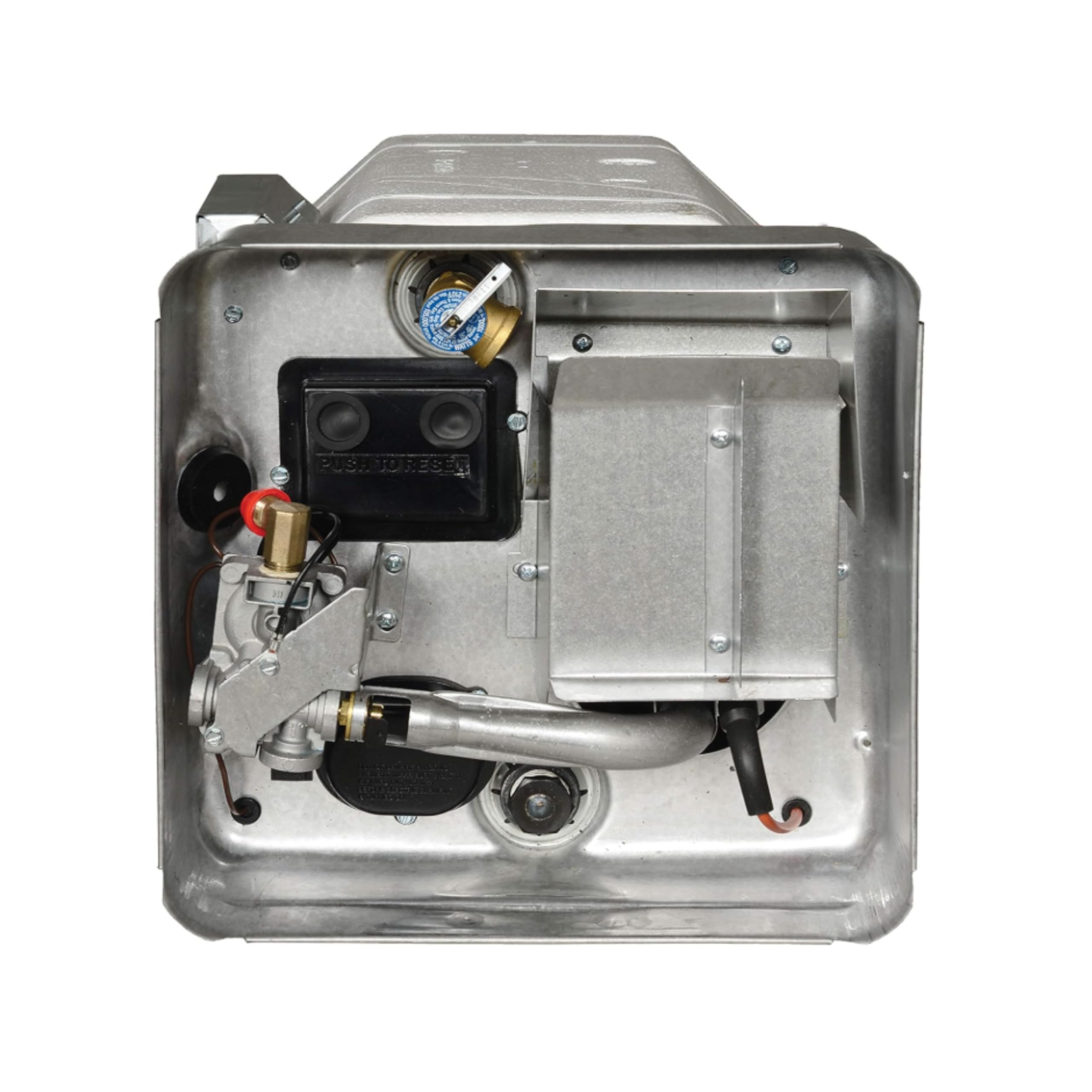
1. Suburban Advantage RV Tank Water Heater SW10DE with Direct Spark Ignition and Incoloy Electric Element
Our pick — over 4.5★ from 3,000+ verified ratings; the strongest balance of quality and price.
Ten gallons of porcelain-lined tank that drops straight into the opening your old one left behind.
Swapping a dead heater in a travel trailer is the job the Suburban Advantage handles best. It runs on propane through a direct spark ignition burner (a burner that lights itself with an electric spark instead of a pilot flame) rated at 12,000 BTU/h, so you get hot water at a campsite. It can also take an optional 1,440-watt electric element, so you can heat from a campsite pedestal or a generator when parked. Recovery sits at 6.1 gallons per hour on electric alone and 10.1 gallons per hour on gas, so the tank refills fast enough to keep two showers back to back. It is the crowd favourite here, with 4.6 stars across 3,000+ ratings.
Functionality is what wins people over, closely followed by build quality. The unit is designed to mimic the life of a residential tank heater, with a replaceable anode rod that doubles as a drain so you can flush sediment without pulling the whole thing. The flue tube is Suburban’s own design that deliberately slows combustion to squeeze more heat into the water rather than up the exhaust. Installers who have done this before describe the fitment as exact — it slides into the old opening and the wiring matches up. The recurring minor gripe in reviews is the water line adapters; the connection at the electric element sometimes needs the connector rotated to sit flat before it will seal properly.
At 46 pounds and 16.21 inches wide by 16.21 inches high, this is a substantial unit — noticeably heavier than the 11-pound CAMPLUX mini tank at the other end of this list. That weight is the point: the porcelain-lined steel tank is what gives it the multi-year lifespan that glass-lined units struggle to match. One buyer did report the pressure blow-off valve (a safety valve that releases excess pressure) starting to leak five months in, which is worth watching. On a unit this widely reviewed, leaks show up in some units, so check at the first sign of moisture.
Where It Shines
- 12,000 BTU/h gas burner plus optional 1,440-watt electric element for dual power
- 6.1 gph electric / 10.1 gph gas recovery keeps up with consecutive showers
- Porcelain-lined steel tank with replaceable anode rod for long-term corrosion protection
- Designed as an exact replacement for common RV openings
What To Watch
- 46 pounds makes it a two-person lift and a permanent install
- Water line adapter fittings can need repositioning to seal cleanly
- Optional electric element is sold separately — not included as standard
Strongly Recommended: If you are replacing a unit in an RV or travel trailer and need both gas and electric capability, this is the one.
Think Twice If: You want a plug-and-play under-sink unit — this demands a proper installation with the right fittings and tools.
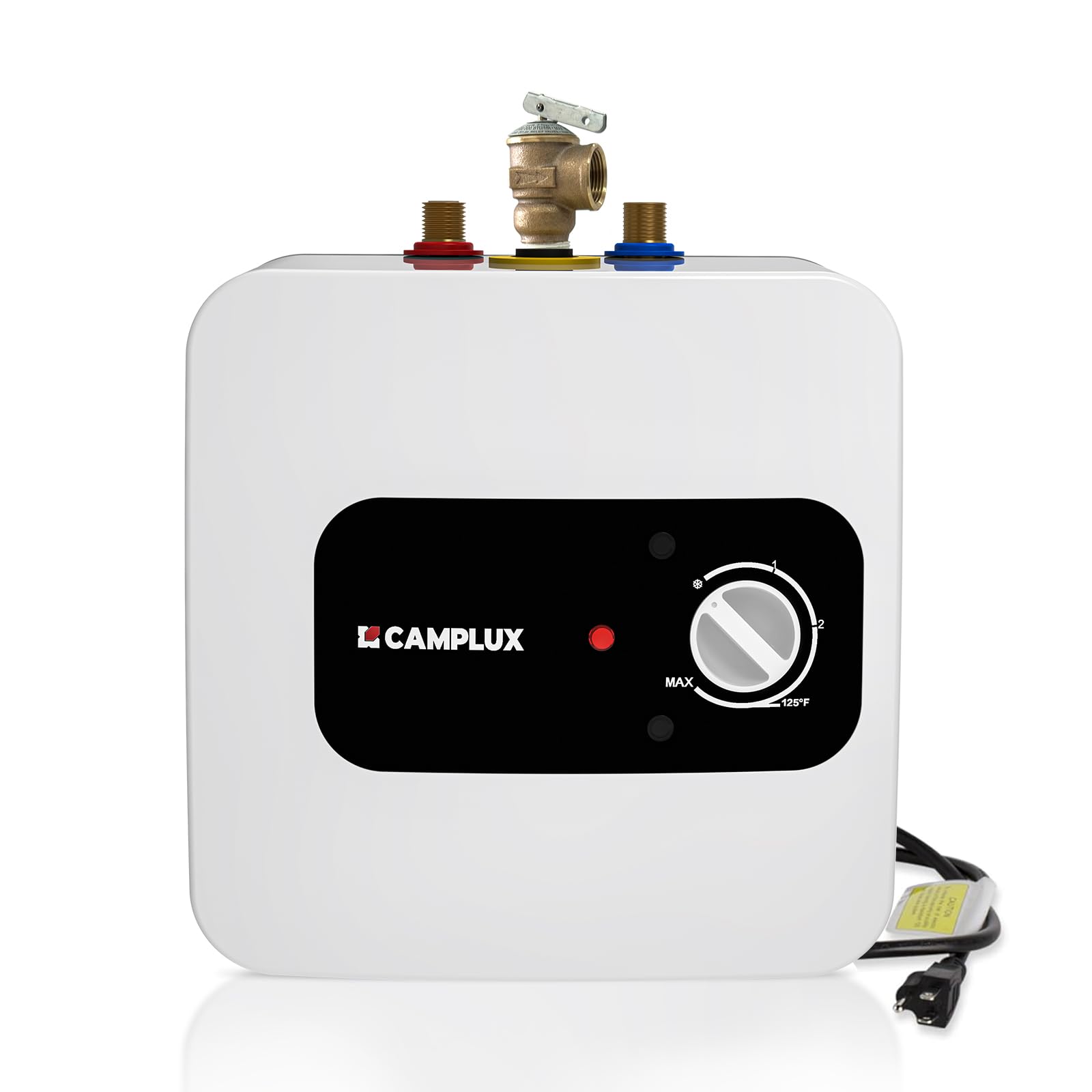
2. CAMPLUX Mini Tank Electric Water Heater 1.32 Gallons, 1.44kW, UL Listed
The 11-pound under-sink answer for anyone tired of waiting for the tap to run warm.
The obvious question with a 1.3-gallon tank is whether it holds enough water to matter. At 11.4 inches wide by 11.4 inches high, it tucks into a cabinet or mounts to a wall without eating your storage. At 11 pounds, it is 35 pounds lighter than the 46-pound Suburban, so one person can hang it alone.
Heat output is what buyers talk about most — the unit reaches temperature quickly and holds it, and the sealed glass-lined tank with freezing mode protects the water inside when temperatures drop below the set point. The built-in overheat protection cuts power automatically at 203 degrees Fahrenheit, and the thermostat offers three levels ranging from 68 degrees Fahrenheit to 140 degrees Fahrenheit. Thermal efficiency is rated at 98%, which means almost all the power you pay for goes into the water rather than escaping as waste heat.
Two honest limits matter here. The compact size draws mixed feedback — some owners find it ideal for its footprint, while others note it occupies roughly a square foot of cabinet space once installed. As one RV full-timer put it after replacing a leaky six-gallon tank: it “runs on 1400W, under 15A fuse, no blown fuses” and “reaches 135°F max, supports long showers.” A separate dedicated circuit is still the safe call, and you may need different half-inch NPT fittings (the threaded connectors that join pipes) to match plastic threads.
The space math works out: At 11.4 by 11.4 inches and 11 pounds, this fits where a ten-gallon tank simply cannot — under a bathroom sink, in a boat galley, in a camper closet.
Plan the circuit first: The 1,440-watt draw wants a dedicated 15-amp line, and the short cord means you need an outlet within reach of your mounting spot.
Reach For This If: You need hot water at one sink or in one small space and want something you can install yourself in under an hour.
Look Elsewhere If: You want to run a full shower or fill a bathtub — 1.3 gallons runs dry on that job quickly.
3. CAMPLUX Tank Water Heater Electric, 10 Gallon Point of Use, ME100B, 120V 1500W

Full-home hot water at 2 gpm — the flow rate that actually keeps a shower running strong.
If flow rate is the number you care about, this is the standout in the group. At 2 gpm (gallons per minute), it pushes hot water through your fixtures 4.4 times faster than the Suburban’s 0.45 gpm — the difference between a trickle and a proper shower. The 10-gallon tank heats in roughly 60 minutes, and the 24-hour insulation keeps that water warm between uses, with the built-in thermostat adjustable between 90 and 150 degrees Fahrenheit. The 1500-watt submerged heating tube reaches 98% heat recovery efficiency, and the 14.75 by 24.5-inch footprint fits spots where running long hot water pipes is impractical — under a counter, beneath a cabinet, in a narrow gap.
Performance is the headline when owners talk about this unit, followed closely by how straightforward the installation is. Multiple reviewers mention running it off 110 volts without trouble, and the triple-layer enameled inner liner with stainless steel construction is built to resist corrosion and abrasion. The T&P relief valve meets ASME, ANSI and CSA standards and handles up to 150 PSI. Recovery is quick enough that you are not standing around waiting between tasks — dishes, laundry, and a shower can all follow one another with a little planning. Five minutes of running pulls roughly 2 gallons, and the recommended circuit breaker is 15 amps.
There are two things to go in with your eyes open about. The unit is hardwired at 120V AC with 3/4-inch NPT connections, so it is not the plug-in kind — you want an electrician or confident DIYer for the job. And DIY installation may affect the warranty, so check the terms before you pick up a wrench. Reviewers who have run this for years report it holding temperature reliably, and the recurring note about upkeep is simply that occasional leaks can appear if the fittings are not tightened correctly.
The 60-minute promise: Heats a full 10-gallon tank in about an hour, then holds it there around the clock — which means the first morning shower is ready when you are.
Wired in, not plugged in: Hardwired 120V AC with 3/4-inch NPT fittings; budget for a proper install rather than a simple outlet swap.
The Clear Pick For You If: You want near-instant hot water at a full 2 gpm and you have a spot under a counter or cabinet to fit a 14.75 by 24.5-inch unit.
Consider Alternatives If: You need something that plugs into a wall socket — this one is hardwired.
4. GE Appliances 10 Gallon Versatile Plug and Play Electric Water Heater, 120 Volt

The one built for a shed, a cabin, or a garage outlet — no wiring harness required.
What sets the GE apart from most ten-gallon units is the install path. It connects into any 120-volt supply using standard 3/4-inch NPT compatible water connections, and the whole thing is pitched as plug-and-play. For a backyard shed, a barn, or an off-grid setup where you want hot water for an outdoor shower, that means less fuss. The 41-pound unit measures 14.75 inches wide by 24.5 inches high and holds 10 gallons at up to 140 degrees Fahrenheit. It also works as a booster inline with an existing heater, so you can warm up a long plumbing run or feed a washing machine without replacing your main unit.
Reliability is the trait that earns the most praise here, with multiple owners reporting it holding heat overnight even after the power is unplugged. One buyer ran it successfully on an 11-kilowatt generator in an off-grid cabin after dialing the thermostat down to 120 degrees Fahrenheit. Another set it up in a shed with the cold inlet fed from a garden hose and the hot outlet running to an outdoor shower, and reported it working excellently at around 125 degrees Fahrenheit. The 8-year limited tank-and-parts warranty with 1-year labor beats the 2 and 3-year coverage on most rivals here.
The catch involves the fittings. Reviewers report that a supply nipple occasionally refuses to seal, even after Teflon tape, pipe dope, and new supply lines; the fix that worked was swapping in a 3/4-inch male adaptor and PEX connector. That is a fitting problem, not a tank problem, but it eats into the time savings of the plug-and-play promise if it hits you. Plan for a dedicated circuit, since the unit pulls a real load at 120 volts. For a home’s primary hot water, a single person will find 10 gallons adequate, but two people showering back to back may find the recovery tight.
What you get: One of the longest tank warranties available, a 120-volt plug-and-play connection, and a dual-purpose design that works standalone or as an inline booster.
The honest caveat: The supply nipples can be fussy to seal, and at 10 gallons with a single person’s demand, it is not built for heavy simultaneous use.
Made For You If: You are fitting a shed, cabin, garage, or off-grid setup and want the simplest possible connection to a 120-volt supply.
Turn Away If: You need to feed a full household of back-to-back showers, or you want a unit with zero risk of fitting trouble.
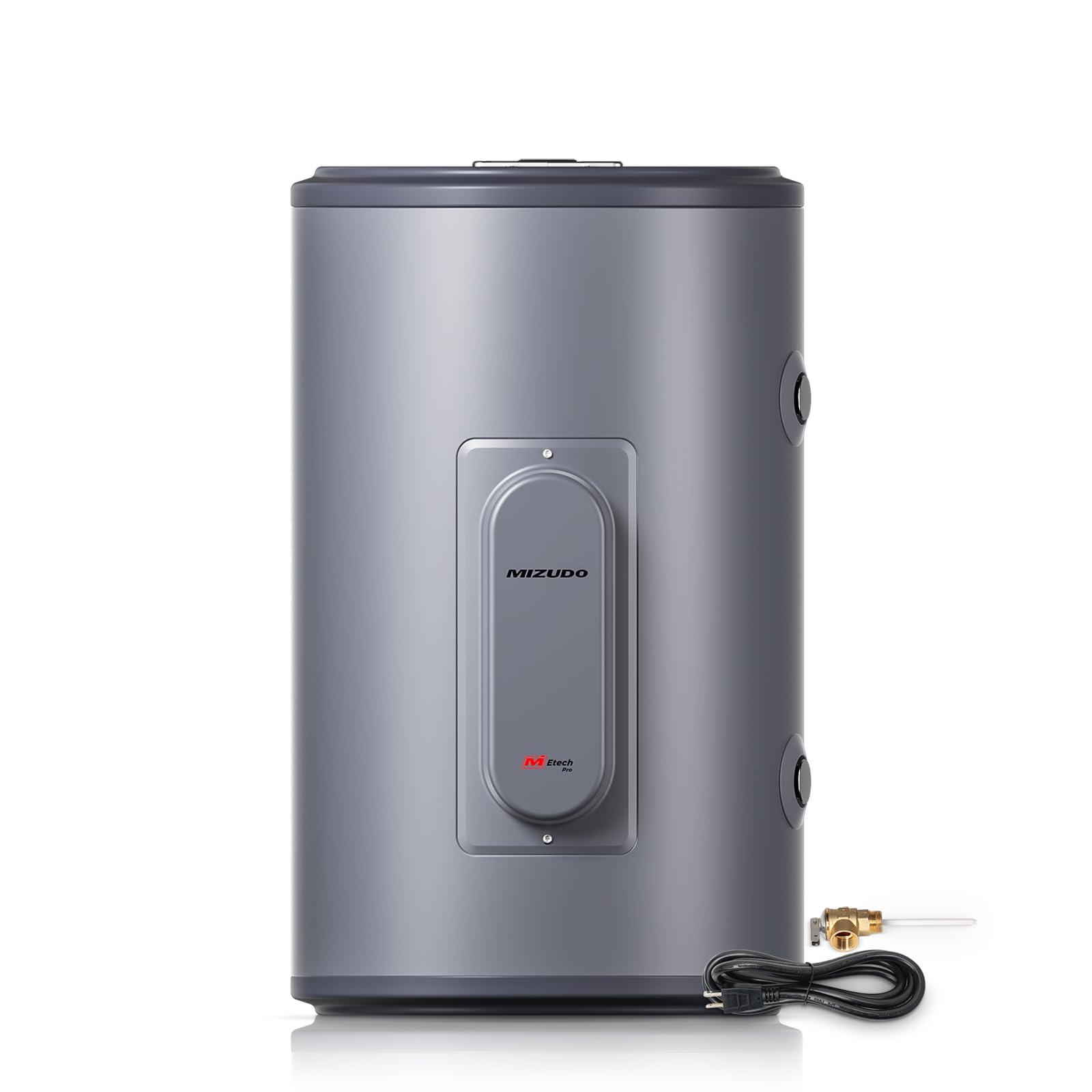
5. MIZUDO 10 Gal Electric Tank Water Heater, 120V Mini Under Sink with Anode Rod
A 37.5-pound workhorse for salons, shops, and RVs where the sink is the whole job.
The MIZUDO sits in the middle of the ten-gallon field on weight, at 37.5 pounds, which makes it the lightest of the full-size units here. That is useful if you are mounting it under a sink in a salon or shop where space is tight and you may be the one holding it up. It measures 14.76 by 27.9 inches, so measure your cabinet carefully — it is taller than the CAMPLUX ME100B at 24.5 inches. The 1500-watt element heats a full tank in roughly 60 minutes, and the adjustable thermostat moves between 90 and 150 degrees Fahrenheit. The porcelain enamel finish over a stainless steel body resists corrosion, and the replaceable anode rod is the maintenance feature that keeps it working over the years.
What the unit does well is deliver consistent temperature without asking much of you. The well-insulated design holds heat between uses, and the UL certification with a T&P relief valve covers the safety side. Buyers report it fitting snugly in a sink cabinet and installing cleanly with the included guide. For a small unit, it produces a generous amount of hot water, and the quick recovery is the reason. Some owners see hot water at the kitchen sink in as little as two seconds, though that reflects a short run from tank to tap rather than a physically impossible heat-up time.
Two things to know before buying. The heat output gets mixed notes — some owners say the water gets very hot, while others find the initial heat-up takes longer than expected, which is usually about starting temperature and tank size rather than the element. And there is a rare but real report of a leak from the front panel on first hookup, which is why the instruction to check the unit as soon as it arrives matters. Overall this runs at 4.1 stars, so it is the lowest-scored unit on this list, and worth knowing for that reason.
What Makes It Work
- 37.5 pounds — the lightest full-size ten-gallon unit here
- 1500W element heats a full tank in about 60 minutes
- Replaceable anode rod for long-term corrosion protection
- Hardwired 3/4-inch NPT with 150 PSI max pressure
Room To Improve
- 27.9 inches tall — measure your cabinet before ordering
- Some find the initial heat-up slower than expected
- Rare reports of first-hookup leaks mean inspect on delivery
- 4.1 stars is the lowest score of the seven picks
A Solid Match If: You are running a salon, shop, or RV and want a light, mountable ten-gallon unit with an anode rod you can service yourself.
skip it if: You need the highest reliability track record or the fastest heat-up — the GE and CAMPLUX units above lead on both.
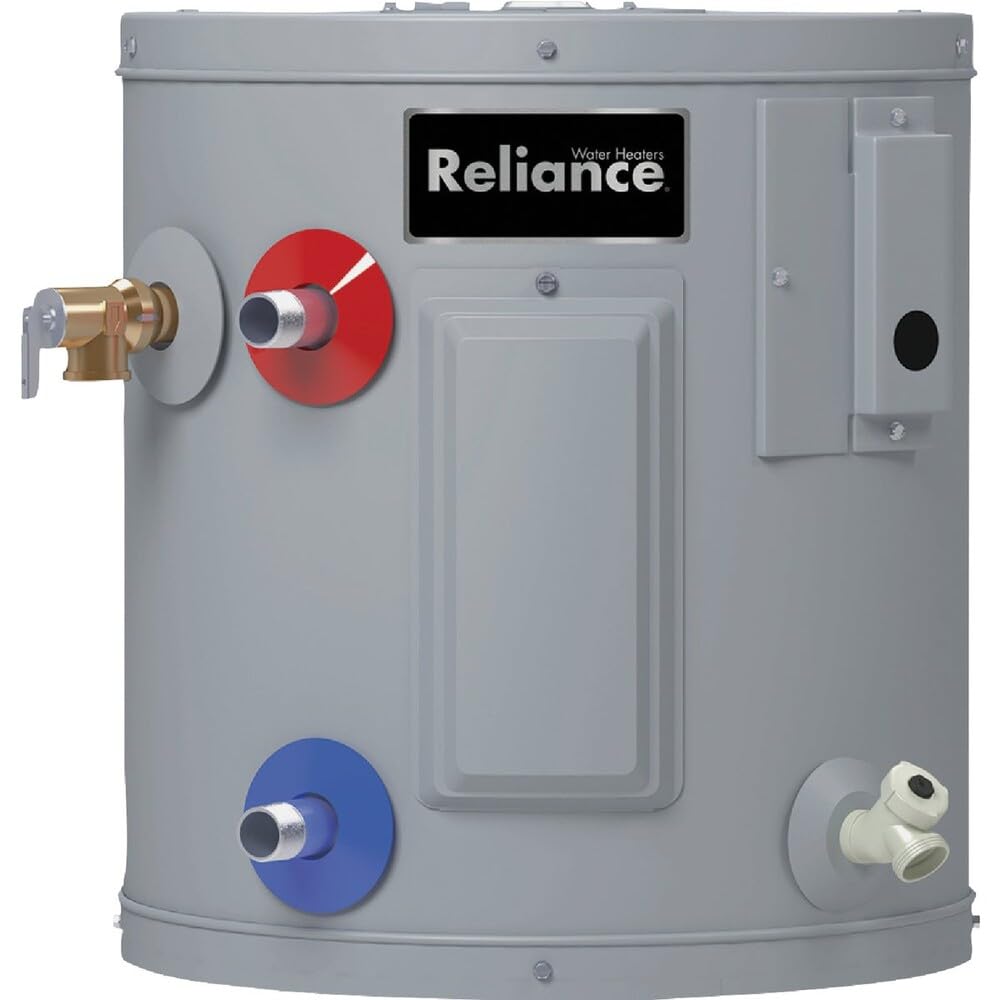
6. Reliance 10 Gallon 6 10 SOMSK Electric Water Heater
The one built to sit in a cold utility room or off-grid cabin and keep water hot anyway.
Insulation is where the Reliance pulls away from the field. It carries 2 inches of insulation with an R-value of 16.00, which is the reason owners mention reliable heat retention between draws. At 18.5 by 20.5 inches and 41 pounds, it fits into tight spots, and the inlet and outlet connections are on the side rather than the top, which simplifies plumbing in cramped rooms. The six-year warranty is one of the better coverage terms available.
What owners rely on this unit for is boosting. It works as a standalone unit but shines when paired with an existing heater or in a utility room where a smaller tank can hold a reserve of hot water. Temperature control is adjustable, and one owner described dialing it in for winter use to keep up with demand. Performance is the top trait owners cite, and the ready-hot-water aspect comes up repeatedly.
The unit does not arrive unscuffed every time. At least one owner received a dented unit — courtesy of minimal packaging protection rather than quality control — but installed it anyway and reported it working great with fast recovery. That is the honest picture: it functions as it should, but shipping damage is a real possibility when a heavy appliance ships in a bare box. For an install job where the cabinet recess is tight, note that the 16-inch depth makes it the deepest of the smaller-profile units here, so measure the opening first.
The number that matters: R-value 16.00 with 2 inches of insulation is the strongest thermal spec in this comparison — the tank loses noticeably less heat between uses.
Check the opening first: The 16-inch depth and the side-located inlet and outlet mean a tight cabinet recess can be a problem.
Consider This If: You need a small tank that keeps water hot in a cold utility room, an off-grid cabin, or a fifth wheel where the insulation actually matters.
Hold Off If: You want a perfect-condition box on arrival — packaging is minimal and dents have been reported on delivery.
7. Dometic WH-10GEA 10-Gallon Water Heater, Gas/Electric

Dual fuel, 22 pounds, and a winterization bypass kit pre-installed for full-time RV life.
At 22 pounds, the Dometic is the lightest ten-gallon unit here — 24 pounds lighter than the Suburban’s 46 pounds and 19 pounds lighter than the GE and Reliance at 41 pounds. That is a real difference when you are fitting an appliance into an RV bay where access is tight. It runs on both propane and electric through a LP/12-volt setup, giving you power options when you are parked and when you are not. The electronic-ignition burner provides 10,000 BTUs, and the aluminum tank — which requires no anode rod — is the reason the weight drops so far. The 10-gallon tank is 66% larger than standard, and the pre-installed winterization bypass kit lets you drain it for cold-weather storage without extra plumbing.
Functionality is the strongest point customers note, with heating performance next. The unit heats water quickly, fits the existing opening, and the wiring connects the same way as the original. Reviewers point out replacing units even as old as a 2009 model with no problem — one writes simply, “works great, replaced our 2009 Attwood no problem.” The unit arrives preset for temperature, and several owners describe it as a direct fit for the cutout. Installation requires the right tools and some skill — do not attempt it if you are not confident with plumbing and electrical work on a vehicle, since the failure mode of a badly supported tank is not a minor one.
The durability picture is the honest part. Thermal cut-off fuses (safety fuses that shut off power if the unit overheats) and pressure relief valves are the recurring reports of trouble, so keep spare fuses on hand and check the relief valve function during your first month. There is also the packaging issue — at least one unit arrived slightly bent due to poor manufacturer packaging, though it still worked as intended after installation. In an RV that was previously fitted with a Dometic unit, the swap is straightforward; if you are installing one for the first time into a new framing, budget more time and check the manufacturer’s instructions carefully around tank support.
The weight advantage: 22 pounds and a no-anode aluminium tank mean you can manhandle it into place alone, which matters in a cramped RV bay.
Spare parts matter: Cut-off fuses and relief valves are the parts shoppers say failing, so keep a set on hand from day one.
The Natural Upgrade For You If: You are replacing an existing RV water heater yourself and want the lightest dual-fuel option with a pre-installed bypass kit.
Look Past It If: You are not comfortable with vehicle plumbing and wiring, or you want a unit that ships without any bent packaging risk.
Understanding the Specs
Capacity and Recovery Rate
Capacity is how much hot water the tank holds before it runs cold. A 10-gallon tank gives you roughly ten minutes of showering at typical flow rates before the element has to start catching up. Recovery rate is the number that saves you: the Suburban recovers 6.1 gallons per hour on electric and 10.1 gallons per hour on gas, which is how it keeps hot water coming when one shower follows another. If you are running a big household, recovery rate matters more than capacity. For a single sink, neither is likely to be tested.
Heating Element Wattage
Heating element wattage is the power draw in watts, and it determines how fast the tank reaches temperature and how much current the circuit has to carry. A 1,440-watt element draws less current than a 1,650-watt element, and both can run on standard household voltage with a dedicated circuit. Check your circuit before buying — these units want their own line, not a shared one with an appliance that pulls a heavy load. Three major factors shape performance here: the element size, the tank insulation, and the starting temperature of the incoming water.
FAQ
Will a 10-gallon tank run a long shower or do I need something bigger?
What size circuit does a 10-gallon electric water heater need?
Do I need an anode rod and how often should I check it?
Can I install a 10-gallon water heater under a bathroom or kitchen sink?
Is a 10-gallon water heater enough for an RV or a small cabin?
What is the difference between a point-of-use and a whole-home water heater?
How often will I need to replace a 10-gallon water heater?
Is it safe to run a 10-gallon water heater on a generator or solar setup?
Will a 10-gallon water heater leak or is that a rare issue?
Can I use a 10-gallon water heater as a booster with my existing heater?
Final Thoughts: The Verdict
For most people, the 10-gallon water heater that earns the top spot is the Suburban Advantage SW10DE, thanks to its porcelain-lined steel tank, dual gas and electric capability, and the anode rod (a sacrificial metal rod that corrodes instead of your tank) that keeps the tank alive over the long term. If you want the fastest flow and a full 2 gpm at the tap, go with the CAMPLUX ME100B. And for a shed, cabin, or off-grid setup, the GE Appliances 10 Gallon is the plug-and-play answer.
How We Picked
We do not accept paid placement. Every pick is matched to a real buyer and a real use-case; we do not hands-on test units.
Sources & Methodology
Specifications: manufacturer listings and product documentation. Review insights: verified customer reviews, as of September 2026. Pricing: not shown on this page (it changes often); check the current price via the retailer link.
As an Amazon Associate, KitchPrep earns from qualifying purchases. This does not affect which products we feature.
Related Guides
