
Specs are compiled from manufacturer listings and verified buyer reviews and can change over time — please confirm the key details on the product page before buying.
Choosing a 10-foot ladder means deciding how much wobble you’ll accept when you’re standing at the top, reaching for a ceiling fixture or a high shelf. The single biggest mistake buyers make is picking by price before checking the load rating, because a ladder that flexes under you is a ladder you’ll stop trusting fast. This guide cuts through the fiberglass-versus-aluminum debate to match each pick to the jobs it handles best.
I’m Mohammad Maruf — the founder and writer behind KitchPrep. This guide is built by comparing the manufacturers’ published specifications and the patterns across verified customer reviews, so you get each pick’s real strengths and trade-offs instead of marketing spin.
Whether you’re painting, cleaning gutters, or reaching high cabinets, this guide to the 10-foot ladder sorts the stable, safe, and sensible options from the ones that feel sketchy at full extension.
Our Picks at a Glance
How To Choose The Best 10-Foot Ladder
Before you look at brands, look at the load rating, the material, and the weight. These three numbers decide if you get a stable platform or a wobbly hazard, and whether you can lift it yourself.
Match the Load Rating to Your Weight Plus Tools
Every ladder carries a maximum weight capacity in pounds, and that number includes your body weight plus everything you’re holding. A 300-pound rating gives you breathing room for a heavy adult with a tool belt, while a 250-pound rating suits lighter users and indoor tasks. The Type IA and Type IAA ratings signal heavy-duty construction for professional and frequent use.
Fiberglass vs. Aluminum: Choose the Trade-Off You Can Live With
Fiberglass is non-conductive, meaning it won’t conduct electricity if it touches a live wire, making it the safer choice for electrical work. Aluminum is lighter and easier to carry but conducts electricity, so it’s best kept away from power lines and better suited to general household tasks. You’re trading roughly 20 pounds of carry weight for the safety margin of fiberglass.
Check the Working Height, Not Just the Label
A 10-foot ladder does not give you 10 feet of reach — the safe standing height is always lower because you should never climb onto the top rung. For a 10-foot stepladder, expect a top step around 7 feet, which comfortably reaches 8-foot ceilings and stretches toward 10-foot ones. If you’re always working at maximum extension, a heavier, more stable model is worth the extra lift.
Quick Comparison
| Model | Best For | Load Capacity | Material | Item Weight | Amazon |
|---|---|---|---|---|---|
| Werner 6210★ Best Overall | Indoor ceiling work | 300 lb | Fiberglass | 39 lb | Amazon |
| VEVOR 11 FT TelescopingCompact Pick | Compact storage & travel | 330 lb | Aluminum | 19.6 lb | Amazon |
| Louisville FXS1510 | Leaning against walls | 375 lb | Fiberglass | 39 lb | Amazon |
| DeWalt DXL3410-10 | Heavy-duty home projects | 375 lb | Fiberglass | 46 lb | Amazon |
| Little Giant Select Step | Adjustable heights & uneven ground | 300 lb | Aluminum | 35.4 lb | Amazon |
| Louisville FM1410HD | Two-sided climbing | 375 lb | Fiberglass | 55 lb | Amazon |
In‑Depth Reviews
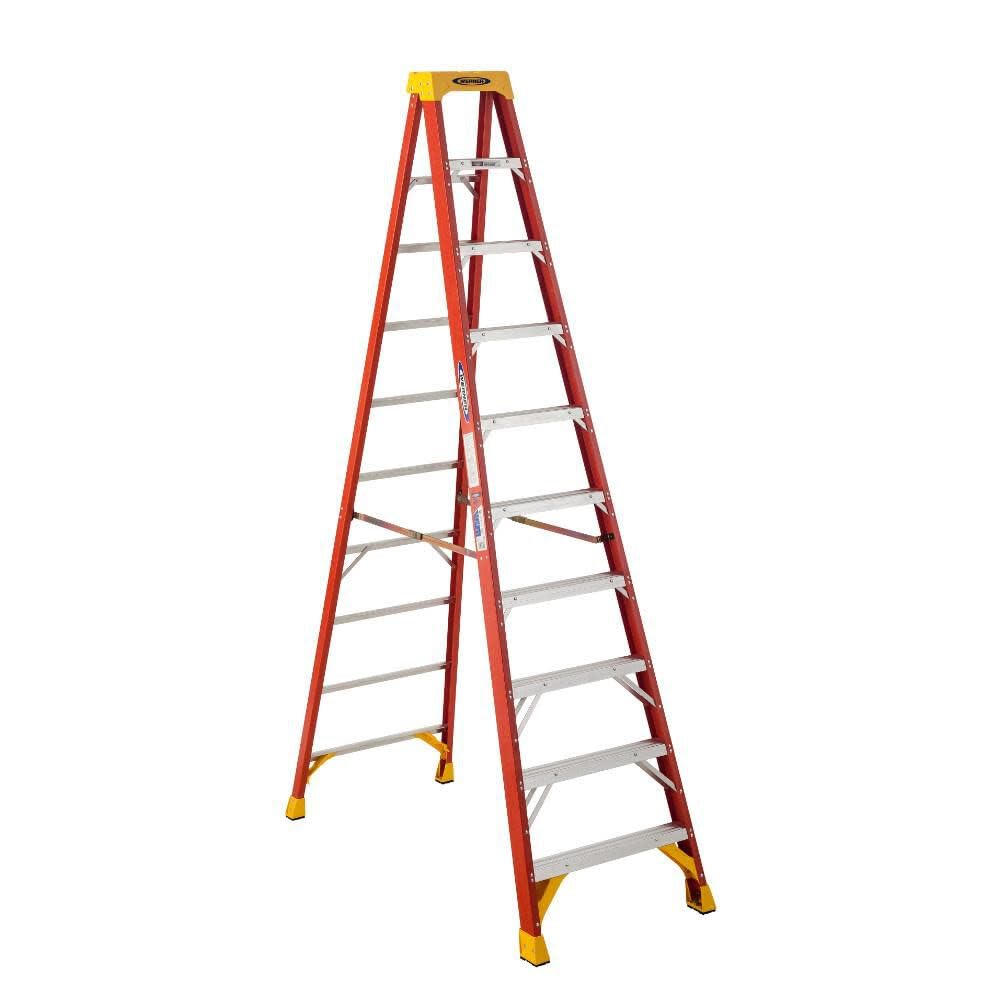
1. Werner 6210 300-Pound Duty Rating Type IA Fiberglass Stepladder, 10-Foot
Our pick — over 4.5★ from 850+ verified ratings; the strongest balance of quality and price.
The indoor ceiling champ that feels planted even near its rated limit.
What wins people over is the sturdiness — it’s the most-discussed trait by far, and the reason is simple: at 39 pounds of fiberglass, it has the heft to stay put while you work. Buyers report it remains “sturdy near 300lb limit,” with non-scuffing feet that won’t mark your floors, which is exactly what you want when you’re stepping off and onto a ladder inside your home.
Its 72-inch maximum height makes it ideal for 8-foot ceilings, with the top step sitting around 7.5 feet for a comfortable reach. That’s a noticeably shorter working height than the VEVOR 11 FT, which extends to 132 inches, but the Werner trades that extra reach for a rock-solid platform you never second-guess.
A snap-on accessory bucket gives you a place for tools, and the ladder stays stable enough that larger climbers feel safe — the review pages repeatedly mention how secure it feels for anyone over 220 pounds. It ships unboxed with plastic wrap, so expect a few minor scuffs on arrival; that’s normal and cosmetic.
What Owners Rave About
- Sturdiness is the top praise — it feels safe at full height
- Non-scuffing feet protect indoor floors
- Snap-on bucket adds handy tool storage
The Trade-Offs
- Shorter working height than extension ladders
- Arrives unwrapped, so cosmetic scuffs are common
Reach for this if: you want a stable, safe indoor ladder for ceiling and overhead work without needing to carry it far.
Think twice if: your jobs take you outside to gutters or roofs, where a taller extension style would serve you better.
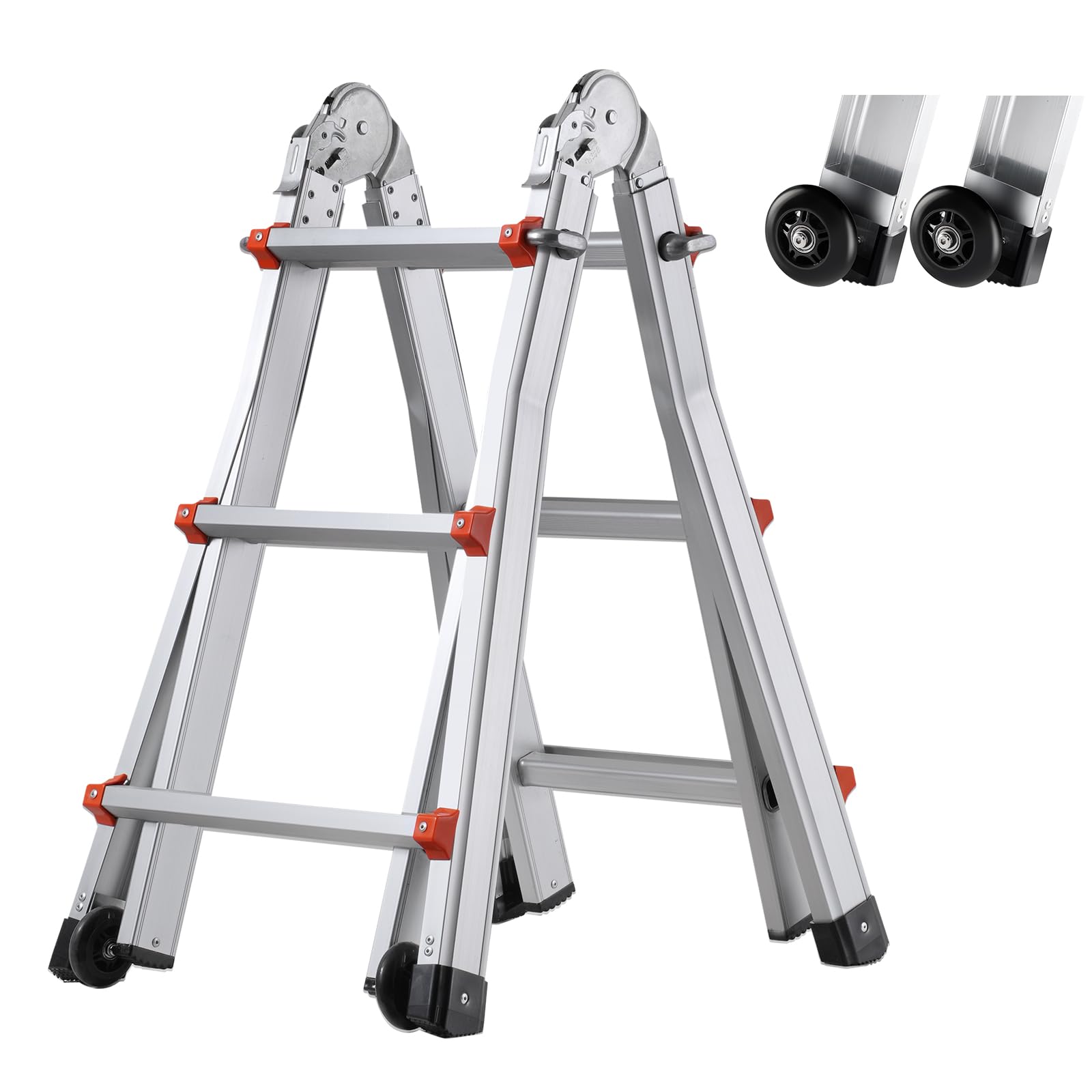
2. VEVOR 11 FT A-Frame Telescoping Ladder
The telescoping wonder that shrinks to closet size but asks for care at full stretch.
You get 10-plus feet of reach without needing a garage to store it. Build quality is what owners rave about, and the numbers back it up: at 19.6 pounds, it’s exactly half the weight of the Louisville cross step, yet it still carries a 330-pound rating and extends to a 132-inch maximum height — 83% more reach than the Werner’s 72 inches.
Each rung locks with its own mechanism, and open up is a simple pull, so it transitions from a step ladder to a straight extension in seconds. The base has dual wheels, letting you roll it one-handed across a driveway, though owners mention those wheels work best on smooth surfaces and struggle on grass or gravel.
The honest catch is stability at full extension. Several owners note the top feels heavy when you move it, and one described it as unstable on first use because of the narrow rungs. This is a light-duty workhorse, not a permanent scaffold — owners agree it’s brilliant for quick indoor tasks and attic access, but if you’re over 210 pounds or working at max height all day, a heftier fiberglass model is the safer call.
Ultimate space-saver: it collapses to 20.28″W x 41.93″H, so it tucks into a trunk or closet in seconds.
Who it suits: apartment dwellers, RV owners, and anyone who needs reach on demand but never wants to haul a 39-pound ladder up stairs.
Best for: occasional indoor reach and tight storage spaces where a rigid ladder simply won’t fit.
Not for: heavy daily use at max height, where the flex and narrow rungs become a real concern.
3. Louisville Ladder 10-foot Fiberglass Cross Step Ladder, FXS1510

The “Man Ladder” that leans against walls and still stands strong as a step.
Quality is the overwhelming consensus here, and it’s easy to see why once you understand the Pro Top system. The top features a V-shape design that lets the ladder lean securely against walls, buildings, and poles, turning it into a shelf ladder when you need to work close to a surface — a 2-in-1 trick most step ladders can’t pull off.
Owners describe it in terms usually reserved for tools from another era: one calls it a “Man Ladder” that has enough weight to resist a stiff wind, feeling safe every time you climb. That weight is 39 pounds, and it earns its keep — you’re not hauling this up stairs daily, but you’re also not wondering if it’ll blow over mid-job.
Its 375-pound load capacity beats the Werner’s 300 pounds by a solid 25%, and the non-conductive fiberglass construction makes it safe around electrical work. The trade-off shows up in portability and set-up: the weight gets mixed reactions, and ease of use trends negative, which usually just means it’s a two-handed job to move and position. Add the magnetic tray for tools and fasteners, and you have a professional-grade unit that doesn’t damage the surfaces it leans against.
Built Like a Pro Tool
- 375-lb capacity — 25% more than the Werner 6210
- Leans against walls and poles via the V-shape Pro Top
- Fiberglass won’t conduct electricity
Consider Before Buying
- Heavy at 39 lb, making repositioning a real effort
- Setup and folding draw negative feedback
Choose this for: professional-grade work where you’ll lean into corners and against walls, not just climb straight up.
skip it if: you need something you can carry one-handed between rooms all day.
4. DeWalt Type IAA 375lb Rated FG Stepladder 10′ DXL3410-10
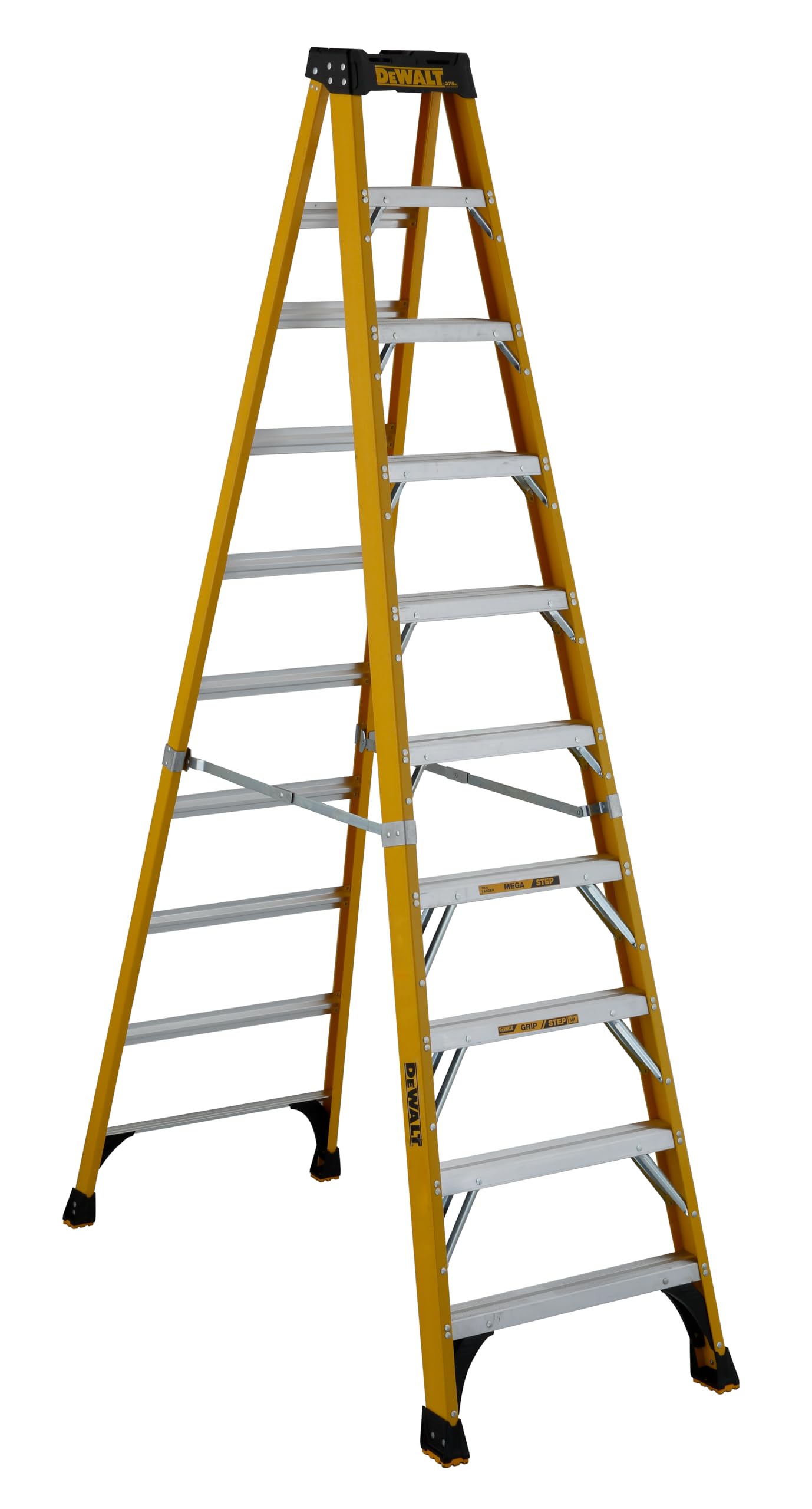
The beast that feels like a platform, not a ladder, under a 225-pound climber.
DeWalt’s name-brand quality lands here with a 375-pound Type IAA rating, the highest duty class in the lineup, and the review pages back it up with a nickname: “a BEAST… in a good way.” Stability is the defining trait, with wide steps that spread your weight comfortably and an extra-strong magnetic holder that keeps its grip even after months of use.
At 46 pounds, it’s the second-heaviest pick here, but owners consistently note it’s “a lot lighter than it looks.” The wide stance and angle-locking bridge prevent buckling, and the rubberized feet grip the floor. It also ships in pristine packaging with protective paper — a detail owners of the Werner, who get scuffs, would appreciate.
The trade-off is the flip side of that stability: 46 pounds is real weight to haul, and durability and stability both draw mixed feedback, with some owners reporting bent legs or wobbling after rough use. For house projects where you want a rock-solid, premium-feeling platform and you’re not moving it constantly, this is the one. The 3-year limited warranty provides extra confidence beyond what most competitors offer.
The Confidence Builders
- Wide, comfortable steps for long jobs
- Strong magnetic tool holder that lasts
- 375-lb Type IAA rating for heavy users
Know Before You Buy
- Heaviest carry in its class at 46 lb
- Occasional reports of bent legs with rough handling
Pick this if: you want the most confidence-inspiring platform for frequent home projects and you’re fine lifting 46 pounds.
Look elsewhere if: you need a ladder that travels between rooms easily every single day.
5. Little Giant Select Step 6-10 ft Stepladder with AirDeck

The shape-shifter that climbs stairs and slopes no standard step ladder can handle.
This is the one to beat for versatility, and owners call it the best ladder they’ve ever owned. Both sides telescope independently, so instead of locking you into one height, the Select Step adjusts from 6 feet to 10 feet to match the exact job — and that independent motion is what lets it set up safely over obstacles, on sloping ground, or directly on stairs where a rigid ladder would rock.
The Comfort Step platform gives you heel-to-toe support at the top recommended step, which reduces fatigue on long jobs, and the cast-aluminum Rock Locks make height changes quick and dependable with a satisfying “clunk.” The included AirDeck accessory holds tools and a nailer horizontally, and can be positioned vertically as a safety aid. Aircraft-grade aluminum keeps it rust-resistant, and the base wheels help you move its 35.4 pounds around.
The catch is the price — it’s a premium investment — and a few practical quirks: the AirDeck feels slightly flimsy, and the wide base can be hard to squeeze through doorways. It also collapses to 73 inches, which fits in a Toyota Highlander but won’t slip into a sedan trunk. Its limited lifetime warranty and 8- to 12-foot ceiling reach replace a whole rack of ladders in one unit.
One ladder, every height: 6 to 10 feet of adjustability plus stair and slope capability makes it the most flexible tool in this list.
The premium cost: you’re paying for engineering, and the AirDeck attachment is the weak point — treat it gently.
Best for: homeowners who work at many different heights and on uneven surfaces, and who want one ladder instead of three.
Not ideal if: budget is the priority or you need something narrow enough for tight closets and doorways.
6. Louisville Ladder 10-Foot Fiberglass Twin Front Step Ladder, FM1410HD
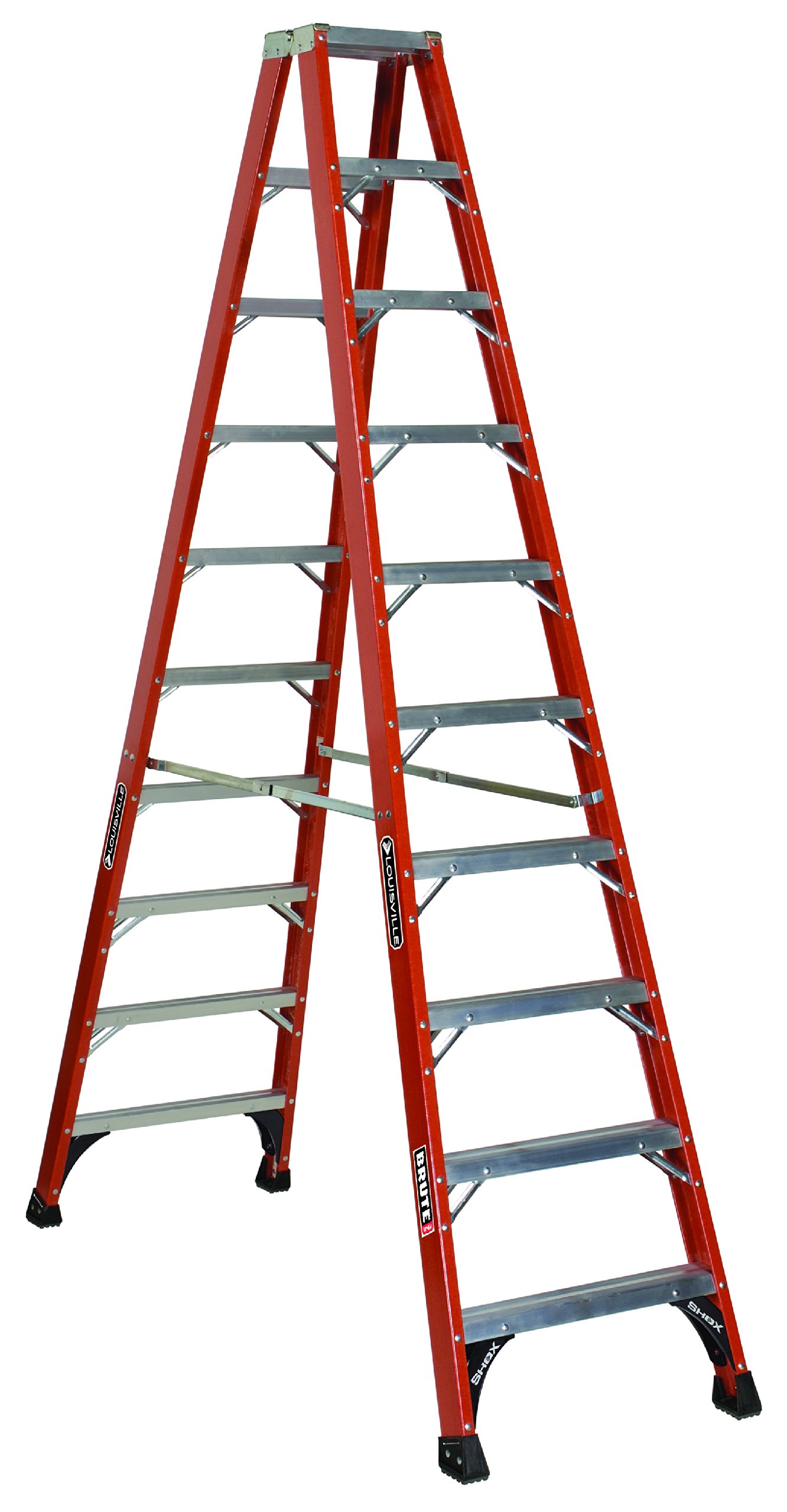
The two-sided tower that keeps a church ceiling project moving without ever repositioning.
If you’ve ever climbed down a ladder just to move it six inches, this twin-front design is your answer. With steps on both sides, you can work from either face, which is why owners describe it as perfect for house projects and small ladder jobs — you simply step through instead of climbing down and dragging the whole unit over. The 375-pound Type IAA capacity gives added confidence even at full height.
Stability is its other superpower, thanks to the raptor boot feet with slip-resistant, non-marring bonded tread. These grip the floor without scratching it, and the inside spreader braces keep the ladder protected during transport while adding structural rigidity. It meets ANSI and OSHA safety standards, a compliance level you want on any job site.
The honest reality is that 55 pounds makes this the heaviest ladder in the roundup, and owners are direct about it: you definitely need a second person to move it. This is not a grab-and-go tool; it’s a set-it-up-and-work-for-hours tool. If you have the space and the help, the twin-step efficiency and rock-solid feel make it a construction-site favorite that owners say is well worth the money.
Efficiency Boosters
- Steps on both sides mean less climbing down to move it
- Non-slip raptor boot feet protect floors
- Meets ANSI and OSHA safety standards
The Heavy Price
- 55 lb — the heaviest carry in this list
- Needs a second person to move safely
Choose it for: long-duration work in one spot — 20-foot ceilings, construction sites, church halls — where you climb constantly.
Avoid if: you work alone or you need a ladder you can reposition without help.
Understanding the Specs
Load Capacity and Duty Rating
The load capacity, measured in pounds, tells you the maximum weight the ladder is engineered to support — that’s your body weight plus everything in your hands. Duty ratings like Type IA and Type IAA signal heavy-duty construction intended for frequent and professional use, with these classes typically rated at 300 and 375 pounds respectively. A higher rating means thicker rails, wider steps, and a more rigid frame, not just a higher limit.
Maximum Height vs. Working Height
Never climb onto the top rung or top platform of a step ladder — the safe standing height is always two rungs down. That’s why a 10-foot step ladder with a 72-inch maximum height is the right tool for 8-foot ceilings, and a telescoping unit extending to 132 inches gives you straight-extension reach for taller work. Check the maximum height spec, then subtract your reach to confirm it covers your task.
FAQ
What is the difference between a Type IA and Type IAA ladder?
Will a 10-foot step ladder let me reach a 10-foot ceiling?
Should I choose fiberglass or aluminum for a 10-foot ladder?
How much weight can a 10-foot ladder hold?
Is a telescoping ladder as safe as a traditional stepladder?
Why is a 10-foot ladder so heavy?
Can I use a 10-foot stepladder outdoors?
What does “Type IA” on a step ladder mean?
Final Thoughts: The Verdict
For most buyers, the 10-foot ladder winner is the Werner 6210 because it pairs a 300-pound Type IA rating with the sturdiness that thousands of owners trust for indoor ceiling work. If you want the lightest possible carry for moving between rooms, grab the Louisville AS2110. And for adjustable heights that handle stairs and slopes, the Little Giant Select Step replaces a whole rack of ladders in one compact unit.
How We Picked
We do not accept paid placement. Every pick is matched to a real buyer and a real use-case; we do not hands-on test units.
Sources & Methodology
Specifications: manufacturer listings and product documentation. Review insights: verified customer reviews, as of August 2026. Pricing: not shown on this page (it changes often); check the current price via the retailer link.
As an Amazon Associate, KitchPrep earns from qualifying purchases. This does not affect which products we feature.
Related Guides
