
Specs are compiled from manufacturer listings and verified buyer reviews and can change over time — please confirm the key details on the product page before buying.
If you need to power a travel trailer all night without the plug ends getting warm, the 25 FT 30 Amp NEMA TT-30P/R RV Extension Cord is the one most buyers should start with. The label “10/3” only tells you the cord carries 10-gauge wire in three conductors (three separate paths for electricity). What separates two cords with that same label is how thick the copper jacket is, how far the run has to stretch, and how many plugs sit on the end. Get those three things wrong and you either cook a compressor or waste money on a cord built for a job you do not have.
I’m Mohammad Maruf — the founder and writer behind KitchPrep. This guide is built by comparing the manufacturers’ published specifications and the patterns across verified customer reviews, so you get each pick’s real strengths and trade-offs instead of marketing spin.
Below are nine cords sorted by what they actually do on a driveway, a campground slab, or a job site — with the honest catch on each. Every cord here is a real 10-gauge three-conductor product, so the choice is about fit, not whether it can carry the load. Finding the right 10/3 electrical cord for a weekend generator job is a very different shopping trip than feeding an RV pedestal every night.
Our Picks at a Glance

How To Choose The Best 10/3 Electrical Cord
Three things decide whether a cord is right for your job: the wire gauge and conductor count stamped on the jacket, the plug style on each end, and the amp-and-watt ceiling the cord is built to carry. Everything else — color, a carry handle, a light — is convenience layered on top of those three.
Start with the connection, not the length
A 10/3 cord usually ends in one of three ways. A NEMA 5-15P male plug and 5-15R female socket is the standard three-prong household pairing most people picture. A NEMA TT-30P to TT-30R set is the dedicated 30-amp RV pairing, the shape you find on campground pedestals. And some products sell as bare bulk cable with no ends at all, so you crimp or tape on whatever terminations your project needs. Match the ends to your outlet — an RV cord’s round TT blades simply will not seat in a household wall receptacle.
Know your real amp draw before you buy
Wire size runs in reverse: a smaller gauge number means a thicker conductor that carries more current. A solid 10-gauge cord handles heavier loads than a thinner 12- or 14-gauge cord and holds voltage steadier on a long run. Overload a thin cord and the resistance turns into heat at the plug. So add up the amps of everything on the cord — a pump, a heater, a welder — then pick a cord whose amp rating sits comfortably above that total. If your appliance pulls close to the cord’s ceiling, step up in rating rather than in length.
Judge the jacket by the weather you will meet
An SJTW or SOOW jacket is what lets a cord survive outdoors. The rating tells you the sheath resists water, oil, and chemicals, and the temperature range tells you how it behaves when the season turns cold. A cord rated down to -40°F or -40°C keeps its flexibility instead of going board-stiff, which matters every time you coil it for storage. If the cord lives outside year-round, prioritize the weather and temperature rating over a flashy color.
Quick Comparison
| Model | Best For | Amperage | Wattage | Length | Amazon |
|---|---|---|---|---|---|
| 25 FT 30 Amp NEMA TT-30P/R RV Extension Cord★ Best Overall | RV pedestals & campsite power | 30 A | 3750 W | 25 ft | Amazon |
| PlugSaf 25ft 10 Gauge Waterproof Outdoor CordBest Value | Lawn gear & block heaters | 15 A | 1875 W | 25 ft | Amazon |
| Nilight 30 Amp 15FT RV Extension CordTop Performer | Spare RV reach | 30 A | 3750 W | 15 ft | Amazon |
| 25FT 10/3 SOOW Portable Power Cable | Welder & motor leads | 30 A | 600 V rated | 25 ft | Amazon |
| HONDERSON Indoor Outdoor Extension Cord | Pool pumps & heaters | 15 A | 1875 W | 25 ft | Amazon |
| Kimbluth 10 Gauge 3 Conductor Wire | Custom runs you wire yourself | — | 300 V rated | 30 ft | Amazon |
| PlugSaf 50 FT 10 Gauge Outdoor Cord (3 Outlets) | Powering several tools at once | 15 A | 1875 W | 50 ft | Amazon |
| 10 Gauge 50 FT Contractor SJTW Cord | Long generator runs | 15 A | 1875 W | 50 ft | Amazon |
| Southwire Extra Heavy Duty Extension Cord | Big tools & welders | 30 A | — | 50 ft | Amazon |
In‑Depth Reviews
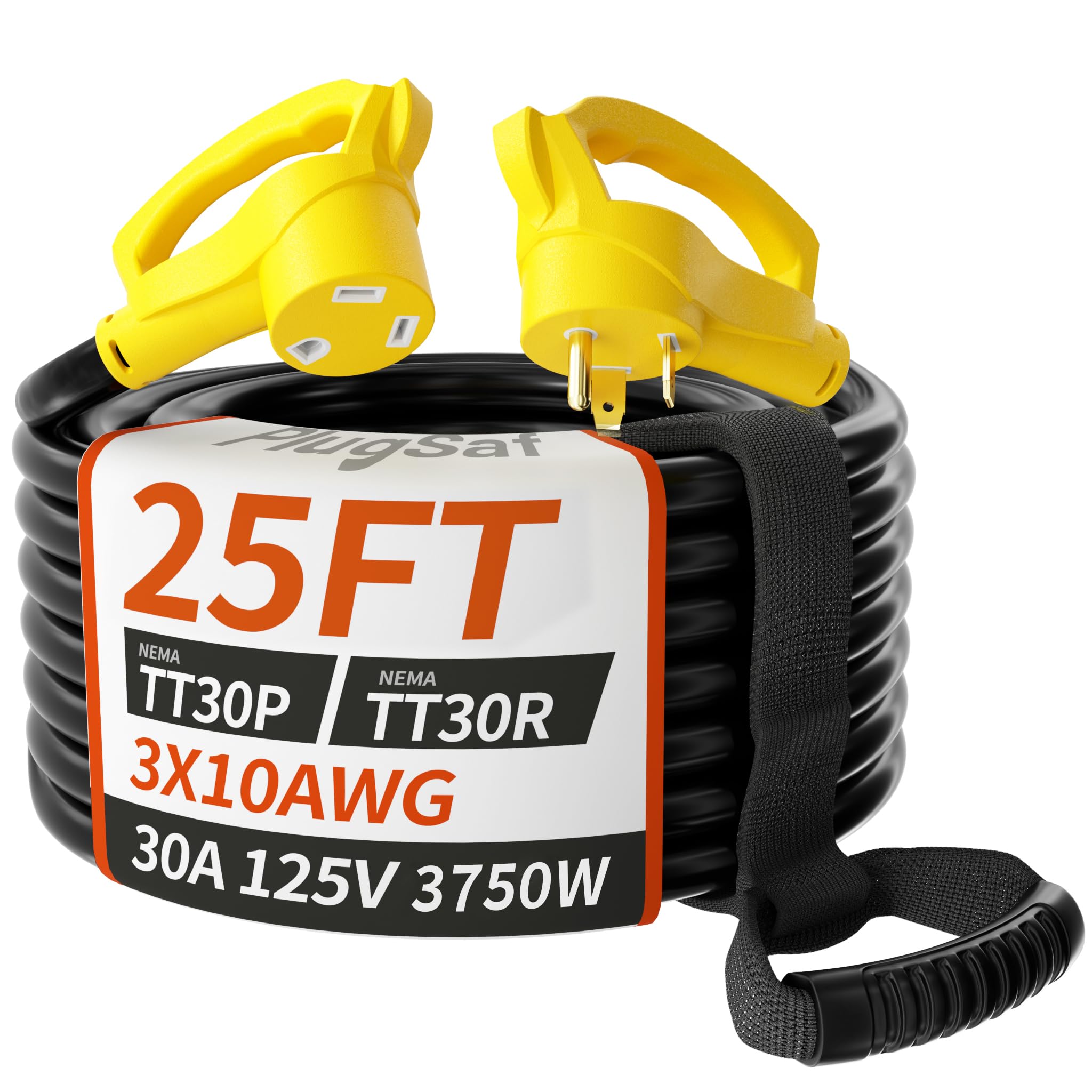
1. 25 FT 30 Amp NEMA TT-30P/R RV Extension Cord Outdoor
Our pick — over 4.5★ from 700+ verified ratings; the strongest balance of quality and price.
The campsite workhorse that hands you 3,750 watts and a grip handle on both ends.
If your rig plugs into a 30-amp pedestal, this is the cord that ends the guessing. It runs 25 feet of STW 10AWG wire and carries a NEMA TT-30P male plug into a NEMA TT-30R female socket — the round-blade pairing campground power posts actually use, not the household flat-blade shape. Rated 125 volts and 30 amps, it delivers 3,750 watts, which is the full ceiling of a 30-amp RV feed rather than a fraction of it. When you compare it to a 15-amp general-purpose cord, the gap is real: 30 A against 15 A is a 2.0x difference, and 3,750 W against 1,875 W is another 2.0x jump. For an air conditioner and a fridge running together, that headroom is the entire point.
What wins people over most is the sheer build. Buyers describe thick casing, plugs that seat with a click, and a cord that survives being driven over and rained on. The weather story backs it up — IP65 waterproofing (that number means dust-tight and protected against water spray) plus a jacketed cable that stays workable down to -40°C, so a February coil-up does not fight you. The ergonomic handles on both ends are the quiet hero here: you unplug by gripping the handle instead of yanking the cord, which is how plugs survive. As buyers report, “Needed an additional 20’ so this is working out quite nicely” — the extra reach is exactly why a 25-footer beats the stubby factory cord your trailer ships with. The adjustable organizer straps keep the coil tidy between trips.
The catch is weight and bulk. Inside, it is 10-gauge copper, so plan on a beefy 2.76 kg coil that wants a hook or a reel rather than a grocery bag. The thickness itself draws split opinions — most love how substantial it feels, while some find it slimmer than the factory RV cord. Neither is a defect; it is simply a heavy-duty cord acting like one.
What earns its keep
- Full 30 A / 3,750 W ceiling — enough for an RV air conditioner and appliances at once
- IP65 waterproof jacket that stays flexible down to -40°C so it coils even in winter
- Grip handles on both plugs make safe unplugging easy and protect the connector
- Adjustable organizer keeps the 25-foot coil tangle-free in storage
What to weigh first
- Substantial at 2.76 kg — you will want a hook or reel, not a bag
- TT-30 blades only fit 30-amp RV outlets, not a standard household wall receptacle
Reach for this if: you camp or park an RV on 30-amp service and want one cord that carries the whole load.
Look elsewhere if: your outlet is a regular three-prong household socket — the TT-30 blades will not seat there.
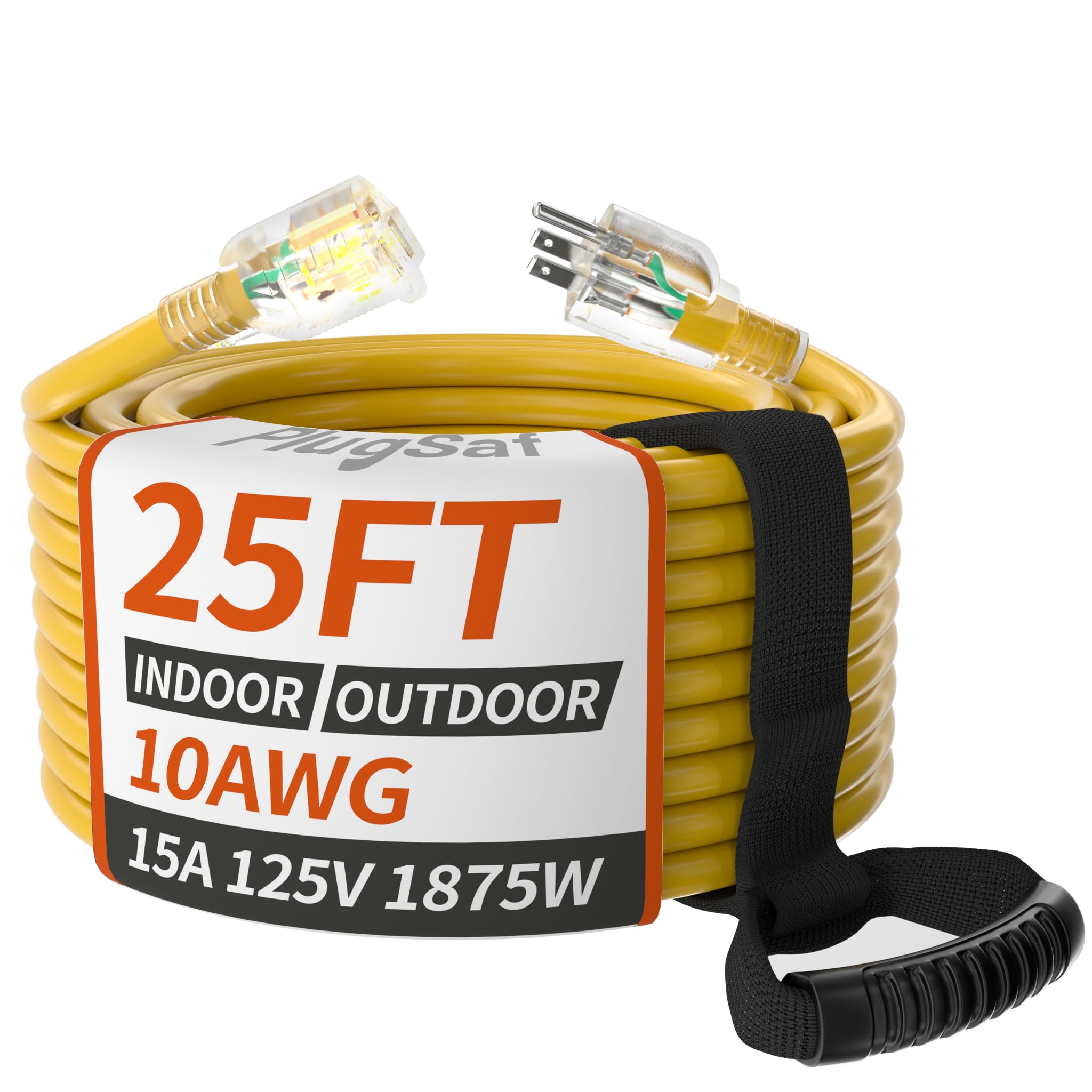
2. PlugSaf 25ft 10 Gauge Waterproof Outdoor Extension Cord Lighted End
The everyday outdoor cord that keeps 15 amps of lawn gear cool and lights up so you know power is live.
For a block heater, a pool pump, or a mower, this is the sensible pick. It runs 25 feet of the flat-blade NEMA 5-15P to 5-15R pairing, so it plugs into an ordinary outdoor receptacle. The 10AWG conductors are rated 15 amps, 125 volts, and 1,875 watts — and here is the interesting part: that watt figure is only half the 3,750 W ceiling of the 30-amp RV cord above. The difference is not a flaw, just a different job. The household plug’s 15-amp shape simply cannot feed 30 amps of current.
The engineering details are what justify the price. A lighted socket indicator shows when power is flowing, the strain relief at each end is built to bend more than 20,000 times without cracking, and every cord passes a 1,500V high-voltage test before it ships. The jacket is IP65 waterproof and heat-resistant up to 100°C, while staying flexible at -40°C — freeze-ready and sun-ready in the same sheath. Owners running marine and block-heater duty report the cord stays cooler than thinner cables. One 25-foot owner put it plainly: “I have used it for many hours at a time running 18 amps with no issues.” The included carry handle and storage straps make coiling it arm-friendly.
One note on the way it handles: it is genuinely heavy-duty, which means it leans stiff when it is brand new on a cold day. It loosens up with use, and most buyers call the stiffness the price of the durability. If you want a cord that flops like a thin indoor cable, this is not that cord — and it is not meant to be.
Best matched to: anyone running outdoor power tools, pumps, or car block heaters off a standard receptacle.
Think twice if: you need a cord that feels soft and limp straight from the box — the heavy jacket starts stiff.
3. Nilight 30 Amp 15FT RV Extension Cord 10 Gauge UL ETL Listed
A short, stout 30-amp RV cord for the nights the pedestal sits just out of reach.
This one is the “just in case” cord — the 15-footer you toss in the bay for the site where the pedestal is a few feet short. It carries the same 125-volt, 3,750-watt rating and the same TT-30P to TT-30R pairing as the longer RV cord in the top slot. It is built with 100% pure copper in full 10-gauge wires, and that copper is the reason a 30-amp load does not sag. Any time you run an RV air conditioner, some voltage drops across the cord; better copper keeps that drop smaller, which is why the manufacturer notes this cord minimizes it. It is UL and ETL certified for use in both the U.S. and Canada.
The sheath is a flame-retardant, heat-resilient PVC jacket that stands up to wind, rain, snow, soil, and rock scuffing. Despite all that mass, the stranded copper keeps the cord flexible enough to coil and stow without a wrestling match. Owners who leave it plugged into a travel trailer every day report it still looks new after a full year of seasons. As one put it, “Great cord im writing this review a year later and since i received it it has gone through all seasons and weather and its still like new.” That kind of long-haul durability is what you are paying for in an RV-grade cord.
Two things to plan around. First, it is heavy — buyers who bought one suggest having a reel ready, because coiling 10-gauge by hand gets old fast. Second, its 15-foot length is deliberately short; if your pedestal distance varies a lot, the 25-footer will spare you an adapter. Either way, the cord itself does its job without fuss.
Copper where it counts: full 10-gauge stranded copper and a flame-retardant PVC jacket mean stable power and outdoor protection, and buyers confirm it grows immune to weather over a year of daily use.
The honest math: at 15 feet this is your reach-adder, not your primary run — and the weight wants a reel.
Pick this when: your RV pedestal is just out of range and you want a certified, copper-heavy cord built for the long haul.
skip it if: you regularly need more than 15 feet — the longer RV cord covers more ground.
4. 25FT 10/3 SOOW Portable Power Cable, 10 Gauge 3 Conductor
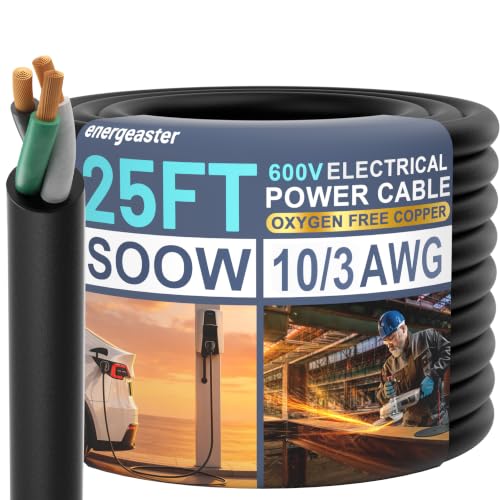
Bare industrial cable you terminate yourself — the blank canvas for welders, pumps, and custom leads.
Every other cord here hands you finished plugs. This one hands you raw material. It is 25 feet of SOOW cable — “Service, Oil, and Water Resistant” — rated up to 600 volts and built for industrial, commercial, and outdoor duty. That voltage rating towers over the 125-volt ceiling the household and RV cords carry, which is exactly why it fits applications the finished cords cannot touch. Same 10-gauge copper, same three conductors, but you supply the ends.
The copper here is OFC — oxygen-free copper — which means fewer impurities and, in practice, higher conductivity, better corrosion resistance, and improved heat dissipation. The outer CPE jacket shrugs off abrasion, battery acid, diesel, engine coolant, ethanol, gasoline, transmission fluid, and water, and it carries a V0 flame-retardant rating. The listed operating range runs from -40°C to 90°C. A buyer wiring the cord as a 240V 20-amp extension for welding called it “Excellent quality and durable,” adding that you install your own terminations and save compared to a pre-made lead.
The one thing to read twice in the specs: this is three current-carrying conductors with no separate grounding wire — the manufacturer is explicit that it is not a “3+1” cable. If your project assumes a dedicated ground path, plan for that in your terminations. Wire it correctly and this 25-footer can become almost anything: a generator lead, a welder tail, a motor run, a heat-pump feed, or an EV-charger drop.
Hand this to: tinkerers wiring their own welder leads, generator tails, and motor runs who want high-voltage industrial cable by the foot.
Know before you buy: there is no separate ground wire in the bundle — three current-carrying conductors only.
5. HONDERSON Indoor Outdoor Extension Cord with Lighted End, 10 Gauge 25FT

A drop-in upgrade for the day your thin cord starts running warm on a pool pump.
This cord exists to solve one very specific headache: the appliance that keeps overheating on the wrong wire. It is a 25-foot SJTW cord, UL certified, running a 3-prong grounded plug rated 15 amps, 125 volts, and 1,875 watts, with a temperature range from -40°F to +140°F. The jacket is copper-cored vinyl built for low resistance and low power loss, so current reaches the tool instead of turning into heat along the wire. The lighted end is the tell — it glows when power is live, so a tripped breaker is obvious from across the yard.
Functionality is the thing that sells this cord; heavy-duty build is a close second. Owners use it for an inflatable hot tub, a power washer, a boat’s onboard charger, and outdoor pumps — and the common thread is that the overheating they were fighting simply stops. One buyer’s water pump kept shutting down on a medium-duty cord; on this cord it no longer trips the breaker or overheats. Another replaced a 50-foot 14-gauge cord that kept getting hot on a hot tub, and the overheating stopped. One owner runs a 1.5hp variable-speed pool pump on it all summer and reports the cable stays cool.
Is it thin and light? No. Thick 10-gauge vinyl means it has real mass, and the jacket arrives fairly stiff before it breaks in. Treat it like the appliance-grade cord it is and it returns the favor with years of cool running.
Why it earns its place: the lighted end and low-resistance jacket turn a mystery breaker trip into a five-second glance and a cool-running cord.
Weight and stance: this is a substantial 25-footer with a stiff jacket when new — expect it to soften with use.
Most at home: pool owners, boat owners, and anyone whose appliance was overheating on a lighter cord.
Less ideal for: a quick indoor lamp run where a light 16-gauge cord would suffice.
6. Kimbluth 10 Gauge 3 Conductor Wire, SJTW Outdoor Power Cable, 30FT
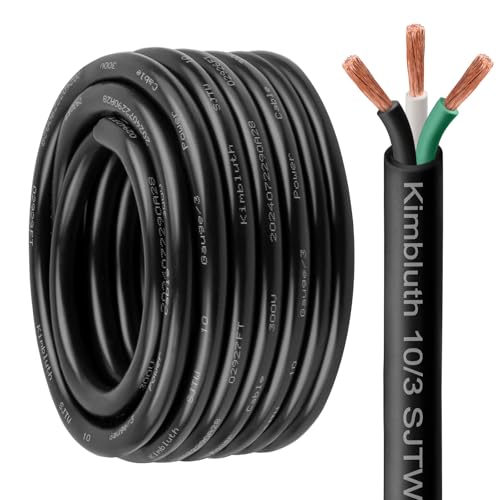
Cut-to-length 10/3 wire for the jobs that never fit a pre-made cord.
When your run is 22 feet, not 25, bulk cable beats another finished cord and its leftover slack. This is 30 feet of SJTW (Service, Junior, Thermoplastic, Weather) 10-gauge three-conductor wire made from OFC — oxygen-free copper — which keeps resistance low and heat absorption in check so the wire carries more current without warming. It is rated to 300 volts and safe from -40°F to 221°F, a wider temperature spread than the household outdoor cords carry. It cuts and solders easily because the strands are twisted copper, exactly what you want when you are making clean terminations.
Value and durability are its calling cards. The PVC jacket resists oxidation, corrosion, gasoline, battery acid, and abrasion, standing up to pumps, generators, snow throwers, vacuums, holiday lighting, mowers, leaf blowers, and trimmers. A buyer running a heavy build put it vividly — thick housing with big number 10 wires inside — while another used it happily as speaker wire. For someone building a jump lead or extending a run on their own terms, that flexibility and copper quality justify the reel every time.
One buyer’s honest read is worth taking: this is not billed as premium lab-grade conductor, and the outer jacket runs thinner than the beefiest cords here, so keep it out of the weather most of the time unless you sheath it. Treat it as excellent value wire for a protected custom run rather than a rugged all-season cord.
Where it shines
- OFC copper in a flexible jacket cuts and solders cleanly for custom runs
- 300 V rating and -40°F to 221°F range suit pumps, generators, and blowers
- Buy exactly the length your project needs and skip pre-made slack
Where it asks more of you
- No connectors included — you terminate it yourself
- Thinner outer jacket than the toughest cords, so protect it from the elements
Made for: DIYers and pros who measure their run and want bare 10/3 wire to finish on their own terms.
Not for: plug-and-play users who want a cord to grab and go — this one needs ends.
7. PlugSaf 50 FT 10 Gauge Outdoor Extension Cord with Multiple Outlets
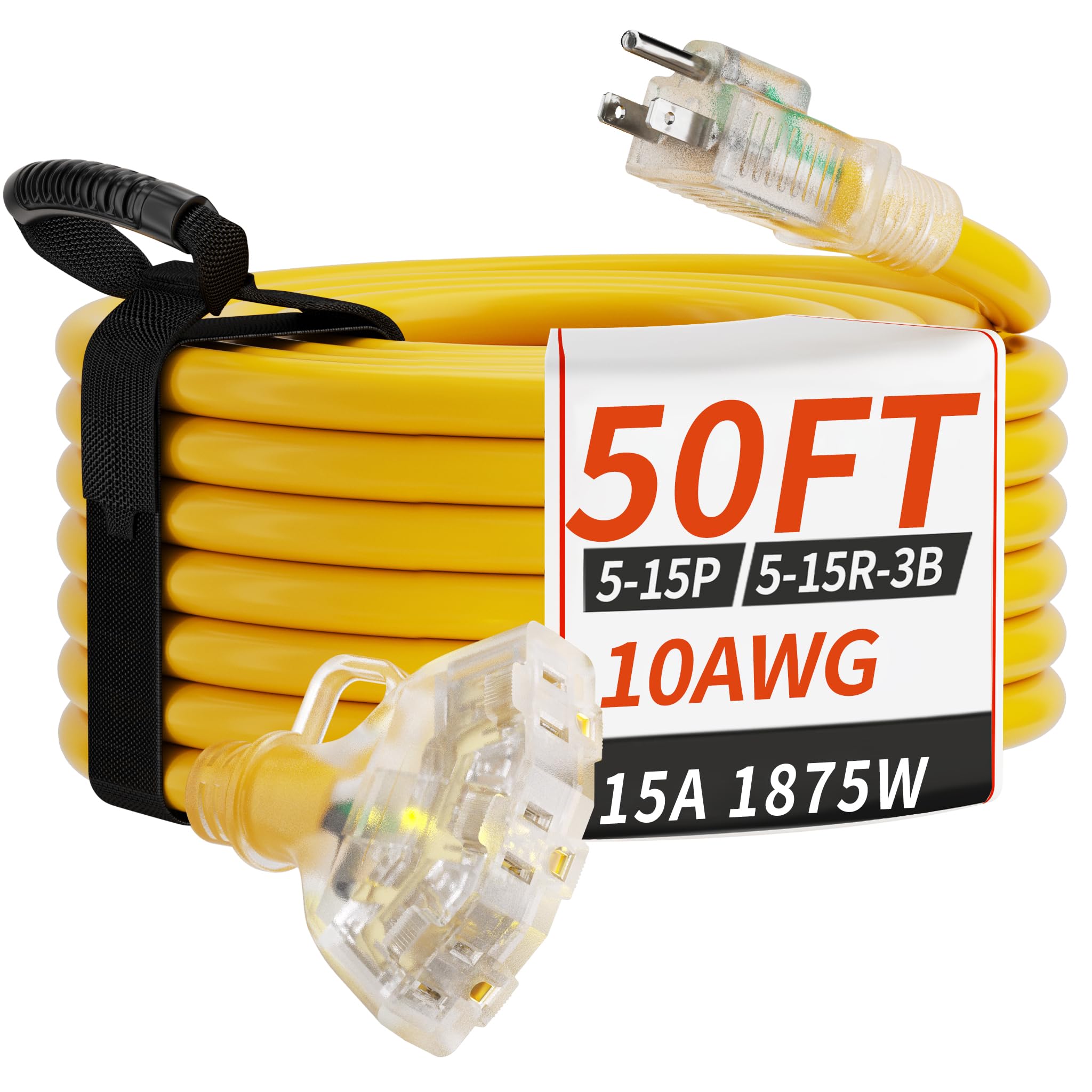
Fifty feet of 10-gauge power with three outlets on the end, so everyone plugs in at once.
Long runs and busy job sites rarely need a single plug. This cord answers both: 50 feet of 10-gauge SJTW cable with a 3-way outlet head, rated 15 amps, 125 volts, 1,875 watts, and finished with NEMA 5-15P to 5-15R blades. That triple outlet lets you run several tools or appliances off one receptacle without dragging an extra power strip outside. The built-in LED indicator glows when the cord is live, and the bright yellow sheath makes the run obvious in the dark — no one trips over a cord they can see.
The weatherproofing and finish are what buyers rave about. The jacket handles -40°F to 140°F and carries an IP65 waterproof rating, and owners describe a heavy, rugged cord that powers a 140,000 BTU air conditioner, a pool pump and salt cell, and generator loads without overheating or voltage drop. As owners mention, the triple outlet can run three 120-volt appliances at the same time — real convenience when you are wiring a vendor tent or a worksite. The special hook design keeps the 50-foot coil in shape, and the tail is built to bend more than 20,000 times without breaking.
The single trade-off is honest: 50 feet of 10-gauge copper is a heavy coil, and the multiple-outlet head adds bulk at the far end. It is not the cord you want for a five-foot indoor task. But for anyone powering tools or appliances across a long yard or campground, it is the rare cord that both reaches and multiplies.
The 50-foot advantage: same rugged 10-gauge build as the shorter cords, but the three-way outlet head and long reach mean fewer extension strips and fewer trips back to the wall.
The weight reality: a 50-foot 10-gauge coil plus an outlet head is heavy and bulky — stow it on a hook, not in a bag.
Right for: job sites, trailer camping, and vendor setups where several tools share one distant outlet.
Overkill for: short indoor runs where a light-duty cord fits the bill.
8. 10 Gauge 50 FT Extension Cord 10/3 Contractor SJTW, Green

Contractor-green 50-footer that holds voltage on a generator run — with a clear tri-tap on the end.
When the outlet is far from the job, voltage drop becomes the enemy, and this cord is built to fight it. It is a 50-foot 10/3 SJTW cord with pure copper wire, a 3-prong grounded plug, and a clear TRI-TAP head that turns one outlet into three. It is rated 125 volts, 15 amps, 1,875 watts, and UL listed, with a bright neon-green jacket that makes the run easy to spot on a dark job site. Rated for both indoor and outdoor use, it is the kind of cord that stretches from a house outlet to a camper or a worksite and still delivers steady power.
It earns its keep on the hard runs. One owner runs 120 feet from a 20-amp outlet to an RV with the air conditioner pulling 17 amps and reports only modest voltage sag and no heat at the plugs after two hours. Others note the insulation stays cool while thinner cords — including ones that had melted under an air conditioner, a lamp, and a laptop — have failed. The lighted ends at both ends show power on the spot. As customers note, this is a solid cord for heavy-amp use during a power outage when the run goes past 100 feet.
Two candid points. The green color draws mixed reactions — some love the high-visibility look, some find the shade off from the photos. And at 50 feet of 10-gauge, it is genuinely heavy and wants some arm strength to roll up. Neither undercuts the performance; both are worth knowing before it lands on your porch.
A fit for: RV owners, outage preppers, and job sites that need power hauled well past 100 feet without overheating.
Weigh if: you want a light, easy-rolling cord or a specific shade of green — this one is heavy and its color splits opinion.
9. Southwire Extra Heavy Duty Extension Cord, 50Ft, 10 Gauge, 3 Conductor

A 50-foot, 10-gauge workhorse that feeds big tools and welders on a long cord.
This is the cord you grab when the tool is big and the outlet is far. It is a 50-foot, 10-gauge, three-conductor outdoor cord with a lighted end that confirms power is on, clear molded plugs with strain relief, and a bright yellow vinyl jacket that resists oil, grease, moisture, and abrasion. The manufacturer rates it for large loads — a hammer drill, multiple drills, a large heater. One owner runs a MIG welder on it and reports no power loss, while another powers an RV from a 20-amp circuit with no warming at all. As reviewers point out, 10/3 wire of this gauge handles the heavy current a long run demands.
The build quality is what keeps it in owners’ kits for years. The lighted outlet and neon-indicator styling make it easy to confirm at a glance that the run is live, which is genuinely useful when the cord disappears behind a bush or under a vehicle.
One quirk to understand: some listings show a 15-amp figure while the cable is a genuine 10/3 build that can carry more. If your load sits between standard household and heavy-duty territory, this cord has the copper to cover it — just size the breaker and outlet to match. It is heavy, so plan a reel or a hook for storage, but for a long, load-hungry run this is a reliable, well-made choice.
What it delivers: 50 feet of heavy 10-gauge copper that powers welders, heaters, and RV runs without voltage loss — and a lighted end that tells you power is live from across the yard.
The fine print: listings show a lower amp figure than the wire can carry, so match your outlet and breaker to the actual load rather than the sticker.
Best used by: home and job-site users feeding welders, large heaters, or long RV runs who want proven, heavy 10/3 copper.
Size check first: it is a heavy 50-foot coil — have a reel ready, and match your circuit to the load you plan to pull.
Understanding the Specs
Wire gauge (AWG)
Gauge is the thickness of the copper conductor, and the numbering works backwards: a lower number means a thicker wire. A 10-gauge wire is heavier than a 12- or 14-gauge wire, so it carries more current with less resistance. That resistance number is the one that matters, because resistance is what turns into heat at the plug when you overload a cord. So a 10-gauge cord stays cooler under a pump or a heater than a thinner cord on the identical load. If your appliance runs hot on its current cord, moving to a heavier gauge is usually the fix.
Amps, volts, and watts
These three numbers describe the power a cord is built to carry. Amps is the current flow, volts is the electrical pressure, and watts is the two multiplied together — the actual work the cord delivers. A household 15-amp cord running at 125 volts tops out near 1,875 watts, while a 30-amp cord at the same voltage reaches 3,750 watts. The catch is the plug shape: a 15-amp household blade will not seat in a 30-amp RV outlet. So match your cord’s amp and watt ceiling to both the appliance and the outlet it plugs into.
Jacket and weather ratings
The jacket letters tell you what the outer sheath is built to survive. SJTW means a thermoplastic weather-resistant jacket for outdoor service. SOOW means a rubber jacket resistant to oil and water for harsher industrial duty. An IP65 rating means the cord resists dust and water spray, and the temperature range tells you how it behaves when the season turns cold. A cord rated to -40°F or -40°C stays flexible in a freeze instead of going stiff, which matters every time you coil it for storage.
Plug types and connectors
The connector shape decides where a cord can plug in. NEMA 5-15P to 5-15R is the everyday three-prong household pairing. NEMA TT-30P to TT-30R is the 30-amp RV pairing found on campground pedestals, and its round blades will not fit a standard wall socket. Bulk cable ships with no ends at all, so you crimp or tape whatever terminations your project needs. Before buying, look at the outlet you intend to use, and confirm the cord’s connector matches it — the wrong plug shape is the single most common ordering mistake.
FAQ
Will a 10/3 cord fit my regular wall outlet or my RV pedestal?
How many amps can a 10-gauge three-conductor cord handle?
What does the lighted end on an extension cord actually tell you?
Can I use a 10/3 cord for a welder or a generator?
Is 10 gauge better than 12 or 14 gauge for an outdoor cord?
Does a 10/3 cord have a separate ground wire?
How do I store a heavy 50-foot 10-gauge cord without tangling it?
Will a 10/3 outdoor cord stay flexible in freezing weather?
Can I plug more than one appliance into one 10/3 cord?
Do I need a 30-amp cord or a 15-amp cord for my camper?
Final Thoughts: The Verdict
For most people shopping for the best 10/3 electrical cord, the 25 FT 30 Amp NEMA TT-30P/R RV Extension Cord is the pick that does the most for the most buyers — it carries a full 30 A and 3,750 W to an RV pedestal, survives IP65 weather, and stays flexible down to -40°C so it coils even in a hard freeze. If your priority is everyday outdoor power off a household outlet, the PlugSaf 25ft 10 Gauge cord delivers a 15 A / 1,875 W ceiling, a lighted end, and a jacket rated to bend over 20,000 times without breaking, at a value-friendly position in this list. And if you are wiring your own run, the 25FT 10/3 SOOW Portable Power Cable hands you 600-volt industrial copper by the foot for welders, generators, and pumps. The RV cord earns the top slot with 4.8 stars across 700+ ratings and a full 3,750-watt ceiling.
How We Picked
We do not accept paid placement. Every pick is matched to a real buyer and a real use-case; we do not hands-on test units.
Sources & Methodology
Specifications: manufacturer listings and product documentation. Review insights: verified customer reviews, as of September 2026. Pricing: not shown on this page (it changes often); check the current price via the retailer link.
As an Amazon Associate, KitchPrep earns from qualifying purchases. This does not affect which products we feature.
Related Guides
