
Specs are compiled from manufacturer listings and verified buyer reviews and can change over time — please confirm the key details on the product page before buying.
Running power to a garage, well pump, or backyard office starts with one choice: the wire. For a 240-volt, 30-amp run buried straight in the dirt, the standard pick is 10/3 UF-B (an underground feeder cable with three current-carrying conductors). Paying more here buys you nothing but a label, so match the wire length to your actual trench and stop there. Below are the four 10/3 direct-burial picks worth your time.
I’m Mohammad Maruf — the founder and writer behind KitchPrep. This guide is built by comparing the manufacturers’ published specifications and the patterns across verified customer reviews, so you get each pick’s real strengths and trade-offs instead of marketing spin.
We dug into the spec sheets and the owner feedback to find the best 10/3 direct-burial wire for your run.
Our Picks at a Glance
How To Choose The Best 10/3 Direct-Burial Wire
A cable that is undersized for the run, or the wrong gauge for the load, becomes a safety issue the moment you flip the breaker. Getting the pick right depends on three things: gauge and conductors, the burial rating, and the exact length of your trench.
Gauge And Conductor Count
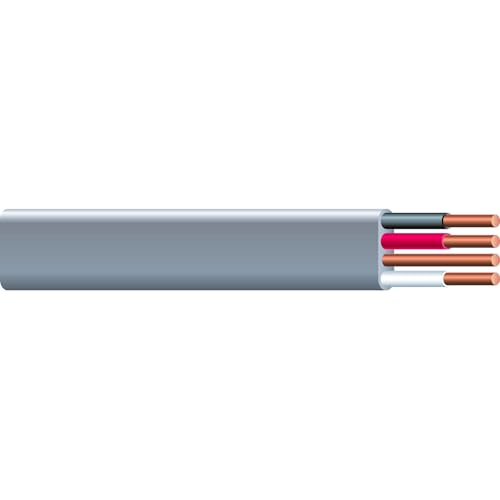
The “10/3” in the name is doing real work here. The 10 is the gauge, or wire thickness, and thinner wire handles less current before it heats up. The 3 means three conductors, which is what you need to carry two hot legs plus a neutral for a 240-volt feed. A ground wire rides along too. Undersize the gauge and the wire warms up under load; oversize it and you simply spend more than the job requires.
Burial Rating
UF and UF-B are the burial designations, and the “B” version is the one rated for direct earth contact without a protective pipe around it. That is the whole point of this category — you trench, you drop the cable, you backfill. The jacket also needs to shrug off sunlight and moisture, since the soil around a buried run stays damp year round. Look for both ratings in writing before you buy.
Length And Voltage Drop
Measure your trench and buy the cut length that covers it with a little slack at both ends. Long runs lose voltage along the way, so a 240-foot run to an outbuilding behaves differently at the far end than a 30-foot run to a garden outlet. Spools come in set cut lengths, so measure your trench first and leave a little slack at both ends for terminating.
Quick Comparison
| Model | Best For | Length | Max Current | Voltage Rating | Amazon |
|---|---|---|---|---|---|
| Southwire 13059122 Romex SIMpull 10/3 UF-B★ Best Overall | Long runs to outbuildings | 50 ft | 30 A | 600 V | Amazon |
| YDDECW 10/3 UF-B Wire 25FT | Short runs and well houses | 25 ft | 10 A | 600 V | Amazon |
| Wirenco 10/3 UF-B Wire 50Ft Cut | Mid-length feeder runs | 50 ft | 30 A | 600 V | Amazon |
| Stock Wire 10/3 UF-B 100ft Cut | Long runs and detached shops | 100 ft | 30 A | 600 V | Amazon |
In‑Depth Reviews
1. Southwire 13059122 Romex SIMpull 10/3 UF-B Building Wire, 50 Ft, Gray
Our pick — over 4.5★ from 800+ verified ratings; the strongest balance of quality and price.
The 50-foot grey spool that does what a buried feeder is supposed to do and nothing else.
This cable is a 50-foot cut of 10-gauge copper with three conductors and a ground, wrapped in a grey UF-B jacket rated for direct earth burial. What wins people over is not a feature — it is that a hardware store charges noticeably more for the same thing, and this shows up ready to bury. One buyer ran a full 240 feet of it from a main house out to a separate building and still had a ten-foot cutoff left over.
If you are feeding a detached structure and want no surprises, this is the sensible anchor pick. Pair it with a long run and let the 30-amp rating and 600-volt insulation do their job. Match it against the Wirenco 50-foot cut below and the two are closely comparable in length and ampacity, so the deciding factor is usually delivery speed and the week’s pricing rather than the copper.
The honest catch is the stiffness. This is a heavy, rigid cable that resists bending, which makes it awkward to wrestle into a tight trench corner or curve into a panel. That same stiffness is what makes it durable underground, so it is a trade, not a flaw. Plan your bends with a generous radius and it will behave.
What makes it the safe pick
- 10-gauge copper with three conductors plus ground in a direct-burial UF-B jacket
- Rated for 30 amps and 600 volts, enough for a sub-panel feed
- 50-foot cut suits most house-to-outbuilding trenches
- Arrives ready to bury, no conduit needed
Where it pushes back
- The jacket is stiff and heavy, so tight bends are a fight
- A 50-foot cut runs short for very long runs
Buy this wire if: you are feeding a shed, garage, or sub-panel on a run that fits in roughly 50 feet and you want a brand-name cable at a store price.
Pass on it if: your trench is short and you would be paying for copper you will never bury.
2. YDDECW 10/3 UF-B Wire 25FT Pure Copper Direct Burial Cable
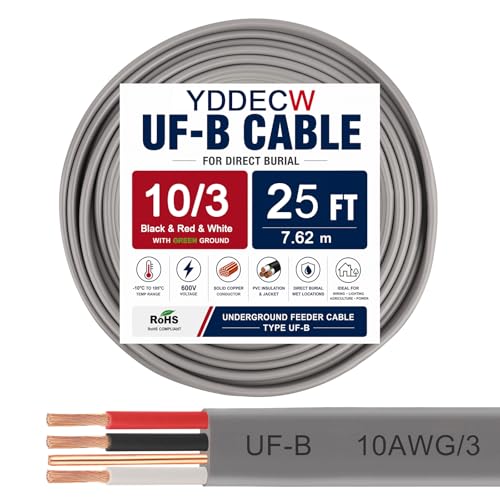
A 25-foot cut that suits the small jobs — a well pump, a window unit, a generator hookup.
For short runs, this 25-foot cut of 10-gauge copper is built for jobs like a well house, a wall-mount air conditioner, or a backup generator connection. It lets you run a small 30-amp sub-panel without dragging a 100-foot spool you will never use. The jacket is PVC, and the maker rates it for water, snow, wind, and sun, with an operating range from -10℃ up to 105℃ so it handles both frozen ground and hot summer soil. It bends easily, which is the part people notice first when feeding it through a tight trench.
Compare it to the 100-foot Stock Wire below and the length gap is stark — 25 feet versus 100 feet. That is the whole trade: this one is for the compact job, and the 100-foot cut is for the detached building across the yard. Neither is better; they are for different trenches.
What the numbers say: the spec sheet lists 10-gauge, three conductors, 600 volts, and a maximum current of 10 amps — the amp figure is the one to check against your load before you buy, so confirm it covers your device.
Where it fits: short, protected runs where flexibility beats brute stiffness, sold in a cut that ends exactly where the job does.
Reach for it if: your run is short, your load is light, and you want an easy-bending cable without overbuying length.
Think twice if: you are pulling a heavy sub-panel feed, since the stated amp rating caps what this cut is meant to carry.
3. Wirenco 10/3 UF-B Wire, Underground Feeder and Direct Earth Burial Cable, 50 Ft Cut
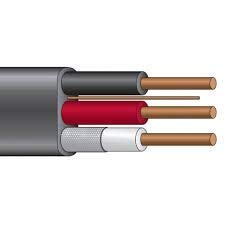
Fifty feet of properly rated feeder cable built for a garage, a shop, or a detached office.
This cut is rated for 30 amps and 600 volts, with a 90-degree Celsius heat capacity and a jacket engineered to shrug off sunlight and moisture whether it sits underground or in a wet corner indoors. That covers the two jobs most people are actually doing — burying a feed to an outbuilding or running through a damp basement — without buying extra pipe. A homeowner burying theirs from the house to the garage called it “easy to work with and very durable.”
Worth comparing to the brand-name Southwire cut above: both are 50-foot, 30-amp, 10-gauge, three-conductor cables, so on paper they are near twins. The difference shows in the details — this one arrives cut from a larger spool and taped, and buyers report it is not labeled the way a store roll would be. That is a packaging quirk, not a performance one, and it does nothing to the copper.
The real-world read: great price, fast shipping, and flexibility that makes trench work far less miserable than wrestling stiff cable through a corner.
The honest note: the ground wire runs slightly smaller in gauge than the diagram suggests, and the loose taped bundle is less tidy than a retail roll — minor, and it does not affect the conductors themselves.
This is the one to grab if: you want 50 feet of 30-amp feeder cable with the flexibility to work a tight trench without overpaying.
skip it if: you need the retail labeling and spool presentation of a name brand, or your run exceeds 50 feet.
4. Stock Wire 10/3 UF-B Wire, Underground Feeder and Direct Earth Burial Cable, 100 Ft Cut

A full 100 feet of buried feeder cable for the outbuilding that sits well across the yard.
When the trench is long, this is the cut that ends the agonizing. It is 100 feet of 10-gauge copper with three annealed (soft) conductors and a nylon-reinforced jacket, rated for 30 amps and 600 volts with the same 90-degree Celsius heat capacity as the shorter cuts. The nylon makes the jacket tougher against abrasion where it drags through rocky soil. A homeowner connecting an outdoor kitchen to a house 100 feet apart buried it themselves.
This is the long run that makes the difference plain against the Wirenco 50-foot and the YDDECW 25-foot above — 100 feet versus 50 versus 25. The jump is real, and for a detached shop or an office set well back from the house, the extra length is the whole point. Doing it with two short cuts and a splice under the ground is not worth the risk, so sizing the spool right the first time is the smart move.
Sizing note: at 100-foot runs, voltage drop starts to matter, so plan your gauge and length together rather than buying whatever is left on the shelf.
What owners mention: heavy-duty, well-packaged, and easy to install and terminate on runs the shorter cuts cannot reach.
Best for: running power to a detached building, shop, or well on a long trench where a single continuous cut avoids any splice.
Look elsewhere if: your run is short — a 25-foot or 50-foot cut costs less for the same job.
Understanding the Specs
Gauge and Conductors
Look for “10/3” written out: 10-gauge copper, three conductors. The gauge sets how much current the wire can carry before it heats up, and the three conductors give you two hots plus a neutral for a 240-volt feed. A ground wire comes along as part of the assembly. Buy thinner than 10-gauge and you risk a warm cable and a tripped breaker.
Ampacity and Voltage
Ampacity is the current the cable can safely carry; the 30-amp cuts here are sized for a sub-panel feed, while the lighter-rated 25-foot cut tops out lower. Voltage rating tells you the maximum it is built to handle, and 600-volt cable covers residential 240-volt work with headroom. Match the ampacity to your load before you buy.
Burial Rating
UF-B is the direct-burial designation and the “B” version is the one cleared for earth contact without a conduit sleeve. The jacket also needs to resist sunlight and moisture, since buried soil stays damp. Confirm both in the listing before you dig.
Cut Length and Voltage Drop
Spools arrive in set cut lengths, so measure your ditch before ordering. On longer runs, voltage drops toward the far end, which is why length and gauge get chosen together. Locking in a single continuous cut avoids a splice underground, where a bad joint is hard to reach and harder to diagnose.
FAQ
What does 10/3 direct-burial wire mean exactly?
Can I run this wire directly in the ground without conduit?
How many amps can 10/3 UF wire handle for a sub-panel?
How long can I run 10/3 underground wire to a garage?
Does 10/3 direct-burial wire need a ground wire?
What is the difference between UF and UF-B wire?
How deep should I bury 10/3 direct-burial cable?
Can I use 10/3 underground wire indoors in a wet area?
Why is direct-burial cable so stiff and hard to bend?
Final Thoughts: The Verdict
For most household runs to a garage, shed, or well house, the Southwire Romex SIMpull 10/3 UF-B is the smart buy — it is a name-brand 50-foot cut of 10-gauge, 30-amp, direct-burial cable at a store price, and it covers the run lengths most people actually dig.
If your trench is short and simple, the 25-foot YDDECW cut bends easily and ends exactly where the job does. If the run is a full hundred feet to a detached shop, grab the Stock Wire 100-foot cut and skip any splice. And if you want a 50-foot cut with the flexibility to work a tight trench, the Wirenco is the one to reach for.
Match the gauge, amp rating, and length to your actual trench before you order.
How We Picked
We do not accept paid placement. Every pick is matched to a real buyer and a real use-case; we do not hands-on test units.
Sources & Methodology
Specifications: manufacturer listings and product documentation. Review insights: verified customer reviews, as of September 2026. Pricing: not shown on this page (it changes often); check the current price via the retailer link.
As an Amazon Associate, KitchPrep earns from qualifying purchases. This does not affect which products we feature.
Related Guides
