
Specs are compiled from manufacturer listings and verified buyer reviews and can change over time — please confirm the key details on the product page before buying.
If you grind knives or clean up steel, the whole job lives or dies on one thing: does the belt stay on the platen (the flat backing plate behind the belt) while you push metal into it. A 1 x 42 belt sander gives you a narrow 1-inch belt and 42 inches of abrasive loop, so you can reach into a finger groove or a tight radius instead of just flattening a slab. The three machines below each do that differently, and the right one depends on if you want quiet power, two speeds, or a cast-iron tank that never moves.
I’m Mohammad Maruf — the founder and writer behind KitchPrep. This guide is built by comparing the manufacturers’ published specifications and the patterns across verified customer reviews, so you get each pick’s real strengths and trade-offs instead of marketing spin.
You will see what separates a grinder that tracks true from one that wanders, which motor setup actually holds speed under load, and where each machine asks you to compromise. Everything below is written for people shopping for the best 1 X 42 Belt Sander, whether this is your first benchtop unit or your third.
Our Picks at a Glance
How To Choose The Best 1 X 42 Belt Sander
You already know you want a 1-inch-wide belt on a 42-inch loop, because that is the size that lets a belt sander do knife work and small-part metal finishing that a wide 4 x 36 machine simply cannot reach. So the real question is not the size — it is what happens when you lean into the belt.
Motor type decides your maintenance schedule
A belt-driven motor spins a separate sanding shaft using an internal drive belt, and that drive belt wears out and needs replacement. A direct-drive motor connects straight to the sanding shaft with no intermediate belt at all. On a direct-drive brushless unit you skip that yearly belt swap entirely, and you also get instant torque instead of waiting for a belt to grab. That is the single biggest long-term ownership difference in this category.
Speed options and what they are for
A single-speed machine runs at one fixed rate, so you pick your grit and your pressure and that is your control. A two-speed machine lets you drop to a slower rate for heat-sensitive work and step up to a faster rate for stock removal. Slower means less heat building in the steel, which matters when you are shaping a blade near its final thickness.
Belt tracking and belt changes
Tracking is how the belt self-centers as it runs. Get it wrong and the belt walks off the edge mid-cut. Look for a tensioning system that keeps the belt under steady pressure rather than one you re-tweak every session. Then look at how fast a belt swap is, because you will change grits often.
Weight, footprint, and where it lives
These are benchtop machines, so the machine’s own weight is what keeps it from dancing across your bench when you push harder. Heavier means more stable and harder to move. If your shop is a corner of a garage, a lighter unit you can lift onto a shelf may matter more than one you bolt down permanently.
Quick Comparison
| Model | Best For | Motor Power | Max Speed | Weight | Amazon |
|---|---|---|---|---|---|
| Kalamazoo 1SM★ Best Overall | Buyers who want a dead-simple, tank-solid sharpening machine | 1/3 HP, 3.3 A | 1725 rpm | 32 pounds | Amazon |
| BUCKTOOL BD1801-DS | Knife makers and car builders who want two speeds and no motor maintenance | 3/4 HP, 4.8 A | 3450 rpm | — | Amazon |
| JET J-4002 | Shops that want cast iron and a full abrasive assortment in the box | 1/3 HP, 15 A | — | 63 pounds | Amazon |
In‑Depth Reviews
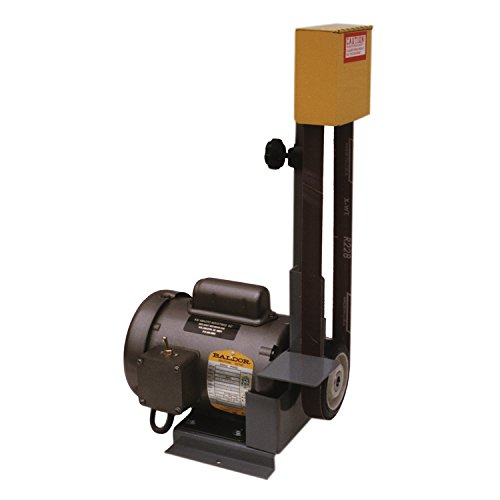
1. Kalamazoo 1SM 1″ Belt Sander, 32 lbs, 1725 RPM, 1/3 HP Motor, 1″ x 42″ Belt, 4″ Contact Wheel
Our pick — 4.5★ from 100+ verified ratings; the strongest balance of quality and price.
The slow-turning 1725 rpm tank that owners keep for a decade.
This machine runs at 1725 rpm (revolutions per minute — how fast the belt spins), which is roughly half the rotational speed of the BUCKTOOL’s top setting. The slower belt builds less heat and gives you far more forgiveness when you are shaping a bevel by eye. It draws just 3.3 A (amps — the electrical current it pulls) off a 1/3 HP single-phase motor, which is a fraction of the 15 A that the JET J-4002 pulls — so you can run it on an ordinary household circuit without thinking about it.
The 4-inch contact wheel is the other half of the story. A smaller wheel puts a tighter curve under the belt, which is what lets you grind a hollow into a blade instead of only flat-grinding it. Pair that with the coarse 60-grit belt it arrives with and you have a machine set up for hogging metal from the first minute, not for polishing. Reviewers praise its raw grinding performance first and its short learning curve second. Belt changes are the kind of simple that reviewers describe in seconds, with the spring-loaded shaft holding tension so you are not chasing tracking after every swap.
Here is the honest trade-off. This is a single-speed machine: 1725 rpm is what you get, and if you want to slow down further for delicate work you cannot. What you are paying for is the build: it arrives sturdier and smoother-running than its 32-pound spec sheet suggests, and it stays that way.
What it gets right
- 1725 rpm and a 4″ contact wheel make hollow grinding forgiving instead of nerve-wracking
- 3.3 A draw means it runs happily on standard household power
- 60-grit coarse belt ships installed, so it hoggs metal from the start
- Spring-loaded shaft holds belt tension, keeping swaps quick and tracking stable
Where it asks you to give something up
- Single speed only — no slower setting for heat-sensitive finishing
- 32 pounds makes it a stay-put machine rather than a shelf-sitter
Reach for this if: you want one grinder that sharpens, hollow-grinds, and runs quietly off a normal outlet without a maintenance calendar.
Look elsewhere if: you need a second, slower speed for thin, heat-sensitive stock — the BUCKTOOL gives you that range instead.
2. BUCKTOOL Dual Speed Belt Disc Sander for Metal,1×42″ Belt,8″ Disc,4.8A

Two speeds, a brushless motor with no drive belt to replace, and an 8-inch disc bolted to the side.
Buy this one if you are shaping blades or building parts and you want the machine to adapt to the job instead of the other way round. The dual-speed switch gives you 1750 rpm for controlled shaping and 3450 rpm for stock removal — and that 3450 rpm is exactly double the Kalamazoo’s fixed 1725 rpm, which is the difference between easing a bevel into shape and flattening it fast. Powering that is a 4.8 A brushless induction motor at 3/4 HP. Brushless means there is no drive belt inside the motor to wear out and swap yearly, so the maintenance schedule is close to nothing.
The other headline is the 8-inch disc running an 80-grit fine abrasive, hung off the same bed as the 1 x 42 belt. That disc is for squaring up handle blocks and flattening surfaces flat — a job the belt alone cannot do well. Quick belt release via a lever-activated spring-loaded idler makes grit changes fast, and the entire frame, base, belt frame, and dust ports are metal rather than plastic. What gets the most praise is unit-to-unit consistency — the thing that matters most when you buy a bench tool sight unseen. Owners put it through real work: it grinds steel quickly, and one buyer reports shaping seven large outdoor blades plus micarta and G10 handle material on it without the machine showing any sign of slowing.
The honest catch sits in the adjustability. The disc work table is the piece that draws the mixed feedback — it does not glide as smoothly as the rest of the machine, and fine-tuning belt tracking takes a little patience on first setup. Long-term durability is genuinely unknown simply because the design is newer, and there is a plastic disc safety guard that a couple of owners would rather see in steel. None of that changes what you get for the tier: 1750 and 3450 rpm, a brushless motor with no drive belt, and metal where it counts.
Two machines in one footprint: a 1″ x 42″ belt for edges and curves plus an 8″ disc for flat, square work, both spun by the same direct-drive 4.8 A brushless motor at 1750 or 3450 rpm.
The setup tax: belt tracking needs dialing in when it arrives, and the disc table’s adjustment is the least refined part of an otherwise solid build.
Best matched to: knife makers and metal fabricators who want speed range and a disc in one benchtop unit, and who would rather not swap a drive belt every year.
Think twice if: you expect the disc table to move like a machined slide — that specific adjustment is the one piece owners find fiddly.
3. JET 1″ x 42″ Belt and 8″ Disc Sander, 1/3 HP, 115V 1Ph (Model J-4002)
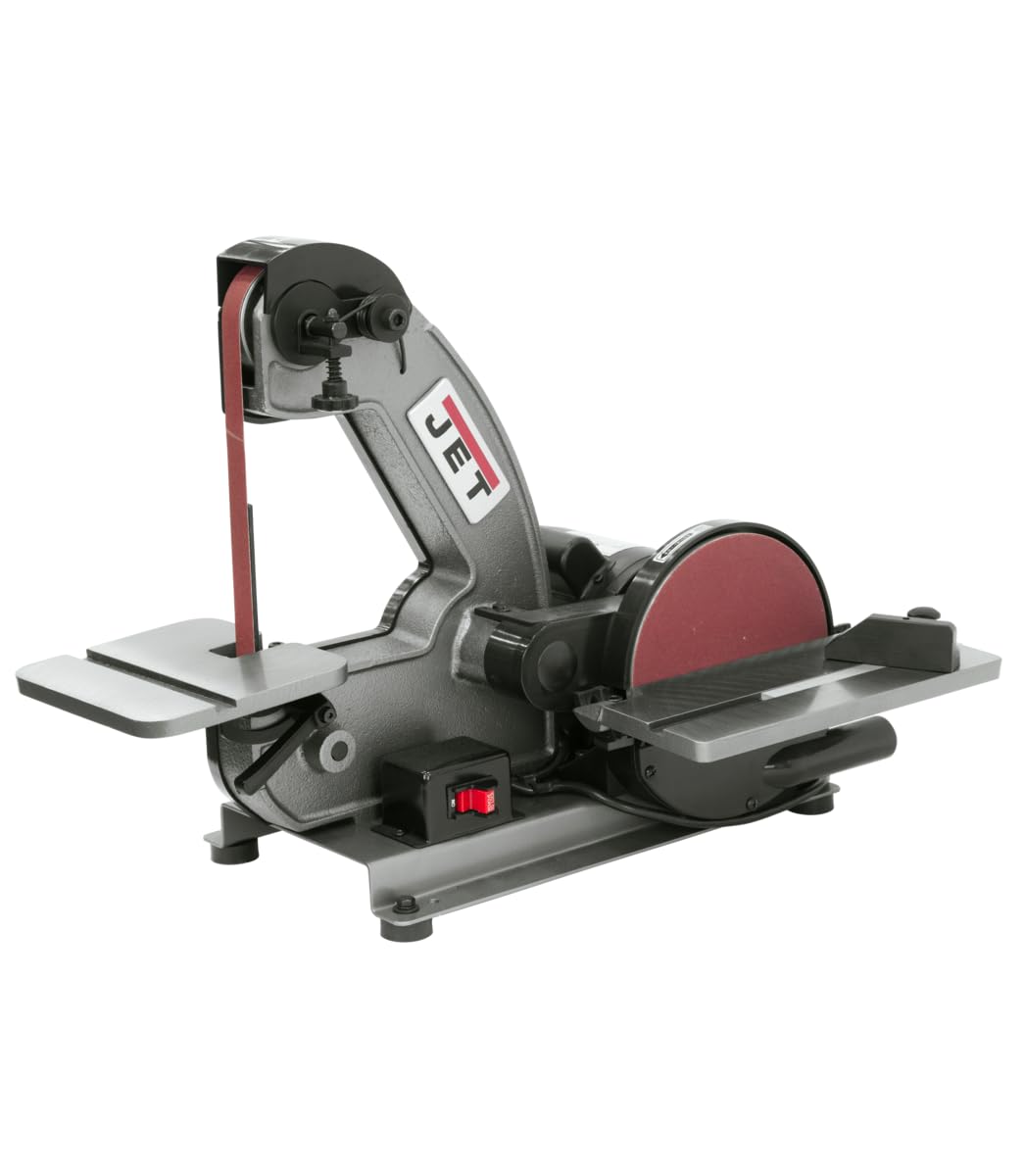
A 63-pound cast-iron frame that arrives with five grits of belt and three of disc already in the box.
If you want a machine that sits absolutely still while you bear down on it, this is the heaviest thing here at 63 pounds — nearly double the Kalamazoo’s 32 pounds. That mass is cast iron, and the payoff is a benchtop unit that will not chatter or creep when you press hard into a 120-grit medium belt (grit is the abrasive particle size — lower numbers cut faster, higher numbers polish smoother). It also arrives with an unusually complete abrasive kit: belts in 50, 80, 120, 220, and 320 grit, plus discs in 50, 80, and 120 grit, so you can go from rough shaping to a 320-grit finish without ordering anything extra.
It draws 15 A off its 1/3 HP single-phase motor — that is the highest amperage of the three, and worth knowing up front because it needs a circuit that can carry it. The features are aimed at odd-shaped work: a removable platen that lets you sand outside curves on the belt, a deluxe miter gauge (an adjustable guide that holds your work at a set angle) that turns and locks at common angles including 45 degrees both left and right, a hinged idler wheel cover, and an adjustable dust deflector with a chute. Assembly runs around 30 minutes, and the well-machined mating surfaces are what owners point to first.
Now the part you need to weigh honestly. This is the lowest-scoring machine on the list, and the pattern behind that is durability — a motor that failed in one owner’s hands after months of weekend use, and a bearing that went noisy on another. Assembly has its awkward moments too, and one owner found the mounting process for the sanding disc fiddly. At 63 pounds, with a replacement motor quoted for the reported failure, this is a machine you commit to rather than move around. It is also the only one here with a stated 2-year manufacturer warranty.
What the cast iron buys you: at 63 pounds and 22″L x 21″W x 14″H, it holds position under hard pressure, and the deluxe miter gauge locks at 45 degrees both directions for angled work.
The durability question: durability is the aspect owners are most split on — some describe it as heavy-duty, others as flimsy, and there are documented motor and bearing failures after light use.
Worth it when: you want maximum mass, a full grit assortment included, and a 2-year warranty backing a cast-iron machine that stays planted.
Skip this one if: you need a machine you can lift onto a shelf, or you want the simplest, most trouble-free motor — the BUCKTOOL’s brushless unit sidesteps the failure pattern here.
Understanding the Specs
Amperage and motor type
Amperage tells you how much current the motor pulls, which shapes both its muscle and what circuit it needs. On these machines you see 3.3 A, 4.8 A, and 15 A. Higher amperage generally means more ability to hold speed when you push metal into the belt. Motor type matters just as much: a brushless direct-drive motor connects straight to the sanding shaft with no intermediate belt, while a belt-driven motor uses an internal belt that wears and needs replacing. A direct-drive unit has less to maintain over the machine’s life.
RPM and grit number
RPM is how fast the belt or disc rotates. A slower rate like 1725 rpm runs cooler and is more forgiving; a faster rate like 3450 rpm removes material faster but builds heat, which matters on thin steel. Grit number works in the opposite direction: a lower number like 60 is coarse and hoggs metal, while a higher number like 120 is medium and leaves a finer surface. Match grit to the stage of the job rather than to the machine, and swap belts as you move from shaping to finishing.
FAQ
What is a 1 x 42 belt sander actually used for?
Will a 1 x 42 belt fit all three of these sanders?
What is the difference between a brushless direct-drive motor and a belt-driven motor?
How long does it take to change a belt on a 1 x 42 sander?
Should I get a sander with two speeds or one?
Is a 3/4 HP motor better than a 1/3 HP motor on a belt sander?
How do I set belt tracking so the belt does not wander off?
Can these sanders handle knife making and metal polishing?
Do I need a dust collection setup with a 1 x 42 belt sander?
Can I use a 1 x 42 belt sander as a disc sander too?
Final Thoughts: The Verdict
If you only buy one machine, the Kalamazoo 1SM is the one to live with. It runs at 1725 rpm on a minimal 3.3 A draw, its 4-inch contact wheel handles real hollow grinding, and owners describe it as sturdy and smooth in a way its spec sheet does not hint at. It is the pick that keeps working without asking for attention. If you want two speeds, an 8-inch disc, and a brushless direct-drive motor that never needs a drive belt, the BUCKTOOL BD1801-DS gives you the widest range of work in one benchtop footprint. And if maximum weight, cast-iron construction, and a full abrasive assortment included at purchase carry the day for you, the JET J-4002 is the one to reach for — just go in knowing its durability record is the most divided of the three. Whichever way you lean, decide by motor type and speed range first, because those two specs set what the machine can do for years.
How We Picked
We do not accept paid placement. Every pick is matched to a real buyer and a real use-case; we do not hands-on test units.
Sources & Methodology
Specifications: manufacturer listings and product documentation. Review insights: verified customer reviews, as of September 2026. Pricing: not shown on this page (it changes often); check the current price via the retailer link.
As an Amazon Associate, KitchPrep earns from qualifying purchases. This does not affect which products we feature.
Related Guides
