
Specs are compiled from manufacturer listings and verified buyer reviews and can change over time — please confirm the key details on the product page before buying.
You need a hoist that lifts a full ton without you wondering whether the brake will hold. The four picks below all carry a 1-ton rating, but they differ in lift height, chain grade, and how the load is shared across the gears — and those are the things that decide whether a job goes smoothly or turns into a fight. Here is what actually matters, and which one fits your garage, shop, or job site.
I’m Mohammad Maruf — the founder and writer behind KitchPrep. This guide is built by comparing the manufacturers’ published specifications and the patterns across verified customer reviews, so you get each pick’s real strengths and trade-offs instead of marketing spin.
If you are rigging an engine, a truss, or a water heater, the deciding factors are chain grade, doggone simple brake design, and honest lift height. This breakdown of the 1 ton chain hoist market sorts the real differences for you.
Our Picks at a Glance

How To Choose The Best 1 Ton Chain Hoist
The number that matters most is the one printed on the load plate: a 1-ton hoist is rated to hold 2,000 lb. Everything else — lift height, chain grade, brake style — exists to keep that rating honest and repeatable. Here is what separates a hoist you trust for years from one you second-guess every time it takes weight.
Lift Height Sets Your Working Range
A 10 ft lift handles most garage and shop jobs, like yanking an engine or dragging a mower deck onto a stand. A 20 ft lift is what you want when the load starts low and has to travel high — a truss, a beam, or a water heater headed to an attic. Too little lift and you stop mid-hoist; more than you need is just extra chain to manage.
Chain Grade And Hook Design Tell You About Wear
Grade 80 chain —a load-rated steel with a high tensile strength— is the standard serious buyers look for. A forged hook that rotates a full 360° keeps the load from twisting your rigging as it comes up. Both features are visible in the photos, so you can spot them without a spec sheet.
How The Brake Shares The Load
A double-pawl or ratchet-style brake splits the holding force across more than one point, so the hoist holds position end-to-end instead of creeping between cranks. This matters with a load parked overhead while you work underneath it.
Quick Comparison
| Model | Best For | Rated Capacity | Lift Height | Chain Grade | Amazon |
|---|---|---|---|---|---|
| JET S90-100-10★ Best Overall | Shop and job-site work | 1 Ton | 10 ft | Grade 80 | Amazon |
| Big RED TR9010-3 | Warehouse and yard chores | 1 Ton (2,000lb) | 8 ft/2.5m | 20Mn2 alloy steel | Amazon |
| TOYO 2200Lb | Tight-space engine work | 1 Ton (2,200Lb) | 10 ft | Grade 80 | Amazon |
| FITHOIST FITVD120 | High-lift and attic jobs | 2,200 lbs | 20 ft | G80 manganese steel | Amazon |
In‑Depth Reviews
1. JET 1-Ton Hand Chain Hoist, 10′ Lift (Model S90-100-10), Gray
Our pick — over 4.5★ from 100+ verified ratings; the strongest balance of quality and price.
The hoist that came off industrial job sites and still shows up ready for work
If you want the pick that feels built for daily trade use, this is it. The 1-ton rating sits under a Grade 80 black oxide chain —a load-rated steel chain with a protective dark coating that shrugs off rust and grime— and the hooks spin a full 360°, so you can rig awkward loads without fighting the chain. At 25.4 pounds, it is light enough to hang solo between beams but heavy enough to feel solid under load.
What wins people over is performance first, then value. Owners put it to work on genuinely heavy jobs — one reviewer noted using it to “pull up a hot water heater into the attic,” and said it “barely felt like anything was attached.” That is the point of a good hoist: a load that should feel impossible comes up with steady, unhurried cranking. It also arrives with a factory certification tested load rating and certificate, which matters when you want documentation in hand.
Two things to know before you buy. First, the 10 ft lift is the limiting factor on tall jobs — if your load has to travel 20 ft, look at the FITHOIST below instead, because this model tops out at half that reach. Second, in the industrial-steel gray, the finish can read darker than the online photos suggest, so set expectations on the color rather than the performance.
The case for the JET
- Grade 80 black oxide chain for durability in harsh, damp environments
- Double ratchet pawl brake splits the load across both sides of the gear
- Needle bearings support the load sheave for smooth, low-effort cranking
- 360° rotating forged hooks make rigging odd shapes far easier
Where it asks you to compromise
- 10 ft lift is limited compared to the 20 ft FITHOIST option
- Industrial gray finish may appear darker in person than in listings
- Heavier than the Big RED, so moving it solo takes more care
Reach for it: anyone who wants a job-site-grade 1-ton hoist with a certified load rating and a 10 ft lift.
Look elsewhere if: your load needs to climb more than 10 ft, or a lighter carry weight is your priority.
2. Big RED Manual Hand Chain Hoist with 2 Heavy Duty Hooks for Warehouse Automotive Machinery, 1 Ton (2,000lb) Capacity, 8ft/2.5m Red
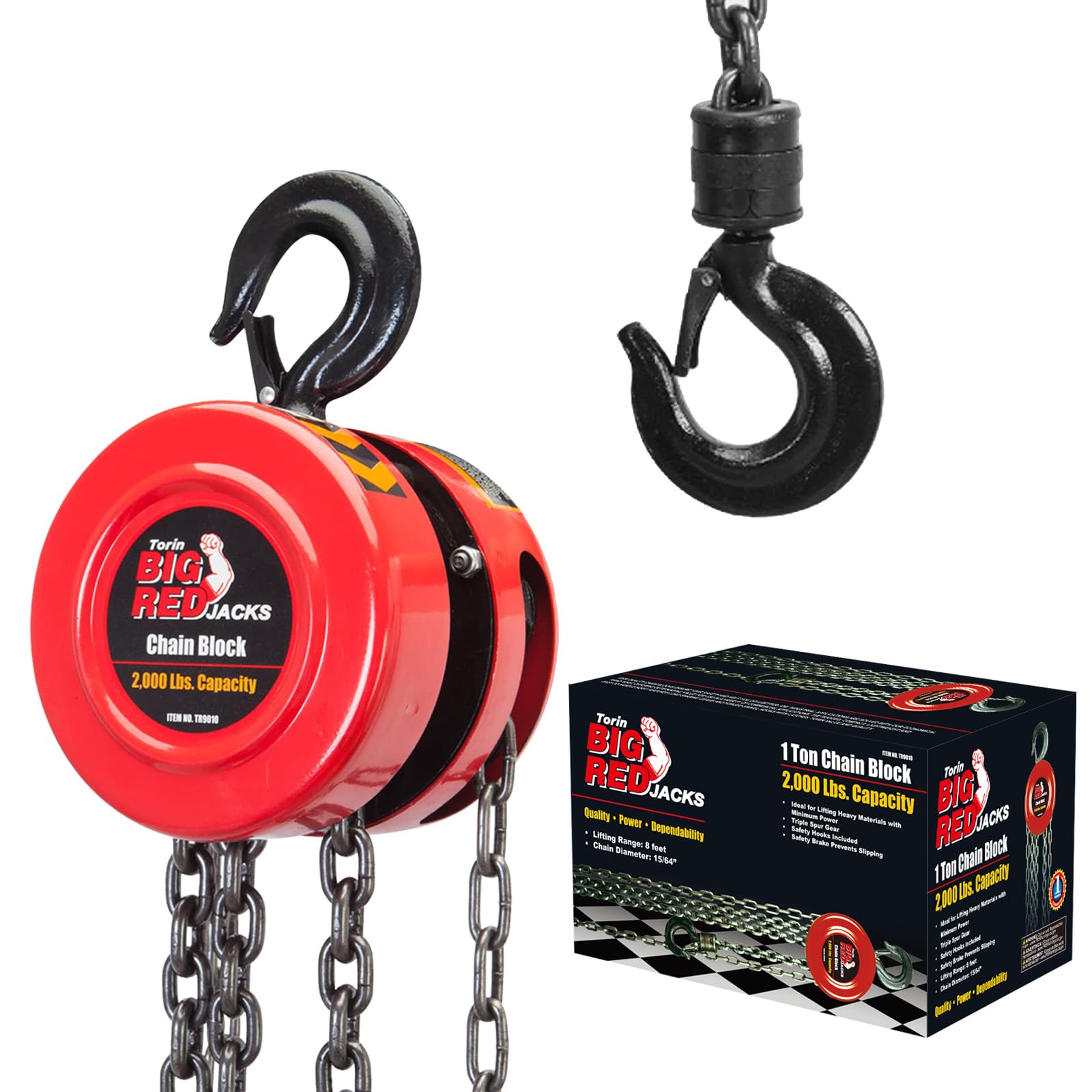
The lighter, budget-friendly 1-ton that punches up on chores around the yard and shop
The 1/4″ diameter chains use premium 20Mn2 alloy steel with a black oxide finish, and load-sharing gears keep the cranking easy. It meets ASME B30.16 overhead hoist safety standards and comes with a limited 1 year manufacturer warranty, which is honest coverage for a work tool.
Where this one shines is the everyday job. Owners use it for lawn tractor maintenance, hanging deer, and lifting a 500 lb metal box — one buyer wrote: “I have two currently lifting a 500lb metal box.” The pull is described as smooth and near easy, and the dual heavy-duty steel hooks rotate a full 360° with a safety latch. For a light-to-mid load that needs steady, reliable lifting without fuss, it does exactly what is asked.
The trade-off is the 8 ft lift and 20.4-pound frame, which suit garage and farm chores rather than tall structural work. If your job is hoisting trusses high or reaching into a second story, this is not the one — but for a garage, farm, or dock job at moderate height, it earns its spot.
Buy it if: you want a lighter, budget-friendly 1-ton hoist for yard, garage, and farm chores.
Think twice if: your lift exceeds 8 ft or you need a certification document.
3. TOYO Chain Hoist 2200Lb, 10ft Manual Chain Block Hoist 1ton Chain Fall 3M Come Along Hand Chain Hoist 2 Heavy Duty Hooks Industrial Grade Steel for Warehouse Automotive Construction Building

A 2200 lb puller that gets into the corners where full-size hoists quit
Sized at 10 ft of lift like the JET but with a 2200 lb rating you can see here, the TOYO is built for the awkward reach — small motors, pumps, and engine work in cramped engine bays. The galvanized chains resist that raw steel look and feel, and the unit has undergone 1.25 times dynamic load testing, which the maker states applies to the 1 ton lifting and dragging tasks. At 25.7 pounds it is one of the heavier picks, but its 7.75 x 11.49 x 8.25 inch body fits engine bays a bulkier hoist cannot.
What people talk about most is quality, followed closely by function. It locks firmly at any height and runs smooth — owners describe it as “smooth like butter” and one reported “no issues lifting a half ton tree trunk.” A firewood crane operator ran it hundreds of times on 200-300 lb rounds without failure. For small engines, mower blade changes, and anything that needs clearance underneath the load, it has earned its keep.
The honest limitation is a shorter 10 ft reach and a heavier 25.7-pound frame versus the Big RED. If you routinely lift taller loads or want less to carry, factor that in. For tight-space lifting of engines and equipment, though, this is a strong all-rounder.
The standout spec: 2200 lb rated capacity backed by 1.25x dynamic load testing and galvanized chains — a hoist that takes a hard pull and keeps its finish.
The catch: at 10 ft of lift and 25.7 pounds, it is a tight-space specialist rather than a high-reach or ultra-mobile tool, so measure your job height first.
Reach for it if: you work in close quarters on engines, mower decks, or pumps and want a smooth, heavy-pulling hoist.
skip it if: your load needs to travel beyond 10 ft or portability is your top priority.
4. Chain Hoist 1 Ton, Chain Fall 20 Ft Lift for Garage and Workshop

When the load starts at the floor and has to finish near the rafters, this is the one
The 20 ft lift is the whole point here. That is double the reach of the JET and TOYO above, so it handles the jobs they cannot: pulling a beam up to a second-floor opening, hoisting into an attic, or lifting anything that sits low and needs to travel high. It is rated at 2200 lbs from industrial-grade G80 manganese steel —a load-rated chain steel that resists corrosion in damp or gritty settings. A dual-pawl brake system spreads the load evenly across the gears, and the forged alloy hook turns a full 360° for rigging in awkward corners.
Owners use it for exactly the tall, heavy tasks you would expect. It has lifted walls, trusses, and a tractor, and one buyer wrote it “saved us thousands by allowing my husband to change the hot water heaters (in an attic) with just himself.” The 20 ft reach is what makes that possible, and the same hoist handled light loads smoothly across repeated jobs. At 28.2 pounds, it is about 7.8 pounds heavier than the Big RED — the price of its longer 20 ft chain.
Two honest notes. The 20 ft lift means more chain to manage, and the lifting chain ships oily, which keeps it rust-resistant but leaves your hands dirty. A buyer also noted it struggles with sideways pulls, so keep the load directly under the hook.
Reach for it if: your loads start low and end high — attic, second story, or tall beam work.
pass on it if: you only need short-lift garage jobs, where the extra chain is a hassle.
Understanding the Specs
Load Capacity And Why You Do Not Lift At The Limit
A 1-ton rating means the hoist is built to hold 2,000 lb, though some models like the TOYO and FITHOIST advertise 2,200 lb. That headroom matters because lifting right at the rated limit leaves no margin for shock, swing, or a snagged load. Buyers doing repeated work — like the firewood crane operator who ran a 2200 lb hoist hundreds of times on 200-300 lb rounds — stay well under the ceiling for a reason. Pick a hoist rated noticeably above your heaviest expected load.
Chain Grade And The Finish That Fights Rust
Grade 80 chain, also written G80, is a load-rated steel with the tensile strength to handle a full-ton lift repeatably. A black oxide finish or galvanized coating slows corrosion, which matters in docks, farms, and damp garages. The trade-off is that coated chains often arrive with an oily film — some owners call it messy, but it is what keeps the rust off. Wipe it down and it will look and run cleaner without losing its protection.
FAQ
A 1 ton chain hoist lifts how much?
What does the lift height mean on a chain hoist?
Is a manual chain hoist strong enough for a car engine?
How do I read the chain grade on a hoist?
Do I need a certification or load test?
Why does my chain hoist jam when I pull the hand chain?
Does a dual-pawl brake really make a hoist safer?
Is a lighter chain hoist always easier to use?
Why is the lifting chain oily when it arrives?
How high should a chain hoist hook rotate?
Final Thoughts: The Verdict
For most buyers, the 1 ton chain hoist to start with is the JET S90-100-10 because its Grade 80 chain, double ratchet pawl brake, and certified load rating make it the pick that holds up to daily job-site use. If reaching high is your priority, grab the FITHOIST 20 Ft Lift and let the longer chain do the work. And for a light, budget-friendly chore hoist around the yard and shop, the Big RED TR9010-3 is the one to reach for. Whichever you choose, keep your load well under the rated capacity and that headroom will serve you every time you crank.
How We Picked
We do not accept paid placement. Every pick is matched to a real buyer and a real use-case; we do not hands-on test units.
Sources & Methodology
Specifications: manufacturer listings and product documentation. Review insights: verified customer reviews, as of September 2026. Pricing: not shown on this page (it changes often); check the current price via the retailer link.
As an Amazon Associate, KitchPrep earns from qualifying purchases. This does not affect which products we feature.
Related Guides
