
Specs are compiled from manufacturer listings and verified buyer reviews and can change over time — please confirm the key details on the product page before buying.
Boring a clean one-inch hole through steel is where cheap bits give themselves away: they skate across the surface, glow red, and dull before the hole is done. This guide sorts the 1-inch reduced-shank bits that actually cut — the ones with the right tip angle, the right shank grip, and steel that survives more than one hole.
I’m Mohammad Maruf — the founder and writer behind KitchPrep. This guide is built by comparing the manufacturers’ published specifications and the patterns across verified customer reviews, so you get each pick’s real strengths and trade-offs instead of marketing spin.
One quick note before the picks: because one-inch bits are sold in a few near sizes, this list uses flexible matching — the nearest same-type size serves the same job, so nothing here should mislead you. Below you’ll find the honest breakdown of the best 1-inch metal drill bit options for real steel work.
Our Picks at a Glance

How To Choose The Best 1-Inch Metal Drill Bit
A one-inch bit is a big bite of steel, and the wrong one turns a five-minute job into a burnt-out afternoon. Four things decide whether a bit cuts clean or fails fast.
Tip Angle And Point Style
The tip angle is the V-shape ground into the cutting end. A 135-degree split point bites on contact and self-centers, so the bit is far less likely to skate across a slick surface. A 118-degree point is the older, more general-purpose grind — it still cuts, but it needs a pilot hole or a center punch to behave.
Shank Grip
A one-inch bit is far too wide to fit a standard chuck, so makers grind the tail down to 1/2 inch — that’s the reduced shank. A 3-flat shank (three ground flats on the tail) locks into the jaws so the bit can’t spin, which matters most on a hand drill.
Material And Coating
Plain high speed steel handles mild steel and aluminum. M35 cobalt (steel blended with cobalt for heat resistance) holds its edge longer in stainless and cast iron, and a coating like TiAlN adds a hard, heat-resistant layer on top. Match the bit to your metal and it holds its edge through stainless and cast iron.
Speed And Lubrication
Big bits want low speed and steady pressure. Run them fast and dry and the cutting edge overheats and dulls. A drop of cutting oil and a slower speed is what keeps a good bit cutting hole after hole.
Quick Comparison
| Model | Best For | Tip Angle | Material | Shank | Amazon |
|---|---|---|---|---|---|
| Drill America KFD3F★ Best Overall | All-round contractor work | 135° split point | M1 High Speed Steel | 1/2″ 3-flat | Amazon |
| Drill America DWDRSD1Best Value | Value bulk buyers | 118° | High Speed Steel | Round | Amazon |
| Vearter 1″ HSS M2 TwistMost Versatile | Multi-material odd jobs | 118° split point | M2 High Speed Steel | 1/2″ round | Amazon |
| Greycore Tools 1″ RS | Wood and light metal | 118° | HSS, titanium coating | 1/2″ 3-flat | Amazon |
| Sinyeenglon M35 Cobalt | Stainless and thick steel | 135° split point | M35 Cobalt | 1/2″ 3-flat | Amazon |
| VALYRIANTOOL M35 Cobalt | Big-drill and mag-drill work | 135° split point | M35 Cobalt | Straight | Amazon |
| Miskamro M35 Cobalt TiAlN | High-heat structural steel | 135° split point | M35 Cobalt (HRC 72) | 1/2″ 3-flat | Amazon |
| ANGELSWORD M35 Cobalt | Hardened and stainless metal | 135° split point | M35 Cobalt | Round | Amazon |
In‑Depth Reviews
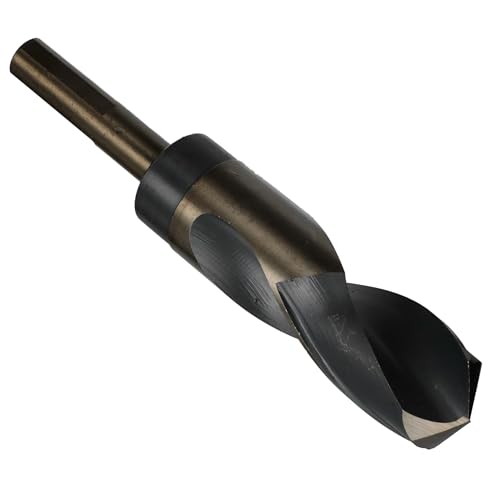
1. Drill America 1″ Reduced Shank Black & Gold Contractor Drill Bit
Our pick — 4.5★ from 550+ verified ratings; the strongest balance of quality and price.
The self-centering workhorse that bites on contact and refuses to walk.
The headline here is the tip. Drill America grinds a 135-degree split point onto this bit, and that geometry is why it earns its keep where a wider-angled tip would skate. The split point lets the edge bite the metal immediately instead of sliding across the surface, so you spend less time fighting the drill and more time making chips. A whole 14-degree difference separates this from the round-shank DWDRSD1 further down the list — a small-looking gap that changes the feel completely on slick steel.
For grip, the reduced 1/2-inch shank carries three ground flats. Those flats lock into the chuck jaws so a hand drill can’t spin the bit under load. In a drill press you barely notice, but on a cordless running steel it’s the difference between clean cutting and a scratched-up shank. The body is M1 high speed steel with a black-and-gold finish, by spec 2 flutes, and a 3-inch flute length inside a 6-inch overall length — a common geometry that needs minimal adjustment when you swap it between tools.
What the reviews show is a bit that performs when you feed it properly and disappoints when you push it past its limit. Owners running it through aluminum report it staying sharp, and one describes boring dowel holes that came out perfectly. But the same review pages carry a warning from someone who burned through three bits trying to force a half-inch pilot in sheet iron — that pattern points to speed and pressure, not the grind. Run it at low RPM with cutting oil and it cuts clean steel without dulling.
Where this bit earns its place
- 135-degree split point bites immediately and slots in 14 degrees tighter than the round-shank DWDRSD1
- 3-flat reduced shank locks the jaw so the bit resists spinning in a hand drill
- Arrives lightly oiled in a plastic case, sharp and ready — owners note the careful packaging
- M1 high speed steel with a black-and-gold finish, 2 flutes, 3-inch flute within a 6-inch overall length
What to keep in mind
- Wants low speed and oil; forced through steel it dulls fast, as more than one owner found out
- Sticky factory oil coating picks up debris until you wipe it down
- Sharpening the split point takes care — the thick web discourages do-it-yourself regrinds
Best for: the buyer who wants one versatile contractor bit that centers itself and holds a cordless chuck across steel, aluminum, and iron jobs.
Think twice if: you plan to run it hard and dry at high RPM — this bit wants the slower, oiled approach.
2. Drill America DWDRSD1 1″ Reduced Shank High Speed Steel Drill Bit
Thousands of chucks have held this round-shank bit — and it still shows up in the shop.
If you want the reduced-shank bit that a working shop is most likely to keep spare, this is the one — 4.3 stars across 5,000+ ratings is a lot of hands on the same tool. It’s the plainest spec sheet in the group: 1-inch cutting diameter, 1/2-inch round shank, 118-degree cutting angle, high speed steel with a black oxide finish. No cobalt, no exotic coating. What it does well is the simple stuff.
The black oxide treatment adds lubricity and creates small surface pockets that help hold coolant near the cutting edge — a small thing that pays off when you’re running a stubby pilot and want the bit to stay cool. The round shank pairs with a wide range of toolholding systems, and the 2-flute spiral pulls chips up and out to cut down on clogging. Owners running it through 1/2-inch steel plate describe it going through with no trouble at all.
The honest split is between the bit and how you run it. Cobalt-rated work in the harder steels is not this bit’s strength — the catalog lists it ideal for low and medium tensile strength materials, not hardened steel. Reviews back that up. Some report drilling 4 holes in roughly 1-inch cast iron Ford knuckles with consistent chips on low gear with lube, calling it good value. Others ran into a shank that bent under load, or dulling after the halfway mark. The pattern says: correct speeds and pressures keep this bit happy; hard steel and aggressive feeds do not. It’s a workhorse, not a finish bit.
Where it wins: A proven general-purpose cutter for mild steel, aluminum, and copper — the shank is round and pairs with most toolholding systems, and the black oxide pockets help hold coolant at the edge.
Where it asks more: Durability is the recurring knock; the shank bends and the tip dulls under hard-steel punishment. Match it to softer metals and it’s a fine everyday bit.
Reach for this: when you want the most-reviewed reduced-shank bit and your work is mild steel and aluminum with proper speed and lube.
Look elsewhere: if your job is hardened steel or production runs where the tip has to stay sharp hole after hole.
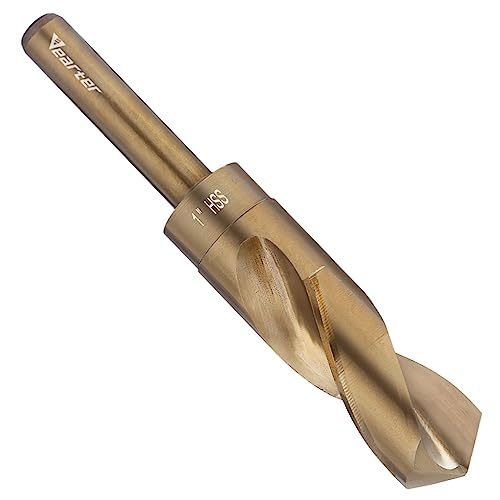
3. Vearter 1″ HSS M2 Twist Drill Bit with Round Shank
A do-it-all M2 bit that goes from cast iron to PVC without a fuss.
For a home shop that touches everything from steel to nylon, the material list is the selling point. Vearter cuts this bit from M2 high speed steel and speccs it for steel, copper, aluminum, brass, zinc alloy, cast iron, wood, PVC, ABS, nylon, and composites in one tool. It’s a 1-inch diameter in a 6-inch overall length with a 3-inch working length, and like the category’s best sellers it uses a 1/2-inch reduced shank so a standard portable drill can grab it.
The design choice that stands out is the parabolic flute — a deep, wide chip channel that pushes chips out fast and pulls heat away from the cut. Vearter pairs that with a 118-degree split point that keeps you from drilling a pilot hole first, and a tapered web that adds strength toward the base to cut down on breakage. The gold oxide finish is spec’d for corrosion resistance and reduced friction. It’s the second pick here to run the 118-degree angle, but the parabolic channel is what separates it from the plain-flute crowd.
Owner experience is genuinely split. The simple jobs go well — one buyer reamed out a bushing for a sway bar and reported it working fine, and a user drilling the thumb holes in a bowling ball said it matched the pro shop’s bit at a fraction of the cost. The other side of the coin is real too: the review page carries an account of a bit that failed to finish two holes in a metal plate that another bit had started. Owners note some frustration with sizing and fit. For light and mid-duty drilling this is a capable, versatile bit; for fast, high-volume metal removal, look at the cobalt picks below.
Sized and specced to do a lot
- M2 high speed steel specced for steel, copper, aluminum, brass, cast iron, wood, PVC, ABS, nylon, and composites
- Parabolic flute moves chips fast to reduce heat build-up
- 118-degree split point keeps the tip from wandering on slick metal
- 1/2-inch reduced shank fits most standard chucks for portable drilling
Where it can disappoint
- Cobalt and TiAlN picks beat it on stainless and hardened steel — this is a general-purpose bit
- Owners note occasional finishing inconsistency at the cutting edges
Suited to: the one-bit owner who drills wood, PVC, aluminum, and brass as often as mild steel and wants coverage over max steel performance.
Not the pick: if stainless or hardened plate is your normal diet — step up to a cobalt bit.
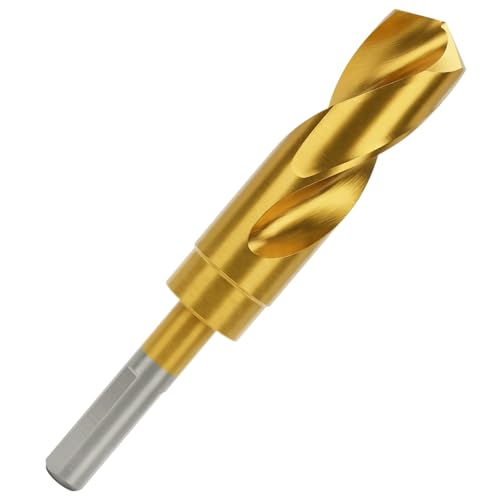
4. Greycore Tools 1″ Reduced Shank Drill Bit, 3-Flat Shank
The coating makes the difference — big holes in wood and metal without an early flame-out.
Greycore cuts this one from high speed steel and wraps it in an industrial titanium coating, a layer that adds heat resistance so the edge survives longer under heavy use. A 118-degree cutting head keeps the tip from wandering. The shank is a 1/2-inch 3-flat reduced design, so it plays nicely with most drill drivers and presses and won’t slip in the jaws. One bit, 6 inches overall, sized exactly as the listing says: 1 inch by 6 inches, reduced shank.
The review page skews short and happy. Buyers report these bits feeling as heavy and accurate as the expensive brand, with one drilling more than 50 holes in a pergola hardware enlargement and reporting it “still looks like new.” Another put it to work cleaning out the inside of 1-1/4-inch steel pipe so a 1-inch pipe would slip inside — a task that asks for straight run and clean bite, exactly what a stiff new bit offers.
The honest limit is at the hard end of the metal spectrum. The bit is specced for aluminum, metal, wood, and plastic — but the review page includes a note from a user who bent the shank while forcing it through hardened steel, and warns it is not for hard or stainless material. That is consistent with the coating spec: titanium is for heat and wear resistance on general metal, not for the extreme edge-holding of cobalt on stainless. For wood, aluminum, and mild steel, the titanium coating keeps the edge cutting longer. For hardened steel, look at the M35 cobalt picks.
Where the titanium earns its place: The coating delivers heat resistance on general metal and wood work, and the 3-flat shank grips a hand drill. Owners consistently report the bits to be as sturdy as premium brands in terms of weight and finish.
Where it wants to be spared: Hardened steel and stainless are not this bit’s terrain — the shank has been known to bend when pushed there. On wood, aluminum, and mild steel it drills clean holes without dulling early.
Reach for this: when your work is wood, aluminum, and light steel and you want the coated bit that holds up without frequent resharpening.
Skip if: the job is hardened or stainless steel — this bit’s coating does not target that.
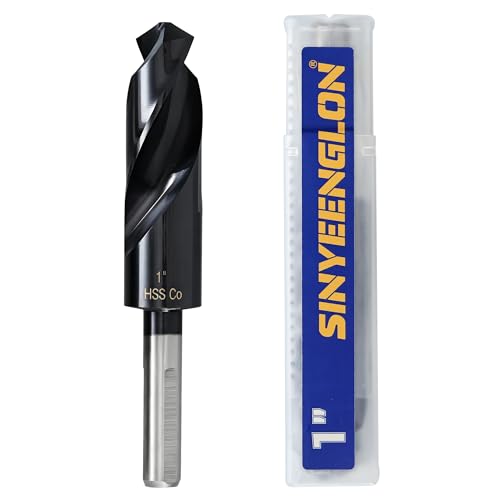
5. Sinyeenglon M35 Cobalt 1″ Reduced Shank Drill Bit with Case
Cobalt steel and a 135-degree tip aimed straight at stainless and thick plate.
The material is where this bit plants its flag. It’s M35 cobalt steel specced for stainless steel, cast iron, steel plate, copper, aluminum, titanium, and hardwood — the harder stuff a general high speed steel bit doesn’t love. The ALTiN coating resists high temperature and oxidation, which matters most when you’re cutting stainless and heat builds fast. Add a 135-degree split point that bites without a pilot hole, and the spec sheet reads like it was written for the buyer who keeps running into stainless.
The shank is a 1/2-inch tri-flat, which grips tighter than a round shank and is specced specifically for machining hard materials by hand or in a press. The bit ships in a plastic storage case with a size sticker, so drawer organization is solved out of the gate. Owners mention it making quick work of thick steel: one drilled four holes roughly two inches deep and reported it “still drilling great,” after reportedly going through five other bits trying to get a single hole done — a comment that says more than any spec.
The review page’s own honesty is worth noting. Mixed durability reports sit right next to the praise: a user noted the cutting edge chattered slightly and looked inconsistent in the press, and others have had bits chip when abused. The consensus is that it does what cobalt is supposed to do when you run it with oil at the correct speed — and punishes rushing. Run it on stainless and thick plate at low speed with oil and it holds its edge. Push it fast through mild steel and you’ll find its ceiling.
Where the cobalt shows up
- M35 cobalt steel specced for stainless steel, cast iron, thick plate, and titanium
- ALTiN coating resists high heat and oxidation to help extend bit life
- 135-degree split point bites without a pilot hole on most jobs
- Tri-flat shank grips tighter than round and takes a lighter bite in the chuck
- Ships in a plastic storage case with size sticker
What to know before buying
- Wants oil and slower speeds — rushing overheats the edge
- Stickers on some cases reportedly lift within a day; sizes are engraved in the case as backup
- Cutting-edge finish is not always uniform out of the packaging
Best for: the buyer whose routine work is stainless, cast iron, and thick structural steel and who wants cobalt durability for the price.
A reason to hesitate: if your daily drill target is wood and aluminum, a cheaper general-purpose bit will get you the same result for less.
6. VALYRIANTOOL 1″ M35 HSSCO Cobalt Reduced Shank Drill Bit
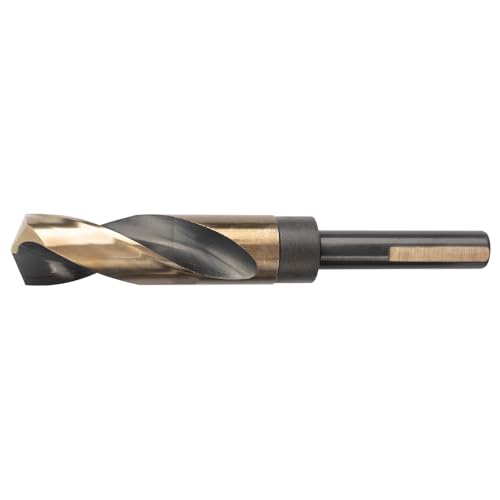
A cobalt bit that shines brightest when it’s mounted in a mag drill on structural steel.
Straight-shanked and cobalt-cored, this is the pick for buyers working heavy sections where a round shank in a mag drill or a sturdy press matters more than three flats. It’s M35 HSSCO cobalt steel with a black-and-gold polished finish that adds lubricity and creates small pockets to hold coolant at the cutting edge. The cutting angle is 135 degrees with a split point, the shank is straight, and the flutes number two.
Owner feedback shows it handling serious structural work. One user ran a bit in a mag drill to bore crane-boom pin holes through both sides of the boom and frame with zero problems reported, calling the fit of the replacement pin tight and perfect. The finish earns praise too — one describes it as looking machined well, with no chipping and an edge that held in a drill press. The mix of value and finish is what buyers tend to mention.
The honest edge-case: this bit wants to be run correctly. The review page carries a negative note about sharpening angles and wobble in a hand-held corded drill — a reminder that 1-inch bits in a hand drill demand steady feed and low speed. Get it into a drill press or a mag drill where the bit can be rigidly supported and this bit is fine. Run it loose in a one-hand attack on stainless and you’ll meet the ceiling fast.
The case for it: Black-and-gold polished M35 cobalt with a 135-degree split point, a straight shank that suits rigid toolholding, and owner reports of zero-issue work in hard, structural steel.
The catch: It is a rounder, less gripping shank than a 3-flat. Use it in a press or a mag drill where it can lock in; hand-held corded drilling is where users report the wobble.
Pick this if: your drilling happens in a drill press or mag drill and you want a cobalt bit that handles structural steel without complaint.
Spare it if: you work mostly outside on ladders with a cordless drill and no way to brace the tool — the shank prefers rigidity.
7. Miskamro 1″ M35 Cobalt Drill Bit, TiAlN Coated, HRC 72
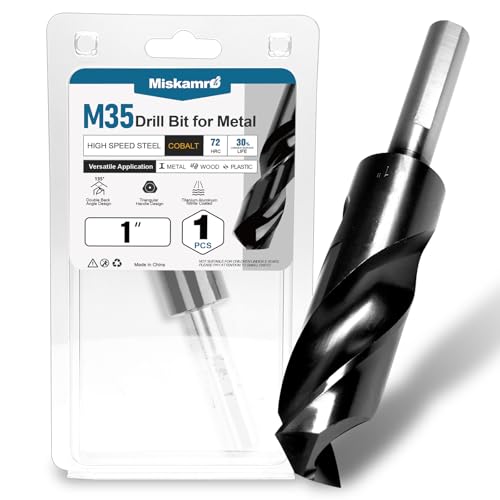
Hardness spec’d to HRC 72 — aimed at thick steel plate and heavy equipment work.
On paper this is the hardest bit in the group: M35 high speed steel with 5% cobalt, fully heat-treated to HRC 72 — a hardness number that speaks to edge retention and resistance to deforming under high torque. The TiAlN coating sits on top and is spec’d to withstand cutting temperatures up to 1000°C, so it holds its edge better than uncoated bits when drilling abrasive material like cast iron. The tip is a 135-degree split point that engages without center-punching, and the shank is a 1/2-inch 3-flat that grips in any chuck.
Miskamro builds this one as a hybrid — a 5% cobalt cutting tip welded to a 4241 high-speed steel shank, ground on automatic CNC equipment. The size is 1 inch across with a 6-inch total length and a 3-inch working length, specced for thick steel plate up to 1-inch thickness, bridge construction, and heavy equipment repair. Owners describe it ripping through sheet steel with the edge intact, cutting hardened trailer rails easily, and holding up well in general use.
The one real risk to know about is brittleness. The review page contains a report of two bits snapping while drilling 1/8-inch mild steel angle iron despite low pressure, cutting oil, and slow speed. That’s a small number against the strong majority reporting clean cuts, but it reflects the trade-off of a hard, heat-resistant cutter: it’s tougher to abuse without chipping than a softer bit. Run it with steady pressure and the right speed and this is a serious performer on tough steel. Force it and the hardness becomes a liability.
Built for the hardest jobs
- HRC 72 hardness — the highest spec in this group — for edge retention and deformation resistance
- TiAlN coating withstands cutting temperatures up to 1000°C
- 1/2-inch 3-flat shank grips securely in any drill chuck
- 135-degree split point engages immediately without center-punching
- Reusable storage box keeps the bit separate from other tools
What to weigh
- Hardness can mean brittleness — a small share of users have had bits snap under too-aggressive feeds
- Costs more than the general-purpose picks and its coating is overkill for wood and aluminum work
Best for: structural steel, heavy equipment repair, and thick plate work where the hardness spec gives you the edge retention you need.
Step back if: your work is mostly light steel and wood — the hardness of this bit is more than the job calls for and easier to chip than a softer tool.
8. ANGELSWORD 1″ Drill Bit for Metal, M35 Cobalt, TiAlN Coated
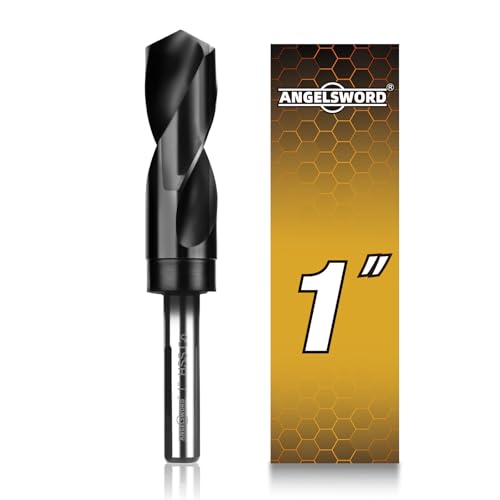
A cobalt bit sized for the small, fussy jobs where accuracy beats bulk.
ANGELSWORD plants this bit in the same ground as the other cobalts — M35 steel with 5% cobalt, TiAlN coating for heat and wear resistance, a 135-degree split point to prevent walking. Where its spec sheet gets specific is the guidance: the maker says this bit is for metal less than 0.1-inch thick, and recommends creating a pilot indentation, running low speed and high torque, and clamping a scrap piece of wood behind the sheet. That level of instruction tells you the bit targets light-gauge metal and a careful hand.
The shank is round, and the coating is spec’d for advanced heat and wear resistance across different conditions. The diameter is 1 inch, the length is standard 6-inch with a 3-inch working length, and the flutes are two. Owner feedback shows it doing small, exact jobs well: tapping a new oil hole in a chainsaw bar, working a full bushing ream, and clean cuts at slow speed and light pressure on slick metal without wandering. Several describe the coating holding up over repeated use with no flaking.
This is the latest of the picks and has the thinnest review record, so buyer beware of over-reading a small sample. Treat it as a precision instrument for thinner metal and specific one-off jobs, not a punch-through heavy-steel workhorse.
Where it earns its spot: A hard M35 cobalt with TiAlN coating and a 135-degree split point, plus a maker spec that says “thin metal, low speed, high torque” — the sheet metal and small-shop job where the guidance matters more than the wattage.
The honest note: It’s the least-reviewed bit in the group, so the story is still building. Owners on thin metal and light stock it does the job; heavy stock isn’t what it was made for.
Pick this if: your projects are light-gauge metal, thin plate, and one-off jobs where a careful M35 bit with heat resistance gets you the clean hole you need.
Look past it if: you’re punching through hardened structural steel — you want the higher-hardness bit above.
9. Meccion 1″ M35 Cobalt Reduced Shank Twist Drill Bit
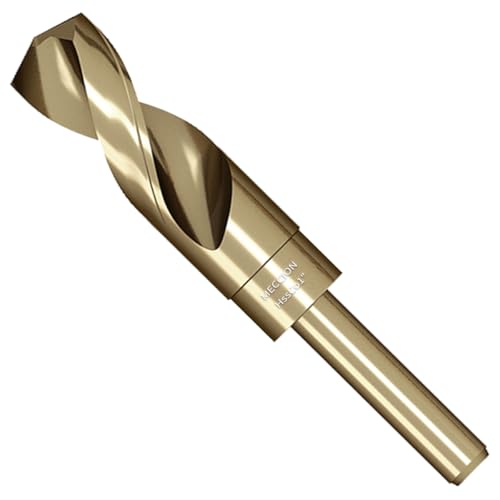
The cast-iron specialist — heat-treated cobalt that machines pipe caps and hard alloy cleanly.
Meccion makes this one out of 5% cobalt high speed steel, heat-treated to HRC 67 — a hardness spec aimed at high-temperature applications and extended cutting periods. The cutting tip is a 135-degree pilot point that reduces walking, and the shank is a straight round design for better concentricity. The helical flutes are tapered with a large spiral to move chips fast and keep the cut cool. Three flutes, one bit, 1-inch diameter in a 6-inch overall length.
Owner feedback is at its most enthusiastic on cast iron. One reviewer noted machining the threads off cast iron 1/2-inch pipe caps with a bench-top mill and remarked it “worked very well.” Others have drilled forged and hardened suspension components and reported the bit still sharp afterward, and a user who reamed a suspension bushing reported success too. The catalog guidance is worth noting: for a drill bit this large, the maker recommends pre-drilling a small pilot hole, and the bit is called out as a consumable that will dull after long use but can be resharpened.
The honest limit is the lighter end. Reviews note a few cases of the bit breaking in use, and one user who couldn’t touch 1/8-inch aluminum called it “seriously garbage” — a fair warning that this is a bit for hard, thick, alloyed stock, not the softest metal you might hand it. Run it on cast iron and steel, where its HRC 67 heat resistance keeps the edge cutting. Hand it soft aluminum and expect less.
The cobalt case
- 5% cobalt high speed steel heat-treated to HRC 67 for high-temperature cutting
- 135-degree pilot point reduces walking on hard surfaces
- Three-flute design with large spiral flutes moves chips out quickly
- Straight round shank for concentricity in a press or mill
Where to adjust
- Breakage reports exist — feed steadily and pre-drill a pilot for best results
- Not a soft-aluminum bit — the hardness spec is tuned for cast iron and steel
- Costs more than the general-purpose picks because cobalt and heat-treatment are priced in
Choose this: when cast iron, alloy, and hard machined parts are on your bench and you want a cobalt bit that keeps cutting long enough to matter.
Look past it if: your work is mostly aluminum and light sheet where a general high speed steel bit gets the same hole for less.
Understanding the Specs
Tip Angle and Point Style
The tip angle is the V-shape ground into the cutting end, and it decides how the bit behaves on contact. A 135-degree split point (a sharper V with a center notch) bites the metal right away and holds a line, which is why it’s the pick for hand-drilled steel. A 118-degree point is the older general-purpose grind — it still cuts clean, but it wants a pilot hole or a punch mark to keep from skating. Split point versus plain point matters for the same reason: the split gives the bit a built-in center that keeps it from wandering on slick stock.
Material, Hardness, and Coating
Plain high speed steel (HSS) handles mild steel, aluminum, and wood with ease. M35 cobalt — HSS blended with cobalt — is the upgrade that keeps its hardness when the cut gets hot, so it holds an edge in stainless and cast iron where a plain bit would soften. Hardness is graded on the Rockwell C scale (HRC): a higher HRC number means the bit resists wear better, but also chips more readily if you force it, which is the trade-off you’re buying into. A coating like TiAlN (a hard, heat-resistant layer) sits on top of the steel to shed heat and extend bit life even further.
FAQ
What is the difference between a 135-degree and a 118-degree drill bit point?
Will a 1-inch drill bit fit my drill?
Is a cobalt drill bit better than a regular high speed steel bit?
What speed should I run a 1-inch drill bit at?
Should I drill a pilot hole before using a 1-inch bit?
Why does my metal drill bit keep walking across the surface?
Can I sharpen a 1-inch cobalt drill bit at home?
Will one of these bits drill through stainless steel?
What does HRC mean on a drill bit spec sheet?
Is a 3-flat shank better than a round shank?
Final Thoughts: The Verdict
The winner here, and the safest pick for most buyers, is the Drill America KFD3F Black & Gold Contractor Bit — a 135-degree split point that self-centers, a 1/2-inch 3-flat shank that locks a cordless chuck, and an M1 high speed steel body that arrives sharp and ready. It won’t fight you on the metal you actually drill. If your diet is stainless and thick plate, the Sinyeenglon M35 Cobalt earns a spot in the drawer for its cobalt edge and ALTiN coating. For cast iron and hardened machine parts, the Meccion M35 Cobalt is the pick to reach for. Match the bit to your metal, run it slow with oil, and any of these will outlast a cheap bit by many holes.
How We Picked
We do not accept paid placement. Every pick is matched to a real buyer and a real use-case; we do not hands-on test units.
Sources & Methodology
Specifications: manufacturer listings and product documentation. Review insights: verified customer reviews, as of September 2026. Pricing: not shown on this page (it changes often); check the current price via the retailer link.
As an Amazon Associate, KitchPrep earns from qualifying purchases. This does not affect which products we feature.
Related Guides
