
Specs are compiled from manufacturer listings and verified buyer reviews and can change over time — please confirm the key details on the product page before buying.
Before you buy a 1-inch drill bit, you need to know one thing: wood bits, tile bits, and metal bits are different tools. A spade bit that chews through a stump will shatter on porcelain. A diamond core bit that slices granite won’t touch steel. This guide matches each pick to the exact material it was built for, so you buy the right one the first time. Note that this list uses flexible matching for the 1-inch size — some picks are exact, others are the nearest same-type size serving the same purpose.
I’m Mohammad Maruf — the founder and writer behind KitchPrep. This guide is built by comparing the manufacturers’ published specifications and the patterns across verified customer reviews, so you get each pick’s real strengths and trade-offs instead of marketing spin.
Whatever surface you are drilling — timber framing, ceramic tile, or hardened steel — the best 1-inch drill bit is the one whose steel, cutting geometry, and shank match your drill and job.
Our Picks at a Glance

How To Choose The Best 1-Inch Drill Bit
Your workpiece material dictates the bit type you need. Using a wood auger on concrete or a twist drill on tile risks breakage and wasted effort. Pick the bit family for your material first, then consider brand and length.
What are you actually drilling?
Wood is the easiest surface to drill. Spade bits, augers, and Forstner bits all handle it, but they differ in hole quality and depth. Metal demands high-speed steel or cobalt with a split point to stay centered. Tile, stone, and concrete need diamond or carbide edges that grind rather than cut.
Will it fit your drill?
The shank — the end that goes into the drill — must match your chuck. Standard chucks grip round or hex shanks up to 3/8-inch. Bigger reduced shanks like 1/2-inch fit some drills and not others. SDS-Plus shanks only work in rotary hammers. Verify shank compatibility with your drill before purchasing.
Quick Comparison
| Model | Best For | Material Type | Flutes | Shank Type | Amazon |
|---|---|---|---|---|---|
| Freud PB-007 Forstner★ Best Overall | Smooth flat-bottom holes in wood | Wood | 3 | 3/8″ Round | Amazon |
| IVY Classic Spade BitLong Reach Value | Long reach through thick wood | High-Carbon Steel | 2 | 1/4″ Hex | Amazon |
| Greycore 3-Flute AugerBest 3-Flute Auger | Deep holes in hard & soft wood | High Speed Steel | 3 | 1/4″ Hex | Amazon |
| DKIBBITH Diamond Core | Porcelain, granite, concrete with grinder | Diamond | N/A | 5/8-11 Thread | Amazon |
| DECKRKAT Diamond Hole-Saw | Tile & glass with pilot bit | Tungsten Carbide | N/A | 3/8″ Triangle | Amazon |
| Drill America Twist Bit | Steel and iron with 1/2″ reduced shank | M1 High Speed Steel | 2 | 3-Flat 1/2″ | Amazon |
| Meccion Cobalt Twist Bit | Stainless & cast iron | Cobalt High Speed Steel | 3 | Round | Amazon |
| DEWALT DW1687 Ship Auger | Stumps and nail-embedded wood | Alloy Steel | 3 | 7/16″ Ball Groove | Amazon |
| Sabre Tools SDS-Plus Bit | Long holes through concrete & brick | Carbide Tipped | 2 | SDS-Plus | Amazon |
In-Depth Reviews
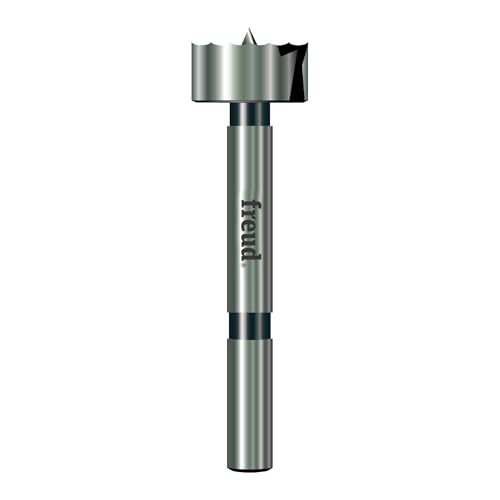
1. Freud PB-007 1″ Forstner Bit
Our pick — over 4.5★ from 450+ verified ratings; the strongest balance of quality and price.
The Forstner that turns tear-out into glass-smooth, flat-bottomed holes for furniture-grade work.
If you want the cleanest possible 1-inch hole in wood — the kind you’d leave visible — this is the bit. Its razor-sharp serrated edge and steep angled cutting edges shear the wood fibers instead of scraping them. That geometry is why owners describe the sides of the cut as “smooth as glass,” and why it earns the top spot for precision work.
It holds a 3/8-inch shank and reaches down 3-1/2 inches, which is plenty for hinge mortises and dowel work. This is also the pick where buyers report cutting through tough materials like a dream — one owner was thrilled drilling a 1″ hole through 0.5″ thick rubber in under a minute. Another project involved 56 holes in a row, all consistently 1 inch, with no dulling.
The thing everyone raves about is the cutting performance — over four dozen owners single it out, and quality praise runs nearly as high. Success in cutting clean, accurate holes is the defining theme across its reviews. On the downside, it doesn’t come in a hard case, so you’ll want to store it carefully. It is also a bit more expensive than basic spade bits, yet the consensus is that the price buys you holes that need zero sanding.
Unlike the Greycore auger’s 12-inch reach for deep boring, this Forstner is about shallow, precise, beautiful holes. It delivers on that promise without wandering, a complaint that plagues lesser Forstner bits.
Why it wins the top spot
- Razor-sharp serrated edge cuts clean, flat holes
- Ultra-sharp spur gives you an accurate starting hole
- Freud backs it with a limited lifetime guarantee
Who should look elsewhere
- No included hard case, so you’ll need your own storage
- Shallow 3-1/2″ depth won’t reach for deep framing work
- Overkill for rough construction holes where a spade works fine
Your best bet if: You build furniture, cabinets, or anything where hole quality and flat-bottomed precision matter more than raw speed.
Think twice if: You only need rough holes in framing lumber — cheaper spade bits handle that.
2. IVY Classic 10750 Swift Bore Spade Bit
A budget 1-inch spade bit with an extra-long 16-inch shaft for reaching through thick timbers.
Need to push a 1-inch hole deep into framing, or run cable through places your drill can’t go? This high-carbon steel spade bit stretches 16 inches — a full 4 inches longer than the Greycore auger’s 12-inch reach — letting you get into tight spaces where a cordless drill body won’t fit. The 1/4-inch hex shank locks into impact drivers without slipping.
You get a budget-friendly bit that handles softer woods, plywood, and occasional deep drilling well, but it won’t survive extreme conditions. One owner drilled railroad ties and reported the bit “lasted thru 10 railroad ties after which I had better luck using a butter knife.” That’s a vivid way of saying this is a value tool, not an indestructible one. If you’re tackling a massive hardwood project, buy two—you’ll still spend less than one premium auger.
What wins people over is its functionality — it simply does the job for the price. Also praised for being a quality product with a sharp tip, this bit handles the top end of what you’d expect. It’s perfect for a one-time job where a premium bit is overkill.
The long reach advantage
- 16-inch overall length reaches deep into walls and timbers
- 1/4″ hex shank fits standard impact drivers
- Low price makes it disposable for tough single jobs
Know the limits
- Double-fluted design can bend on very hard woods
- Electronically heat-treated but not built for marathon sessions
Reach for it when: You need deep holes in softwood, or you’re doing a one-time plumbing or electrical run.
Look elsewhere if: Your project involves dense hardwoods like railroad ties or oak — grab the sharper auger below.
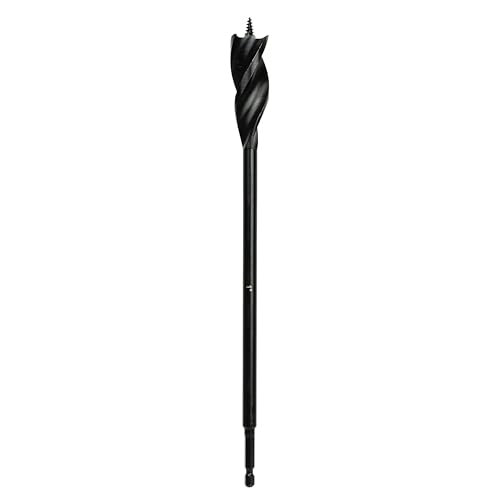
3. Greycore Tools 1″ x 12″ 3-Flute Auger Bit
A high-speed-steel auger with a screw point that pulls itself through deep wood easily.
For boring deep, clean holes in wood, this auger’s design does the heavy lifting. Made from high-speed steel (HSS) with razor-sharp cutting teeth, it stays sharp for long stretches between sharpenings. The 1/4-inch hex shank fits most impact drivers and standard chucks, making it versatile across your tool collection.
The standout story here is a buyer who needed to bore a hole down the center of two palm tree stumps. The bit “went through them like a hot knife through butter,” perfectly handling a brutal task. That screw-point tip — designed to pull the bit into the wood — is what makes deep boring feel nearly easy. It’s rated for hardwood, softwood, plywood, MDF, and plastics.
One honest caution: because it’s so aggressive, you need a powerful drill. One owner found their cordless Bosch lacked the torque and had to modify the screw point’s thread. The praise focuses on its quality, sharpness, and durability, calling it a great drill bit for light-duty work through 6-inch landscape timbers.
The deep-bore specialist
- 3-flute design clears chips fast, preventing clogging
- Screw point self-feeds for easy deep holes
- HSS steel holds an edge for many projects
What to watch for
- Demands a high-torque drill — cordless models may struggle
- Flute sharpness is concentrated at the tip for lighter work
Built for: Deep holes in timbers, stumps, and thick lumber where chip clearance is the challenge.
Not for: Low-powered drills—pair it with a corded drill or a sturdy impact driver to get enough torque.
4. DKIBBITH 1″ Diamond Core Bit
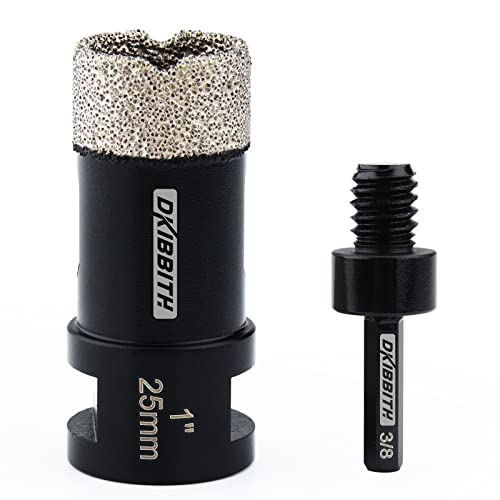
The go-to for clean holes in porcelain, granite, and concrete when mounted on an angle grinder.
Drilling tile for a faucet or shower arm? A standard bit shatters the surface, but this diamond core bit grinds through instead, handling porcelain, ceramic, granite, marble, brick, and concrete. It connects to most angle grinders via a 5/8-11 thread, and the included arbor adapts it to a 3/8-inch hex drill shank for electric drills. That flexibility makes it among the most useful masonry bits you can own.
It shines brightest in tough materials — owners mention cutting through solid granite and quartz sinks with excellent results. They also appreciate how it doesn’t walk or travel when you start the hole, a common frustration with lesser bits. Works both dry and wet; using water and a vacuum for dry drilling keeps the diamonds cool and the edges sharp.
What wins people over is its functionality, earning the most praise by far. The quality also impresses, even at a mid-range price. While some mention durability as a mixed point, the consensus is that it’s a great value that performs well above its price tag.
Why it’s a versatile must-have
- Cuts the hardest tile and stone materials with ease
- Works with both angle grinders and drills via adapter
- Diamond edge stays sharp longer than masonry alternatives
The learning curve
- Best started at a 45-degree angle to prevent walking
- Needs cooling breaks or water for longevity on long cuts
Grab this if: You’re installing faucets, fixtures, or running lines through tile or concrete.
Pass it up if: You only drill wood — the Freud above is better suited to that.
5. DECKRKAT 1″ Diamond Hole-Saw (2-Pack)
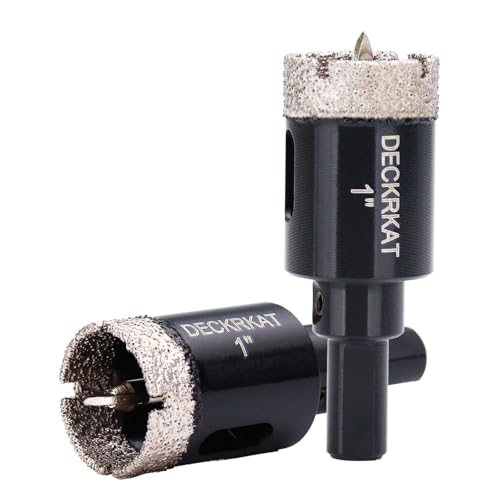
A two-pack with a guiding pilot bit for precise starts on tile, glass, and granite.
Precision starts are the name of the game with this set. Each 1″ diamond-tipped hole saw comes with a centrally placed pilot bit that locks your position before the main diamond edge engages. This prevents the bit from skating across smooth porcelain or glass — the #1 cause of cracked tile. You get two complete saws in the pack, a spare for when the job runs long.
The diamond-tipped edge cuts wet or dry and is built for a 3/8″ triangle shank that grips better in your drill chuck than a smooth round one. It handles ceramic, porcelain tile, granite, stone, glass bottles, and concrete countertops. Customers note cutting through glass “perfectly” and through concrete pavers for well lights with great success. Impressively, one owner cut 4 holes in 1.5-inch granite for a sink using both saws efficiently.
There’s a real technique involved: start with the pilot, then remove it and use a wobbling motion to clear debris. An occasional owner notes the saw can flex on very thick stone or that the depth can feel shallow, but the diamond coating stays intact.
The precision advantage
- Pilot bit prevents dangerous walking on glass or tile
- Comes with a spare 1″ saw in the box
- Works with or without water cooling
Keep in mind
- Requires a steady hand and wobble technique for best results
- 3/8″ triangle shank needs a suitably sized drill chuck
Choose this for: Precise, clean holes in tile, glass, and granite where pilot-guided starts save your material.
Skip this if: You need one-off rough holes in concrete where an SDS hammer bit is faster.
6. Drill America 1″ Reduced Shank Twist Bit
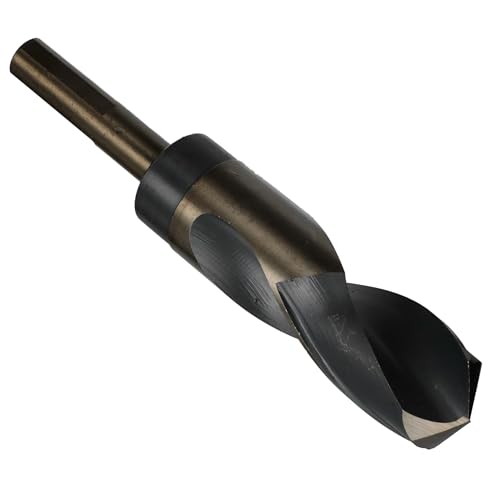
A contractor-grade twist bit that self-centers on steel so you don’t have to wrestle it.
Drilling a 1-inch hole in metal is hard work, but this bit’s design makes it controllable. Its stand-out feature is a 135-degree split point tip, which self-centers on contact. Unlike a flat 118-degree tip, this special grind won’t “walk” or skate across the steel surface when you start. The 1/2″ reduced shank — flattened on three sides — gives your drill chuck an extra-secure grip, preventing the bit from spinning under heavy load.
Manufactured from M1 high-speed steel, it’s built for the iron and steel family: aluminum, iron, and other metals. That 6″ overall length with a 3″ flute length works in tight spaces without constant tool changes. Owners arrive impressed with its build quality, noting it’s well-made and arrives sharp, ready to cut.
There’s a slight learning curve — the oil-based coating it ships with is sticky. Some owners note it holds onto metal debris while drilling, so clean the flutes regularly. While opinions on long-term durability vary, the consensus is that it’s a surprisingly tough bit for the value it delivers, with many noting it handles the job.
The metal-drilling workhorse
- 135° split point self-centers to prevent wandering
- 3-flat 1/2″ shank gives a secure grip in your chuck
- M1 HSS steel handles aluminum, iron, and steel
The honest trade-off
- Ships with a sticky oil coating that grabs debris
- Make sure your drill accepts a 1/2″ shank
Built for: Metalworkers who need a clean, centered hole in steel or iron with a standard drill.
Not ideal if: You’re drilling wood or masonry — this is a dedicated metal bit.
7. Meccion Cobalt Reduced Shank Drill Bit (M35)
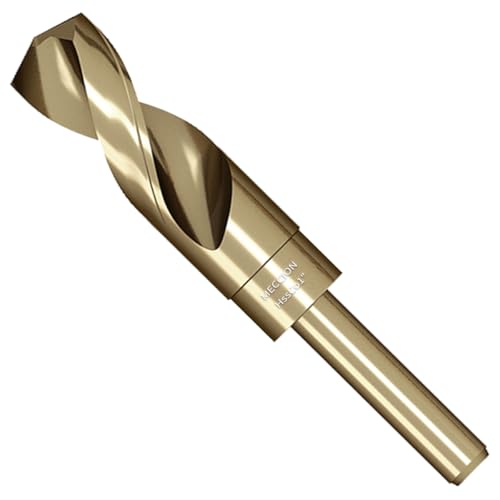
High-cobalt steel made for the toughest stainless and cast-iron drilling jobs.
Some metals eat ordinary drill bits for breakfast. This one is formulated to fight back. Its 5% cobalt M35 steel (HRC 67) resists heat for sustained drilling in stainless steel, cast iron, and hard alloys. The 135-degree pilot point tip reduces walking for a precise start.
The 3-flute spiral design helps export metal chips efficiently, keeping the flutes clear for faster progress. Because this is a large-diameter bit, the maker recommends you pre-drill a small pilot hole first — that’s standard practice for a 1-inch twist bit in metal. Owner experiences run the gamut; satisfied users report drilling through hardened suspension components and machining cast-iron pipe caps with excellent results, with the bit staying sharp. One does note a single failure through thin aluminum, which serves as a reminder that technique and correct speeds matter with dense metal.
This is a specialist’s tool for demanding materials. The reviews emphasize that the bit cannot simply muscle its way through without proper feed pressure.
The tough-metal specialist
- 5% cobalt steel (M35) handles stainless steel and cast iron
- 135° pilot point prevents walking on hard surfaces
- Large spiral flutes clear metal chips rapidly
Handle with care
- Always pre-drill a small pilot hole for best results
- Consumable by nature — needs sharpening after heavy use
Your pick if: You routinely drill into stainless, cast iron, or hardened alloys where cobalt’s heat resistance is essential.
Overkill if: Your jobs are all in soft steel or wood — the Drill America is a better value there.
8. DEWALT DW1687 Ship Auger Bit
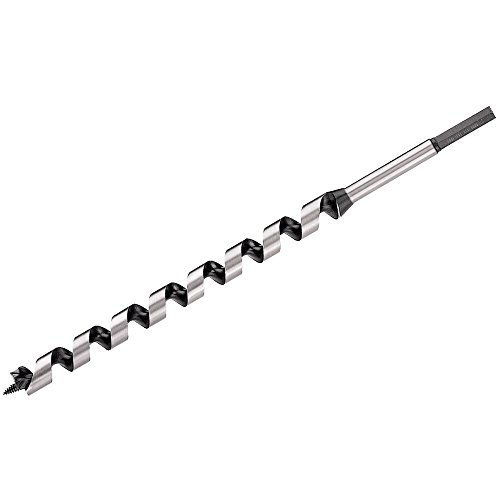
A 17-inch self-feeding behemoth that rips through stumps and nail-embedded wood.
For brutal jobs—grinding out a tree stump, boring through old treated timber, or drilling down through dirt and roots—this DEWALT auger is the one people call “a beast.” Its self-feed spur (a screw tip that pulls the bit into the material) removes the need to push hard. It’s also built to shrug off nails embedded in the wood, which would immediately destroy lesser bits.
At 17 inches, it’s the longest wood bit on this list, dwarfing the IVY Classic at 16 inches. This reach is essential for stump removal, allowing your drill to torque its way down to depths that shorter bits can’t manage. The hardened alloy steel construction extends bit life, while the 3-flute spiral design pulls wood chips out of the hole efficiently, preventing binding. The 7/16″ ball groove shank fits standard quick-change chucks.
Because it self-feeds so aggressively, reviewers emphasize you need a powerful drill with a side handle — it can twist your wrist if you’re not braced. The consensus is that it stays sharp through massive amounts of wood, with one owner drilling dozens of full-depth holes through clay and mud. The screw tip is the most vulnerable point; keeping it sharp and maintaining feed pressure protects it.
The heavy lifter
- Self-feed spur pulls the bit through thick material
- Hardened alloy steel resists nails and dirty wood
- 17-inch length is ideal for stump work
Respect the power
- Demands a high-torque drill with side handle
- Screw tip can snap if you let it dull in wet wood
Reach for this when: You face stumps, thick beams, or old nail-laden lumber that would dull other bits fast.
Avoid if: You’re drilling neat finish holes — the Freud Forstner is far cleaner.
9. Sabre Tools 1″ x 39″ SDS Plus Masonry Bit

A 39-inch SDS-Plus bit built to punch clean holes through the deepest concrete.
This is the bit for the job no wood or metal tool can touch: long holes through concrete, masonry, brick, or stone. Its stand-out spec is the massive 39-inch working length, letting you drill clean through thick foundations or walls in a single pass. It’s compatible with any SDS-Plus rotary hammer, regardless of brand, so it works with the tool you already own.
The 2-flute spiral design with a self-centering carbide tip clears concrete dust efficiently, keeping the bit cool and cutting fast even on deep holes. One owner drove it through an 18-inch thick cinder block wall in about 5 minutes with a rotary hammer, enabling a Starlink cable pass-through — proof of its speed and effectiveness. Others report it enduring tough conditions like hard soil and concrete for numerous ground rod holes without showing wear.
This bit wins on functionality and quality—it simply performs where you need it. Its lengthy size is a praised advantage, and it’s durable enough for demanding projects, holding up with consistent use. Reviewers repeatedly advise: drill steadily with sufficient pressure to get the best results.
The concrete penetrator
- 39-inch length drills through walls and foundations
- Self-centering carbide tip prevents wandering
- Works with all SDS-Plus rotary hammers
What you’ll need
- Requires an SDS-Plus rotary hammer — regular drills won’t fit
- Heavy-duty use may call for an SDS-Max hammer
The tool to grab when: You’re running cables or pipes through thick concrete or masonry walls.
Not for: Anyone without a rotary hammer in their kit.
Understanding the Specs
Shank Types and Chuck Fit
The shank is the end you clamp in the drill. Round shanks are for standard chucks. Hex shanks (like 1/4″) lock into impact drivers without slipping. Reduced shanks (like 1/2″) give a very secure grip in bigger drills. SDS-Plus is a special system that clicks into rotary hammers, not regular drills. Choosing the wrong shank means the bit simply won’t fit your tool.
Number of Flutes
Flutes are the spiral grooves that pull debris out of the hole. A bit with 3 flutes (like the Greycore or DEWALT) clears chips faster and reduces clogging on deep cuts, letting you drill quicker with a cleaner result. A 2-flute bit is more common and perfectly fine for shorter, shallower holes. More doesn’t always mean better — it means faster chip removal in deep bores.
Point Angle and Self-Centering
The tip’s geometry controls how the bit starts. A 118-degree point is standard. A 135-degree split point or pilot point (found on the metal bits here) is self-centering — it bites immediately and won’t “walk” or skate across a smooth steel surface. For metal work, this is the difference between a clean hole and a scratched-up mess.
Steel and Coating Materials
The base metal determines what you can cut. High-carbon steel suits softer woods. High-speed steel (HSS) handles wood and softer metals. Cobalt steel (M35) adds heat resistance for stainless and cast iron. Carbide tips grind through concrete and tile. Diamond edges are for the hardest stone surfaces. Match the material to your workpiece.
Buyer FAQ
Can I use a 1-inch wood bit on metal or tile?
What does the number of flutes do for my drilling?
Will a 1/4-inch hex shank bit fit my standard drill?
Why do I need a pilot hole for a large metal drill bit?
How does a Forstner bit differ from an auger or spade bit?
Can a diamond core bit work on both porcelain and concrete?
How long should a wood drill bit stay sharp?
Do I need a rotary hammer for an SDS-Plus bit like the Sabre Tools?
Final Thoughts: The Verdict
A 1-inch drill bit ends the guesswork by matching the right tool to your material. If you’re building or finishing wood, the Freud PB-007 Forstner is the clear winner — the crowd favorite, with a stellar reputation among owners for flawless, flat-bottomed holes. For running cables or deep timber boring, grab the affordable IVY Classic spade for value or the DEWALT ship auger when the wood gets brutal. And when your surface is porcelain or concrete, reach for the DKIBBITH diamond core instead of ruining a wood bit. Match the bit to the material, and the 1-inch hole becomes routine.
How We Picked
We do not accept paid placement. Every pick is matched to a real buyer and a real use-case; we do not hands-on test units.
Sources & Methodology
Specifications: manufacturer listings and product documentation. Review insights: verified customer reviews, as of September 2026. Pricing: not shown on this page (it changes often); check the current price via the retailer link.
As an Amazon Associate, KitchPrep earns from qualifying purchases. This does not affect which products we feature.
Related Guides
