
Specs are compiled from manufacturer listings and verified buyer reviews and can change over time — please confirm the key details on the product page before buying.
You need a quick burst of air for a brad nailer, a tire top-up, or a dust blow-off without hauling a 60-pound floor unit out of the corner. A 1-gallon air compressor delivers that convenience, but the one worth your bench space refills fastest and stays quiet enough for indoor use. The deciding factor is a single number: how much air it delivers, measured in CFM at 90 PSI, and how quickly the small tank recovers after you use it.
I’m Mohammad Maruf — the founder and writer behind KitchPrep. This guide is built by comparing the manufacturers’ published specifications and the patterns across verified customer reviews, so you get each pick’s real strengths and trade-offs instead of marketing spin.
For the best 1 gallon air compressor to handle tires, nailers, and shop blow-off tasks without an ear-splitting racket, the quietest and quickest refilling options rise straight to the top.
Our Picks at a Glance

How To Choose The Best 1 Gallon Air Compressor
Small tanks all look similar on the shelf, but the differences in motor quality, noise, and air delivery separate a handy bench tool from a frustrating one. Focus on these four points before you buy.
Match the CFM to the tools you actually own
CFM (cubic feet per minute) at 90 PSI tells you how much air the pump can push while the tank is doing real work. A finish nailer sips air and works on almost any small unit, while a die grinder or spray gun drinks it down and will starve on a 1-gallon tank. If you stick to brad nailers, tire inflators, and blow guns, a low-CFM unit is fine — just know its limits.
Ask how fast the tank refills
With only a single gallon of storage, the pump kicks on constantly during use. Recovery time — the seconds it takes to climb back to full pressure — decides whether you wait between nail gun bursts or keep working. A quick-refill pump keeps the momentum going; a slow one turns every job into a patience test.
Read the decibel number, not the marketing
Noise is measured in decibels (dB), and the difference between a 60 dB unit and an 81 dB unit is huge in practice. Every 10 dB increase sounds about twice as loud to your ears, so a 60 dB compressor is a quiet hum while an 81 dB one is a loud roar. If you work in a garage near an open door or share a shop, pick a model rated below 65 dB to keep conversations and your hearing intact.
Quick Comparison
| Model | Best For | Tank Size | Air Delivery (CFM @ 90 PSI) | Noise Level | Amazon |
|---|---|---|---|---|---|
| VEVOR 2 Gallon★ Best Overall | Heavy DIY bursts with tools | 2 gallons | 2.1 cfm | 81 dB | Amazon |
| Greteefor 1 GallonFastest Refill | Fast-fill quiet indoor work | 1 gallon | 4 cfm | 60 dB | Amazon |
| RYOBI ONE+ P739 | Cordless tire inflation on the go | 1 gallon | 0.5 cfm | Battery Powered | Amazon |
| Stealth SAUQ-1105 | Whisper-quiet small shop duty | 1 gallon | 1 cfm | Under 60 dB | Amazon |
| Metabo HPT EC28M | Professional trim nailing | 1 gallon | — | 59 dB | Amazon |
| VIAIR 10000 | On-board vehicle air systems | 1 gallon | 1.53 cfm | Hard-mount design | Amazon |
In‑Depth Reviews
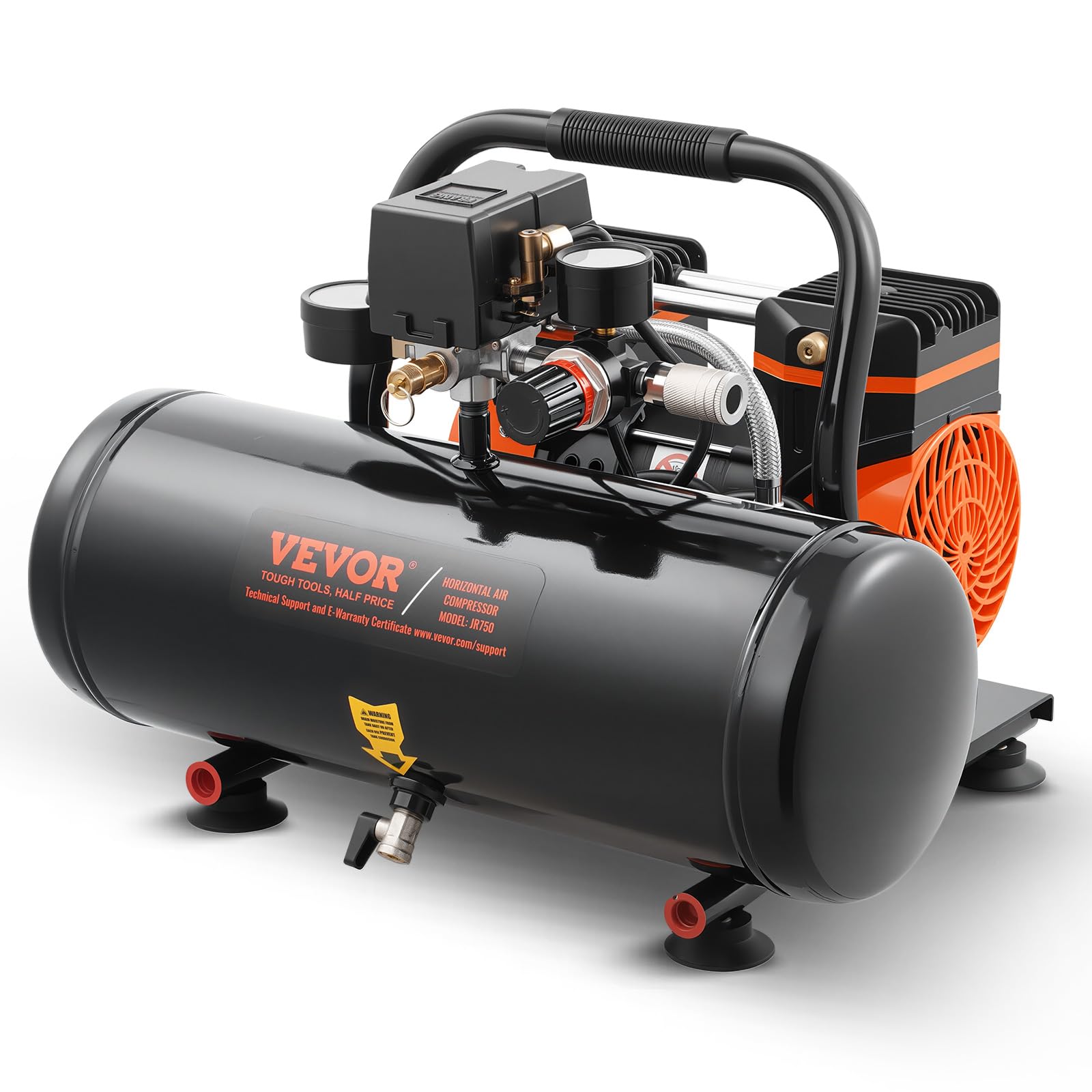
1. VEVOR 2 Gallon Steel Tank Air Compressor
Our pick — 4.5★ from 450+ verified ratings; the strongest balance of quality and price.
The bigger tank that still sits on a bench, with the airflow to back a real tool.
You get a serious jump in usable air here without graduating to a floor-standing monster. The 2-gallon steel tank holds twice the reserve of the Greteefor unit below, and the oil-free 1 HP motor pushes an honest 2.1 CFM at 90 PSI up to a 120 PSI ceiling. That output means it can keep up with a nail gun, a spray gun, or an impact wrench on light duty — tasks that strand a true 1-gallon unit.
The trade-off for that power is a 33.1-pound weight and an 81 dB noise level, so it is not the unit you run at midnight next to a sleeping house. Buyers report it excels at blowing out sprinklers and woodworking, and a garage owner swears by it for blasting water out of a freshly washed car.
Setup demands a little patience: the included power cord is short at 3 feet, and the manual does not clearly explain the filter, regulator, or gauge hookups. Plan for Teflon tape and a separate wrench, and it is ready to work.
Why it wins the bench spot
- Double the tank of a 1-gallon unit for longer run times between refills
- 2.1 CFM output handles real tools, not just inflators
- 3-layer rust-resistant steel shell built to survive a garage
Know the limits
- 33.1 pounds makes it the heaviest pick here to haul around
- 81 dB is noticeably louder than the quiet 60 dB class
- Short 3-foot cord plus thin manual slow down first setup
Reach for this if: your projects mix nailing, spraying, and inflation and you want one small unit that does all three without gasping.
Look elsewhere if: you need a whisper-quiet unit for indoor use where neighbors or sleeping kids are close by.
2. Greteefor 1 Gallon Ultra Quiet Air Compressor
A 13-second charge and a 60 dB hum that lets you work while others talk.
This is the pick for anyone who wants the noise problem solved outright. The Greteefor’s 4-Pole motor runs at just 60 dB, quiet enough for indoor workshops, and it claims a 13-second fill from empty plus a 4-second recovery back to 120 PSI. On the spec sheet it delivers up to 4 CFM at 90 PSI from a 1.5 HP peak motor — the strongest airflow figure in this lineup.
What wins people over is the size — with over 30 owners calling it out as the standout trait — followed closely by the noise level. It weighs 23.7 pounds, and a 6.6-foot power cord beats the VEVOR’s stubby 3-footer for reach. Owners mention it runs pin nailers, trim guns, and even a framing nailer without complaint, as long as you are not doing high-production work all day. A solid Q235B steel tank and four layers of protection, including a safety valve and overload guard, back the build.
Here is the honest catch: durability feedback is mixed. A few customers note the unit stopping on its own after a few months of heavy weekly use, and one mentioned rust forming inside the tank in a humid climate despite daily draining. For light shop and trim duty it shines; for daily commercial hammering, the long-term record is less certain.
Why it earns its spot: the fastest refill and quietest operation in this group make it the easiest small compressor to live with indoors. The durability question is the only reason it does not take the top crown.
3. RYOBI ONE+ P739 1 Gallon Air Compressor

The go-anywhere inflator that ditches the wall outlet and rides in your trunk.
No extension cord, no wall hunt — this RYOBI runs on the same 18V ONE+ batteries as the rest of your RYOBI tools, which makes it the most portable machine in this roundup. It hits a 120 PSI maximum and comes with a 15-foot hose, so you can reach all four tires without moving the unit. Buyers keep it in the car for road trips and call it genuinely useful for topping off tires on cars, ATVs, and bikes.
The performance data tells the real story: at just 0.5 CFM at 90 PSI, it delivers far less sustained air than the Greteefor’s 4 CFM — a gap so wide it is really a different tool category. Owners describe it as fast for inflation, reaching 120 PSI in about a minute, and note it can add 3-5 PSI to four mid-size car tires on roughly half a 4Ah battery charge. It is genuinely quiet and precise with pressure.
Know the limits before you buy. The small tank bleeds pressure after about 30 seconds of full-flow air blast, so it is an inflator and blow-off tool, not a nail-gun workhorse. The battery drains quickly, so an extra pack is worth keeping charged. There is no hybrid option to plug it into 110V when the battery dies.
Best in the driveway: nothing here matches its freedom from the wall for tire duty. The airflow is simply too low for continuous tool work — treat it as a super-powered inflator with bonus blow-off ability.
4. Stealth SAUQ-1105 1 Gallon Air Compressor

A 26-pound machine that runs below 60 dB and carries a lifetime warranty.
Stealth engineered this one for the workshop owner who treats noise like a real problem. The pump runs under 60 decibels — owners measure it near 32 dB above ambient, quieter than the 87 dB pancake units they replaced — and it starts on just 2.8 amps, which makes cold-weather starts far easier. The motor uses advanced technology the maker says saves up to 30% energy over traditional compressors.
The build quality is where the premium price shows. A Q235B steel tank, rubber feet, a cord wrap, and a Limited Lifetime Warranty card in the box signal a unit built to stay. Reviewers point out it handles 100 PSI rivet work back-to-back, recovers quickly, and keeps up with brad nailers and staplers for small shop projects. It is compact enough to tuck away and light enough to carry one-handed.
The honest trade-off is the price tag for the size — several owners note it is pricey for a 1-gallon unit — and the airflow tops out at 1 CFM, so it is not for heavy continuous demand. A muffler can unthread during handling, fixable with thread tape. If the job is light trim, tires, and dusting, this is a quiet, well-made partner.
The quiet performer
- Genuinely near-silent operation for indoor and late-night work
- Lifetime warranty signals long-term confidence
- Fast pressure recovery keeps rivet and staple work moving
The premium cost
- Highest price in the corded 1-gallon class here
- 1 CFM output limits it to lighter tools only
Choose this for: a small workshop where quiet operation and build quality matter more than saving a few dollars. The 1 CFM ceiling means heavier tools are off the table.
5. Metabo HPT EC28M 1 Gallon Quiet Air Compressor

The trim carpenter’s favorite, quiet at 59 dB and tough enough for a jobsite.
Metabo HPT built this for pros who drive finish nails all day and refuse to wear ear protection for it. At just 59 dB, the maker says a normal conversation can continue while it cycles, and owners confirm you can sit right next to it without annoyance. The steel roll cage and rubber handle make the 25.2-pound unit comfortable to carry room to room or onto a truck.
This is the defined pick for finishing work. A universal quick coupler speeds tool changes between framing, siding, finish, and roofing nailers, and the integrated control panel gives accurate PSI adjustments. Owners call it the perfect trim compressor, noting it runs a finish nail gun beautifully and holds pressure for months with no leakage from fittings or hoses. The oil-free motor needs no maintenance, protected by an overload circuit.
Here is the plain truth from the reviews: it simply does not supply enough air for almost any high-volume application. Owners warn it has about one second of reserve for a blow gun or continuous air tool, and some units have failed after a year of heavy use. It also arrived damaged for some buyers, pointing to thin shipping padding. For its intended job — trim nailing — it is superb; for general shop air, it falls short.
The specialist’s tool: unbeatably quiet and light for trim work, but the low air output and occasional QC issues mean it is not the versatile garage all-rounder.
6. VIAIR 10000 Ultra Light Air System

Not a bench tool at all — a bolt-in air system for lockers, horns, and boost.
This is the outlier that deserves its place because it solves a completely different problem. The VIAIR is an on-board air (OBA) system designed to hard-mount in a vehicle, pairing the compressor with a 1-gallon tank to run air locking differentials, air horns, and air tools. It fills that 1-gallon tank from 85 to 105 PSI in 30 seconds, and the whole kit weighs just 8.1 pounds.
The hardware arrives ready to install: a 1.53 CFM compressor, a 20-foot 16-gauge wire with an inline fuse holder, an omega bracket, a pressure switch, a 40-amp relay, and a 145 PSI safety valve. Owners running it on turbo setups and air horns report it works “flawlessly,” with fast recovery and straightforward installation. It is IP54 rated, meaning it resists dust well enough for under-vehicle life.
Two honest notes before you commit. The compressor is loud — owners describe it as “way too noisy” and recommend extra rubber isolation to kill vibration. And it is genuinely light-duty, with a 10% duty cycle at 100 PSI, so it is not built for continuous heavy running. If your project lives in a vehicle, this is the right tool; for a garage bench, it is not.
Purpose-built for vehicles: this belongs under the hood or in the bed, not on a workshop shelf. Skip it entirely if you just need to inflate tires at home.
Understanding the Specs
CFM at 90 PSI
CFM (cubic feet per minute) at 90 PSI is the honest measure of how much air the pump delivers while under load. A higher number means the tool keeps running smoothly instead of starving between tank refills. Compare this number across units — the gap between 0.5 CFM and 4 CFM is the difference between a tire inflator and a tool driver.
Recovery Time
Recovery time is the seconds it takes the pump to refill the tank after you use the air. On a 1-gallon tank, this matters constantly because the reserve is tiny. A quick-recovery pump like a 4-second refill keeps nail guns cycling fast, while a slow pump turns every job into a wait.
Noise Level in Decibels
Noise is measured in decibels (dB), and the scale is deceptive: every 10 dB increase sounds roughly twice as loud. A 60 dB unit is a quiet background hum, while an 81 dB unit demands hearing protection for extended use. This single number often decides whether a compressor lives indoors or stays in the garage.
Oil-Free Motors
An oil-free motor runs with sealed, pre-lubricated bearings, so you never change oil or deal with oil mist in the air line. It also starts more reliably in cold weather, which is why most portable 1-gallon units use this design. The trade-off is that oil-free pumps tend to run slightly louder and have a shorter lifespan than oil-lubricated industrial units.
FAQ
Can a 1-gallon air compressor run a nail gun?
Will a 1-gallon compressor inflate car tires?
Which is better, a 1-gallon or a 2-gallon air compressor?
How quiet is a “quiet” 1-gallon air compressor?
How long does a 1-gallon air compressor last?
Do I need to maintain an oil-free air compressor?
Can a 1-gallon compressor run a paint sprayer?
Is the RYOBI ONE+ compressor worth it for driveway use?
What is a duty cycle and why does it matter on a 1-gallon compressor?
What tools cannot run on a 1-gallon air compressor?
Final Thoughts: The Verdict
For the best all-around 1 gallon air compressor, the VEVOR 2 Gallon leads because its doubled tank and 2.1 CFM output let it drive real tools, not just inflators, and its 4.5-star rating across hundreds of owners shows strong satisfaction. If you want maximum portability with the quietest operation, choose the Greteefor 1 Gallon for its 60 dB hum and 13-second fill time. And if your compressor lives in a vehicle to run lockers, horns, or boost setups, the VIAIR 10000 is the bolt-in system built for that job. Whichever you pick, match the CFM to your tools and check the decibel rating before you buy — those two numbers decide whether a small compressor feels like a helper or a headache.
How We Picked
We do not accept paid placement. Every pick is matched to a real buyer and a real use-case; we do not hands-on test units.
Sources & Methodology
Specifications: manufacturer listings and product documentation. Review insights: verified customer reviews, as of September 2026. Pricing: not shown on this page (it changes often); check the current price via the retailer link.
As an Amazon Associate, KitchPrep earns from qualifying purchases. This does not affect which products we feature.
Related Guides
