
Specs are compiled from manufacturer listings and verified buyer reviews and can change over time — please confirm the key details on the product page before buying.
Order the wrong size for a refrigeration line, a gauge run, or a live-steam build and the whole job stalls. The measurement that decides it is the outside diameter (OD — the width across the outside of the tube), and 1/8 inch is where most orders go wrong. You also need to know if you want rigid copper or soft-annealed copper (heated so it bends by hand), how long a coil you can actually feed through a cabinet, and how to tell true 1/8″ tubing from the metric 3mm coils sold under the same title. Here is that sorted, plus the seven picks that hold up in real workshops and studios.
I’m Mohammad Maruf — the founder and writer behind KitchPrep. This guide is built by comparing the manufacturers’ published specifications and the patterns across verified customer reviews, so you get each pick’s real strengths and trade-offs instead of marketing spin.
Copper this thin lives and dies on wall consistency and how it was coiled, so the picks below are ordered by fit and finish rather than by any single headline number. Here is the straightforward breakdown of the 1/8 copper tubing worth buying.
Our Picks at a Glance

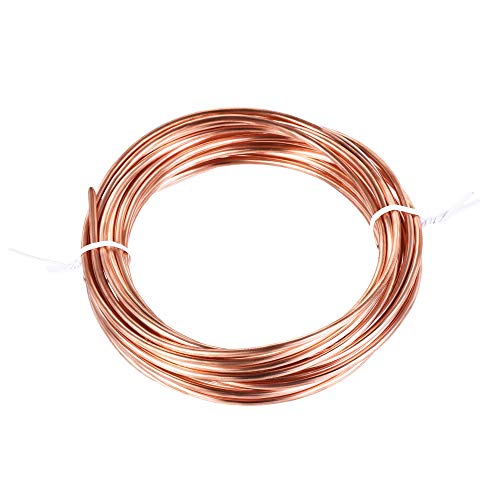
How To Choose The Best 1/8 Copper Tubing
Half of the returns in this category happen for one reason: the buyer ordered a coil that does not physically mate with the fitting already on the bench. Get the diameter, the temper, and the length right and everything else is easy.
Match the outside diameter to your fitting, not the label
Outside diameter — the measurement across the outside of the tube — is what your compression fitting, flaring tool, or brazing sleeve grips. That is why the uxcell, MECCANIXITY, and ICS picks all sit at 1/8″ OD. A coil marked 3mm OD is close, but metric fittings and ACR fittings are not the same thing, so measure with calipers before you cut.
Inside diameter matters too, because it sets your flow. A 1/8″ OD tube with a 5/64″ ID (about 2mm) passes refrigerant or gauge pressure fine through a short run, but it is not a substitute for a 1/2″ line on a full system.
Soft-annealed versus hard tubing
Soft-annealed means the copper has been heated and slowly cooled so it stays pliable — you can bend it around a mandrel by hand and re-bend if you get the angle wrong. Every pick here is a soft coil, which is exactly what you want for routing through a cabinet or winding an inductor. Hard temper tubing holds a straight line and is harder to route around obstacles.
How long a coil do you actually need
Sixteen feet handles a single repair. Twenty-five feet covers a custom run with waste. Fifty feet is the sensible floor for a full HVAC install, because you want slack at both ends for a clean flare. Buying short and splicing with a coupling adds a joint that can leak, so measure your route twice before ordering.
Corrosion, purity, and what you can ignore
Copper resists corrosion on its own. What varies between picks is purity and manufacturing treatment — C12200 grade with an ASTM B280 label and nitrogen-charged processing is a cleaner, more consistent tube than an unlabeled generic coil. If you are soldering, look for a coil that arrives straight rather than tightly wound, because crushing during shipping is the single most common complaint in this category.
Quick Comparison
| Model | Best For | Length | OD / ID | Wall Thickness | Amazon |
|---|---|---|---|---|---|
| uxcell 1/8″ OD x 5/64″ ID★ Best Overall | All-round first buy | 16 ft | 3mm / 2mm | 0.5 mm | Amazon |
| uxcell 3mm OD x 2mm ID CoilBest For Hard Fits | Hard-to-find metric sizes | 19.5 ft | 3mm / 2mm | 0.0197 in | Amazon |
| GOORY 1/8″ OD ACR Tube | HVAC and long runs | 25 ft | 1/8″ / 0.07″ | 0.02 in / 0.5mm | Amazon |
| MECCANIXITY 1/8″ OD Flexible Pipe | Extra reach on a budget | 24.6 ft | 3mm / — | 0.5 mm | Amazon |
| Sadnyy Flexible Copper Tube | Craft and antenna work | 50 ft | 3mm / 2mm | 0.5 mm | Amazon |
| Reading Refrigeration Copper Tubing | Re-bending without collapse | 50 ft | 1/8″ / — | 0.125 in | Amazon |
| ICS Industries ACR Tubing | Code-compliant installs | 50 ft | 1/8″ / — | 0.030 in | Amazon |
In‑Depth Reviews
1. uxcell Refrigeration Tubing, 1/8″ OD x 5/64″ ID x 16 Ft Soft Coil Copper Tubing
Our pick — over 4.5★ from 350+ verified ratings; the strongest balance of quality and price.
A dead-soft 16 ft coil that bends by hand and holds the angle you set
The reason this coil earns the top spot is simple: it behaves the way soft-annealed copper is supposed to. The outside diameter is 3mm (1/8″) and the inside is 2mm (5/64″), spanning 16 feet across a 0.5mm wall. Fold that into a gauge run, a fuel line, or a dollhouse frame and you are never fighting the metal.
What wins people over is how pliable it arrives. Owners describe it as fully annealed and “darn close” to dead-soft, easy to form and easy to re-form when a bend lands wrong. It bends at any angle by hand without hardening, and it flares and solders without drama. The temper is the whole story here — plumber after plumber picks this tube for exactly that reason, and it is the pick I would hand a first-timer without a second thought.
The catch is a short one. Sixteen feet runs out on a full HVAC install, and a few buyers wish it came in longer sections, so measure your route before committing. Soldering also rewards a light touch: keep the strong flame off it and it stays clean, which is the standard caution with any thin copper this soft. It is the coil to grab when the job is short and the fit has to be right the first time.
What works in its favor
- Fully annealed and dead-soft — bends by hand and holds the shape you set
- 16 ft of 1/8″ OD x 5/64″ ID copper with a 0.5mm wall for compression fittings
- Flares, solders, and cuts without kinking on a measured bend
Where it asks for care
- 16 ft is tight for a complete system run — order two coils for a full install
- Thin wall wants a controlled flame during soldering, not a long soak in heat
The first coil to buy: perfect for repairs, gauge lines, and craft work where you need copper that yields to your hand and holds its line.
Look elsewhere when: your run needs more than 16 feet in one piece — the 25 ft and 50 ft coils cover that.
2. uxcell Refrigeration Tubing 3mm OD x 2mm ID x 19.5Ft Length Copper Tubing Coil
A 3mm OD x 2mm ID coil for metric fittings that local counters rarely stock
Some jobs will not accept a 1/8″ fitting no matter how hard you push. That is where this 19.5 ft coil lives: 3mm outside, 2mm inside, a 0.0197 inch wall. It is the same nominal diameter as the pick above in metric terms, just cut 3.5 feet longer.
When you cannot find a metric size anywhere locally, this coil is the one buyers report fills the gap — reviewers report it “works perfect for that metric size or millimeter size that you can’t find anywhere.” Coils arrive clean with no blemishes, and shipping is quick, which matters when you are mid-repair and blocked on one part.
Honestly, the two uxcell coils overlap so closely that you should pick by your fitting, not the brand. Go with this one if your hardware is genuinely metric; take the 16 ft version if you are working in SAE. Both are soft and easy to route, and neither will disappoint you at the bench.
Where it earns its place: a genuine metric 3mm x 2mm coil that local stores rarely stock, at 19.5 ft with a clean surface and a soft temper for tight routing.
The honest qualifier: if your flare tool and fittings are SAE, this is the wrong coil — the sizing is the point, so match it to the hardware you already own.
Reach for this if: your equipment is metric and everything on the shelf near you is imperial.
Pass it by if: you have not confirmed your fitting size with calipers first.
3. GOORY Copper Tubing 1/8″ OD x 0.07″ ID x 25 FT – 99.9% C12200 Pure ACR Tube – ASTM B280 Refrigeration T2 Copper Tube Soft Coil
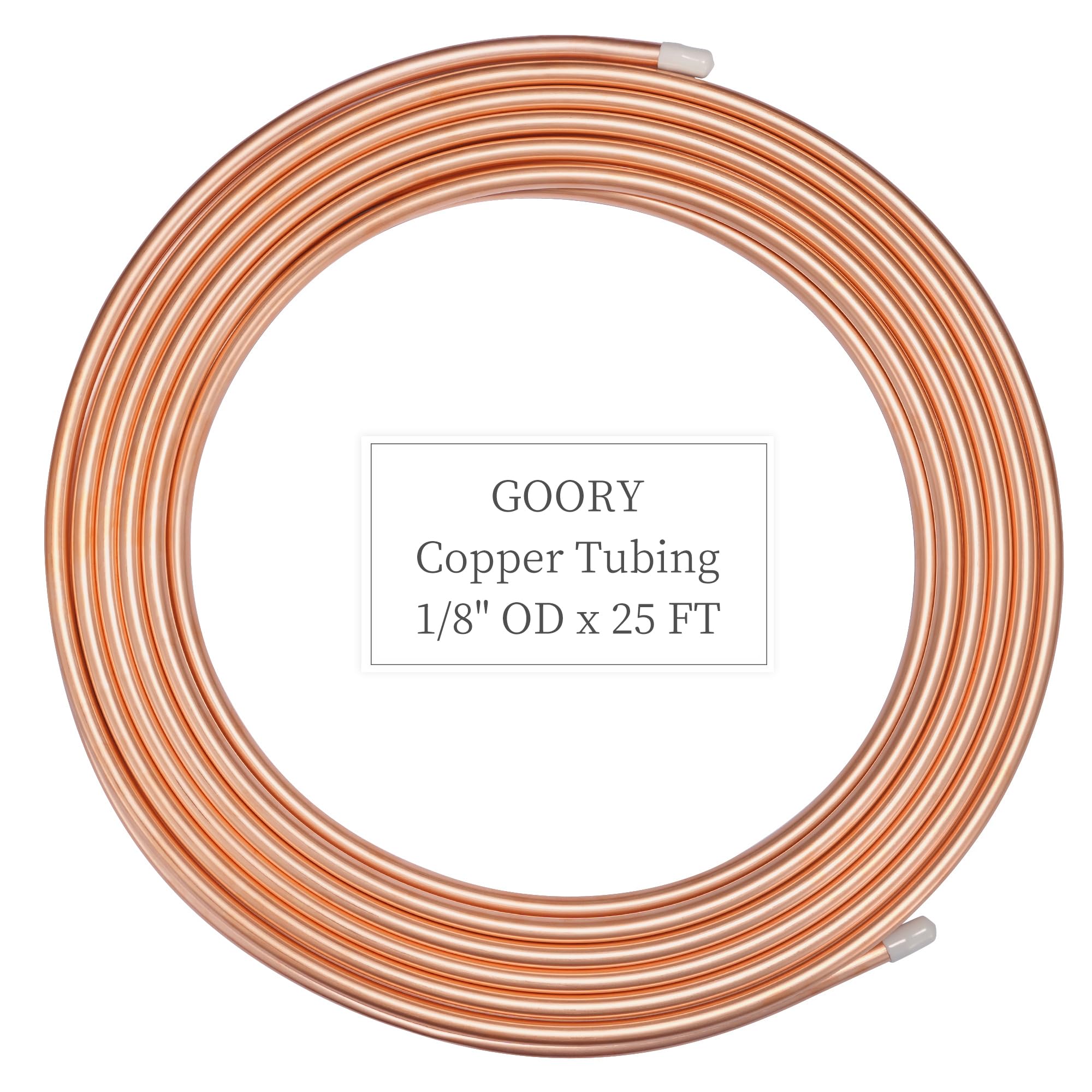
25 ft of 99.9% C12200 copper to the ASTM B280 ACR spec, for a sealed-system run
When a job needs paperwork to prove the material, this coil answers. It is 99.9% UNS C12200 grade copper (a standard high-purity copper alloy) built to the ASTM B280 ACR specification (the industry standard for air-conditioning and refrigeration tube), running 1/8″ outside with a 0.07″ inside diameter across 25 feet and a 0.5mm / 0.02 inch wall. The nitrogen-charged treatment during manufacturing (the tube is filled with nitrogen to keep the inside clean) is what separates it from generic coils, and it is why the interior stays clean enough to trust on a sealed system.
The length is the practical win here. At 25 feet it covers a custom run or a repair with slack left over, and it is noticeably more tubing than the 16 ft uxcell and the 19.5 ft metric coil, so you are not splicing in a coupling halfway through. It flares or sweats into a fitting (you can either flare the end or solder it), bends by hand, and ships in a strong box — installers who took it straight into an HVAC job report it arrived undamaged and exactly as needed.
What to weigh before you commit: this is not potable-water plumbing, and it should not be pushed into a high-pressure line where a larger diameter belongs. For refrigerant, HVAC, and DIY routing, the purity spec and 25 ft length together make it the most complete pick on this list for a serious build.
The material argument: 99.9% C12200 copper to the ASTM B280 ACR standard with nitrogen-charged processing, so the tube going into an air conditioner or cooler is documented, uniform, and clean inside.
Loose ends to plan for: it is not intended for high-pressure potable plumbing, and tightly wound coils can show crush marks on arrival — give it a look before the first cut.
The professional’s pick: it delivers code-friendly ACR copper with the purity spec and a 25 ft length that a full custom run actually needs.
Skip it for: plumbing a water line, or any job where a larger bore is the correct call.
4. MECCANIXITY Copper Tube 1/8” OD x 24.6Ft 1/64″ T Refrigeration Flexible Pipe smooth Hollow Metal Soft for Air Conditioners Refrigerators and Other Equipment

24.6 ft of 3mm OD smooth copper at a budget price for longer routes
Where the 16 ft uxcell coil leaves off, this one keeps going. A 24.6 foot smooth copper tube at 3mm / 0.12 inch outside diameter with a 0.5mm wall gives you roughly the same reach as the 25 ft GOORY without stepping into a different grade of copper.
The wall is measured carefully on arrival in most cases. One measured report with Starrett calipers put the inside and outside diameters about.001″ oversize, roundness within.0005, and the length about 1/8″ over the advertised figure, with no defects and no leaks. That is a good sign for a coil at this end of the market, and it matches the maker’s own note that the tube stretches and solders easily.
Watch the size label closely, though. The listing title on one variant says 1/4″ OD while the actual tube is the 6mm metric size, so a coil that will not seat in a 1/4″ adapter has happened to buyers. Read the spec line, not the title, and confirm against your fitting before you cut. Do that and this is a capable, affordable coil for air conditioners, refrigerators, and the odd craft project.
The value calculation: 24.6 ft of 3mm OD smooth copper with a 0.5mm wall covers the longer runs that a 16 ft coil cannot, and the measured dimensions come in tight when you verify them.
Read before you order: some variants are titled 1/4″ OD while shipping the 6mm metric tube, so confirm the actual diameter against your adapter rather than trusting the headline.
Worth it when: you need the extra length and your fittings are confirmed for the smaller metric bore.
Not your coil if: you are grabbing a 1/4″ system part without checking the tub
5. Flexible Copper Tube for Refrigeration, 1/8″ OD x 5/64″ ID x 50 ft L

50 ft of soft 3mm OD x 2mm ID copper for sculpture, coil winding, and antenna work
Fifty feet changes what you can build. This coil runs a 1/8″ outside, 5/64″ inside, and a 0.5mm wall over 50 feet — 15.24 meters of material — which is enough to keep a maker busy for a long stretch or to feed a single generous run without a splice.
What makes it interesting is how wide the use cases stretch beyond refrigeration. People form it into artwork and sculpture, wind it for a live steam locomotive, and run it as a ground connection for amateur radio antennas, where owners note that despite the thin wall it arrives well packed with no kinks or extreme bends. The tube bends and cuts on demand, holds any angle you set, and the surface is smooth and smooth.
The honest caveat is the wall itself. It is thin, and thin copper rewards patience — force a tight radius too quickly and you will crease it where a heavier gauge would have held. Treat the bend as a slow, guided move with a mandrel and it does exactly what you want. For a long coil at a moderate price, this is a hard combination to argue with.
Why makers keep it in rotation
- 50 ft of 3mm OD x 2mm ID soft copper — serious run length without a splice
- Cuts and bends at will, holds the angle you form, smooth smooth surface
- Well packed and arrives free of kinks and extreme bends
Plan around these
- The 0.5mm wall wants a slow, guided bend on tight radii
- Fifty feet is more than most single jobs require
Suits the long project: a 50 ft coil at 1/8″ OD for installs, sculptures, and coil-winding work that eats material.
Consider a shorter coil if: your job is a small repair where 50 feet would simply sit in the workshop.
6. Refrigeration Copper Tubing, 1/8″ x 50′

A soft 1/8″ x 50′ coil that survives repeated bending without collapsing
Repeat bending is where most thin copper gives up. This 1/8″ x 50′ soft coil from Reading is the exception — it holds up when you change the angle a second and third time, which is a rare quality to find in tubing this size.
Tesla coil builders prize it for exactly that: super soft and malleable, and unlike most copper tubing it can be bent and re-bent repeatedly without collapsing. Stained-glass and wind-chime makers take it to a mandrel and a hammer and report that it holds the shape it is given, even if it takes strong hands and a good pair of pliers to get it there. Ham radio operators wind it into RF coils without deforming the section.
The trade-off is that it is not a precision instrument. The wall arrives at 0.125 inches nominal, so this is a pliable work coil rather than a code-spec ACR tube. If your job cares about a documented standard, the ICS tubing below is the tighter choice; if your job cares about bending freely and re-bending without a crack, this is the one. The 0.88 kg coil weight tells you it is a substantial length to work through, so store it on a spool.
The standout property: a soft 1/8″ x 50′ coil that tolerates repeated bending — you can correct an angle without scrapping the piece.
The different mission: at 0.125 inch nominal wall this is a pliable work coil and a craft favorite, not a documented ACR specification tube, so match it to the job.
The right call for hands-on forming: craft, jewelry, coil winding, and gauge lines where the same tube gets bent more than once.
Choose the ICS tubing instead if: your inspector wants a published standard on the label.
7. ICS Industries – Refrigeration ACR Tubing (1/8R50)

USA-made ASTM B280 ACR copper with factory-sealed ends and a 0.030 in wall
If the job has to pass an inspection, this is the coil that gets you there. ICS manufactures this 1/8R50 ACR tubing in the USA from high-purity copper to the ASTM B280 specification, with a factory-sealed cap on each end, a 50-foot coil, and a 0.030 inch nominal wall. The 0.125″ outside diameter seats straight into micro-bore HVAC connections, capillary fittings, and brazing sleeves.
What the wall thickness buys you is margin. At 0.030 inches it is the heaviest nominal wall in this lineup, and ICS builds it soft-annealed for ductility so it can be routed through tight runs, control lines, and instrument setups without fatigue or cracking. The end caps are a small detail with a real payoff — they keep moisture and dust out of the bore while the coil sits in your truck, so you start the install with a clean interior.
Against the GOORY, the two specs that separate them are the domestic manufacturing and that heavier wall; against the Reading coil above, the difference is the published standard and the sealed ends. Buyers use it for straight HVAC work and, occasionally, for something more creative entirely, and the shipping arrives clean with no bends or kinks. It sits at the top of the range, and on an install that has to hold for years it earns the extra.
Where the money goes: USA manufacturing, ASTM B280 ACR compliance, a 0.030 inch nominal wall, and factory end caps that seal the bore until you are ready to flare.
One thing to know: this is a focused micro-bore coil, so confirm your system is set up for 1/8″ OD before you buy — it is built for capillary and instrument work, not large-bore lines.
The finishing move for a serious install: code-compliant, domestic ACR copper with sealed ends that handles repeated thermal cycling without fatigue.
Think twice if: your project is a hobby build where the lighter coils above already do the job.
Understanding the Specs
Outside and Inside Diameter
The outside diameter is the measurement across the full tube and it is what your fitting grips. Inside diameter is the open bore, and it sets flow. A coil listed as 1/8″ OD usually carries a 5/64″ ID, which is about 2mm — fine for instrument lines and short refrigerant runs. When a listing shows only a metric figure like 3mm OD, the bore is typically 2mm, so a metric fitting is the correct match. Always measure both before cutting, and never assume a “1/8 inch” title means an imperial tube, since the metric size is often sold under the same heading.
Wall Thickness and Temper
Wall thickness is given in millimeters or inches and it decides how hard the tube is to bend and how well it resists kinking. A 0.5mm wall is the soft standard for refrigeration routes that weave through a cabinet. A heavier wall like 0.030 inch stands up to more handling and to the pressure swings of a working system. Temper is the other half of that equation: soft-annealed copper has been heated and slowly cooled so it bends by hand and can be re-bent, while harder temper tubing is stiffer and will crack at the flare. For any route with bends, soft is what you want.
FAQ
Is 3mm copper tubing the same as 1/8 inch tubing?
What size fitting does 1/8 inch OD copper tubing need?
Can I bend 1/8 copper tubing by hand?
Does 1/8 copper tubing work for air conditioning and refrigeration?
What is the difference between soft copper and rigid copper tubing?
Can I reuse or re-bend 1/8 inch copper tubing without it cracking?
Does 1/8 copper tubing arrive kinked or crushed?
How long should my copper tubing coil be for an HVAC install?
Do I need a special solder or torch for 1/8 inch copper tubing?
What does the ASTM B280 rating mean on copper tubing?
Final Thoughts: The Verdict
The 1/8 copper tubing coil to start with is the uxcell Refrigeration Tubing, because it lands the balance of a pliable fully-annealed temper (softened so it bends by hand), a 1/8″ OD x 5/64″ ID diameter that seats properly, and 16 feet of usable copper for repairs, gauge runs, and craft work — the crowd favorite on this list, and the one most buyers will be happy with. If you want more reach and a documented spec for an HVAC job, grab the GOORY 25 ft ACR tube, which carries the ASTM B280 label and 25 feet to spare. And for an install that has to pass inspection, the ICS Industries ACR tubing is the one to reach for — USA made, soft-annealed, with factory end caps that keep the bore clean until you flare it.
How We Picked
We do not accept paid placement. Every pick is matched to a real buyer and a real use-case; we do not hands-on test units.
Sources & Methodology
Specifications: manufacturer listings and product documentation. Review insights: verified customer reviews, as of September 2026. Pricing: not shown on this page (it changes often); check the current price via the retailer link.
As an Amazon Associate, KitchPrep earns from qualifying purchases. This does not affect which products we feature.
Related Guides
