
Specs are compiled from manufacturer listings and verified buyer reviews and can change over time — please confirm the key details on the product page before buying.
If your forearm is still burning from a hand riveter, the fix is air. A pneumatic rivet gun pulls the mandrel for you, so a 1/4-inch steel rivet snaps off in a single squeeze instead of a full-body wrestling match. This guide covers eight guns that all accept 1/4-inch rivets, and it separates the ones that pull cleanly for hundreds of rivets from the ones that jam on the second one. Pulling force, measured in LBF (pounds of force), is the number that decides whether a gun sets a 1/4-inch rivet cleanly or stalls halfway.
I’m Mohammad Maruf — the founder and writer behind KitchPrep. This guide is built by comparing the manufacturers’ published specifications and the patterns across verified customer reviews, so you get each pick’s real strengths and trade-offs instead of marketing spin.
You will see nosepiece sizes, air-pressure ranges, and weight in pounds. Those three specs decide whether a gun survives a boat rebuild or only manages a mailbox bracket. Here is what separates a workload tool from a weekend tool in the 1/4 rivet gun market.
Our Picks at a Glance

How To Choose The Best 1/4 Rivet Gun
Buying a pneumatic rivet gun for 1/4-inch work is really three decisions: how much pull force you need, what air supply you already own, and whether the kit hands you every nosepiece on day one. Get all three right and the gun sets rivets without fighting you. Get them wrong and you are clearing jams or waiting on a compressor that cannot keep up.
Pull Force — The Number That Sets The Rivet
Pull force is measured in LBF, which means pounds of force — how hard the gun yanks the rivet mandrel to snap it off. The picks here run from 2,646 LBF up to 4000 LBF. A 1/4-inch stainless rivet is the hardest common job, so more pull force means a cleaner break with less effort. If you mostly fasten aluminum, a lower-force gun handles it fine at a lighter weight.
Air Supply And Pressure Range
Every gun here needs a compressor, not a wall outlet, and the listed working ranges sit around 6 to 8 bar or roughly 70 to 110 PSI depending on the model. A small pancake compressor that cannot hold pressure under load will leave a 1/4-inch rivet half-set. Check your tank and regulator before you buy, because a powerful gun and a weak air supply is the most common mismatch.
Nosepieces, Jaws, And The Little Extras
You can switch rivet sizes without a second tool, because every unit in this guide ships five nosepieces covering 3/32-inch up to 1/4-inch. What differs is the supporting kit — spare jaws, wrenches, a mandrel collection bottle, and whether a case is included. Spare jaws are the quiet hero, because the jaws grip the rivet pin and they are the first thing to wear.
Quick Comparison
| Model | Best For | Pull Force | Nosepieces | Weight | Amazon |
|---|---|---|---|---|---|
| Pneumatic Rivet Gun with 3/32″-1/4″ Rivet Heads★ Best Overall | High-volume sheet metal work | 4000 LBF | 5 (3/32″–1/4″) | 4.6 lb | Amazon |
| Pneumatic Rivet Gun Hydraulic Air RiveterLightweight Pick | Budget one-handed repairs | — | 5 (3/32″–1/4″) | 4.27 lb | Amazon |
| Air Rivet Gun 5 Nosepiece SizesBest First Air Gun | First-time air tool buyers | 3916 LBF | 5 (3/32″–1/4″) | 4.6 lb | Amazon |
| JiGiU Pneumatic Rivet Gun 3916LBF | Garage and workshop pros | 3916 LBF | 5 (3/32″–1/4″) | 1.55 kg / 4.64 lb | Amazon |
| JUSTOOL Heavy Duty Pneumatic Rivet Gun | Big floor and minibus jobs | 3916 LBF | 5 (3/32″–1/4″) | 4.62 lb | Amazon |
| Proster Pneumatic Rivet Gun 3924LBF | All-day auto body and marine work | 3924 LBF | 5 (3/32″–1/4″) | 4.84 lb | Amazon |
| Wadoy Heavy Duty Air Rivet Gun | Rivet-included starter kit | 3924 LBF | 5 (3/32″–1/4″) | 4.22 lb | Amazon |
| Steel Force ANR25 | Light, low-effort pulling | 2,646 lbs | 4 (1/8″–1/4″) | 3.7 lb | Amazon |
In‑Depth Reviews
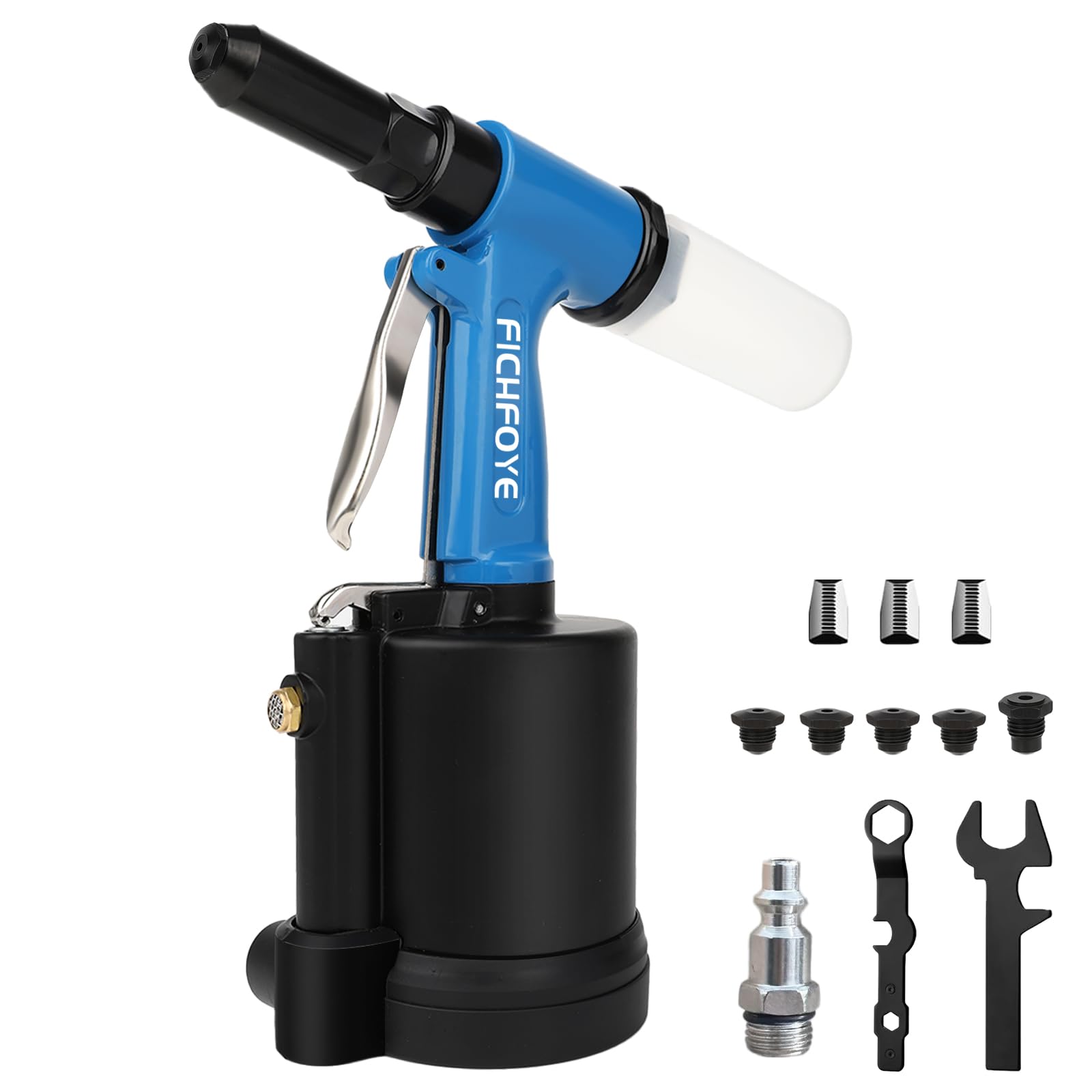
1. Pneumatic Rivet Gun with 3/32″-1/4″ Rivet Heads
Our pick — 4.5★ from 150+ verified ratings; the strongest balance of quality and price.
The gun that out-pulls every rival here, then hands you the spare jaws to keep going.
If you set a lot of rivets — boat decks, door skins, trailer panels — this is the one to start with. It delivers 4000 LBF of pulling pressure, the highest figure in this lineup, and it beats the VORXEON Air Rivet Gun’s 3916 LBF by a clear margin. That extra force is what snaps a stubborn 1/4-inch rivet in one clean pull instead of two. Each installation finishes in seconds, which matters when you are staring down a repair with hundreds of rivets in it.
The kit leaves nothing to hunt down mid-job. You get five rivet heads spanning 3/32-inch to 1/4-inch, plus two wrenches, three spare claws, a U.S.-standard air nozzle, and a removable collection bottle for the spent mandrels. It handles aluminum, steel, stainless steel, and iron rivets. Each jaw is rated for roughly 30,000 to 50,000 rivets, so the three spares are a real wear-part replacement, not filler.
The whole tool weighs 4.6 pounds, so one-handed work over a long afternoon is realistic. A build of 9.61 by 4.41 by 13.03 inches means it is a bench tool rather than a pocket one — worth knowing if your work happens in tight overhead spaces. The catch is consistent quality, not raw power: most units show up strong and stayed that way, but jamming on 1/4-inch rivets is the recurring complaint, and a bad unit can arrive that way. Treat the finer 1/4-inch work with a firm, even trigger pull rather than a snap.
Where it earns its keep
- 4000 LBF pulling pressure, the top figure in this lineup
- Balanced 4.6 lb weight for a tool this powerful
- Five heads, two wrenches, three spare claws, and a mandrel bottle all included
- Handles aluminum, steel, stainless, and iron rivets
Worth knowing before you buy
- No carrying case, compressor, hose, rivets, or oil in the box
- Occasional units jam on 1/4-inch rivets
- Jaws are a wear part — the spares exist for a reason
Top of the pile: the strongest pull force here wrapped in a lightweight, fully stocked kit — the crowd favorite across 4.5-star feedback from 198 ratings.
Think twice if: you only ever fasten aluminum and want a featherweight gun, in which case the 3.7 lb Steel Force is the lighter path.
2. Pneumatic Rivet Gun Hydraulic Air Riveter Tool
A 4.27-pound air gun built for people who are done squeezing a hand riveter.
At 4.27 pounds this is the lightest full-force gun in the roundup — it sits just below the 4.6 lb FICHFOYE and JiGiU units and above only the dedicated 3.7 lb Steel Force. The aviation aluminum shell keeps it manageable to hold in any position with one hand, which is exactly the point for overhead panel work. Five nosepieces cover 1/4-inch down to 3/32-inch, and three of them screw onto the base of the gun so they cannot wander off in your toolbox.
Power is the headline — buyers report that 1/4-inch rivets are no problem at all, with one noting, “This thing has plenty of power. Very happy with my purchase. I would buy one again if I needed one.” The short-cylinder design keeps the air and oil circuit fast, and an anti-vibration rubber pad shrugs off the bumps of a busy shop floor. On the whole, owners describe it as strong value once they have it running.
The honest catch is consistency. Some units run perfectly from the first rivet, while a minority stop working after setting just two or three. That is a build-quality spread rather than anything you can spot in the spec sheet, so it suits a home shop or a one-off project better than a daily production line. Fit it with a swivel connector rather than relying on the factory air fitting, which more than one owner found fussy to seat properly.
The appeal here: lightweight one-hand control plus enough force for 1/4-inch rivets, all in a package that covers five sizes.
The fit-note: reliability is the mixed part, not the power — a professional running hundreds of critical rivets a day should look higher up this list.
Reach for this if: you want the lightest practical air gun for occasional repairs on cars, trailers, or panels.
Look elsewhere if: every rivet you set is safety-critical and consistency is non-negotiable.
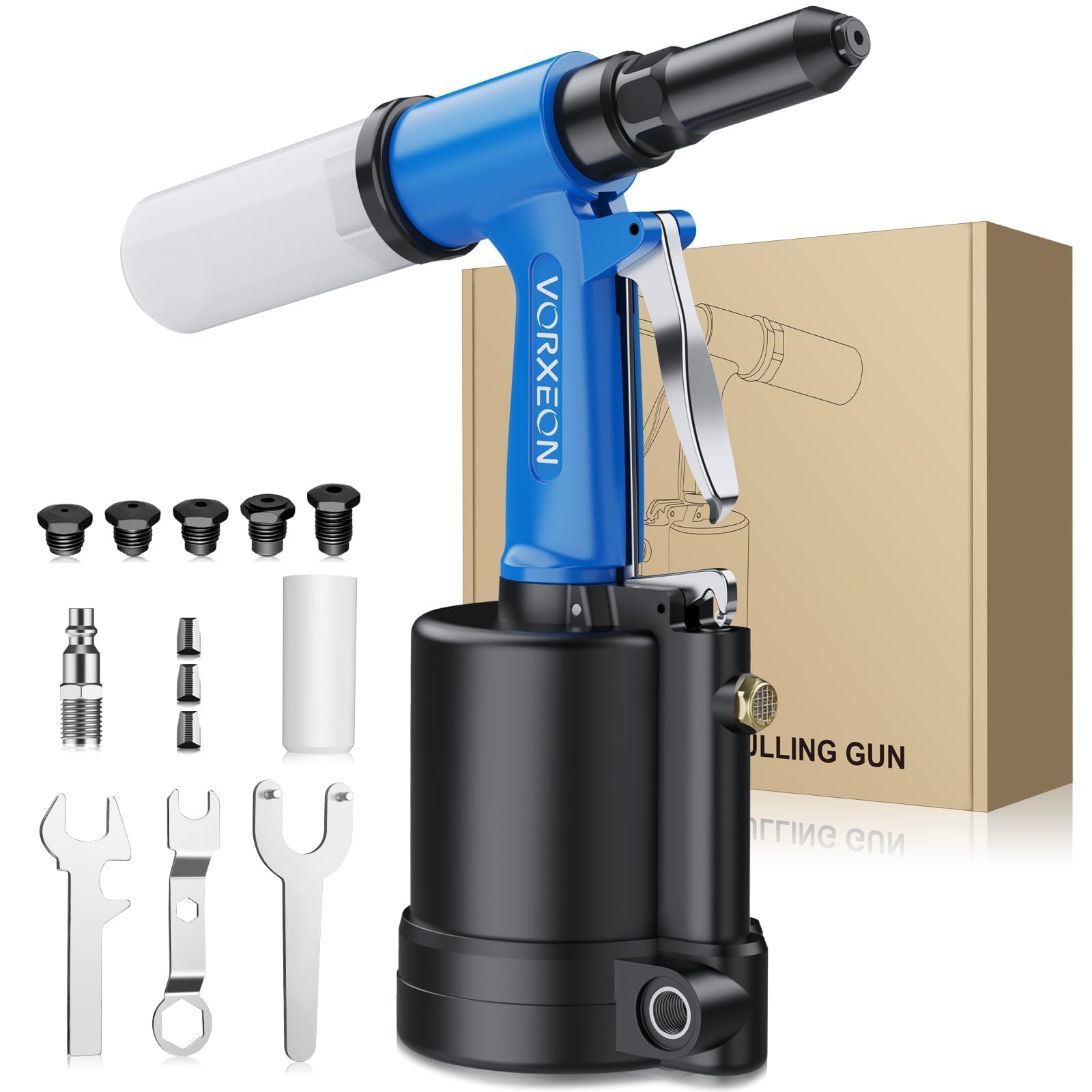
3. Air Rivet Gun 5 Nosepiece Sizes 3/32″ to 1/4″
The VORXEON built for the person holding an air riveter for the very first time.
If you have never owned a pneumatic riveter, this is a low-risk place to start. It runs an air-hydraulic drive rated at 3916 lbf — levels with the JUSTOOL and just under the FICHFOYE’s 4000 LBF, but far beyond what any hand tool delivers. Rivet stems drop into a clear cup at the rear so you can see your progress and empty it in one motion. The blue powder coat is smooth and durable, and this gun is notably quieter than a lot of older riveters, which your ears will thank you for in a small garage.
If you are new to air tools, you will warm to it fast, and the collected feedback backs that up: it is easy to change heads, and one buyer who riveted thin metal cabinets described it as simple to pick up, ending that it is worth recommending as a first rivet gun. Plenty of power sets 1/4-inch rivets easily, as the top-line review puts it. The two-wrench plus base-wrench kit gives you everything you need to swap nosepieces without a trip to the hardware store.
Two things to weigh. The 4.6 pound body will feel heavier than the VOTOER over a long session, and if your compressor is small, it can struggle to feed this gun under load — one reviewer noted it would not actuate at all on a fresh setup, which usually points to air delivery rather than the tool itself. Neither is a flaw for a hobbyist, but a production environment wants more reserve.
Beginner-friendly: quiet running, rear cup for easy mandrel dumping, and a full five-size head kit mean it works straight from the start.
Pick this one: your first pneumatic riveter and you want the gentlest learning curve plus a switchable 3/32-inch to 1/4-inch head set.
Pass it over if: you run a big air-hungry shop where the lighter build and modest reserve may feel stretched.
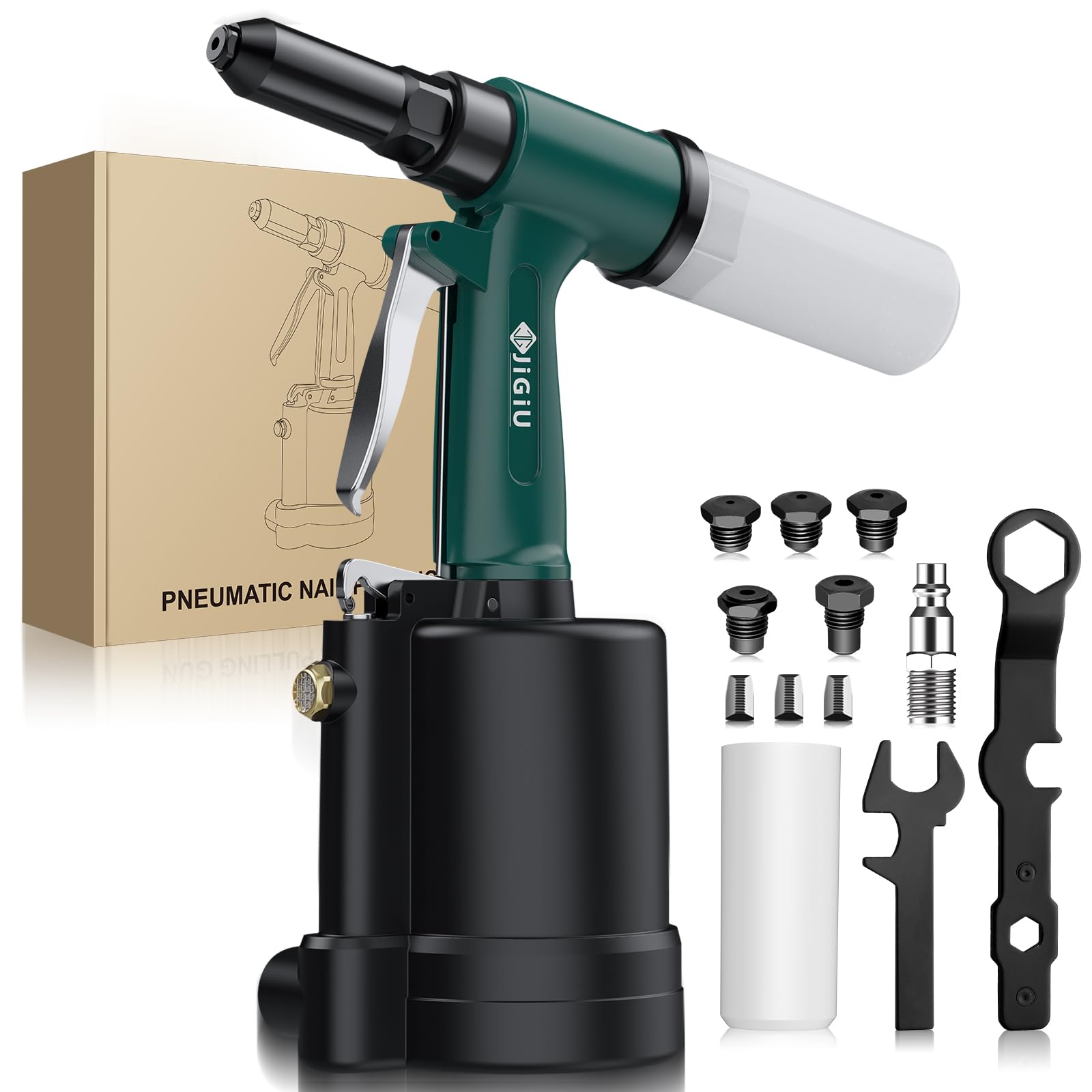
4. JiGiU Pneumatic Rivet Gun 3916LBF Heavy Duty
A 4.8-star garage tool with an 18-month warranty and a spare jaw set built in.
The warranty is the detail that jumps out — 18 months of coverage on a tool that gets dropped and dragged around a garage every day is unusual at this level, and it signals confidence in the build. Pull force runs at 3916 LBF at 6 to 8 kg air pressure, enough to break tough steel, iron, and aluminum rivets without complaint. Aircraft-grade aluminum construction keeps the whole unit at 1.55 KG, and the cylinder snaps back fast for high-speed work.
Five nosepieces cover 3/32-inch through 1/4-inch, with one pre-installed so you can get straight into a job. The 360-degree three-claw grip holds each rivet securely, and a spare jaw set is included to keep you running when the originals finally wear. There is also a silencer to take the edge off the noise — worth having if you share a wall with anyone. Owned-use feedback here is short but consistent: it works great, and the pull is clean on the jobs people are actually running.
One reviewer who weighed it noted it runs a touch heavy and feels less nimble on articulated assemblies, which lines up with the 1.55 KG body. The trade-off is real but small — you are buying the extra metal for stability at the tip. If your work involves long hours of high-repetition panels, the weight becomes a factor; for everything else it is a non-issue.
What clinches it
- 18-month warranty backing a professional-grade tool
- 3916 LBF pull force with fast cylinder return
- Aircraft-grade aluminum build with a spare jaw set included
- Silencer keeps the noise down in a shared shop
Before you commit
- Body feels heavier than lighter rivals on intricate assemblies
- Shorter track record than the older veteran tools here
Serious buy: a pro-grade tool with real warranty protection and clean, strong pulls — ideal for a working garage.
Look elsewhere if: you need to work one-handed in tight articulated spaces where every ounce counts.
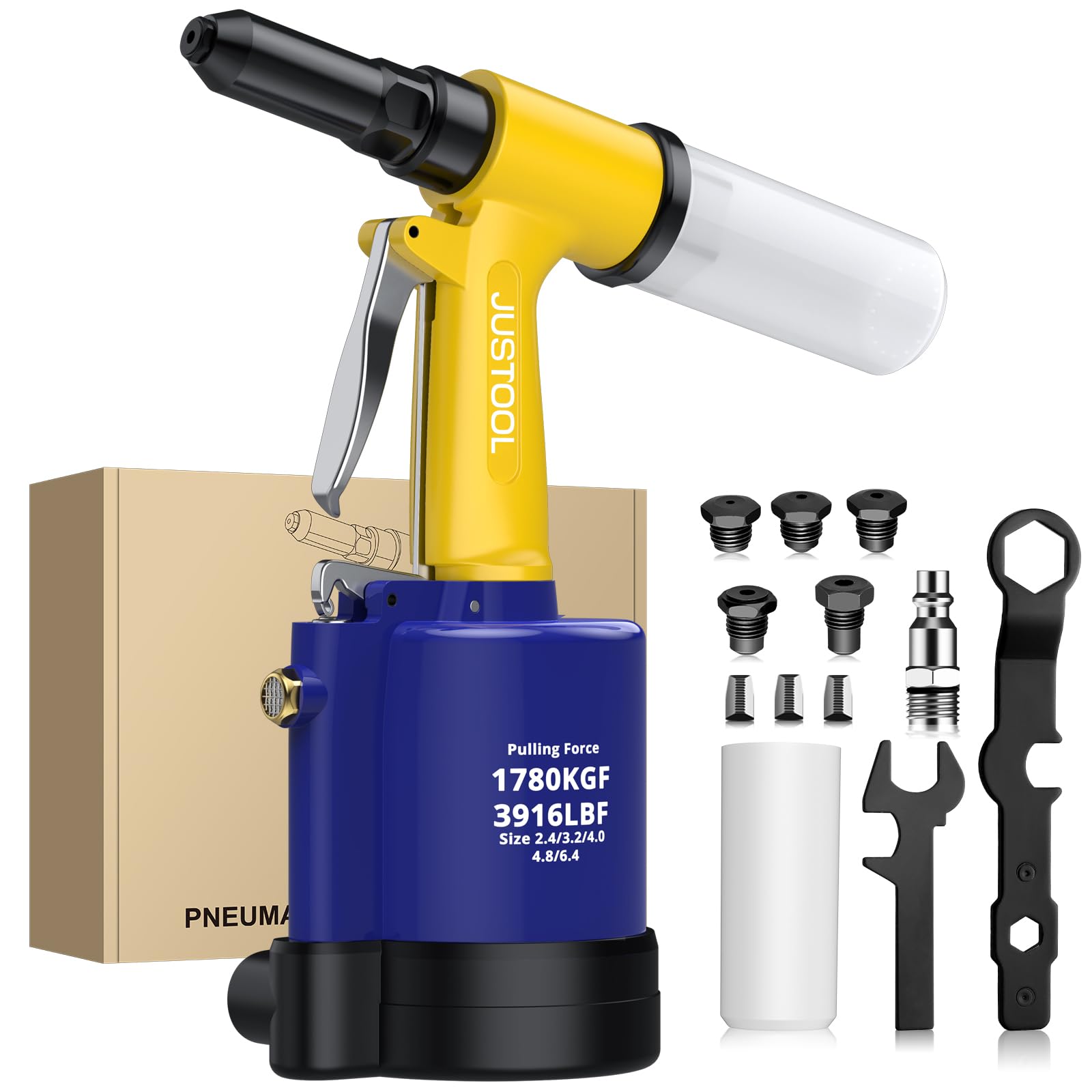
5. JUSTOOL Heavy Duty Pneumatic Rivet Gun 3916 LBF
The floor-panel specialist — over 200 rivets in one sitting without a single hiccup.
When a job runs into the hundreds of rivets, consistency beats everything else. This gun uses an air-hydraulic drive rated at 3916 LBF (1780 KGF, or 17455N), which sits in the same band as the VORXEON and JiGiU units. The documented work range is 6.2 to 8 bar, and the manufacturer ships it with an 18-month warranty. A one-handed ergonomic handle eases fatigue through long flooring or panel runs.
The reviews show where it shines. Owners have installed an aluminum floor in a minibus and popped over 200 rivets with no problems, and the general sense across the collected feedback is that it handles 3/16-inch stainless steel rivets without fuss. One user put it plainly: they are getting too old to hand-set those 3/16-inch stainless pop rivets, and this gun takes over. The box arrives complete, with five nosepieces, three claw clips, and a nail container included.
Two cautions worth flagging. The manual is thin and does not spell out which oil to use or how much — so if your unit leaks oil, that is a symptom to chase rather than ignore, and the nozzle should be inspected before the first run. The single roughest report describes exactly that situation, which is rare but worth checking when you unbox. Fit the tool with a proper regulator and keep the air clean; do that and this gun handles floor-scale jobs without complaint.
Why it earns the slot: 3916 LBF output plus a documented 6.2-8 bar working range make it a reliable floor-tool choice for panel runs.
One thing to respect: the included manual is minimal on lubrication, so confirm oil type before heavy use and check the nozzle seating.
Suited to: repetitive large-surface work — flooring, siding, trailer panels — where sustained throughput matters more than compactness.
skip it if: you want clear setup documentation and a manual that guides you through the oil and maintenance routine.
6. Proster Pneumatic Rivet Gun Air Riveters 3924LBF
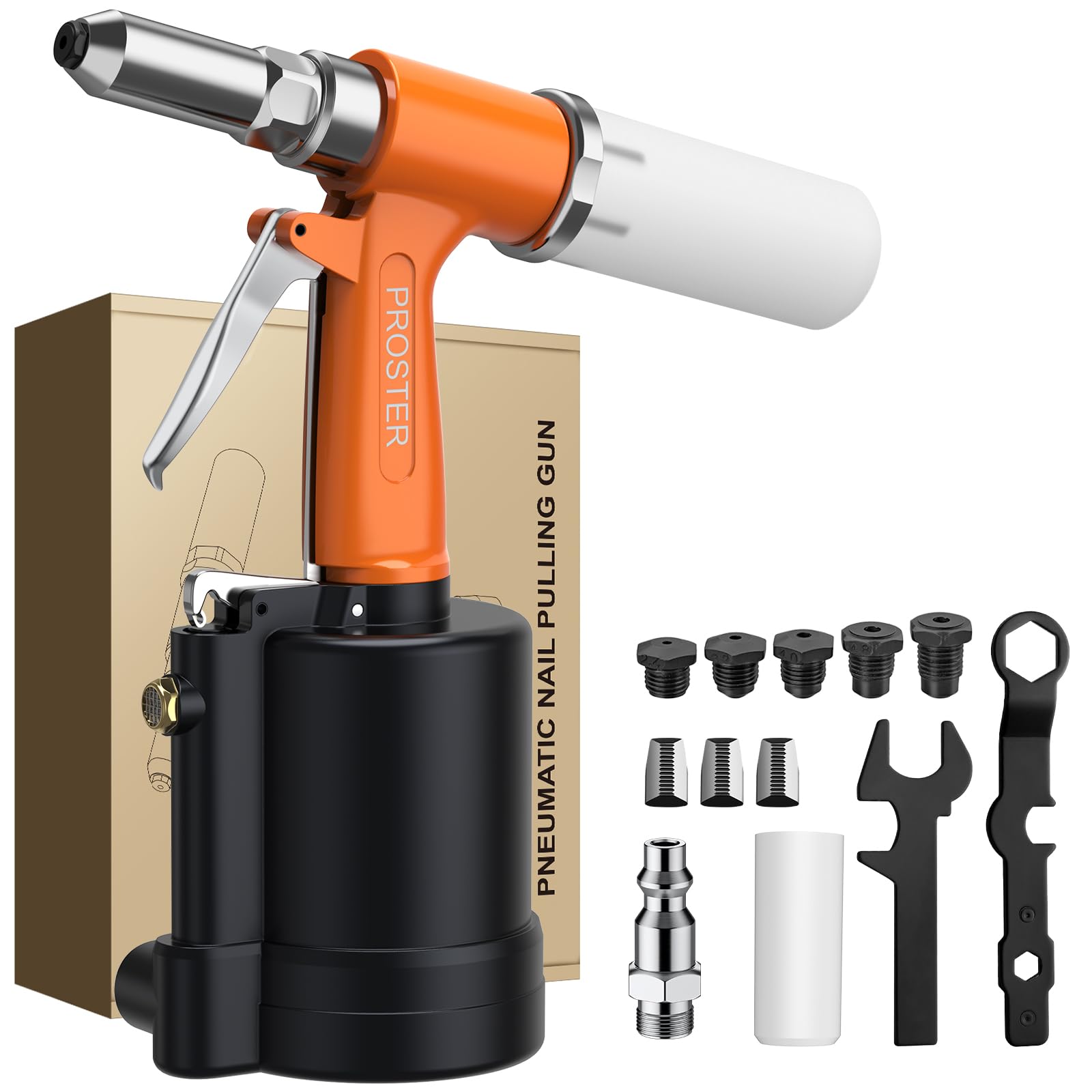
A 3924 LBF workhorse with the highest count of positive owner mentions in the roundup.
This gun’s 3924 LBF (1780 KGF) pull force sits at the top of the 3916-4000 LBF band shared with the FICHFOYE, VORXEON, and JUSTOOL. The 16 mm maximum stroke handles most rivet lengths in one pull — longer ones take two strokes if the mandrel runs 10 to 16 mm, and the manual explains exactly when. Owners note that installing about 200 to 300 pop rivets in one session works without issue, and the sense across the reviews is that it works great at pressures as low as 70 PSI or as high as 110 PSI.
The kit supplies five nosepieces from 3/32-inch to 1/4-inch, one pre-installed, plus a spare jaw set, a U.S.-spec air inlet, and an air silencer. The collection bottle catches spent mandrels for easy cleanup at the end. A useful detail: this gun is not recommended for stainless steel rivets — stick to aluminum, iron, or standard steel for the best result and longest jaw life.
The standard-size stroke and the disposable bottle design mean you can run continuously for a full job day, but two honest limitations show up. Some owners find the head is wider than a hand tool and slightly awkward in very tight spaces, so it works best where you have at least 1/2-inch of clearance. And a small number of units are hard to open up for lubrication, so if maintenance is critical to your workflow, factor that in before you buy.
The daily driver: top-end pull force, a full kit including extra jaws, and consistent function from 70 to 110 PSI make it a genuine production tool.
Make it yours if: you run high-volume riveting across auto body, boat building, or HVAC ductwork and want the strongest pull with the widest usable pressure range.
Think again if: you need to reach into very tight corners or want a tool you can easily strip down for routine servicing.
7. Wadoy Heavy Duty Air Rivet Gun 3924LBF
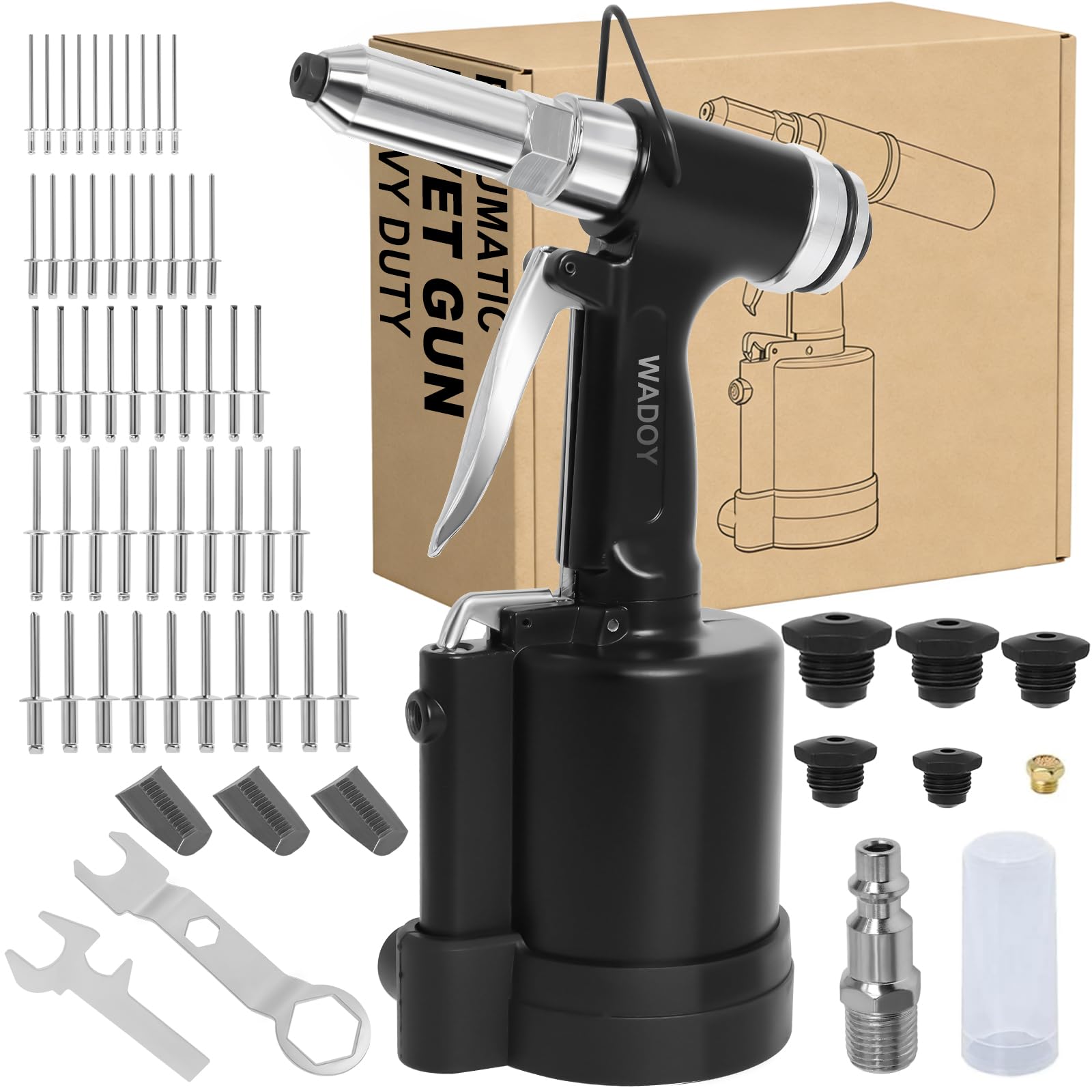
The only pick that ships with 50 rivets, so you can test it the day it lands.
Buy this if you want to be riveting within minutes of opening the box. As well as the five nosepieces — 1/4-inch, 3/16-inch, 5/32-inch, 1/8-inch, and 3/32-inch — Wadoy throws in 50 rivets of assorted sizes. That is the differentiator. Pull force sits at 3924 lbf (1780 KGF), which is a stronger figure than the electric rivet guns it is compared against, and the quick-release air valve returns the cylinder fast for high-speed assembly. The front-set trigger and compact top make it easy to hold in awkward positions.
The live feedback is mixed on reliability — plenty of owners have sunk 500 rivets into a metal ceiling or used the gun through a 500-rivets-plus boat rebuild with great results, but a minority report it stopping after around 100 rivets. The most consistent complaint from satisfied buyers is the collector tube, which snaps off the bottom easily rather than screwing on securely — treat that fit gently and you will not have an issue. One auto repair shop owner got a dud from the start, but that is the outlier rather than the pattern.
For a home DIY buyer who wants a complete package with rivets in hand, this is a strong entry point. For a production shop running hundreds of units a day, the reliability question is worth weighing carefully before you commit. If you buy this one, order a swivel air fitting at the same time; the stock connector takes some wrestling and slows the initial setup.
Standout details
- 50 rivets included — the only kit here that does this
- 3924 LBF pull force with a fast-return quick-release valve
- Front-set trigger and compact top for use in tight spaces
- Five nosepieces from 1/4-inch down to 3/32-inch
Manage expectations
- Consistency of output is mixed across the range
- Collector tube fit is a known weak point
- No instructions — a YouTube search is your setup guide
Built for: the home or small-shop user who wants rivets and every nosepiece in one box and a full-size pull at a friendly price point.
Caution for: a busy production shop that cannot risk a mid-job stop and needs documented service instructions.
8. Steel Force ANR25 1/4″ Heavy Duty Air Riveter

A 3.7-pound air riveter for elbows that have had enough of hand squeezing.
At 3.7 pounds listed, this is the lightest body in the entire roundup. It pulls up to 2,646 lbs of force, which is well below the 3916-4000 LBF band of the higher-end picks but realistically plenty for aluminum and light steel jobs. The four included nosepieces — 1/8-inch, 5/32-inch, 3/16-inch, and 1/4-inch — store underneath the rubber base so you never misplace them. A quick-release air valve returns the cylinder fast between rivets.
The reason owners love it is simple: a compressor and a long hose turn a hard hand-squeeze job into something easy. As one happy customer put it, they bought it because a hand riveter had become hard to use and a compressor plus a long hose made this gun perform “perfect just like a professional.” The grip is comfortable and the tool stores and travels easily, which suits anyone working under a car trailer or out on a job site.
Two limitations are worth naming. There is no 3/32-inch nosepiece, so if you ever fasten the smallest common rivet, this is not the tool. And with a pull force well below the 3900-plus band of the rivals above, heavy stainless 1/4-inch work may fall outside its comfort zone. Neither is a knock for its intended use — it is the low-effort pick, not the brute-force one.
Where it fits: 3.7 pounds, sub-2,646-lb pull, quick-release valve — it is a low-effort choice for someone retiring a hand riveter.
Made for: the person with a decent compressor and a long hose who wants an easy hand at the gun and no heavy bulk to hold overhead.
Not the one if: your work calls for the smallest 3/32-inch rivet or a steady diet of heavy 1/4-inch stainless.
Understanding the Specs
Pull Force (LBF)
LBF is pounds of force — how hard a gun yanks the rivet’s central pin to snap it. Everything from about 2,646 LBF up to 4000 LBF appears in this roundup. Higher numbers handle harder 1/4-inch stainless steel rivets more cleanly; lower numbers suit aluminum and light steel. If your job mix is mostly sheet metal and aluminum, a 2,646 LBF gun is more than enough.
Air Pressure (Bar / PSI)
Bar and PSI both measure the compressed air you feed the gun. The working band here runs about 6.2 to 8 bar, or roughly 70 PSI to 110 PSI depending on the model. Feeding lower pressure than the minimum means a stubborn rivet will not fully set; feeding too high can strain the jaws. A regulator on your compressor lets you dial in the sweet range and keeps the pull consistent.
FAQ
What does a 1/4 rivet gun handle that a smaller one cannot?
Will any 1/4 rivet gun work with my compressor?
What is the difference between a 3916 LBF and a 4000 LBF rivet gun?
Do I need a rivet collection bottle on my gun?
How long do the jaws last on a pneumatic rivet gun?
Can I use stainless steel rivets with every gun here?
What is the best air pressure to set rivets cleanly?
Do these guns come with the compressor and hose?
Can I use a 1/4 rivet gun on a car body panel?
Should I buy a pneumatic or electric rivet gun?
Final Thoughts: The Verdict
The strongest overall pick in the 1/4 rivet gun lineup is the Pneumatic Rivet Gun with 3/32″-1/4″ Rivet Heads, because its 4000 LBF pull force tops every rival here and its 4.6-pound body still handles long sessions. If you want the highest-rated, warranty-backed garage tool instead, the JiGiU Pneumatic Rivet Gun covers you with an 18-month warranty and a spare jaw set. And for one-handed work on car trailer repairs, the lightest tool at 3.7 pounds — the Steel Force ANR25 — is the one to grab. All eight earn their spot; pick the one whose pull force and weight match the rivets you actually set.
How We Picked
We do not accept paid placement. Every pick is matched to a real buyer and a real use-case; we do not hands-on test units.
Sources & Methodology
Specifications: manufacturer listings and product documentation. Review insights: verified customer reviews, as of September 2026. Pricing: not shown on this page (it changes often); check the current price via the retailer link.
As an Amazon Associate, KitchPrep earns from qualifying purchases. This does not affect which products we feature.
Related Guides
