
Specs are compiled from manufacturer listings and verified buyer reviews and can change over time — please confirm the key details on the product page before buying.
Putting a wheel back on and just cranking until you can’t anymore is a recipe for warped rotors or a snapped stud. A proper 1/2-inch torque wrench saves you from that headache by letting you set exactly how much twist you apply — every lug nut gets the same, correct tension. This guide walks through real-world picks so you land on a tool that actually holds its accuracy and feels good in your hand, without getting lost in the jargon.
I’m Mohammad Maruf — the founder and writer behind KitchPrep. This guide is built by comparing the manufacturers’ published specifications and the patterns across verified customer reviews, so you get each pick’s real strengths and trade-offs instead of marketing spin.
The right torque wrench ensures you tighten bolts correctly the first time, whether on a truck or an engine. Here is the clearest breakdown of the best 1/2 inch torque wrench options available right now.
Our Picks at a Glance


How To Choose The Best 1/2 Inch Torque Wrench
You need a torque wrench that fits the jobs you actually do, not one that is overkill or too weak. The three specs that decide that are the torque range (how tight it can turn a bolt), the accuracy rating (how close it gets to the number you set), and the head design (how it fits into tight spaces). Get these right, and you avoid buying a tool that cannot handle your work.
Torque Range — Match It to Your Jobs
A basic 1/2-inch wrench often starts around 10 ft-lb and goes up to 150 ft-lb. That handles most car work like brake calipers and suspension bolts. But if you regularly tighten truck lug nuts — which often call for 140 to 180 ft-lb — you want a range that peaks at 250 ft-lb or even 300 ft-lb. And if you work on heavy equipment, check the low end too: a wrench that bottoms out at 25 ft-lb cannot do the delicate small-bolt work a 10 ft-lb floor can.
Accuracy Rating — Understanding the Difference
Most click-type wrenches ship certified at ±3% or ±4%. That tiny percentage matters: on a 100 ft-lb bolt, a ±3% wrench is off by at most 3 ft-lb, which is fine for wheels and suspension. A ±4% wrench is off by up to 4 ft-lb — still safe for most DIY work but not ideal for an engine build. A good wrench comes with a calibration certificate so you know exactly what its serial number tested at.
Head Design and Ratchet Teeth
The ratchet head’s tooth count tells you how tight a space you can work in. A 72-tooth head moves in 5-degree increments — you barely have to rotate your hand to engage the next click. A 45-tooth head needs 8 degrees of swing, which can be maddening in a cramped wheel well. Look for a quick-release button on the head, too: it lets you swap sockets without prying them off by hand.
Quick Comparison
| Model | Best For | Torque Range | Accuracy | Weight | Amazon |
|---|---|---|---|---|---|
| LEXIVON LX-183★ Best Overall | Best Overall | 10–150 ft-lb | ±4% | 3 lb | Amazon |
| ARUCMIN BS005Best Value | Value with extras | 10–150 ft-lb | ±3% | 4.2 lb | Amazon |
| VEVOR 25-250Heavy-Hitter | Long-range power | 25–250 ft-lb | ±3% | 5.5 lb | Amazon |
| Hairich HRC-SI-12250 | High-end DIY | 40–300 ft-lb | ±3% | 4.09 lb | Amazon |
| EPAuto ST-10A-4 | Professional DIY | 25–250 ft-lb | ±4% | 6.5 lb | Amazon |
| GEARWRENCH 85066 | Pro mechanic | 30–250 ft-lb | ±3% | — | Amazon |
| TEKTON TRQ62203 | Shop durability | 40–250 ft-lb | ±4% | 3.7 lb | Amazon |
| Wera 05075621001 | German precision | 14.7–73.7 ft-lb | ±3% | 2.7 lb | Amazon |
| DEWALT DWMT17060 | Digital readout | 50–250 ft-lb | — | — | Amazon |
In‑Depth Reviews
1. LEXIVON 1/2-Inch Drive Click Torque Wrench (LX-183)
Our pick — over 4.5★ from 11,500+ verified ratings; the strongest balance of quality and price.
The torque wrench that tens of thousands of owners reach for — because it gets the basics right at a price that doesn’t sting.
You can tighten bolts from 10 to 150 ft-lb with this LEXIVON, which is the balance for passenger cars and light trucks. It arrives pre-calibrated to ±4% accuracy (meaning it will be within 4% of the number you set) and includes a serial-numbered calibration certificate. The dual-range scale uses high-contrast yellow numbers on a black background, so you can read your setting easily even in a dim garage. At 3 pounds, it is noticeably lighter than many wrenches that go up to 250 ft-lb, so your arm will not tire as fast on long jobs.
What wins owners over here is the build quality: the reinforced ratchet head uses hardened, heat-treated Chrome Vanadium alloy steel, and the proprietary Electro-Black finish resists rust. Owners talk about hearing the crisp “click” when the preset torque hits — a satisfying sound that prevents over-tightening. The ergonomic, knurled handle means your hand does not slip even when you are leaning into a stubborn bolt.
Precise Click
- Pre-calibrated to ±4% with a trackable certificate — you know exactly what you are getting
- Weighs only 3 lb, so it works comfortably for extended sessions on a brake job
- Reversible ratchet head with a non-slip, knurled handle reduces hand fatigue
Heavy Handle
- Torque range stops at 150 ft-lb — too low for heavy truck or large SUV lug nuts
- The handle, while grippy, is a fixed design; some prefer a rotating collar for faster setting
Accurate Jobs: you do mostly car and light-truck work and want a wrench that is accurate from the start without spending on pro-level gear.
Budget Builders: you routinely torque 200+ ft-lb bolts on a 3/4-ton truck or heavy equipment — you need the VEVOR or Hairich below for the extra headroom.
2. ARUCMIN 1/2-Inch Drive Click Torque Wrench (BS005)
A torque wrench that rivals sets costing twice the money, with a 72-tooth head and a tighter ±3% accuracy spec.
The ARUCMIN stands out because it delivers industrial-grade accuracy — ±3% — and comes with a formal calibration certificate. The 72-tooth ratchet head moves in 5-degree increments, which makes a real difference when you are working in a cramped engine bay. It also includes a 3/4-inch and 13/16-inch socket plus a 5-inch extension bar, so you can start on lug nuts right inside the box.
The body uses hardened chromium-molybdenum alloy for the head and an aluminum-titanium alloy handle that resists corrosion and stays comfortable. The pull-down lock knob is simple: you pull it, set the torque, and release — it snaps back to lock automatically. Buyers report the tool feels “much better than expected” and specifically praise how easy it is to set the torque across the full range. The one recurring note is that a few more included sockets would be nice, but for the price and the extras it does include, the value is undeniable.
Value Pick: If you want higher accuracy (the LEXIVON is ±4%; this is ±3%) and the convenience of a ratcheting head plus a couple starter sockets, the ARUCMIN gives you more tool for roughly the same spend.
Budget Buy: first-time buyers who want a set that works immediately — sockets, extension bar, and a precise (±3%) wrench ready to go.
3. VEVOR 1/2-Inch Drive Click Torque Wrench
The 250 ft-lb ceiling that lets you torque axle nuts and truck lugs without worrying about the wrench’s limit.
The VEVOR stretches its torque range from 25 to 250 ft-lb — a 2.5x jump over the 150 ft-lb wrenches above. That extra headroom directly covers heavy truck suspension work, axle nuts, and large equipment. It also comes with a 1/4-inch adapter and two extension rods (3-inch and 5-inch), so you can reach recessed bolts without hunting for extra adapters.
It is built from chrome-vanadium steel with a six-stage heat-treated process and a chrome-plated surface. The laser-engraved dual-range scale is prominent and easy to read in low light. At 5.5 pounds it is noticeably heavier than the LEXIVON (3 lb), but that weight comes from the longer handle and sturdier materials needed for the higher torque. One owner compared it directly to a Snap-on and said it tested dead accurate at both 40 ft-lb and 250 ft-lb. The impact-resistant case survived a 3-foot drop from a lift truck with only a scratch.
Heavy Duty: anyone who works on trucks, tractors, or heavy equipment and needs a verified accurate (±3%) tool that can take real abuse while staying affordable.
Light Work: the heavier build provides leverage but you will feel it after a dozen lugs — plan for it.
4. Hairich 1/2-Inch Drive Click Torque Wrench (HRC-SI-12250)

The most generous torque ceiling on this list at 300 ft-lb, paired with a 72-tooth ratchet that works in the tightest spots.
The Hairich runs from 40 to 300 ft-lb (33.9 to 339 Nm), which is the widest single-wrench range here. That makes it the tool to reach for if you deal with large diesel lugs, heavy equipment, or axle nuts that call for 250+ ft-lb. The 72-tooth ratchet — a 5-degree swing arc — is genuinely useful in confined spaces where you cannot swing a long handle.
The body is chrome vanadium steel with a polished black-and-red finish. The knurled handle is aluminum-titanium alloy, designed to stay comfortable during extended use. Build quality is what owners praise most — 32 separate buyers call it out as a standout feature. Reviewers describe the click as positive and crisp, and one experienced owner noted it feels “a lot of other more expensive brands don’t feel this good.” The 24-month warranty gives extra confidence if you push it hard in a pro setting.
Home Mechanic: you need a single 1/2-inch wrench that can handle everything from car lug nuts to heavy truck work without switching tools.
5. EPAuto 1/2-Inch Drive Click Torque Wrench (ST-10A-4)
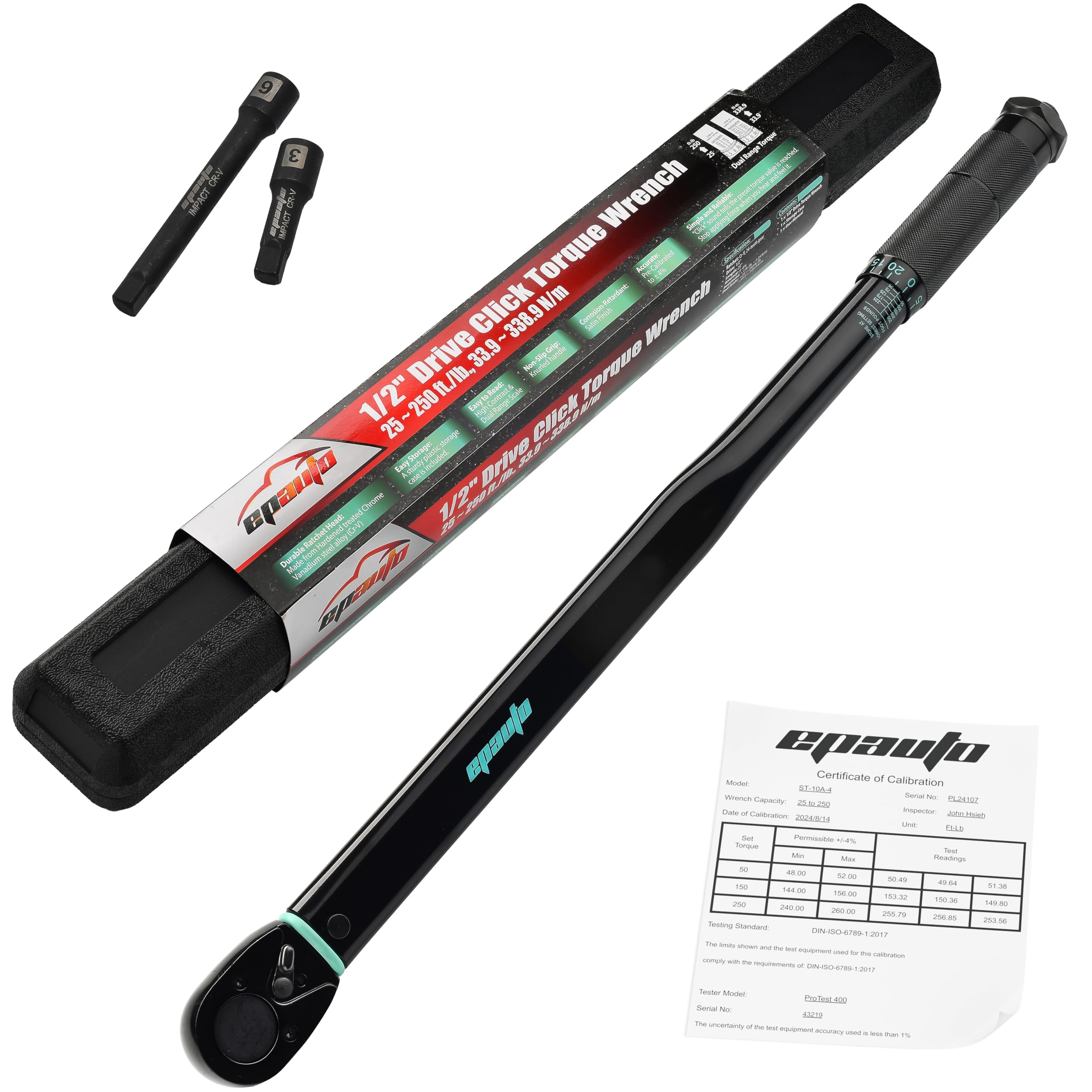
A straightforward, range-flexible wrench that goes to 250 ft-lb and comes with a storage case for clean garage storage.
The EPAuto spans 25 to 250 ft-lb, covering everything from wheel bearing nuts to suspension links. The ratchet head uses hardened Chrome Vanadium steel, and the satin finish helps resist corrosion without being glossy. The knurled handle gives you a solid grip even with greasy hands.
Pre-calibrated to ±4% accuracy, it comes in a sturdy plastic case that keeps the wrench safe when it is not in use — something owners consistently mention as a plus. The lock ring that holds your torque setting can loosen slightly during use, which a few owners note; it pays to double-check the setting before each bolt. At 6.5 pounds it is the heaviest wrench on this list, so extended overhead work may tire your arm faster.
Car Repairs: the home mechanic who wants a 250 ft-lb ceiling and appreciates the included storage case for a tidy toolbox.
Truck Jobs: the torque-setting lock needs periodic checking — not a deal-breaker, but worth knowing.
6. GEARWRENCH 1/2″ Drive Micrometer Torque Wrench (85066)

A micrometer-style wrench with a pull-adjustment collar that pro mechanics have trusted for years of daily shop use.
The GEARWRENCH is a different animal from the click-type wrenches above. It uses a micrometer-style mechanism with a pull adjustment collar — you pull back the collar, spin it to your torque, then release. The collar locks at the setting, so you do not have a separate lock ring to remember. Torque accuracy is ±3% clockwise between 20% and 100% of its 30–250 ft-lb range.
Its teardrop head and lever cam ratchet have a mechanical feel that seasoned mechanics prefer. Owners mention using this wrench daily for a decade without issue, and it holds accuracy within 2 ft-lb at 150 ft-lb. The long handle (26.75 inches) gives you the leverage you need for high-torque bolts. It is built in China now, which some long-time owners note as a change, but the fit and finish remain excellent. A carry case is included.
Shop Use: you want a professional-grade, micrometer-style wrench with the after-sales reputation of the GearWrench brand — a staple in shops for years.
7. TEKTON 1/2 Inch Drive 72-Tooth Split Beam Torque Wrench (TRQ62203)

The split-beam design eliminates the need to zero the wrench after each use, saving time in high-volume work.
The TEKTON is a split-beam torque wrench, which is a fundamentally different internal design from the micrometer click-types. The split beam means you can store the wrench at any torque setting without slowly wearing out the internal spring. It also means you do not have to wind it back to zero after every bolt — a step that is easy to forget and that extends the life of micrometer-style tools. The thumbscrew adjustment is silky smooth, and a flip-up cover locks the setting in place.
The 72-tooth ratchet head provides a 5-degree swing, and the wrench is accurate to ±4% across its full 40 to 250 ft-lb range. It is serialized and calibrated to the ASME B107.300-2010 standard, with detailed results on the included certificate. Owners consistently praise the build quality — 56 call it out as a standout feature — and the warranty is famously straightforward: replacement in minutes without proof of purchase. At 22.8 inches and 3.7 pounds, it is a manageable length for most work.
Speed Work: anyone who wants a tool that survives rough shop use — drops, water, multiple users — and can be stored without worrying about spring fatigue.
Tight Spaces: the 40 ft-lb floor means it cannot handle very small bolts (where a 10 ft-lb minimum would be needed).
8. Wera 05075621001 Click-Torque C 2
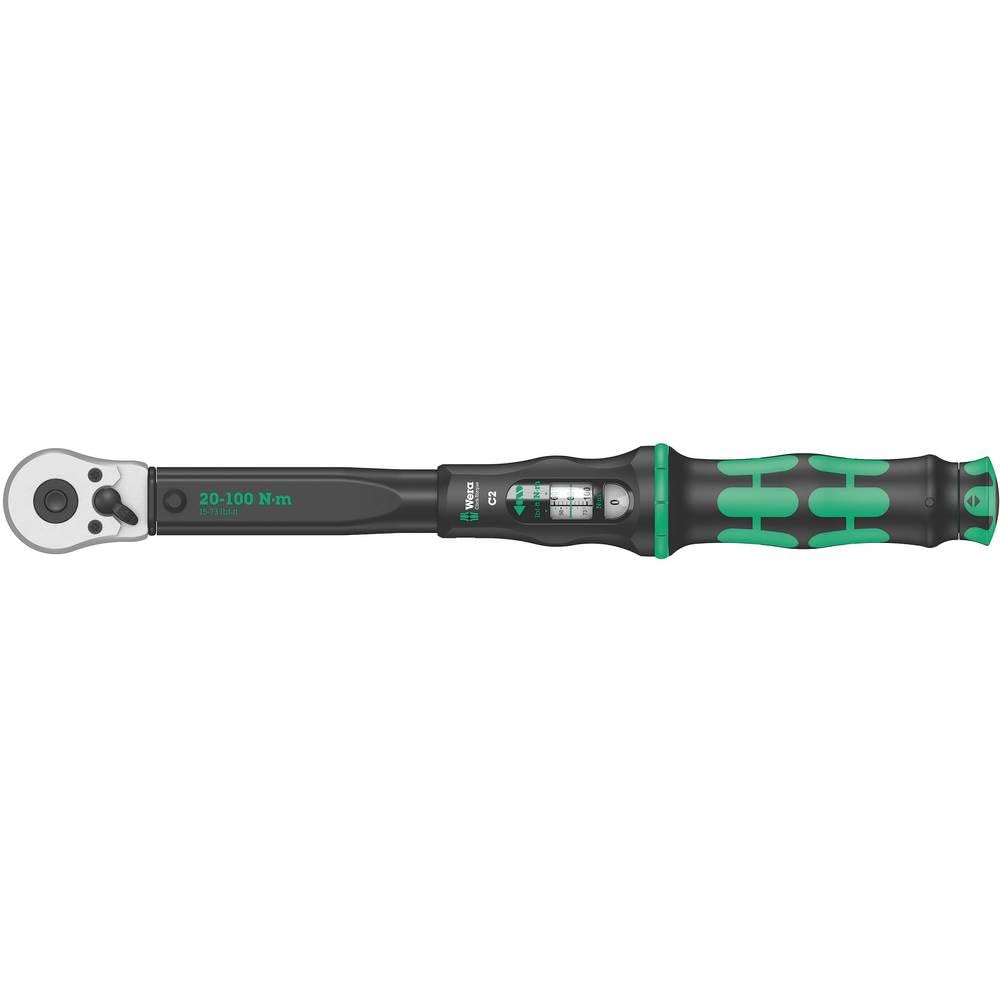
A smaller, 20–100 Nm German-made wrench that excels on European cars and precision assembly work.
The Wera is the specialist in this list. Its measuring range is 20–100 Nm (about 14.7 to 73.7 ft-lb), which is designed for the torque specs on many European vehicles, motorcycle fasteners, and precision mechanical assembly. It is not a truck or heavy-equipment tool — it is for the jobs where over-torquing by 5 ft-lb could damage a part.
The handle is a 2-component ergonomic design tune for right-hand use, and the ratchet head has 45 teeth. Accuracy is ±3% per DIN EN ISO 6789-1:2017-07. The release mechanism gives both an audible click and tactile feedback when the preset torque is reached. Owners love the quality — “precision without compromise” is a common sentiment — and it is hand-assembled in Germany. At 1.24 kg (about 2.7 lb) it is the lightest wrench here, perfect for carrying to different workstations.
Precision: the home mechanic or tech who works on BMW, Audi, VW, or motorcycles and wants factory-recommended torque for delicate fasteners.
9. DEWALT Digital Torque Wrench, 1/2 Inch Drive (DWMT17060)
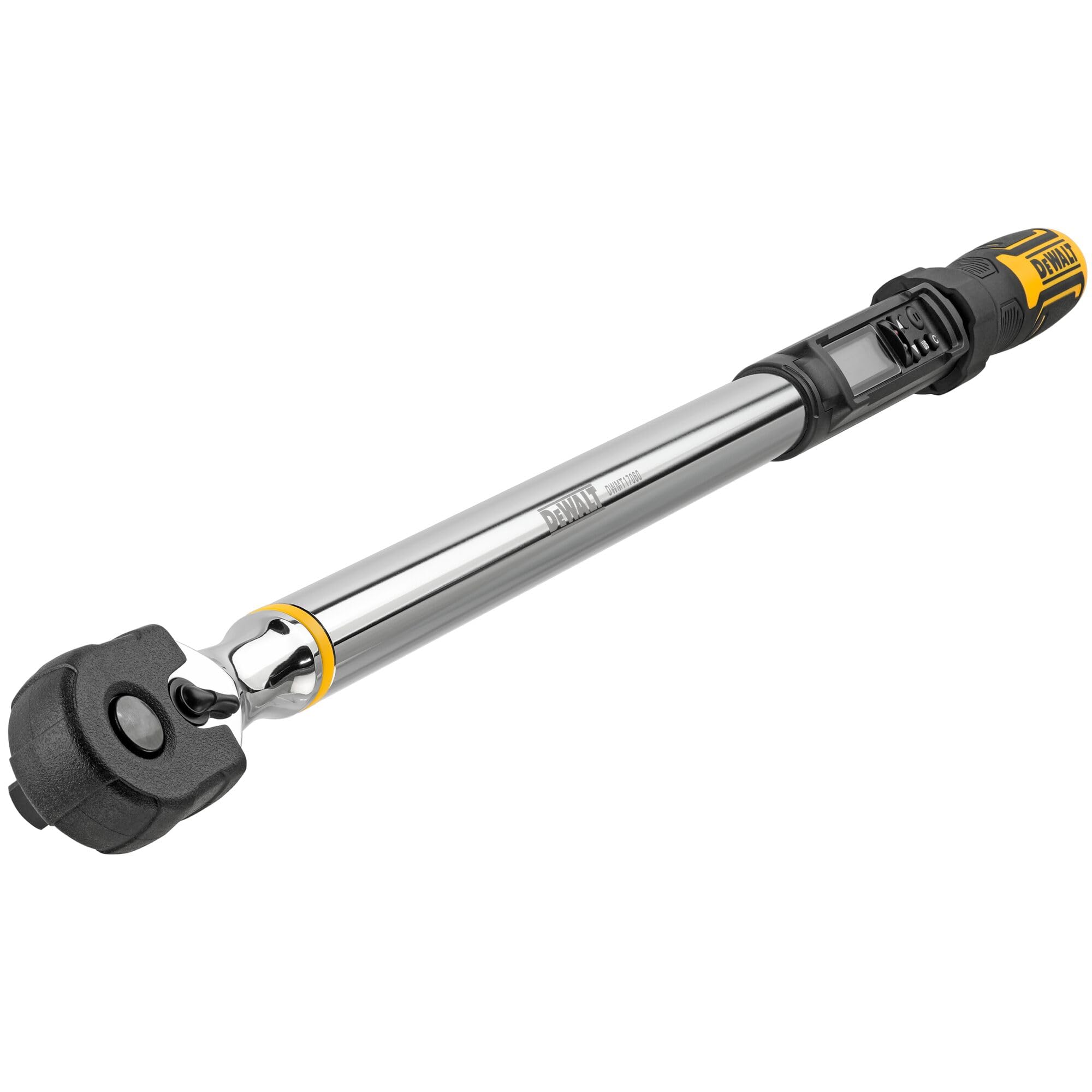
A digital wrench that swaps mechanical scales for a backlit LED screen — great for fast, accurate reading without squinting.
The DEWALT is the only digital option here. Instead of reading a scale on the shaft, you set the torque via a control panel and see the value on a backlit LED screen. You can switch between ft-lb, in-lb, and Nm with a button press. When you reach the target torque, it alerts you with beeps and a green LED — no need to listen for a click over the noise of a busy garage.
Its range is 50 to 250 ft-lb, covering most heavy automotive work. The bi-material handle is designed for extended comfort, and the ratchet head makes hand-tightening easy before torquing. Owners say the controls take a short learning curve but the accuracy is solid, and the included case keeps the unit protected. The one recurring note is that the final beep can let you drift slightly past the target if you push through, so aim to stop right at the alert. It runs on batteries that are best removed when the tool is stored for long periods.
Exact Torque: you prefer reading a clear digital screen and want the flexibility of switching units mid-job without mental math.
Understanding the Specs
Torque Range and Drive Size
The two numbers you see most — like “25–250 ft-lb” — tell you the minimum and maximum torque this wrench can apply. A 1/2-inch drive is standard for car and light-truck work because the square drive is thick enough to handle high torque without twisting. The low-end number matters as much as the high end. A wrench that starts at 10 ft-lb can do brake caliper bolts, while one that starts at 40 ft-lb cannot.
Accuracy and Calibration
Accuracy is stated as a percentage of the reading. A ±3% wrench at 100 ft-lb is off by at most 3 ft-lb either way; a ±4% wrench is off by up to 4 ft-lb. For lug nuts and suspension bolts, either is fine. For engine internals or transmission work, the tighter spec matters. Most quality wrenches ship with a calibration certificate tied to the tool’s serial number — keep it as proof the tool was tested against a known standard.
Split-Beam vs. Micrometer Click
Micrometer-style wrenches use a rotating handle that compresses an internal spring. They are accurate and familiar, but you should return them to the lowest setting for storage to prevent spring fatigue. Split-beam wrenches use a different internal mechanism — a beam that flexes. You can store them at any setting without wear, and you don’t need to reset to zero after each bolt. The trade-off is a slightly higher price point and a physically bulkier head.
Ratchet Tooth Count
The tooth count on the ratchet head determines the smallest swing angle you can make before the next click. A 72-tooth head needs 5 degrees of rotation — you can ratchet in a very tight space. A 45-tooth head needs 8 degrees; a 36-tooth head needs 10 degrees. For wheel wells or engine bays, 72 teeth or more saves you from pulling the wrench off and repositioning it constantly.
FAQ
How do I know what torque range I need for my car?
Should I store my torque wrench set to zero?
Can I use a 1/2-inch torque wrench for small bolts?
What does ±3% accuracy mean in real terms?
How often should I have a torque wrench recalibrated?
Why does my torque wrench length matter?
Is a digital torque wrench better than a click type?
Can I use a torque wrench to loosen bolts?
What is the difference between ft-lb and Nm?
Why do some torque wrenches come with adapters and extension bars?
Final Thoughts: The Verdict
Across the board, the best 1/2 inch torque wrench is the LEXIVON LX-183 because it nails the essentials — accurate (±4%), light (3 lb), and backed by tens of thousands of buyers who confirm it works. If you need a wider 30-250 ft-lb range and prefer a micrometer-style with a pro brand name, the GEARWRENCH 85066 is the shop-standard choice. And if you want a split-beam design that you can store anywhere and abuse without worry, the TEKTON TRQ62203 is the pick that keeps giving. Every tool on this list performs well; choose the one whose torque range fits your daily tasks.
How We Picked
We do not accept paid placement. Every pick is matched to a real buyer and a real use-case; we do not hands-on test units.
Sources & Methodology
Specifications: manufacturer listings and product documentation. Review insights: verified customer reviews, as of July 2026. Pricing: not shown on this page (it changes often); check the current price via the retailer link.
As an Amazon Associate, KitchPrep earns from qualifying purchases. This does not affect which products we feature.
Related Guides
