
Specs are compiled from manufacturer listings and verified buyer reviews and can change over time — please confirm the key details on the product page before buying.
If you are flattening a tabletop, refinishing a door, or stripping paint off a staircase, a 1/2-inch sheet sander is the right tool for the job. It covers a bigger surface than a palm sander, so you finish large, flat areas faster and with a more even result. This guide breaks down the four best options so you can match the right one to your workshop and your hands.
I’m Mohammad Maruf — the founder and writer behind KitchPrep. This guide is built by comparing the manufacturers’ published specifications and the patterns across verified customer reviews, so you get each pick’s real strengths and trade-offs instead of marketing spin.
You are here because you want a flat, smooth finish without burning time or money, so let’s find the best 1/2-inch sheet sander for your projects and your budget.
Our Picks at a Glance

How To Choose The Best 1/2-Inch Sheet Sander
Flattening a large wooden surface is faster with a 1/2-inch sheet sander than with a palm sander, because its tight orbital motion removes material quickly. Your choice depends on how much power you need, how much vibration you can tolerate, and how much you value a dust-free workshop.
Match the motor to the material
Motor amperage tells you how hard the sander can push. A higher-amp motor (think 2.5 A versus 2 A) maintains its speed better when you lean into tough jobs like stripping old paint. If you only do light finishing on new wood, a lower-amp motor easily keeps up and weighs less in your hand.
Weight is a real trade-off
Heavier sanders often feel more stable and help you flatten without pressing down, but they tire your arms on overhead work. Lighter models are easier to control for long sessions on vertical surfaces. Think about what you will sand most: heavy flat tabletops or the side of a cabinet.
Quick Comparison
| Model | Best For | Motor (Amps) | Max Speed | Weight | Amazon |
|---|---|---|---|---|---|
| Makita BO4900V★ Best Overall | Flat, flawless finishing | 2 A | 10,000 OPM | 6.6 lbs | Amazon |
| VEVOR Sheet Sander | Budget-friendly versatility | 2.5 A | 12,000 OPM | 4.9 lbs | Amazon |
| Steel Force PFS300 | Large flat panels | 2.5 A | 12,000 OPM | 3.3 lbs | Amazon |
| Bosch OS50VC | Low-vibration comfort | 3.4 A | — | — | Amazon |
In‑Depth Reviews
1. Makita BO4900V 1/2 Sheet Finishing Sander
Our pick — over 4.5★ from 300+ verified ratings; the strongest balance of quality and price.
The workshop favorite that flattens large surfaces with a smooth, quiet touch.
The first thing you notice is the control. A variable speed dial spins from 4,000 to 10,000 OPM (orbits per minute — how fast the pad moves in tight circles), so you can slow down for a fine finish or speed up for material removal. The motor is rated at 2 A, which is lower than some rivals, yet buyers report it handles heavy paint removal on old cedar without breaking a sweat.
Comfort is clearly where Makita spent its effort. The design minimizes vibration and uses contoured grips, which matters when you are sanding a floor or stair treads for an afternoon. The large trigger switch is easy to operate even with gloves, and the through-the-pad dust collection system keeps the work area noticeably cleaner. At 6.6 lbs, it is the heaviest sander here — that weight helps you flatten without pressing, but owners warn it gets tiring for overhead work.
It uses the common 4-1/2″ x 9-1/8″ hook-and-loop paper or 4-1/2″ x 11″ half-sheet abrasive, so finding supplies is easy. One honest note: the dust bag is disposable and some owners simply skip it. Owners mention it “beats Festool RS2E in direct test: smoother, quieter, flatter pad, better control/finish” — high praise from a demanding crowd. It is the only half-sheet sander many buyers can find, and they consider the cost justified for that reason alone.
Where it shines
- Variable speed dial (4,000–10,000 OPM) matches the tool to the task
- Minimized vibration and contoured grips for long sessions
- Owners rank the finish quality above pricier rivals
Fair trade-offs
- At 6.6 lbs it is heavy for overhead sanding
- Paper clips are stiff for tired hands
- Disposable dust bag is not everyone’s favorite
Grab it for: clean, flat finishing on large surfaces where vibration control matters most.
Think twice if: you do most of your sanding overhead — the weight will wear you out.
2. VEVOR 1/2 Sheet 2.5A Electric Sander
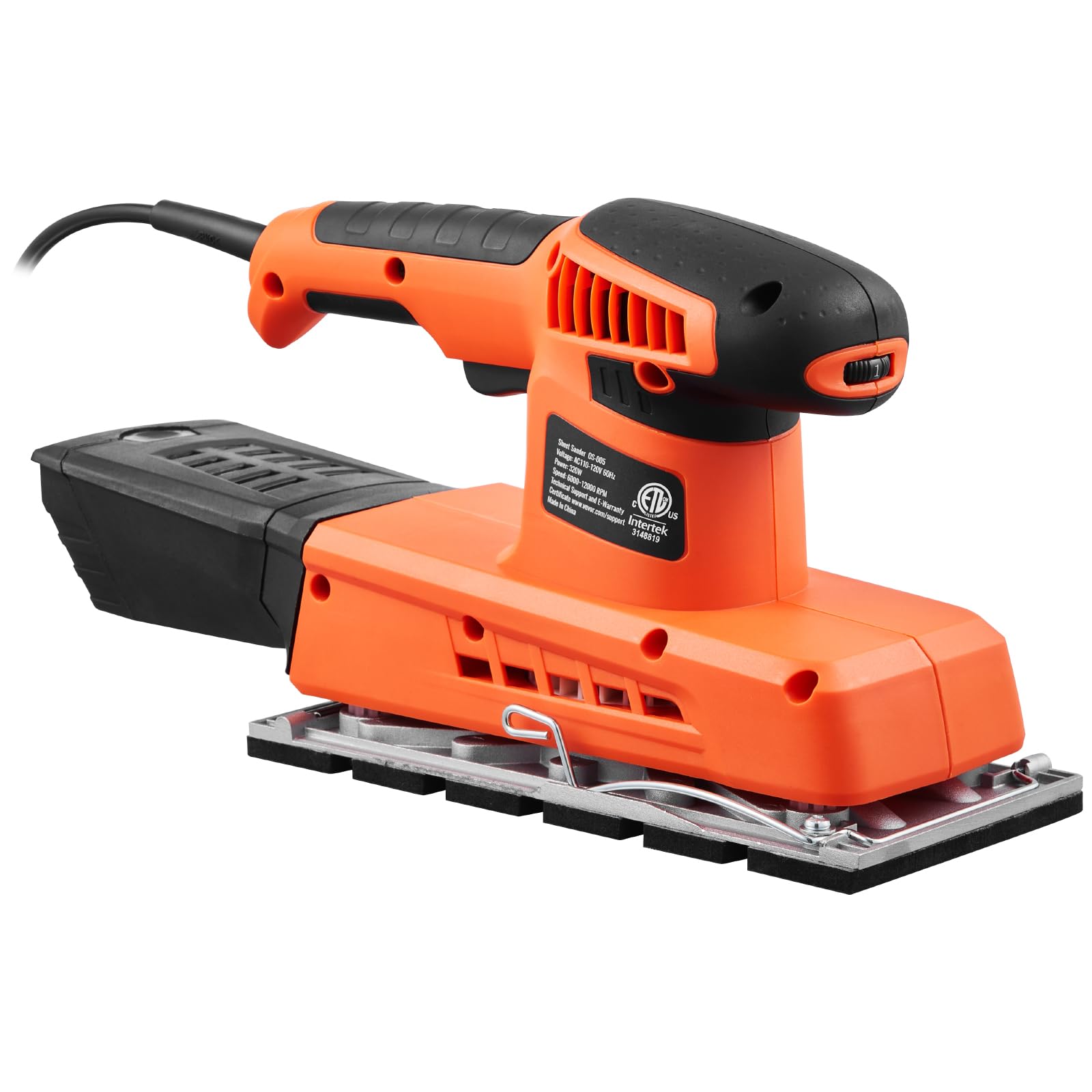
A budget-friendly workhorse with an aluminum base plate for even sanding.
VEVOR skips the frills and focuses on the fundamentals. A 2.5 A motor delivers 6,000–12,000 OPM in multi-stage adjustable speeds, giving you the same top speed as the Steel Force below but with a slightly lower starting point for delicate work. The rubber-coated handle is ergonomically shaped to reduce fatigue, a real plus when you face a long list of sanding tasks.
What sets this apart at its tier is the precision-machined aluminum sanding plate. Aluminum stays flatter and sands more uniformly than plastic bases, which translates directly to a more even finish on tabletops and panels. The clamp-type sandpaper design lets you swap sheets without any tool, and it even accepts cloth-backed paper for more options.
The detachable dust box collects the mess indoors, and buyers confirm the dust collection works “really great too.” As one owner put it, the vacuum system is a genuine highlight. At 4.9 lbs, it sits mid-pack for weight — noticeably lighter than the Makita above, but about 1.6 lbs heavier than the Steel Force. It is an honest budget pick, though a few customers note that finding the proper sandpaper takes some hunting.
Why it earns its keep
- Aluminum base plate sands flatter than plastic rivals
- 2.5 A motor with 6,000–12,000 OPM variable speed
- Tool-free clamp design for quick paper swaps
Know before you buy
- Sanding paper can be hard to source at first
- Vibration is about average for the category
Pick this if: you want solid performance and an aluminum plate without spending premium money.
Look elsewhere if: you need the lowest possible vibration for hours of continuous work.
3. Steel Force PFS300 Sheet Sander

The featherweight that covers ground fast with a 9×4.5-inch sanding base.
At 3.3 lbs, this is the lightest sander on the list — 1.6 lbs lighter than the VEVOR above and about half the weight of the Makita. That makes it the friendliest option for overhead work and long sessions where arm fatigue is the real enemy. The large 9×4.5 inch base (230×115mm) covers more surface per pass than most rivals, so big flat panels get done in fewer strokes.
Power is not sacrificed for the light weight. A 2.5 A motor drives 6,000–12,000 OPM with a 6-stage speed dial, letting you dial in the right pace for everything from fine finishing to aggressive stripping. It matches the VEVOR’s 12,000 rpm top speed while also sharing the bump up from the Makita’s 10,000 rpm ceiling. The aluminum base plate keeps the sanding even and durable, and the hook-and-loop pad makes paper changes quick.
Its built-in microfilter traps particles down to 1/2 micron, keeping indoor air cleaner during sanding. Long-time owners are emphatic — one in their 60s calls it “the best 9×4.5 orbital sander I have ever owned.” The honest caveat: finding hook-and-loop pads in this exact size is hard, and some buyers fall back to cutting larger sheets and using the clips. It also sees interesting uses beyond wood — one felter calls the variable speed a standout for wet felting.
The strong points
- Featherlight 3.3 lbs for fatigue-free overhead work
- Microfilter traps particles down to 1/2 micron
- Large 9×4.5 inch base covers ground fast
The honest gaps
- Hook-and-loop pads in this size are hard to find
- Quality feedback is mixed across owners
Reach for this if: you want a light sander for large flat areas and don’t mind hunting for pads.
skip it if: you want to buy standard-size paper off any shelf without fuss.
4. Bosch OS50VC Orbital Sander

The anti-vibration marvel that makes long sanding sessions genuinely comfortable.
The flex-mounted motor isolates vibration, and owners confirm it delivers the lowest vibration of any electric orbital sander. The flex-mounted motor isolates the vibration before it reaches your hands, and reviewers point out no more tingling after extended use. One owner who switched from a Milwaukee 6010 says this one is much quieter and simply “an engineering marvel.” At 3.4 A, it is the most powerful motor on this list, giving it the muscle to flatten glue-ups and even save you the cost of a drum sander.
The SheetLoc Supreme paper clamping system is the best in class — easy to operate even for arthritic hands, and it pulls the paper taut for a perfectly flat surface. It also accepts stick-on paper and any sheet via the included punch plate. The orbit diameter is 3/32 inch, a tight pattern that leaves a smooth finish. Inside the kit you get the sander, a micro filter dust canister, a removable front handle, a vacuum hose adapter, a 5 mm hex wrench, a sanding sheet, and a punch plate.
Dust collection is where this sander truly separates itself. The translucent micro filter canister screws off for easy emptying, and with a vacuum attached, shoppers say zero visible dust. A 3.4 A motor and specialized features justify the premium price for serious woodworkers. The recurring gripes are minor: the trigger lock takes getting used to, and the heavy weight is actually an advantage for flattening since it prevents you from pressing too hard. It accepts 4.5 x 9 inch sheets.
What you’re paying for
- Lowest-vibration design with flex-mounted motor
- top-tier SheetLoc clamping, easy on the hands
- Exceptional dust collection — zero visible dust with vacuum
Keep in mind
- Premium price tag for a finishing tool
- Trigger lock position takes time to learn
Choose this if: you spend long days sanding and want the most comfortable, cleanest experience available.
Pass if: your sanding is occasional and light — the price is hard to justify for weekend touch-ups.
Understanding the Specs
OPM and variable speed
OPM stands for orbits per minute — how many tight circles the pad makes in a minute. A higher number means faster material removal. Variable speed lets you slow down for a fine finish on soft wood or speed up to strip paint. Look for a range like 6,000–12,000 OPM so you can match the tool to the job.
Dust collection systems
A sheet sander without good dust control coats your shop in a fine layer of wood dust. Look for through-the-pad collection, where holes in the base pull dust into a canister or a vacuum hose. Higher-end units trap particles down to 1/2 micron, which keeps indoor air noticeably cleaner while you work.
FAQ
What is the difference between a sheet sander and a random orbital sander?
Will a 1/2 sheet sander remove paint effectively?
What size sandpaper does a 1/2 sheet sander use?
Is a heavier sander better for flattening surfaces?
How does the Bosch OS50VC compare to the Makita BO4900V?
Is the VEVOR sander good for a beginner?
Can I use a 1/2 sheet sander for wet felting or other crafts?
How important is a dust collection system on a sheet sander?
Final Thoughts: The Verdict
For the majority of shoppers, the best 1/2-inch sheet sander winner is the Makita BO4900V because it pairs a variable speed dial with a low-vibration design at a price that undercuts premium rivals. If you want the lightest tool for long overhead sessions, grab the Steel Force PFS300. And if you spend serious hours in the shop and want the most comfortable, cleanest experience money can buy, the Bosch OS50VC is the one to reach for — its crowd of owners gives it a 4.6-star rating that speaks to its polish.
How We Picked
We do not accept paid placement. Every pick is matched to a real buyer and a real use-case; we do not hands-on test units.
Sources & Methodology
Specifications: manufacturer listings and product documentation. Review insights: verified customer reviews, as of August 2026. Pricing: not shown on this page (it changes often); check the current price via the retailer link.
As an Amazon Associate, KitchPrep earns from qualifying purchases. This does not affect which products we feature.
Related Guides
