
Specs are compiled from manufacturer listings and verified buyer reviews and can change over time — please confirm the key details on the product page before buying.
Running a gas line to a grill, generator, or dryer used to mean cutting and threading rigid black iron pipe — a job most homeowners hand off to a plumber. A flexible 1/2 inch gas line changes that. It bends around corners by hand, connects with brass fittings, and lets you move an appliance where you actually want it. The trick is matching the right hose to the right job, because a generator hookup and a stove install need different fittings. This guide sorts the real options by how you’ll use them, so you buy once and get it right.
I’m Mohammad Maruf — the founder and writer behind KitchPrep. This guide is built by comparing the manufacturers’ published specifications and the patterns across verified customer reviews, so you get each pick’s real strengths and trade-offs instead of marketing spin.
A quick note before we start: this list allows the nearest same-type size when an exact 1/2 inch match isn’t available, so not every pick is the precise number you searched. Here’s what separates the best 1/2 Inch Flexible Gas Line picks from the rest of the shelf.
Our Picks at a Glance


How To Choose The Best 1/2 Inch Flexible Gas Line
Every one of these hoses does the same basic job: it carries low-pressure natural gas or propane from a supply line to an appliance. What separates a good experience from a frustrating one is fit — the inside diameter, the threaded ends, and how much gas the hose can move. Get those three right and installation is a fifteen-minute job. Get them wrong and you’re making a second trip to the hardware store.
Inside Diameter And BTU Capacity
The number that matters most is the inside diameter — the actual width of the tube the gas flows through, measured in inches or millimeters. A wider bore moves more fuel per hour, which is measured in BTU (British Thermal Units). A hose rated for 100,000 BTU per hour feeds a large grill or a mid-size generator; a hose rated for 135,000 or 150,000 BTU per hour gives you headroom for bigger burners. Undersize the bore and burners run weak while generators starve under load.
Thread Types And Adapters
Gas fittings speak a language of abbreviations. MIP means Male Iron Pipe, a threaded male end. FIP means Female Iron Pipe, the matching female end. Flare fittings seal on an angled cone instead of threads. A quick-disconnect plug lets you snap the hose on and off without tools. Most kits throw in several adapters so one hose fits a range of appliances — check the included list carefully, because a missing adapter is the most common reason a hose gets returned.
Rubber-And-Brass Versus CSST
Rubber-and-brass hoses are the flexible, kink-resistant choice for grills, patio heaters, and generators you hook up seasonally. CSST — Corrugated Stainless Steel Tubing — is a thin metal tube wrapped in a yellow UV-resistant polyethylene jacket. CSST can be cut to any length you need and snaked through attics and basements. Both are approved for indoor and outdoor use when they carry the right certification.
Quick Comparison
| Model | Best For | Length | BTU Capacity | End Fittings | Amazon |
|---|---|---|---|---|---|
| Azdele 12 Ft RV Quick Connect★ Best Overall | Generator hookups | 144 inches | 100,000 BTU/hr | 1/2″ quick disconnect, 1/2″ & 3/8″ flare | Amazon |
| Alloxity 48″ Gas Dryer KitBest Value | Appliance installs | 48 inches | — | 1/2″ & 3/4″ MIP, 1/2″ FIP | Amazon |
| MIFLUS 72″ Flexible Gas LineTightest Bends | Fireplaces & dryers | 72 inches | — | 1/2″ MIP, 1/2″ FIP | Amazon |
| CALPOSE 15 Ft Natural Gas Hose | Outdoor grills | 15 feet (180″) | — | 1/2″ quick disconnect, 3/4″-16UNF flare | Amazon |
| SUMNEW 12 Ft CSA Kit | Weber & Charbroil grills | 144 inches | 135,000 BTU/hr | 3/4″ quick disconnect & flared coupling | Amazon |
| GasSaf 10 FT Quick Connect | BBQ & pizza ovens | 10 feet (120″) | — | 1/2″ female flare | Amazon |
| Grehitk 33 Ft CSST Kit | Long custom runs | 396 inches (33 ft) | 150,000 BTU/hr | 2 male adapters | Amazon |
| Kinchoix 37 Ft CSST | Permanent line runs | 444 inches (37 ft) | 100,000 BTU/hr | 1/2″ male brass, both ends | Amazon |
In‑Depth Reviews
1. Upgraded 12 Feet 1/2 Inch Rv Quick Connect Natural Gas Hose Gas Line
Our pick — over 4.5★ from 700+ verified ratings; the strongest balance of quality and price.
The generator hose that keeps the house lit when the grid goes down
Running a tri-fuel generator off your home gas meter? You need a hose long enough to reach from a covered walkway or garage corner to where the generator sits. The Azdele hose gives you 144 inches (12 feet) of reach and moves up to 100,000 BTU per hour (a measure of fuel flow), enough to fuel grills 30 inches and larger.
Start with the build, because this is where it earns its place at the top. The tube body is rubber and the threads are solid brass — a metal that resists chipping and rust rather than flaking away after a season in the weather. The kit ships with a 1/2 inch quick disconnect plug, 1/2 inch female flare fittings, and a 3/8 inch female flare by 1/2 inch male flare brass adapter, plus sealing tape. It carries CSA certification, the safety standard for gas connectors, so you’re not guessing about whether it’s rated for this job.
Buyers report using this hose through Houston outages and freeze-driven blackouts without problems. One reviewer wrote: “Works with Firman 7500W tri-fuel generator; 48-ft flexible hose reaches meter from covered walkway; brass fittings, good quality; used twice during Houston outages; recommended to friends.” Others pair it with 250-gallon propane tanks to feed two inverter generators at once and say the heavy-duty feel matches the price. The catch: fitting size is everything here, and mismatches happen. Several buyers found the connectors didn’t match their supply stub, so measure both ends of your connection before ordering.
What earns it the top spot
- Twelve feet of reach and 100,000 BTU/hr fuel flow in one hose
- Solid brass threads that resist rust and chipping
- Ships with 1/2″ quick disconnect, flare fittings, and a 3/8″ adapter
- CSA certified for confidence on gas connections
Where it needs care
- Fitting size mismatches happen — measure your connection first
- Rubber outer layer will dry and crack if left in direct sun long-term
Built for: anyone converting a tri-fuel generator to run off home natural gas or a bulk propane tank through a power outage.
Skip if: your appliance uses a different flare size than the included fittings — check the adapter list against your stub before buying.
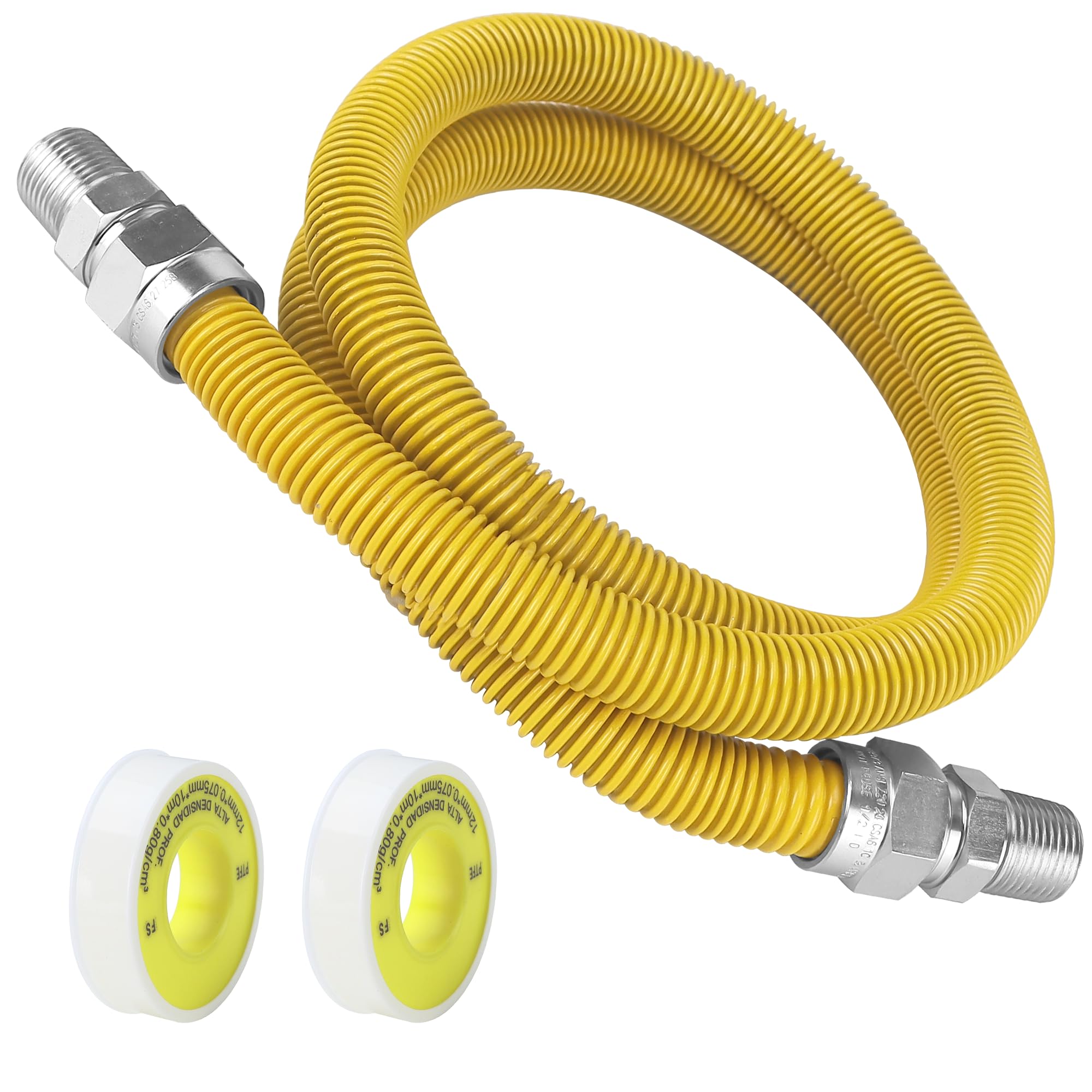
2. 48″ Flex Gas Line, Gas Dryer Connector Kit by Alloxity
Four feet of coated stainless with six adapters — the appliance swap kit
You’re replacing a dryer, range, or water heater and you want the fittings sorted before you start. This is the kit for that job. The 48-inch corrugated line is made from 304 stainless steel — the corrosion-resistant grade — with a coating that stands up to smoke, chemical stains, and UV light, and it’s approved for indoor and outdoor use. Factory leak testing and CSA certification to ANSI Z21.24, Z21.75, and Z21.93 back it up.
The included hardware list is the reason to pick this one over a bare hose: two 1/2 inch MIP fittings, two 3/4 inch MIP fittings, two 1/2 inch FIP adapters, and a roll of gas thread tape. LG, GE, and Samsung gas range owners make up most of the happy crowd here, and the kit has the fittings to cover the common appliance thread patterns. What wins people over most is the sheer completeness — this is the set that ends the second trip to the store. It also handles tight installations well: a stove tucked into a narrow gap installs cleanly because the corrugated tubing flexes where rigid pipe won’t.
The one thing to know going in is that fit varies by appliance, not by hose. Some owners found it slid straight on; others needed slightly different threads than their particular model used. That’s a measurement question, not a quality one — and the adapters included cover far more combinations than a single-fitting hose would. For the money, the adapter count alone justifies the pick.
The complete-package case: six fittings and sealing tape turn a two-trip project into a one-trip project, and the 304 stainless body resists the kinks and corrosion that kill cheap connectors.
Reach for this if: you’re swapping in a new dryer, stove, or water heater and want adapters for every common thread size in one box.
Look elsewhere if: you need a run longer than four feet between the supply valve and the appliance.
3. 72″ Flexible Gas Line Hose by MIFLUS
Built for the corner no rigid pipe can reach
Some installs aren’t about total length — they’re about one impossible turn. This six-foot hose is the answer when you need a sharp 90-degree bend at one end and there’s no room to bring in elbows. The yellow-coated stainless steel construction folds and bends into narrow corners, and the yellow coating makes the line easy to spot in a dark cabinet or behind a fireplace insert.
What makes it work is the stainless body with a compression joint, which holds a metal-to-metal seal instead of relying on tape at every connection. The kit comes with two end fittings — a 1/2 inch OD by 3/4-16UN fitting and a 1/2 inch OD by 1/2 inch MIP fitting — plus a set of threaded tape. A word of warning straight from the manufacturer: do not wrap raw tape on the side that connects to the yellow bellows, or you’ll create a leak where you meant to seal one.
Repeat buyers run these on gas fireplaces. One household bought two — one for each new fireplace — and reported no leaks after installation and compatibility with two different fireplace brands. Another used one to connect a refurbished antique fireplace insert and loved the result. The recurring caution is straightforward: fit and length are everything with gas hoses, and the wrong thread size on your appliance means this won’t seal no matter how well it’s built.
The flexibility payoff: a 90-degree turn that would take three pipe fittings on a rigid run happens in one bend here, and the coated stainless resists the corrosion that eats bare metal in damp basements.
Install note worth repeating: leave the bellows side tape-free and use the supplied fittings as designed — the two-fitting kit covers most gas dryers and wall heaters without extras.
Pick this one when: your run needs a hard corner or a fireplace insert connection and you want the yellow line visible for safety checks.
Consider a longer hose instead if: your gap between the valve and appliance is more than six feet.
4. CALPOSE 15 Feet 1/2 inch ID Natural Gas Hose for Outdoor Grill

Fifteen feet of reach turns any patio corner into a grill station
If your gas stub sits on the far wall and your grill lives at the other end of the deck, fifteen feet is the length that solves that problem without adding fittings. This CALPOSE hose measures 180 inches and carries a 1/2 inch inside diameter — the full-bore size that moves more gas than a 3/8 inch hose ever will. That matters for a grill that needs even heat across a wide grate.
Construction is a layered approach: a natural rubber outer skin over a flexible stainless steel inner layer, with 100% solid brass 1/2 inch quick connect/disconnect fittings at the working end. That means you can snap the hose on and off the grill without tools — a real benefit if you pull the grill under cover for winter and need to break the connection cleanly. The other end is a 3/4-16UNF female flare fitting. It’s rated for both natural gas and LP applications, and it connects to existing low-pressure supply lines.
Buyers use these on emergency generators, patio heaters, fire tables, pizza ovens, and natural gas grills. The heavy-duty feel gets consistent praise, and one reviewer noted the pliability lets the hose “lay flat and not cause any tripping hazard” — a small detail you appreciate when you step over a stiff line. The trade-off is the connections: quick-connect fittings on gas lines are more sensitive to torque (tightening force) than people expect, and a slightly loose connection leaks. That’s why the standard advice is to use blue bubble solution or a gas sniffer on every joint before first use.
The best of this pick
- 180-inch reach covers most patio layouts without extensions
- 1/2″ inside diameter feeds larger grills with steady flow
- Quick-disconnect ends mean tool-free attach and removal
- Rubber-and-stainless construction resists cracking and rust
What to know going in
- Quick-connect joints need a proper wrench-tight seal — check every one for leaks before the first cook
- Rated for a 3/4″-16UNF female flare connection; different flare sizes need an adapter
Right fit for: a permanent outdoor grill, fire table, or patio heater that lives at the far end of a long supply run.
Wrong size for: appliance connections that need MIP or FIP iron pipe threads — those want a kit with adapters like the Alloxity above.
5. 12 Feet 1/2 Inch ID Natural Gas Hose with Quick Disconnect by SUMNEW

The high-flow hose for big burners and hungry grills
For a wide grill or a high-BTU burner array, fuel flow rate is the limiting factor and this hose leads the group on paper. The 12-foot, 1/2 inch inside diameter hose can deliver up to 135,000 BTU per hour — a step above the 100,000 BTU hourly rating on the Azdele at the top of this list. If you’ve ever watched a large grill struggle to hold temperature while the hood is open, that flow number is why. It’s CSA certified and built with solid brass quick-disconnect fittings on both ends so you can attach and remove it without tools.
The shape and coverage are the broader story here: a rubber body over solid brass, finished with weather and rust resistance for outdoor use. It fits Weber and Charbroil grills cleanly, and it converts propane appliances to a natural gas supply with the right fitting sequence. It’s also a frequent pick for generator owners — the same 135,000 BTU rating buys you a wide margin of safety when a generator is drawing at partial load.
Where this one calls for care is around the fittings. Quick-connect hardware is only as reliable as its thread match, and a subset of owners found the ends on their particular supply didn’t align as advertised. That’s a fit and completeness issue rather than a build problem — the hose itself holds up. The headroom per hour of fuel flow is the standout: no other standard hose on this list hits this rating with a 12-foot working length and brass quick connects in the same package.
The flow argument: 135,000 BTU/hr over 12 feet is real range for a large grill or generator that needs margin — that number is the reason this sits above the 100,000-reted hoses here.
Thread match is the whole game: measure your supply stub and your appliance fitting first, because the quick-connect ends must match exactly — several buyers found the female ends weren’t quite what their setup needed.
Best for: a Weber or Charbroil owner converting to natural gas who wants maximum fuel headroom in a 12-foot run.
Not for: anyone who needs a custom length longer than 12 feet — the fittings on this kit are preset and the hose can’t be trimmed.
6. GasSaf 10 FT 1/2″ ID Natural Gas Hose with Quick Connect Fitting

Ten feet of brass-terminated hose — the everyday grill connector
For most fixed outdoor grills, ten feet is the balance. This GasSaf hose hits that with a 1/2 inch inside diameter (the width of the fuel passage) that delivers more fuel than the narrower 3/8 inch hoses common on older kits. The 120-inch length gives you room to slide the grill a few feet without disconnecting. It’s rated for both LP (liquefied petroleum, or propane) gas and natural gas, so it works whether your supply is a bulk propane tank stub or a natural gas line.
The connectors are boring by design, and that’s a good thing. The hose uses 1/2 inch female flare fittings (they seal on an angled cone, not threads) and includes a 1/2 inch female flare by 1/2 inch female adapter, plus a dust cap and plug to protect the brass ends between seasons. The included 3/8 inch to 1/2 inch adapter turns many conversions into a ten-minute job — thread it onto the grill end to mate a 1/2 inch feed line to the standard 3/8 inch grill inlet. Brass construction keeps the fittings smooth, and the quick-connect ends snap on with a click.
The caveat that shows up most often in longer-term use isn’t the hose — it’s the outdoors. The rubber outer layer isn’t armored, and a couple of owners found squirrels or weather chewed through it over a season or two. If your grill sits exposed year-round in a rodent-heavy yard, a steel-braided or CSST-style line gives you more protection. For covered patios and normal use, though, this earns its keep as the dependable everyday connector — no leaks, no fittings to chase down.
Value in the small stuff: the included 3/8″ to 1/2″ adapter and the protective dust cap/plug mean this hose arrives ready for a standard grill hookup without an extra store run.
Environment matters: the rubber jacket isn’t armored, so hoses left exposed to weather and wildlife benefit from a cover or a swap to steel-braided over time.
Good match for: anyone connecting a backyard grill or pizza oven to a house LP stub or natural gas line where 10 feet will do.
Choose differently if: your grill is far from the supply stub or sits fully exposed to weather — a longer or armored line serves better.
7. Grehitk 33ft 1/2” Flexible Gas Line, CSST Corrugated Stainless Steel Tubing Pipe Kit

Thirty-three feet you can cut to the exact length you need
When you’re running a new gas line through an attic or basement — not just hooking up one appliance — this is the one to get. The 396-inch CSST (Corrugated Stainless Steel Tubing, a flexible metal pipe) reel comes in at 33 feet, the longest nominal run in this guide, and you can cut it anywhere along its length to fit. The bore is 1/2 inch nominal, the body is SUS304 corrosion-resistant stainless steel, and the surface has a yellow UV-resistant polyethylene jacket (PE, a plastic coating) that stands up to sunlight and damp crawl spaces.
This one has the highest fuel capacity on the list: up to 150,000 BTU per hour, enough headroom for a big burner array, a fire pit, or a water heater fed off the same trunk line. It’s flexible enough to snake through corners and bends that would need a stack of elbows on rigid pipe. One-piece molding means no interior joint inside the tube, which reduces leak points. Owners mention it bends around corners without kinking and mounts to wall studs cleanly.
The honest caveat is sizing. Buyers consistently flag that the actual pipe dimensions don’t match the industry-standard nominal size printed on the listing. So if your install requires mating to standard termination flanges or stock iron pipe fittings, check the spec carefully before ordering. If you’re running a line outdoors and using the supplied adapters, that same 8-gauge reality doesn’t bite as hard. And a safety note from the manufacturer: never bury CSST directly in the ground — it needs a non-metallic conduit sleeve at least a half-inch larger than the tube’s outside diameter.
Why the length matters
- 33 feet of cuttable CSST stretches across a large home run in one piece
- 150,000 BTU/hr capacity clears big fire pits and multi-appliance trunks
- SUS304 stainless and a UV-resistant PE jacket resist corrosion and sunlight
- No interior joints — fewer leak points than an elbow-stacked rigid run
Where matching gets tricky
- Advertised nominal size may not match standard iron pipe sizing — verify against your fittings
- Needs conduit protection if routed underground
Best suited to: a home project running a fresh gas line across a long distance where a single cuttable reel beats piecing rigid pipe together.
Expect issues if: your install must mate to stock iron pipe fittings — measure the actual OD/ID against your hardware first to confirm compatibility.
8. CSST Corrugated Stainless Steel Tubing 37 Ft 1/2″ Flexible Natural Gas Line Pipe by Kinchoix

The full twenty-yard run for a proper hardwired gas branch
For a run from a main trunk line to a water heater, fireplace, or range across the house, 37 feet (444 inches) is a comfortable single-piece working length. The tube carries a 12mm inner diameter and 16mm outside diameter — listed as 0.48 inch ID by 0.63 inch OD — and is rated for up to 100,000 BTU per hour of flow. The body is SUS304 stainless steel under a yellow UV-resistant polyethylene jacket, and both ends come fitted with 1/2 inch male brass fittings using standard male and female pipe threads.
This is the install-friendly option among the CSST picks: the tube snakes easily into attics and basements, bends around corners, and can be embedded in concrete or fished behind a drywall system without extra joints between the fittings. The one-piece molding means there’s no interior seam inside the body — one fewer leak point in the assembly. The compression-style end connections hold a solid seal when they’re properly torqued, and the stainless-and-PE build resists the temperature swings and humidity of a crawl space.
Two things to know before you commit. First, over-tightening the end fittings is the most common mistake — snug and then a quarter-turn more is plenty. Second, the actual dimensions are a frequent complaint: buyers expecting a true 3/4 inch pipe found a roughly 5/8 inch ID (inside diameter) tube with 3/4 inch pipe ends instead. So if your install has to mate to a specified nominal size, measure carefully. For a straightforward run using the included fittings, it’s a clean, low-fuss install that doesn’t need a threading machine.
The labor-saving angle: snaking this through a stud bay or around a corner is hands-on work a single person can manage, where a rigid pipe run would need elbows, cutting, and threading at every turn.
Torque to taste: the fittings need a firm but not aggressive hand — crank them too hard and the seal deforms instead of seating.
Ideal for: a homeowner or contractor pulling a long CSST line from a trunk to a distant appliance in one continuous piece.
Double-check the fit if: you need a true 3/4 inch pipe run — the actual ID here runs smaller, so confirm against your end hardware first.
Understanding the Specs
Inside Diameter (ID) And Flow Capacity
Inside diameter is the width of the channel the gas actually travels through, measured in inches or millimeters. The 1/2 inch ID hoses here move more fuel per hour than 3/8 inch lines, and each listing states its BTU/hr capacity — the number you match to your appliance’s demand. A generator or large grill that needs more flow than the hose delivers will run weak, so size up slightly for headroom. Always match the inside diameter first, since the outside diameter printed on a box can describe the jacket rather than the bore.
Fitting Types And Certification
MIP (Male Iron Pipe) is the threaded male end; FIP (Female Iron Pipe) is the matching female end; flare fittings seal on an angled cone instead of threads; and a quick-disconnect plug lets you remove the hose without tools. Certification matters too — CSA certification proves a gas connector has been tested to the relevant ANSI safety standards for its intended use, whether that’s indoor appliances, outdoor grills, or both. Match the fitting types on your supply stub and your appliance before buying, torque every joint snug, then leak-test with a bubble solution.
FAQ
How do I know if a 1/2 inch flexible gas line will fit my grill?
What is the difference between MIP and FIP gas fittings?
Can a 1/2 inch flexible gas line be used outdoors all year?
What BTU rating do I need for a natural gas generator hookup?
Do I need to check for leaks after installing a flexible gas line?
How long does a flexible gas line last?
Can I cut a CSST flexible gas line to a custom length?
Is a flexible gas line better than rigid black iron pipe?
What should I do if the fittings on my hose don’t match my appliance?
Can I use a natural gas hose for propane, or are they different?
Final Thoughts: The Verdict
The clear pick is the Azdele 12 Feet 1/2 Inch RV Quick Connect — CSA-certified, 144 inches of reach, and 100,000 BTU/hr, enough to feed a tri-fuel generator through an outage. For a stove, dryer, or water heater install, the Alloxity 48″ Gas Dryer Kit ships with six adapters and covers the widest range of appliance threads from the start. If you want maximum fuel flow for a big grill or a generator with margin to spare, the SUMNEW 12 Ft CSA Kit leads on flow at 135,000 BTU/hr. And for a long line run through an attic or basement, the Grehitk 33 Ft CSST Kit gives you the most cuttable length with the highest flow rating in the guide. Whichever you pick, measure your fittings first and leak-test every joint — that’s the two minutes that makes the whole job worthwhile.
How We Picked
We do not accept paid placement. Every pick is matched to a real buyer and a real use-case; we do not hands-on test units.
Sources & Methodology
Specifications: manufacturer listings and product documentation. Review insights: verified customer reviews, as of September 2026. Pricing: not shown on this page (it changes often); check the current price via the retailer link.
As an Amazon Associate, KitchPrep earns from qualifying purchases. This does not affect which products we feature.
Related Guides
