
Specs are compiled from manufacturer listings and verified buyer reviews and can change over time — please confirm the key details on the product page before buying.
You need a 1/2 inch drive ratchet when a smaller tool just won’t deliver the twisting force to free a stubborn lug nut or bolt. A bad ratchet slips, skips teeth, or breaks mid-job — wasting time and risking injury.
I’m Mohammad Maruf — the founder and writer behind KitchPrep. This guide is built by comparing the manufacturers’ published specifications and the patterns across verified customer reviews, so you get each pick’s real strengths and trade-offs instead of marketing spin.
Tooth counts, handle lengths, flex heads, and build quality vary widely. This guide breaks down the top contenders by what they actually do best in the real world — not just the spec sheet — so you can pick the right 1/2 inch drive ratchet for your job.
Our Picks at a Glance

How To Choose The Best 1/2 Inch Drive Ratchet
Choosing a ratchet means matching the tool to your actual work. A home mechanic who tackles the occasional brake job has a different set of priorities than a pro who lives under a car eight hours a day. These key factors separate a great-feeling ratchet from one you’ll regret buying.
Tooth Count and Swing Arc
This is the single detail that determines how little room you need to move the handle. A standard ratchet with a 24-tooth gear requires a 15-degree swing arc to grab the next tooth, which means you have to move the handle a lot before it clicks. A 72-tooth ratchet only needs a 5-degree arc, and a 90-tooth ratchet needs just 4 degrees. In a tight engine bay where you can barely fit your hand, a higher tooth count means you are not constantly bumping into things while you wrench.
Handle Design: Fixed, Flex Head, and Extendable
A fixed-head ratchet is the strongest, simplest design — nothing to break or wiggle. A flex-head ratchet (one where the head pivots, usually up to 180 degrees) is a lifesaver when the fastener is behind or beside an obstruction. An extendable handle gives you extra leverage not by using a cheater pipe, but by the handle itself telescoping longer; this is huge for cracking loose rusted bolts without carrying a breaker bar. Some ratchets combine both flex and extension in one tool.
Build Quality and Material
The best ratchets are made from chrome vanadium steel, which resists bending and rust better than cheaper alloys. A full-polish chrome finish wipes clean easily after oily jobs, while a black oxide finish resists corrosion in a shop. Pay attention to the pawl (the small part that engages the gear teeth): a single, half-moon pawl engaging multiple teeth at once is a hallmark of durability and means the ratchet is less likely to skip under high torque.
Quick Release vs. Ball Detent
A quick-release button on the head lets you pop a socket off instantly with one hand — very useful when you are working quickly and do not want to wrestle the socket off manually. The trade-off is that the button mechanism adds a small potential weak point or wiggle. A ball detent (a simple spring-loaded ball bearing that holds the socket) has no moving parts to break and provides a rock-solid lock, but you have to pull the socket off by hand. Both are valid; it is about whether you value speed or simplicity more.
Quick Comparison
| Model | Best For | Tooth Count | Head Style | Handle Length | Amazon |
|---|---|---|---|---|---|
| EZRED MR12★ Best Overall | Breaking loose big bolts | 72 | Fixed Square | 12″ to 17.25″ | Amazon |
| FIRSTINFO F3222NDMost Versatile | Reaching tight spots | 72 | Flex, Locking | 13.8″ to 19.3″ | Amazon |
| DEWALT DWMT81156Pro Daily Driver | Everyday pro use | 72 | Flex | — | Amazon |
| Steelman Pro 96756 | DIY contortionist work | 72 | Flex, Extendable | 13.75″ to 19″ | Amazon |
| GEARWRENCH 81309T | Tight engine bay access | 90 | Ratchet (Teardrop) | 11.02″ | Amazon |
| TEKTON SRH31210 | Obstacle navigation | 90 | Flex (9 positions) | 10.5″ | Amazon |
| TEKTON SRH11210 | Balanced daily driver | 90 | Fixed Square | 10.5″ | Amazon |
| WERA 8004 C | Comfortable all-day use | 72 (5° arc) | Fixed Square | 11.63″ | Amazon |
| Proto J5237 | Heavy-duty brute force | 24 | Pear Head | 16″ | Amazon |
In‑Depth Reviews
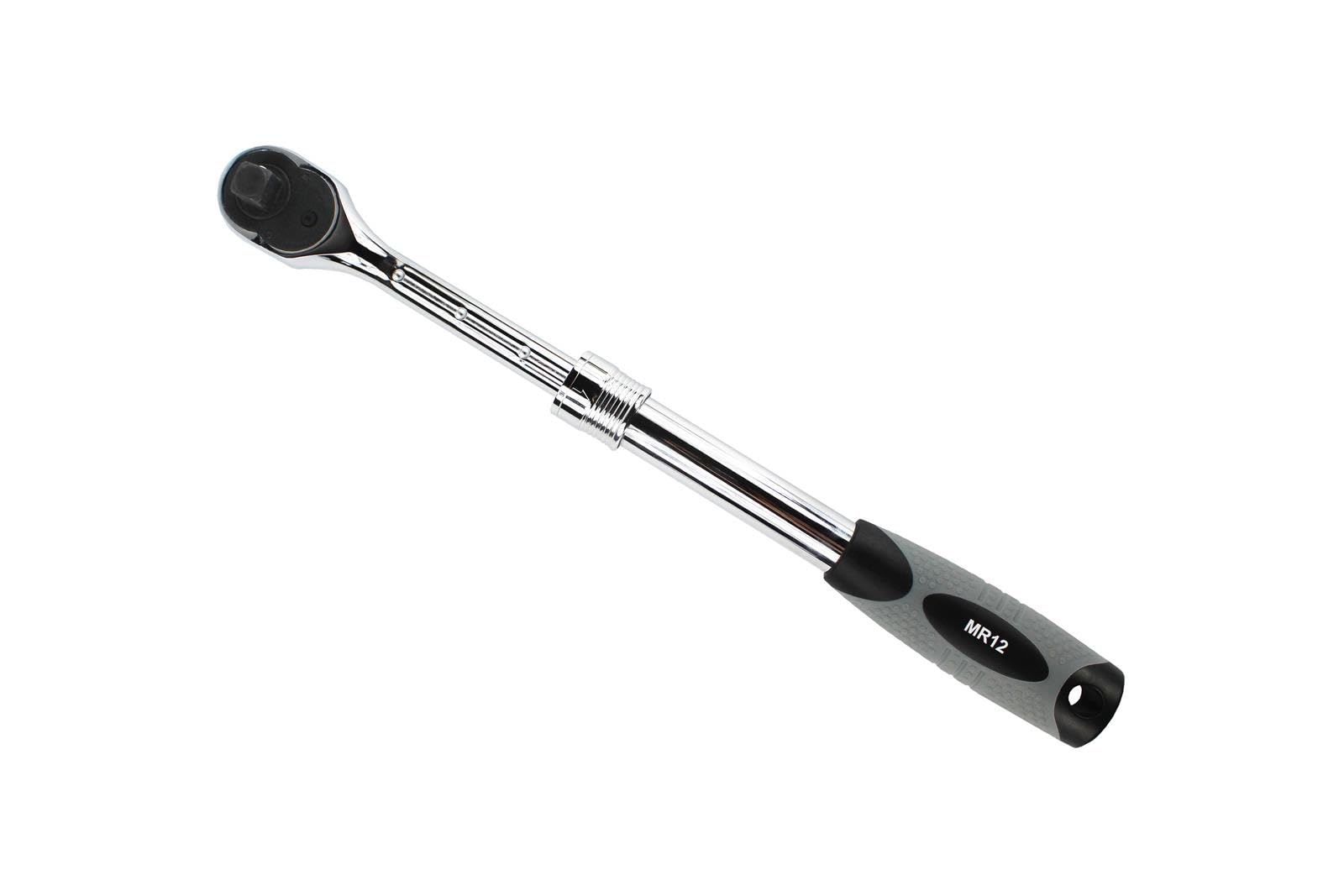
1. EZRED 1/2″ Drive Extendable Ratchet, MR12
Our pick — over 4.5★ from 900+ verified ratings; the strongest balance of quality and price.
The telescoping brute that cracks a stuck bolt in seconds.
The defining feature here is the ability to extend the handle from 12 inches up to 17.25 inches — effectively turning this ratchet into a breaker bar when you need it, but letting it collapse small enough to fit in a standard toolbox drawer. It weighs 2 pounds, noticeably heftier than a standard flex-head model, but that weight comes from real substance. What wins people over is the quality — the crowd favorite among 900+ owners, with 76 singling out the build quality alone and 59 more praising its durability. The thermal plastic over-molded grip stays locked in your hand even when your palm is slippery with grease.
This is the ratchet that an owner used to remove a BMW N20 crankshaft bolt torqued to 700 Nm in under a minute. That is not a marketing claim — that is a real-world result from the review pages. The 72-tooth mechanism means you only need a 5-degree swing arc to grab the next tooth, which is helpful even in moderately tight spots. The trade-off to know: at 2 pounds it is heavier than the DEWALT flex-head at 1.5 pounds, so if you are reaching overhead or working all day, the extra weight will be noticeable. But for the raw mechanical advantage and the fact that buyers report it withstood 250 lbs of force fully extended, this is the one toolbox that does two jobs.
Real-world muscle: The telescoping extension delivers the leverage of a breaker bar without needing a second tool in your box. Owners mention it has been used daily for five-plus years with no tooth wear.
The honest trade-off: It is a fixed-head ratchet — no flex, no pivot. If your fastener is behind an obstacle, you will need a universal joint or a different tool.
Grab this for: cracking loose rusted lug nuts, engine mount bolts, or crank bolts where raw torque wins. The extension is a cheat code.
Think twice if: you work in tight, obstructed engine bays where a flex head is the only way to reach the fastener at all.
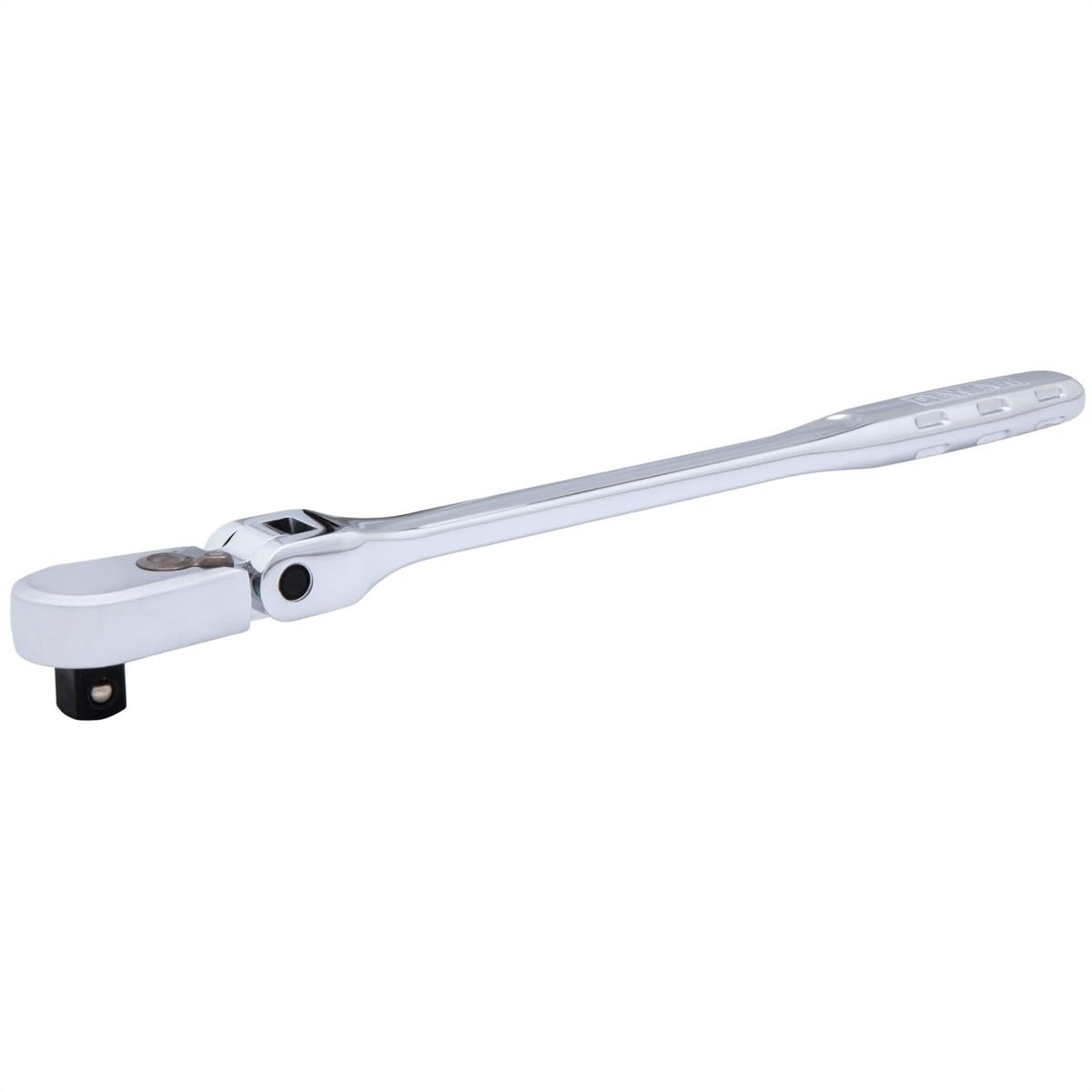
2. FIRSTINFO 1/2 Drive Locking Flex-Head Extendable Ratchet, 72-Tooth
The one tool that bends, extends, and locks exactly where you need it.
This ratchet combines two features in one body: a 180-degree locking flex head and a telescoping handle that goes from 13.8 inches to 19.3 inches. That is a rare combination — as owners note, it is one of the only affordable ratchets that offers both a locking flex head and handle extension together. The “one-touch locking mechanism” on the flex head locks the angle you choose so it does not flop around when you push hard. The head is made from heat-treated chrome vanadium steel, with a 72-tooth mechanism that needs only a 5-degree swing arc.
The real talking point is strength: customers note it is strong enough for rusted 1.5-inch shaft bolts, and one owner used it as their main ratchet daily for 1.5 years without issue. The quick-release button on the back of the head makes dropping sockets easy. At 1.1 kilograms (about 2.4 pounds), it is the heaviest ratchet in this list — but that weight disappears when you consider it replaces both a standard flex-head and a breaker bar. Quality and durability are the most-praised aspects among over 750 ratings, with the locking mechanism earning specific praise for engaging solidly.
What you gain
- Locking flex head stays at your chosen angle — no flop under torque
- Extends nearly 5.5 inches for extra leverage
- Taiwanese quality with a comfort grip resistant to oil and solvents
What to check
- At 2.4 lbs it is the heaviest option here; overhead work gets tiring
- 72-tooth mechanism is not quite as buttery as premium truck brand ratchets
Reach for this if: you want one ratchet that can pivot around obstacles and then extend for brute force — a real space-saver in a mobile toolbox.
skip it if: weight is your primary concern and you prefer a lighter, simpler tool for just one job.
3. DEWALT DWMT81156 1/2IN Drive Flex Head Ratchet
A lightweight flex-head that feels natural in a pro’s daily rotation.
At only 1.5 pounds, this is the lightest ratchet in the premium tier — at 1.5 pounds versus the EZRED at 2 pounds — which makes a real difference when you are using it hour after hour. The 180-degree flex head gives you the reach to work around obstructions, and the 5-degree swing arc from the 72-tooth gear means you can get a click in tight spots. The handle has contoured anti-slip grooves that owners describe as comfortable and well-weighted, not flimsy.
The thing everyone raves about is how smooth the ratcheting mechanism feels, with very little back drag. That matters when you are spinning a fastener on and off repeatedly — a gritty ratchet is exhausting. The chrome vanadium steel construction gives it the strength for heavy-duty use, and reviewers point out it handles daily abuse well. The honest caveat here is that it lacks a quick-release button on the head; sockets snap on and off but are not locked in place, and a few owners note an occasional unwanted pop-off when pulling the ratchet back. It is not a failure — just an irritation if you are used to a locking mechanism. The flex head itself does not lock into indexed positions, so it flops freely until you tighten it manually.
Why it wins: Dewalt hand-tool quality in a light, well-balanced package. The ratcheting is remarkably smooth, and the flex head gets around obstacles without adding weight.
The small catch: No quick-release button and a non-locking flex head. If you are okay with that trade-off, the value here is tough to top.
Best for: auto mechanics and tradespeople who need a reliable flex-head daily driver that will not wear out their arm.
Who should look elsewhere: anyone who wants a locking flex head or a quick-release button — those features are not on this model.
4. Steelman Pro 1/2-inch Drive 72-Tooth Extendable Flex-Head Ratchet
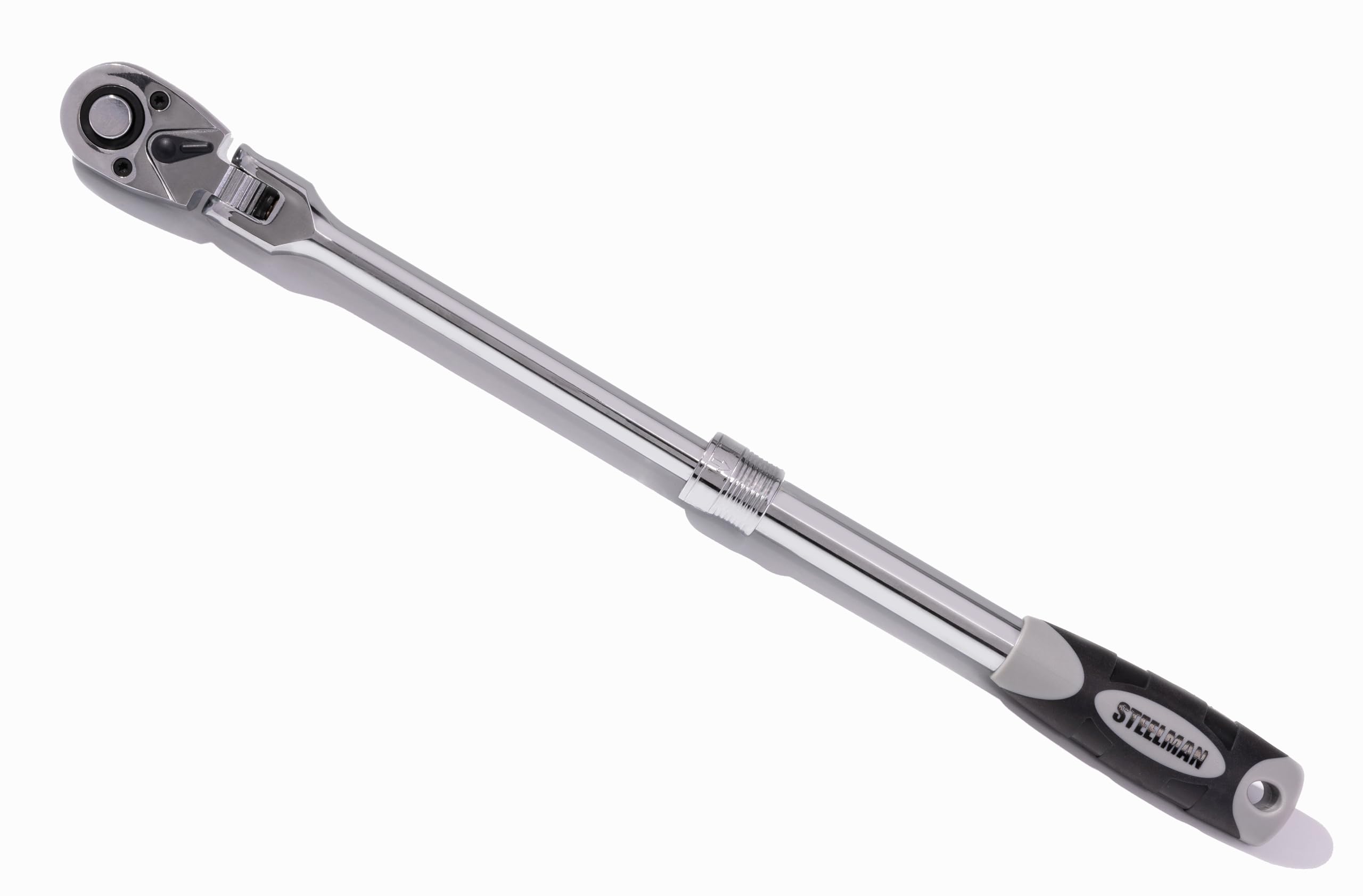
The flex-head extender that gets you into impossible nooks and then breaks the bolt loose.
This Steelman Pro combines a 180-degree flex head with a telescoping handle that stretches from 13.75 inches to 19 inches. Unlike some flex heads that just flop, this one uses a semi-locking design — the tapered sleeve has o-rings that reduce wiggle and keep the head from flopping around when you do not want it to. The 72-tooth mechanism gives you a 5-degree arc, and the heat-treated chrome vanadium steel frame is built to handle serious leverage abuse. Shoppers say it withstood heavy abuse at full extension without breaking.
The value proposition here is strong: you get both flex and extension for a mid-range price. Buyers praise its versatility for tight spaces and note that the quick release on the head works well. The most-discussed negative is durability under extreme abuse — one owner broke the 3/8-inch drive version removing a control arm bolt, though the warranty replacement process was painless and fast. For the 1/2-inch drive model, the consensus is that it handles what a DIY mechanic throws at it. The TPR comfort grip handle adds grip when your hands are wet or oily.
What makes it useful: The semi-locking flex head stays where you set it, and the telescoping handle gives you the reach to break loose seized fasteners without a cheater pipe.
Be realistic about: This is a solid DIY and semi-pro tool, but if you are a professional hammering on it daily, you might eventually push past its limits.
Reach for this if: you want the convenience of flex and extension in one tool at a fair price — perfect for driveway mechanics and weekend warriors.
Consider something else if: your job involves daily, sustained high-torque abuse on stuck industrial bolts; a heavier-duty unit may be a better fit.
5. GEARWRENCH 1/2″ Drive 90-Tooth Quick Release Teardrop Ratchet

The 4-degree swing arc that fits where nothing else will click.
With a 90-tooth gear, this GEARWRENCH needs only a 4-degree swing arc to grab the next tooth — that is the tightest rotation in this group. In a crowded engine bay where you can barely wiggle the handle, that degree makes the difference between turning a bolt and walking away to find a different tool. The teardrop low-profile head design is slimmed in height, width, and length, not just thickness, so it slips into tighter spaces than a standard round-head ratchet.
The flush-mounted on/off switch has highly visible markings, so you know at a glance which direction you are set to spin. The quick release uses a precision ball detent that locks sockets in tightly — one owner says it survived two cheater bars. The same owner used this exact ratchet to remove a frozen exhaust bolt in a tight space where other ratchets failed. At 0.73 kilograms (about 1.6 pounds), it has a nice balanced heft. The only real feedback from the crowd is that the quick release mechanism gets mixed reviews — some find the button perfect, others wish for a more positive lock feel.
What stands out
- 4-degree swing arc is among the best for tight-quarters wrenching
- Low-profile teardrop head fits where bulkier designs cannot
- Smooth polish finish wipes clean easily
What to know
- Fixed head — no flex, no extension
- Quick release feel varies from owner to owner
Best for: the DIY mechanic who works on modern engines with tight clearances. The 4-degree arc is a real advantage when every millimeter counts.
Skip if: you need a flex head or an extendable handle — this is a straightforward, no-frills fixed-head ratchet.
6. TEKTON 1/2 Inch Drive x 10-1/2 Inch Flex Head Ratchet | SRH31210
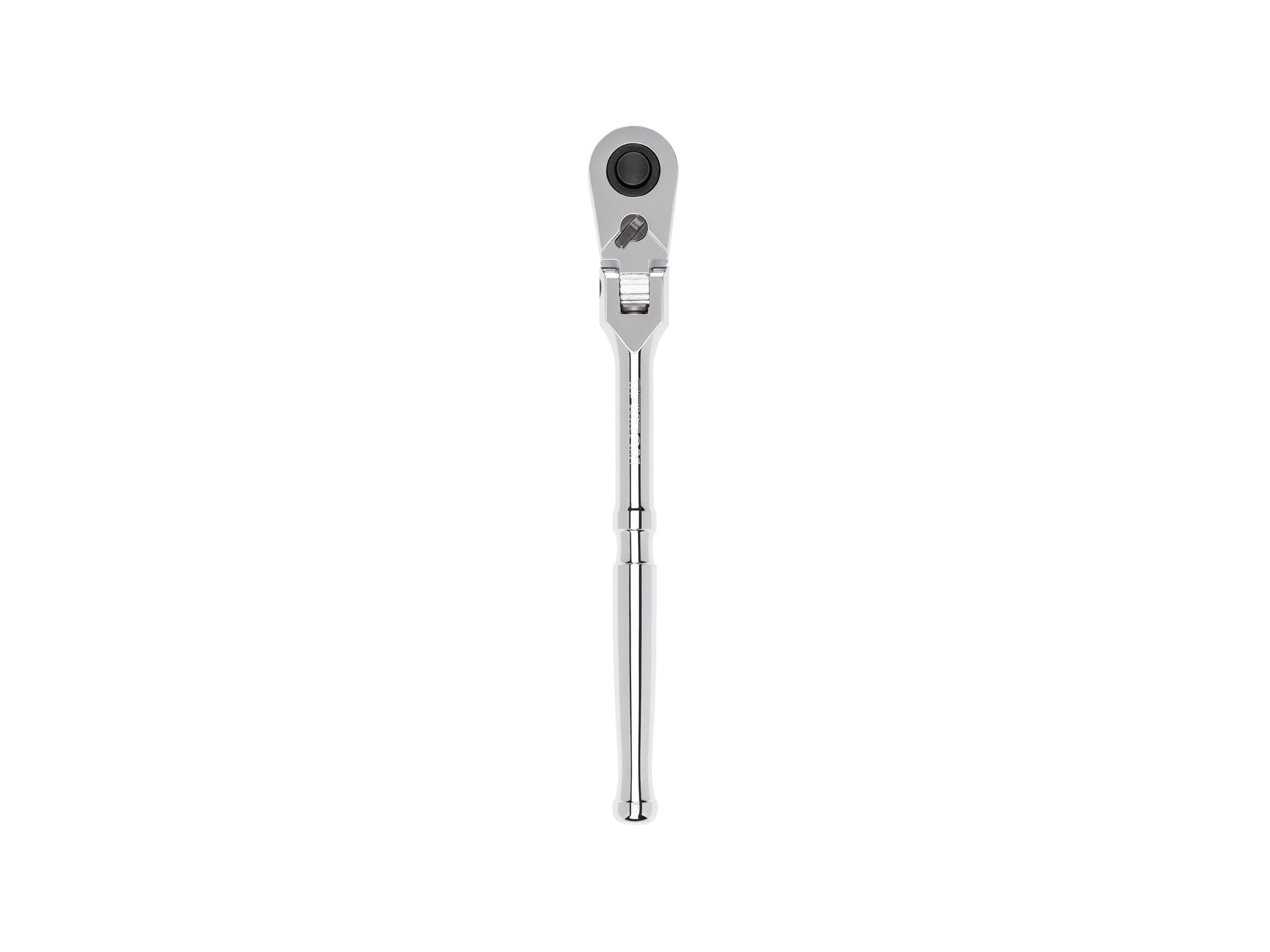
The flex-head that clicks into nine distinct positions — no flopping, no guessing.
The standout engineering on this Tekton is the flex head indexing system: it sweeps through 180 degrees and snaps into nine different detent positions. That means you can set the head to a specific angle and it stays there under load, unlike a free-flopping flex head that shifts when you push. The 90-tooth gear requires only a 4-degree swing arc, which combined with the flex head makes this a real problem-solver in confined spaces. The head itself is ultra-compact — Tekton reduced the height, width, and length, not just the thickness of the head.
Under the hood, a single half-moon pawl maintains nine teeth engaged with the gear at all times. That is a sturdy design choice that means the ratchet will not slip or skip under heavy torque. The chrome vanadium steel handle is polished to a bright finish, and the finger groove has pronounced interior edges for a secure grip. The most common feedback from owners is that the flex head feels slightly loose compared to a locking design — it is indexed, not locked in place, so it can move if you push against it. But the quality and value are the most-praised aspects by a wide margin among 770 ratings, with owners saying it is a strong value compared to tool truck brands.
The key advantage: Nine indexed positions give you precise control over the head angle, which is crucial when you need to work around a specific protruding part.
The realistic trade-off: The flex head is semi-locking via detents, not a true lock. If you want a head that cannot move at all until you release it, a locking flex head is a better fit.
Reach for this if: you want a well-finished, high-tooth-count flex head that lets you dial in the angle and keep it there.
Look elsewhere if: you need a locking flex head that requires a button release to move — this is an indexed head, not a lock.
7. TEKTON 1/2 Inch Drive x 10-1/2 Inch Quick-Release Ratchet | SRH11210
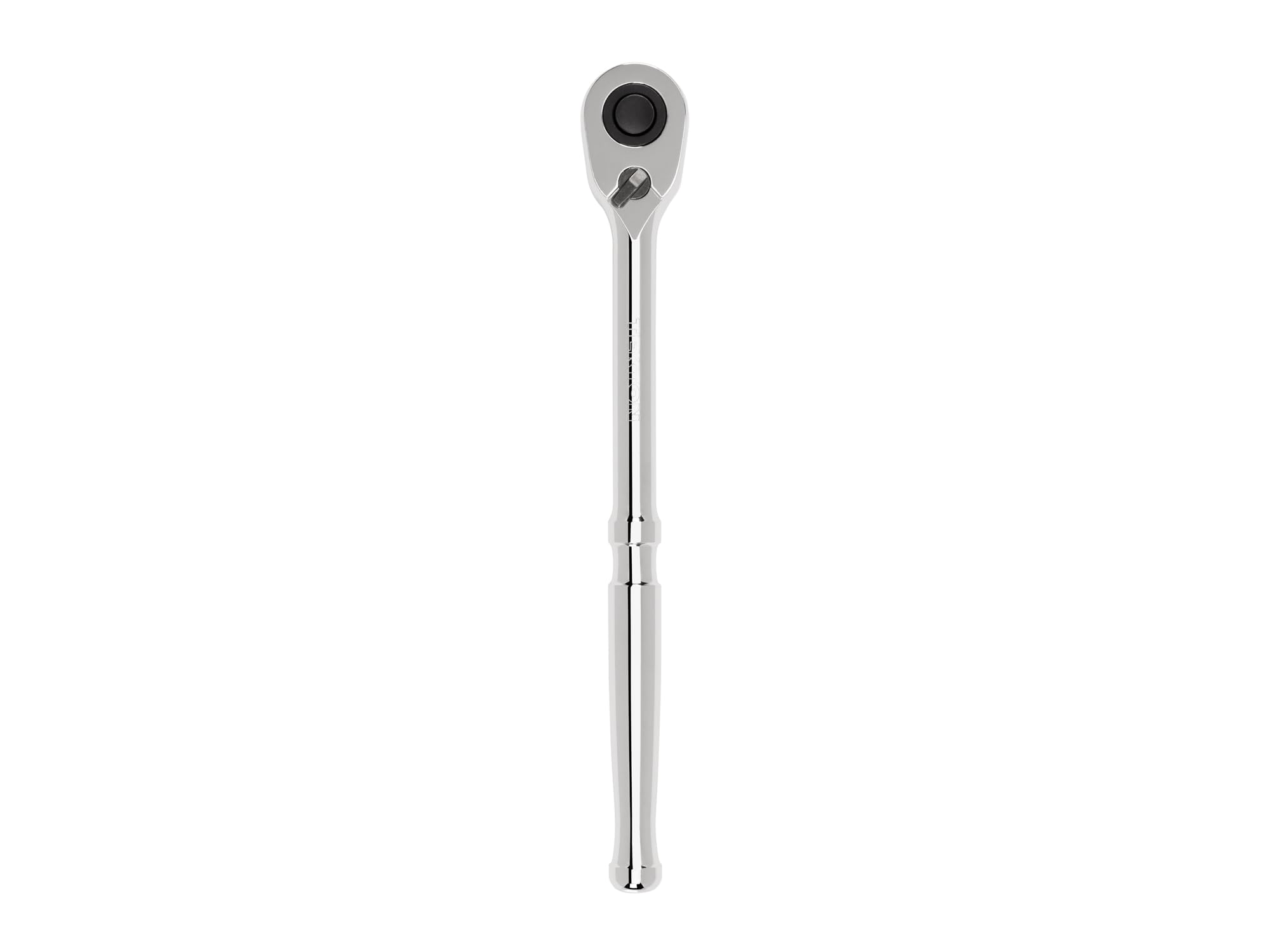
The clean, fixed-head choice for when you want no-nonsense reliability and a smooth click.
The fixed-head version of Tekton’s 1/2-inch drive offering is built around the same 90-tooth gear and 4-degree swing arc as the flex-head model, but in a simpler, potentially stronger package — no moving parts in the head means nothing to wobble or break. The ultra-compact head (reduced in every dimension) helps it fit into tighter spots than a traditional round-head ratchet. The single half-moon pawl maintaining nine teeth engaged at all times gives you the confidence to lean on it without worrying about skipping.
The polished chrome finish is bright and easy to wipe down after a dirty job. Owners note that the ergonomics and finish feel premium — several compare it favorably to ratchets costing significantly more. The quick release button lets you swap sockets one-handed. The handle’s finger groove with pronounced interior edges gives traction without being uncomfortable. The most-discussed aspect is the adjustability of the reverse lever: a few owners note it can move unintentionally when turning the head. Overall though, quality and ergonomics are the standout features buyers praise most, and at 1.29 pounds it is light enough for comfortable everyday use.
Why it works: A straightforward, well-machined fixed-head ratchet with a 90-tooth gear that gives you excellent clearance in tight spaces. The chrome finish is beautiful and practical.
One note: The reverse lever can be bumped out of position if you are not paying attention — not a deal-breaker, just something to be aware of on a clean new tool.
Best for: the mechanic who wants a dedicated, high-quality fixed-head ratchet with a smooth action and a compact head that slips into narrow spaces.
Consider something else if: you need a flex head or an extendable handle — this is a classic, fixed-head design.
8. WERA 8004 C Zyklop Full Metal Ratchet with Switch Lever, 1/2″ Drive

The German-engineered full-metal body that just feels right in your hand — and stays that way.
The Wera Zyklop is a full metal ratchet, meaning no plastic or rubber overmold on the handle — just a slim, brushed-metal shaft that gives you direct tactile feedback from the fastener. The return angle is 5 degrees, and the secure socket locking uses a ball lock rather than a quick-release button. The switch lever at the top allows fast one-handed direction changes. At 11.63 inches, it is a comfortable length for a 1/2-inch drive: long enough for decent leverage, but not so long that it is awkward in a standard toolbox.
What owners consistently praise is the handle finish and shape — it is comfortable for extended use, and the full metal construction means no rubber to degrade or peel over time. The socket compatibility is generally solid across brands (Craftsman, Husky, etc.), though a few note that it does not lock into some older Craftsman sockets as tightly. The 0.71-kilogram (1.56-pound) weight means it is light enough for all-day use without being flimsy. The overall sentiment across 700+ ratings is that this is a tool that feels premium the second you pick it up — the action is tight with very little play or slop. It is not ideal for extremely low-clearance areas, but that is typical for any 1/2-inch drive ratchet.
The defining trait: The full-metal handle gives you a sensory connection to the work that rubber grips cannot match. It is sleek, durable, and easy to clean.
The practical note: No quick release means you pull the socket off by hand. Some socket brands may have a looser fit than others.
Reach for this if: you appreciate a well-designed, all-metal tool that feels solid and lasts. The Wera Zyklop is an investment in daily comfort.
pass on it if: you require a quick-release button on the head — this uses a ball lock retention system and you pull the socket off manually.
9. Proto Ratchet 1/2 Dr (J5237)

A stout 16-inch lever with a 24-tooth gear that shrugs at high torque like it was nothing.
The Proto J5237 is a throwback to an era when ratchets were built with brute simplicity. It has a 24-tooth gear with a 15-degree swing arc — that is a wide arc by modern standards, but it comes from a very sturdy design that handles extreme torque without skipping or breaking. The handle is a full 16 inches long, giving you serious leverage without needing a cheater pipe. The low-profile pear head helps it fit into spaces you would not expect from a 16-inch tool. The black oxide finish resists rust and glare in the shop.
This is an American-made ratchet (or imported, depending on the production run) that owners describe as “built like a tank.” It is the one to reach for when you are dealing with brake caliper bolts, ball joints, or suspension hardware that has not moved in a decade. The sturdy 24-tooth gear is intentionally coarse — it trades fine-tooth convenience for sheer, unbreakable strength. A few owners note the knurling feels rough compared to polished ratchets, and the action is not as smooth as a high-tooth-count model from the start. But as one owner put it: “it will not fail like high-tooth-count models.” If you want a ratchet that will survive being a hammer and a pry bar in a pinch, this is it.
What matters most
- 16-inch handle gives immense leverage without an extension
- 24-tooth gear is very strong — unlikely to strip or skip under load
- Low-profile pear head for a tool this large
What to know
- 15-degree swing arc needs more room to operate — not for tight spaces
- Finish is functional, not refined; some owners mention a rough knurling
Best for: heavy suspension work, brake jobs, and any job where you need a long lever and a bulletproof mechanism. Ideal for truck and tractor maintenance.
Think twice if: your work is in tight engine bays or requires fine-arc ratcheting — the 15-degree swing arc will frustrate you.
Understanding the Specs
Tooth Count and Swing Arc
The number of teeth on the gear inside the ratchet head determines how much you have to swing the handle before the pawl engages the next tooth. A higher tooth count (72 or 90 teeth) means a smaller swing arc (5 degrees or 4 degrees), which is critical when you are working in a tight spot where the handle only has a few inches of travel. A lower tooth count like 24 teeth gives a 15-degree arc — stronger but harder to use in cramped areas.
Flex Head vs. Fixed Head
A flex head allows the ratchet head to pivot (typically 180 degrees) so you can reach fasteners that are not straight-on. Some flex heads are “indexed” with detent positions that hold the angle you choose; others are “locking” with a mechanism that locks the head in place until you release it. A fixed head is the simplest, strongest design with no moving parts in the head — less versatility but higher reliability under extreme torque.
Extendable Handle
Some ratchets have a telescoping handle that slides out to give you extra leverage — essentially turning the ratchet into a breaker bar without needing a separate tool. The extension range is typically 5 to 6 inches. The trade-off is added weight and complexity, and a fixed-head or flex-head design is all you can pair with an extension mechanism (no flex + extension feature exists in every model).
Quick Release vs. Ball Detent
A quick-release button on the ratchet head pushes a mechanism that disengages the socket, letting it fall off easily. A ball detent uses a spring-loaded ball that presses into a dimple on the socket side, holding it firmly; you pull the socket off manually. Quick release is faster for swapping sockets; ball detent is simpler and less likely to wear out or develop play over time.
FAQ
What does the tooth count mean on a 1/2 inch drive ratchet?
Is a flex head ratchet better than a fixed head?
How long should a 1/2 inch drive ratchet handle be?
Can a 1/2 inch drive ratchet break a stuck bolt?
What is a quick release ratchet and do I need it?
Is it worth paying more for a name brand ratchet?
Can I use a breaker bar and a 1/2 inch ratchet together?
What is the difference between chrome vanadium and chrome molybdenum steel?
Does a 1/2 inch drive ratchet work with all 1/2 inch sockets?
Can I use an impact socket with a 1/2 inch drive ratchet?
Final Thoughts: The Verdict
For most people, the 1/2 inch drive ratchet that does the most jobs is the EZRED MR12. Its telescoping handle gives you the leverage of a breaker bar in a package that collapses small enough for any toolbox, and the build quality is proven by owners who have used it daily for years. If you need a flex head to reach around obstacles, the FIRSTINFO F3222ND gives you both a locking flex head and an extendable handle — a rare and useful combination. And for the purist who wants a simple, smooth, high-tooth-count fixed-head ratchet, the TEKTON SRH11210 with its 90-tooth gear and compact head is a joy to use every day.
How We Picked
We do not accept paid placement. Every pick is matched to a real buyer and a real use-case; we do not hands-on test units.
Sources & Methodology
Specifications: manufacturer listings and product documentation. Review insights: verified customer reviews, as of July 2026. Pricing: not shown on this page (it changes often); check the current price via the retailer link.
As an Amazon Associate, KitchPrep earns from qualifying purchases. This does not affect which products we feature.
Related Guides
