
Specs are compiled from manufacturer listings and verified buyer reviews and can change over time — please confirm the key details on the product page before buying.
Bolts do not forgive guesswork. Tighten an axle nut too little and it works loose; too much and you stretch the threads or snap the stud, which turns a quick job into a weekend in the driveway. A 1/2 inch digital torque wrench removes that gamble. It shows you the exact torque number on a screen, beeps or vibrates as you close in on your target, and then confirms the moment you hit it — so you know the fastener is right rather than hoping it is. Three specs decide the pick: the accuracy tolerance on the certificate, the torque range’s low and high ends, and the handle length for your workspace.
I’m Mohammad Maruf — the founder and writer behind KitchPrep. This guide is built by comparing the manufacturers’ published specifications and the patterns across verified customer reviews, so you get each pick’s real strengths and trade-offs instead of marketing spin.
Most of the picks here are half-inch drive ratchets rated for the kind of daily suspension, truck, and engine work that asks for a trustworthy number. If you want the short version, the winner below earns its spot by pairing a verified accuracy tolerance with a build that survives real shop abuse, which is exactly why our pick for the 1/2 inch digital torque wrench earns the top slot here for daily garage work.
Our Picks at a Glance

How To Choose The Best 1/2 Inch Digital Torque Wrench
The number that matters most on a digital torque wrench is the accuracy tolerance printed on its calibration certificate, not the brand on the handle. A ±1% tolerance means the wrench can be off by one percent of the reading; a ±2% tolerance means twice that. For a lug nut spec’d at 150 ft-lb, that difference is a few foot-pounds of slop either way, That is why serious buyers check the tolerance before the price.
Drive size and socket compatibility
All the picks here are 1/2 inch drive, which is the standard square stub that fits 1/2 inch sockets. If you own a mostly 3/8 inch socket set, look for a bundled 1/2 to 3/8 adapter — several units in this guide ship with one. Grab a 1/2 inch wrench only if you regularly work on suspension, axle nuts, and truck lugs, because the smaller 3/8 inch tools top out well below the torque those fasteners demand.
Torque range and what it covers
A 1/2 inch digital wrench with a 50-250 ft-lb or 3.8-250.8 ft-lb range covers most automotive fasteners from brake caliper brackets up through axle nuts. If you also want to torque small fasteners — valve covers, motorcycle bolts — look for a unit that reaches down toward 3.8 ft-lb or a combo kit that bundles a second, lower-range 1/4 inch wrench.
Alert style — buzzer, LED, and vibration
Every digital wrench here signals with a buzzer, and most add an LED that turns green as you approach the set value and red when you pass it. Vibration alerts are the newest addition and are genuinely useful in a noisy bay where a beep can get lost. If you work in a shop with compressors running, a wrench with all three alert types is easier to trust than one with sound alone.
Battery, storage, and the little stuff
These tools run on standard AA or AAA batteries, and the recurring complaint across owner feedback is drained cells when the wrench sits unused. Pull the batteries when you store it, and keep spare cells in your box. Memory storage for preset torque values is the other feature worth checking, especially if you rebuild engines or repeat the same torque sequence on multiple bolts.
Quick Comparison
| Model | Best For | Torque Range | Accuracy | Drive / Head | Amazon |
|---|---|---|---|---|---|
| SUZUME SM3201★ Best Overall | Daily axle and truck work | 12.5-250.7 ft-lb | ±2% | 1/2 in / 72-tooth ratchet | Amazon |
| ANPUDS AP6Top Accuracy | Precision work with a low profile | 3.76-250.75 ft-lb | ±1% | 1/2 in / fixed square | Amazon |
| PUIBERS PBS04250FTBest Value Range | Wide-range engine and truck work | 3.8-250.8 ft-lb | ±1% | 1/2 in / fixed ratchet | Amazon |
| Uharbour UHXM013 | Suspension and dual-direction jobs | 3.8-250.8 ft-lb | ±1% | 1/2 in / square drive ratchet | Amazon |
| VEVOR Digital Torque Wrench 227 | Budget-minded DIY with adapters | 25-250 ft-lb | ±2% | 1/2 in / fixed square | Amazon |
| GROWNEER Combo Kit | Owning one kit for every size | 1.1-22.1 & 7.38-147.5 ft-lb | ±2% | 1/4 in & 1/2 in / fixed ratchet | Amazon |
| CRAFTSMAN CMMT99436 | Repeat wheel and engine work | 50-250 ft-lb | Not listed | 1/2 in / fixed square | Amazon |
| SK 1/2″ Drive Digital | Precision gasket and O-ring sequences | 17-340 N-m | ±2% CW / ±3% CCW | 1/2 in / flex head | Amazon |
| DEWALT DWMT17060 | Big-job lug and spindle work | 50-250 ft-lb | Not listed | 1/2 in / fixed square | Amazon |
In‑Depth Reviews
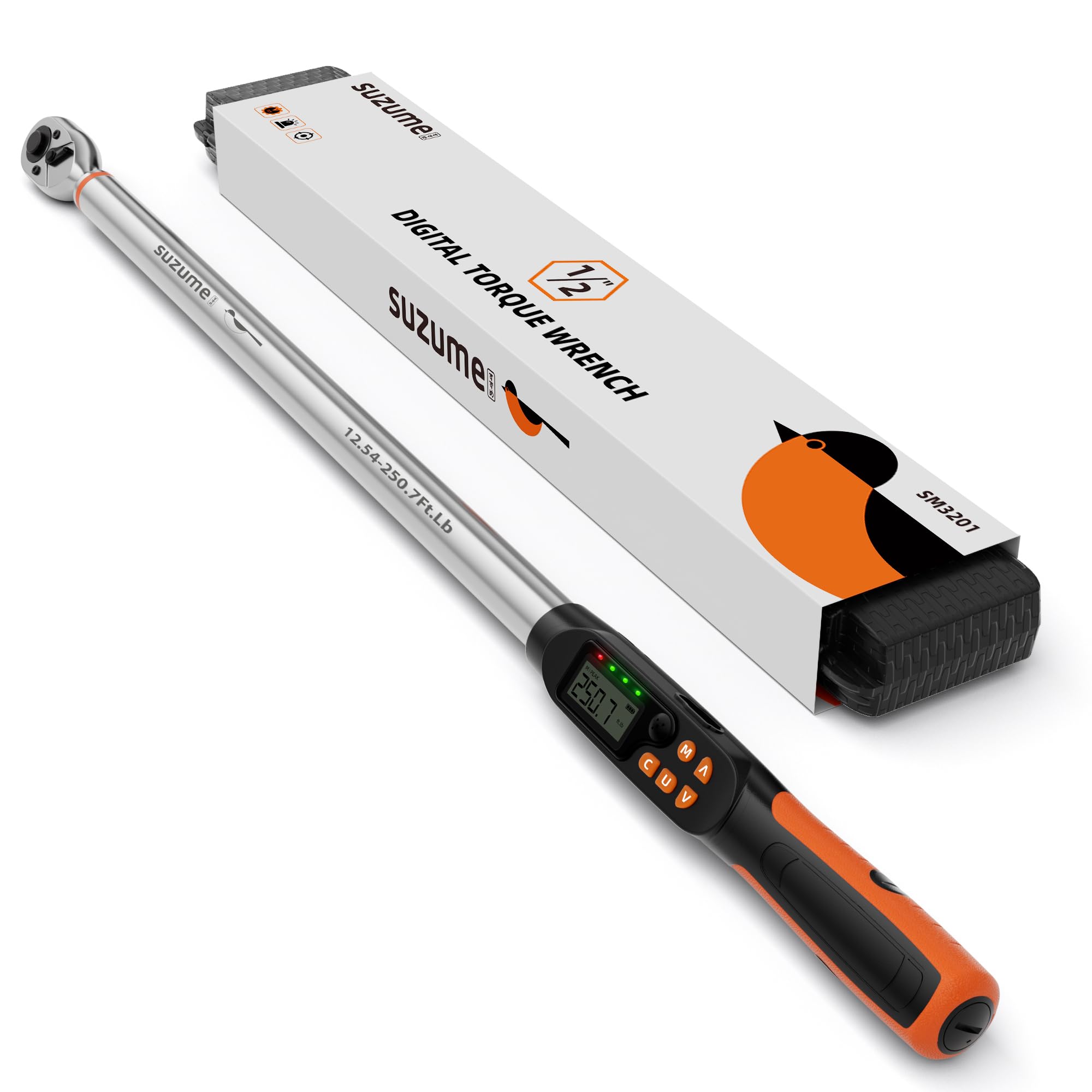
1. SUZUME Digital Torque Wrench 1/2 Drive (12.5-250.7 Ft. Lb/ 17-340 N.m)
Our pick — over 4.5★ from 700+ verified ratings; the strongest balance of quality and price.
The shop-ratchet energy of a wrench that survives axle nuts and keeps reading straight
This is the pick for anyone who tightens real hardware every week — hub nuts, suspension arms, dirtbike axles — and wants a screen number they can actually trust. SUZUME rates the SM3201 at ±2% across a 12.5-250.7 ft-lb range, tested over 20,000 cycles, and ships a Certificate of Correction in the box. The ratchet head carries 72 teeth, which means each click takes a 5° swing, so you are not stuck hunting for a spot to seat the socket when the bolt sits in a tight corner.
The alert system is the part that wins people over, and it works on two channels at once. As you close in on your set torque the wrench beeps faster, and the LED turns green somewhere around 85% to 90% of target before locking red at 100%. In peak mode the display freezes on the highest torque it saw; switch to track mode and it reads live. Four units cover Nm, ft-lb, in-lb, and kg-cm, so whether your manual is in metric or imperial, you set it once and move on.
Under the skin it is chrome vanadium steel with an electrophoresis coating and a non-slip, shockproof handle. Owners run it on Yamaha and Toyota jobs with no drama, and one noted how handy it is for a battery connection where you need good readings rather than a guess. As buyers put it, this one is “very tough to top for the money” — the recurring nudge being that the factory batteries drain fast, so keep a fresh set on the shelf.
The case for buying this one
- 72-tooth reversible head swings just 5° — ticks easily in tight corners
- Peak and track modes with green/red LED and progressive beep keep you on target
- Four torque units (Nm, ft-lb, in-lb, kg-cm) cover metric and imperial specs
- Certified ±2% accuracy over a 12.5-250.7 ft-lb range that reaches axle nuts
What you should know before you commit
- Batteries quit early — pull them when it sits on the shelf
- Long body (26.57 in) can be awkward in cramped engine bays
Pick it for: repeat axle, suspension, and truck work where a certified ±2% number and a ratchet you can set at 5° matter more than portability.
Know first: the handle is 26.57 inches long, so tight engine bays want a stubby instead.
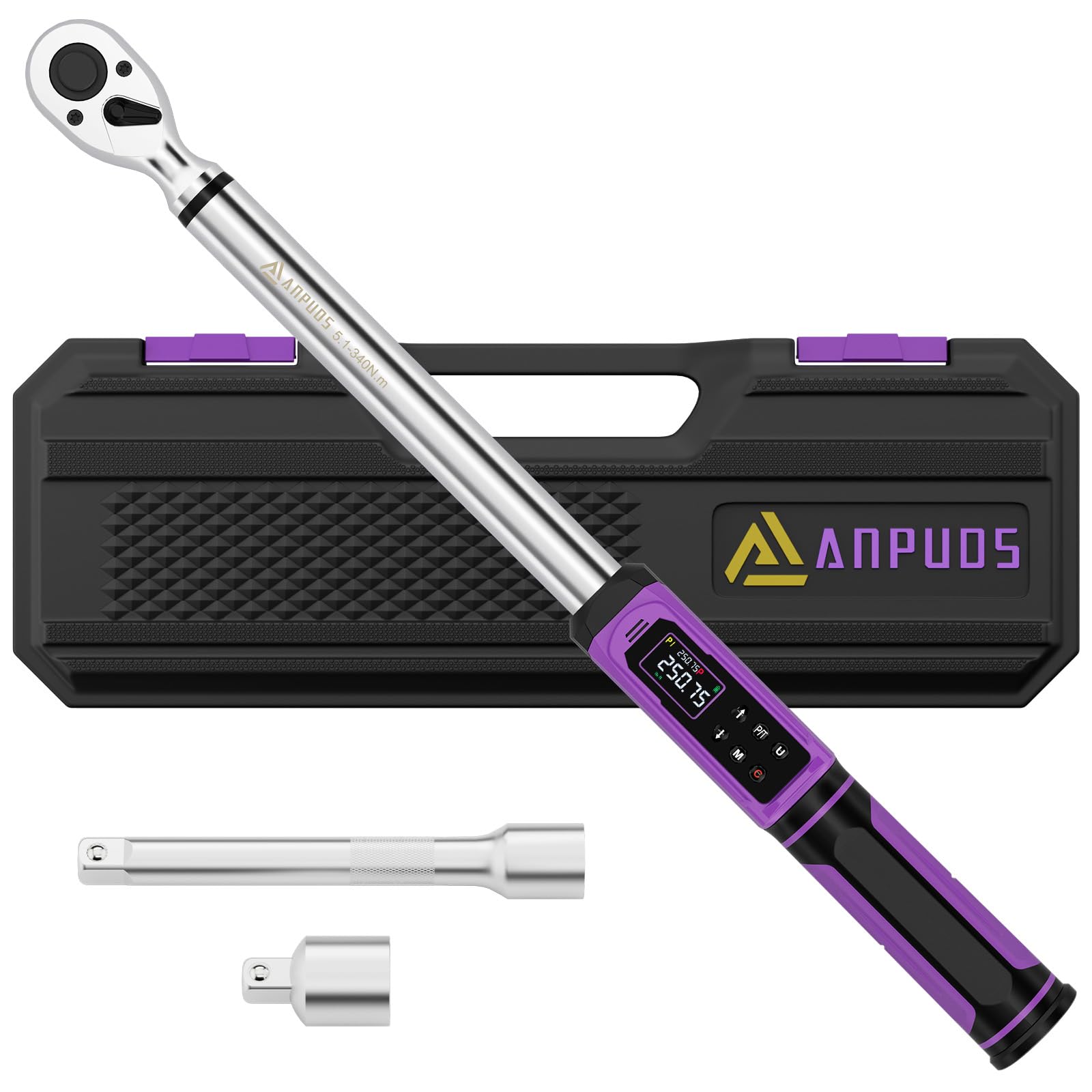
2. ANPUDS 1/2″ Digital Torque Wrench, ±1% Accuracy, 3.76-250.75 Ft-lb
The tightest accuracy claim in the whole lineup, in the shortest body
Here is the one number that should make you look twice: ANPUDS states ±1% accuracy, while the SUZUME above holds to ±2% — a 2.0x gap in the tolerance each tool promises. If you are building an engine or bolting a suspension system you will recheck, that tighter figure is the reason to pick this one. The range runs 3.76-250.75 ft-lb, low enough to catch small fasteners and high enough for lug nuts and hitch hardware.
It is the shortest wrench on this list, which buyers report is the whole point — the low profile slips into spark-plug wells, tight engine bays, and confined linkage spots where the longer picks simply wedge themselves against the block. Three alert channels fire as you approach target: LED, vibration, and buzzer. That is a serious advantage in a dim garage or a loud bay where a beep alone can disappear under compressor noise. Nine programmable presets mean you can store the torque values you use most and skip the button dance on repeat jobs.
Storage runs up to 500 records in peak mode, and there are five units to pick from — N·m, ft-lb, in-lb, kg·cm, and kg·m. It comes factory calibrated with a certificate, and includes both a 125mm extension bar and a 1/2 to 3/8 adapter. One honest note: the manual does not spell out where the batteries live (under the cap at the bottom), and the painted finish rubs off if you habitually slip a cheater bar over the handle. For the accuracy it delivers, that is a small tax.
The precision case: a certified ±1% tolerance, a factory certificate, and five torque units make this the pair of hands you want on fasteners that matter. The 3.76-250.75 ft-lb span is wide enough to cover small bolts and axle nuts in one tool.
Reach for it: when top-end accuracy and a compact body both matter — engine internals, suspension re-torques, tight linkage.
Look elsewhere if: you want a wrench that will shrug off cheater-bar abuse, because the paint finish scuffs quickly.
3. PUIBERS Digital Torque Wrench 1/2″ Drive 3.8-250.8 FT.LB (5-340Nm)
A wide 3.8-250.8 ft-lb span with nine presets and a memory that logs every pull
If your jobs swing from tiny bike bolts all the way up to wheel studs, this is the range to own. PUIBERS covers 3.8-250.8 ft-lb with ±1% accuracy, and that wide low end means you can set it for a valve cover without reaching for a second wrench. Nine presets (P1-P9) let you store repeat torque values, and a short press of the M button logs the result — up to 500 groups of stored data you can pull back later. For anyone running the same torque sequence across multiple bolts, that alone saves a pile of button-punching.
The feedback is progressive on purpose. As you near your target the buzzer speeds up, then goes continuous with a sequence of LED lights once you hit it — so even if your eyes are on the fastener rather than the screen, your ears track the approach. Five units — lb.ft, lb.in, N.m, kg.cm, kg.m — switch on a backlit LCD. Peak mode freezes the achieved value; tracking mode reads live, which is the mode you want when you need to watch the number climb.
Two trade-offs worth knowing. The display scratches easily if you toss it in a toolbox without the case, and the number entry button is described as jumpy — slow to move one digit, then suddenly fast. Both are workable if you simply slow your thumb on the setting step. The build is alloy steel with an impact-resistant housing and an ergonomic grip, and it holds up to daily shop use.
Settle on this if: you want one wrench that spans small bike fasteners up to heavy wheel hardware with stored presets and logged pulls.
Cool on it if: you want an unscratchable screen or feather-light setting control — the display marks and the value-entry button jumps.
4. Uharbour 1/2″ Drive Digital Torque Wrench 3.8-250.8 Ft.lb

A reversible head and haptic feedback that handles both directions of the job
Dual-direction use is the reason to reach for this one. The reversible head works clockwise and counterclockwise, so loosening a stubborn bolt and tightening its replacement both happen with the same tool — no swapping out mid-job. The torque range spans the same wide 3.8-250.8 ft-lb as the PUIBERS above, and it carries the same ±1% accuracy certification. Its alert system adds haptic vibration to the buzzer and LED, so you feel the moment you hit target as well as hearing and seeing it.
Owners mention the Uharbour holds up to repeated high-torque pulls. One buyer put it through tightening an axle nut at 217 lbs and reported no complaints, and another used it across an entire car-suspension job and called it the tool that took the work “like a champ.” The programmable memory stores torque values in sequence, which pays off big on engine rebuilds where you torque a run of bolts to different specs one after another. The high-definition LED screen reads clearly, and unit switching covers four systems — N-m, kgf-cm, lb-ft, and lb-in.
The catch is the setting controls. Dialing in a specific number means tapping one digit at a time, and holding the button to speed up can overshoot your target and blow past it. It is not a dealbreaker — you simply release and correct — but if you set torque values constantly through the day, the cycle-through interface will test your patience compared with the preset-based picks above. For everyone else, the performance-to-build ratio here is a strong argument.
Why it stands out: a reversible ratchet head for both directions, a 3.8-250.8 ft-lb range, ±1% accuracy, and vibration feedback you can feel at the mark. The bundled calibration certificate means you start with a documented tool.
Make it yours if: you work both directions on suspension and driveline jobs and want a wide range with haptic confirmation.
Pass it up if: you change torque values all day and want preset memory — punching digits one at a time will slow you down.
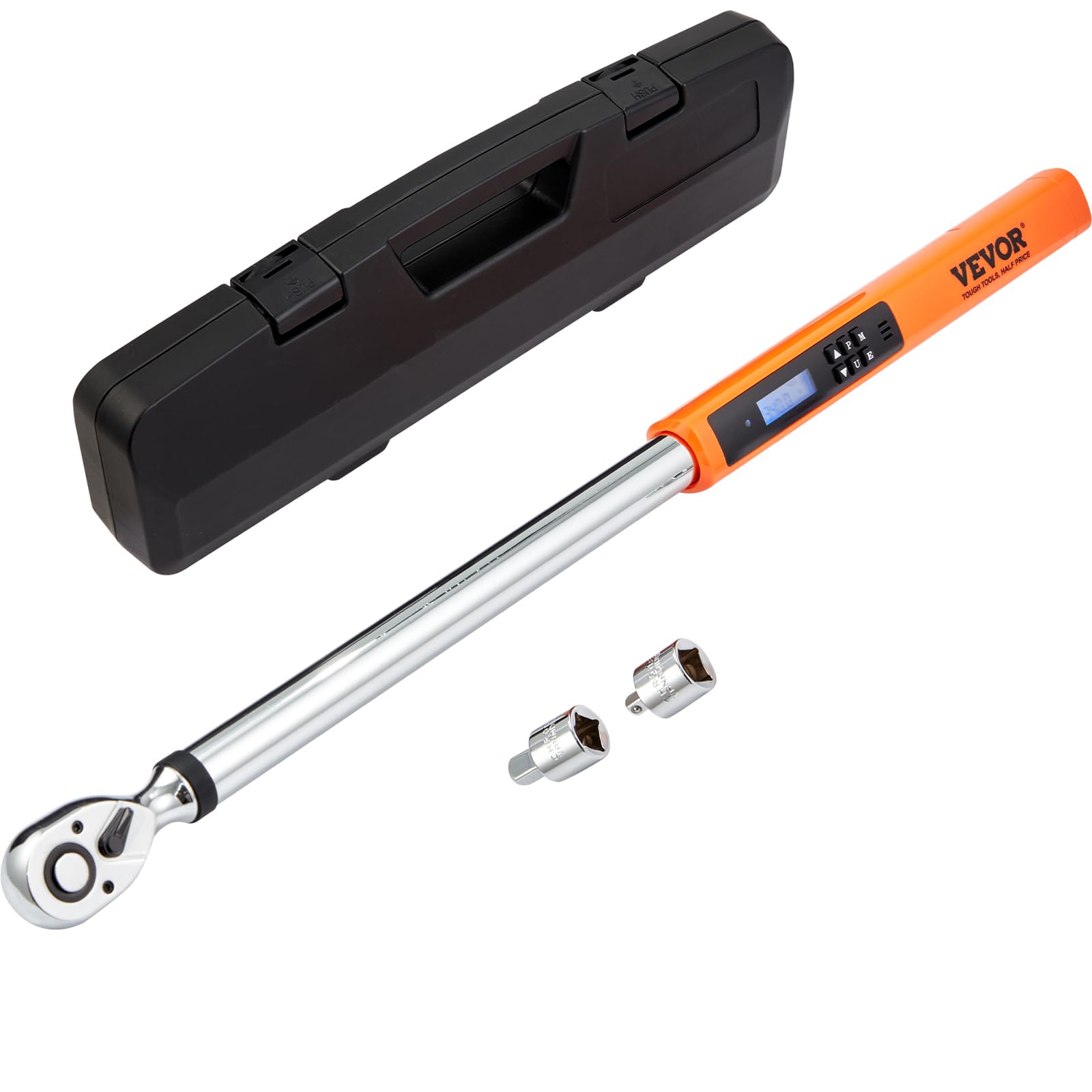
5. VEVOR Digital Torque Wrench 1/2″ Drive (25-250ft.lb/34-340n.m)
A pre-calibrated workhorse that ships with the adapters most kits don’t include
If you already own a set of 3/8 inch and 1/4 inch sockets, this is the wrench that meets you halfway. VEVOR bundles a 1/2 to 1/4 inch adapter and a 1/2 to 3/8 inch adapter in the case, so you can run the sockets you already have without buying new ones. The range spans 25-250 ft-lb, pre-calibrated to ±2%, and the coating is chrome-plated over chrome vanadium steel rather than the plain finish on a couple of the budget rivals.
Four measurement modes cover the manual in front of you — kg-m, Nm, in-lb, and ft-lb — and the high-definition LED screen has a built-in backlight, which is genuinely useful if your garage is dim or you work under the hood where the shop lights do not reach. Track mode gives you live torque for a balanced pull; peak mode records the value you generated so you can check it after the fact. When you reach your preset torque a regular beep sounds — the sound catches you before you over-torque the fastener.
The honest caveats: owners say the programming instructions are ambiguous, especially if you are not tech-minded, so budget a few minutes with the manual the first time. The tool itself is also on the long side, and one buyer found it too long for the tight space they needed, so measure before you commit if you work in confined areas. Everything else — the sturdy plastic storage box, the beep alert, the four modes — is exactly what a budget-minded buyer needs in a first digital wrench.
Go this route if: you want a pre-calibrated digital wrench plus the 1/2-to-1/4 and 1/2-to-3/8 adapters in the box without a premium outlay.
Think twice if: you work in tight engine spaces — the long body has pushed at least one buyer to swap it out.
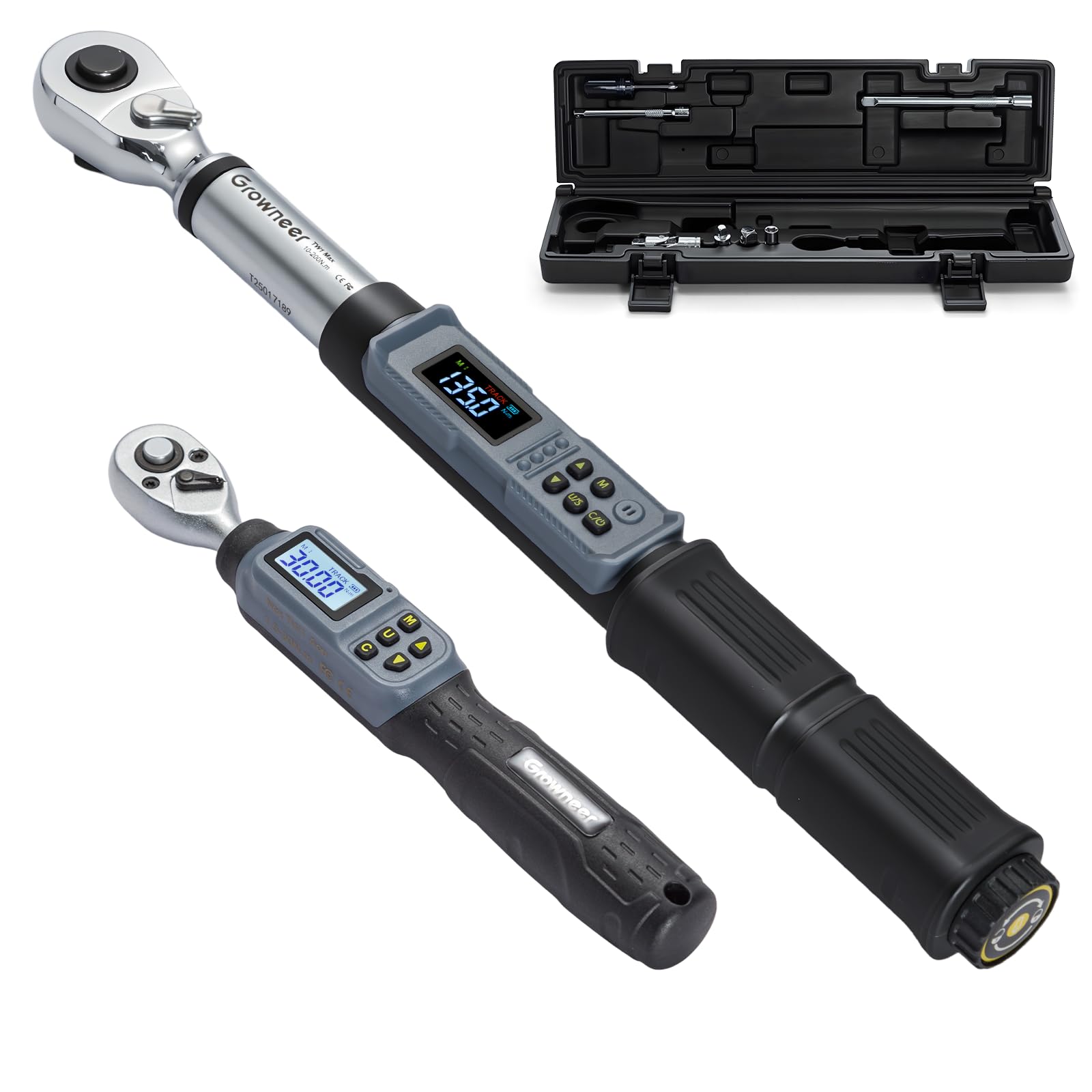
6. GROWNEER Digital Torque Wrench Set (1/4″ & 1/2″ Drive Combo)
Two wrenches in one case, so small bolts and big ones never argue over the same tool
Buying one wrench means accepting the range it will not reach. This kit sidesteps that problem entirely, shipping two digital wrenches — a 1/4 inch drive covering 1.1-22.1 ft-lb and a 1/2 inch drive covering 7.38-147.5 ft-lb — both rated to ±2%. The 1/4 inch unit handles the delicate end of motorcycle and small-engine work; the 1/2 inch unit covers most automotive fasteners under 147.5 ft-lb. If you work across a range of fasteners rather than one narrow job, that combined coverage is the reason to pick a kit.
The heads swap quickly, so you can move from a 1/4 inch socket to a 1/2 inch one without swapping tools, and both wrenches share the same LED panel that reads the live torque without delay. Six preset modes hold your repeat torque settings and storage runs to 500 data sets, so historical pulls are right there if you need to look back. Four units — kg-cm, N-m, in-lb, and ft-lb — cover the manual whichever system it uses. The kit also bundles a 1/2 to 1/4 adapter, a bit holder, universal joints, extension bars, a manual screwdriver, and AAA batteries, all in a storage case.
One honest limit: a small share of customers note the 1/4 inch side can give false readings when side-loaded — press it sideways at the socket and it can beep as though torque is met. If the 1/4 inch channel is your main use, watch that behavior and verify before you trust a reading on delicate fasteners. For the combined coverage at this tier, that is a manageable caveat worth knowing.
What the combo delivers: two calibrated wrenches covering 1.1-22.1 ft-lb and 7.38-147.5 ft-lb in one kit, with quick-swap heads, 6 presets, 500 data sets, and a full accessory bundle. Very few single wrenches span that much fastener territory.
Own this if: you want one box to cover small engine bolts and most automotive ones without buying two separate wrenches.
Eye the caveat if: the 1/4 inch side is your primary tool — side-loading it can produce a false torque reading.
7. CRAFTSMAN Digital Torque Wrench, 1/2-Inch, 50-250 FT-LB, CMMT99436

A 29.64-inch body that reaches car tires without a struggle, from a name you grew up with
Two things make this the pick for repeat automotive work. First, the length: at 29.64 inches it reaches lug nuts and wheel hardware with a comfortable pull rather than a strained one. Second, the range — 50-250 ft-lb covers lug nuts, caliper bolts, and most undercar fasteners with room to spare. The screen is backlit, so if you are working in a dim garage or under a car, the readout is right there. Unit conversion from ft-lb to in-lb to Nm is a single button press.
Everyday operation is straightforward: set the torque value, wait a few seconds for the wrench to catch up on the setting change, and pull until the dual-color LEDs and beeper signal you have arrived. There is no memory button, which is the one gap — if you torque the same sequence of bolts repeatedly, you will reset the value by hand each time. The ergonomic handle has a comfortable sure grip, and the tool ships in a durable clear case for quick identification in a crowded toolbox.
Reviewers point out it holds up to regular use; the recurring practice note is simply to take the batteries out when the wrench is not in service, because they will drain if left in. For a wrench you will pick up once a month rather than daily, that habit keeps it ready. It hits the 50-250 ft-lb setting you dial in without fuss.
Where it earns its keep
- 29.64-inch length reaches car tires and wheels without a cramped pull
- 50-250 ft-lb range suits lug nuts, caliper bolts, and general undercar work
- Backlit LED screen reads clearly in a dim garage or under the hood
- Ships with a durable clear case and hits the set torque every pull
One thing worth planning around
- No memory button — you reset the torque value by hand on every job
- Batteries drain if you leave them in when it is not in use
Choose it if: you want a long, backlit, single-range wrench for lug nuts and undercar fasteners and value a familiar brand.
Reconsider if: you torque a fixed sequence of bolts over and over and want stored presets to skip the manual re-entry.
8. SK 1/2″ Drive Digital Torque Wrench, 17 to 340 N-M, LED Display

A flex-head body that keeps the socket square when the bolt sits at an angle
The flex head is what separates this from everything above. Instead of a fixed square head, the socket joint pivots, so you can keep the wrench body clear of obstructions while the drive stays square on the fastener — a real advantage on gasket and O-ring torques where you need an even sequence and the bolt heads sit at awkward angles. Rate it at ±2% clockwise and ±3% counterclockwise, guaranteed from 20% to 100% of maximum range, so you know exactly where the accuracy holds and where it tapers.
The range is 17 to 340 N-m, which covers the high end of automotive and motorcycle work. The four-unit readout switches between measurement systems and the digital display carries an indicator light that goes green at 90% of target and red at 100% — the same two-stage confirmation you see on the top pick. There is also a 5-minute auto-sleep that saves battery, and the wrench retains the last torque value you set so you can pick up where you left off. It runs on two AA batteries, included, in a portable storage organizer.
The one thing to know: this wrench does not perform angle measurement, so if your spec calls for torque-plus-degrees, plan for a separate angle tool. The anti-slip handle minimizes fatigue through extended work, and the flex head makes tight-access jobs easier than a fixed-head tool — which is the trade you are making at this tier.
Match it to: gasket, O-ring, and precise-sequence jobs where a flex head keeps the drive square in awkward spots.
Rule it out if: your spec pairs a torque figure with a degree turn — this wrench does not measure angle.
9. DEWALT Digital Torque Wrench, 1/2 inch Drive, 50-250 FT-LB (DWMT17060)
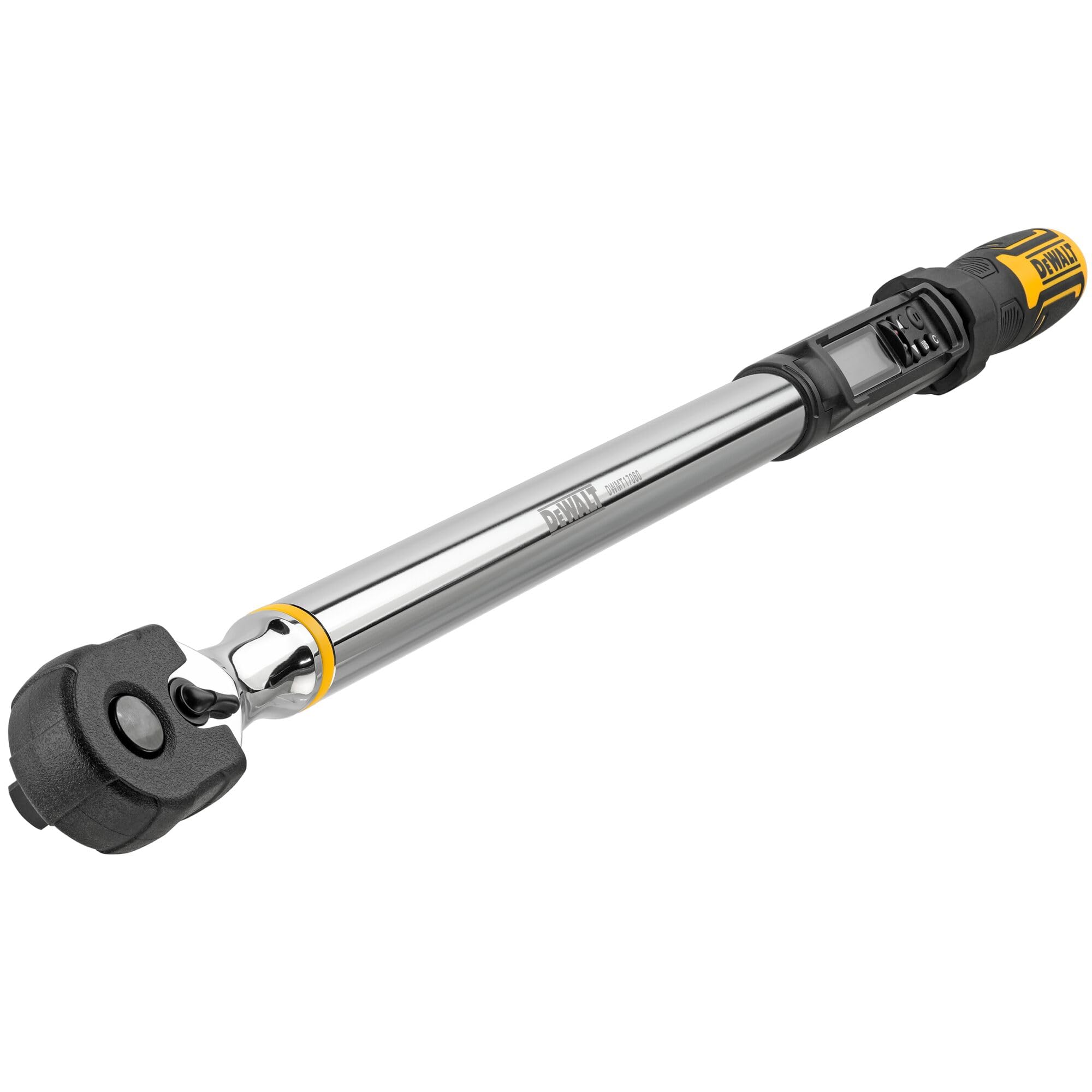
Batteries, case, and a backlit readout straight from the start — the no-fuss name brand
If you want to unbox and start working without hunting for batteries, this is the one. DEWALT ships the DWMT17060 with batteries included and a storage case to keep it safe on the shelf. The range is 50-250 ft-lb, and the same one-button conversion shifts between ft-lb, in-lb, and Nm — so whatever the spec sheet says, you can match it. The handle uses a bi-material grip built for long days, and the backlit LED screen gives an at-a-glance readout even in a dim garage.
Confirmation as you approach target is audible and visual — a build-up of beeps plus LEDs that signal approaching and then reaching the set value. Some owners prefer a final click-style cue rather than just the beep and green light, because a click is harder to miss than a tone when you are pulling on a lug nut. That is a preference thing rather than a fault. It is a well-stocked, ready-to-go wrench in a premium tier.
The honest caveat sits in the controls. Setting a specific torque value is fiddly on this wrench — it takes practice to hit an exact number, and several owners note the controls can be challenging at first. Give it a few uses and it becomes second nature. For everything else — the case, the included batteries, the grip, the backlit screen — it is exactly the polish you expect from a name-brand premium tool.
What comes in the box: a 50-250 ft-lb digital wrench with included batteries, a storage case, a bi-material comfort grip, one-button ft-lb/in-lb/Nm conversion, and a backlit LED screen. Straight to work, no extra shopping.
It fits: buyers who value a ready-to-work premium tool with batteries and case included and want a name-brand grip on a 50-250 ft-lb wrench.
Be ready for: a fiddly value-setting control that rewards a few practice runs before you rely on it for precision work.
Understanding the Specs
Accuracy tolerance (±1% vs ±2%)
The percentage printed on the calibration certificate tells you the maximum error the wrench promises at any reading. A ±1% wrench can be off by one percent of the number on screen; a ±2% wrench by twice that. For a fastener spec’d at 150 ft-lb, a ±1% tool is closer to the target than a ±2% one, which matters on critical fasteners like axle nuts and suspension bolts. The tighter the tolerance, the more important the calibration certificate that ships with the tool, because it documents the wrench was checked at the factory.
Peak mode vs track mode
Track mode shows live torque as you pull, so you watch the number climb and ease off before you overshoot — handy for delicate fasteners. Peak mode freezes the highest torque the wrench recorded, so even if your pull was too fast to read the screen, the wrench remembers the number. Most digital torque wrenches offer both, and you toggle between them with a single button. For bolts where over-tightening is the risk, track mode helps; for bolts you cannot see while pulling, peak mode is your record.
Drive size (1/2 inch vs 3/8 inch)
The drive is the square stub that accepts sockets. 1/2 inch drive is the standard for automotive work where the torque runs high — lug nuts, suspension, axle nuts — because the larger square takes more load than the smaller 3/8 inch. If your socket set is mostly 3/8 inch, look for a bundled 1/2 to 3/8 adapter so you do not have to rebuy sockets. The picks here are 1/2 inch drive so the socket fits the fasteners those jobs demand.
Ratchet tooth count and swing angle
The number of teeth in the ratchet head determines how far the handle must travel before it clicks. A 72-tooth head, like the one on the SUZUME above, clicks every 5 degrees, so you can engage it in very tight corners. Fewer teeth means a wider swing and a harder time in confined spaces. If you frequently work in tight spots, a higher tooth count pays off, because you spend less time re-seating the socket against the fastener.
FAQ
What torque range do I need for car axle nuts?
Is a ±1% digital torque wrench better than a ±2% one?
Do digital torque wrenches need recalibration?
Can I use a 1/2 inch digital torque wrench for small bolts?
How do the buzzer and LED alerts work on these wrenches?
Do these wrenches measure torque in both directions?
What is the difference between peak mode and track mode?
Do these digital torque wrenches include a calibration certificate?
What size sockets fit a 1/2 inch drive torque wrench?
How long does the battery last in a digital torque wrench?
Final Thoughts: The Verdict
If you want one dependable pick, the 1/2 inch digital torque wrench worth starting with is the SUZUME SM3201, because it pairs a certified ±2% accuracy over a 12.5-250.7 ft-lb range with a 72-tooth reversible head that clicks every 5 degrees and a progressive beep-and-LED alert system — a documented, well-built wrench that handles the daily axle, suspension, and truck work most buyers actually face. If your priority is the tightest accuracy claim and a compact body, grab the ANPUDS AP6, whose ±1% tolerance and 3.76-250.75 ft-lb range beat the top pick’s accuracy figure while leaving you a shorter handle for tight engine bays. And for owning one case that covers small engine bolts and automotive fasteners together, the GROWNEER combo kit is the one to reach for, with its 1/4 inch and 1/2 inch wrenches spanning 1.1-22.1 and 7.38-147.5 ft-lb in a single storage case.
How We Picked
We do not accept paid placement. Every pick is matched to a real buyer and a real use-case; we do not hands-on test units.
Sources & Methodology
Specifications: manufacturer listings and product documentation. Review insights: verified customer reviews, as of September 2026. Pricing: not shown on this page (it changes often); check the current price via the retailer link.
As an Amazon Associate, KitchPrep earns from qualifying purchases. This does not affect which products we feature.
Related Guides
