
Specs are compiled from manufacturer listings and verified buyer reviews and can change over time — please confirm the key details on the product page before buying.
When a furnace or air handler motor dies, the first quote you hear often starts with a four-figure number. A 1/2 HP fan motor sits at the heart of that repair, and the good news is that swapping one is frequently a plug-and-play job, not a full HVAC overhaul. This guide compares nine of the most reliable replacements on the market, separating the units that fit without modification from the ones that need a little extra hardware.
I’m Mohammad Maruf — the founder and writer behind KitchPrep. This guide is built by comparing the manufacturers’ published specifications and the patterns across verified customer reviews, so you get each pick’s real strengths and trade-offs instead of marketing spin.
The best 1/2 hp fan motor for most homes is the one that matches your old unit’s frame, voltage, and shaft size exactly.
Our Picks at a Glance


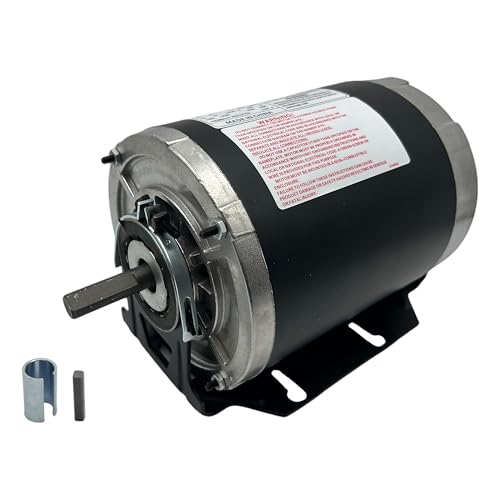
How To Choose The Best 1/2 HP Fan Motor
Not all 1/2 HP fan motors are interchangeable, even when the horsepower matches. Your furnace or air handler expects a motor with a specific physical frame, voltage, and rotation direction. Buying on horsepower alone leads to returns and wasted weekends.
Match the Frame and Shaft First
The NEMA 48 frame is the standard for most residential blowers, with a body diameter of about 5-5/8 inches. The shaft diameter is almost always 1/2 inch, but shaft length varies wildly — from 3.4 inches up to 4.5 inches — so measure your old motor’s shaft before ordering. A belly band mount (a metal strap that wraps around the motor) needs the right body diameter to sit securely.
Voltage Either 115V or 208/230V
Split the market down the middle: standard residential systems run on 115V, while many package units and heat pumps need 208/230V. Wiring a 115V motor into a 230V system burns it out instantly. Check the nameplate on your old unit or the furnace’s wiring diagram — this one number decides which pool of motors you can even consider.
PSC, ECM, or Constant Torque
Older furnaces use PSC (permanent split capacitor) motors — simple, cheap, and needing an external capacitor to start. Modern high-efficiency systems use ECM (electronically commutated motor) or constant-torque motors that run on a 24VAC control signal and sip less power. If your system was built around an ECM, a PSC replacement won’t interface with the control board.
Quick Comparison
| Model | Best For | Voltage / Amps | Speed (RPM) | Frame / Shaft | Amazon |
|---|---|---|---|---|---|
| Evergreen Genteq 6205E★ Best Overall | ECM/X-13 replacements | 208-230V | 1075 | 48 Frame / 0.5″ | Amazon |
| Century DL1056Top Performer | Direct-drive blowers | 115V / 6.5A | 1075 | 48 Frame | Amazon |
| CHIOWO GF2054Most Versatile | Belt-drive HVAC units | 115V / 7.2A | 1725 | 48 Frame / 1/2″ | Amazon |
| VEVOR FNM1075 | Budget 230V swap | 208/230V / 2.7A | 1075 | 48 Frame / 3.4″ shaft | Amazon |
| Dial 2204 | Evaporative coolers | 115V / 8.1A | 2-speed | Copper wound | Amazon |
| Knocokie 0131F00042SP | Goodman/Amana furnaces | 115V / 7.0A | 1130 | 1/2″ x 4″ shaft | Amazon |
| Regal Beloit 3S045 | Trane OEM-style swaps | 115V / 7.9A | 1075 | 48 Frame / 1/2″ x 4.5″ | Amazon |
| US Motors 8200 | Belted fans and blowers | 115V / 8.0A | 1725 | 48/56 Frame / 1/2″ | Amazon |
| Century GF2054 | Shop and cooler duty | 115V / 7.2A | 1725 | 48 Frame / 1/2″ x 1.5″ | Amazon |
In‑Depth Reviews
1. Evergreen Genteq 6205E — X-13 Constant Torque Motor
Our pick — over 4.5★ from 800+ verified ratings; the strongest balance of quality and price.
A universal constant-torque ECM that replaces dozens of OEM X-13 motors with a self-setting, plug-and-play install.
For homes with a newer high-efficiency furnace, the control board expects a constant-torque motor, not an old PSC. This Evergreen delivers that — it’s a multi-speed, brushless DC motor with four discrete speeds, driven by a 24VAC signal, and rated at 1075 RPM on 208-230V. It self-sets on install, which is exactly why buyers describe it as plug-and-play; the electrical connectors match the old motor’s harness, so there’s no rewiring guesswork.
The performance reputation here is the strongest in this roundup — more than 140 owners single out how well it runs, and over 110 more call the installation surprisingly easy. It’s a direct superseder for a long list of Trane, American Standard, Carrier, and ICP part numbers, including MOT13004, MOT12888, MOT12319, and HD44AE137. Buyers report it saved them a service call by doing the seal-and-swap themselves in under an hour.
At 1.6 ounces the listed weight is clearly a data entry slip — the real story is the metal construction and the NEMA 48 belly band mount with a 5-inch long, 1/2-inch diameter shaft. The one thing to double-check: this does not replace EON, 3.0, 2.3, or 2.5 ECM motors, and it’s a 230V unit, so it won’t help a 115V system at all.
What owners keep praising
- Genuine plug-and-play install for X-13 systems — connectors match the old harness
- Quiet operation with strong airflow through the vents
- Replaces dozens of OEM part numbers from Trane and Carrier
Check before you buy
- Only for 208-230V systems — a 115V furnace needs a different motor
- Does not cover EON, 3.0, 2.3, or 2.5 ECM motor families
- Durability feedback runs slightly mixed across long-term owners
Reach for this if: you own a Trane, Carrier, or Rheem system with a failed X-13 motor and want the closest drop-in match with the least wiring.
Think twice if: your furnace runs on 115V — this motor needs the higher 230V supply.
2. Century DL1056 — Direct Drive Blower Motor
A 1075 RPM, three-speed direct-drive motor that owners call the cheapest path to a working air handler.
When the quote from an HVAC company runs past and the part itself is under the DIY threshold, this Century DL1056 is what people buy. It’s a 1/2 HP, 1075 RPM, three-speed direct-drive motor at 115V with a 6.5-amp draw — a near-universal shape for residential air handlers. The sleeve-bearing construction is the classic budget-friendly design; it’s not the quietest bearing type long-term, but it’s the standard for this class of motor.
What buyers repeatedly discover is that it replaces older A.O. Smith part numbers like F48J50B22 and f48f95a48 with a mechanically identical fit. The one honest gotcha: your original may have had four speeds while this offers three, so you’ll wire to the closest match rather than an exact one. A few owners also note it wants a 10 MFD capacitor where their old unit used a 7 — a small part, but one to have on hand before you start.
Value is the loudest theme in the feedback, with install ease close behind. One owner’s experience sums up the appeal: the furnace blower hub needed a spot weld to hold tight, and after that the motor ran with no problems at all. If your system is a Goodman air handler, expect to supply your own mounting bracket — the motor doesn’t ship with the belly band.
Why owners choose it
- Mechanically identical to common A.O. Smith F48-series replacements
- Strong airflow — several owners say it blows harder than the original
- Straightforward install for a DIY under the cost of a service visit
Plan around these
- Only three speeds when some originals had four
- Needs a separate bracket for Goodman air handlers
- May require a 10 MFD capacitor instead of the original 7
Best suited for: direct-drive furnace blowers that need a proven, cheap, mechanically-identical 115V swap.
Not for you if: you expect four matching speeds or a mounting bracket in the box.
3. CHIOWO GF2054 — Belt Drive Motor
A 1725 RPM belt-drive motor with copper windings that handles loads that burned out smaller units.
This CHIOWO is a direct replacement for the AO Smith GF2054 and BF2054 line, spinning at 1725 RPM on 115V with a 7.2-amp draw. It’s the faster, belted cousin of the 1075 RPM direct-drive motors — built for furnaces where a belt connects the motor to the blower wheel. The 5-5/8 inch diameter body sits squarely in the 48-frame family with a 1/2 inch shaft.
That speed makes it a favorite for repurposing, not just HVAC. Owners have bolted it onto old cast-iron drill presses and cement mixers, where the extra RPM and torque handle loads that smaller motors couldn’t. Its 17.8-pound weight and copper windings give it a solid, substantial feel, and the open dripproof design keeps it cool under sustained running.
You get a motor that runs cooler than the smaller units you may have dealt with before: one long-time furnace owner reports that after decades of watching 1/4 HP units burn up and 1/3 HP units run hot, this 1/2 HP motor still fit the original frame and ran at 103°F after 30 minutes. The main caution is simple — a single unit arrived dead on arrival, so test yours before you button everything up. More than 30 owners give it a strong rating overall, and the rotation is reversible, so it works whichever direction your belt runs.
Real-world flexibility: this is the rare blower motor that crosses from furnace duty into shop tools without complaint, but a small number of units need an exchange from the start.
Grab this for: belt-drive furnaces, drill presses, or mixers craving the 1725 RPM speed and 1/2 HP grunt.
Look elsewhere if: you need a direct-drive 1075 RPM blower — this spins too fast for that job.
4. Knocokie 0131F00042SP — Goodman Blower Motor
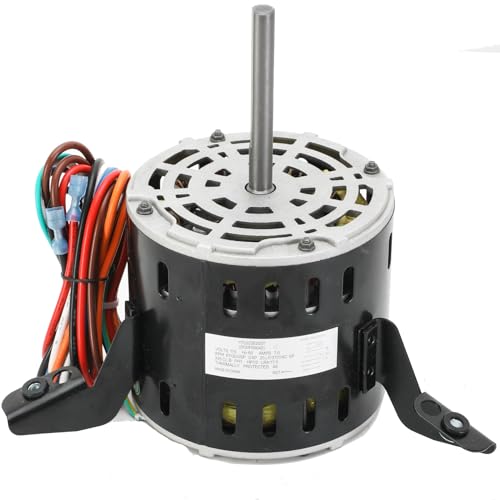
A 1130 RPM, four-speed motor that drops into Goodman, Amana, and Janitrol furnaces with zero modifications.
If you own a Goodman, Amana, or Janitrol unit, this motor targets your exact part number. It replaces the obsolete 0131F00042 with a 1/2 HP, 115V, four-speed motor spinning at 1130 RPM with a 7.0-amp draw and an LRA of 17. The shaft runs 1/2 inch by 4 inches long, and the whole unit weighs 15.5 pounds of metal-bodied reliability. The manufacturer is Broad-Ocean, a name familiar to anyone who has serviced Goodman equipment, with part number Y7L623E203T stamped on the case.
Owners mention it fits compatible models like the ACS90704CXA and AMH80704BN gas furnaces with no modifications required. A buyer who ran one for nearly three years without a single problem even had an HVAC technician compliment how well the unit was running during a routine inspection. The quality feedback is the most common theme in the reviews, with install ease and a direct fit close behind.
The honest caveats: noise gets genuinely mixed feedback — some find it whisper-quiet while others notice audible operation — and it draws 7.0 amps, so confirm your system’s wiring can handle it. The seller also asks you to double-check compatibility before buying, which is solid advice for any motor in this class. One buyer did note it runs slightly larger than the original part, so verify your blower compartment has a little breathing room.
The verdict in one line: a purpose-built Goodman replacement with years of proven service behind it, as long as you can live with the mixed noise reports.
Choose this for: Goodman, Amana, or Janitrol furnaces needing the exact 0131F00042SP match.
Think twice if: silence is your top priority — noise feedback is split down the middle.
5. Regal Beloit 3S045 — PSC Blower Motor
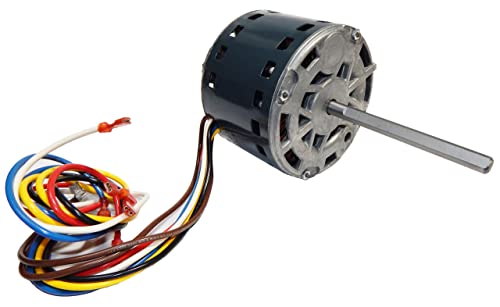
A four-speed 1075 RPM PSC motor with ball bearings that Trane owners call an exact stand-in.
This Regal Beloit motor matches the profile of a classic Trane blower: 1/2 HP, 1075 RPM, 115V at 7.9 amps, with a 1/2 inch shaft that runs 4.5 inches long. It’s a four-speed PSC design on a 5-5/8 inch body diameter with ball bearings — a meaningful upgrade in longevity over sleeve bearings. The open dripproof housing and copper construction make it a 16-pound, solidly built unit rated for 40°C ambient temperatures.
Owners have used it both as a furnace replacement and as a power plant for a mini lathe running through a VFD. It even resolved one furnace issue so cleanly that the buyer described it as working “like magic.” The 4.5-inch shaft is on the longer side, which makes it adaptable when your old motor had a slightly different length.
Here’s the catch that shows up in the reviews: the motor requires a 10 MFD 370V capacitor (a small part that stores electrical charge to help the motor start), and while some owners received one in the box, others did not — so expect to supply it if your old one is weak. One buyer on a 1996 Tempstar furnace needed about three hours to install it because the chimney had to come apart first, meaning the physical swap isn’t always a 20-minute job.
Owners highlight
- Ball bearings instead of sleeve bearings for longer service life
- 4.5-inch shaft gives flexibility on fitment
- Exact replacement for GE 5KCP39LGR668AS blowers
Owners flag
- Capacitor may or may not ship with the motor — buy a 10 MFD 370V to be safe
- Not a direct swap on older Tempstar furnaces without extra work
Right for: buyers who want a four-speed PSC motor with the durability of ball bearings and a long shaft for adapter flexibility.
skip it if: you want the capacitor guaranteed in the box — this one keeps you guessing.
6. US Motors 8200 — Belted Fan and Blower Motor
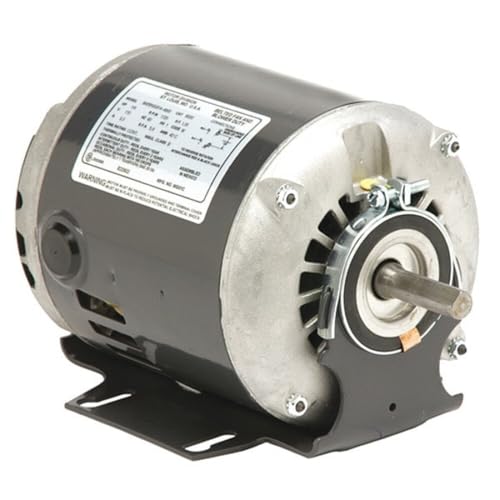
An open dripproof, split-phase belted motor with automatic overload reset for air-handling equipment.
This US Motors 8200 spins at 1725 RPM on 115V with 8.0 full-load amps and a 1.25 service factor — the headroom that keeps it running cool even when the belt tension is a bit heavy. It’s a reversible single-speed split-phase motor on a NEMA 48 frame, with a 1/2 inch shaft that extends 1.5 inches, and it uses ball bearings. The 40°C ambient rating and Class B insulation are the engineering details that matter when the motor sits near a heat source.
It crosses between HVAC and shop use with ease. A cement mixer owner replaced a burnt-out motor and found it bolted to the existing mount and pulley, wired cleanly using the diagram, and ran quiet enough that only the gearbox could be heard. Another buyer simply said the fan ventilates again after a straightforward hookup. The combination 48/56 mounting holes plus a 5/8 inch shaft adapter give it uncommon flexibility for older equipment.
The one real complaint in the feedback: the power cord can get hot during extended running, which suggests the motor draws what it’s rated for and then some. Remember this is the bare motor — pulley, belt, and wiring accessories are not included. And because it’s split-phase rather than capacitor-start, confirm your application doesn’t demand high starting torque.
Straight talk: a reliable, adaptable belted motor for HVAC and shop fans alike, though the hot cord on heavy duty is worth watching.
Ideal for: belt-driven air handlers and shop equipment where the 48/56 frame combo and 1725 RPM speed are the match.
Pass on it if: you need a capacitor-start motor or a longer shaft for a deep pulley.
7. Dial Manufacturing 2204 — Evaporative Cooler Motor

A two-speed, copper-wound 115V motor with built-in surge protection that runs quieter than the tired units it replaces.
For evaporative coolers — the “swamp coolers” of the dry Southwest — this Dial motor is a specialist. It’s a two-speed, 115V motor drawing 8.1 amps, built with copper windings, and it’s heavier than its size suggests at 7.63 kg. The body includes built-in surge protection, a welcome feature for a motor that lives outdoors and takes the brunt of summer storms.
Buyers who swapped this in describe it as rescuing their entire cooling system. The recurring story: the old motor was chugging to start, noisy, and couldn’t cool the house, and this Dial replacement fixed all three at once. Matching it to the old motor’s measurements and specs took the guesswork out — owners say it’s a perfect fit that saved their summer. Multiple buyers have come back for a second one, which says plenty about consistency.
The noise reduction is the standout, with owners calling it noticeably quieter than what they pulled out. It’s a straightforward bolt-in replacement for a standard cooler pulley, and the 11-inch height keeps it inside most cooler shrouds. There’s no capacitor to fuss with and no complicated wiring diagram — this is the simplest motor on this list to install for its specific job.
Why it wins for cooler owners: a true two-speed, copper-wound, surge-protected drop-in that’s dramatically quieter than the tired motors it replaces.
Buy this for: any standard evaporative/swamp cooler that needs a quiet, reliable 115V two-speed workhorse.
Not the one if: you’re repairing a furnace or forced-air system — this is cooler-specific.
8. VEVOR FNM1075 — Furnace Blower Motor
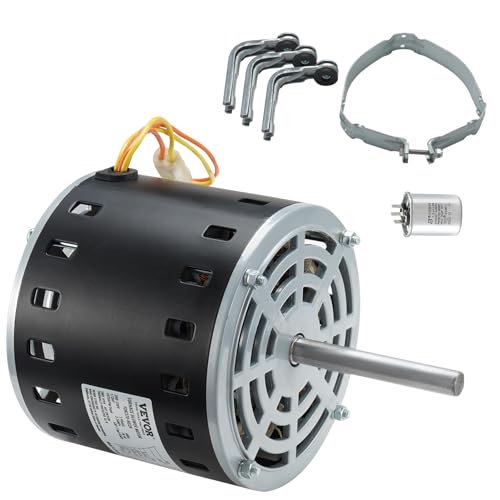
A five-speed 230V blower that pairs with a bonus capacitor and holding hoop.
The VEVOR gives you everything needed for a DIY swap at once: the 48-frame motor, a CBB60 7.5μF/450V capacitor to prevent failure from an aging capacitor, and an 11-inch hold hoop as the mounting bracket. That bundle means no second trip for hardware. It’s a 1/2 HP, 1075 RPM, five-speed motor drawing 2.7 amps at 208/230V, with a 3.4-inch shaft — the shorter length that fits many residential air handlers.
In a pinch, it’s proven itself. Another dropped it into a 30-year-old heat pump where it fit perfectly and ran well for months. The reversible CW/CCW rotation takes the guesswork out of which way your blower spins.
One clever workaround emerged in the feedback: a buyer used this 1/2 HP motor to replace a 1/3 HP unit, ran it on high speed only, left three legs unused, and enjoyed more airflow with less noise. That’s the versatility of having headroom. The high-strength metal casing resists corrosion, which matters when the motor sits in a damp basement or crawlspace.
The bundle wins
- Ships with the capacitor and hold hoop — no extra hardware to buy
- CW/CCW reversible for easier installation
- Can step up from a smaller 1/3 HP motor with more airflow
The limits
- 230V only — a 115V furnace cannot use this motor
- Smaller review base than the category leaders
Perfect for: a quick, complete 230V swap where buying the capacitor and bracket separately would be a hassle.
Avoid if: your system is 115V — check the nameplate before you order.
9. Century GF2054 — Resilient Base Motor
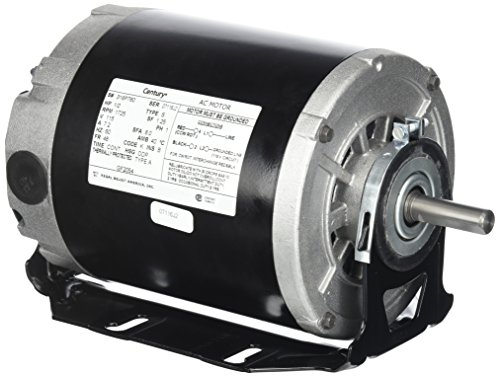
A 1725 RPM split-phase motor with a resilient cradle base that absorbs vibration for coolers and compressors.
The Century GF2054 is a split-phase motor with a resilient cradle base — the rubber-mounted feet that dampen vibration — making it a natural fit for swamp coolers, air compressors, and other equipment where noise transfer matters. It’s 1/2 HP, 1725 RPM, drawing 7.2 amps at 115V, with a 1/2 inch shaft that extends 1.5 inches and sits 3 inches off the mounting surface. The automatic overload protection and 1.25 service factor mean it can run hard without tripping.
Its reliability record is the most-reviewed positive on this list, with over 100 owners vouching for it. In brutal summer heat, one buyer ran it 24/7 to keep a home at 75°F when it was 100°F outside, and it held up for weeks on end. The copper construction and sleeve bearings keep the price approachable, and the 17.6-pound weight signals solid build quality.
But there’s a durability split that you should respect. While the reliability feedback is strong, a minority of units failed early — one bearing seized when a pulley jammed against the casing, and another tripped its internal breaker on startup under a heavy v-belt load. The recurring install advice from owners: oil the sleeve bearings upon install (they ship dry), and check your pulley size, because an oversized sheave can overload the startup current. A swamp cooler owner found it drew about 6.5 amps against a nameplate of 8.2, so there’s real headroom in practice.
What the 100+ happy owners say
- Excellent value for money on a 1/2 HP belted motor
- Runs reliably 24/7 through extreme heat
- Resilient base mounts easily with no modifications
What you must handle
- Oil the sleeve bearings at install — they arrive dry
- Wrong pulley size can trip the internal breaker on startup
- Durability feedback splits, with some early failures reported
Take this one for: swamp coolers, compressors, or any 1725 RPM belted job on a budget — just oil it first.
Step back if: you can’t confirm the correct pulley size, since an oversized sheave strains startup.
Understanding the Specs
NEMA 48 Frame and Shaft Size
The frame size defines the motor’s body diameter — 48-frame motors are about 5-5/8 inches across, the standard for residential blowers. The shaft diameter (almost always 1/2 inch) must match your blower wheel or pulley hub. Shaft length varies from 3.4 to 4.5 inches, so always measure your old motor before ordering.
Voltage and Full-Load Amps
Motors run on either 115V or 208/230V. Full-load amps (FLA) tell you how much current the motor draws under load — matching the old motor’s FLA ensures your wiring and breaker are sized correctly. A 2.7A 230V motor and a 7.9A 115V motor can both be 1/2 HP because higher voltage means lower current for the same power.
RPM: 1075 vs 1725
Direct-drive blower motors spin at 1075 RPM and connect straight to the blower wheel. Belt-drive motors spin at 1725 RPM and use a pulley and belt to turn the wheel. Swapping one for the other changes your airflow completely.
Rotation Direction
CCWLE (counterclockwise lead end) is the most common blower rotation, but some systems need CW. Many modern motors are reversible — you simply swap two wires. Always confirm rotation before permanently mounting, because a motor spinning the wrong way moves almost no air.
FAQ
Is a 1/2 HP fan motor a direct replacement for my old 1/3 HP motor?
How do I know if my furnace needs 115V or 230V?
What is the difference between a direct-drive and belt-drive motor?
What is an X-13 or constant-torque ECM motor?
Do I need a capacitor for my new blower motor?
Will a motor with a longer shaft work in place of a shorter one?
What does frame 48 or 48/56 mean for my install?
Why does my blower motor need oil before use?
How hard is it to replace a furnace blower motor myself?
Can I use a 1/2 HP blower motor for other equipment like a drill press?
Final Thoughts: The Verdict
The clear winner for most homes is the Evergreen Genteq 6205E, because it solves the hardest problem in this category — replacing an X-13 ECM motor (an electronically commutated motor that runs on a control board) without touching that board — and does it with a self-setting, plug-and-play install that has already saved owners serious service-call money. If you want a straightforward 115V direct-drive swap, the Century DL1056 is the crowd-proven budget route. And for evaporative cooler owners, the Dial 2204 is the quiet, copper-wound specialist that ends a summer of struggling motors.
How We Picked
We do not accept paid placement. Every pick is matched to a real buyer and a real use-case; we do not hands-on test units.
Sources & Methodology
Specifications: manufacturer listings and product documentation. Review insights: verified customer reviews, as of September 2026. Pricing: not shown on this page (it changes often); check the current price via the retailer link.
As an Amazon Associate, KitchPrep earns from qualifying purchases. This does not affect which products we feature.
Related Guides
