
Specs are compiled from manufacturer listings and verified buyer reviews and can change over time — please confirm the key details on the product page before buying.
You need four feet of black steel pipe for an oil-heat conversion, or a nipple to weld onto an air tank, and the local big-box store wants to sell you ten feet and thread it themselves. Buying 1 1/4 inch steel pipe online means you need to know three things before you click: the thread type, the schedule (wall thickness grade), and what the pipe is actually coated in when it arrives. Get those wrong and you get short threads that will not seat, or greasy pipe you have to scrub before you can use it.
I’m Mohammad Maruf — the founder and writer behind KitchPrep. This guide is built by comparing the manufacturers’ published specifications and the patterns across verified customer reviews, so you get each pick’s real strengths and trade-offs instead of marketing spin.
Below, four pre-cut options in this size are broken down by thread engagement, finish, and whether the coating protects or annoys you. Use this guide to match the right 1 1/4 inch steel pipe to a driven well, a repair, or a furniture build.
Our Picks at a Glance
How To Choose The Best 1 1/4 Inch Steel Pipe
The pipe on this page all measures 1 1/4 inches and carries Schedule 40 walls, but the finish, length, and thread quality differ in ways that change what job each one is actually good for. Here is what to check before you order.
Thread Type and Engagement
Every pipe here uses NPT (National Pipe Taper) threads, which taper slightly so they wedge tighter as you turn them. Full, cleanly machined threads are the difference between a joint that seals and a joint that weeps, or worse, refuses to start at all. Short or partially cut threads are the most common defect on cut-rate fittings, so buy from brands whose threads arrive in good condition.
Black Steel vs Galvanized Finish
Black steel pipe is bare steel with a thin protective oil coating, and it is the standard choice for gas, oil, and air lines as well as industrial-style furniture. Galvanized pipe is coated in zinc so it resists rust in damp settings — a driven well, a buried line, or outdoor work. If you plan to paint the pipe to match a room, black steel takes paint more readily; galvanized needs a proper primer first.
Pre-Cut Length and What You Are Actually Getting
Pre-cut pipe saves you from buying a ten-foot stick and having it cut and threaded at the store. Check the listed piece count carefully — a pack may contain four or five individual pipes, not four or five bundles. For a driven sand-point well, most buyers link several sections together, so plan on buying the couplings or links you need at the same time.
Quick Comparison
| Model | Best For | Pipe Size | Length / Pack | Finish / Material | Amazon |
|---|---|---|---|---|---|
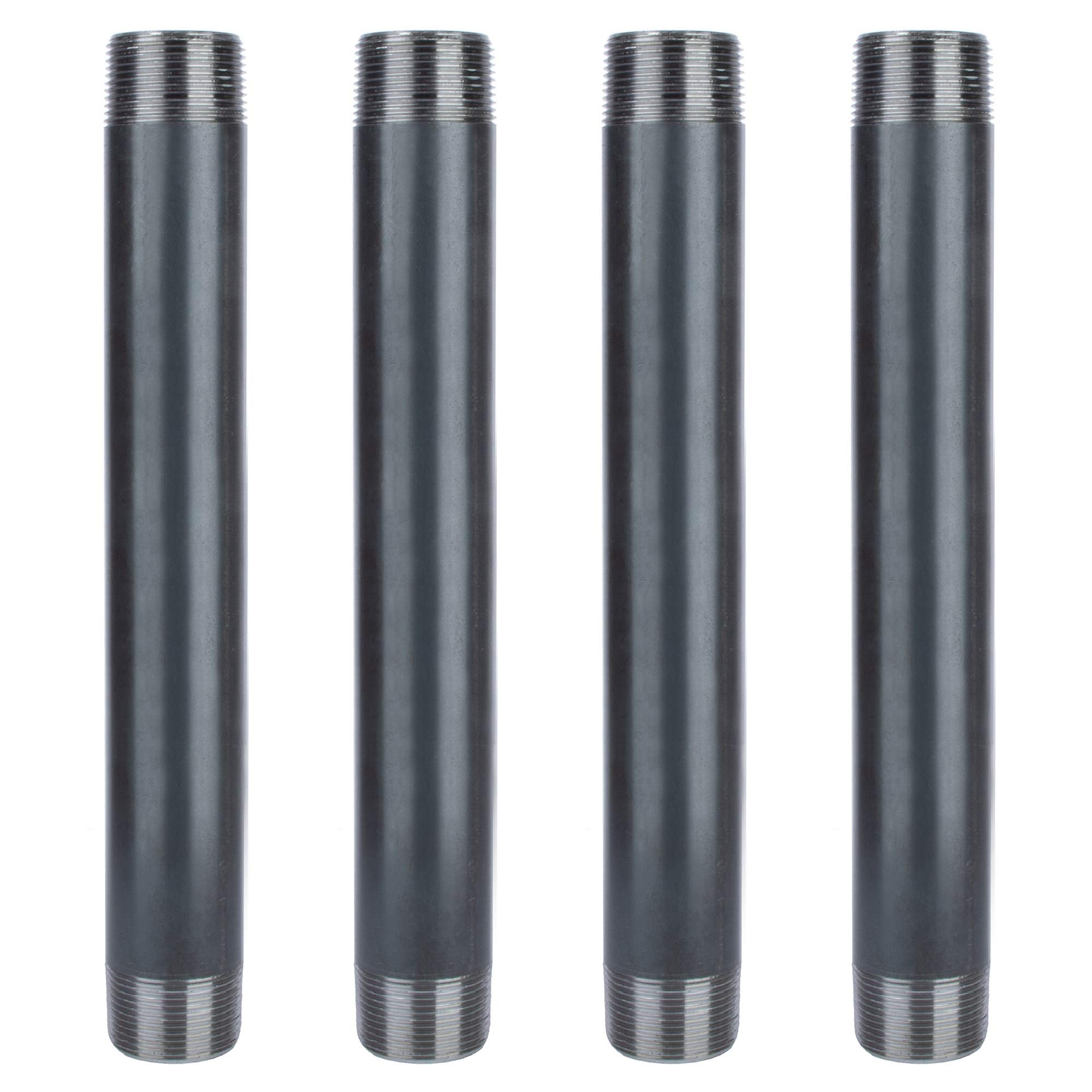
| PIPE DECOR Black Steel 1 1/4 in. x 12 in.★ Best Overall | Furniture, lamps and air-tank builds | 1-1/4 inches | 12 in. x 4 pack | Black steel, grease-coated | Amazon |
| Anvil 8700153300 Steel Pipe Nipple | Pipeline repair and clean installs | 1-1/4″ NPT | 8 in. single nipple | Galvanized alloy steel | Amazon |
| Supply Giant QDHM1136 Schedule 40 | Sand-point wells and buried runs | 1-1/4″ | 36 in. single pipe | Galvanized Schedule 40 | Amazon |
| Supply Giant 1-1/4 in. x 24 in. Galvanized 5-Pack | Multi-section well and water lines | 1-1/4″ | 24 in. x 5 pack | Galvanized alloy steel | Amazon |
In‑Depth Reviews
1. PIPE DECOR Black Steel Plumbing Pipe, 1 1/4 in. x 12 in. (4 Pack)
Our pick — over 4.5★ from 100+ verified ratings; the strongest balance of quality and price.
Four short black-steel sticks that turn a flat-pack idea into industrial furniture — or hold an air-tank leg steady.
You get four pipes, each 12 inches long, threaded with 1-1/4 inch NPT (a standard pipe thread size) on both ends, and finished in the industrial black-steel grey the trade calls “black.” That short length is the point: 12 inches is exactly what you want for table legs, shelf brackets, lamp stems, and bar-cart frames. It is long enough to give you real height, but short enough that the whole piece stays rigid instead of flexing at the joint.
You save a trip and a cutting fee because these arrive pre-cut and ready to use, the same category of pipe a local plumbing supply would cut and thread in the back for you. One buyer converting to oil heat needed four feet of black steel pipe threaded on both ends and reported that the local big-box store wanted double the money to cut and thread a ten-foot stick. The review pages sum it up: “Perfectly described and exceeded expectations!” A tire-bead-blaster project and a set of tank legs both landed on the same verdict — the threads and dimensions match what is advertised.
Every pipe ships lightly oiled to keep rust off, and buyers report that the coating is exactly that — a thin protective film, not a defect — but it does mean you need to wipe the pipe down before you paint or handle it. The brand includes a cleaning-and-sealing sheet, recommends gloves, and stays sticker-free so you are not scraping label residue off a piece you are about to use as furniture. Note the recurring gripe on one order: a pack arrived short a piece, so count your four pipes before you start cutting. The Anvil nipple at position 2 is cleaner from the start, but it is one eight-inch nipple — this four-pack gives you the working length and quantity for a real build.
Why the four-pack wins
- Four threaded 12-inch pipes in one order — enough to frame a table, shelf, or lamp without a second trip
- 1-1/4 inch NPT threads on both ends thread cleanly into standard black fittings and flanges
- No stickers or labels to scrape off before painting
- Meets ASME and ASTM standards, with a 2-year limited warranty backing the parts
What to plan for
- Ships with a light grease coating that needs wiping before paint or handling
- Twelve-inch length will not reach across a room — count your cuts before ordering
- Occasional packs have arrived short one pipe, so verify the count on arrival
Reach for this if: you are building industrial furniture, a lamp, or a tank stand and want four pre-threaded 12-inch sections in one order.
Think twice if: you need a long uninterrupted run — a single 24- or 36-inch pipe serves that better than chaining four short ones.
2. Anvil 8700153300 Steel Pipe Fitting Nipple, 1-1/4″ NPT Male x 8″
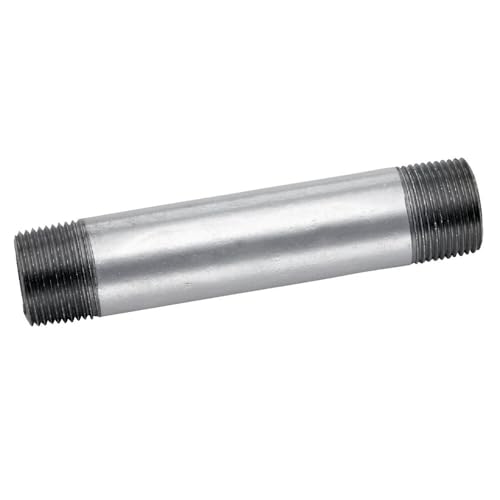
One clean, correctly threaded nipple that arrives ready to install — no grease, no rust, no scraping.
For a single repair, this 8-inch nipple (a short pipe section with threads on both ends) screws between two female-threaded fittings to bridge a gap or extend a run. It has 1-1/4 inch NPT male threads on both ends, is galvanized over steel, and is machined to meet ASTM A53 and ASME B1.20.1 (standards for pipe material and thread dimensions). Weighing just 1.6 ounces, it is light enough to hold in one hand while you line up the threads. The galvanized finish — a zinc coating that resists rust — means it does not need painting or protection in a damp basement or exterior wall.
This one earns a top spot because of thread quality. Buyers who have used both this and the big-box equivalent are blunt that the Anvil fitting wins — the review pages sum it up: “These are premium fittings with correctly machined threads, and are clean and ready to install.” That difference shows up on the job, not just on the spec sheet. Short threads on cut-rate nipples mean fewer turns of engagement, which is the usual reason a fitting will not seal. Anvil’s threads are cut to spec, so a valve, coupling, or elbow torques on the way it is supposed to. Someone welding a quick-release onto an air tank reached for this exact nipple — until the threads on theirs were not fully machined, forcing a cut-and-replace. That is the honest worst case: a unit can slip through with incomplete threads, so test-fit before you commit the weld.
At 8 inches, this is a repair part, not a build kit. If you need four feet of run or a driven-well section, the Supply Giant 36-inch at position 3 gives you the length in one piece. But for joining two threads or extending an existing line, this clean, correctly machined nipple is the one to reach for.
Why it earns its spot: clean, correctly machined NPT threads that seat on the first try, on a rust-resistant galvanized finish, from a brand buyers trust over the box-store imports.
Honest limit: it is a single 8-inch nipple, and threads that arrive incompletely machined cannot be rescued — always dry-fit before a permanent weld.
The repair-job go-to: grab this when you need one clean 8-inch nipple to bridge or extend a 1-1/4 inch line.
Look elsewhere if: you are framing furniture or driving a well — you want the four-pack or the 36-inch section instead.
3. Supply Giant QDHM1136 Schedule 40 Threaded Pipe, 1-1/4″ x 36 in.

A full 36 inches of Schedule 40 galvanized pipe — the one to drive into the ground when a well needs depth.
Schedule 40 tells you how thick the wall of this pipe is — the grade most residential plumbing and driven-well work is built around. At 36 inches long and 1-1/4 inch diameter, this single section is galvanized over steel to resist rust and finished with threaded ends capped for shipping. The up-front length means fewer joints to link and fewer places for a driven run to leak or buckle, and it is exactly the length of the pieces buyers are hammering into sand-point wells.
Owners mention driving this pipe into the ground for a shallow well from Florida to points north, and the pattern is consistent: the pipe has the schedule the job needs and does not bend under the hammer. One long-time well installer dismissed the local hardware-store pipe as having the wrong schedule and switched to this, driving a point and three sections through with no trouble. For a driven well, the real spec is the wall thickness and the thread integrity at each joint — a section that buckles at a joint is scrap, and that is the honest failure mode here. Across enough hammers and enough soil types, the odd section gives way at the joint you are driving hardest. Treat the threads as the point of load, add a sacrificial pipe when you pound, and expect the durability that is typical of Schedule 40 galvanized in this size.
Unlike the four 12-inch pieces at position 1, this is one continuous, uncut 36-inch length. The PIPE DECOR at position 1 is four 12-inch pieces — more joints to seal, but more flexibility for furniture. This one trades that flexibility for one long, uninterrupted run with one thread at each end. In the table, that is the 36-inch figure in every well job: fewer pieces, fewer leaks, more reach per order.
Where it delivers
- 36 inches in a single section — fewer joints than chaining shorter 12-inch pieces
- Schedule 40 wall is the grade driven-well work is built around
- Galvanized coating resists rust in damp, buried, and outdoor jobs
- Meets or exceeds applicable ASTM and ANSI standards
Where it strains
- Pounding a run always loads the threads — a few buyers have had a joint give out or a thread end arrive damaged
- Sold as a single piece, so a multi-section well means buying extras and couplings
Best for driven wells and buried lines: one long, Schedule 40 galvanized section that takes the hammer and resists rust.
skip it if: you need short furniture legs — the 12-inch four-pack at position 1 fits that job better.
4. Supply Giant 1-1/4″ x 24″ Galvanized Pipe, Pack of 5

Five 24-inch galvanized sections in one order — the bulk route for multi-section wells and longer water runs.
For a job that needs several linked sections, you get five pieces at 24 inches each. Each pipe is galvanized steel with 1-1/4 inch NPT male threads and ships with plastic end caps protecting the threads in transit — the same rust-resisting finish as the 36-inch above, but at a length that pairs cleanly with the driving head and point you are using. Five sections at 24 inches gives you a run long enough to reach deeper than one 36-inch section without the trip-to-the-store add-on of buying each pipe singly. One buyer running a shallow well line was clear the listing is for five pipes, not five bundles, and used them to drive a shallow well; another kept them in reserve as a backup well line.
One thing to note: this is the pick with the widest spread of owner experience on the list. A substantial block of customers note that when you pound these together and drive them, the threads are the point that wears. Some sections go in clean; others have cosmetic thread damage from the start, and a heavy-handed driving head will strip a thread long before the pipe body gives. The practical fix the more experienced buyers landed on is a sacrificial 12-inch pipe you are willing to consume with the hammer, and retightening the driving head every few blows. Skip those habits and the threads strip before the pipe body gives.
For furniture or lamp builds, this pack is overkill — the pipe is heavy at 11.3 pounds for the set, and 24 inches is long for a table leg. That said, if you are running a shallow water well or a multi-section line, the five-pack spreads the per-piece cost and the shipping across a bigger job.
Read the listing right: this is five individual 24-inch pipes, not five sets — the quantity and the 24-inch length are what the pack delivers.
The quality caveat: threaded ends are the durability weak point when these are pounded — plan on a sacrificial pipe and consistent head tightening.
Best for quantity jobs: pick the five-pack when a multi-section well, a longer line, or a big build needs several 24-inch galvanized sections at once.
Not for single repairs: for one clean replacement part, the Anvil nipple is the better fit — this pack is built for volume.
Understanding the Specs
Schedule 40 & Nominal Pipe Size
Schedule 40 is a wall-thickness grade, not a diameter. It tells you the steel is thick enough for the pressure and load of most residential plumbing, gas, oil, air, and driven-well work. “1-1/4 inch” is the nominal size — the trade name for the pipe’s inside flow diameter, not the outside measurement you would get with a tape measure. That is why a 1-1/4 inch pipe will not slip through a 1-1/4 inch hole; the outside is larger.
NPT Threads and How They Seal
NPT stands for National Pipe Taper — the threads are cut on a slight angle so they tighten and wedge as you turn them, which is what creates the seal without a gasket. Male threads point outward (like a nipple’s ends); female threads sit inside a fitting. Match male to female, turn until snug, and the taper does the sealing. Short or partially machined threads are the usual reason a joint will not start or refuses to hold.
FAQ
What does 1 1/4 inch steel pipe actually measure?
Will a 1 1/4 inch pipe thread onto a fitting sold as 1-1/4 inch NPT?
What is the difference between black steel and galvanized pipe?
Do I need to clean the pipe before I use it?
Can I use these pipes to drive a shallow sand-point well?
How many pipes come in the PIPE DECOR four-pack?
What is the difference between the 12-inch four-pack and the 24-inch five-pack?
Why would a pipe thread arrive damaged?
Can I paint these pipes to match a room?
Is Schedule 40 strong enough for a driven well?
Final Thoughts: The Verdict
For most jobs, the winner is the PIPE DECOR Black Steel 1 1/4 in. x 12 in. four-pack because it delivers four pre-threaded sections you can build or repair with right from the start, and it is the strongest all-round pick in the group. If you are driving a well or running a long line, the Supply Giant QDHM1136 36-inch Schedule 40 section is the one to grab for the length and rust resistance. And for a single clean repair part, the Anvil 8700153300 8-inch nipple is the one to reach for when a correctly machined thread matters most.
How We Picked
We do not accept paid placement. Every pick is matched to a real buyer and a real use-case; we do not hands-on test units.
Sources & Methodology
Specifications: manufacturer listings and product documentation. Review insights: verified customer reviews, as of September 2026. Pricing: not shown on this page (it changes often); check the current price via the retailer link.
As an Amazon Associate, KitchPrep earns from qualifying purchases. This does not affect which products we feature.
Related Guides
