
Specs are compiled from manufacturer listings and verified buyer reviews and can change over time — please confirm the key details on the product page before buying.
If you need to cut or clean a 1-1/4″-11-1/2 NPT thread (a standard U.S. pipe thread size), the decision is simpler than the tool aisle makes it look. Only a handful of taps in this size are ground accurately enough to chase a rusted manifold or cut fresh threads in steel. Most buyer frustration depends on three things: dull cutting edges, a shank too short to reach the damaged section, and a case that lets the teeth bang together in a truck toolbox.
I’m Mohammad Maruf — the founder and writer behind KitchPrep. This guide is built by comparing the manufacturers’ published specifications and the patterns across verified customer reviews, so you get each pick’s real strengths and trade-offs instead of marketing spin.
The size you need depends on the pipe you are fitting into, not the pipe you are holding. A 1-1/4″ NPT (National Pipe Taper, a US standard for tapered threads that seal as they tighten) tap threads a nominal 1-1/4″ pipe or fitting, and the tapered shape is what makes the joint leak-free without a gasket. Below are seven 1 1/4 inch pipe thread tap options, sorted so the sharpest cutters and the longest reach sit closest to the top.
Our Picks at a Glance

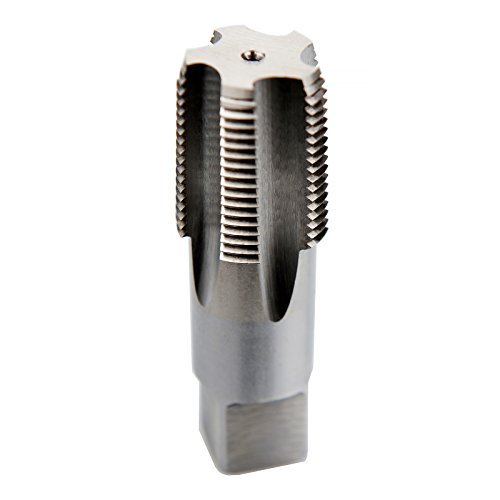
How To Choose The Best 1 1/4 Inch Pipe Thread Tap
A tap has no moving parts, so almost everything that decides whether it works lives in the geometry: the material it is ground from, the angle of the taper (the sloped lead-in that starts the cut), the number of flutes (the grooves that form the cutting edges), and how much shank you have behind the cutting head. Get those four right and the job takes a few minutes. Get them wrong and you either strip the thread or snap the tap inside the hole — a far worse problem than the one you started with.
Match the thread size and pitch exactly
An NPT tap is named by the pipe it fits, so a 1-1/4″ tap threads a 1-1/4″ nominal pipe. Your pipe also has a pitch — the number of threads in one inch of length — and in this size the standard is 11-1/2 TPI. If your pipe is 11-1/2 TPI, you need an 11-1/2 TPI tap; there is no adjusting for a mismatch. Buying the wrong pitch is the single most common reason a new tap feels like it is fighting the hole.
Carbon steel versus high-speed steel
Carbon steel taps handle everyday work: cleaning up a rusted thread, chasing a fitting on a water heater or a hydrant, cutting into brass or aluminum. High-speed steel (HSS) is a harder, more heat-resistant grade that stays sharp longer when you are cutting steel, cast iron, or doing the same job repeatedly. If you are a plumber or mechanic reaching for this tap weekly, HSS is the version that keeps its edge. If you are fixing one thing this weekend, carbon steel does the job for less.
Flutes and shank length decide what you can reach
Flutes are the grooves running up the side of the tap that give the cut metal somewhere to go. More flutes mean more cutting edges and a smoother finish; a 6-flute tap cuts more finely than a 4-flute one, which is why a 6-flute is a good general-purpose choice. Shank length matters just as much — an extended or “lengthened” tap can reach a damaged thread buried deep inside a bore that a standard tap cannot touch at all.
Expect to use cutting oil
Every tap in this size cuts better with cutting oil or fluid, and most need a back-and-forth motion rather than one continuous turn. Oil carries heat away from the edge and flushes chips out of the flutes. Skip it and the edge dulls faster and the tap is likelier to snap.
Quick Comparison
| Model | Best For | Material | Thread Size | Item Weight | Amazon |
|---|---|---|---|---|---|
| DECKRKAT 1-1/4″-11-1/2 NPT Precision Carbon Steel Tap Set★ Best Overall | All-round home and shop threading | Carbon Steel | 1.25 inch / NPT | 0.94 kg | Amazon |
| MaxTool 1 1/4″-11 1/2 NPT HSS M2 Fully Ground TapTop Performer | Repeated work in steel | High Speed Steel M9 | 1 1/4″ / 11 1/2 TPI | 620 g | Amazon |
| Yamesh NPT Pipe Tap Alloy Carbon Steel 1-1/4″-11-1/2 | Cleaning up existing threads | Carbon Steel | 1-1/4″-11 1/2 | 2 ounces | Amazon |
| DKIBBITH 1-1/4″-11-1/2 NPT Carbon Steel Hand Threading Tap | Service and maintenance techs | Carbon Steel | 1-1/4″ | 2.07 pounds | Amazon |
| DRINYOUNG Extended HSS Taper Pipe Thread Tap | Reaching deep or recessed threads | 6542 High Speed Steel | 1-1/4″-11-1/2 NPT | 1.3 pounds | Amazon |
| HFS 3-Piece NPT Pipe Tap Set (1″, 1-1/4″, 1-1/2″) | Sizing one case for several jobs | Carbon Steel | 1″, 1-1/4″, 1-1/2″ | 4.7 pounds | Amazon |
| Drill America 1-1/4″ NPT HSS 5 Flute Pipe Tap, T/A Series | General-purpose shop threading | High Speed Steel | 1-1/4″ NPT | 1 pound | Amazon |
In‑Depth Reviews
1. DECKRKAT 1-1/4″-11-1/2 NPT Precision Carbon Steel Tap Set
Our pick — over 4.5★ from 800+ verified ratings; the strongest balance of quality and price.
A six-flute carbon steel cutter that handles the everyday thread- chasing job without costing HSS money.
Start with the geometry, because that is what you actually feel in your hand. DECKRKAT grinds this 1-1/4″-11-1/2 NPT tap with right-hand cutting, a square-ended round shank, and six straight flutes. Six flutes means six cutting edges working at once, so the tap bites smoothly and leaves a cleaner wall than a four-flute cutter. The square end lets you drive it with a tap wrench or a socket, which matters once you are leaning on a 1-1/4″ thread in steel. It arrives as a single tap in a plastic case that keeps it from rusting and keeps it away from the other tools in your box.
The balance of the whole package is where this one pulls ahead. What wins people over is the build quality — that is the thing the review pages return to again and again. It reads as a well-made tap that does the job and holds up. Buyers report using it to chase a rusted thread on a yard hydrant and to clean up an RV water heater anode thread, and the case earns its own share of praise for being solid rather than flimsy. It re-threads a damaged fitting, then stores in its case until the next job.
The honest catch is sharpness at the leading edge, which is the one point buyers split on. Some find it slices threads cleanly from the first turn; others find the starting edge duller than they hoped and have to work harder to start the cut. Either way it is a carbon steel tool, so it is happiest on brass, aluminum, and re-threading work rather than heavy production cutting in tool steel. Pair it with cutting oil and a steady back-and-forth motion and it behaves.
What this tap gets right
- Six straight flutes give a smooth, clean cut on a 1-1/4″-11-1/2 NPT thread
- Square-ended round shank drives with a tap wrench or socket for real leverage
- Ships in a plastic case that holds it rust-free and organized
- Carbon steel keeps the price in home-shop range while still re-threading damaged pipes
Where it will test your patience
- Leading-edge sharpness is inconsistent piece to piece, so a fresh cut takes more pressure
- Carbon steel is not the grade for repeated threading in hard steel — that is HSS territory
- Sold as a single tap, so you pay once for one size
Reach for this if: you are a plumber, mechanic, or DIYer fixing one job at a time and want a well-built six-flute carbon steel tap that chases or cuts a 1-1/4″ NPT thread and stores cleanly.
Look elsewhere if: you cut threads in steel all day and need a high-speed steel edge that holds its sharpness through repeated passes.
2. MaxTool 1 1/4″-11 1/2 NPT HSS M2 Fully Ground Tap
The fully ground high-speed steel cutter for someone who taps steel more than once a week.
Here is where the money goes. MaxTool builds this 1-1/4″-11-1/2 NPT tap from high-speed steel M2 and grinds the threads and flutes fully rather than forming them. Fully ground means the thread form is accurate and the tolerances are tight, so each turn produces a consistent, smooth thread instead of a ragged one. It is rated with a cutting diameter of 1-1/4 inches and 11-1/2 TPI right-hand threads, which is exactly the pitch a standard 1-1/4″ NPT pipe calls for. It ships in a coded plastic box that keeps the edge protected and makes the size easy to spot in a crowded toolbox.
For a working tap, that hardness is the point. HSS M2 resists heat and wear, so the edge keeps cutting through repeated use on tough material instead of dulling out halfway through a run. The shape of this tap suits sustained work: it is built to stay sharp across job after job, which is what separates a tool you buy once from a tool you replace. If you cut steel weekly, the HSS M2 edge holds up where carbon steel dulls.
It is also the least forgiving about setup. A fully ground HSS tap rewards good technique and punishes a rushed start, so you want proper cutting oil and a true first turn. This is one of the heavier single taps here at 620 g, which is a fine trade for rigidity but noticeable if you are reaching into an awkward space.
Built to stay sharp: HSS M2 fully ground threads hold their edge through repeated cuts in tough material, which is the whole reason to step up from carbon steel.
The trade you are making: you pay more and carry more weight for that edge life, and the tap wants clean technique and cutting oil to give you its best.
Go for it when: threading steel is regular work and you want a fully ground HSS M2 tap that holds a sharp, accurate edge across job after job.
Think twice if: you are re-threading one brass or aluminum fitting this weekend — a carbon steel tap will do that for less.
3. DKIBBITH 1-1/4″-11-1/2 NPT Carbon Steel Hand Threading Tap

The heavier-bodied carbon steel tap built for chasing worn threads on the job.
Same flute count and cutting angle as the DECKRKAT above, but a different feel in the hand. DKIBBITH grinds this 1-1/4″ NPT tap with precision-ground right-hand threads, a round shank, square end, and six straight flutes. The NPT taper is what makes the joint work: because the thread narrows as it goes, it tightens into a leak-free seal as you turn. It comes as one tap in a plastic case that guards against rust and keeps it ready to grab. At 2.07 pounds it is the heavier of the two similar carbon steel taps in this lineup, which gives it a beefier feel once you have a wrench on it.
This tap is built for cleaning or re-threading jammed and damaged pipes, and that is exactly the job owners hand it. among the most repeated uses is tapping an oil cooler where a press-fit barb has broken off, and it handles that cleanly. One maintenance-tech buyer reports the tap paid for itself on the first oil-cooler repair.
The thing to know before you buy is that size accuracy and sharpness get mixed feedback. Some buyers find the cutting edge and thread start work smoothly; others report a duller edge or the wrong size arriving. If your job depends on a fresh, deep cut in hard material, check the size printed on the tap against your pipe as soon as it lands.
The service-truck pick: precision-ground NPT threads, a square end for wrench leverage, and a rust-guarding case make it a natural fit for maintenance work where you re-thread worn fittings.
This suits you if: you are chasing or re-threading damaged pipe on service calls and want a substantial carbon steel tap that stores rust-free.
skip it if: you need guaranteed sharpness for a fresh cut in steel — verify the edge and the size on arrival before you rely on it.
4. HFS 3-Piece NPT Pipe Tap Set (1″, 1-1/4″, 1-1/2″)

One indexed case that covers three of the pipe sizes you are most likely to meet.
If you are tired of buying the same size twice, this is the case to own. HFS packs a 1″, a 1-1/4″, and a 1-1/2″ tap into a single tray, so the 1-1/4″ job is covered and so is the next one up or down the line. All three are carbon steel with precision-ground right-hand threads, a round shank, square end, and four straight flutes. Four flutes cut a little coarser than a six-flute tap but clear chips more freely, which suits cleaning and re-threading jobs. Each size is clearly marked and indexed in the tray so you can grab the right one without sorting through loose tools.
The materials list is broader than most single taps here — it names steel, cast iron, and aluminum pipes, so it is not limited to soft metal. That, plus the three-size spread, is what makes it the practical choice for someone whose work is varied rather than focused on one pipe. Even a rusty, seized inlet is in range: a 76-year-old buyer used the larger tap in this kit to chase rusted threads on a water tank inlet for a good seal, cleaning it up afterward.
Two things to weigh. With four flutes and carbon steel construction, it is not the tap for high-volume steel cutting — that is HSS work. And at 4.7 pounds for the set, it is a case you keep on a shelf rather than carry loose in a pocket. The 1-1/4″ end also came up short of ideal reach for at least one buyer, who wished the tap body were longer.
Why the case is worth it
- Three sizes in one indexed tray — 1″, 1-1/4″, and 1-1/2″ — so one purchase covers several jobs
- Clears chips well thanks to the four-flute straight design
- Listed for steel, cast iron, and aluminum, not just brass
The honest trade-offs
- Four flutes leave a slightly coarser thread finish than a six-flute tap
- Carbon steel is not built for high-volume cutting in hardened material
- The 1-1/4″ tap body could use more length to reach deep recesses
Best for: the person who works across multiple pipe sizes and wants one organized case to handle 1″, 1-1/4″, and 1-1/2″ threads instead of buying them one at a time.
Not for: the buyer who only ever touches 1-1/4″ pipe and wants a single lighter tap, or anyone cutting steel in volume.
5. DRINYOUNG Extended HSS Taper Pipe Thread Tap
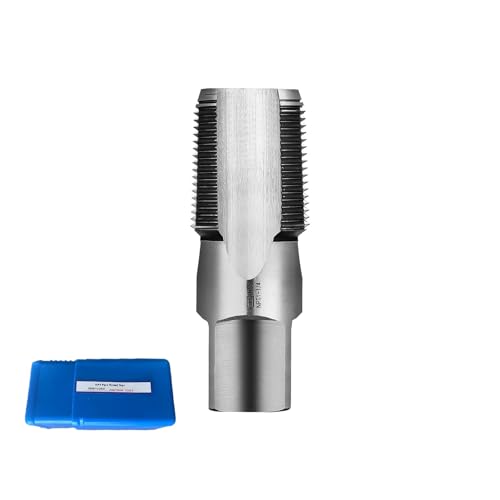
The lengthened shank that reaches threads a standard tap simply cannot touch.
The standout feature here is reach, and it is not close. DRINYOUNG extends the shank on this 1-1/4″-11-1/2 NPT tap so it can clean or repair deeper holes that a standard-length tap will never get to. The cutting head uses a wide straight notch design that keeps resistance low and lets debris clear instead of packing up behind the edge. The material is preferred 6542 high speed steel, a grade chosen for durability and a fast cutting speed. A square head on a round handle lets you drive it with a wrench and keep the cut under control.
Weight is the real story for anyone hauling tools around. This tap runs 1.3 pounds, and put next to the 2.07-pound DKIBBITH above, the difference is noticeable in the hand and in the toolbag. For a tap this size, that lighter build is worth a lot when you are working overhead or in a tight cabinet. It also ships through an edge-polishing, full-grinding process that leaves a smooth, precise surface, so the first bite into metal is clean rather than grabbing.
Size consistency is the curveball. At least one buyer found the tap ran over an inch when it should have stayed under, even though the pitch (threads per inch) was right — a reminder to check the actual cutting diameter against your pipe before you commit to the cut. Measure the cutting diameter against your pipe on arrival, and keep the edge oiled.
Where it wins: the extended shank and light 1.3-pound build let you clean threads in recessed or hard-to-reach holes that standard taps miss, in a fully ground 6542 high speed steel head.
Pick this when: the damaged thread sits deep in a bore and a normal tap will not reach it, and you want the lighter, extended high speed steel tool for the job.
You may want something else if: you only thread shallow, easy-to-reach holes — the extra reach buys you nothing there and the size needs verifying on arrival.
6. Yamesh NPT Pipe Tap Alloy Carbon Steel 1-1/4″-11-1/2
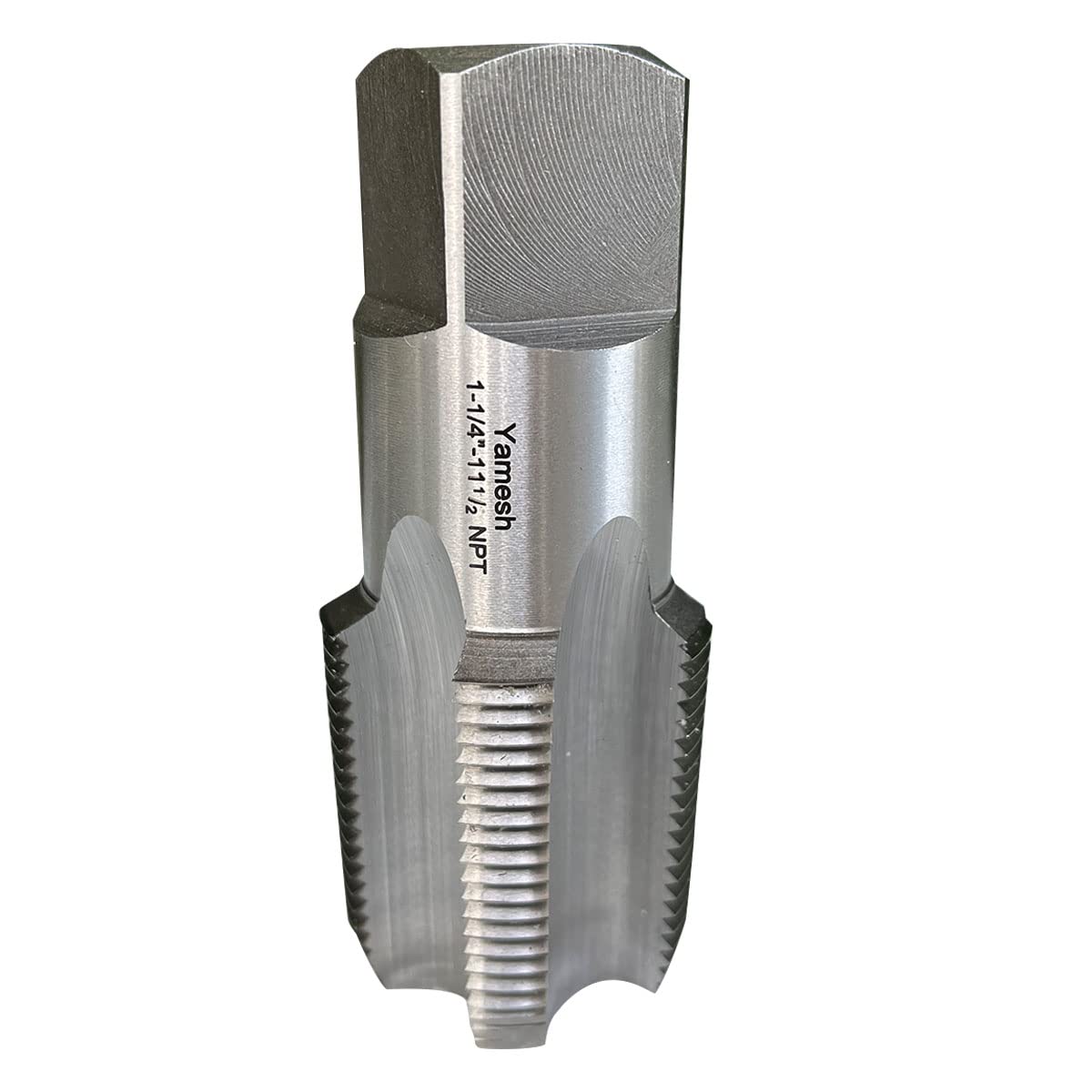
A no-frills alloy carbon steel tap made for chasing threads and clean repairs.
You do not need a heavy tap to fix one fitting, and this is the case for keeping one on hand. Yamesh builds this 1-1/4″-11-1/2 tap from alloy carbon steel and sizes it for clean threads and thread repair. It comes as a single tap labeled 1-1/4″, which is the exact size the job calls for. It is the lightest tap in this group at just 2 ounces, so it sits in a drawer or a small tool roll without you noticing it until you need it.
It is built for re-forming existing threads, not cutting new ones. It is a natural fit for chasing an already-cut thread back to a clean, usable condition — the kind of job where a fitting has been marred or partly damaged and needs to be re-formed before it will seal. A professional plumber uses it regularly, and a buyer tapped holes in a bronze manifold with it and reported it worked great. For a soft metal like bronze, the carbon steel edge is well matched.
The honest limit is at the cutting edge: it is happiest servicing existing threads rather than cutting deep fresh ones in steel, and it is a light, compact tool at roughly 2 x 0.75 x 0.75 inches. Use it as a thread chaser on brass and bronze, not for deep new cuts in steel.
The thread-chaser read: a lightweight alloy carbon steel tap built for cleaning and repairing pipe threads, ideal when the thread already exists and just needs re-forming.
Know before you buy: it is a light, single tap, so if you need to cut deep new threads in steel, you want a heavier HSS tool instead.
Right for you if: you are chasing damaged threads in brass or bronze and want a light alloy carbon steel tap that does the repair without adding bulk.
Wrong for you if: your task is cutting brand-new deep threads in steel — step up to a fully ground HSS tap.
7. Drill America 1-1/4″ NPT HSS 5 Flute Pipe Tap, T/A Series
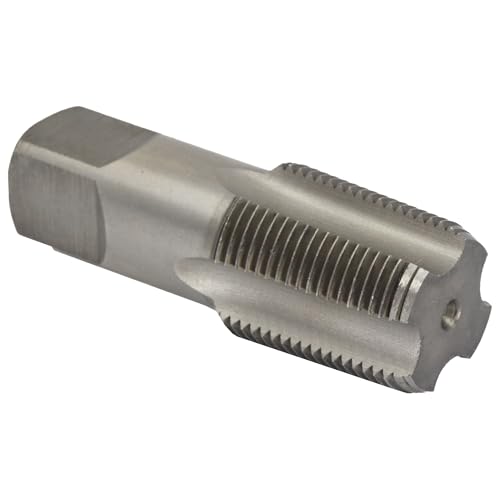
A lightweight high-speed steel tap with a square end for straightforward general-purpose threading.
This is the lightest tap of the whole group at one pound, and the shape is built for control. Drill America uses high-speed steel for this 1-1/4″ NPT tap, which gives you hardness and toughness together for wear resistance on most general-purpose work. The round shank ends in a square drive so a tap wrench sits tight and you can keep the cut square. Five straight flutes let chips collect as they cut, which suits shallow threading. The bright, uncoated finish keeps it usable across a wide range of materials rather than being tuned for one. Five flutes with a square end and right-hand cut is, in short, a flexible format for threading in many situations.
At one pound, this is the tap to hand someone who spends a shift on their feet. It is light enough to work with for a long stretch without tiring your arm, which matters when you are turning a 1-1/4″ thread by hand. The high-speed steel body stands up to the kind of general shop and repair threading this size is usually asked to do.
One caution worth knowing up front, and it is a real one: the wrong tap can snap under load. At least one buyer had this tap bite into metal and then break halfway through, which is what happens when a tap is overloaded or started without enough lead. That is a technique risk on any tap this size, so take small bites, keep the chips cleared, and use cutting oil. Start it square, take small bites, and clear the chips as you go.
The light-handed choice: one pound of high-speed steel with a square-end round shank and five straight flutes, built for general-purpose threading and easy to control in the hand.
Suits you if: you want the lightest tap here for general-purpose threading and are willing to work it slowly with a tap wrench and oil.
Be wary if: you tend to push a tap hard in one continuous turn — this size can snap under that kind of load.
Understanding the Specs
NPT Taper and Thread Pitch
NPT stands for National Pipe Taper, a US standard where the thread is cut on a slight angle so it narrows toward the end. As you turn the tap in, the thread presses tighter into the mating pipe, which is what makes the joint seal without a gasket. The size name — 1-1/4″ — refers to the nominal pipe, not the actual outside diameter of the tap. The pitch tells you how many threads fit in one inch, and in this size it is 11-1/2 TPI. A 1-1/4″-11-1/2 tap only matches a pipe of the same pitch, so confirm both the size and the pitch before you buy.
Material Grade and Flute Count
Carbon steel taps are the everyday choice for brass, aluminum, and chasing existing threads, and they cost less. High-speed steel (HSS) is a harder, more heat-resistant grade that holds an edge longer in steel, cast iron, and repeated work — worth it if the tap earns its keep. Flute count changes the cut: a six-flute tap leaves a finer finish, while a four- or five-flute tap clears chips more freely for shallow or cleaning work. Both trade-offs matter more than brand name once you are in the shop with the wrench in your hand.
FAQ
What does 11-1/2 TPI mean on a 1-1/4 inch NPT tap?
Is a carbon steel tap good enough or do I need high speed steel?
Why did my tap snap halfway through the hole?
Can I use one 1-1/4 inch tap to clean threads instead of cutting new ones?
How do I know if I need an extended or lengthened tap?
What is the difference between a 4 flute and a 6 flute pipe tap?
Do I need cutting oil when using a 1-1/4 inch NPT tap?
Will a 1-1/4 inch NPT tap also work on a 1 inch pipe?
What kind of wrench do I need for this size NPT tap?
How long should a high speed steel pipe tap last?
Final Thoughts: The Verdict
For most people cutting or cleaning a 1-1/4″ NPT thread, the 1 1/4 inch pipe thread tap to buy is the DECKRKAT Precision Carbon Steel Tap Set — six straight flutes, a square end for real leverage, and a rust-guarding case make it the best-rounded pick for plumbers, mechanics, and DIYers alike. If your work is steel-heavy and you want an edge that holds, move up to the MaxTool HSS M2 Fully Ground Tap and treat it as a tool you buy once. And when the damaged thread sits deep inside a bore where nothing else reaches, the DRINYOUNG Extended HSS Tap is the one to reach for.
How We Picked
We do not accept paid placement. Every pick is matched to a real buyer and a real use-case; we do not hands-on test units.
Sources & Methodology
Specifications: manufacturer listings and product documentation. Review insights: verified customer reviews, as of September 2026. Pricing: not shown on this page (it changes often); check the current price via the retailer link.
As an Amazon Associate, KitchPrep earns from qualifying purchases. This does not affect which products we feature.
Related Guides
