
Specs are compiled from manufacturer listings and verified buyer reviews and can change over time — please confirm the key details on the product page before buying.
If your last hole saw wobbled, grabbed, or went dull halfway through a job, the problem is usually the wrong tooth design for the material, not the brand. A 1-1/4 inch bit is a workhorse size — it opens holes for disposal buttons in stainless sinks, deadbolts in steel doors, faucets in quartz counters, and sensor bungs in exhaust pipe. This guide sorts nine real options by what they are actually built to cut, so you buy once and cut clean.
I’m Mohammad Maruf — the founder and writer behind KitchPrep. This guide is built by comparing the manufacturers’ published specifications and the patterns across verified customer reviews, so you get each pick’s real strengths and trade-offs instead of marketing spin.
You will see which tooth geometry handles sheet metal versus thick plate, which shanks fit the arbor you already own, and where the honest limits sit. Here is the practical breakdown of the 1 1/4 inch hole saw.
Our Picks at a Glance

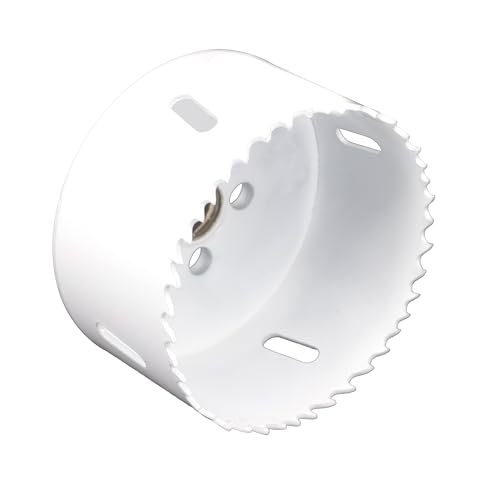
How To Choose The Best 1 1/4 Inch Hole Saw
The measure that decides everything is the material you are cutting, because a tooth profile that sails through pine will skate across stainless. Get the tooth geometry and arbor match right, and this size cuts cleanly in almost anything.
Match the tooth pitch to the material
A variable pitch means the teeth are spaced at different gaps around the rim, which breaks up chatter (the vibrating bounce you feel in the drill) and clears chips as you go. A straight pitch keeps one even spacing all the way around, which suits thin cross-sections like sheet metal and interrupted cuts. A fine, tightly set tooth line makes a tidier hole but can bind once you get deep.
Check the shank and arbor thread first
Most of these cutters are sold as the saw body only, so you need an arbor (the spindle that holds the saw and fits your drill chuck) to run them. Some use a 5/8-11 thread, some a 3/8 inch hex shank, some a 3-flat shank. Measure your existing arbor before ordering. A saw with the wrong thread simply will not mount, no matter how good the teeth are.
Decide how deep you really need to go
Cutting depth is the usable wall height of the saw, and it sets how thick a piece you can pierce in a single pass. If you are going through a counter or a steel plate, a shallow body forces you to notch from both sides or break the core out. Buy the depth your thickest job demands, not the one that looks tidiest on the shelf.
Pick the cutting edge for the material
Bi-metal teeth are the generalist — hardened high-speed steel teeth welded to a flexible steel body, and they handle wood, plastic, and metal. Tungsten carbide tipped teeth are harder and fare better on stainless and iron. Diamond coating is what you want for stone, tile, and quartz, where metal teeth would round off fast.
Quick Comparison
| Model | Best For | Cutting Edge | Depth / Pitch | Shank / Arbor | Amazon |
|---|---|---|---|---|---|
| LENOX Tools Hole Saw with Arbor 1772491★ Best Overall | Stainless sinks and general metal | Bi-Metal | Speed Slot staircase body | Arbor included | Amazon |
| Drill America DMS04-1032Best for Arbor Owners | Fitting an existing Lenox arbor | Bi-Metal, cobalt HSS teeth | 4/6 variable pitch | Fits Lenox arbor | Amazon |
| GRIXLEN 42TCT01Hardest Cutting Edge | Stainless and hard metal | Tungsten carbide tip | 1 inch cutting depth | 3-Flat shank | Amazon |
| Starrett DCH0114-G | Deep cuts in thick material | Bi-Metal, HSS teeth | 2 inch depth, NVP progressive pitch | A2-E or A10-E arbor | Amazon |
| Starrett FCH0114-G | Sheet metal and interrupted cuts | Bi-Metal, HSS teeth | 1-5/8 inch depth, straight 5.5 pitch | 1.25 inch arbor size | Amazon |
| Makita 714012-A | Wood and steel drilling | Bi-Metal, HSS teeth | 4/6 variable pitch | Makita Arbor 714063-A or 714065-A | Amazon |
| DECKRKAT DECK-007 Diamond Core Bit | Quartz, granite, and tile | Vacuum brazed diamond | 2 two-way flutes | 5/8-11 thread plus 3/8 inch hex adapter | Amazon |
| DECKRKAT DECK-2428 2-Pack TCT | Hard metal with spring pilot | Tungsten carbide tipped | 4 flutes | 3/8 inch 3-Flatted shank | Amazon |
| DKIBBITH DKVIP-0008 2-Pack TCT | Sheet steel up to 1/8 inch | Tungsten carbide tipped | Split point pilot | Handheld cordless drills, drill press, magnetic drill | Amazon |
In‑Depth Reviews
1. LENOX Tools Hole Saw with Arbor, Speed Slot, 1-1/4-Inch (1772491)
Our pick — over 4.5★ from 900+ verified ratings; the strongest balance of quality and price.
The only saw here that arrives ready to run, arbor included.
The reason this one sits at the top is simple: it ships with its arbor (the spindle that holds the saw and locks into your drill chuck), so you can cut the day it lands instead of hunting down a matching thread. Lenox rates this generation at 2X more durable with 50% longer life than previous LENOX hole saws, backed by thicker walls that resist losing teeth under load. At 4.8 ounces it is easy to control one-handed on a step ladder.
What buyers keep coming back to is how cleanly it pierces stainless. In a stainless steel sink, a 1-1/4 inch hole for a disposal button came out flawless — fast, clean, no ragged edge. It also runs true rather than walking, which matters when you are cutting an expensive countertop or a finished panel. Wood, plastic, and thin sheet metal all fall to it, and the larger, sharper teeth are tuned to bite metal without you leaning on the drill. Aerogarden growers use it to cut basket holes in bin lids for deep water culture setups, which tells you the edge stays keen across repeated cuts in soft material.
The honest catch is the coating, not the teeth. The black paint wears off after about four uses and gives off a faint odd smell while it does — cosmetically annoying, functionally harmless, since the markings underneath are engraved rather than printed. The bigger consideration is the Speed Slot body: its staircase cutaway makes plug ejection easy, but it is not a deep-cut body, so very thick plate wants a slower, staged approach.
What earns the top spot
- Arbor included — no separate purchase, no thread-matching headache.
- Thicker wall thickness holds teeth and takes repeated cuts without wandering.
- Speed Slot staircase design flicks the plug out fast so you are not prying cores free.
What to keep in mind
- Paint finish scuffs off within roughly four uses; the smell fades with it.
- Body is built for standard depth, not deep plate work.
Buy it if: you want one box that cuts sinks, counters, and lids without an extra arbor order.
Think twice if: your job is thick steel plate, where the deep-cut body below earns its keep.
2. Drill America 1-1/4″ Bi-Metal Hole Saw, Made in USA (DMS04-1032)
Sized exactly where Lenox stops, and it mounts on the arbor you already own.
This is the pick for anyone who already has a Lenox arbor in the toolbox and does not want to switch systems. The 1-1/4 inch body is a size Lenox does not carry in this line, yet it threads onto a Lenox hole saw arbor — so you can extend the set you own rather than start over. The cutting edge is cobalt high-speed steel teeth laser-welded to a steel alloy backing, and the 4/6 variable pitch with a positive rake angle is what keeps the drill from grabbing.
Where it wins is precision in round stock and panel work. It makes a precise round hole without wandering around, which is the whole game when you are fitting a sensor bung or a grommet. It cuts wood, plywood, aluminum, sheet metal, and plastic, so one body covers most of a weekend’s projects. Side cutouts let you poke the plug and debris out without dismantling anything.
One note on expectations: while the listing is a US-made product line, a buyer noted the performance matches the big-box name brands more than beating them. That is a fair read — you are buying value and fit, not a mystery upgrade. The saw body itself is sold on its own, so budget for the arbor if you do not have one.
The fit advantage: it slots straight onto a Lenox arbor, which is the single most useful detail here for anyone mid-project.
Reality check: the cobalt HSS teeth and 4/6 variable pitch do the honest work — expect big-box-brand performance, not a step above it.
Reach for this if you own a Lenox arbor and need a size the Lenox line skips.
Look elsewhere if you want the arbor in the box — the top pick covers that for you.
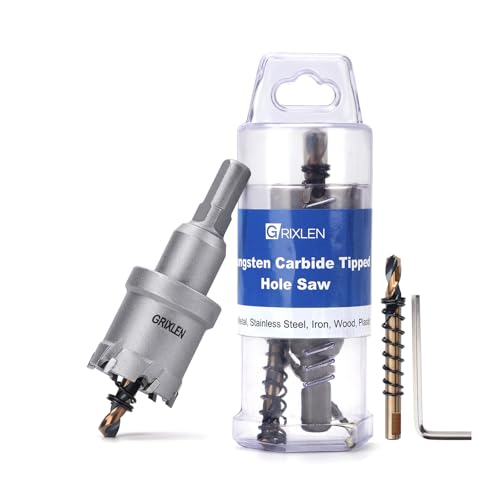
3. GRIXLEN 1-1/4” (32mm) Tungsten Carbide Tip Hole Saw with M2 Pilot Bits
Carbide teeth that chew stainless headers and sheet metal without blinking.
For hard metal, this is the one that behaves like a different class of tool. Tungsten carbide teeth stay sharp where bi-metal dulls, and the M2 pilot bit (a hardened starter drill that locks the saw on center) keeps it from skating across stainless. The cutting depth is 1 inch, which is plenty for sheet metal, plate, and sensor bungs, and the 3-flat shank locks into a standard chuck without spinning. It suits drills, bench drills, handheld power tools, CNC, and impact drills.
Stainless steel is where it shows off. It drilled an 1 1/4 inch hole in stainless steel headers for O2 sensors quickly and cleanly, with no walking and no ragged edge. Cutting a metal plate to fit gate locks was another easy job — the sort of work that eats cheap bits for lunch. What wins people over is the cut itself: 41 owners single out build quality, cutting performance follows at 30. The recommendation to drip coolant on it during continuous high-speed work is worth following; it is not the sort of bit you run dry on a hot job.
Its honesty is in the depth and the hand-drilling tolerance. On thick steel held in a hand drill the body wants a steady, patient touch — this is a bit that rewards a drill press. Its 1 inch depth also means it is not aimed at deep cuts; for thick material in one pass you want the Starrett deep cut below.
Where it shines: stainless headers, sheet metal plates, and any job where a fresh bi-metal tooth would round off too fast.
Its honest limit: the 1 inch cutting depth keeps it shallow-drilling territory, and thick stock held freehand demands a gentle, slow hand.
Best for: anyone cutting stainless, iron, or hard sheet metal who wants the edge to survive past hole one.
Skip if: you need to pierce plate thicker than an inch in a single pass.
4. Starrett Deep Cut Hole Saw, 1-1/4″ Diameter, 2″ Depth (DCH0114-G)
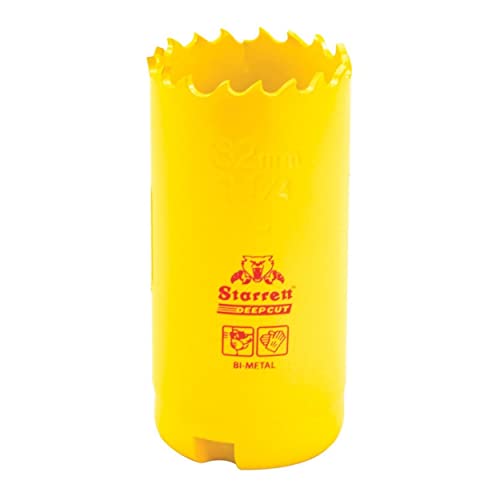
A two-inch body built to reach through stock that stops shallow saws cold.
If your job is thick tube or double-wall material, depth is the only spec that matters, and this body delivers 2 inches of it — noticeably more usable wall than the shallow 1 inch carbide bit above. The teeth are hardened, heat-resistant high-speed steel with Starrett’s NVP progressive pitch, which varies the tooth spacing to cut faster and damp the vibration that wears out your wrist. It runs on drills set up for an A2-E or A10-E arbor type.
Tube notchers swear by it. It cuts fast and smooth through 4130 tube, holds up under pressure without dulling or chattering, and fits up better than other brands on the same joints. Buyers report more than 50 notches, mostly doubled up, before the teeth gave out — roughly three times the life of another brand they had run. That is what the thicker, deeper body buys you: more cuts between replacements.
The trade-off is aggression. The teeth are hungry, and in a hand drill they can catch and jump, which ruins a finished plywood surface. A workaround buyers use is to run it in reverse at high speed with light pressure to score a groove first, then switch direction — that settles it down on fine work. On very large pipe the 2 inch depth still cannot notch the whole profile in a single pass, so expect to work one side at a time.
Why tube workers trust it
- 2 inch cutting depth clears thick stock in one pass on most jobs.
- NVP progressive pitch dampens vibration and keeps the cut smooth.
- Hardened, heat-resistant HSS teeth hold their edge through dozens of cuts.
Before you commit
- Needs an A2-E or A10-E arbor type — check yours before ordering.
- Aggressive teeth want a steady hand or a press on fine finished surfaces.
Pick this up when thick tube, pipe, or plate is on the bench and you want depth over finesse.
Leave it alone if your work is thin sheet, where the fine-pitch Starrett below cuts cleaner.
5. Starrett Fast Cut Straight Pitch Hole Saw, 1-1/4″ Dia, 1-5/8″ Depth (FCH0114-G)
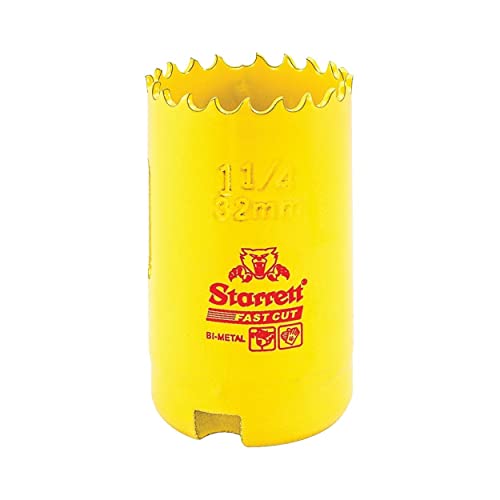
The thin-metal specialist — a straight 5.5 pitch built for sheet and perforated steel.
Where the deep-cut body above is all about depth, this one is about smoothness on thin stock. Its straight 5.5 pitch is designed to glide through thin cross-sections of sheet metal, corrugated or perforated steel, and interrupted cuts (jobs where the tooth catches material only part of each rotation). The teeth are hardened, heat-resistant high-speed steel, and the 1-5/8 inch depth gives you more reach than a shallow body without the aggression of a deep-cut rim. It runs on a 1.25 inch arbor size and carries 14 teeth.
What it delivers daily is control. It cuts fast through wood and common materials, teeth stay sharp, and it produces accurate holes with minimal splintering and no overheating or binding. Plug removal is straightforward, and the low vibration paired with a quality arbor keeps the cut stable. Owners upgraded from cheap bits appreciate how it mows through wood without a fuss and holds a clean edge.
The caution is brittleness. It is made from high speed steel, so it is very hard and also brittle — narrow tooth set keeps the cuts accurate, but it can tend to bind in deep cuts. A few report toughness lifting teeth on hardened plate after catching an edge, which is a material-suitability issue rather than a defect. It is not indestructible, and matched to the wrong material it will let you know.
My read: the practical sheet-metal and thin-stock solution, with the low-vibration cut that keeps a masonry or cabinet job tidy.
Fair warning: high speed steel is hard and brittle, so treat deep cuts and hardened plate with respect — the teeth will bind if you force the pace.
Choose this if you are working sheet metal, corrugated steel, or anything with interrupted cuts.
Pass it over if your bench is thick hardened plate, where a deep-cut body is the better survival bet.
6. Makita 714012-A Bi-Metal Hole Saw, 1-1/4-Inch

A tough, flexible body that shrugs off the shatter that kills rigid saws.
The standout here is the body construction. Makita builds this with a flexible, shatter-resistant steel body so a hard catch does not crack the ring, and pairs it with extra hard high speed steel teeth. The 4/6 variable pitch is tuned to cut faster and last longer, and the deep cutting capacity means it handles 2×4 material in one pass. It threads onto Makita Arbor 714063-A or 714065-A, which use a 5/8-18 thread — check your arbor before you buy.
Fiberglass work is where it proves its worth. It cut through 1/2 inch thick fiberglass easily with no chipping or jagged edge, the kind of clean shoulder you need on a boat repair. On aluminum it drilled six holes in 3/4 inch 6061 stock and kept perfectly sharp teeth. It also handles industrial-strength plywood and wood without complaint, which is why so many woodworkers keep one on the bench alongside their metal cutting.
The friction note is worth respecting: snap the arbor by running dry and you will not be the first. Lubrication at around 250rpm is the fix, and the saw itself survived a first-use arbor failure and kept cutting. Powder coat wearing off after heavy use is cosmetic and does not dull the teeth. It is a workhorse body, not a display piece.
Why it earns its place
- Flexible, shatter-resistant body survives hard catches better than brittle rings.
- Extra hard HSS teeth and 4/6 variable pitch cut wood and steel in one bit.
- Deep cutting capacity takes 2×4 material without a staged cut.
What to watch
- Requires Makita arbor 714063-A or 714065-A with 5/8-18 thread.
- Dry running can snap the arbor — use lubrication for clean long wear.
Suits you if you switch between wood, plywood, and light metal on the same bench.
Not for you if you are already committed to a non-Makita arbor system.
7. DECKRKAT Diamond Core Drill Bit 1-1/4” (DECK-007)

The diamond-coated cutter for countertops — where metal teeth would round off.
This is a different tool for a different job. Vacuum brazed diamond coating cuts granite, quartz, porcelain, marble, concrete, tile, and brick, the hard materials that destroy high-speed steel. It is built with a 5/8-11 thread for easy mounting on angle grinders, and it comes with a 5/8-11 to 3/8 inch hex shank adapter so it also fits a drill. It runs dry or wet; the maker notes the lifetime lasts longer if you apply coolant, and it should never be used on a hammer setting.
Countertop installers get the cleanest result. A 1 1/4 inch hole in 1 1/4 inch thick quartz came out in a few minutes with no chipping, and a faucet cut in quartz finished in around two minutes with a smooth shoulder. The 2 two-way flutes are what make that possible — they push the mud and swarf out of the cut and cool the bit as they spin. Owners praise performance most (50 voices), durability close behind (34), with zero chipping reported on marble.
The one honest adjustment is startup technique. There is no center drill bit, so you have to start at a 45 degree angle and slowly bring the tool vertical to avoid wandering and scratches. Some find that entry technique fussy on polished surfaces and instead clamp a scrap of wood with a matching hole as a guide — a neat fix that solves the problem outright.
Where it wins: clean holes in quartz, granite, porcelain, and tile with no chips, thanks to the diamond coating and two-way flutes.
The startup quirk: no center bit means the 45 degree entry needs a steady hand or a wood guide, and it is strictly off-limits on hammer mode.
You want this if stone, tile, or quartz is on the schedule and you have a grinder or a drill ready.
Wrong tool if you are cutting steel — the carbide and bi-metal picks are the ones for that.
8. DECKRKAT 2-Pack 1-1/4″ TCT Hole Saws for Hard Metal (DECK-2428)
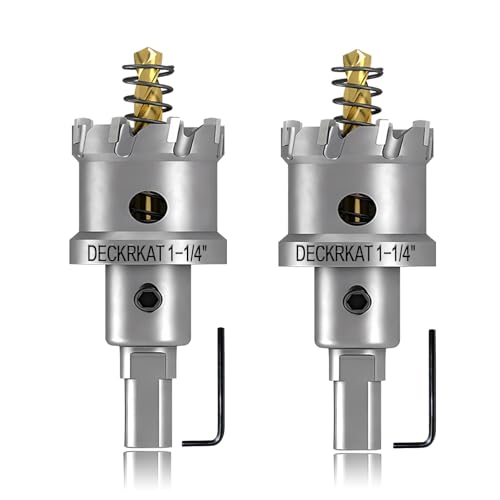
Two carbide-tipped cutters, four flutes each, aimed at stainless and hard plate.
You get two tungsten carbide tipped bodies in the box, which matters on hard materials where a single cutter can round off mid-project. Each carries 4 flutes for faster swarf clearing (the channels that carry chips away from the teeth), and the 3/8 inch 3-flatted shank gives you a firm, low-slip grip in the chuck. It handles stainless steel, aluminum, high alloy steel, copper, plastic, FRP, and PVC. The cutters arrive pre-oiled in a plastic case to fend off rust between jobs.
At the bench, the cut quality surprises people. It carved many 1-3/8 inch holes in 5/16 inch steel with lube and the right speed and pressure, on aluminum patio framing and on 3/16 inch steel plate, all with a clean, precise edge. The pilot drill keeps the saw from wandering, so placement is accurate without a jig. The maker’s tip to start at low torque and speed on the pilot before ramping up is worth following — it is what keeps the carbide teeth sharp.
The recurring quirk is the set screw that holds the pilot bit: it works loose during use, and a longer set screw or a wrap of thread tape is the standard fix. On the low end, a handful of owners hit a cutter that chipped on the very first sheet, but For a twin pack with more than 900 ratings, the vast majority report it cuts steel effectively at low speeds. — this is a value pick where the pilot-bit retightening is the price of admission, not a dealbreaker.
Why it stands out
- Two TCT bodies in one kit — a spare when the first cutter wears on hard metal.
- 4 flutes clear swarf fast, which keeps the teeth from loading up.
- Spring-loaded pilot and 3-flatted shank keep the cut steady at low speed.
Where it nags
- Pilot set screw loosens in use — a longer screw or thread tape sorts it.
- Wants oil and slow speed; rushed, dry drilling is what wears the teeth.
Great fit for hard-metal work where you want a second cutter ready and a steady pilot.
Consider the DKIBBITH set instead if your steel is thicker than an eighth of an inch.
9. DKIBBITH TCT Hole Saw Set, 2-Pack of 1-1/4″ (32mm) (DKVIP-0008)
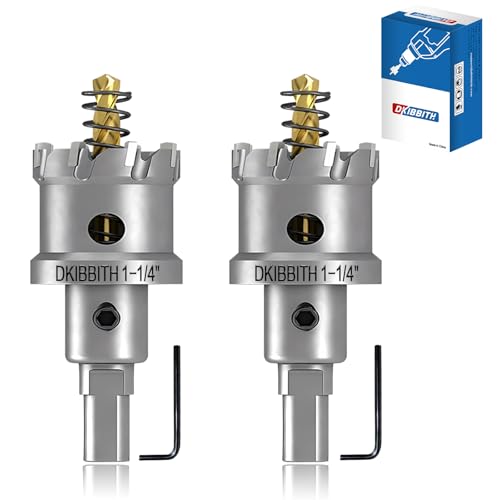
The deadbolt-saver — it sliced a steel door in seconds where a big-box saw stalled.
This two-pack is aimed squarely at sheet and plate up to 1/8 inch thick, which covers stainless, mild steel, iron, copper, aluminum, FRP, plastic, and brass. The teeth are high-grade cemented carbide, and the split point pilot drill (a tip ground so the leading edge bites center instead of skating) stops the saw from walking on smooth material. It fits handheld cordless drills, drill presses, and magnetic drills — the last being exactly where you want it on a steel door.
The real-world proof is impressive: it expanded a deadbolt hole through a steel door in seconds, after a cheaper hole saw refused to cut at all. It also cleared 1/2 inch steel and 3/8 inch hard steel, and its ejection spring makes slug removal quick so you are not prying cores out. It comes in a semi-transparent rust-proof case, and the maker suggests an oil wipe and careful handling between uses — the high-hardness carbide teeth hate a drop.
Be honest about the ceiling with this one. Durability is the mixed side of the ledger — a few owners mention bits breaking on the first use, and heavy hogging on difficult stock can be the culprit. Match it to its 1/8 inch sheet-metal comfort zone, keep the speed low for harder material, and it performs as intended. Push it past that into thick plate and it will punish you.
The highlight: split point pilot and ejection spring make deadbolt and lock holes in steel doors a fast, controlled job.
Its honest boundary: rated for sheet up to 1/8 inch, so heavier plate is out of its comfort zone no matter the settings.
Reach for it if your work is sheet metal, locks, and light plate on a cordless or magnetic drill.
skip it if you are hogging through thick steel all day — that job wants the DECKRKAT twin pack above.
Understanding the Specs
Tooth pitch and rake angle
Pitch is the spacing between teeth when measured around the rim. A variable pitch, like the 4/6 pattern on several picks here, uses irregular spacing to break up vibration and clear chips, which keeps the cut stable. A straight pitch, like Starrett’s 5.5 on the Fast Cut body, keeps one even spacing and suits thin sheet and interrupted cuts. Rake angle is the tilt of each tooth into the material — a positive rake bites harder through harder stock, which is why it shows up on metal-focused cutters.
Cutting edge material
Bi-metal teeth are hardened high-speed steel welded to a flexible steel body, and they handle wood, plastic, sheet metal, and general metal. Tungsten carbide tipped teeth are harder and hold up longer on stainless, iron, and hard plate. Diamond coating, as on the DECKRKAT core bit, is what survives stone, tile, and quartz, where metal teeth round off fast. The right choice is the one matched to the material you actually drill, not the hardest edge on the page.
Speed, feed, and lubrication
Low speed and steady pressure is the pattern across every cutter here. High speed with a slow feed overheats the teeth, while excessive torque can grab and wrench the saw. Cutting oil or coolant matters most on stainless and hard metal, and several of these cutters are rated to last longer when coolant is applied. For diamond work, water keeps the stone cool and clears the dust that would otherwise clog the diamond surface.
Shank and arbor compatibility
Shank is the mounting end that goes into your chuck — a 3-flat shank has three flat faces so the drill grips without slipping, while a hex shank does the same in a hex chuck. Arbor is the spindle that holds the saw, and it must match the saw’s thread. Sizes here include 5/8-11 and 5/8-18 thread and Makita’s 714063-A or 714065-A arbor. Confirm your arbor before ordering, since a mismatched thread will not mount at all.
FAQ
Will a 1-1/4 inch hole saw fit my existing arbor?
Can I cut stainless steel with a bi-metal hole saw or do I need carbide?
What depth cut can I get in a single pass?
Do I need to use cutting oil when drilling metal?
Why does my hole saw wobble, walk, or jump?
Can I use a diamond core bit in a hammer drill?
How do I stop a carbide pilot bit set screw from loosening?
Will one 1-1/4 inch saw cut wood and metal both?
What is the difference between a TCT saw and a bi-metal saw?
How do I keep the carbide teeth from breaking during a cut?
Final Thoughts: The Verdict
For most buyers, the best of the 1 1/4 inch hole saw picks is the LENOX Tools Hole Saw with Arbor, because it arrives ready to cut with its arbor included and its Speed Slot body flicks the plug out without prying. If you already own a Lenox arbor and just need the size, grab the Drill America DMS04-1032 and save the hassle. For stainless and hard metal, reach for the GRIXLEN carbide-tipped bit, and for countertops and tile, the DECKRKAT diamond core bit is the one that cuts clean stone without chipping.
How We Picked
We do not accept paid placement. Every pick is matched to a real buyer and a real use-case; we do not hands-on test units.
Sources & Methodology
Specifications: manufacturer listings and product documentation. Review insights: verified customer reviews, as of September 2026. Pricing: not shown on this page (it changes often); check the current price via the retailer link.
As an Amazon Associate, KitchPrep earns from qualifying purchases. This does not affect which products we feature.
Related Guides
