
Specs are compiled from manufacturer listings and verified buyer reviews and can change over time — please confirm the key details on the product page before buying.
If water is creeping backward through your line, you need a check valve that shuts tight and stays shut. A 1 1/4 inch check valve keeps your well pump primed, protects your pressure tank, and blocks the reverse flow that cycles the pump. Get the swing-versus-spring question wrong, though, and you will be re-priming your line every week.
I’m Mohammad Maruf — the founder and writer behind KitchPrep. This guide is built by comparing the manufacturers’ published specifications and the patterns across verified customer reviews, so you get each pick’s real strengths and trade-offs instead of marketing spin.
Below you will find nine brass, stainless, and PVC options sorted by how they handle pressure, sealing, and installation angle. Every pick here is a true 1 1/4 inch valve, so you are not guessing on thread size. Whether you are replacing a failed pump valve or plumbing a new line, these nine picks cover the best 1 1/4 inch check valve for the job.
Our Picks at a Glance


How To Choose The Best 1 1/4 Inch Check Valve
A check valve is a one-way gate for liquid or gas. It opens when flow moves the right way and slams shut the moment flow tries to reverse. On a well line, that reverse flow drains your pressure tank and forces the pump to restart again and again. Size, mechanism, and material decide whether the valve seals for a decade or fails in a season.
Swing vs. Spring-Loaded: Match the Mechanism to Your Pipe
A swing valve uses a hinged disc that falls shut when flow stops, much like a door on a hinge. It works best in horizontal pipe, where gravity can help the disc close. A spring-loaded valve uses a stainless steel spring to push a poppet shut, so it can sit in a horizontal or vertical line. On a vertical well casing, choose spring-loaded: the spring closes the poppet where gravity cannot.
Thread Type: NPT, FIP, and What Fits What
NPT is a tapered thread, meaning it gets tighter as you screw it in, which is what creates the seal. FIP means female iron pipe, the standard threaded connection on household plumbing. Most 1 1/4 inch valves use 1.25 inch NPT threads on both ends, so they join directly to male-threaded pipe. Always wrap the threads with pipe sealant tape before you tighten, and never overtighten a plastic valve body.
Pressure Rating and Material
Look for the pressure rating stamped in the specs. A 200 PSI WOG rating means the valve handles water, oil, and gas at working pressure, while a WSP figure is the steam rating. For well pump duty, brass and stainless steel resist corrosion and mineral buildup far better than standard plastic. For high-mineral well water, stainless steel 316 resists rust and galvanic corrosion longer than brass or PVC.
Quick Comparison
| Model | Best For | Type | Material | Max Pressure | Amazon |
|---|---|---|---|---|---|
| Midline Valve 432U336★ Best Overall | All-round well & water line duty | Swing (horizontal) | Cast Brass | 200 PSI WOG | Amazon |
| Merrill CVNL125Most Versatile | Deep submersible well installs | In-line poppet | No-Lead Brass | 200 PSI | Amazon |
| Midline Valve 372U336Best for Lawn Pumps | Keeping a lawn pump primed | In-line spring-loaded | Cast Brass | 200 PSI CWP | Amazon |
| Wassermann GCV-NPT1-1/4 | Submersible well pumps & irrigation | Spring-loaded poppet | Brass | — | Amazon |
| Boltigen BCVY | Vertical or horizontal pump lines | Spring-loaded | Brass | 200 PSI (14 bar) | Amazon |
| HYDROSEAL Sharkfellow | Pool, aquarium & irrigation plumbing | True union ball | PVC | 200 PSI @73F | Amazon |
| 1-1/4″ NPT Swing Check Valve (SYWUWV) | Budget horizontal piping runs | Swing (horizontal only) | Brass | 1.6 MPa (232 psi) | Amazon |
| 1-1/4″ SS316 Swing Check Valve | High-mineral, corrosive water | Swing (horizontal only) | Stainless Steel 316 | 200 PSI / PN16 | Amazon |
| Zonon 2 Pcs 1-1/4 Inch Check Valve | Two-valve value & replacements | Spring-loaded | Brass | — | Amazon |
In‑Depth Reviews
1. Midline Valve 432U336 Swing Check Valve
Our pick — over 4.5★ from 500+ verified ratings; the strongest balance of quality and price.
The dead-simple brass swing valve that shrugs off reverse flow on well and water lines
This is the pick that earns the top spot on hardening rather than hype. The body is cast brass, treated to resist dezincification (the slow leaching of zinc that turns brass brittle over years in water), and rated 200 PSI WOG and 125 PSI WSP. It carries a lead-free design, conforms to NSF/ANSI-61/372, and meets UPC and CSA approval standards — the paperwork that matters if a home inspection or municipal code looks at your line.
In real use it is the little black plastic backflow valves that fail first. As buyers report, they replaced a 2″ PVC backflow valve that had been working for two years, then watched two replacement PVC valves fail within a week each — and this brass one, in their words, “is doing the job just fine.” On the low-flow water-ram-pump side, the same valve hit 1 cycle per second and pushed 10-11 gallons per hour where a stainless model managed 7 gallons per hour. Those are two different jobs, and the valve handled both.
The catch to plan around: it is a swing valve, so it wants a horizontal run where the hinged disc can fall shut under gravity. Mount it vertically and you are fighting physics. It also leans on gravity alone, not a spring, so a badly sloped line can let a little reverse seepage past. The thread ends comply with ANSI.B2.1, which keeps it compatible with standard 1 1/4 inch pipe.
What earns its keep
- Cast brass body rated 200 PSI WOG and 125 PSI WSP for real water-line duty
- Lead-free design with NSF/ANSI-61/372 conformance and UPC approval for potable lines
- Versatility that covers water, oil, or gas — buyers use it across all three
- Just 2.56 ounces, so it adds almost no weight to a suspended pipe run
Where it asks patience
- Horizontal mounting is effectively a requirement; vertical lines will not seat as cleanly
- Relies on gravity to close, so a shallow-sloped run can seep slightly
- Standard brass body rather than the stainless option some corrosive-water users prefer
Buy this one if: you want one brass valve that handles a well line, an oil feed, or a gas appliance feed without fuss, and your pipe runs horizontally.
Reconsider if: your line climbs vertically or carries aggressive, high-mineral water where stainless 316 wears better.
2. Merrill CVNL125 1-1/4″ No-Lead Brass In-Line Check Valve
The in-line poppet valve built to stack one every hundred feet down a deep well
Where the Midline swing valve relies on gravity, the Merrill CVNL125 uses an in-line poppet with an abrasion-resistant O-ring fitted to it, which means it can sit in vertical pipe without losing its seal. The body is no-lead brass, the connections are 1-1/4 in. x 1-1/4 in. female NPT, and it is IAMPO certified. It is rated to 200 psi.
The features that sell it are the O-ring and the flexible mounting. That rubber O-ring gives a positive seal even as the poppet cycles, and Merrill says it works equally well vertically or horizontally. One deep-well owner stacked several down a 400 ft submersible well — one roughly every hundred feet plus one at the holding tank — and after several years those valves are still holding back flow with no leaks. Long-stretch pumping like that is exactly where an in-line poppet earns its place, because the disc never has to fight gravity to seat.
Here is the honest limit: the O-ring is a wear part. Abrasive grit or heavy sediment can scuff it over time, and once it dulls, the seal softens. That is the trade-off for a valve that can be mounted vertically, unlike the swing valves above. Keep the line reasonably clean and it lives a long time.
The mounting advantage: an in-line poppet and O-ring design lets this sit vertically or horizontally, so it fits well-casing installs a gravity swing valve cannot.
The long-haul record: several years of service on a 400 ft deep well, valves spaced along the run, still holding back flow.
Best for deep well casings: submersible pump lines and any run where the pipe climbs and a gravity-closed disc would not seat.
Think twice if: your water carries heavy grit or sediment — the O-ring is the first thing to wear.
3. Midline Valve 372U336 Inline Spring-Loaded Check Valve
The spring-loaded brass valve that holds a lawn pump’s prime between weekly runs
For anyone tired of re-priming a pump every single time, this is the valve built for that job. Inside the cast brass body sits a stainless steel spring that pushes the poppet closed, so the valve never waits on gravity. It is rated 200 PSI CWP (cold working pressure), lead-free, and the threaded ends comply with ANSI.B2.1. It weighs 8 ounces.
The spring design is what a lawn pump needs. Owners who switched from plastic valves report those cheap ones leaked and needed re-priming before every use, while this Midline valve maintains prime between weekly runs — the exact behavior that saves you from lugging a priming can to a pump house. Its reliability is the thing people rave about most, with fit close behind: one well-line owner called it a perfect fit with no threads out of place, connected between the pressure tank and the pitless adapter.
The snag worth knowing: leakage reports are genuinely split — plenty of owners run it leak-free for years, but a few report drips. When a valve this size leaks, it is almost always the thread seal rather than the valve itself, so tape the NPT threads properly and torque it evenly. It is also longer in body form than a swing valve of the same size, so check that you have the pipe length to seat it.
Why pump owners lean on it
- Inner stainless steel spring closes the valve without relying on mounting angle
- Holds prime between weekly lawn-pump runs, ending repeat re-priming
- Lead-free cast brass, 200 PSI CWP, with ANSI.B2.1 threaded ends
- A tidy 8 ounces, so it will not load a lightly supported pipe
Worth knowing before you buy
- Leak experiences are genuinely mixed — the thread seal is usually the culprit, so prep it carefully
- Longer body than a swing valve, so plan your run for the extra length
Grab it for: irrigation and lawn pump lines that sit idle between watering days and keep losing their prime.
Look elsewhere if: you already have a swing valve doing the job — the spring here is most valuable in pump systems.
4. Wassermann 1-1/4″ Brass Check Valve for Submersible Well Pump
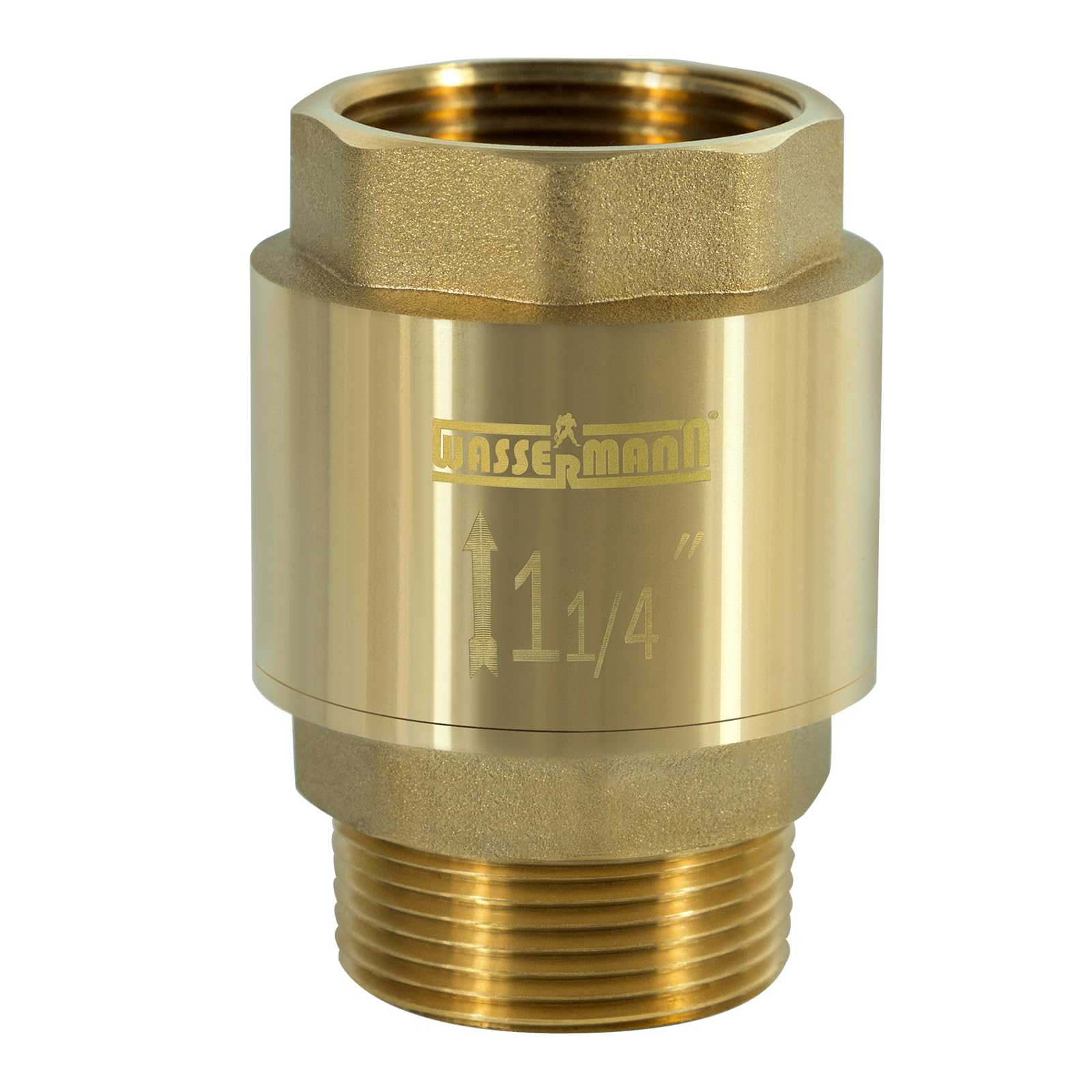
The no-fuss valve sized to screw straight onto a 1 1/4 inch submersible well pump
Threading mismatch is the number one reason a pump valve comes back, so Wassermann keeps it simple: a 1.25″ NPT inlet and a 1.25″ FNPT outlet, purpose-built to bolt to a 1-1/4 inch submersible well pump. Its poppet uses a stainless steel spring and fasteners with a spring-loaded design that softens water hammer — the bang that hammers a pipe when flow slams shut too fast.
It mounts horizontally or vertically, and the body carries an arrow marking the required flow direction so you can clock it correctly on install. In the field it behaves: owners mention no measurable water-pressure loss even after a week on the line, and one user running a hand-pump well simply bought a second for a generator hookup. A well-pump backup buyer described it as perfectly sized and designed.
The trade-off is very little. It is a spring-loaded valve, which means the spring adds a small amount of resistance compared to a wide-open swing valve, so extremely low-flow systems want to size accordingly. And it comes boxed on its own with no unions or fittings, so you supply your own connections and tape. The bright side: the brass body is built to resist corrosion on a submerged pump.
The fit that matters: matching 1.25″ NPT inlet and 1.25″ FNPT outlet threads directly to a submersible well pump, with arrowing to guide the flow direction.
The daily strength: a stainless spring and spring-loaded poppet that hold pressure for a full week without measurable loss.
Ideal for: replacing or backing up the check valve on a 1-1/4 inch submersible well pump, garden irrigation, or a water supply system.
Not the pick if: you need a wide-open low-flow pass — this valve is spring-assisted, so very low-flow systems should match it carefully.
5. Boltigen Solid Brass Spring Check Valve, 1-1/4 Inch NPT
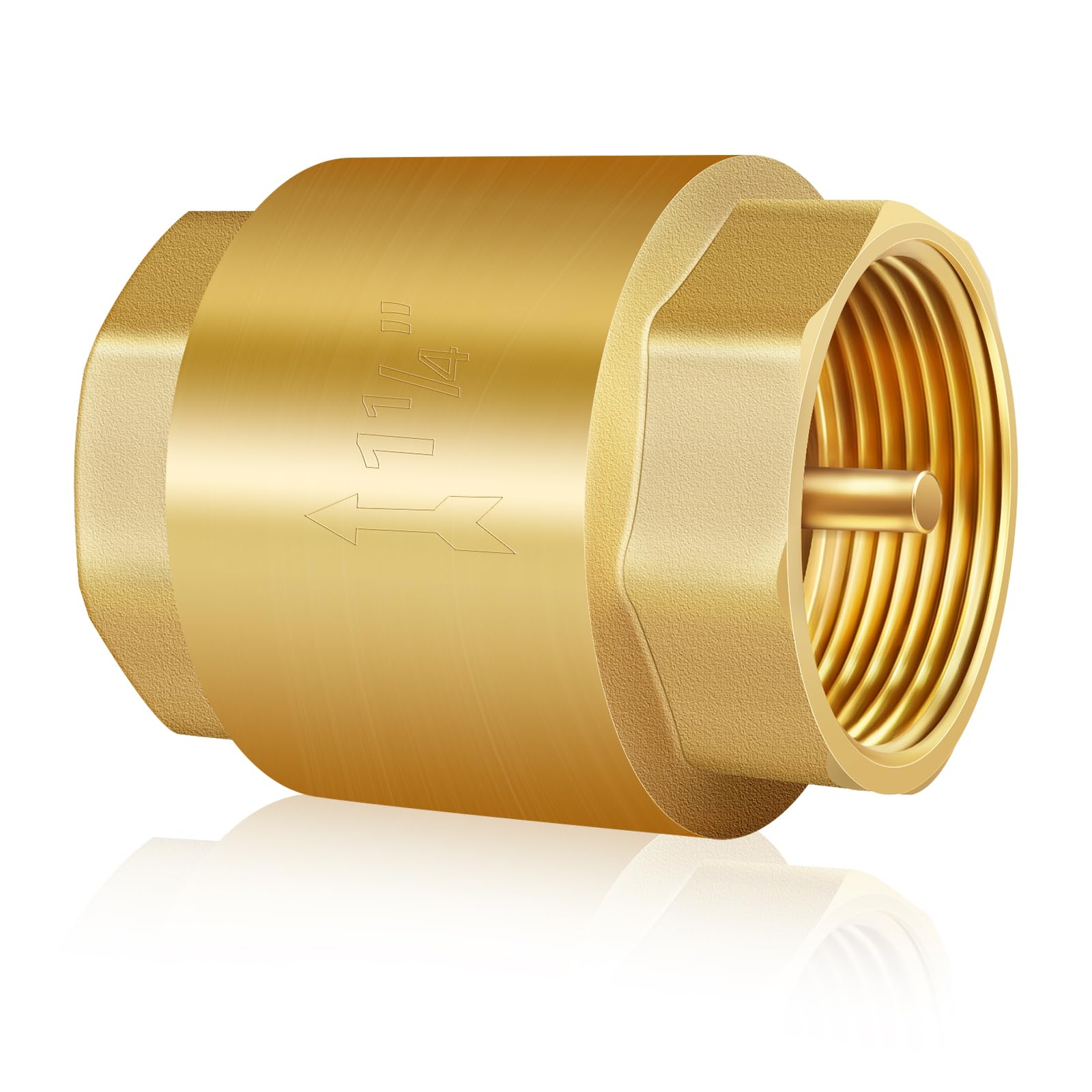
A brass spring valve rated for brutal temperature swings on wells, tanks, and solar lines
Nine Fahrenheit below zero to 248°F — that is the working range Boltigen prints for this valve, from -10 ℃ to +120 ℃. That wide band is what lets it live on solar water heaters, gas water heaters, and well lines that see both freezing nights and hot daytime runs. It is heavy-duty brass, spring-loaded with a stainless spring, and rated 14 bar (200 psi) max, so it handles pressure spikes without complaint.
The spring element is the deciding factor for anyone fighting gravity. Because a spring pushes the poppet shut, this valve sits in either a horizontal or a vertical line, which the swing valves here simply cannot match in a vertical run. Buyer feedback backs the build: the valve feels well built, and most customers note it works perfectly and holds pressure. It carries a 45 PSI opening pressure and needs 0 minimum back pressure to seat, so it seals even when line pressure drops to nothing.
The one honest note: one buyer installed it six months ago and reported it holding fine but leaking a little, suspecting their own installation. That tracks with what NPT threads do when they are under-taped — the seal is mechanical, so prep matters. Order the 1-1/4” NPT size to match this review, since the listing text also references smaller sizes elsewhere.
Where it shines
- Wide -10 ℃ to 120 ℃ range covers freezing nights and hot-water systems
- Stainless spring allows both vertical and horizontal mounting
- 45 PSI opening pressure with 0 minimum back pressure needed to seal
- Heavy-duty brass body resists corrosion across industrial and home duty
The honest caveats
- Thread seal quality decides whether it weeps — under-taped NPT threads will drip
- Listing text mentions other sizes, so double-check you are ordering the 1-1/4” NPT model
Choose it for: wells, water purifiers, pumps, solar systems, and gas water heaters where the valve must work in any pipe angle.
Skip if: you want zero prep — this one rewards a clean, well-taped thread job on every install.
6. HYDROSEAL Sharkfellow 1 1/4” PVC True Union Ball Check Valve

The serviceable PVC ball valve that lets you unscrew it without cutting your pipe
If your plumbing runs into a pool, an aquarium sump, or an irrigation manifold, the union body is the whole reason to buy this. A true union valve unscrews in the middle, so you can pull it for cleaning or replacement without cutting and re-gluing the surrounding pipe. It sockets onto 1 1/4 inch pipe, is rated 200 PSI at 73F, and uses EPDM seals. The PVC body cannot rust or corrode.
The mechanism is a ball, not a flap or a spring poppet. When the pump shuts off, the ball drops and closes itself, and reviewers point out it seals every time with near-zero pressure loss on a pool line. On a sump or fish tank it runs silent in the horizontal position — one reef-tank user praised that quiet running specifically, though the same valve became loud when mounted vertically. Owners also note these ship with a set of replacement O-rings, handy for a serviceable valve.
The real catch is the plastic body. One owner’s PVC threads snapped off after roughly three years in service, though that valve may have been overtightened at install. It is also a valve you replace, not repair — there are no spare parts sold separately, and the union threads are non-standard, so a wrong fitting means buying an entire new valve. Treat the plastic threads with care and torque them lightly.
The union advantage: unscrew the valve out of the line for service without disturbing the pipe, a trait none of the all-metal valves here offer.
What to respect: the PVC body is molded plastic, so it wants gentle torque — overtightening is what cracks union threads over the years.
Right for: pool lines, aquarium sumps, irrigation manifolds, and water parks where you need to service a valve without breaking the plumbing.
Not for: high-pressure metal pipe systems or anyone who wants to swap internal parts — this is a replace-whole-unit valve.
7. 1-1/4″ NPT Horizontal Swing Check Valve Brass Heavy-Duty (SYWUWV)
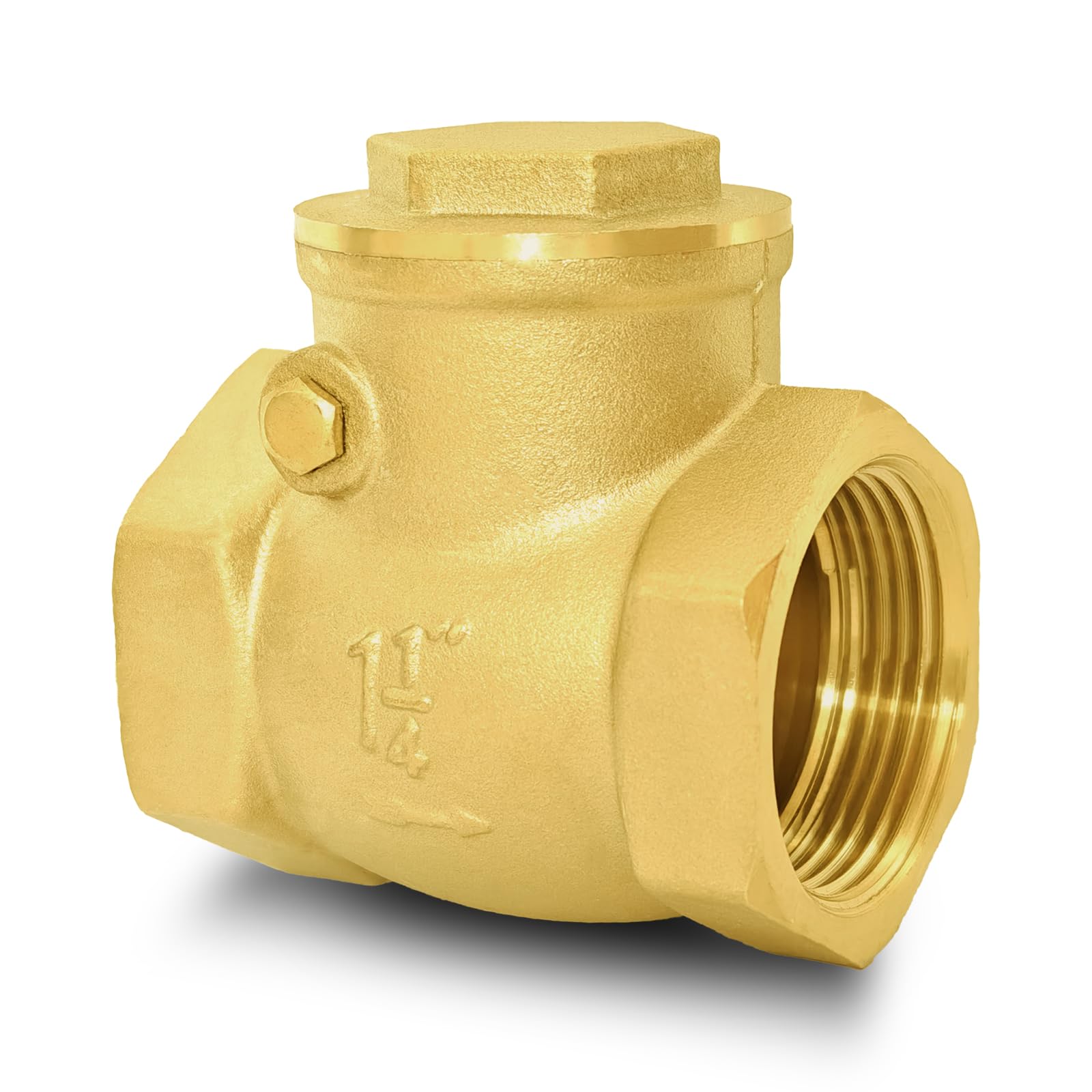
The low-pressure-drop brass swing valve for a straight horizontal run on a budget
This is the pick for a simple horizontal pipe with no angle tricks. It is a brass swing valve with a polished inner wall that limits scaling and mineral buildup, and it is rated for a 1.6 MPa (232 psi) maximum working pressure across a -4°F to 302°F range. Media coverage runs from water to oil to non-corrosive gas. The smooth internal path keeps pressure drop low while the line flows.
Two things buyers keep coming back to are its quality and how easily it functions. The build is solid enough that owners describe it as well-built and easy to install, and on a ram pump it produced steady flow while its smooth interior kept minerals from settling. That polished bore is the quiet advantage — a rough cast interior grabs scale, and scale is what eventually kills a swing disc’s seat.
The limitation is baked into the name: it is horizontal only, and it wants flow parallel to the pipe. Tilt it toward vertical and gravity stops doing its job on the hinged disc. Thread length is also the one point reviewers split on, with some noting the input-side threads run short, which can mean fewer turns of engagement. Give it a proper tape wrap and check your thread depth before you commit.
Reasons it earns a spot
- Polished inner wall reduces scaling and clogging for easier maintenance
- Smooth flow path keeps pressure drop low while running
- Swing disc closes without water hammer, protecting pumps downstream
- 232 psi max rating with a -4°F to 302°F working range
Plan around these
- Horizontal installation only — flow must run parallel to the pipe
- Input-side thread length is the one spec reviewers flag as short
Worth it for: a straight horizontal run on water, oil, or non-corrosive gas where you want steady low-pressure-drop flow without paying for a union or stainless body.
Pass if: your pipe tilts toward vertical — this disc depends on gravity and a level line.
8. 1-1/4″ Stainless Steel SS316 Swing Check Valve

Stainless 316 for high-mineral, high-corrosion water that eats ordinary fittings
If your well water rusts galvanized pipe and pits aluminum, this is the valve built for that water. The body and disc are stainless steel 316, the seal is PTFE, and it is rated 200 PSI and PN16. It carries female x female threaded ports on both ends and a screwed cap. Temperature coverage stretches from -60 to 450 degrees Fahrenheit, so it handles the full range of liquids and gas — water, oil, air, gas, and light acids or alkali.
The whole point of 316 stainless is resistance to the corrosion that eats brass and galvanized fittings in aggressive water. Owners who switched from galvanized and aluminum describe it as the fix for exactly that, and the build quality is what people rave about most. The swing design opens under flow and shuts on reverse — the same one-way gate as the brass Midline, but in a body that never rusts.
The trade-off is the mechanism itself: this is a swing valve, so it is for horizontal use only. The listing is explicit that it cannot be used in vertical applications because gravity drives the swinging motion. It also runs a premium over the brass budget swings, though one grout-line user who goes through valves often reported the local Miami shop charges roughly triple for the equivalent. Match it to a level line and clean, aggressive water.
The material story: stainless steel 316 body and disc with PTFE seals, built to survive water, oil, gas, and light acids where brass would corrode.
The install rule: horizontal mounting only — the swinging disc needs gravity, so a vertical line will defeat it.
Reach for it when: your water is mineral-heavy, corrosive, or flowing grout — anything that has already chewed through ordinary brass or galvanized fittings.
Choose differently if: your line is vertical, or you just need a low-cost horizontal valve where plain brass would survive fine.
9. Zonon 2 Pcs 1-1/4 Inch Check Valve, One Way Spring Brass

Two spring-loaded brass valves and a removable core you can clean out
This is the value play: two valves in the box, so you keep one as a spare. Each is 1.25″ NPT male in and 1.25″ FNPT out, brass with a gold coating, and measures about 2.68 inches long by 2.05 inches in diameter. The brass core inside can be pulled out for cleaning, which is unusual at this price and handy on lines that collect grit.
For basic backflow duty they do the job. Buyers describe the threads as clean and the install as easy, with the flow-direction arrow clearly marked, and the brass build is what earns the most praise. On a 3/4 inch line with adapters, one owner compared the internal poppet to a well foot valve — a spring-loaded, self-centering brass disc that opens and seals cleanly. Two-for-one pricing is what tips most people toward this set over a single valve.
Two things to know before ordering. First, these are not a certified backflow preventer, so if local code requires one, they are not the answer — they are for basic plumbing and irrigation only. Second, watch for the reported thread-direction issue, where one buyer found the threads reversed. And note Zonon states the valve is not suitable for drinking water supply systems, so keep it off potable lines.
What you get in the box
- Two 1.25″ spring-loaded brass valves, so you have a spare on hand
- Removable brass core for cleaning on gritty lines
- Clean threads with a clearly marked flow-direction arrow for easy install
- Machined brass disc that self-centers and seals like a foot valve
Before you order
- Not a certified backflow preventer where local code requires one
- Not suitable for drinking water supply systems per the maker
- Reports of reversed threads on some units — verify direction before install
Pick this for: basic irrigation or chemical-line backflow where you want a spare brass valve in the drawer.
Look past it if: you need a code-compliant backflow preventer or a valve for a potable water line.
Understanding the Specs
PSI, WOG, and WSP Ratings
PSI means pounds per square inch — the amount of force the valve holds before it fails. WOG stands for Water, Oil, and Gas, so a 200 PSI WOG rating means the valve handles all three media at that working pressure. WSP is the steam rating, usually printed lower than the WOG figure because hot steam is harder on seals. For a household well or irrigation line, a 200 PSI rating gives plenty of headroom over normal system pressure.
Swing vs. Spring-Loaded Mechanisms
A swing valve uses a hinged disc that falls closed, so it needs a horizontal line where gravity can work. A spring-loaded valve uses a stainless steel spring to push a poppet shut, letting it work horizontally or vertically. Spring valves can add slight resistance on very low-flow systems, while swing valves run with a lower pressure drop. Match swing to horizontal runs and spring-loaded to vertical pipe or low-flow pump lines.
FAQ
Will a 1 1/4 inch check valve fit my 1 inch pipe?
Why is my check valve leaking at the threads?
Can a check valve be installed vertically?
What does 200 PSI WOG mean on a check valve?
Brass or stainless steel check valve for well water?
How do I stop water hammer with a check valve?
Does a check valve stop my well pump from losing prime?
Can I use a check valve for pool or aquarium plumbing?
What is the difference between a swing and a spring check valve?
Is a check valve the same as a backflow preventer?
Final Thoughts: The Verdict
For most people, the 1 1/4 inch check valve winner is the Midline Valve 432U336 because its lead-free cast brass body, 200 PSI WOG rating, and NSF/ANSI-61/372 conformance cover well lines, oil, and gas in one valve. If your line runs vertically or drops down a deep well casing, grab the Merrill CVNL125, whose in-line poppet and O-ring seat without gravity. And for pool, sump, or irrigation plumbing that you service often, the HYDROSEAL Sharkfellow true union is the one to reach for — it unscrews out of the line instead of forcing you to cut pipe.
How We Picked
We do not accept paid placement. Every pick is matched to a real buyer and a real use-case; we do not hands-on test units.
Sources & Methodology
Specifications: manufacturer listings and product documentation. Review insights: verified customer reviews, as of September 2026. Pricing: not shown on this page (it changes often); check the current price via the retailer link.
As an Amazon Associate, KitchPrep earns from qualifying purchases. This does not affect which products we feature.
Related Guides
