
Specs are compiled from manufacturer listings and verified buyer reviews and can change over time — please confirm the key details on the product page before buying.
If you are running power to a hot tub, an EV charger, a generator, or a shed, the wrong conduit turns a weekend job into a fight. The right one bends around corners, seals out water, and lets wire slide through without snagging. This guide covers the real 1-1/2 inch trade-size options that hold up outdoors and underground, so you can pick the one that fits your run.
I’m Mohammad Maruf — the founder and writer behind KitchPrep. This guide is built by comparing the manufacturers’ published specifications and the patterns across verified customer reviews, so you get each pick’s real strengths and trade-offs instead of marketing spin.
Some of these kits ship with straight and angled connectors so you are not hunting for fittings at the last minute. Others give you a longer coil and let you supply your own ends. Every pick here is a genuine 1-1/2 inch trade-size conduit, and the best 1 1/2 inch liquid-tight conduit for your job depends on run length and fittings.
Our Picks at a Glance


How To Choose The Best 1 1/2 Inch Liquid-Tight Conduit
Liquid-tight conduit is a flexible tube that protects electrical wires from water, dirt, oil, and physical damage. You see it on HVAC equipment, generators, EV chargers, hot tubs, pumps, and outdoor lighting. The 1-1/2 inch version is the bigger size, built for heavier wire bundles and longer runs.
Trade size is not the actual diameter
The label “1-1/2 inch” is a trade size — an industry naming convention, not a tape-measure number. The real outside diameter runs bigger, often close to 1.87 or 1.88 inches. Check the actual OD and ID before you order, especially if you already have fittings or a knockout to match.
Metallic core or all-plastic construction
A metallic-core conduit uses a spiral steel core wrapped in a PVC jacket, which adds crush and pull strength. A non-metallic version is all virgin PVC, which makes it lighter and easier to cut. Both resist corrosion, oil, and water, so the choice depends on how much physical abuse your run will see.
Fittings change the real cost of the job
Some kits arrive with straight and 90-degree connectors plus pipe straps. That saves you a trip to the hardware store and keeps the water seal consistent. Others are conduit-only, so budget for ends separately and match them to the conduit type.
Where the run goes decides what you need
Direct burial means the conduit goes straight into the ground without extra sleeving. Sunlight resistance matters for anything above ground. If the wire has to slide a long way, the smoothness of the inner wall is what saves your arms, not the brand name on the box.
Quick Comparison
| Model | Best For | Outside Diameter | Length | Fittings Included | Amazon |
|---|---|---|---|---|---|
| Sealproof Type B★ Best Overall | Long direct-burial runs | 1.5 inches | 50 feet | — | Amazon |
| Electriduct PVC Coated MetalSteel Core Pick | Heavy mechanical protection | 1.71 inches | 25 feet | — | Amazon |
| AISIMEE Conduit and Connector Kit | Complete one-box installs | 1.87 inches | 25 feet | 5 straight, 3 angle | Amazon |
| Elecoman Conduit Kit | Value on a 25-foot run | 1.87 inches | 25 feet | 5 straight, 3 angle | Amazon |
| Feotech Non-Metallic | Long feeder runs | 1.5 inches | 50 feet | — | Amazon |
| Wocloer 50 Foot Kit | Goods with elbows and straps | 1.5 inches | 50 feet | 5 straight, 4 angle, 10 straps | Amazon |
| HydroMaxx PVC Kit | Heavy wire bundles | 1.5 inches | 50 feet | 2 straight, 2 angle | Amazon |
In‑Depth Reviews
1. Sealproof Flexible Non-Metallic Liquid-Tight Electrical Conduit Type B
Our pick — over 4.5★ from 950+ verified ratings; the strongest balance of quality and price.
Half the weight of metal and rugged enough to bury straight in the ground.
You get 50 feet of all-plastic hose that is roughly 50% lighter than metallic conduit, so hauling it around the yard does not wear you out. It is made in the USA from virgin PVC, which is the grade that resists corrosion, abrasion, oil, water, and acid without the sharp edges or burrs that snag your knuckles during a wire pull.
The UL listing under File No. E-129973 is the credential that matters most if an inspector will look at the job. Ratings run 80°C dry and 60°C wet, with 70°C oil resistance, and it holds CSA certification from -18°C to 75°C. That temperature band covers hot attics and cold garages without cracking. It is also rated for direct burial and sunlight resistance, so one coil handles both the trench and the wall.
The one issue the reviews raise again and again is wire pulling. The hose is a straight tube with no built-in fish tape, and buyers report it is genuinely hard to thread wire once the run gets long. One owner spelled out the reality: “My needs were 10 gage wire on 75’ run buried 24 inches underground.” A simple shop-vac and string trick solves it, but plan for that step. The coil arrives at a full 50 feet, twice the length of the 25-foot Electriduct below.
Where it earns its keep
- 50% lighter than metallic conduit with no sharp edges to cut your hands
- UL and CSA rated, including 80°C dry and 60°C wet temperature limits
- Direct-burial and sunlight-resistant for outdoor and underground runs
- Cuts with a utility knife or PVC cutter — no special tooling
What you should know before buying
- Feeding wire through a long run takes patience and a pulling method
- Arrives as conduit only — you supply straight or angled connectors separately
- It comes in 50-foot lengths, so a short 10-foot run wastes a lot of coil
Go this way if: you need a long, code-friendly run you can bury directly and you already own your connectors.
Pick another route if: you want fittings in the box or the wire pull has to be easy on a first attempt.
2. Electriduct 1.5″ PVC Coated Liquid-Tight Flexible Metal Conduit – 25 Feet
The armored one — a steel spine wrapped in rubbery PVC for jobs that take abuse.
Where the plastic options flex and dent, this one holds its shape. The core is galvanized steel with a single-buckle structure that raises tensile strength, and the whole thing is then coated in liquid PVC so the metal never touches moisture. The jacket is waterproof, corrosion resistant, flame retardant, and UV resistant, with a UL94-V2 rating, and it operates from -40°F to 185°F.
At 25 feet it is half the length of the Sealproof coil above, yet the coil weighs only 9.44 ounces despite the steel core. It handles both static and dynamic use, from conveyors and tooling machines to cranes, so if your conduit will be bumped or dragged, the armor is worth the trade-off in flexibility.
The catch is fit. Several owners expected a plain plastic hose and instead received a PVC-coated metallic flex — an entirely different product with a bigger inner diameter. The ID here is 1.5 inch and the OD is 1.71 inch, which is what a 1-1/2 trade-size sleeve should measure, but check your connectors before you commit. One note that comes up in reviews: the coating means you cannot use the conduit itself as a ground, so run a separate ground wire. For outdoor EV runs and damp spots, it does the protecting job fine.
Why it holds up: the steel core plus PVC jacket combination is the reason it shrugs off crushing, pull, and solvents that would ding a plain plastic hose.
What to plan for: confirm your fitting size against the 1.5-inch ID before ordering, and budget a separate ground conductor because the coated jacket cannot serve as one.
Best matched to: workshops, machine rooms, and any run where the conduit gets knocked around or dragged.
Think twice if: you assumed you were buying plain plastic — this one has a metal spine and a different feel.
3. AISIMEE Liquid Tight Conduit 1-1/2inch 25FT with Connector Kit

One box, one trip — coil, elbows, and straights all in the same package.
This is the pick for anyone who does not want to make a second trip for fittings. The 25-foot coil arrives with five straight connectors and three 90-degree connectors, so you can go around a corner without digging through the hardware aisle. The tubing is virgin PVC with a smooth interior, no burrs, and it resists corrosion, abrasion, oil, water, acid, and metal shavings.
The plastic build is 50% lighter than a metallic conduit, and the connector design lets one person finish the job without tools — you push the tube onto the ferrule and tighten the dome sealing nut by hand. The outside diameter is 1.87 inches, which is the widest of the plastic picks here, and that extra girth is what lets it swallow heavy wire. The brand’s own customer reviews back the fit, with the recurring note being that it works on a 6AWG wire for an EV wall charger and is thick enough to stand up to outdoor weather.
Honest limit: it is stiff. The all-virgin-PVC construction trades bendability for sturdiness, and the reviewers who mention it say it is not so flexible, though good enough for the job. If your run has a tight S-curve, plan to work it slowly. For a straight or gently curved run to a charger or panel, that stiffness is exactly what keeps the tube from kinking.
Reasons owners stick with it
- Five straight plus three 90-degree connectors mean a single-source install
- Resists oil, water, acid, and metal shavings for outdoor work
- No tools required — push the tube onto the ferrule and tighten the nut by hand
- Thick 1.87-inch OD swallows heavier cable bundles
The trade-offs to weigh
- Stiff construction makes tight bends slow work
- Some buyers end up with more connectors than a small job needs
Pick this one for: a 25-foot run to an EV charger or outdoor outlet where walking into the house for a fitting would stall the job.
Look past it if: your layout needs sharp bends, since the stiff PVC resists tight turns.
4. Elecoman 1-1/2 (1.5) 25ft Trade Size Liquid-Tight Conduit and Connector Kit

The conduit that explains itself — it prints the real dimensions right on the listing.
If you have ever ordered “1-1/2 inch” conduit and discovered the tube is nowhere near that wide, this kit is built for you. The label spells out the confusion: 1-1/2 inch is the trade size, not the diameter. The actual OD runs about 1.88 to 1.89 inches, roughly 47.8 to 48 mm, while the actual ID is about 1.61 inches, or 40.8 mm. You can check your connectors against real numbers before you buy instead of guessing.
The construction is the same formula as its plastic rivals: virgin PVC, a smooth interior, low weight, and resistance to corrosion, abrasion, oil, water, and acid. It is rated for direct burial and sunlight, and it arrives with five straight and three 90-degree connectors, so the whole kit is one purchase. The included fittings and the value price are what buyers mention most, along with how quickly a single person can install it.
The honest trade-off here is stiffness and consistency. Reviewers disagree about flexibility — some find it hard to straighten out of the coil, and a small handful report the connectors overtighten easily or that a frustrated pull made cable snag. Set against that, the kit is built for standard residential and commercial cable management, and the 25-foot length suits an EV charger run or a utility feed. Stretch it in the sun first and it behaves.
What it gets right
- Publishes real dimensions — about 1.88 to 1.89 inch OD and 1.61 inch ID
- Fittings included: five straights plus three 90-degree connectors
- Direct-burial and sunlight rated for outdoor service
- Single-person install with hand-tightened fittings
Where it tests your patience
- Can arrive coiled stiff and need time to relax
- Connectors tighten quickly — snug, not gorilla-tight
- Plain PVC build, so it is less protective than a metal-core conduit
Made for you if: you want the fittings in the box and you want to know the exact diameter before it ships.
Not your pick if: the job demands lots of tight bends or heavy mechanical protection.
5. Feotech 1 1/2 Inch Flexible Conduit 50 FT Non Metallic Liquid-Tight
Double the coil, half the frustration — 50 feet for the price of a short run.
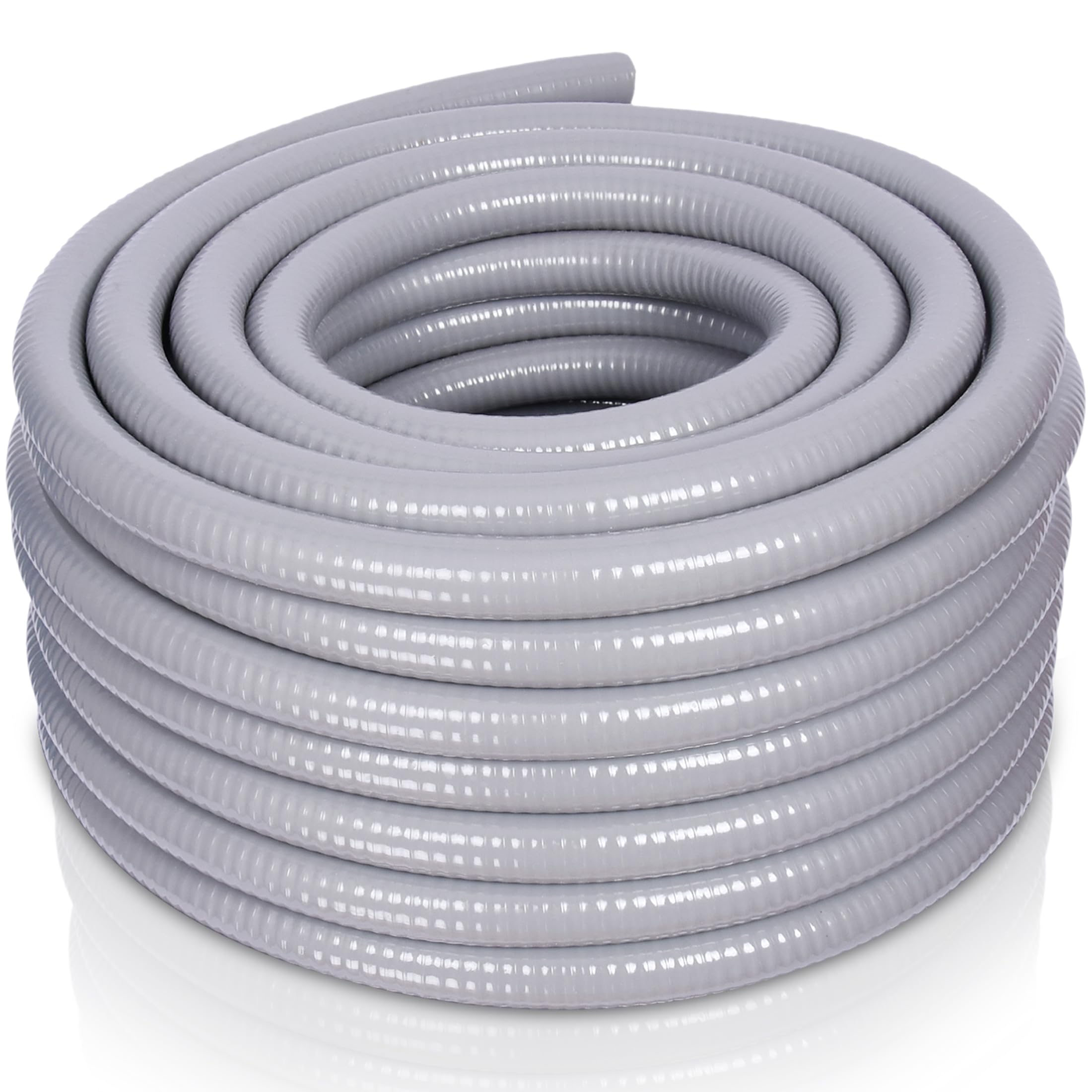
The headline here is simple: a full 50 feet of non-metallic liquid-tight conduit for a mid-range price. That is twice the length of the 25-foot kits, so a long feeder run from the panel to a detached garage or shed does not need a splice. The tubing is virgin PVC with a smooth interior and no sharp edges or burrs, so wire pulls slide rather than scrape, and it resists corrosion, oil, and water.
Flexibility is the design focus. The material routes around corners, walls, and uneven surfaces without kinking, and the low weight makes it easy to carry up a ladder or drag through an attic. No special tools are needed — you cut it to length with a utility knife, which is the kind of thing that keeps a weekend job from turning into a three-tool project.
The buyer feedback lines up with the spec sheet. Owners mention it handles heavy bundles — one noted it fits 4x12AWG plus 7x10AWG wires — and another called it ideal for garage or outdoor installs. The recurring caution is that it is light-duty by nature, so it belongs over a run that is not going to take a beating. One owner flagged it as light-duty outdoor protection for cabling, which is exactly the right way to think about it. Use it where the conduit is protected, and it does its job.
The length advantage: 50 feet of conduit versus the 25-foot coils from the value kits, with no mid-run splice required.
The limit to respect: it is built as light-duty protection, so keep it off routes where heavy equipment or foot traffic will crush it.
Worth grabbing if: you need the extra footage for a long feeder run to an outbuilding and want to keep the install tool-free.
Skip the switch if: your conduit path runs where it will get stepped on or crushed.
6. Wocloer 1-1/2 inch 50 Foot Liquid-Tight Conduit Kit
The 50-foot bundle that shows up with everything already in the box.
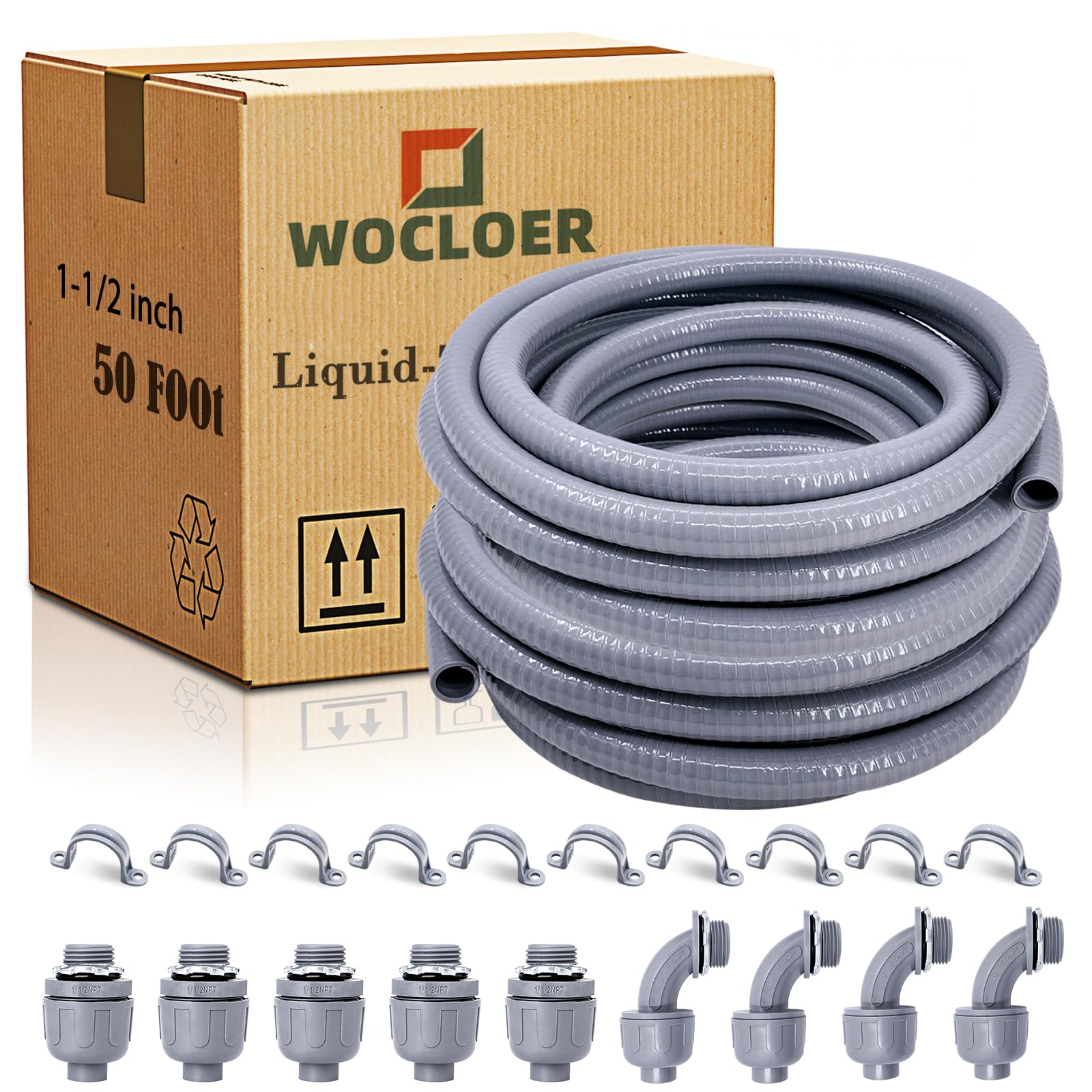
Most kits give you conduit and fittings. This one also includes straps, so you can secure the run to a wall or a stud without a separate purchase. The package carries 1-1/2 inch conduit at 50 feet, five straight connectors, four 90-degree connectors, and ten pipe straps — enough hardware that a full panel-to-load run usually finishes without a hardware-store detour.
The tubing is anti-oxidation PVC with corrosion, wear, oil, water, and acid resistance for harsh environments. Installation is tool-light: no disassembly, and you push the tube onto the ferrule and tighten the dome sealing nut. The outside diameter is 1.5 inches, matching the trade size on the label. It is the widest fitting count of any kit here at nine connectors plus ten straps.
The reviews point to real-world use: generator connections, camper power runs around a meter pole, and breaker-panel feeds. One buyer’s electrician said it was worth the money and that all the parts came in the box. One caveat to know: a few units arrive missing a connector, and the seller asks that you contact them directly if that happens — they say they will make it right. Check the box contents before you start.
What the box delivers
- 50 feet of conduit with nine connectors and ten pipe straps included
- Anti-oxidation PVC resists corrosion, oil, water, and acid
- No-disassembly install — push and tighten the sealing nut
- Sufficient hardware for a full run in one order
What to eyeball on arrival
- An occasional kit ships short a connector — verify contents on day one
- Plain PVC build means less crush resistance than a metal-core conduit
Choose it for: a complete 50-foot run where you want straps and elbows included in one box.
Look elsewhere if: you need heavy mechanical armor or you would rather supply your own fittings.
7. HydroMaxx Flexible PVC Non Metallic UL Liquid Tight Electrical Conduit Kit

Nylon connectors, steel lock-nuts, and a coil that seals tight around big wire.
This is the kit for the person running a serious load. The 50-foot coil comes with two straight and two angle fittings, and the connectors are molded from Type Nylon 6 with an O-ring and a steel lock-nut included. No threading is required — you push the tubing onto the fitting and tighten. The conduit itself is non-metallic PVC, UL listed, and rated for indoor and outdoor use, with resistance to corrosion, oil, and water.
The seal is the standout. Customers note it stays watertight, which matters on a buried run or a generator feed where moisture is the enemy. One owner wired up a 16KW GENERAC generator running several heavy wires — a couple of 6 gauge, 8 gauge, and a ground — and reported it fit and worked perfectly with just the right parts in the box. Smooth interior walls keep wire pulling manageable, though a dab of cable lubricant helps on long pulls.
Here is the honest part: some owners find it stiff. The flexibility is mixed in the feedback, and the conduit takes force to work into a panel. One owner who tried to build an elongated S-shape gave up after letting it sit in the Florida sun. The fix is to pre-install the conduit before setting the panel, so you have room to make adjustments, and to relax the coil first. Route it around gentle curves and the stiffness becomes an advantage — it holds its shape and resists crushing.
Why the seal wins: the nylon connectors with O-rings and steel lock-nuts hold water out, which is the whole point of a liquid-tight run.
The flexibility reality: it takes muscle to bend and work into a panel, so plan your curves before you fasten anything down.
Right for: generator feeds and subpanel runs with multiple heavy conductors where a tight seal is the priority.
Wrong for: tight S-curves and cramped boxes where you need the conduit to bend easily on the first try.
Understanding the Specs
UL Listing
A UL listing means Underwriter’s Laboratories has tested the conduit against a published safety standard. On these products it shows up as a specific file number, like the File No. E-129973 on the Sealproof Type B, with temperature ratings such as 80°C dry and 60°C wet. If a local inspector will check the job, that listing is the paper trail they look for. Not every conduit here carries one, so confirm before you commit to a code-sensitive install.
Outside Diameter vs Trade Size
The 1-1/2 inch label is a trade size, a naming convention shared across the industry. The real outside diameter runs larger, and it varies by product — the Electriduct measures 1.71 inches, while the AISIMEE and Elecoman sit around 1.87 inches. That gap matters when you already own fittings or you are matching a knockout. Always check the actual OD and ID on the listing before ordering, because two conduits with the same trade-size label can have different physical measurements.
FAQ
Will 1-1/2 inch liquid-tight conduit fit standard 1-1/2 inch connectors?
Can I bury 1-1/2 inch liquid-tight conduit directly in the ground?
Why is it so hard to pull wire through liquid-tight conduit?
Does the PVC coating on metallic conduit mean I do not need a ground wire?
How is non-metallic liquid-tight conduit different from the metallic kind?
Can I use 1-1/2 inch conduit for an EV charger or a generator run?
Will 1-1/2 inch conduit bend around a tight corner?
How long will liquid-tight conduit last outdoors?
Do I need a special tool to cut and install 1-1/2 inch liquid-tight conduit?
Is a conduit kit with fittings worth it or should I buy them separately?
Final Thoughts: The Verdict
For most 1-1/2 inch jobs, the Sealproof Type B is the one to grab — 50 feet, UL and CSA listed, direct-burial and sunlight rated, in a coil about half the weight of metal. Its 4.8-star rating across 900+ reviews is the strongest owner record of the seven picks here. If you want the fittings already in the box and an easier hand-fed install, reach for the AISIMEE kit with its five straight and three 90-degree connectors. And when the run carries multiple heavy conductors to a generator or subpanel, the watertight HydroMaxx kit with its nylon connectors and steel lock-nuts is the one built for the load.
How We Picked
We do not accept paid placement. Every pick is matched to a real buyer and a real use-case; we do not hands-on test units.
Sources & Methodology
Specifications: manufacturer listings and product documentation. Review insights: verified customer reviews, as of September 2026. Pricing: not shown on this page (it changes often); check the current price via the retailer link.
As an Amazon Associate, KitchPrep earns from qualifying purchases. This does not affect which products we feature.
Related Guides
