
Specs are compiled from manufacturer listings and verified buyer reviews and can change over time — please confirm the key details on the product page before buying.
If your well pressure has gone soft, or your old pump finally quit, the fix is a 1.5 horsepower (HP) unit — a motor size that lifts serious water without forcing you into a two-horsepower upgrade. The trick is matching the pump to your well type: a submersible drops down the casing into the water, while a shallow-well jet pump sits above ground and pulls water up through suction. Pick the wrong type and no amount of horsepower will fix it.
I’m Mohammad Maruf — the founder and writer behind KitchPrep. This guide is built by comparing the manufacturers’ published specifications and the patterns across verified customer reviews, so you get each pick’s real strengths and trade-offs instead of marketing spin.
Below you get eight real 1 1/2 HP pumps sorted by what they actually do best, plus plain-English explanations of head, flow, and voltage so you can order the right one the first time. Whether you are replacing a dead pump or building a new water system, this breakdown of the 1 1/2 hp well pump covers what matters before you buy.
Our Picks at a Glance


How To Choose The Best 1 1/2 HP Well Pump
Picking a 1.5 HP pump is really three decisions stacked together: what kind of well you have, how high the water has to travel, and what power you can supply at the wellhead. Get those three right and the brand choice falls into place.
Submersible Or Shallow-Well Jet?
A submersible pump (a sealed cylinder that hangs underwater inside the well casing) is the right call for deep drilled wells — it pushes water up from below rather than pulling it. Every VEVOR and the LEO and Red Lion units here are submersible, and most need a 4-inch casing or larger. A shallow-well jet pump sits above ground and uses suction, which is why its maximum lifting height is measured in feet of pull rather than feet of push. If your water level sits within suction range, a jet pump is simpler to install and service because everything stays on the surface.
Match Head And Flow To Your House
Head is how high a pump can lift water, measured in feet. Flow is how much water arrives per minute, measured in gallons per minute (GPM). A sprinkler system and a full house draw very different numbers, so check both before ordering. A pump rated for 276 feet of head will still push water up a 225-foot well; a unit capped at 25 feet of lift will not, no matter how many GPM it claims.
Voltage, Wiring, And Pressure Tanks
Most submersibles here run on 230V, while a few offer 115V for easier hookup. A jet pump with a built-in pressure tank (a stored-air chamber that keeps water pressure steady between pump cycles) holds pressure all day and starts and stops on its own. Submersibles have no tank — you supply the pressure switch and tank separately, usually through an external control box.
Quick Comparison
| Model | Best For | Max Head | Flow Rate | Power | Amazon |
|---|---|---|---|---|---|
| STA-Rite SNF-L★ Best Overall | Whole-home supply and sprinklers | Not stated | Not stated | 1.5 HP, 115/220V | Amazon |
| FOTING 1.5HP Jet PumpMost Self-Contained | Surface boosting with a tank | 164 ft | 22.3 GPM | 1.5 HP | Amazon |
| VEVOR Deep Well 115VEasiest Voltage | Easy-voltage deep-well installs | 276 ft | 37 GPM | 1.5 HP, 115V | Amazon |
| LEO DWL-1500N | Long-cord submersible installs | 170 ft | 1902 GPH | 1.5 HP, 115V | Amazon |
| VEVOR 2HP 230V | Very deep wells and big tanks | 427 ft | 37 GPM | 2 HP, 230V | Amazon |
| Star JHU15S | Above-ground sprinkler pressure | 25 ft | 50 GPM | 1.5 HP, 115/230V | Amazon |
| Red Lion RL12G15-3W2V | Deep wells on a 12 GPM budget | 548 ft shut-off | 12 GPM | 1.5 HP, 230V | Amazon |
In‑Depth Reviews
1. STA-Rite SNF-L 1-1/2 HP Shallow Well Pump
Our pick — over 4.5★ from 50+ verified ratings; the strongest balance of quality and price.
The heavy cast-iron workhorse that keeps sprinkler zones and house taps fed without drama.
If you already own a Sta-Rite and just want the same pump again, this is that pump — a 1-1/2 HP above-ground jet unit in a cast-iron and polypropylene body that weighs 60 pounds on the bench. The 60 pounds is the tell: this is a stationary, bolted-down installation, not something you move around. It wires up on either 115 or 220 volts, so it fits whatever circuit your well house already runs, and the maker lists it for gardening, lawn irrigation, and bathing duty.
You get quiet operation that wins people over. Owners who swapped out an older, noisier unit say this one runs far softer than the pump it replaced. The pressure jump shows up right away at the sprinkler heads — zones that used to dribble now throw water hard enough to add extra heads per line. Compare it to the FOTING jet pump and the difference is blunt: the Sta-Rite is a 60-pound cast-iron build, while the FOTING has a 17-by-10.5-inch frame. So if you want a smaller benchtop footprint, this is not the one.
The honest trade-off is that installation takes patience. The base bracket leaves tight clearance for a wrench on the mounting nuts. The carriage bolts can spin in the pressed-wood base and wallow out their holes. And the inlet port has been threaded at a slight angle to the centerline — which makes PVC cross-threading a real risk if you rush the glue-up. Budget extra time for the plumbing and use hex-head bolts where you can. The 4.6-star record across 50+ owners says the pump itself rarely disappoints; the install is where people get frustrated.
Where it earns its keep
- Quiet running compared with older pumps it replaces
- Runs on 115V or 220V, so no rewiring surprises
- One owner reports a 12-year service life on a smaller 3/4 HP predecessor
- Cast-iron and polypropylene build rated for sprinklers, irrigation, and bathing
Plan around these
- 60-pound body needs a solid, permanent mounting surface
- Base bracket clearance makes the mounting nuts awkward to tighten
- Tight inlet thread angle invites cross-threading if you force the PVC
Reach for this if: you run multiple sprinkler zones off a shallow well and want a quiet, rebuildable pump that wires up to your existing 115 or 220 supply.
Look elsewhere if: you need high head from a deep drilled well — that job belongs to a submersible, not this above-ground unit.
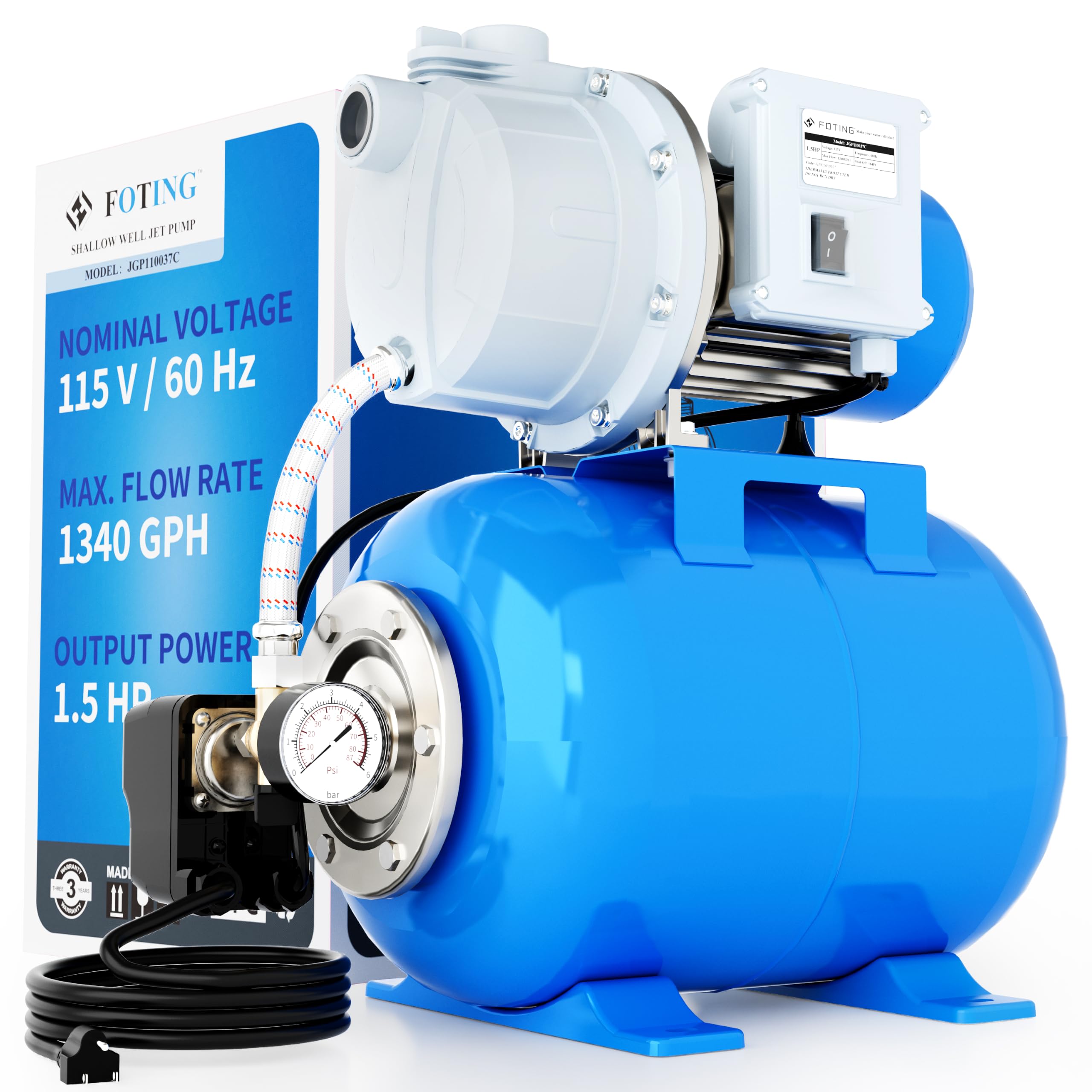
2. FOTING 1.5HP Shallow Well Pump with Pressure Tank
A jet pump with its own pressure tank onboard, so it holds household pressure without extra plumbing.
What makes this FOTING stand apart is the 5-gallon pressure tank bolted to the pump — a stored-air chamber that keeps water pressure steady between motor cycles. That tank, plus an automatic pressure switch preset to start at 1.5 bar and shut off at 3 bar, means the whole pressure system arrives in one box. It pulls water from up to 23 feet of suction, moves up to 1340 GPH, and lifts water up to 164 feet. The reinforced thermoplastic body and finished iron tank are built to resist corrosion, and it ships with two adapters for hooking up.
Owners find the performance genuinely strong for shallow wells and household water — the recurring fix when pressure drops is air in the tank. One owner traced short cycling (the motor firing on and off every 30 seconds) to a missing tank charge, then found the air valve hidden under the black plastic tank cover and refilled it to 20 PSI, which cured it. So if yours cycles oddly, check the tank air charge first.
The main thing to weigh is long-term durability. It uses a carbon ceramic mechanical seal to keep water out of the motor, and it runs on the smaller, lighter side, but a few owners mention failures after moderate seasonal irrigation duty. That makes this a natural fit for light-to-moderate use — watering a lawn and boosting house water — rather than running flat out every day. It’s easy to prime (fill it with water on first start) and easy on the bench, and it takes 1-inch NPT inlet and outlet fittings.
Why it clicks
- 5-gallon tank and automatic pressure switch ship as one unit — no separate tank to buy
- Holds pressure all day at 4.5 bar, starts at 1.5 bar and stops at 3 bar on its own
- 23-foot suction, 1340 GPH flow, and 164-foot max lift cover typical shallow wells
- Includes two adapters and overheat protection to guard the motor
Where owners hit friction
- The sealed tank can arrive under-charged, and the air valve sits under the plastic tank cover if you need to top it up
- Needs priming with water on the first start, and priming can take a couple of attempts
- Best kept to moderate duty — heavy daily draw is where the durability story gets thinner
Best for: a shallow well or booster setup where you want the pump, tank, and switch in a single, easy-to-prime package.
Skip if: you’re pushing constant high-volume flow — this pump rewards lighter, season-to-season use.
3. VEVOR Deep Well Submersible Pump 1.5 HP 115V/60Hz 37 GPM 276 ft
The submersible that skips the 230V headache by running on standard 115V power.
Most deep-well submersibles demand a 230-volt circuit, which is where a lot of DIY installs stall at the panel. This version of the VEVOR runs on 115V — the same household voltage as a wall outlet — while keeping the same 276-foot maximum head and 37 GPM flow as its 230V sibling. That combination of full head on easy voltage is what makes it a first choice for anyone whose well house already has 115V wiring. It ships with a 33-foot cord and an external control box, and its stainless-steel 4-inch body fits standard 4-inch-or-larger casing.
The design points are the ones owners talk about: quality of build and steady water pressure. The 8-stage thermoplastic impellers and copper motor carry built-in overload protection that shuts the motor down before it burns out if it jams — but it must never run dry, so keep the intake submerged. One owner’s setup pushed 27 GPM 130 feet up and filled a 15,000-gallon tank in 9 hours; another cited a 40-foot lift delivering a steady 20 GPM. Those are healthy numbers for a 115V unit.
The catch to plan for is the control box. It’s the part that takes the brunt of a pump’s start-up load, and the review pages show some boxes burning out — which is why some owners buy a spare unit and a longer warranty rather than relying on a single box. Replacing the control box is far cheaper than replacing the pump, so keep that in mind as a maintenance line item rather than a dealbreaker.
Why the voltage wins: running a genuine 1.5 HP, 276-foot-head submersible on 115V removes the biggest barrier to a home install — no need for a dedicated 230V run to the wellhead.
Choose it when: you have 115V at the well, want real deep-well head, and are comfortable keeping a spare control box on the shelf as insurance.
Pass it over if: you’d rather not think about the control box at all — a pump whose electronics you can’t easily spare is a mismatch for a zero-maintenance mindset.
4. LEO 1.5HP Shallow Deep Well Pump 170FT Head Submersible
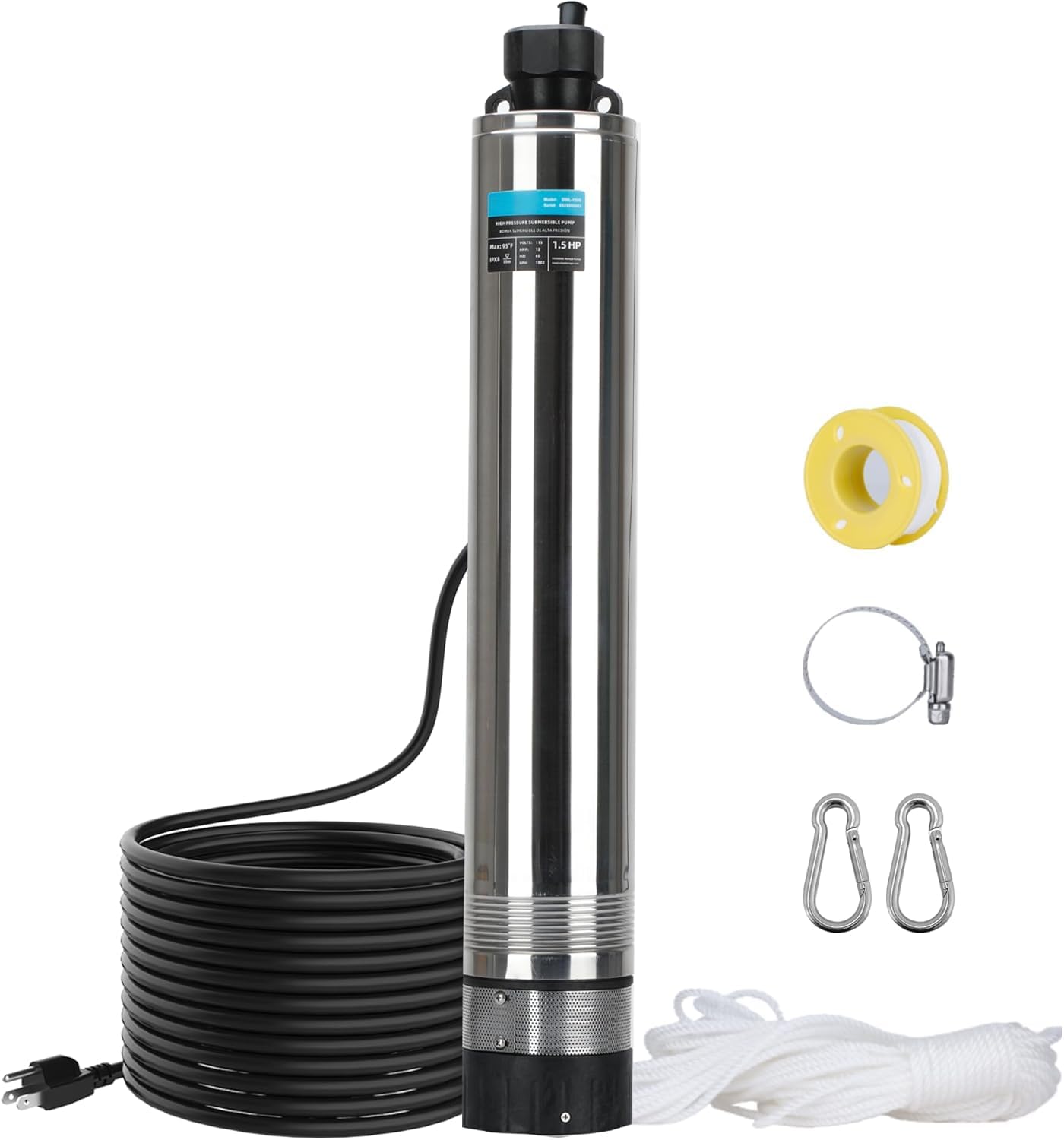
The submersible that shows up ready to drop, with a long cord and a rope already in the box.
Two lengths jump out before you read anything else: a 72.2-foot power cord and a 75.5-foot rope, both included. That cord length matters because it lets you hang the pump deep without splicing on extra cable — and every splice in a wet well is a leak risk. The rope gives you a proper drop line for hoisting the pump in and out. It runs on 115V, reaches a maximum head of 170 feet, and moves up to 1902 GPH, with a 1-1/4-inch NPT discharge and a maximum submersion depth of 62.3 feet.
The housing is a one-piece 304 stainless steel design with an integrated dirt sieve and a built-in non-return valve, so it mounts vertically and keeps sediment out of the impellers. The 1.5 HP motor is hermetically sealed and thermally protected against overheating. Owners praise the head pressure for irrigation and the fact that the cord, rope, sieve, and check valve are all pre-fit — the usual dig-and-splice headaches are gone. A 110V install restored full flow to every faucet at once where an older weak pump had stalled.
Match it to your well depth before buying. At 170 feet of head, a well near that depth will test the limits, and the included 72-foot cord and rope may want upgrading or extending on a deeper well. That depth ceiling — not the build — is the real limit here.
The install-ready wins
- 72.2-foot cord and 75.5-foot rope included — fewer splices, easier drop
- 1902 GPH flow and 170-foot head on 115V power
- 304 stainless steel body with integrated sieve and check valve
- 62.3-foot max submersion depth with thermally protected motor
Check your well first
- 170-foot head ceiling rules out wells deeper than that
- The supplied 72-foot cord and rope can run short on a deep well
- Runs on 115V, so plan your breaker and wire gauge around that load
Suited to: a homeowner with a mid-depth well who wants a submersible that arrives with cord, rope, sieve, and check valve already fitted.
Not designed for: wells over 170 feet, where you’ll want a higher-head pump and longer cable than the box provides.
5. VEVOR Deep Well Submersible Pump 2HP 230V 37GPM 427 ft Head
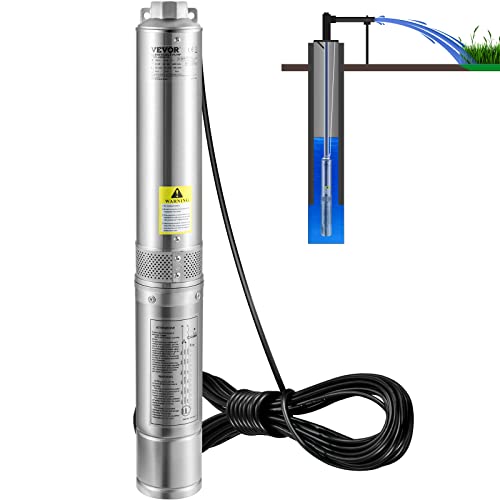
A 2 HP step up that reaches 427 feet down for the wells the 1.5 HP units cannot serve.
Here is the honest caveat before the specs: this is a 2 HP pump, not a 1.5 HP unit, so it sits above the strict power class the rest of this list covers. Buyers reach for it anyway because the 427-foot maximum head beats every 1.5 HP submersible here, including the 276-foot VEVOR siblings — that is 151 more feet of lift, and it’s the number that decides whether a very deep well can be served at all. Like its smaller siblings it uses stainless steel throughout, runs on 230V, moves 37 GPM, and carries an IP68 waterproof grade on a 4-inch body with a 33-foot cord.
The increase in lift comes from 12-stage thermoplastic impellers pushing the water through more stages than the 8-stage 1.5 HP units, all driven by a copper motor with built-in overheat protection. Owners put it to work on deep wells: one describes running it on a 400 to 500-foot well and staying satisfied, and another reports it filling a 2,200-gallon tank in about 10 hours. That’s reliability and performance doing the talking in the review pages, with a few buyers calling it a bargain against a plumber’s alternative.
What to weigh is the value split. Some buyers consider it a great deal; a few advise caution, largely tied to the same warranty turnaround that shows up with the brand’s other submersibles. And because it’s a 2 HP 230V pump, confirm your well’s flow rate and your breaker can handle the draw before you buy — overpowering a low-yield well just churns water. If your well comfortably feeds a 2 HP, this is the deep-reach pick.
Where it beats its siblings: 427 feet of head versus the 276 feet on the 1.5 HP VEVOR units — a deep-well-only advantage that no amount of flow-rate tuning can substitute.
Note: this is a 2 HP pump listed as the deep-well step-up, not a 1.5 HP unit.
Right for: owners of very deep wells who need more head than any 1.5 HP here can deliver and can supply 230V at the wellhead.
Not for: a shallow or low-yield well — this pump is sized for depth, not for gently lifting water a short way.
6. Star JHU15S High Pressure 1-1/2 HP Shallow Well Jet Pump

An above-ground cast-iron jet pump built to push pressure, made in the USA from majority US content.
Where the submersibles on this list hang underwater, the Star JHU15S stays on the surface and pushes from above. Its headline number is the flow — up to approximately 50 GPM and pressures up to 80 PSI, which is enough to feed several household fixtures or sprinkler zones at once. That 50 GPM is far beyond the 12 GPM of the Red Lion submersible and the 22.3 GPM of the FOTING jet pump, so if raw volume through multiple taps is the goal, this is where the flow lives. It uses a 115/230V uni-frame 56 motor with capacitor start for strong starting torque.
The build is cast iron with a carbon/ceramic mechanical shaft seal for corrosion resistance, and the motor carries thermal overload protection so it can survive continuous-duty running without cooking itself. It arrives ready to plumb: ejector, pressure switch, and a priming port are all included, and an accessible drain plug makes seasonal winterizing and routine servicing easy. Above-ground placement means no hoisting it back up a casing when it needs attention — a genuine advantage over any submersible here.
The ceiling to respect is the 25-foot maximum lifting height. This pump pulls water up by suction, so it only works when your water level sits shallow — well within that 25-foot window. If your water table drops in dry season and pushes past that line, the pump loses prime. Keep it for genuinely shallow wells and above-ground boosting, and lean on the easy drain plug to winterize it properly.
What it does well
- Up to ~50 GPM flow and up to 80 PSI for multiple fixtures or zones
- Cast-iron body with carbon/ceramic shaft seal resists corrosion
- Includes ejector, pressure switch, and priming port for quick setup
- Drain plug makes winterizing and servicing simple
Where it stops
- 25-foot maximum lift suits only shallow wells and above-ground boosting
- Above-ground jet pumps need a prime before each start
- Positioning and plumbing matter — spot it as close to the water as the install allows
The fit: a shallow well or booster setup where you want high flow through many fixtures and easy surface access for service.
The miss: any deep drilled well — a pump that lifts only 25 feet can’t reach water that sits further down.
7. Red Lion RL12G15-3W2V Submersible Well Pump, 1-1/2 HP, 3-Wire, 230V
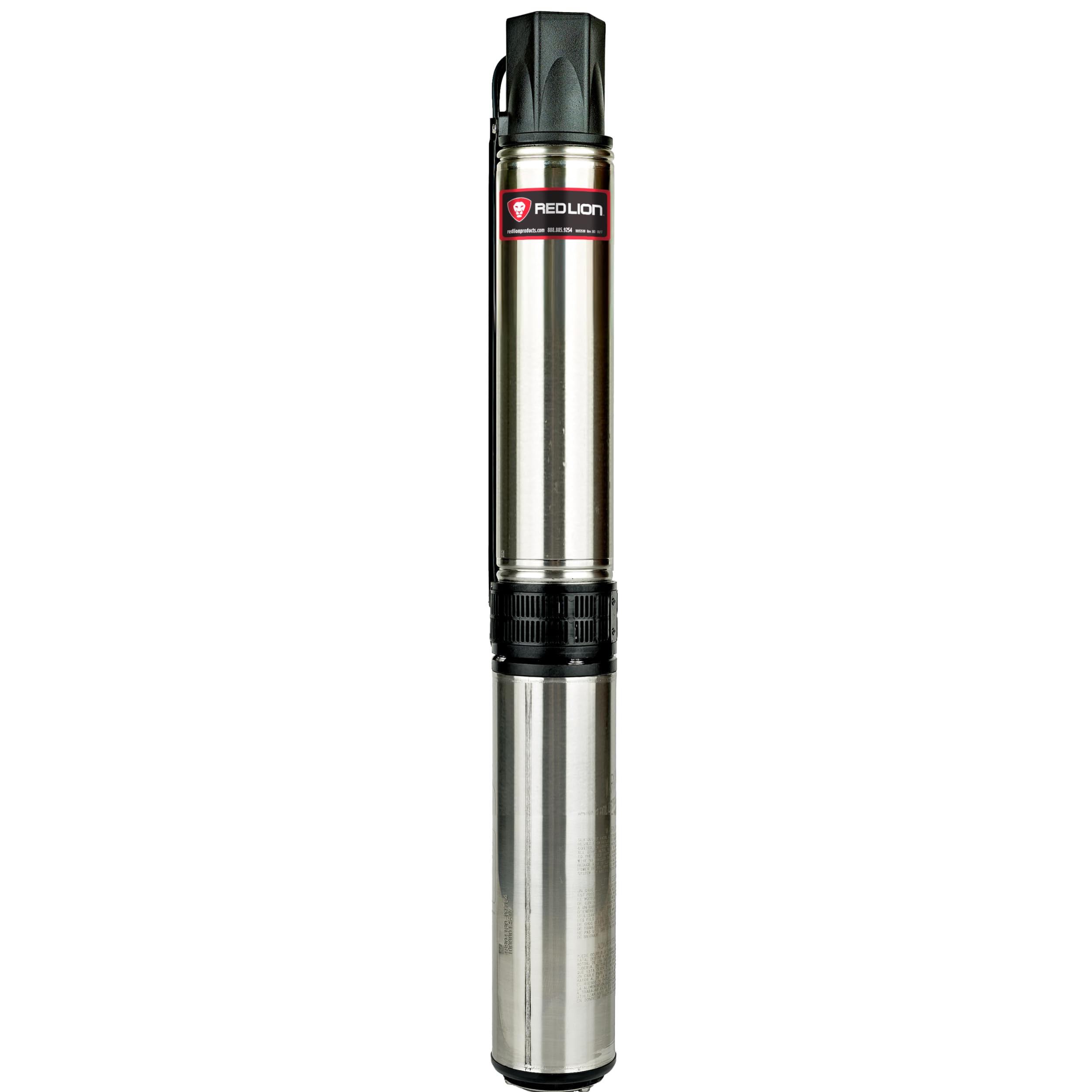
A stainless-steel submersible tuned for steady 12 GPM delivery from a deep well.
This Red Lion trades big flow for controlled, deep delivery. Where the VEVOR submersibles move 37 GPM, the Red Lion is rated to deliver 12 GPM at a depth of 240 feet, and it has a 548-foot shut-off. So it is not about how much water arrives per minute — it is about pulling steadily from a deep well without straining. It runs on 230V, uses stainless steel with a thermoplastic discharge and motor bracket, fits 4-inch or larger driven wells, and it is NSF/ANSI 372 certified for potable water. Built-in check valve and suction screen are included.
One detail you must read before ordering: the control box is not included — you have to buy the matching Red Lion box separately to run this 3-wire motor. Owners who sorted that out report strong results: it wired up with a new control box and delivered ample pressure, and one went so far as to note that the same-spec pump from a local company would have cost a multiple of what they paid. It carries a 3-year manufacturer warranty.
Set expectations on lifespan honestly. This is a pump with mixed durability feedback — a few customers note shorter service than they expected and a cover-only partial credit when a unit failed within the first year, while others have it pumping fine from deep wells. Its NSF/ANSI 372 potable-water rating and built-in check valve suit a clean, well-maintained deep well, but keep your receipt in case a service call is needed.
The takeaway: 12 GPM from 240 feet of depth on 230V and NSF/ANSI 372 potable-water certification, with a spare control box a smart purchase since it ships separately.
Pick this one for: a clean, certified deep well where steady moderate flow matters more than maximum GPM, and you’re ready to source the matching control box.
Steer away if: you want everything in one box or need the short-term reliability guarantee this pump’s mixed record can’t give you.
Understanding the Specs
Head (Maximum Lifting Height)
Head is the highest point a pump can lift water to, measured in feet. A unit rated for 276 feet of head can keep pushing water up a 225-foot well with room to spare. A shallow-well jet pump that tops out at 25 feet cannot reach water that sits lower than that — the number dictates which wells a pump can serve at all. Deep wells need hundreds of feet of head; above-ground boosting and shallow suction need far less.
Flow Rate (GPM)
Flow rate is how many gallons the pump moves per minute, written as GPM or GPH (gallons per hour). A sprinkler zone and a whole house pull very different volumes, so a high-head pump with modest GPM can still be the right choice for a deep well, while a shallow-well unit with high GPM suits wide coverage through many fixtures. Match the GPM rating to how many taps or sprinkler heads run at once.
Voltage And Wiring
Deep-well submersibles here mostly run on 230V, while some models run on 115V. A 3-wire submersible needs an external control box to start the motor — and that box is sometimes sold separately, so check the included-components list before ordering. A 2-wire pump runs directly. Confirm what your breaker and wellhead wiring can supply before you pick, because the wrong voltage means rewiring or a return.
Submersible Vs Jet Pump
A submersible hangs underwater inside the casing and pushes water upward — the standard choice for deep drilled wells, and most need 4-inch or larger casing. A jet pump sits above ground and pulls water up through suction, so it works only when the water level is shallow. Above-ground placement makes jet pumps easier to service and winterize; submersibles handle depth and stay out of sight.
FAQ
Do I need a submersible or a shallow well jet pump?
Will a 1 1/2 HP well pump run my whole house?
What is the difference between 115V and 230V well pumps?
What does the maximum head figure mean for a well pump?
Does a submersible well pump need a control box?
How deep can a 1 1/2 HP well pump sit in the well?
Do I need a pressure tank with a submersible pump?
Can a well pump run dry and burn out?
What GPM do I need for a household and irrigation?
How long should a 1 1/2 HP well pump last?
Final Thoughts: The Verdict
For most homes on a shallow well or doing household boosting, the 1 1/2 hp well pump winner is the STA-Rite SNF-L — its quiet running, 115/220V flexibility, and cast-iron build make it the safest long-term bet for feeding sprinkler zones and house taps. If you need real deep-well head and want the most head for the money, the VEVOR 230V submersible delivers 276 feet and 37 GPM in stainless steel, while the 115V version covers anyone without a 230V circuit. On the rare well deeper than 400 feet, step up to the VEVOR 2 HP for its 427-foot reach. And if you value full-cycle pass-through plumbing above all, the Star JHU15S with its 50 GPM flow and easy surface access is the one to grab.
How We Picked
We do not accept paid placement. Every pick is matched to a real buyer and a real use-case; we do not hands-on test units.
Sources & Methodology
Specifications: manufacturer listings and product documentation. Review insights: verified customer reviews, as of September 2026. Pricing: not shown on this page (it changes often); check the current price via the retailer link.
As an Amazon Associate, KitchPrep earns from qualifying purchases. This does not affect which products we feature.
Related Guides
