
Specs are compiled from manufacturer listings and verified buyer reviews and can change over time — please confirm the key details on the product page before buying.
A battery backup surge protector is the difference between calmly saving your work during a blackout and losing everything to a sudden power cut. It acts as a bridge, giving your computer, router, and modem a few precious minutes of power so you can shut down safely. This guide breaks down the best options by capacity, runtime, and the real-world experiences of thousands of owners, so you can match a unit to your actual setup.
I’m Mohammad Maruf — the founder and writer behind KitchPrep. This guide is built by comparing the manufacturers’ published specifications and the patterns across verified customer reviews, so you get each pick’s real strengths and trade-offs instead of marketing spin.
If you are tired of losing progress or connectivity when the power flickers, find the right battery backup surge protector by focusing on battery capacity, the number of backup outlets, and power output that fits your devices.
Our Picks at a Glance


How To Choose The Best Battery Backup Surge Protector
Before you pick a battery backup (a UPS, or uninterruptible power supply, which keeps your gear running during an outage), ask yourself three things: how much power your devices draw, how long you need them to stay on, and which items actually need battery power versus just surge protection. Answer those, and the right model becomes clear.
Match the Wattage to Your Real Load
The watt rating (like 360W or 810W) tells you the maximum power the unit can deliver on battery. Add up what you plan to plug into the battery outlets — a typical desktop PC might draw 200-400W, while a router and modem together often stay under 50W. If your gear exceeds the rating, the unit will overload and shut down.
Count Battery Outlets, Not Just Total Outlets
Every UPS has two outlet types. Battery backup outlets keep devices running during an outage. Surge-only outlets just protect against spikes but go dead when the power goes out. A good rule is to put your computer and router on battery outlets, and printers or monitors on the surge-only ones.
Consider AVR and Waveform for Sensitive Gear
Automatic Voltage Regulation (AVR) corrects small dips and surges in power without draining the battery, which extends its life. For modern computers with active PFC power supplies, a pure sine wave output is safer than simulated sine wave, as it mimics clean utility power.
Quick Comparison
| Model | Best For | Capacity | Power Output | Total Outlets | Amazon |
|---|---|---|---|---|---|
| APC 850VA/510W Pro★ Best Overall | Home office PCs | 850VA | 510W | 8 | Amazon |
| SKE VL425 425VA/240WCompact Pick | Compact low-power setups | 425VA | 240W | 7 | Amazon |
| SKE 600VA/360WBudget Champion | Budget PC protection | 600VA | 360W | 6 | Amazon |
| Eaton Tripp Lite AVR750U | Wall-mount flexibility | 750VA | 450W | 12 | Amazon |
| CyberPower AVRG900LCD | Whole-desk coverage | 900VA | 480W | 12 | Amazon |
| CyberPower CP850PFCLCD | Pure sine wave value | 850VA | 510W | 10 | Amazon |
| GOLDENMATE 1000VA/600W | Long-term investment | 1000VA | 600W | 8 | Amazon |
| APC BR1350MS | Heavy home office | 1350VA | 810W | 10 | Amazon |
| Eaton Tripp Lite OMNI1500LCDT | Big rigs and servers | 1500VA | 810W | 10 | Amazon |
In-Depth Reviews
1. APC 850VA/510W Pro UPS
Our pick — over 4.5★ from 750+ verified ratings; the strongest balance of quality and price.
The household name in backup power that blends real lightning protection with a user-friendly LCD.
The APC 850VA/510W Pro is the benchmark for a reason. It delivers over 29 minutes of backup runtime at a 100W load., which is plenty for a desktop PC and modem to save work and shut down cleanly. With 4 battery backup outlets and 4 surge-only outlets, you can keep your computer on the battery while parking peripherals on surge protection alone.
Its Automatic Voltage Regulation (AVR) corrects brownouts starting at 88V and trims surges of +/-13% without draining the battery, so your gear sees a stable 120V. The unit also protects coaxial and Ethernet lines, which proved critical for one owner: as buyers report, the APC Back-UPS Pro protected a PC from a lightning strike that fried a modem and router via coax. A user-replaceable battery (RBC17) and ENERGY STAR efficiency round out a package that simply works.
Crowd favorites note the beeping is informative rather than annoying, and the PowerChute software enables auto-shutdown. The most common gripe involves support turnaround times for warranty claims, not the unit’s daily performance. If you want a dependable, well-supported backup for a standard home office, this is it.
Why It Wins
- 29+ minutes runtime at 100W load
- 4 battery + 4 surge-only outlets
- Built-in coax and Ethernet protection
The Trade-offs
- Support can be slow for replacements
- Battery terminal setup isn’t everyone’s favorite
Your best bet if: you run a desktop PC and networking gear and want proven, balanced protection from a brand owners trust for years.
Think twice if: you need prolonged runtime for heavy loads; this is built for safe shutdowns, not extended use.
2. SKE VL425 425VA/240W UPS
A space-saving tower that quietly guards low-power gear and even charges your phone mid-outage.
The SKE VL425 is a compact 425VA/240W unit aimed squarely at routers, modems, and light computer setups. Its defining trick is the integrated USB and Type-C charging ports, so you can top up a phone or tablet without burning a battery backup outlet. With 5 battery backup outlets and 2 surge-only, it ranks 25% more battery outlets than the APC 850VA model above — useful when you have several small devices to keep alive.
Buyers found it economical and space-efficient, with one using it to power a motorized recliner during an outage so they could exit safely. Another runs a PC, two monitors, and external storage from it comfortably. The AVR stabilizes voltage fluctuations, though as a compact unit it’s not made for extended runtime — its 240W output is a fraction of the 510W the APC delivers.
The main criticism is outlet spacing: plugs sit side-by-side and close together, making it hard to fit larger block adapters. One unlucky owner reported a unit that stopped holding a charge after a day. For low-power network gear and brief power blips, this is a great fit; for sustained blackouts, it will leave you waiting.
Standout Features
- USB and Type-C charging built in
- 5 battery outlets in a compact tower
- Quiet operation
Know Before Buying
- Outlets are too close for bulky plugs
- Not for extended runtime needs
Reach for this if: you need a small, quiet UPS for networking gear in a tight home office and want extra charging ports.
Look elsewhere if: you expect it to run a full desktop through long outages; its 240W rating is for light duty.
3. SKE 600VA/360W UPS
An LCD-equipped workhorse that guards your PC and router without emptying your wallet.
The SKE 600VA/360W strikes a strong value balance for a single desktop setup. Its multifunction intelligent LCD shows input voltage, output voltage, battery capacity, and load capacity in real time, and it auto-extinguishes the screen after 30 seconds to save power. With 6 battery backup outlets and 2 surge-only, it gives you more battery outlets than the APC 850VA’s 4, though less total capacity at 360W versus 510W.
Owners mention reliable surge and outage protection for a PC and router for 18+ months, with the battery cheap and easy to replace when runtime declines. The free management software enables unattended system shutdown and sends text or email outage alerts, a feature buyers genuinely valued. The built-in cooling fan handles high-power demands that smaller units can’t.
The honest caveat is capacity: some owners find 360W just enough for their rig, while others hit the ceiling quickly. A recurring note is that the battery runtime declines after a year or so, but the ~ replacement cost keeps it a budget-friendly proposition over time.
What Shines
- Informative LCD with auto-dim
- Free software with outage alerts
- Cheap, easy battery replacement
Where It’s Limited
- 360W max output for bigger rigs
- Battery life declines after ~18 months
Smart pick for: budget-conscious owners wanting real-time monitoring and alert features on a standard PC and router setup.
Not ideal for: high-wattage gaming systems or servers that need more than 360W of headroom.
4. Eaton Tripp Lite AVR750U 750VA UPS

A wall-mountable powerhouse with six battery outlets and a three-year warranty that backs it up.
The Eaton Tripp Lite AVR750U is a 750VA/450W UPS that stands out for its sheer outlet count: 12 total, with 6 on battery backup and 6 surge-only. That makes it a superb fit for a desk littered with monitors, a modem, a router, and a hub. Its compact form factor includes bottom mounting tabs, so you can bolt it under a desk or on a wall to keep it out of the way.
The AVR corrects input voltages between 89V and 145V without dipping into battery, extending battery life. Owners describe it as quiet and effective — one used it to keep a video call running through a 2-second surge, while another reported about 2 hours of runtime on a modem, router, and hub setup. A USB port connects to PowerAlert software for safe unattended shutdown.
The mixed feedback centers on longevity: some units lasted 4 years on a single battery, while others failed after 8 months or, in one frustrating case, at 12 months with warranty issues. The connected equipment insurance and 3-year warranty are reassuring, but treat it as a solid choice rather than a gamble-proof one.
Why It’s Flexible
- 12 outlets: 6 battery + 6 surge
- Wall-mount design saves desk space
- 3-year warranty + K insurance
Watch For
- Battery life varies; some fail under a year
- Heavier and larger than expected
Grab this if: you have many peripherals to protect and want the flexibility of wall mounting or a compact footprint.
Pause if: consistency matters most — a few owners hit early battery failures, so warranty terms are worth checking.
5. CyberPower AVRG900LCD Intelligent LCD UPS

Twelve staggered outlets and a clearly labeled LCD make this the easiest desk-wide protector to live with.
The CyberPower AVRG900LCD packs a 900VA/480W punch with 12 NEMA outlets — six on battery backup and six surge-only. Its smartest design choice is staggered ports, which accommodate large block plugs without wasting adjacent outlets. The input plug uses a right-angle, 45-degree offset with a five-foot cord, so it tucks neatly against the wall.
Owners consistently praise the free PowerPanel Management Software, noting it works with Linux for auto-shutdown and beats the included manual for setup guidance. One measured 62 minutes of runtime at a 72W load with auto-shutdown at 5 minutes. The AVR corrects minor fluctuations without switching to battery, and the unit is UL safety certified with a 3-year warranty including the battery, plus a connected equipment guarantee.
The main complaints are a bright LCD that some find distracting and frequent beeping when on battery. A rare unit arrived dead on arrival, though tech support responded and shipped a replacement after battery tests. For a full desk of gear with an informative display, this is a top contender that some owners even prefer to APC.
Its Strengths
- 12 outlets with staggered spacing
- Free feature-rich management software
- UL certified with 3-year warranty
Its Quirks
- Bright LCD may annoy in dark rooms
- Frequent beeping on battery power
Choose this when: you want room for lots of adapters and a detailed LCD monitoring your power in real time.
skip it if: a bright glowing screen or audible beeps in a bedroom or media room would drive you crazy.
6. CyberPower CP850PFCLCD PFC Sinewave UPS

Pure sine wave output for modern PFC power supplies, wrapped in a nine-year track record.
The CyberPower CP850PFCLCD is an 850VA/510W UPS designed explicitly for active PFC and conventional power supplies, meaning it won’t randomly reset your gaming PC or workstation. Its pure sine wave output mimics utility electricity, which keeps sensitive components running cooler and longer. With 10 outlets (5 battery + 5 surge), it covers a serious multi-device setup including coax, modems, routers, and NAS boxes.
The color LCD tilts up to 22 degrees and shows real-time battery and power conditions, alerting you to issues before they cause downtime. Customers note impressive longevity — One owner ran it for 9 years through hundreds of outages., replacing the battery. Another handled 8 outages in 2 months flawlessly, with 45 minutes of runtime at server load and 140 minutes on a modem and router alone.
The standout caveat is generator compatibility: one owner found it toggled rapidly between battery and utility with a 14kW diesel generator despite low sensitivity settings. The 3-year warranty covering the battery and connected equipment guarantee are strong. For a pure sine wave at a reasonable tier, this is a favorite among IT folks.
Why It’s A Favorite
- Pure sine wave protects PFC supplies
- Proven 9-year lifespan in reviews
- Tilting color LCD for easy viewing
Keep In Mind
- May misbehave with some generators
- Power bricks need short cables
Perfect for: owners of modern PFC-equipped PCs and larger network setups who want clean, reliable sine wave power.
Be cautious if: you rely on a generator during long outages — test compatibility before committing fully.
7. GOLDENMATE 1000VA/600W Lithium UPS

A lithium-powered tower that It promises a decade of service. and outlasts any lead-acid rival.
The GOLDENMATE 1000VA/600W is the head-turner of this list, swapping traditional lead-acid for a Lithium Iron Phosphate (LiFePO4) battery Its LiFePO4 battery is rated for over 10 years and 5000+ charge cycles.. The maker claims it cuts total cost of ownership by over 40% versus lead-acid., and the math is easy to believe given most lead-acid UPS batteries die in 2-4 years. Its pure sine wave output supports computers, workstations, and network gear.
Owners rave about the light, compact build versus clunky lead-acid units. One measured about 3 hours of runtime at a 185W load after 6 months of use, and another got over 40 minutes at just 22W with more than 90% battery remaining. The intelligent LCD shows real-time battery and power conditions, and a low-noise cooling fan stays under 50 dB, kicking in only during heavy battery usage.
The trade-offs are real: the battery is not user-replaceable, there’s no USB or network shutdown port, and there’s no AVR or surge rating listed. Battery life and power output draw mixed feedback, with some finding 600W limiting. If you want a set-and-forget unit for a light office that won’t need battery swaps, this is compelling, though its 20ms switchover risk makes it less ideal for critical computers.
The Lithium Advantage
- 10+ year battery lifespan
- Much lighter than lead-acid units
- Pure sine wave output
Honest Limits
- Battery is not replaceable
- No USB shutdown or AVR
Ideal for: anyone tired of swapping lead-acid batteries every few years and willing to invest upfront for a decade of backup.
Avoid if: you need automatic shutdown software or AVR for unstable power; this is a simpler, standalone protector.
8. APC 1350VA/810W Pure Sine Wave UPS
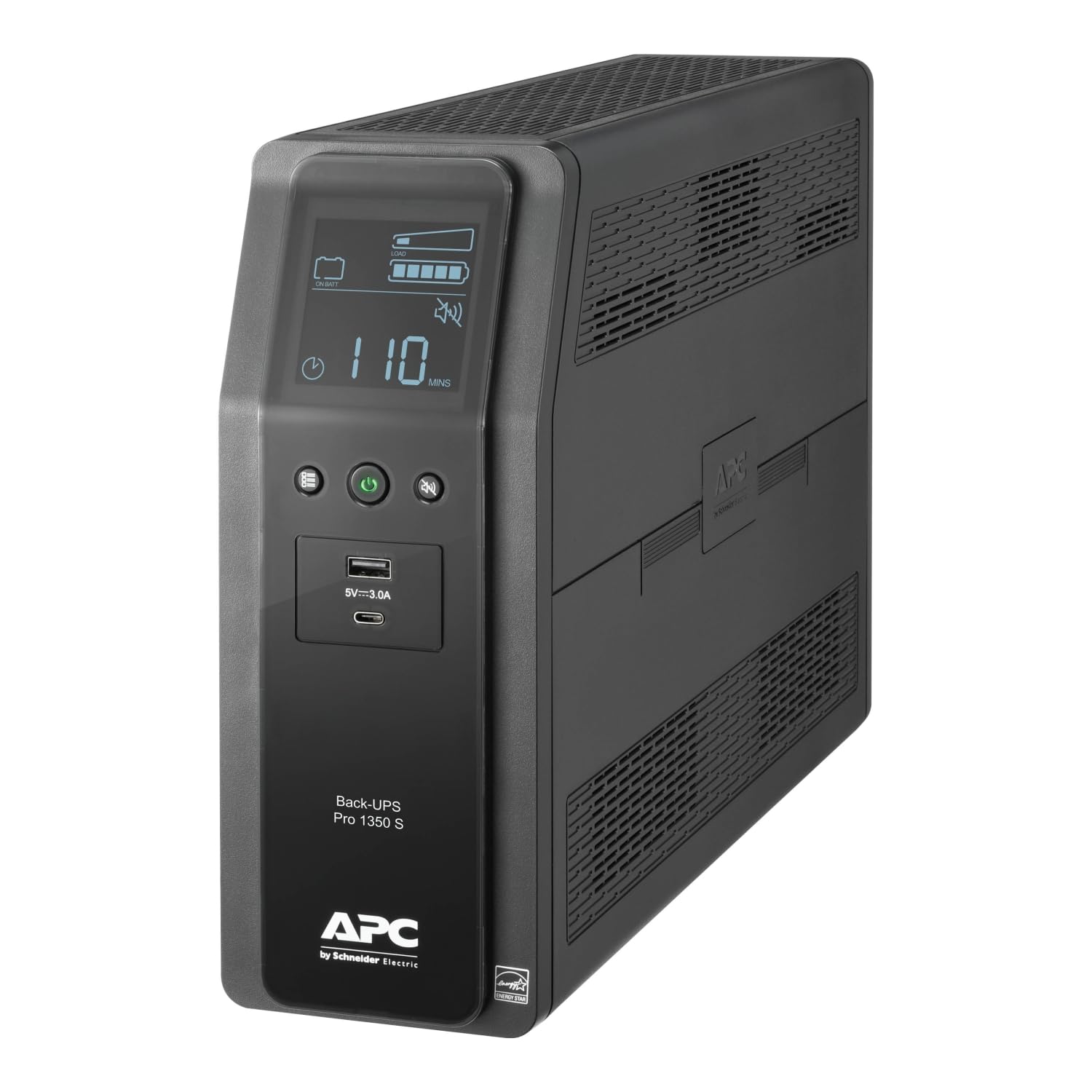
A metal-bodied juggernaut with true sine wave power and USB-C charging for a serious home office.
The APC BR1350MS is the workhorse for setups that can’t afford an interruption. At 1350VA/810W, it provides up to 54 minutes of runtime at a 100W load, which owners translate into 45-60 minutes of real office tasks. It boasts 10 outlets (6 battery + 4 surge) plus built-in coaxial and Ethernet protection, wrapping your whole rig in one safety net.
The metal enclosure runs silently, and the angled LCD gives you real-time wattage and remaining runtime from a seated position. Its built-in USB-C and USB-A ports (5V/3A shared) deliver fast charging for phones and tablets without needing an adapter. Owners with 20+ years of experience report it offers faster response and better surge protection than rivals, with one crediting it for surviving a storm that damaged a TV on another brand.
The pure sine wave output makes it Active PFC compatible, protecting expensive modern power supplies. The main drawbacks are the heavy lead-acid battery and occasional out-of-box failures, though APC’s warranty support drew high praise for replacing a bad battery in 3 days without shipping. Battery charge time runs 16 hours, so plan accordingly after a full discharge.
Its Power
- 54 minutes at 100W load
- Metal body runs cool and quiet
- USB-C and USB-A fast charging
Its Weight
- Heavy lead-acid battery
- 16-hour recharge time
Reach for this if: you have expensive PCs or multiple devices that demand clean power and long backup windows.
Think twice if: you’re on a budget or hate heavy equipment; the premium price and bulk reflect its power.
9. Eaton Tripp Lite OMNI1500LCDT 1500VA UPS

A 1500VA giant that keeps your internet and phone running for hours when the grid goes dark.
The Eaton Tripp Lite OMNI1500LCDT is the biggest unit here at 1500VA/810W with 10 outlets, all providing battery backup and surge protection. It’s the go-to for small servers, gaming consoles, and workstations where staying online matters. The six-foot extension cord and 650 joules of surge protection make it a serious shield for your entire desk.
Reviewers point out exceptional longevity — One owner powered a modem, NAS, and switch for hours on a 5-year-old battery during a January 2026 outage.. Another supports two monitors plus a modem and router with no interruptions even in 5-minute outages. The LCD displays runtime, wattage load, overload, AVR status, input voltage, and battery state, so you always know what’s happening.
The AVR corrects brownouts and overvoltages between 92V and 150V back to a safe 120V without touching the battery. One owner praised it as a great cheaper alternative to premium brands, though the software drew harsh criticism for being difficult to discover devices. The bright display may also be too intense for dark rooms. At 7.5-minute average battery life at full load, it’s built for graceful shutdowns and short blips, not extended off-grid work.
Its Strengths
- Huge 1500VA capacity for big rigs
- Long battery life at light loads
- LCD shows complete power stats
Its Drawbacks
- Software is frustrating to use
- Bright display may bother some
Best for: owners of multiple high-power devices or small servers who need maximum capacity and reliable protection.
Not for: anyone who wants polished software or a subtle display; this is pure hardware muscle.
Understanding the Specs
VA vs. Watts
Volt-Amps (VA) measures the apparent power a UPS can handle, while watts measure the real power your devices actually draw. The watt rating that matters for sizing your gear together. A 850VA unit with 510W means the battery can realistically deliver 510 watts, so add up your devices’ wattage to ensure you stay under that ceiling.
Backup Runtime
Runtime is how long the UPS can power your gear once the grid fails, and it depends entirely on the load. A unit rated for 29 minutes at a 100W load will last much longer powering just a router and modem, which often draw under 50W combined. The lighter the load, the longer the battery lasts.
Automatic Voltage Regulation
AVR (Automatic Voltage Regulation) smooths out minor voltage dips and spikes without switching to battery power. This matters because brownouts and small surges can stress your electronics even when the power doesn’t fully go out. A good AVR corrects voltages within a wide range, extending both your gear’s life and the UPS battery’s lifespan.
Pure Sine Wave vs. Simulated
Pure sine wave output mimics the clean electricity from your wall outlet, which is essential for modern computers with Active PFC power supplies. Simulated or stepped sine wave can cause some PFC power supplies to shut down unexpectedly. If you own a newer gaming PC or workstation, pure sine wave is the safer bet.
FAQ
How much battery backup do I need for my computer?
How long will a UPS run during a power outage?
Can I use a battery backup surge protector with a generator?
How long does a UPS battery last before replacement?
Is pure sine wave worth the extra cost?
How many outlets should a UPS have?
What is AVR and do I need it?
Can a UPS protect against lightning strikes?
Will outlets spaced too closely block each other?
Should I plug my whole desk into one UPS?
Final Thoughts: The Verdict
For most buyers, the battery backup surge protector winner is the APC 850VA/510W Pro because it blends proven lightning protection, 29+ minutes of runtime, and a user-friendly LCD into one dependable package. If you want a pure sine wave for modern PFC power supplies, grab the CyberPower CP850PFCLCD. And for maximum capacity to cover a small server or a serious gaming setup, the Eaton Tripp Lite OMNI1500LCDT is the one to reach for.
How We Picked
We do not accept paid placement. Every pick is matched to a real buyer and a real use-case; we do not hands-on test units.
Sources & Methodology
Specifications: manufacturer listings and product documentation. Review insights: verified customer reviews, as of August 2026. Pricing: not shown on this page (it changes often); check the current price via the retailer link.
As an Amazon Associate, KitchPrep earns from qualifying purchases. This does not affect which products we feature.
Related Guides
