
Specs are compiled from manufacturer listings and verified buyer reviews and can change over time — please confirm the key details on the product page before buying.
Nothing kills a backyard cookout faster than a grill that won’t stay hot. When flames go weak or the burner won’t light, the hose and regulator are often the real culprit hiding behind a bad tank connection. This guide cuts straight to the eight best replacements that fit the most common grills, fire pits, and camp stoves, so you can get back to cooking without guessing which part you need.
I’m Mohammad Maruf — the founder and writer behind KitchPrep. This guide is built by comparing the manufacturers’ published specifications and the patterns across verified customer reviews, so you get each pick’s real strengths and trade-offs instead of marketing spin.
Whether yours is a Weber, a Char-Broil, or a Blackstone griddle, finding a reliable bbq grill propane hose with the right length and fitting type saves you a frustrating trip back to the store.
Our Picks at a Glance


How To Choose The Best BBQ Grill Propane Hose
Not every hose fits every grill. Matching the connector type, length, and safety features to your specific appliance is the only way to avoid leaks and weak gas flow. Here are the three factors that matter most.
Fitting Type and Compatibility
The most common setup on standard grills is a 3/8-inch male flare fitting that screws into a 3/8-inch female flare nut on the hose. The tank side uses a QCC1 or Type-1 connection with a black plastic hand wheel that twists onto the propane cylinder. Before buying, flip your grill over and check whether the gas inlet is a threaded brass port with a flared end. If yours uses a different connector, like a smaller 1-inch fitting found on some portable grills, you will need an adapter or a different hose.
Hose Length and Tank Placement
A typical replacement measures 2, 4, or 6 feet. A shorter 2-foot hose keeps the tank close to the grill, which works for compact patio setups but can make swapping a full tank awkward. A 4-foot hose gives you breathing room to hide the tank behind a cabinet or under a table. Longer 6-foot or 24-foot extensions let you place the grill well away from the house for safety. Measure your current setup from the tank valve to the grill inlet and add a foot of slack so the hose is never pulled tight.
Safety Features and Build Quality
Look for a regulator with excess flow protection — a safety valve that automatically cuts gas if the hose ruptures. The outlet pressure should be 11 inches water column (11″ W.C.), which is the standard for low-pressure propane grills. A three-layer hose (PVC, nylon thread, and rubber) resists weather cracking and leaks better than a single-wall rubber tube. Solid brass fittings resist corrosion far longer than plated steel, and a CSA or ETL certification confirms the unit passed a third-party safety test.
Quick Comparison
| Model | Best For | Length | Outlet Pressure | Hose Material | Amazon |
|---|---|---|---|---|---|
| GrillAce 2-ft★ Best Overall | Weber/Charbroil Replacements | 2 ft | 11″ W.C. | 3-layer PVC/Rubber | Amazon |
| ABYDA 4-ftTop Performer | Large 5-Burner Grills | 4 ft | 11″ W.C. | 3-layer Weather-Resistant | Amazon |
| CALPOSE 6-ftBest for Blackstone | Blackstone Griddles | 6 ft | 11″ W.C. | Weatherproof Rubber | Amazon |
| Stanbroil 4-ft | High-BTU Fire Pits | 4 ft | Low Pressure | Solid Brass | Amazon |
| BeeGo 4-ft Adapter | Portable Stoves & Heaters | 4 ft | N/A (High-Press.) | SS Braid / Rubber | Amazon |
| CALPOSE 2-ft w/ Gauge | Seeing Fuel Level | 2 ft | 11″ W.C. | Weatherproof Rubber | Amazon |
| ATKKE 3-ft w/ Gauge | Universal Fit + Gauge | 3 ft | 11″ W.C. | Rubber / Brass | Amazon |
| Samplife 24-ft Ext. | RV & Long-Reach Setups | 24 ft | 350 PSI | Braided SS / Rubber | Amazon |
In‑Depth Reviews
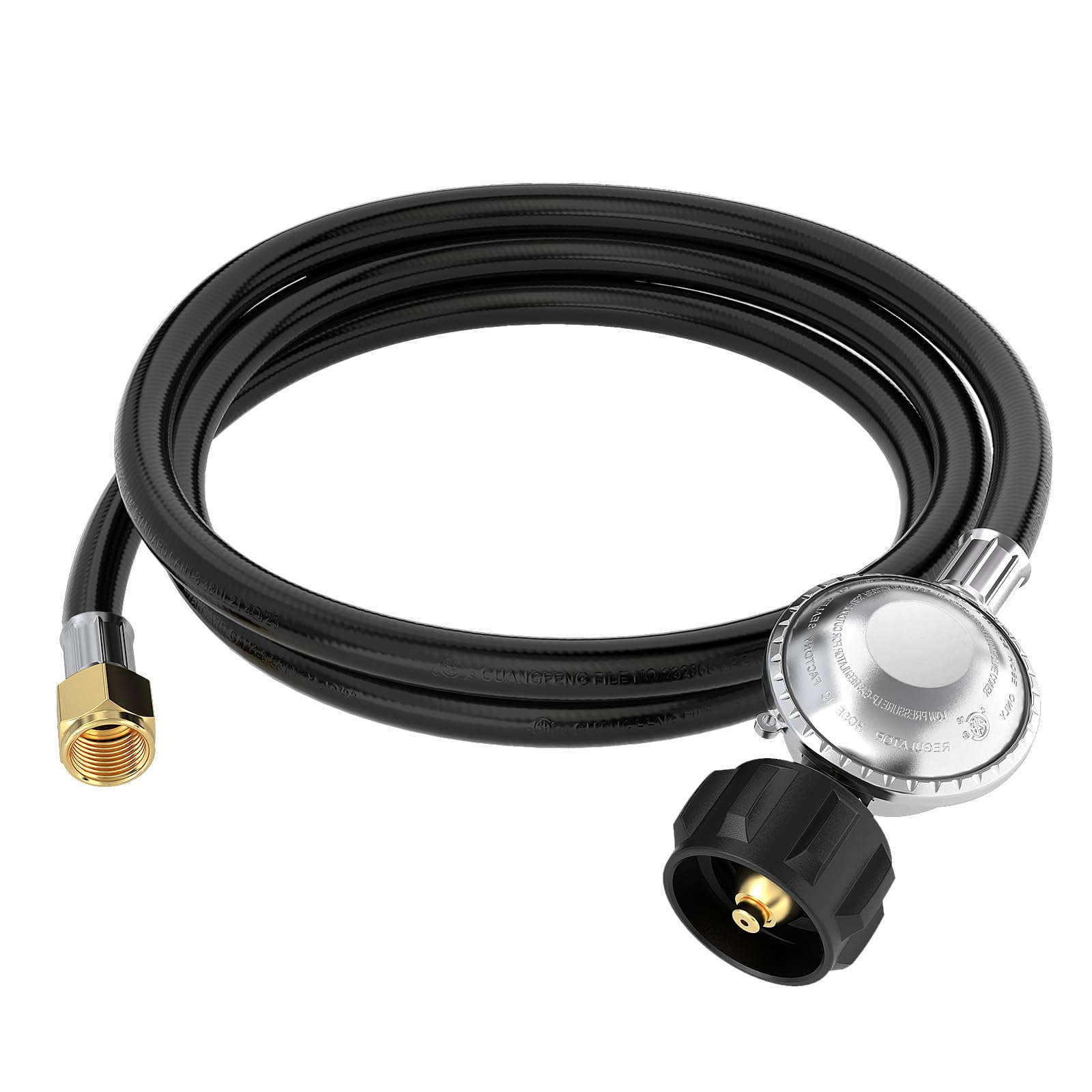
1. GrillAce 2-ft Propane Gas Regulator and Hose
Our pick — over 4.5★ from 950+ verified ratings; the strongest balance of quality and price.
The 2-foot direct-fit hose restores full flame to a failing Weber burner.
This is the crowd favorite for a reason — owners consistently praise it as the easiest swap they have ever made. The 2-foot length keeps the tank tucked right beside the grill, and the 11″ W.C. outlet pressure feeds a steady flame that buyers report “brought burners back to life.” It connects to any QCC1 tank and uses a standard 3/8-inch female flare fitting with a 5/8-18 UNF thread, which covers Weber Genesis 300-series grills, Char-Broil, Nexgrill, and most patio heaters without a second trip to the hardware store.
The three-layer hose (PVC, nylon sewing thread, and rubber) shrugs off weather far better than a basic single-wall tube. Excess flow protection shuts the gas down automatically if the line gets cut. At just 24 inches long, this is the shortest option in the lineup, so plan for the tank to sit directly under or beside the grill — there is no slack for hiding it behind a planter. The hose length drew mixed reactions; some wanted a foot more to reach the tank on a wider cart.
What wins people over
- Boasts the highest satisfaction for simple hook-up and direct fit on Weber/Char-Broil grills
- Excess flow safety valve automatically cuts gas if the hose ruptures
- Priced competitively and widely considered a fantastic value
The honest trade-off
- At 2 feet, the tank must sit very close to the grill — not ideal for larger cart setups
- A minority of buyers reported leakage issues, underscoring the need for a soapy water test on installation
Reach for this if: you own a standard Weber or Char-Broil and want a straight swap that installs in under 10 minutes.
Think twice if: you need extra hose length to place the tank out of sight or farther from the flame.
2. ABYDA 4-ft Propane Regulator and Adapter Hose
The 4-foot hose revived a 5-burner grill from persistent low-flame issues.
Where the 2-foot GrillAce is best for compact grills, this 4-foot ABYDA gives you the extra reach to tuck the tank behind a cabinet leg or under a side shelf. It covers the same universal fittings — QCC1 tank to 3/8-inch female flare — and owners mention that installing it on a large 5-burner grill immediately restored gas flow, pushing the temperature from 250°F to 450°F quickly. Unlike the shorter options, this length saves you from crouching around an awkwardly placed cylinder.
The three-layer weather-resistant hose and solid brass fittings aim for longevity, and the CSA certification backs up the safety claims. The regulator is rated for an inlet pressure of 25-250 PSI and outputs the standard 11″ W.C. Several owners called it “well made and worth it,” especially for the price relative to big-box store alternatives. A small number flagged leakage at the tank gasket, which the manufacturer addresses in a tip: check the tank gasket for cracks and ensure the regulator enters the cylinder valve in a straight line.
The standout spec: restored grill temperature from 250°F to 450°F after installation, per buyer reports, making this a strong fix for grills that lost heat over time.
Who this works for: anyone with a large or multi-burner grill who wants a simple 4-foot replacement that stops the low-flame guessing game.
3. CALPOSE 6-ft Propane Hose with Regulator
The 6-foot hose allows a Blackstone 36-inch griddle to sit far from the propane tank.
Blackstone griddle owners consistently call this a “perfect fit” because the 6-foot hose reaches across a standard camping table or tailgate setup without pulling on the connector. Where the 2-foot and 4-foot hoses leave the tank stuck beside the griddle, this one lets you place the propane cylinder behind you or under a separate prep table. It uses the same 3/8-inch female flare and QCC1 tank connection, and the regulator delivers 11″ W.C. with excess flow protection.
Buyers on Weber Spirit 310 grills say it is longer than the original Weber hose, which makes the tank hookup easier. The 100% solid brass fittings and weatherproof rubber jacket resist cracking. The max allowable pressure is 350 PSI, far above what a standard low-pressure grill will ever produce. The catch is that leakage received more negative feedback here than on the higher-rated picks; several owners reported a leak that developed after the return window closed. A careful soapy water test on installation is non-negotiable with this one.
Why it stands out
- 6-foot length is noticeably longer than the stock Weber hose, easing tank placement
- Rated for 350 PSI max pressure, well above the typical 11″ W.C. operating spec
- Firm but flexible rubber hose installs with a 3/4-inch wrench in about 10 minutes
A caution you should hear
- Leak reports are the most common negative — always apply soapy water to every connection before lighting
- A few units developed regulator leaks after a short period, so check it before each season
Best for: Blackstone 28″ or 36″ griddle owners who want the tank farther from the cooking surface.
Avoid if: you are not comfortable with a thorough leak test on every installation.
4. Stanbroil 4-ft QCC1 Vertical Low Pressure Propane Hose

The 4-foot hose rated for 80,000 BTU fires up fire pits affordably.
This is the hose to grab when you need serious gas flow for a fire pit, patio heater, or a high-output burner. The Stanbroil is rated for a maximum of 80,000 BTU per hour, which outpaces many universal hoses in this price range. Owners running a 3-burner Weber Genesis report that a single burner on low reaches 325°F with the lid closed — noticeably hotter than the stock regulator delivered. It fits all QCC1 tank connections and the standard 3/8-inch male flare.
The build relies on high-quality solid brass fittings for the connection points rather than plated steel. No tools are needed for installation; the hand-tightened swivel nut does the job. Some owners found the line ran hotter than their previous hose, which matters if you plan to slow-cook at very low temperatures. The 4-foot length is ideal for a Blackstone-to-tank setup and for connecting a pizza oven via a splitter. Durability reports are split — several owners have used it daily for a year with no degradation, while others call it a short-term fix.
The BTU advantage: rated at 80,000 BTU/hr, this handles fire pits and high-output burners that smaller regulators would starve.
Know this: the higher gas flow means low-temperature cooking (below 250°F) is harder to maintain; this is a hot-flame hose.
5. BeeGo 4-ft Propane Hose Adapter with Gauge
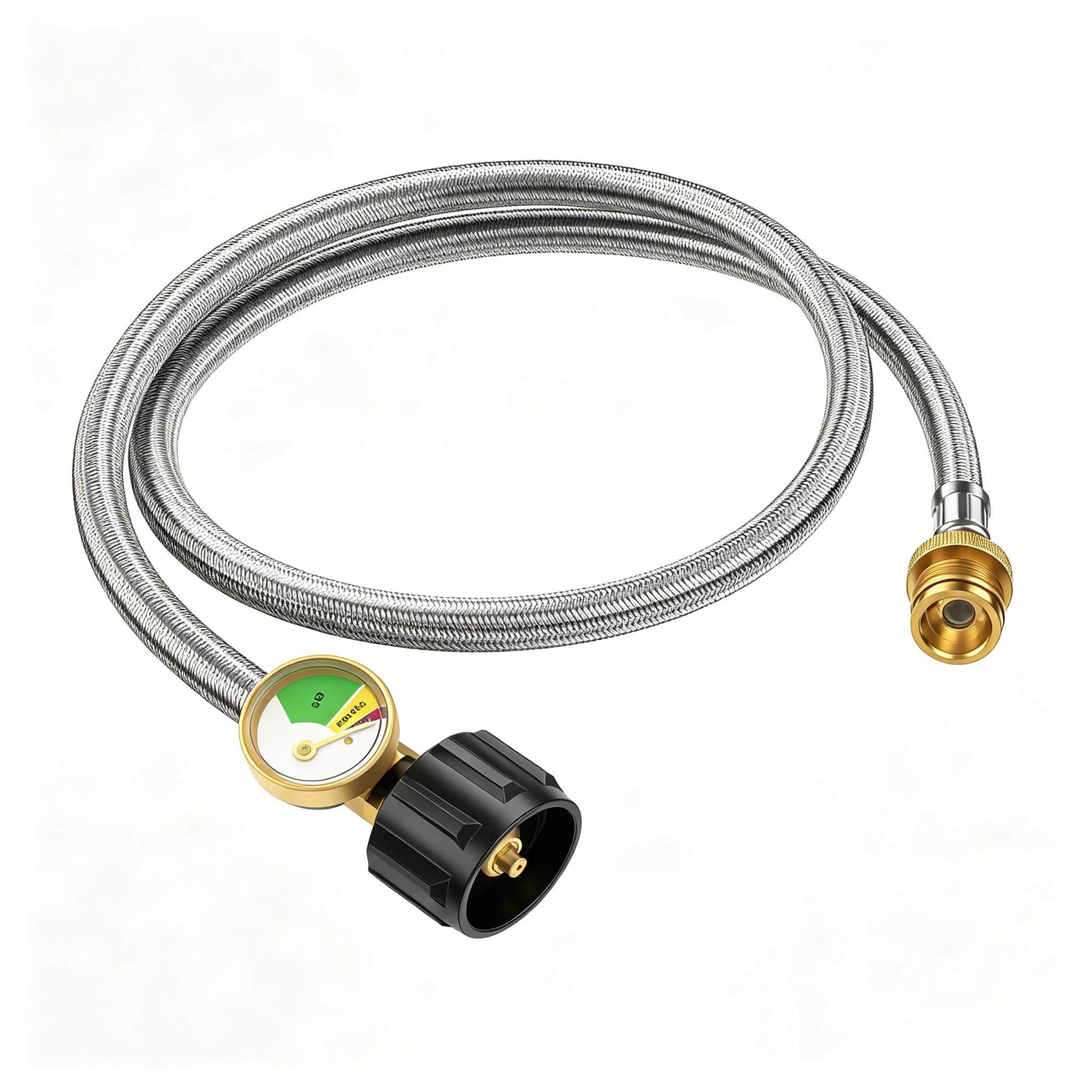
The adapter with a built-in fuel gauge eliminates the need for disposable 1-pound canisters.
This is a different animal from the regulator hoses above — it connects a large 5-40 lb propane tank directly to appliances that normally use the small 1-pound disposable cylinders, like a Coleman camping stove, a Buddy heater, or a Weber Q grill. The 4-foot braided stainless steel hose has a QCC1 connector on one end and a CGA600 outlet on the other, plus a color-coded visual gauge that shows green, yellow, or red fuel levels. Owners call it a “money saver” because a single 20-pound tank costs a fraction of the equivalent in disposable cans.
The real difference here is the four-layer construction: an outer braided stainless steel layer over rubber, galvanized steel mesh, and an inner PVC core. That stainless steel braid protects against rodent chewing far better than a plain rubber hose. Setup takes less than two minutes with hand-tightened brass connectors — no wrench needed. Note that this is a high-pressure adapter hose, not a low-pressure regulator hose, so it works only with appliances that have their own built-in regulator. A perfect match for a Blackstone 17″ or 22″ griddle that already has its own regulator.
The standout for campers: the color-coded tank gauge takes the guesswork out of how much propane is left before a weekend trip.
One constraint: this is a high-pressure adapter line, so it only pairs with appliances that already have a built-in low-pressure regulator.
6. CALPOSE 2-ft Propane Hose with Regulator and Gauge
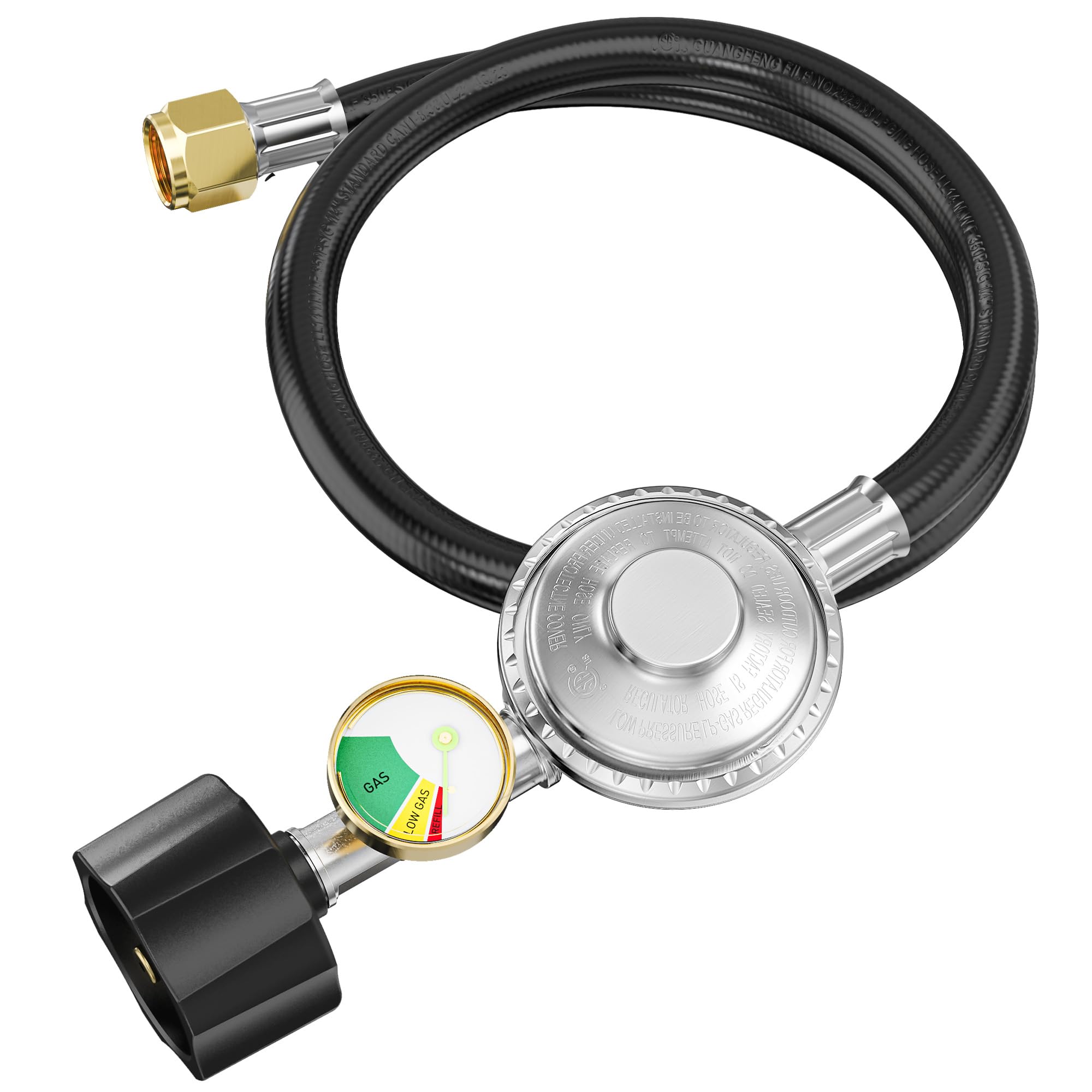
The 2-foot hose with an integrated gauge shows fuel level to prevent mid-cook surprises.
If the GrillAce is the pure replacement hose, this CALPOSE is the smart upgrade — it does everything the basic hose does but adds a built-in tank gauge that tells you exactly how much propane is left. Customers note it “worked perfectly on a 1974 bell camper” and on a Weber grill where “no more hoping I have enough gas left” says it all. It still uses the standard QCC1 connection and 3/8-inch female flare fitting, and the regulator outputs the standard 11″ W.C. with excess flow protection.
The 100% solid brass fittings and weatherproof rubber hose match the build quality of the other CALPOSE options, and at 2 feet this is a compact choice for a fire table or a small grill where the tank sits close. The integrated valve makes installation straightforward — reviewers point out it took minutes to swap. The chief complaint, mirrored across about a quarter of the reviews, is leakage around the connection points. A careful installation with yellow gas-rated Teflon tape, as some buyers suggest, addresses the issue for most.
The gauge changes how you cook: you see the fuel level at a glance instead of guessing mid-meal, which is a real peace-of-mind feature for a busy cookout.
The catch: a notable minority report leaks at the tank side — always perform a soapy water test on first use.
7. ATKKE 3-ft Propane Hose Regulator with Gauge

The 3-foot hose with a three-color tank dial eliminates fuel-level guessing.
This ATKKE takes the gauge concept a step further by using a three-color dial (green, yellow, red) on the tank gauge so you can read the fuel level without unscrewing the connection. The 3-foot length splits the difference between the compact 2-foot hoses and the longer 4-foot models, giving a little more placement flexibility without a bunch of slack. It works with Weber Genesis 300-series grills, Char-Broil, Nexgrill, and most patio heaters, connecting via the standard QCC1 tank and 3/8-inch male flare fitting.
The regulator includes built-in excess flow protection and a pressure relief device, and the outlet pressure sits at the standard 11″ W.C. Heavy-duty 100% solid brass fittings and a strong plastic hand wheel back the build. Owners call it “reliable,” noting it fired up a malfunctioning grill that had stumped them through multiple tank swaps. The biggest complaint is that not every unit delivers enough gas flow — about 10% of the feedback flags insufficient flow for larger burners. Also, returns are not accepted on this item, so make absolutely sure your grill uses a 3/8-inch male flare before ordering.
The dial difference: three distinct color zones (green, yellow, red) let you see at a glance if you have a full tank or are running near empty.
Who should pass: owners of high-BTU commercial-style burners who need maximum flow; this is best for standard home grills.
8. Samplife 24-ft Propane Hose Extension Kit

The 24-foot braided hose runs from an RV hookup to a campfire without needing a second tank.
Every hose above is a shorter replacement unit — this Samplife extension is in a different league. It is a high-pressure, 24-foot braided stainless steel hose rated for 350 PSI, designed to extend the reach from a propane source to a grill, fire pit, RV connection, or portable generator. It comes with six different adapter fittings (3/8″ NPT male, 1/2″ female NPT, 3/8″ flare male, 1/4″ NPT male, and 1/8″ NPT male) so you can connect virtually any appliance. No regulator is included — this is purely an extension line, meant to be used downstream of an existing regulator.
The braided stainless steel outer layer over rubber gives this hose serious abrasion and weather resistance. Owners note it works with LNG as well as propane, and the variety of adapters turned out to be more useful than expected. The 24-foot length means you can place the grill well away from your RV or house, a major safety plus. One buyer summed it up: “just what I needed, fits good, length easy to install, no leaks, connection was simple.” The only downside reported is that it is rated as a high-pressure hose, which surprised a few buyers expecting a standard low-pressure extension.
The reach advantage: at 24 feet, this is the only option here that lets you place a grill or fire pit across a patio or far from an RV.
One thing to confirm: because it is a high-pressure extension (no regulator), it must connect after your appliance’s existing regulator — not between the tank and a regulator.
Understanding the Specs
11″ W.C. Outlet Pressure
This stands for 11 inches water column, the standard low pressure used by nearly every home BBQ grill. If the regulator says anything different, it may not be designed for a grill. The 11″ W.C. rating ensures a stable flame that does not flutter or starve the burners.
3/8-Inch Female Flare Fitting
This is the brass nut on the end of the hose that screws onto your grill’s gas inlet. “Flare” means the end is shaped like a bell to create a gas-tight seal when tightened. If your grill uses a different size, like a 1/2-inch fitting, you need an adapter or a specific hose.
Excess Flow Protection
A built-in safety valve that automatically restricts gas flow if the hose breaks or gets disconnected. It is a passive mechanical device — no batteries or sensors. Every hose on this list includes it, but make sure the regulator you buy explicitly states it.
QCC1 vs Type-1 Tank Connection
These two names describe the same standard: the black plastic hand wheel with internal threads that screws onto a standard 20-pound propane cylinder. Anything marked QCC1 or Type-1 will fit the tanks found at any gas station or home center.
FAQ
Will a 2-foot hose fit my Weber Spirit E-310?
Yes, if your grill uses a 3/8-inch male flare fitting. The GrillAce and CALPOSE 2-foot hoses are directly compatible with Weber Genesis 300-series models, including the Spirit E-310. The 2-foot length means the tank will sit right beside the grill’s cabinet.
Can I use a 24-foot extension hose on my standard BBQ grill?
Yes, but only as an extension after the regulator. The Samplife 24-foot hose is a high-pressure line — it does not have a built-in regulator. You connect it between your existing grill’s regulator output and the tank, or use it to run from an RV quick-connect to your grill.
How do I know if my grill uses a 3/8-inch male flare fitting?
Look at the brass connector where the hose screws into the grill. It will be a threaded nipple about 3/8-inch in diameter with a flared cone at the end. If in doubt, measure the outside diameter of the threads — if it is roughly 5/8-inch across, it is a standard 3/8-inch flare fitting.
What is the difference between a low-pressure and high-pressure propane hose?
A low-pressure hose (like all regulator hoses here) operates at 11″ W.C. and includes a regulator to reduce tank pressure. A high-pressure hose, like the Samplife 24-foot extension, carries full tank pressure (up to 350 PSI) and must be used downstream of a regulator — never directly on a standard grill without its own regulator.
Can I use a propane hose with a natural gas grill?
No, never interchange them. Propane hoses and regulators are calibrated for a different gas pressure and orifice size than natural gas. Using a propane hose on a natural gas appliance creates a dangerous flame condition. Always use the hose type that matches your grill’s fuel type.
How often should I replace my BBQ grill propane hose?
There is no fixed schedule, but inspect the hose before each grilling season. Look for cracks, dry rot, or brittleness in the rubber. Replace immediately if the hose feels stiff, shows any cracking near the brass fittings, or if you smell gas after tightening the connection.
Why does my new regulator hiss when I turn on the gas?
A slight hissing sound is normal — it is the resonance of gas flowing through the regulator’s internal valve. The ABYDA manual specifically states this is normal. If the hiss is accompanied by a strong gas smell or bubbles appear in a soapy water test, shut off the tank immediately and recheck all connections.
Does a hose with a built-in gauge really tell me how much propane is left?
Yes, but with a caveat. The gauge measures tank pressure, which correlates to fuel level only when the tank is above about 20% full. Below that, the pressure drop is not linear. It is a useful tool for avoiding mid-cook surprises, but not a precision instrument for measuring exact remaining volume.
What does the 80,000 BTU rating on the Stanbroil hose mean for my fire pit?
It means the hose and regulator can safely supply up to 80,000 BTUs of propane per hour. Most standard fire pits use 30,000 to 60,000 BTUs, so this gives you headroom. If your fire pit has a higher output, you need a hose with a matching or higher BTU rating to avoid starving the flame.
My grill has a low flame after a few years. Do I need a new hose or just a new tank?
Start with a fresh, full tank. If the flame stays weak, the regulator is the most likely culprit. Regulators can fail internally over time, restricting gas flow. A replacement hose/regulator combo like the ones on this list typically solves the low-flame problem immediately.
Final Thoughts: The Verdict
For most people, the bbq grill propane hose winner is the GrillAce 2-ft because it combines straightforward installation with the highest owner satisfaction for the most common grill brands. If you need extra length for a Blackstone or a large grill cart, the ABYDA 4-ft brings the flame back to hot with a bit more setup flexibility. And for anyone who wants to stop guessing about fuel, the CALPOSE 2-ft with gauge adds tank-level visibility to the same reliable build — worth the small step up in investment.
How We Picked
We do not accept paid placement. Every pick is matched to a real buyer and a real use-case; we do not hands-on test units.
Sources & Methodology
Specifications: manufacturer listings and product documentation. Review insights: verified customer reviews, as of July 2026. Pricing: not shown on this page (it changes often); check the current price via the retailer link.
As an Amazon Associate, KitchPrep earns from qualifying purchases. This does not affect which products we feature.
Related Guides
