
Specs are compiled from manufacturer listings and verified buyer reviews and can change over time — please confirm the key details on the product page before buying.
When the power fails, every minute counts for your fridge and sump pump. A generator with fuel flexibility and clean sine-wave output turns a blackout into a smooth experience. Matching wattage and fuel type to your actual loads prevents overpaying for a rarely-used giant.
This guide compares manufacturer specs and verified customer reviews to reveal each generator’s real strengths and trade-offs.
if you need to keep a single freezer running or power your entire house through a multi-day blackout, this breakdown of the best backup power generator options cuts through the noise to give you the one that fits your situation and budget.
Our Picks at a Glance
How To Choose The Best Backup Power Generator
The most common mistake is choosing a generator too weak to start your well pump or too heavy to move and store. Only a few specs — wattage, fuel type, and inverter vs. conventional — decide if a generator fits your needs.
Wattage: Running vs. Starting
Every motor-driven appliance — fridge, AC, sump pump — needs a surge of power, called starting watts, for a few seconds before it settles down to its running watts. Add up the running watts of everything you want to run at once, then add the single largest starting watt number on top. That total tells you the peak wattage you need.
Fuel Type: Gasoline, Propane, or Both
Gasoline is dense with energy but has a shelf life of about six months if not treated. Propane stores indefinitely, burns cleaner, and is easier on the engine over the long haul. A dual-fuel machine gives you the choice to run whichever is available, which is a huge advantage during a regional emergency when fuel stations might be out.
Inverter vs. Conventional
An inverter generator electronically adjusts the engine speed to match the load, so it sips fuel when you are just running a few lights and a fridge. It also produces clean power — measured as total harmonic distortion (THD) under 3% — which is safe for modern laptops, televisions, and variable-speed furnace controls. A conventional generator runs at full speed all the time, using more fuel and producing dirty power that can damage sensitive electronics.
Noise and Portability
Sound levels are measured in decibels (dBA). A difference of 10 dBA sounds twice as loud to your ears — a 64 dBA inverter can sit near a window without disrupting sleep, while an 80 dBA unit will be heard through walls. Weight and whether the unit has sturdy wheels and a folding handle determine if you can roll it out of the garage by yourself.
Quick Comparison
| Model | Best For | Running Watts | Fuel Tank | Noise Level | Amazon |
|---|---|---|---|---|---|
| Westinghouse iGen12000DFc★ Best Overall | Whole-Home Power | 9000W (Gas) | 7.9 gal | 64 dBA | Amazon |
| AIVOLT VS12000411Premium Pick | Large Home & RV 50A | 9000W (Gas) | — | Ultra Quiet | Amazon |
| DuroMax XP15000HXHeavy Hitter | Maximum Whole-Home | — | — | Loud | Amazon |
| DuroStar DS13000MX | Heavy-Duty Home Backup | — | — | Notable | Amazon |
| Westinghouse wGen9500DF | Home Backup Combo | 7500W (Gas) | 6.6 gal | Loud | Amazon |
| WEN DF680iX | EV & RV Charging | 5100W (Gas) | — | Quiet (Eco Mode) | Amazon |
| Generac iQ5200 DF | Portable & Quiet Inverter | 3900W (Gas) | — | Very Quiet | Amazon |
| Champion 4000W Inverter | Lightweight RV/Camping | 3000W | — | 64 dBA | Amazon |
| PowerSmart MB5040DC (2nd) | Budget Dual-Fuel Inverter | 3600W (Gas) | 1.6 gal | 59 dBA (25% load) | Amazon |
| GENMAX GM4600IAEDC | Ultra-Quiet Mid-Range | 3800W (Gas) | — | Very Quiet | Amazon |
| PowerSmart MB5040DC | Entry-Level Budget Pick | 3600W (Gas) | 1.6 gal | 76 dBA | Amazon |
In-Depth Reviews
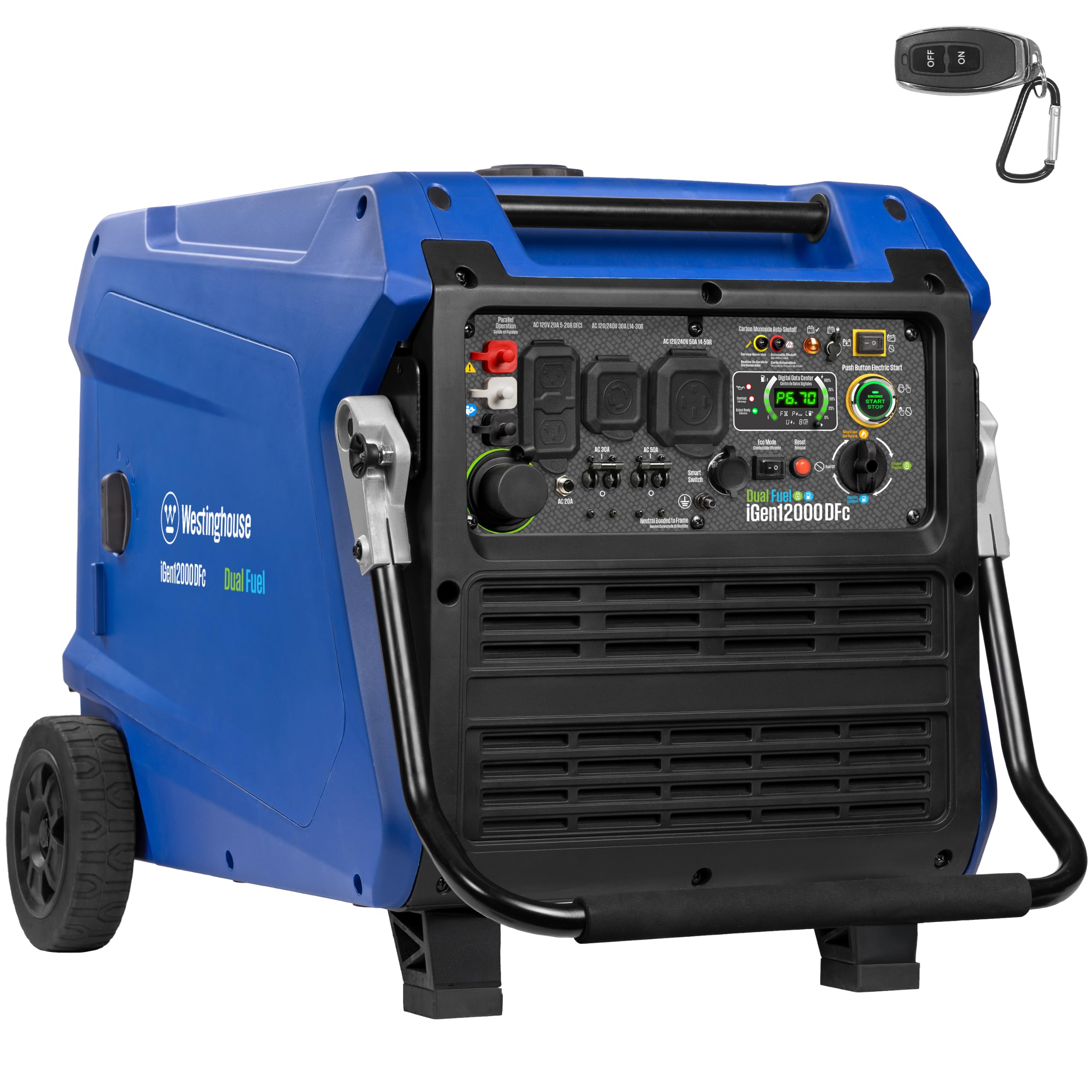
1. Westinghouse 12000 Peak Watt Dual Fuel Portable Inverter Generator (iGen12000DFc)
Our pick — over 4.5★ from 650+ verified ratings; the strongest balance of quality and price.
The whole-home inverter that runs for 19 hours on a single 7.9-gallon fill.
This is the unit that the crowd — 4.6 stars from over 600 owners — calls out for its quiet operation, with the low noise level being the most praised aspect. The 457cc engine delivers 12,000 peak watts on gasoline and 9,000 running watts, all through inverter technology that keeps total harmonic distortion at or below 3% — meaning your refrigerator’s control board and your television are safe from dirty power.
The fuel tank holds a massive 7.9 gallons, which at 25% load stretches into a 19-hour run time. That is two full nights of sleep without refueling. The LED data center on the control panel shows fuel level, power output, remaining run time, and lifetime hours in real time, so you are never guessing how much is left. It also comes with a remote start key fob that works up to 50 feet away, a 50A outlet ready for a transfer switch or interlock kit, and a CO sensor for automatic shutoff.
Owners who ran it through real outages confirm it handles a 2,700-square-foot home including a heat pump and dryer without strain. The review pages sum it up: “Charges Tesla at 20-25 mi/hr via 50A outlet.” The trade-off is the weight — at 187.4 pounds, you will want to keep it on the included wheels and not plan on lifting it often. The included break-in oil is not suited for temperatures below 23°F, so if you live in a cold climate, budget for a bottle of 5W-30 synthetic after the first five hours.
What Wins People Over
- True 50A outlet for whole-home transfer switch hookup — no adapter needed.
- Remote start from 50 feet via key fob: start it from the porch in bad weather.
- ECO mode reduces fuel consumption under light loads, saving money and refills.
The Real Trade-Off
- Weighs 187 pounds — plan a permanent spot on the wheels, not a daily move.
- Break-in oil is too thick for sub-23°F starts; you need to swap to 5W-30 synthetic after five hours.
Reach for it if: you want a single generator that can power your whole house, including large AC and well pump, through multi-day outages without constant refueling.
Think twice if: you need something you can lift into a truck bed alone — at 187 pounds, that is a two-person job.
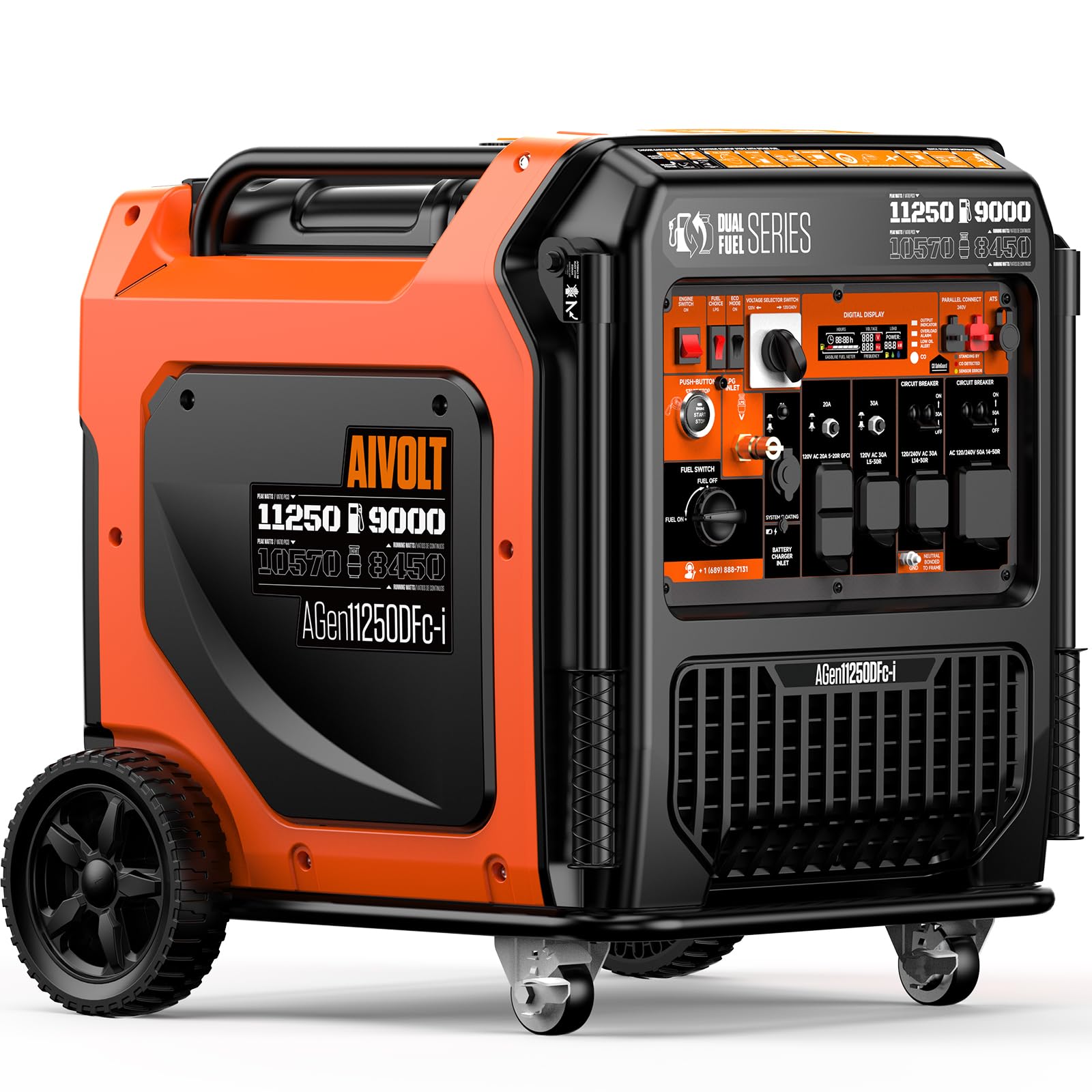
2. AIVOLT 11250W Dual Fuel Inverter Generator
The 50A inverter that runs your home or RV without needing a separate transfer-switch box.
Unlike the DuroMax which is a conventional open-frame unit, this AIVOLT is an inverter generator producing 11,250 peak watts on gasoline and 9,000 running watts, with a 459cc engine that is both EPA and CARB compliant — meaning it is legal to buy and use in California. The standout feature is the built-in 50A RV outlet, which means you can plug your RV’s shore power cord directly into this generator without any adapter.
The inverter technology keeps total harmonic distortion low, safe for sensitive electronics. The remote start lets you fire it up from inside the house, and the digital display shows fuel level, voltage, and runtime. The company shipped a replacement generator promptly when an early unit had a propane function issue, showing responsive support. Buyers report it runs a rooftop camper van AC all night on propane, and handles a refrigerator, lights, and a small AC unit with ease. The noise level at 5 feet is around 72 dB — quieter than a conventional generator but louder than the manufacturer’s claimed 57 dB at 23 feet.
The honest catch here is the weight: 221 pounds. The wheel kit helps, but this is a roll-it-out-and-park-it unit, not something you casually reposition. A small number of buyers reported carburetor or fuel system defects on arrival, though the 12-hour refund response from customer service suggests the company stands behind the product.
Best-case scenario: one generator that powers both your home’s critical circuits via the 50A outlet and your 50A RV — no adapter swapping, no extra gear.
Ideal if: you have a 50A RV or want a single generator that can back up your home panel and feed your camper on the same trip.
Pass if: you believe the 57 dB claim at face value — real-world noise is higher, especially under heavy load.
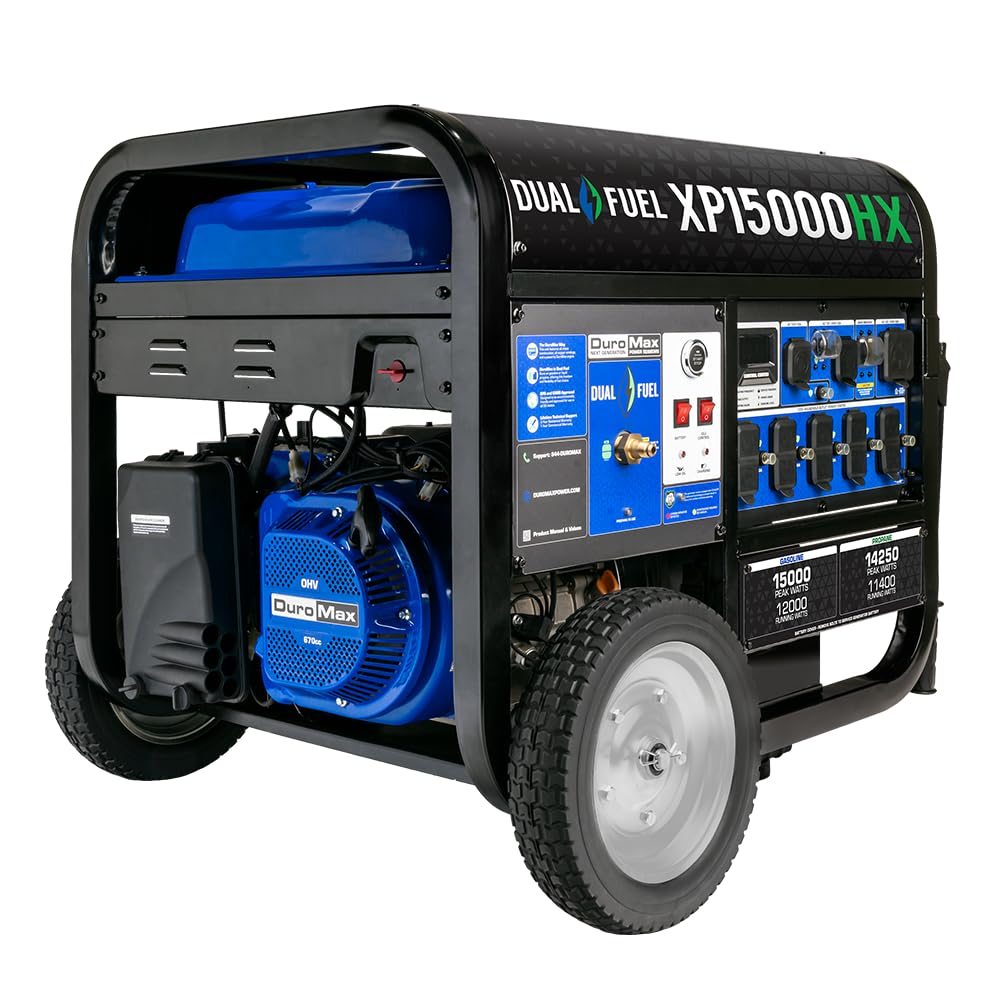
3. DuroMax XP15000HX 15,000-Watt Dual Fuel Portable Generator
The 15,000-watt brute that uses a 670cc engine and all-copper windings to power everything at once.
This is not an inverter generator — it is a massive conventional machine designed for one job: never letting anything in your house turn off. The 670cc DuroMax engine is the largest displacement in this roundup, and combined with 100% copper windings (copper conducts heat better than aluminum, extending the generator’s life), it is built to run under sustained heavy loads for days. The control center has a digital multimeter that shows voltage, frequency, total hours, and hours until the next maintenance interval.
The power panel is loaded: five 120V GFCI household outlets, one 120V 30A outlet, one 120/240V 30A twist-lock, and a heavy-duty 120/240V 50A outlet that is transfer-switch ready. The CO Alert system automatically shuts the unit down if dangerous carbon monoxide levels are detected. Owners mention it powers their entire property like normal during outages, including running a 1HP air compressor and a welder simultaneously. The dual-fuel interface lets you switch between gas and propane in seconds via the front-facing panel.
The catch is significant: at 345 pounds, this is not portable — it is a stationary backup on wheels that you roll out and park. The noise level is described as “loud” by owners. There are also isolated reports of the idle control switch being defective and customer service being unresponsive, so a thorough break-in test before a real outage is essential. The unit ships with no oil, so read the manual and add oil before the first start.
One-line verdict: if your home has a 5-ton AC, a well pump, an electric range, and you want them all running at once, this is the one — but only if you have the space, the fuel supply, and the tolerance for noise and weight.
Perfect for: anyone who needs to power a large home with multiple high-draw appliances simultaneously and has a dedicated outdoor spot for a permanent backup.
Not for: campers, tailgaters, or anyone who needs to move the generator between locations — at 345 pounds, that just is not happening.
4. DuroStar DS13000MX 13,000-Watt Dual Fuel Portable Generator

The 13,000-watt dual-fuel giant that owners say fires up with a one-second button push.
With a 500cc engine and dual-fuel capability on gasoline or propane, this DuroStar is designed to be the centerpiece of a whole-home backup plan. The push-button electric start is genuinely instant — customers note a one-second hold of the button fires it right from the start. The control panel includes a 50A outlet that is transfer-switch ready, so you can connect it directly to your home’s electrical panel.
The all-metal construction with a steel frame is built to withstand harsh weather. The CO Alert system automatically shuts the generator down if carbon monoxide reaches dangerous levels. Owners have used it to power entire two-story homes including a 1.5-ton AC unit, a split unit, fridge, stove, microwave, TVs, and a water heater. The dual-fuel feature simplifies storage because you can run it on propane, which does not go stale like gasoline. The fold-out handles make wheeling it around manageable, though at 220 pounds it is still a heavy unit.
The honest trade-off is noise — this is not an inverter generator, so it runs at full engine speed all the time. Owners describe it as “notable” and “powerful and loud.” It is also a large machine at 29.75 x 27.5 x 25.75 inches, so it demands floor space. A recurring owner tip is to keep a trickle charger on the battery between uses to ensure the electric start always works.
Owners’ bottom line: near-unanimous 4.5-star ratings — this is the lowest-priced high-wattage dual-fuel generator in its class, and the general consensus is that it performs as well as units costing much more.
Best for: homeowners who want the brute-force backup of a 13,000-watt conventional generator at a price that undercuts the premium inverter models.
Skip if: you need quiet nighttime operation for a neighborhood or campground — this unit is heard.
5. Westinghouse 9500 Peak Watt Dual Fuel Home Backup Portable Generator (wGen9500DF)

The proven 9,500-watt open-frame that relies on a cast-iron sleeve engine for longevity.
This is a conventional (non-inverter) generator that prioritizes raw reliability over fuel-saving technology. The 420cc Westinghouse engine with a cast-iron sleeve — a feature usually found on much more expensive industrial engines — is designed to last through years of occasional heavy use. It delivers 9,500 peak watts on gasoline and 7,500 running watts, with a 6.6-gallon fuel tank.
The start options include a push-button electric start and a remote key fob, plus a manual pull cord as backup. The control panel has two GFCI 120V 20A household outlets and one L14-30R 120/240V 30A twist-lock outlet with rubber covers for weather protection. All three start methods work reliably from the start. The digital hour meter helps you track when the first oil change is due. Reviewers point out it powers a fridge, freezer, furnace, and well pump without issue. The CO sensor automatically shuts the unit down if carbon monoxide builds up.
The downside is that this is an open-frame generator, so it is loud — owners describe it as “loud” and “heavy” at 202.1 pounds. The included oil drain plug is 12mm, not the 10mm stated in the manual, so double-check your socket size before the first change. The remote fob requires the fuel valve to be left open, which is a minor safety concern for some owners. A few owners noted the frequency ran high (63.8 Hz) from the start, requiring a screw adjustment to bring it into the 59.8-60.4 Hz range for sensitive UPS equipment.
Why Owners Trust It
- Cast-iron sleeve engine is built to outlast aluminum-sleeve competitors — a genuine longevity feature.
- Three start methods (electric, fob, pull) mean you are never stranded by a dead battery.
- Dual-fuel capability gives you the flexibility to run propane for storage or gasoline for maximum power.
The Real Trade-Off
- At 202 pounds and open-frame, it is loud and heavy — not a quiet machine.
- Frequency may need a voltage regulator screw adjustment from the start for sensitive electronics.
Reach for it if: you want a rugged, no-nonsense backup that will still be starting reliably a decade from now, and noise is not your primary concern.
Think twice if: you live in a close-neighbor setting and plan to run it at night — the noise level will be noticed.
6. WEN 6800-Watt Dual Fuel RV-Ready Electric Start Portable Inverter Generator (DF680iX)

The 224cc inverter that serves double duty as an RV generator and a low-power EV charger.
This is one of the few generators specifically designed with electric vehicle charging in mind. The bonded-neutral 240V configuration provides low-power Level 2 charging for battery and hybrid electric vehicles. On gasoline, it puts out 6,800 surge watts and 5,100 rated watts, and on propane it delivers 6,000 surge watts and 4,500 rated watts — all through inverter technology for clean power.
The control panel is unusually complete for this price range: one L14-30R 120V/240V receptacle, two three-prong 120V receptacles, a TT-30R RV receptacle, a 12V DC receptacle, and two 5V USB ports. The fuel shutoff feature boost engine life by running the carburetor dry before shutdown, preventing old fuel from gumming up the works. The telescoping pull handle and onboard wheels make the 99.2-pound unit relatively easy to move. The WEN Watchdog CO Shutdown Sensor provides automatic safety shutoff.
Owners confirm it runs both AC units on a 37-foot fifth wheel travel trailer with lights and TVs on, and one owner noted it is very efficient on a 40-pound propane tank — lasting two weekends on of propane. The honest issues: there is a documented case of the 240V outlet failing after two weeks, and WEN customer service was unresponsive in that instance. The unit is heavy at 99 pounds, making it manageable but not truly portable for frequent lifting.
Standout feature: the 240V bonded-neutral output for Level 2 EV charging — effectively the only generator on this list that can also serve as a roadside EV charger in a pinch.
Great for: RV owners who also drive an EV and want one generator that can charge both their RV batteries and their car at a campsite or during an outage.
Wary note: quality control on the 240V outlet has been inconsistent — test it thoroughly during the return window.
7. Generac 5,200 Watt Dual-Fuel Portable Inverter Generator (iQ5200 DF)
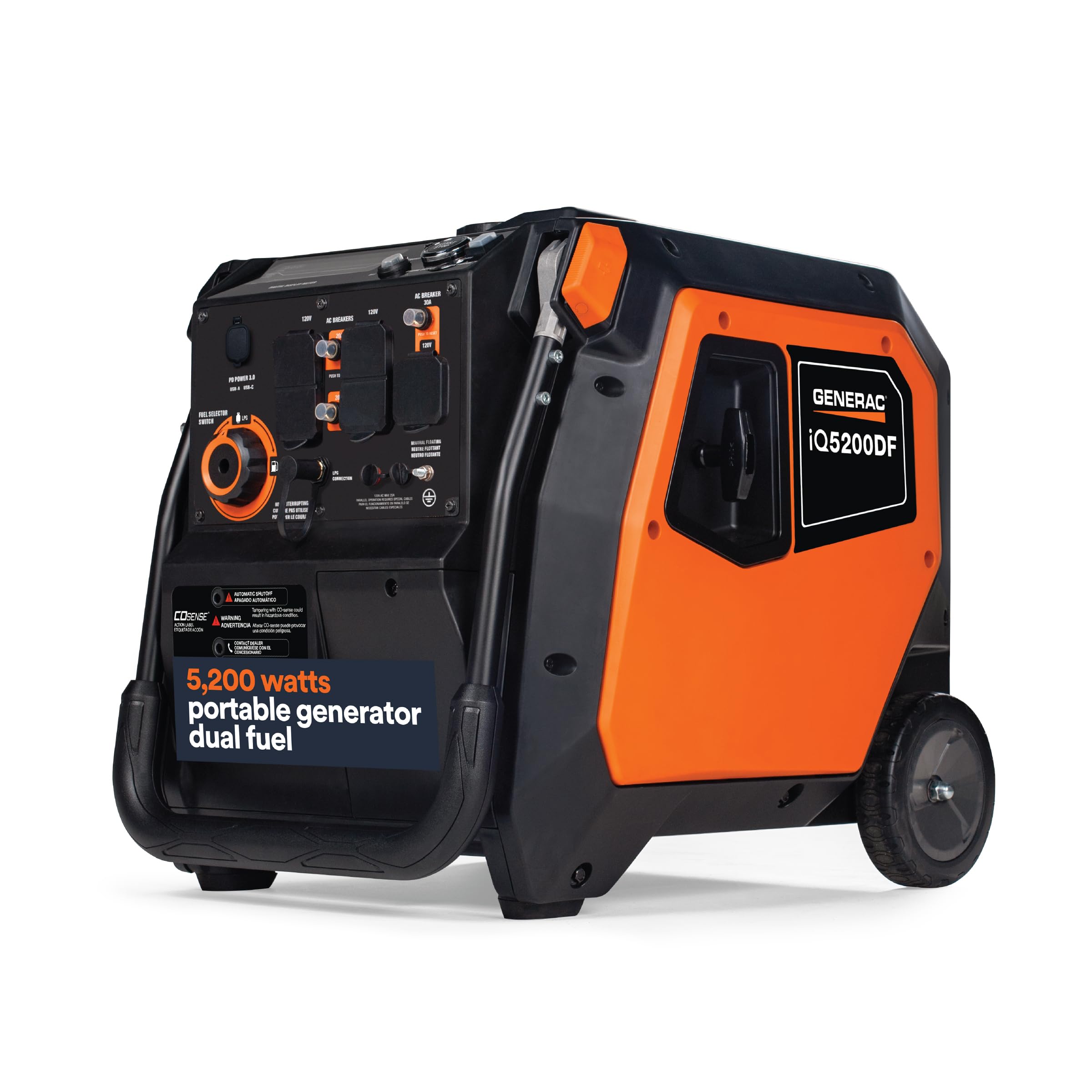
The Generac inverter that owners say is as quiet as a Honda but costs less.
Generac is a household name in backup power, and this inverter model brings their reputation to the portable space. It runs on gasoline (3,900W running / 5,200W starting) or propane (3,500W / 4,700W), with inverter technology keeping THD under 3% so it is safe for laptops, phones, and other sensitive electronics. The Economy Mode reduces fuel use and noise, and run times extend up to 15 hours at 25% load on gas.
The push-button electric start with an included battery eliminates the pull-cord struggle. The COsense technology automatically shuts the unit off if dangerous CO levels are detected nearby. The display is an intelligent LED panel showing real-time power output and fuel level. The outlet selection includes a 120V 30A L5-30R for RV use, two 120V 20A GFCI outlets, a USB-A port, and a USB-C port — the latter being a modern touch for charging devices directly without an adapter.
At 107 pounds with never-flat wheels and a folding handle, it is genuinely portable for one person to roll around. Owners describe it as “very quiet” — one owner, age 57, reported being able to lift it into a vehicle alone. The parallel capability allows you to connect two iQ5200 DF units using an optional kit to double the output. The honest downsides: a few units arrived with a broken propane regulator fitting, and Generac’s warranty process required a dealer diagnosis 30 miles away rather than shipping a replacement part. Also, the 3-year residential warranty applies, but the 2-year commercial warranty is shorter.
Why It Stands Out
- Extremely quiet operation — described as “Honda quiet” by multiple owners.
- USB-C and USB-A ports built into the panel for direct device charging.
- Parallel ready to scale up output without buying a second larger generator.
The Honest Catch
- Warranty support requires finding an authorized dealer — not a simple phone call for a part.
- At 5,200 starting watts, it will not run a large central AC or a well pump with a high starting surge.
Ideal for: homeowners who want a quiet, portable inverter generator that can back up a fridge, lights, and a few circuits without annoying the neighbors.
Pass if: you need to power a large central AC or a well pump — the 5,200 starting watts will not be enough.
8. Champion Power Equipment 4000-Watt RV Ready Portable Inverter Generator

The 49-pound featherweight that RV owners call their new favorite for a reason.
At under 49 pounds, this Champion inverter generator is one of the lightest 4,000-watt inverter generators you can buy. It produces 4,000 starting watts and 3,000 running watts, all with less than 3% total harmonic distortion for clean, electronics-safe power. The noise level is 64 dBA from 23 feet — quiet enough for a campground without drawing dirty looks from neighboring campsites.
The outlet selection is RV-focused: a 120V 25A TT-30R outlet (the standard plug for most RVs), a 120V 20A household duplex outlet, a 12V automotive-style outlet, and parallel outlets so you can connect a second Champion 4000-watt inverter to double the output. The CO Shield automatic shutoff system is standard, and the 3-year limited warranty with free lifetime technical support is genuinely useful for a long-life purchase.
Owners confirm it powers a 15,000 BTU RV air conditioner, lights, and a 12V fridge — but you cannot run the AC and microwave simultaneously, which is typical for a 3,000 running-watt inverter. The fuel consumption is about 5 gallons per 24 hours under continuous AC load, meaning the tank needs frequent refills. The reliability is the most-praised aspect, and build quality comes second. The catch is the small fuel tank — owners wish it were larger to avoid midday refueling during an outage.
One owner’s real-world note: “It powers my 15k AC unit — that is the single thing that matters for camper boondocking. Will it run the AC and microwave together? No. Does it need to? No.”
Best for: RV owners who care about weight — at 49 pounds, this is light enough to lift into a truck bed solo.
Skip if: you need to run a large central AC or a well pump — the 3,000 running watts will not handle the starting surge.
9. PowerSmart 4400-Watt Dual Fuel Portable Generator with Inverter Technology
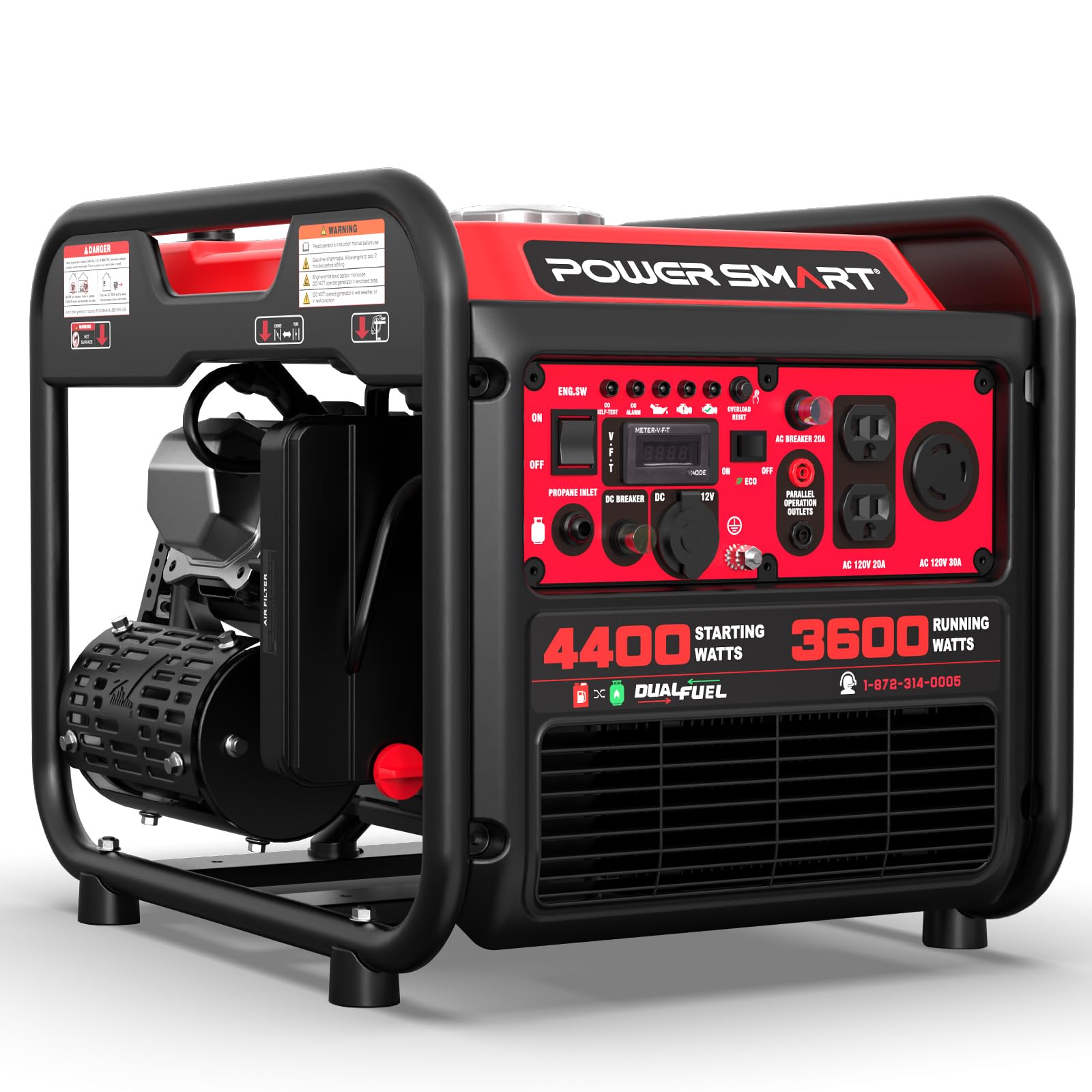
The 59 dBA inverter that is quiet enough for a campground and powerful enough for home essentials.
This second PowerSmart model is the one that gets the inverter upgrade — total harmonic distortion below 3% for safe electronics use, plus a much quieter noise profile at 59 dBA from 23 feet at 25% load. That is noticeably quieter than the 76 dBA of the open-frame version. On gasoline, it delivers 4,400 surge watts and 3,600 rated watts, and on propane it drops to 4,000 surge and 3,300 rated watts.
The outlet selection is practical: two three-prong 120V 15A receptacles, one 120V 30A receptacle, one 12V DC outlet, and parallel ports. The safety features are comprehensive with low oil shutdown, overload reset, and carbon monoxide auto shutdown. At 19.3 x 16.9 x 16.5 inches and a reasonable weight, it fits in a compact corner of the garage. Owners confirm it ran a fridge, TVs, fans, and laptops for 8 hours straight on a full load during Hurricane Melissa.
The honest trade-off is that this is the quieter inverter version — not the 1.6-gallon open-frame model. But it is still an open-frame design, so while the engine noise is managed by inverter technology, it is not fully enclosed like some premium inverter generators. A few owners note the noise is “tolerable” rather than “silent,” and it lacks wheels, so you need to buy a dolly or be comfortable carrying about 70 pounds.
What owners say: “This is not too heavy and it was easy to use. The noise level is tolerable, not too loud. Works good for my household needs.”
Ideal for: budget-conscious buyers who want inverter-quality clean power without paying for a fully-enclosed chassis.
Consider the trade: the open frame means it is not as quiet as a fully-enclosed inverter — if silence is your priority, look at the Champion or Generac above.
10. GENMAX Dual Fuel Generator 4600W Ultra-Quiet (GM4600IAEDC)
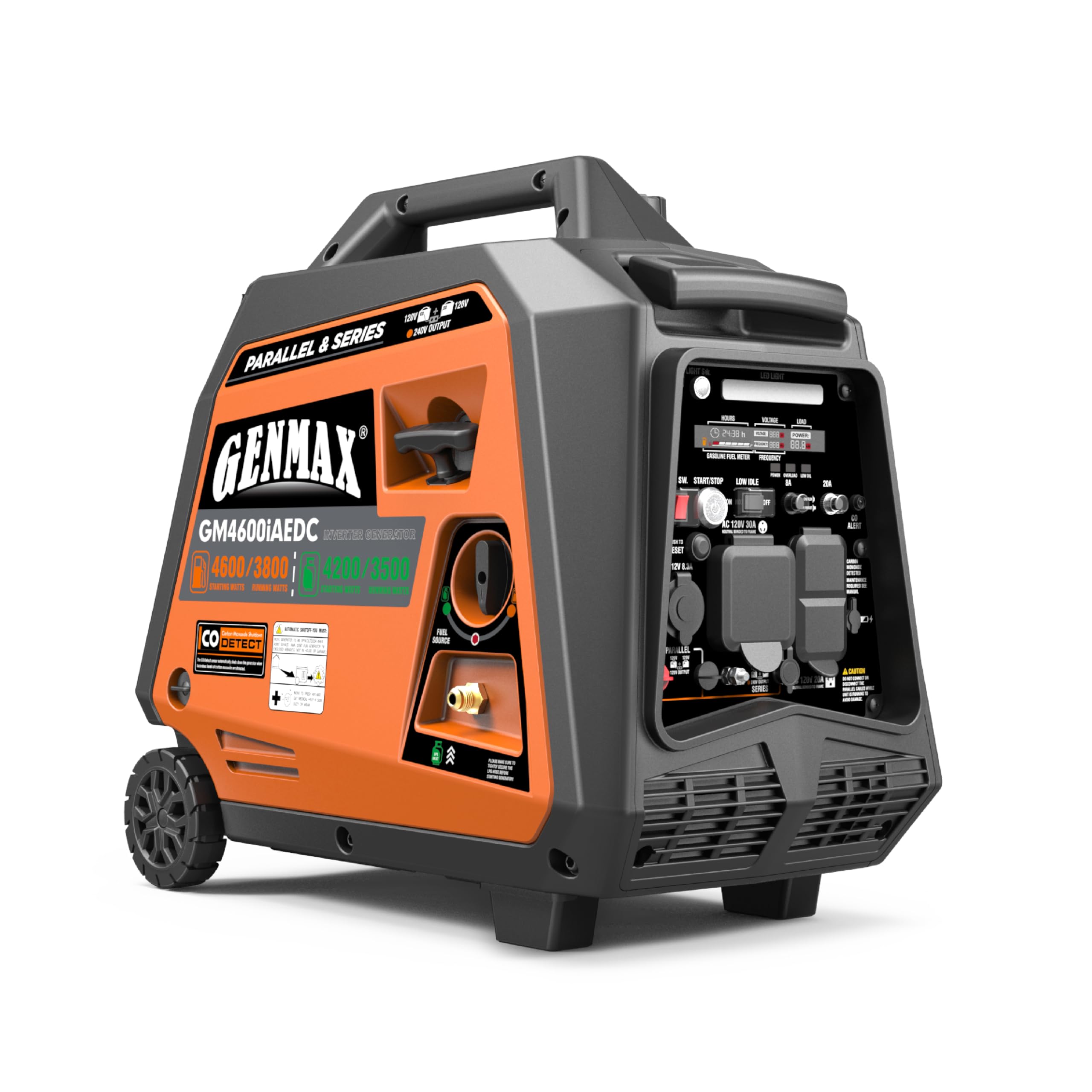
The 60-pound inverter that packs an LED floodlight for nighttime work and power.
The GENMAX GM4600IAEDC is a fully-enclosed inverter generator powered by a 159cc dual-fuel engine, producing 4,700 starting watts and 3,800 running watts on gasoline, and 4,200 starting watts and 3,500 running watts on propane, both with less than 3% THD for clean power. At 60 pounds with a telescoping handle and wheels, it is one of the lightest generators in this wattage class.
The digital control panel is well-equipped for a unit this compact: it has a big LED display showing hours run, voltage output, load level, and fuel level. The remote start key and push-button start mean you can fire it up from inside. The 30A RV-ready outlet makes it suitable for RV campers, and the parallel and series connection capability means you can combine two units into a 240V output using a separate box. The built-in LED floodlight provides illumination for 30 seconds when the main switch is on but the generator is not running — a clever touch for nighttime setup.
Owners praise the power output, noting it runs a 13.5 BTU RV AC, lights, fridge, and microwave from a single unit, and report it delivered 18 hours of runtime on 2/3 of a propane tank during Hurricane Helene. The noise level is the most-praised aspect, described as “very quiet.” However, the reliability is mixed — there are verified reports of units failing after two uses due to a bad computer module, and GENMAX support being unresponsive for warranty claims under a year. This is a high-risk-reward pick: great specs and low weight, but quality control is inconsistent.
Why It Stands Out
- Only 60 pounds — light enough for one person to maneuver into a truck bed.
- Built-in LED floodlight for nighttime operation — genuinely useful during a blackout.
- Remote start and digital display make operation easy from inside a camper or house.
The Honest Risk
- Reliability is the most-mentioned aspect — and it is rated as mixed by owners, not purely positive.
- Warranty support has been slow for those who received a defective unit.
Buy it if: you prioritize low weight and quiet operation above all else and are willing to accept the quality-control gamble for the price.
Hesitate if: you need guaranteed reliability for a critical medical device or essential sump pump — a unit that fails at hour two is a liability, not a backup.
11. PowerSmart 4400-Watt Dual Fuel Portable Inverter Generator (MB5040DC)
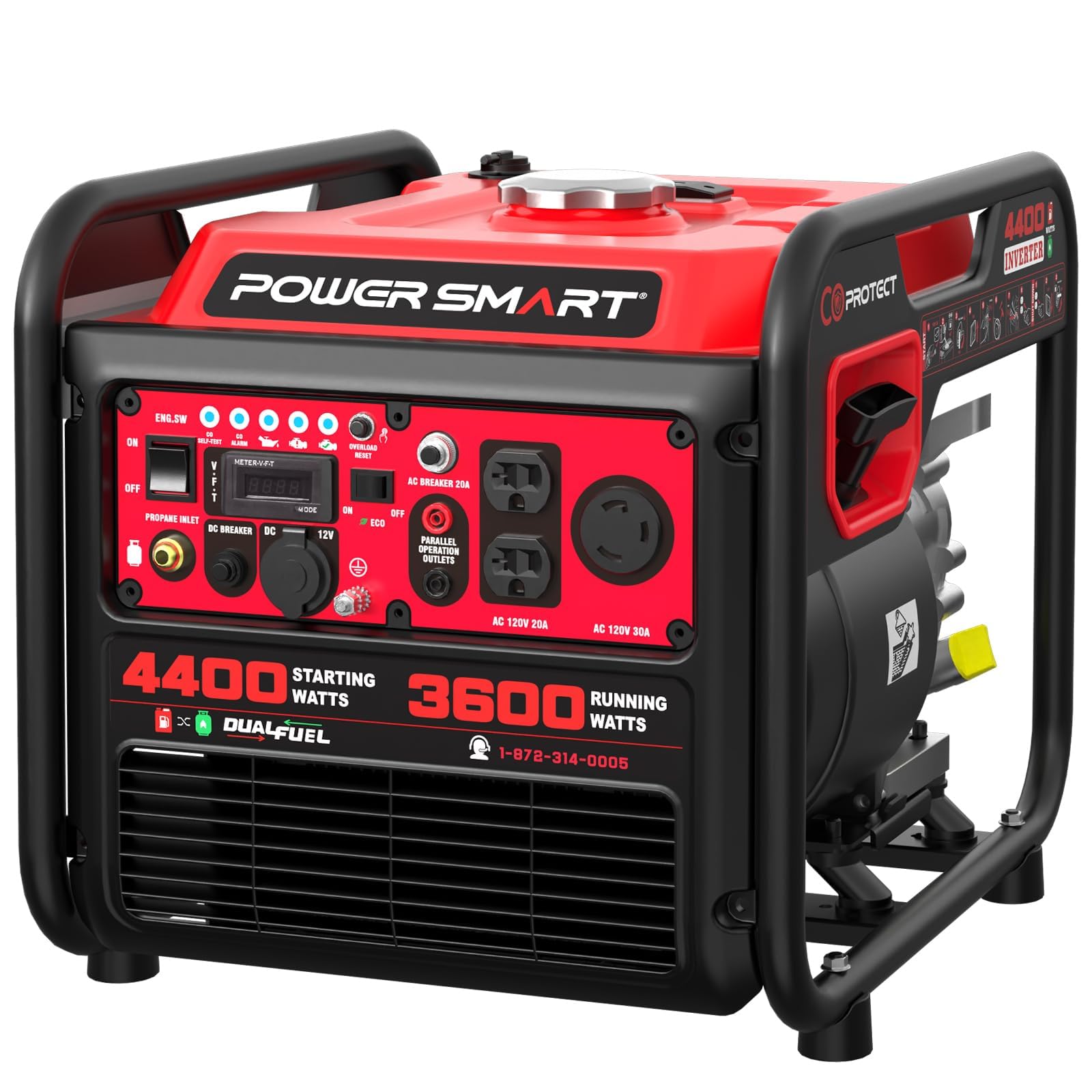
The entry-level inverter that runs an RV AC and fridge on a 1.6-gallon tank at an entry-level price.
This is the budget entry point into the dual-fuel inverter category, and for the price it delivers genuinely useful power. The 223cc engine produces 4,400 starting watts and 3,600 running watts on gasoline, with a 1.6-gallon fuel tank that runs for 11 hours at 25% load. At 61.29 pounds with a compact 19.3 x 16.9 x 16.5 inch footprint, it is easy to store and move. It is EPA compliant and includes a CO sensor, low oil shutdown, and overload protection.
The review data shows a 4.2-star rating from over 700 owners, with the consensus being that it is “a good quality generator and priced right.” One owner’s real-world test: it runs an AC, fridge, and fan in a camper — the AC needs 3,500W and the generator gives 3,800W, so it handles that load without bogging down. In Economy Mode, it runs for about 6 hours on a tank. The noise level is 76 dB at 23 feet at 25% load — not quiet, but typical for an open-frame inverter.
The honest downsides are real at this price point. The choke sticker is printed opposite to the actual operation — owners advise starting at half-choke. One verified failure at 9 hours was traced to a faulty oil sensor and a gas leak from the carburetor bowl. The wheels and handle are described as “cheap,” and customer service was unresponsive in that case. This is not a buy-it-for-life generator — it is a buy-it-for-this-season generator that will likely serve you well if you stick to light-duty backup for a camper or small home essentials.
Owners’ honest take: “A good quality generator and priced right. Runs AC, fridge, fan in camper — needs 3500W, gives 3800W. ~6 hrs on econo with < 2gal tank.”
Pick it if: you need a low-cost, lightweight inverter generator for occasional RV trips or powering a few essential circuits during an outage, and you are comfortable with some minor quirks.
Spend more if: you need guaranteed reliability for whole-home backup or long-distance travel — the quality control and customer service are not at the level of premium brands.
Understanding the Specs
Running Watts vs. Starting Watts
These are the two most important numbers on a generator spec sheet. Starting watts (also called surge watts) is the extra burst of power a motor needs to get moving — a refrigerator might need 2,200 watts to start but only 800 watts to keep running. Running watts is the steady power the generator can supply continuously. You add up the running watts of everything you want to run at once, then add the single largest starting watt number to find the minimum peak wattage you need.
Total Harmonic Distortion (THD)
THD measures how clean the electrical sine wave is. Utility power is usually under 3% THD. Inverter generators produce clean power (under 3% THD), which is safe for sensitive electronics like laptops, TVs, and furnace control boards. Conventional generators often have THD over 20%, which can damage or shorten the life of those devices. Look for “inverter” or “clean power” if you plan to plug in electronics.
Dual Fuel Capacity
A dual-fuel generator runs on both gasoline and propane. Gasoline gives you the highest wattage output and is widely available at gas stations, but it degrades over time and requires stabilizer for storage. Propane stores indefinitely, burns cleaner (less carbon buildup in the engine), and is cheaper per BTU in many regions. The ability to switch fuels during a multi-day outage is a real advantage if one fuel runs out.
CO Sensor (Carbon Monoxide Shutdown)
This is a mandatory safety feature on modern generators. A CO sensor monitors the air and automatically shuts the engine off if it detects dangerous levels of carbon monoxide building up, even if the generator is placed outside but exhaust is recirculating into a garage or through an open window. This feature has saved lives. Never disable it.
FAQ
Can I plug a generator directly into a wall outlet?
How do I know what size generator I need for my house?
How long can a generator run continuously?
Is propane or gasoline better for a generator?
What does inverter technology do for a generator?
Can I run my generator in the rain?
What is a transfer switch and do I need one?
How often should I change the oil in a generator?
What is the difference between an open frame and a fully enclosed generator?
Can I run a generator on propane while it is raining?
Final Thoughts: The Verdict
If you want one dependable pick, the best backup power generator is the Westinghouse iGen12000DFc because its inverter technology, 19-hour runtime, and 50A outlet deliver whole-home backup in a single package that the owner community overwhelmingly trusts. If you want a quiet, portable unit that is light enough for RV travel and quiet enough for a campground, grab the Champion 4000-Watt Inverter. And for the deepest budget entry into dual-fuel inverter power, the PowerSmart 4400-Watt Inverter is the one to reach for — just keep your expectations realistic on long-term reliability.
How We Picked
We do not accept paid placement. Every pick is matched to a real buyer and a real use-case; we do not hands-on test units.
Sources & Methodology
Specifications: manufacturer listings and product documentation. Review insights: verified customer reviews, as of July 2026. Pricing: not shown on this page (it changes often); check the current price via the retailer link.
As an Amazon Associate, KitchPrep earns from qualifying purchases. This does not affect which products we feature.
Related Guides
