
Specs are compiled from manufacturer listings and verified buyer reviews and can change over time — please confirm the key details on the product page before buying.
You need a 2-pole 40-amp breaker to safely power heavy appliances like an electric vehicle charger, central air conditioner, large water heater, or a garage sub-panel without tripping or causing electrical chaos. But matching the amperage number alone is not enough — the breaker must physically and electrically lock into your specific panel brand. A wrong choice creates a dangerous mismatch or voids your warranty.
I’m Mohammad Maruf — the founder and writer behind KitchPrep. This guide is built by comparing the manufacturers’ published specifications and the patterns across verified customer reviews, so you get each pick’s real strengths and trade-offs instead of marketing spin.
Whether you are installing a new circuit or swapping out a worn-out unit, these are the top choices for the best 2-pole 40-amp breaker for your panel, ranked by reliability, compatibility, and real owner confidence.
Our Picks at a Glance


How To Choose The Best 2-Pole 40-Amp Breaker
A 2-pole 40-amp breaker takes up two adjacent slots in your panel and connects to both hot legs of your 240-volt service. Before you click “buy”, you need to lock down three things: your panel brand, the breaker type, and the physical dimensions that make it fit.
Panel Brand Matching
A Square D QO breaker will not physically snap into a Homeline panel, and vice versa — the bus-bar design and mounting tab shape differ between brands. The same rule applies to Siemens versus Murray, Eaton’s CH versus BR lines, and every other manufacturer. The breaker must be listed as compatible with your panel’s make and model number. If you mix brands, you risk a loose connection, an arc fault, and a panel that fails inspection.
Standard vs GFCI
A standard thermal-magnetic breaker protects against overloads and short circuits. A GFCI (ground fault circuit interrupter) breaker adds protection against electrical shock by detecting tiny imbalances in current flow. Code now requires GFCI protection for circuits in bathrooms, kitchens, outdoors, garages, and around pools or spas — and many local codes now enforce it for EV chargers too. If your circuit serves a location where water or damp conditions exist, you need the GFCI version.
Interrupting Rating (AIC)
The AIC (amperes interrupting capacity) tells you how large a fault the breaker can safely stop without welding its contacts shut. Most residential panels use a 10,000 AIC breaker, which is standard for typical home wiring. If your panel is close to the utility transformer or in a high-available-fault-current location, you may need a higher rating — but 10kAIC covers the vast majority of residential installs.
Quick Comparison
| Model | Best For | Panel Brand | Type | Weight | Amazon |
|---|---|---|---|---|---|
| Square D QO240CP★ Best Overall | Best Overall QO Panel | Square D QO | Standard | 8 oz | Amazon |
| Leviton LB240-TModern Feel | Modern Load Center | Leviton | Standard | — | Amazon |
| Murray MP240Murray Classic | Murray Panel Replacement | Murray | Standard | 8.96 oz | Amazon |
| Square D HOM240 | Homeline Panel Value | Square D Homeline | Standard | 10.88 oz | Amazon |
| DIHOOL DZ47LED-2PE | GFCI + Surge Combo | DIN Rail | GFCI / Surge | 0.34 kg | Amazon |
| Eaton CHF240 | Eaton Type CH Panel | Eaton CH | Standard | 8 oz | Amazon |
| FalconSupply HOM240 Kit | Homeline with Hardware | Square D Homeline | Standard | — | Amazon |
| Siemens Q24040CT2 | Saving Panel Space | Siemens | Standard Quadplex | — | Amazon |
| Siemens QF240A | GFCI for Wet Locations | Siemens | GFCI | 16 oz | Amazon |
In‑Depth Reviews
1. Square D by Schneider Electric Square D – QO240CP QO 40 Amp Two-Pole Circuit Breaker
Our pick — over 4.5★ from 500+ verified ratings; the strongest balance of quality and price.
The breaker that QO-panel owners trust most — with 500+ owners backing its long-haul reliability.
If your panel is a Square D QO (the model with a bolt-on-looking plug design and a red Visi-Trip flag that shows a tripped breaker from across the room), this is the breaker you need. It clicks into place with a plug-on mount (no screws needed), fits into just two slots, and at 8 ounces it is noticeably lighter than the Homeline version — a real help when you are working overhead in a dark panel.
The real story is the track record. Buyers report one unit “has been installed for 5 years now” with zero issues, and the recurring verdict is that this is genuine Square D quality at a price cheaper than the local big-box store. The half-conical screw contacts grip stiff 6-gauge aluminum wire more securely than older flat designs.
The only real caveat is specificity: this breaker fits QO panels and CSEDs with two spaces, and nothing else. If you have a Homeline, Siemens, or Eaton panel, this will not physically snap in.
Why owners stick with it
- Visi-Trip indicator shows tripped status at a glance — no guessing which breaker popped
- New half-conical screw contacts grip thick aluminum wire more reliably than flat screws
- Plug-on mount installs in seconds without tools
The hard line
- Compatible only with Square D QO panels — no cross-brand use whatsoever
- At 2.9″D x 1.5″W x 3.1″H it is compact, but the 8-ounce weight feels a touch light compared to the Homeline version
Grab it if: you own a Square D QO panel and want the highest-rated, most-field-tested 40-amp breaker for 240-volt circuits — the one that 500+ owners have proven reliable.
Think twice if: your panel is Homeline, Siemens, Eaton, or any brand other than QO — this breaker is a strict brand-lock.
2. Leviton 40A 2-Pole Plug-On Standard Branch Circuit Breaker, LB240-T
Leviton’s rocker-switch breaker that makes flipping and spotting tripped circuits feel almost modern.
Leviton redesigned the breaker with a wide rocker-style switch that takes less finger pressure to flip, plus color indicators in the handle that show operational status at a glance — no squinting at a tiny window. The 120/240-volt, 40-amp, 2-pole model fits Leviton’s own plug-on load centers (breaker panels), and the thermal-magnetic guts (dual-action protection against overload and short circuit) are the same proven design you expect.
The real selling point is the rough-in workflow. Leviton’s system lets you wire the entire load center at rough-in stage with zero breakers installed, then snap in the breakers later. That saves serious time on new construction. A few owners note the body can feel a bit fragile during shipping — one mentioned inspecting theirs carefully before installation — but once seated, the performance track record is clean across the board.
The 10-year warranty adds confidence at this price, though the breaker’s availability is still narrower than the Square D ecosystem (fewer stores stock it).
What makes it different
- Rocker switch requires less activation force than traditional toggles — easier on the thumb during testing
- Color-coded handle shows status without opening the panel cover
- 10-year limited warranty backs the purchase
What to watch
- Bodies can feel a little fragile in the box — inspect before installing
- Compatible only with Leviton load centers, not universal
Choose it for: a new Leviton panel install where the rough-in-first workflow saves real labor and the rocker switch makes daily operation smoother.
Pass if: you need a breaker for an existing Square D, Siemens, or Eaton panel — this is Leviton-specific.
3. MP240 40-Amp Double Pole Type MP-T Circuit Breaker
The Murray workhorse that still fires up old panels, even if the brand name has faded.
Murray load centers are common in homes from the 90s and early 2000s, but the company stopped making new breakers years ago — the MP240 is now built by Siemens under the Murray brand. That is not a downgrade; the Siemens-manufactured internals are identical in performance, and the 10,000 AIC interrupting rating and 240-volt double-pole protection are exactly the specs you need for a 40-amp circuit. At 8.96 ounces, it sits between the QO and Homeline versions in heft.
What owners consistently report is that it is a “true Murray breaker” — it snaps into Murray rock-solid load centers without modification and the insta-wire feature makes connection faster than fiddling with individual lugs. The main thing to know is that Murray is effectively discontinued; the equivalent direct replacement moving forward is the Siemens Q240. If you need a direct Murray-branded replacement and stock matters, this is your pick, but expect to transition to Siemens models eventually.
Why it still matters
- Direct plug-in fit for Murray load centers — no adapter or modification
- Siemens-built internals provide the same quality as the Siemens Q-line
- Insta-wire feature speeds up installation
One honest reality
- Murray breakers are no longer manufactured — stock is limited, and future replacements may need the Siemens Q240 equivalent
- A few units have arrived looking lightly used; inspect before installing
Best for: anyone with a Murray panel who wants a direct, drop-in replacement that is confirmed genuine by dozens of owners.
Not for: owners of newer panels — this is specifically for Murray enclosures, and the brand’s phase-out means long-term consistency is better served by the Siemens equivalent.
4. Square D HOM240 Plug-In Mount Standard Miniature Circuit Breaker 2-Pole 40 Amp

Homeline’s own 40-amp double-pole — the value champion that leans heavier but leans reliable.
Square D’s Homeline series is the more budget-friendly sibling to the QO line, and the HOM240 is the go-to 40-amp, 240-volt breaker for any Homeline load center. It is 10.88 ounces — noticeably heavier than the 8-ounce QO240CP — but that weight does not hurt its plug-on fit. The real feature here is the TIME SAVER diagnostics: a small button on the breaker that gives you additional circuit information during troubleshooting without needing a meter.
Owner after owner reports that it “works as it should” and fits perfectly in Homeline panels. The value-for-money score stands out — this breaker consistently costs less than what you would pay at a local electrical supply house, and the build quality is pure Square D. The only difference versus the QO line is the bus-bar design (Homeline uses a different tab shape), so this will not fit a QO panel, and vice versa.
One thing to note: the HOM240 is a standard thermal-magnetic breaker. If you need GFCI protection for a bathroom, kitchen, or exterior circuit, you need the Homeline GFCI version, not this one.
What wins people over
- TIME SAVER diagnostics button gives circuit info at the touch of a button
- Direct plug-on mount for Homeline load centers — no adapter needed
- Rated for 120/240V and 40 amps, covering EV chargers, water heaters, and AC units
The honest limit
- Works only with Homeline panels — not compatible with Square D QO panels
- Heavier than the QO version at 10.88 oz, though that doesn’t affect function
Reach for this if: you own a Homeline panel and want the same Square D quality as the QO line at a more accessible price point, with diagnostic capability built in.
Look elsewhere if: your panel is QO, Siemens, or Eaton — brand-lock is absolute in the breaker world.
5. DIHOOL Ground Fault Circuit Breaker with Voltage Surge Arrester Protection, 40 Amp 2 Poles
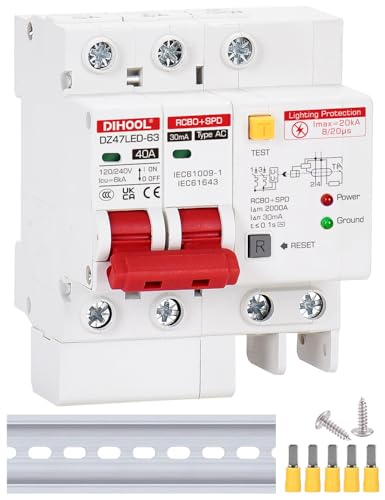
A DIN-rail breaker packing ground-fault and surge protection in one unit — a rare combo at this price.
This DIHOOL breaker does something most residential breakers do not: it combines Type 2 surge protection (20kA rating), 30mA Class AC ground fault protection, overcurrent protection, short circuit protection, and circuit isolation in a single 2-pole, 40-amp package. It mounts on a DIN rail rather than a traditional plug-on panel, making it a strong fit for sub-panels, mini-split disconnects, generator transfer switches, and industrial control cabinets.
At 4.17″D x 3.03″W x 3.27″H, it is the physically largest breaker in this roundup — 44% deeper than the QO240CP — so confirm your enclosure has the depth. Build quality gets consistent praise; owners call it “reliable” and “premium quality” with a “professional finish.” The LED indicator lights on the unit show power and ground status, and the test button lets you verify the GFCI function. The included DIN rail and five crimp lugs for stranded wire remove the guesswork from termination.
The one catch is voltage: this unit is rated for 120V, not the 240V that most 40-amp 2-pole circuits use for large appliances. It suits 120V/240V circuits in a split-phase context but verify your application’s voltage requirements before ordering.
what separates it
- Five protection functions in one unit — surge, ground fault, overcurrent, short circuit, and isolation
- DIN-rail mounting with included rail and crimp lugs simplifies installation
- Visual status indicators and test button for easy verification
What to know first
- Rated for 120V, not 240V — confirm your circuit’s voltage before buying
- DIN-rail mount means it won’t snap into a standard residential load center panel — requires a DIN rail enclosure
Ideal for: sub-panels, generator connections, or mini-split disconnects where you want GFCI and surge protection in one compact DIN-rail device.
Not for: standard Square D or Siemens plug-on load centers — this needs a DIN rail enclosure and is 120V rated.
6. Eaton CHF 40A Double-Pole Standard Trip Circuit Breaker

The Eaton Type CH breaker that wired up for a Tesla 14-50 NEMA outlet without a hitch.
Eaton’s CHF240 is a standard-trip, 40-amp, 2-pole breaker built for Eaton’s Type CH load centers — the line with the distinctive tan handle and the bolt-on-looking clamp connection. It weighs 8 ounces and operates at 240 volts with a 10,000 AIC interrupting rating, exactly what a 40-amp EV charger or a large air conditioner needs. Owners confirm it works cleanly with a NEMA 14-50 outlet for Tesla home charging.
Buyer experiences split. Most installations go smoothly, and the breaker is called “easy” and a “good price.” But a small number of owners received units that appeared used or arrived dead on arrival (DOA) — one blew on first use, another showed terminal deposits and non-Eaton packaging. If you are ordering for a critical circuit and cannot tolerate a delay, the local hardware store may be safer for a quick replacement.
What works
- Confirmed working with NEMA 14-50 outlets for EV charging
- Plug-on mount for Eaton Type CH panels — no adapters needed
- Light at 8 ounces and easy to handle in tight panels
What to watch for
- Inconsistent packaging — some units arrive without OEM branding, suggesting a used or re-packaged product
- A fraction of owners mention receiving DOA or previously installed breakers; inspect immediately on arrival
Best for: an Eaton Type CH panel owner who needs a standard 40-amp breaker for a known local circuit like an EV charger or water heater.
Skip if: you cannot risk receiving a used or DOA unit — buy from a local supplier for critical circuits.
7. Genuine Square D HOM240 40 Amp Double Pole Circuit Breaker Kit (FalconSupply)
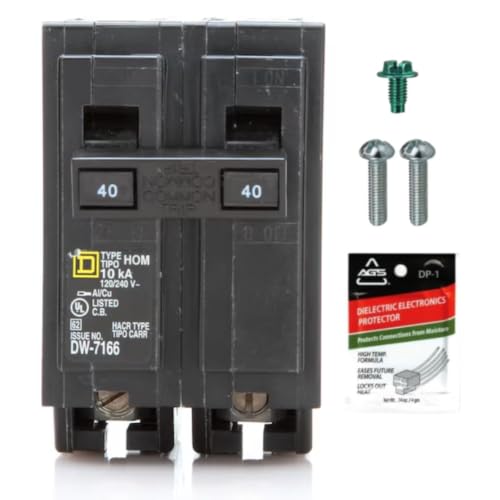
A genuine Homeline 40-amp breaker with the extras — grease, screws, and a grounding screw you usually scramble for.
This is the same OEM Square D HOM240 breaker sold at Home Depot, but FalconSupply bundles it with a dielectric grease packet (for the bus-bar connection), two zinc-plated steel combination-drive panel cover machine screws, and a green hex-head grounding machine screw. That last item alone saves a trip to the hardware store when you need a ground screw for the sub-panel you are feeding. The specs match the standard HOM240: 40-amp, 2-pole, 10kAIC (10,000 amps interrupting capacity — the maximum fault current it can safely stop), plug-on mount for Homeline load centers, accepting #8 to #2 AWG copper or aluminum wire at 45 lb-in of torque.
The one thing to flag is that this is a third-party seller bundle, not a Square D factory kit. The breaker itself is genuine and UL-listed, but the extras are added by FalconSupply. Owner feedback is universally positive — “works great for a breaker replacement” and “installed for a garage furnace” sum up the typical use case.
What you get extra
- Includes dielectric grease for terminal lug and bus-bar lubrication — better connection, less corrosion
- Pro-finishing hardware pack with panel cover screws and a green ground screw saves a separate trip
- UL-listed and ANSI-certified genuine Square D breaker
The fine print
- Third-party bundle, not a Square D factory kit — verify if the branding matters for your project
- Same panel-lock as the standard HOM240: Homeline only, not QO or any other brand
Reach for this: if you are installing a Homeline breaker and want the convenience of having mounting screws, a ground screw, and dielectric grease in the same box without a second run to the store.
Pass if: you would rather buy the naked breaker alone and already have hardware on hand — the base HOM240 is the same unit for less.
8. Siemens Q24040CT2 Two 40-Amp Double Pole Circuit Breaker

Two 40-amp double-pole breakers crammed into one slot — the space-saving trick for a full panel.
The Q24040CT2 is a quadplex (or “quad”) breaker: a single 1/2-inch wide unit that contains two independent 40-amp, 2-pole breakers. That means you can add two 240-volt circuits — say, an EV charger and a water heater — while using only two spaces in your Siemens panel instead of four. This is a lifesaver when your panel is already full but you need to add more heavy loads.
Owners confirm it “installed as it should” and praise its function on all four legs (the inner two switches serve one circuit, the outer two serve the other, both at 240V). A few note it is made in China and wonder about longevity, but the build quality meets Siemens standards and the UL listing is intact. One important note from Siemens’ own docs: they strongly recommend against used breakers and installing them voids the panel warranty — so make sure you buy new, not a “recycled” unit.
Why this stands out
- Packs two 40-amp double-pole circuits into a single 1/2-inch slot — huge space savings in a full panel
- UL listed and Siemens-branded for full warranty compatibility
- Ideal for expanding a full panel without needing a sub-panel upgrade
What to consider
- Made in China — some owners question long-term durability
- Siemens voids the panel warranty if used breakers are installed; buy new only
Perfect for: anyone with a crowded Siemens panel who needs to add two 40-amp 240V circuits and cannot spare four slots.
Not for: panels with plenty of open spaces — a standard double-pole breaker costs less and is simpler to wire.
9. SIEMENS QF240A Ground Fault Circuit Interrupter, 40 Amp, 2 Pole

The Siemens GFCI that keeps your hot tub, spa, and outdoor circuits safe from ground faults.
This is a 40-amp, 2-pole GFCI breaker for Siemens panels, providing Class A ground fault protection (the standard that trips at 5mA of leakage current) plus the built-in self-test that UL 943 now requires. It is physically the largest unit here at 16 ounces and 3″D x 2″W x 4.5″H — the extra bulk comes from the GFCI electronics and the neutral pigtail that needs to connect to the panel’s neutral bar.
Owners have installed it on everything from LG Washtowers on 240V outlets to Tesla chargers, hot tubs, and portable generator GFCI replacements. The reliability story is strong: one owner replaced a failing Westinghouse generator GFCI with this Siemens unit and reports it solved the no-load tripping during a 12-day power outage. The recurring theme is that this breaker works as a direct drop-in replacement for Siemens panels and many generator transfer switches, and the self-test feature adds an extra layer of safety that older GFCI breakers lacked.
The biggest friction point is the price — this is the most expensive breaker in the roundup by a wide margin. Owners are split on whether the cost is worth it for the protection, though most agree that for wet-location circuits (spas, bathrooms, kitchens, outdoor outlets), you simply cannot skip GFCI protection by code.
What it brings
- Class A GFCI protection — trips on 5mA leakage, critical for wet-location safety
- Built-in self-test as required by UL 943 for ongoing verification
- Direct plug-on mount for Siemens load centers, plus generator compatibility
The real trade-off
- Significantly more expensive than standard breakers — the premium for GFCI safety
- Larger and heavier at 16 oz — needs more panel space and careful wire routing
- Some owners feel the value is mixed given the high price
Must-buy if: you have a Siemens panel and need GFCI protection for a spa, hot tub, outdoor circuit, or any location where code requires ground fault protection.
Overkill if: your circuit is in a dry, indoor location (garage attic, utility room) and code does not mandate GFCI — a standard breaker costs far less.
Understanding the Specs
Interrupting Rating (AIC)
This number — typically 10,000 AIC for residential breakers — tells you the maximum fault current (in amperes) the breaker can safely interrupt without welding its contacts shut or exploding. Your utility company determines the available fault current at your home’s service entrance. For 99% of homes, 10,000 AIC is adequate. If you live close to a large transformer, you may need a higher-rated breaker; check with a licensed electrician.
Standard vs GFCI vs Surge
A standard thermal-magnetic breaker trips on sustained overload (heat) and instantaneous short circuits (magnetic). A GFCI breaker adds a sensor that detects current leakage to ground as low as 5mA — the level that can stop your heart — and trips in milliseconds. A surge-protective breaker (like the DIHOOL) also absorbs voltage spikes so they don’t fry your electronics. For pools, spas, bathrooms, kitchens, and outdoor circuits, code now requires GFCI protection. For sensitive electronics, surge protection at the panel is an extra layer.
Plug-On vs DIN Rail Mount
Most residential panels use plug-on mount breakers that snap directly onto a metal bus bar. The tab shape and spacing are unique to each brand — Square D QO, Homeline, Siemens, Eaton, and Murray are not interchangeable. DIN rail mount breakers (like the DIHOOL) slide onto a standard 35mm DIN rail inside an enclosure. DIN rail is common for sub-panels, transfer switches, and industrial control panels, but it will not fit a standard plug-on load center. Always confirm your panel type before choosing a mount style.
Wire Size and Torque
A 40-amp breaker typically accepts #8 AWG to #2 AWG copper or aluminum wire. The terminal lug must be tightened to the manufacturer’s specified torque — typically 45 lb-in for many residential breakers — to ensure proper electrical contact and prevent arcing. Using the wrong wire gauge or undertightening the lug is a leading cause of breaker failure and panel fires.
FAQ
Can I use a 40-amp breaker with a 50-amp appliance?
Will a Square D QO breaker fit a Homeline panel?
What does the 10,000 AIC rating mean for my home?
Can I replace a 30-amp breaker with a 40-amp breaker on the same wire?
Do I need a GFCI breaker for an EV charger?
Why is a 2-pole 40-amp breaker so big compared to a single-pole?
What does the Visi-Trip indicator do on Square D breakers?
Can I use a Siemens GFCI breaker in a Murray panel?
Final Thoughts: The Verdict
For most buyers, the best 2-pole 40-amp breaker is the Square D QO240CP because it combines the highest owner confidence, the Visi-Trip diagnostic flag, and a rock-solid fit for the most common residential panel brand. If you need to pack two 40-amp circuits into a crowded Siemens panel, the Siemens Q24040CT2 quadplex is a space-saving lifesaver. And for wet-location circuits — spas, hot tubs, outdoor outlets — the Siemens QF240A GFCI breaker is the safety-first choice that code demands.
How We Picked
We do not accept paid placement. Every pick is matched to a real buyer and a real use-case; we do not hands-on test units.
Sources & Methodology
Specifications: manufacturer listings and product documentation. Review insights: verified customer reviews, as of July 2026. Pricing: not shown on this page (it changes often); check the current price via the retailer link.
As an Amazon Associate, KitchPrep earns from qualifying purchases. This does not affect which products we feature.
Related Guides
