
Specs are compiled from manufacturer listings and verified buyer reviews and can change over time — please confirm the key details on the product page before buying.
A leaky or stuck ball check valve can turn a simple plumbing job into a messy flood. You need a one-way valve that stops backflow reliably without slowing your flow—whether you are working on a well pump, an irrigation line, or a sump discharge. This guide compares eight of the most-purchased brass and PVC check valves using their real specs and patterns from thousands of owner experiences, so you can pick the right one for your pressure, pipe size, and budget without guessing.
I’m Mohammad Maruf — the founder and writer behind KitchPrep. This guide is built by comparing the manufacturers’ published specifications and the patterns across verified customer reviews, so you get each pick’s real strengths and trade-offs instead of marketing spin.
Whether you are threading a 1-inch well line or gluing a 3/4-inch aquarium return, this breakdown of the best ball check valve for your setup covers everything from brass durability to PVC serviceability.
Our Picks at a Glance


How To Choose The Best Ball Check Valve
A ball check valve is a simple device — a disc or ball inside a body that lets fluid flow one way and snaps shut if it tries to reverse. But picking the wrong one means leaks, hammering, or a valve that never seats. Here is what you need to check before buying.
Material: Brass vs PVC vs Clear UPVC
Brass valves (like the Merrill or Boltigen spring check) resist corrosion and handle higher working pressures — typically up to 200 PSI (pounds per square inch, a measure of water force). They are the go-to for potable water (drinkable water), well pumps, and hot lines where temps can reach 248°F or more. PVC valves (like the HYDROSEAL or SANKING) are cheaper, lighter, and perfect for corrosive environments such as saltwater aquariums or chemical lines. Clear UPVC versions let you inspect the ball for debris without disassembly. The trade-off: PVC valves are often gravity-closed (no spring), so they must be mounted vertically to seal properly, and they fail in suction-line applications (where the pump pulls water, not pushes it).
Connection Type: Threaded (NPT) vs Socket (Slip)
NPT (National Pipe Taper) threads are standard for metal valves — you wrap them in Teflon tape or pipe dope (a sealing paste) and screw them into matching female threads. Socket / slip connections (PVC) require PVC primer and cement; they glue directly onto the pipe outer diameter. Threaded is easier to remove later; socket is permanent unless you cut the pipe. Make sure you match the inlet connection type to your system — mixing thread types or sizes causes leaks.
Spring vs Swing (Gravity) Mechanism
A spring-loaded check valve uses a stainless steel spring to push the ball or poppet (the sealing piece) back onto its seat the moment flow stops. These work in any orientation — vertical or horizontal — making them the most versatile choice for tight spaces. A swing or gravity-closed valve relies on the ball’s own weight to drop onto the seat when flow reverses. These MUST be installed vertically with upward flow. They fail on suction-side installations or horizontal runs, and they cannot handle systems with a static head (standing water pressure) of water pushing backward.
Quick Comparison
| Model | Best For | Material | Pressure Rating | Connection | Amazon |
|---|---|---|---|---|---|
| Merrill CVNL100★ Best Overall | Well Pumps / Potable Water | No-Lead Brass | 200 PSI | 1″ Female NPT | Amazon |
| SYWUWV 3/4″ NPTTop Performer | Ram Pumps / General Duty | Brass | 232 PSI | 3/4″ Female NPT | Amazon |
| Boltigen 2PCS Spring CheckBest Value | Vertical / Horizontal Install | Brass | 200 PSI | 3/4″ Female NPT | Amazon |
| Boltigen PVC True Union | Pedicure Chairs / Aquariums | PVC (EPDM O-ring) | 150 PSI | 1″ Slip (Socket) | Amazon |
| GASHER 2PCS Spring Check | Multi-Unit Installations | Brass / SS Spring | 200 PSI | 1″ Female FNPT | Amazon |
| Merrill CVNL125 | Large Well / Irrigation Lines | No-Lead Brass | 200 PSI | 1-1/4″ Female NPT | Amazon |
| HYDROSEAL Sharkfellow PVC | Sump Pumps / Pools | PVC (EPDM Seals) | 200 PSI @73F | 1″ Socket (Slip) | Amazon |
| SANKING 3/4″ UPVC | Aquarium / Inspection Lines | Clear UPVC | 150 PSI | 3/4″ Socket (Slip) | Amazon |
In‑Depth Reviews
1. Merrill MFG CVNL100 1″ No-Lead Brass Check Valve 700 Series
Our pick — over 4.5★ from 450+ verified ratings; the strongest balance of quality and price.
The crowd-favorite brass valve that well-pump owners trust year after year.
This valve pops up again and again in discussions about shallow well jet pumps and pressure tank tees (the fitting that connects pump, tank, and pipes). Made from No-Lead Brass (brass containing less than 0.25% lead, safe for drinking water) with IAPMO certification (a safety standard for plumbing products), the Merrill CVNL100 handles a maximum pressure of 200 PSI and connects with 1-inch female NPT on both inlet and outlet. You can mount it vertically or horizontally thanks to its abrasion-resistant O-ring poppet design (a rubber ring that seals against the seat when flow stops) — no spring to orient. As buyers put it: “Works nice for well pump pressure tank tee. Easy install and no leaks so far.” The crowd — with over 450 ratings and a near-perfect score — consistently praises the quality and functionality above all else. The Merrill is also the heaviest hitter against the smaller 3/4-inch swing valve from SYWUWV below, offering a 33% larger outlet connection at 1 inch versus 0.75 inches for higher-flow well systems.
Where it earns its “Best Overall” badge is in trust and repeat buys. Owners mention installing it on 400-foot deep submersible wells and relying on it for years with “no back flow leaks.” The sealing performance does get mixed feedback from a minority, but that is the only real asterisk against an otherwise stellar reputation. If you want a no-lead brass valve that simply works on a well pump or main water line and does not make you second-guess the threads, this is your one-stop pick.
Lead-free brass durability
- No-Lead brass construction is IAPMO certified for potable water
- Works in both vertical and horizontal positions
- Abrasion-resistant O-ring provides a positive, leak-proof seal
- Quality is the most-praised aspect — buyers consistently call it well-made
Heavy for small pipes
- Sealing receives mixed feedback from a small number of owners; a few needed extra Teflon tape
Grab if lead-free needed: you need a proven, heavy-duty brass check valve for a well pump or potable water system and want the confidence that comes with 450+ satisfied owners.
Think twice if space tight: you need a budget multi-pack for light-duty sprinkler lines — the single-valve price is higher than some twin-packs.
2. SYWUWV 3/4″ NPT Horizontal Check Valve, Brass Non Return Swing
The ram-pump specialist that handles high-pressure backflow without breaking a sweat.
While the Merrill above is the best all-rounder, this SYWUWV swing valve is the go-to for anyone running a ram pump (a pump that uses water hammer to push water uphill) or a higher-pressure system. It is rated at 232 PSI — noticeably higher than the Merrill’s 200 PSI — and its polished inner wall is designed to resist scaling (mineral buildup) and clogging over time. A buyer using it on a ram pump with “4gpm flow and 3ft head” (gallons per minute and vertical lift distance) confirmed it works great, noting the smooth interior prevents mineral buildup. The 3/4-inch NPT connection is standard for smaller branch lines, and the brass body handles oil, water, and non-corrosive gas up to 302°F. However, this is a horizontal-only swing design — it relies on gravity and pressure to close, so it will not work in vertical installations. The thread length gets mixed feedback: some owners find the input side threads too short for a deep seal, so use plenty of Teflon tape.
The quality and functionality are the top praised aspects, and at a price that undercuts most single brass valves, this is a genuine value play. Just confirm your setup is horizontal before ordering.
Compact horizontal design
- 232 PSI working pressure beats most brass valves in this price range
- Polished inner wall resists mineral buildup and clogging
- Wide media compatibility — water, oil, and non-corrosive gas
Not for vertical use
- Horizontal-mount only — cannot be used vertically
- Input side threads are shorter than some buyers expect; use extra sealant
Reach for horizontal setups: you are building a ram pump or need a budget brass swing valve for a horizontal line that sees higher pressure than standard household water.
Look elsewhere if vertical: you need a vertical-mount valve or the pipe connection requires longer threads to seat properly.
3. Boltigen 2PCS 3/4 NPT Thread Spring Check Valve
The two-pack that solves sprinkler hammer and sump noise for less than a single hardware-store valve.
If you have multiple low-pressure lines — think sprinkler zones or a sump pump discharge — buying a single premium valve for each can get expensive fast. The Boltigen twin-pack gives you two 3/4-inch NPT spring-loaded check valves in heavy-duty brass, each rated at 200 PSI and capable of being mounted vertically OR horizontally thanks to the stainless steel spring inside. One owner using it on a sump pump said they “reduced the discharge hose size to 3/4″ and pump is almost silent now.” Another called it a “cheap solution” running at 30 PSI with no issues, and compared it favorably to valves from a local plumbing shop. The valve body is compact at 1.5 x 1.5 x 1.5 inches per unit, letting it fit into tight spaces. Quality is the top-praised aspect, followed closely by functionality. The key number here is the inlet connection: 1.05 inches, which is a 40% larger opening than the 0.75-inch inlet on the SYWUWV swing valve, giving better flow characteristics for the same nominal pipe size.
A few owners mention a slow drip, usually attributing it to their own installation rather than the valve itself. For the price of one mid-tier single valve, you get two spring-loaded units that work in any orientation.
Affordable twin pack
- Two valves for the price of one — clear value for multi-point installations
- Spring-loaded design works in vertical AND horizontal positions
- Stainless steel spring resists corrosion
Plastic spring wears
- A few buyers report minor leakage that they suspect is from their own thread seal job
Buy if budget priority: you need to add backflow prevention to multiple sprinkler valves, sump lines, or well tees on a budget and want the flexibility of spring-loaded orientation.
Skip if long-term use: you need a single valve for a critical potable-water main — the Merrill is the safer bet for zero-doubt sealing.
4. Boltigen PVC True Union Check Valve, 1″ Slip
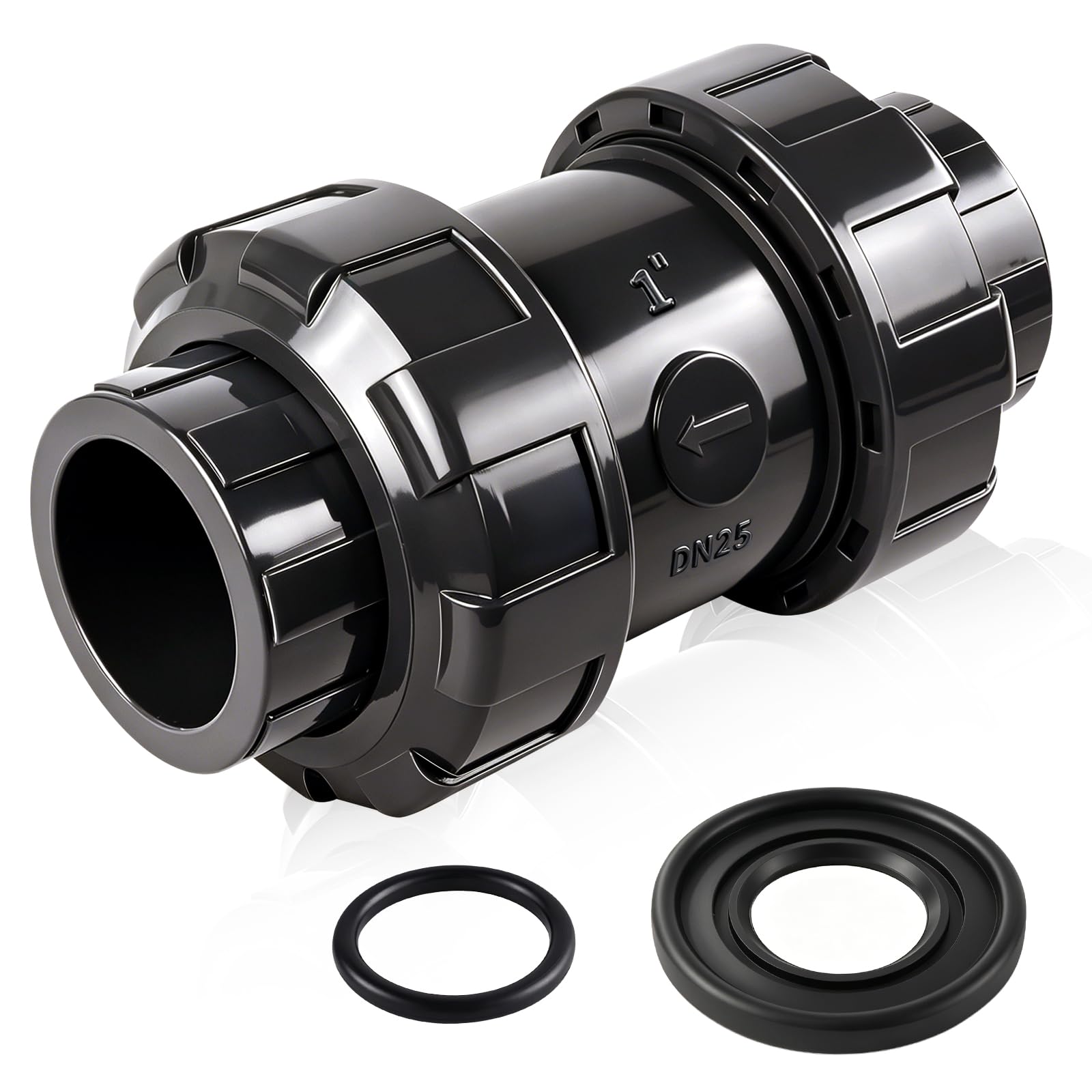
The corrosion-proof union valve you can fully disassemble for cleaning in seconds.
For aquarium systems, pedicure chairs, and pool piping where rust is the enemy, this Boltigen PVC valve is a smart choice. It is a true union check valve (a valve with detachable ends that let you remove the center without cutting pipe) — meaning the entire center section unscrews from the pipe stubs so you can clean the ball and seat without cutting any glue joints. The body is Schedule 80 PVC (a thicker, stronger grade of PVC pipe) rated at 150 PSI, with an EPDM O-ring (a synthetic rubber seal that resists ozone and weather) that resists ozone and UV damage. Several owners using it on pool pump piping and pedicure chairs report it “works well installed vertically with upward flow.” A critical design note: this valve has NO spring. The ball relies on gravity to close, so it MUST be installed vertically with the flow arrow pointing up. If you mount it horizontally or on the suction side of a pump, it will not seal. The backflow control aspect gets mixed reviews — a few owners found it could not seal against a static head of water on the pump suction side, causing priming issues (difficulty getting the pump to draw water).
For applications where you need to regularly inspect or clean debris from the valve (common in pond filters and aquariums), the true-union design is a genuine time-saver. Just respect the vertical-only limitation.
PVC corrosion resistance
- True union design lets you remove the valve without cutting pipe
- No metal parts to corrode — ideal for saltwater or chemical lines
- EPDM O-ring handles UV and low temperatures well
Slip joints leak risk
- Gravity-closed ball requires strict vertical installation with upward flow; fails on horizontal runs or suction-side systems
Choose for chemical lines: aquarium returns, pedicure station drains, and any corrosion-sensitive system where you want easy access for cleaning.
Pass if high pressure: your installation is horizontal or you need a valve that can handle backward static pressure (e.g., on pump suction lines).
5. GASHER 2PCS Brass Check Valve 1″ Female Thread

Two 1-inch brass spring checks for jobs where you need a larger bore at a budget twin-pack price.
When your pipe size jumps to 1 inch, most budget options disappear. The GASHER twin-pack fills that gap: two 1-inch FNPT (female National Pipe Taper) spring-loaded brass valves rated at 200 PSI, with stainless steel springs that let you mount them in any orientation. Performance is the top-praised aspect — buyers confirm it “works great” for fuel, air, oil, and water applications. However, this is a classic “you get what you pay for” scenario. The thread quality receives negative feedback, with several owners reporting that the female threads are overcut, meaning the male pipe bottoms out before the threads fully engage. One owner noted: “Good quality but fails to seal due to short female threads… leaks despite Teflon tape or pipe dope.” A second confirmed the threads “were off a bit” and required a large crescent wrench to force a seal. The overall rating and review count (4.2 stars from 200+ ratings) reflect this split — excellent performance when the threads cooperate, frustration when they do not.
If you have the tools and patience to wrestle with tight threads, this is a solid two-valve deal for 1-inch lines. If you want a sure thing on a critical system, spend a little more on a single premium 1-inch valve like the Merrill CVNL100.
Easy thread installation
- Two 1-inch brass valves at a price that competes with single units
- Spring-loaded design works in any orientation
- Stainless steel spring for corrosion resistance
Brass may tarnish
- Thread quality is a known weak point — overcut female threads can prevent a proper seal
Go for quick install: you need two 1-inch valves for non-critical systems and are comfortable using extra thread sealant or a wrench to get a seal.
Skip if aesthetics matter: you need a guaranteed leak-free seal on a potable water or pressure system — the thread risk is real.
6. Merrill CVNL125 1-1/4″ No-Lead Brass In-Line Check Valve 700 Series
The larger brother to our top pick, built for 400-foot deep wells and high-volume irrigation.
When your pipe size moves up to 1-1/4 inches, you are dealing with serious water volume. The Merrill CVNL125 is the same proven design as the top-ranked CVNL100 — No-Lead Brass construction, IAPMO certification, 200 PSI rating, abrasion-resistant O-ring poppet, and dual-orientation mounting — but scaled for larger flow. A buyer using it on a “400 ft deep submersible well” installed one every hundred feet plus one at the holding tank. “Been several years now and holding up with no back flow leaks.” The construction is repeatedly called “solid” and “comparable to the branded sold by the reputable Home DYI retailer but well below the price.” Functionality and quality are the top-praised aspects across over 200 ratings. Like its smaller sibling, the sealing gets mixed feedback from a small minority, but the overwhelming consensus is a durable, leak-proof valve that lasts years.
If your system requires a 1-1/4-inch bore and you want the same reliability as the best 1-inch valve on the market, this is the straightforward upgrade. It is more expensive than the CVNL100, but for a 400-foot well, the extra size is essential.
Larger flow capacity: deep well systems, large irrigation mains, and any 1-1/4-inch line where brass durability and proven performance matter more than saving a few dollars.
Reach for high volume: your well or irrigation line is 1-1/4 inch and you want a valve with years of positive owner reports at that size.
Pass if tight space: your pipe size is smaller — the CVNL100 is the same design at a lower price point.
7. HYDROSEAL Sharkfellow 1″ PVC True Union Ball Check Valve
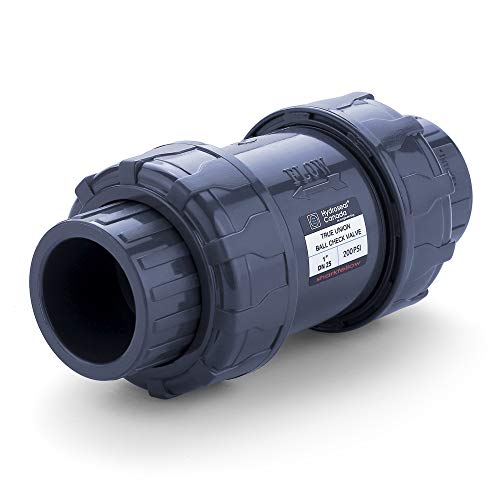
The service-free PVC valve that sump pump owners say will “literally work forever” if installed vertically.
For sump pumps, swimming pools, and irrigation systems where corrosion is the primary enemy, the HYDROSEAL Sharkfellow is a heavy-duty PVC option. It is a true union ball check valve with full-port flow (the internal passage is the same diameter as the pipe, so flow is not restricted), rated at 200 PSI at 73°F (higher than most PVC valves can claim). The ball is gravity-closed and spring-free, so install it vertically with the arrow pointing up and it will never jam from rust. One owner called it “the absolute best you can get at any price for a sump pump.” The true union design lets you remove the valve body for cleaning or replacement without cutting the glued PVC connections. It comes with a set of replacement O-rings right in the box. However, there is a catch: the union threads are non-standard. If you over-tighten and snap a thread, or if you glue the socket in the wrong orientation, you must replace the entire unit — HYDROSEAL does not sell spare union halves. A couple of owners mention thread failures after years of service, possibly from over-tightening. The overall feedback is overwhelmingly positive on build quality, with over 360 ratings backing it.
A few owners also note that the gravity-closed ball is noisy in vertical installations — one moved theirs to horizontal to quiet it, which is technically against the vertical-only guideline, so results can vary.
True union easy maintenance
- 200 PSI rating at 73°F — stronger than typical PVC check valves
- True union design with replacement O-rings included; easy to clean
- Corrosion-free body for pools, aquariums, and sump lines
PVC not for hot water
- Non-standard union threads mean a broken thread requires a full replacement
- Gravity-closed ball can be noisy in vertical position; some install horizontally despite instructions
Get for easy disassembly: a corrosion-free, high-pressure PVC valve on a sump, pool, or irrigation line where you want easy maintenance and do not mind the vertical-only rule.
Avoid if hot fluids: you are prone to over-tightening fittings or need a spring-loaded valve for horizontal mounting.
8. SANKING 3/4″ UPVC True Union Swing Check Valve

The see-through UPVC valve that lets you spot blockages without disassembly.
When you need to visually confirm that your check valve is seating properly or check for debris, a clear UPVC valve like this SANKING is invaluable. It is a 3/4-inch socket-mount true union swing check — meaning it disassembles for cleaning and the clear body lets you watch the ball move. The build quality is consistently called top-notch by buyers. It is rated at 150 PSI, meets ASTM (American Society for Testing and Materials) and ANSI (American National Standards Institute) standards, and the no-spring swing design can be mounted at any angle. That flexibility is important: unlike many gravity-closed valves, this one works in horizontal runs because it is a swing-type rather than a vertical-lift ball. Aquarium owners in particular praise it — one has “one on each of the returns on my aquarium” and notes “being clear also lets you inspect without disassembly.” However, the clear UPVC also makes the reliability feedback more honest: a buyer using it for a condensate line (drain from an air conditioner) found the check ball did not float vertically, so it failed in that role. The highest-count aspect is reliability, and it carries a mixed verdict, so treat this as a valve for low-pressure, visible-service lines where occasional cleaning is expected.
It is purpose-built for hobbyist and light-commercial systems where the ability to see into the flow path is a genuine advantage.
UPVC chemical resistance
- Clear UPVC body lets you inspect for debris without opening the line
- True union design allows full disassembly for thorough cleaning
- Can be mounted at any angle — no strict vertical requirement
Swing mechanism fragile
- Reliability gets mixed feedback; not suitable for systems where automatic sealing is critical
- 150 PSI rating is lower than brass options
Ideal for corrosive media: aquarium return lines, pond filters, and any visible-service system where you prioritize easy cleaning and visual inspection over brute-force sealing.
Not for high pressure: high-pressure well systems, potable water mains, or any installation where a failed seal would cause damage.
Understanding the Specs
Maximum Working Pressure (PSI or MPa)
This is the highest water pressure the valve can handle before it could leak or burst. PSI (pounds per square inch) is the common measure of pressure in plumbing. Brass valves typically land around 200 PSI (1.4 MPa, or megapascals — a metric unit of pressure), while PVC and UPVC versions usually sit at 150 PSI. If your system runs higher — like a deep-well submersible pump or a ram pump — you need a brass valve rated at 200 PSI or more. A standard household water pressure is around 40-60 PSI, so most valves are well within range. The number matters most when the pump cycles on and creates a pressure spike.
Connection Size and Thread Type (NPT vs Socket)
The connection size (3/4 inch, 1 inch, 1-1/4 inch) must match the pipe diameter you are connecting to. NPT (National Pipe Taper) is a standard threaded connection that uses Teflon tape or pipe dope to seal. Socket / slip connections require PVC primer and cement — they are permanent once glued. Always confirm whether your valve has female NPT threads, male NPT, or socket ends before buying. Mixing thread standards will cause leaks.
Spring-Loaded vs Swing (Gravity) Mechanism
Spring-loaded valves use a stainless steel spring to push the ball or poppet shut the moment flow stops. They work in any orientation — vertical, horizontal, or even upside down — making them the most flexible for tight install spaces. Swing or gravity-closed valves have no spring: the ball drops into place by its own weight when flow reverses. This type MUST be installed vertically with flow moving upward. It will fail (leak backward) if mounted horizontally or on the suction side of a pump. If you are not sure about your mounting orientation, always choose a spring-loaded model.
Material: No-Lead Brass vs PVC vs UPVC
No-Lead Brass is the standard for potable (drinking) water systems. It is strong, corrosion-resistant, and can handle higher temperatures (up to around 250°F). PVC is lighter, cheaper, and completely immune to rust, making it the best choice for saltwater aquariums, chemical lines, and pool systems. Clear UPVC adds the ability to see into the valve body for inspection. The trade-off: PVC and UPVC are more brittle than brass, can crack if over-tightened, and often have lower pressure ratings. For underground or concealed installations, the long-term durability of brass is usually worth the extra cost.
FAQ
Will a 3/4 inch check valve work on my 1 inch pipe?
Can I install a brass check valve underground for a well line?
Is a spring check valve better than a swing check valve?
Why does my new check valve leak backward?
What does full port mean on a check valve?
Can I use a PVC check valve on a hot water line?
How do I know if my check valve is NPT or not?
Will a check valve cause water hammer?
Can I use a check valve to keep my pump from losing prime?
How do I clean a check valve without removing it?
{“@context”: “https://schema.org”, “@graph”: [{“@type”: “ItemList”, “name”: “8 Best Ball Check Valve”, “url”: “https://kitchprep.com/best-ball-check-valve/”, “numberOfItems”: 8, “itemListElement”: [{“@type”: “ListItem”, “position”: 1, “name”: “Merrill MFG CVNL100 1\” No-Lead Brass Check Valve 700 Series”, “url”: “https://kitchprep.com/best-ball-check-valve/#product-1”}, {“@type”: “ListItem”, “position”: 2, “name”: “SYWUWV 3/4\” NPT Horizontal Check Valve, Brass Non Return Swing”, “url”: “https://kitchprep.com/best-ball-check-valve/#product-2”}, {“@type”: “ListItem”, “position”: 3, “name”: “Boltigen 2PCS 3/4 NPT Thread Spring Check Valve”, “url”: “https://kitchprep.com/best-ball-check-valve/#product-3”}, {“@type”: “ListItem”, “position”: 4, “name”: “Boltigen PVC True Union Check Valve, 1\” Slip”, “url”: “https://kitchprep.com/best-ball-check-valve/#product-4”}, {“@type”: “ListItem”, “position”: 5, “name”: “GASHER 2PCS Brass Check Valve 1\” Female Thread”, “url”: “https://kitchprep.com/best-ball-check-valve/#product-5”}, {“@type”: “ListItem”, “position”: 6, “name”: “Merrill CVNL125 1-1/4\” No-Lead Brass In-Line Check Valve 700 Series”, “url”: “https://kitchprep.com/best-ball-check-valve/#product-6”}, {“@type”: “ListItem”, “position”: 7, “name”: “HYDROSEAL Sharkfellow 1\” PVC True Union Ball Check Valve”, “url”: “https://kitchprep.com/best-ball-check-valve/#product-7”}, {“@type”: “ListItem”, “position”: 8, “name”: “SANKING 3/4\” UPVC True Union Swing Check Valve”, “url”: “https://kitchprep.com/best-ball-check-valve/#product-8”}]}, {“@type”: “Product”, “position”: 1, “name”: “Merrill MFG CVNL100 1\” No-Lead Brass Check Valve 700 Series”, “image”: “https://m.media-amazon.com/images/I/31rDzTTq8mL.jpg”, “brand”: {“@type”: “Brand”, “name”: “Merrill”}, “url”: “https://www.amazon.com/dp/B08GGBBR63/?tag=kpmaruf-20”, “offers”: {“@type”: “Offer”, “url”: “https://www.amazon.com/dp/B08GGBBR63/?tag=kpmaruf-20”}}, {“@type”: “Product”, “position”: 2, “name”: “SYWUWV 3/4\” NPT Horizontal Check Valve, Brass Non Return Swing”, “image”: “https://m.media-amazon.com/images/I/71vs5Loch4L.jpg”, “brand”: {“@type”: “Brand”, “name”: “SYWUWV”}, “url”: “https://www.amazon.com/dp/B0CGZZJG67/?tag=kpmaruf-20”, “offers”: {“@type”: “Offer”, “url”: “https://www.amazon.com/dp/B0CGZZJG67/?tag=kpmaruf-20”}}, {“@type”: “Product”, “position”: 3, “name”: “Boltigen 2PCS 3/4 NPT Thread Spring Check Valve”, “image”: “https://m.media-amazon.com/images/I/71xmSlZr4rL.jpg”, “brand”: {“@type”: “Brand”, “name”: “Boltigen”}, “url”: “https://www.amazon.com/dp/B0BZYLQB2Y/?tag=kpmaruf-20”, “offers”: {“@type”: “Offer”, “url”: “https://www.amazon.com/dp/B0BZYLQB2Y/?tag=kpmaruf-20”}}, {“@type”: “Product”, “position”: 4, “name”: “Boltigen PVC True Union Check Valve, 1\” Slip”, “image”: “https://m.media-amazon.com/images/I/71KxUCvlfQL.jpg”, “brand”: {“@type”: “Brand”, “name”: “Boltigen”}, “url”: “https://www.amazon.com/dp/B0BG5B659W/?tag=kpmaruf-20”, “offers”: {“@type”: “Offer”, “url”: “https://www.amazon.com/dp/B0BG5B659W/?tag=kpmaruf-20”}}, {“@type”: “Product”, “position”: 5, “name”: “GASHER 2PCS Brass Check Valve 1\” Female Thread”, “image”: “https://m.media-amazon.com/images/I/71M0JsBhL9L.jpg”, “brand”: {“@type”: “Brand”, “name”: “GASHER”}, “url”: “https://www.amazon.com/dp/B0C5X7FMWB/?tag=kpmaruf-20”, “offers”: {“@type”: “Offer”, “url”: “https://www.amazon.com/dp/B0C5X7FMWB/?tag=kpmaruf-20”}}, {“@type”: “Product”, “position”: 6, “name”: “Merrill CVNL125 1-1/4\” No-Lead Brass In-Line Check Valve 700 Series”, “image”: “https://m.media-amazon.com/images/I/31rDzTTq8mL.jpg”, “brand”: {“@type”: “Brand”, “name”: “Merrill”}, “url”: “https://www.amazon.com/dp/B01IRMACX2/?tag=kpmaruf-20”, “offers”: {“@type”: “Offer”, “url”: “https://www.amazon.com/dp/B01IRMACX2/?tag=kpmaruf-20”}}, {“@type”: “Product”, “position”: 7, “name”: “HYDROSEAL Sharkfellow 1\” PVC True Union Ball Check Valve”, “image”: “https://m.media-amazon.com/images/I/418qVw5NoRL.jpg”, “brand”: {“@type”: “Brand”, “name”: “HYDROSEAL”}, “url”: “https://www.amazon.com/dp/B07L3Y3H2P/?tag=kpmaruf-20”, “offers”: {“@type”: “Offer”, “url”: “https://www.amazon.com/dp/B07L3Y3H2P/?tag=kpmaruf-20”}}, {“@type”: “Product”, “position”: 8, “name”: “SANKING 3/4\” UPVC True Union Swing Check Valve”, “image”: “https://m.media-amazon.com/images/I/610EQ7JQF4L.jpg”, “brand”: {“@type”: “Brand”, “name”: “SANKING”}, “url”: “https://www.amazon.com/dp/B08KVYDQTV/?tag=kpmaruf-20”, “offers”: {“@type”: “Offer”, “url”: “https://www.amazon.com/dp/B08KVYDQTV/?tag=kpmaruf-20”}}, {“@type”: “FAQPage”, “mainEntity”: [{“@type”: “Question”, “name”: “Will a 3/4 inch check valve work on my 1 inch pipe?”, “acceptedAnswer”: {“@type”: “Answer”, “text”: “No. The valve size must match the pipe size for a proper seal and full flow. A 3/4 inch valve on a 1 inch pipe would create a bottleneck and require a bushing (a fitting that reduces pipe size), which adds potential leak points. Buy the size that matches your existing pipe’s nominal diameter.”}}, {“@type”: “Question”, “name”: “Can I install a brass check valve underground for a well line?”, “acceptedAnswer”: {“@type”: “Answer”, “text”: “Yes, brass is well-suited for direct burial because it resists corrosion from soil moisture. No-Lead brass is especially durable. The Merrill CVNL100 and CVNL125 are commonly used in underground well pump systems. Just wrap the NPT threads well with Teflon tape to protect the connection.”}}, {“@type”: “Question”, “name”: “Is a spring check valve better than a swing check valve?”, “acceptedAnswer”: {“@type”: “Answer”, “text”: “It depends on your installation. A spring check valve works in any position (vertical, horizontal, or angled) because the spring forces the ball shut. A swing / gravity check valve must be installed vertically with upward flow. For tight spaces or horizontal runs, a spring check valve is the better choice. For straight vertical pipes where you want fewer moving parts, a swing valve is fine.”}}, {“@type”: “Question”, “name”: “Why does my new check valve leak backward?”, “acceptedAnswer”: {“@type”: “Answer”, “text”: “The most common reasons are: (1) installing a gravity-closed valve horizontally or upside down, (2) debris caught in the ball seat, (3) over-tightening that warped a plastic body, or (4) insufficient Teflon tape on NPT threads causing a connection leak rather than a valve leak. First check your installation orientation and clean the seat.”}}, {“@type”: “Question”, “name”: “What does full port mean on a check valve?”, “acceptedAnswer”: {“@type”: “Answer”, “text”: “Full port means the internal bore (the hole the water flows through) is the same diameter as the pipe you are connecting. This minimizes flow restriction and pressure drop. It matters most for high-flow applications like pool pumps or irrigation mains. Many PVC true union valves are full port; smaller spring check valves sometimes have a reduced internal bore.”}}, {“@type”: “Question”, “name”: “Can I use a PVC check valve on a hot water line?”, “acceptedAnswer”: {“@type”: “Answer”, “text”: “No. PVC is typically rated for a maximum temperature of around 140°F. Hot water lines can exceed that. EPDM seals (synthetic rubber seals) also degrade at high temperatures. Brass check valves with abrasion-resistant O-rings handle temperatures up to 250°F or more. Use brass for any hot water or steam application.”}}, {“@type”: “Question”, “name”: “How do I know if my check valve is NPT or not?”, “acceptedAnswer”: {“@type”: “Answer”, “text”: “NPT threads have a slight taper — they get tighter as you screw the male pipe into the female connector. Look for \”NPT\” in the product description or for the \”National Pipe Tapered\” spec. If the valve uses socket ends (smooth inside for gluing), it is not NPT. Visual check: NPT threads are angled and sharp; straight threads are parallel.”}}, {“@type”: “Question”, “name”: “Will a check valve cause water hammer?”, “acceptedAnswer”: {“@type”: “Answer”, “text”: “It can if the valve slams shut too quickly. Spring-loaded check valves typically close faster than swing types, which can cause a hammering sound. Some owners reduce noise by installing the valve at a lower pressure point or switching to a swing valve (which closes more gently). If hammer is a concern, look for valves with cushioned or silent-close features, or install a shock absorber.”}}, {“@type”: “Question”, “name”: “Can I use a check valve to keep my pump from losing prime?”, “acceptedAnswer”: {“@type”: “Answer”, “text”: “Yes, a check valve installed on the pump discharge line just above the pump prevents water from draining back when the pump shuts off. This keeps the pump primed (filled with water so it can pump) and reduces startup wear. The Merrill CVNL100 is a common choice for this on shallow well pumps. Make sure the valve is rated for your pump’s maximum pressure and flow rate.”}}, {“@type”: “Question”, “name”: “How do I clean a check valve without removing it?”, “acceptedAnswer”: {“@type”: “Answer”, “text”: “If your valve is a PVC true union type (like the Boltigen or HYDROSEAL), you can unscrew the center section without disconnecting the pipe. For clear UPVC versions (like the SANKING), you visually inspect and can disassemble the union. For brass NPT valves, you typically need to unscrew the entire valve from the pipe. Flushing the system with clean water can sometimes clear minor debris without disassembly.”}}]}]}
Related Guides

Related Guides