
Specs are compiled from manufacturer listings and verified buyer reviews and can change over time — please confirm the key details on the product page before buying.
If your 4G or 5G router lives in a spot where bars are scarce and video calls stutter, an external 4×4 MIMO antenna is the single upgrade that turns a frustrating connection into a genuinely usable one. These antennas pack four internal elements that grab signals from every direction at once, so you stop fussing over placement and start getting consistent speeds.
I’m Mohammad Maruf — the founder and writer behind KitchPrep. This guide is built by comparing the manufacturers’ published specifications and the patterns across verified customer reviews, so you get each pick’s real strengths and trade-offs instead of marketing spin.
The three antennas we compare cover the real range of what you should expect from a 4×4 mimo antenna, from a budget-friendly entry-level model to a rugged vandal-proof option built for permanent outdoor duty.
Our Picks at a Glance
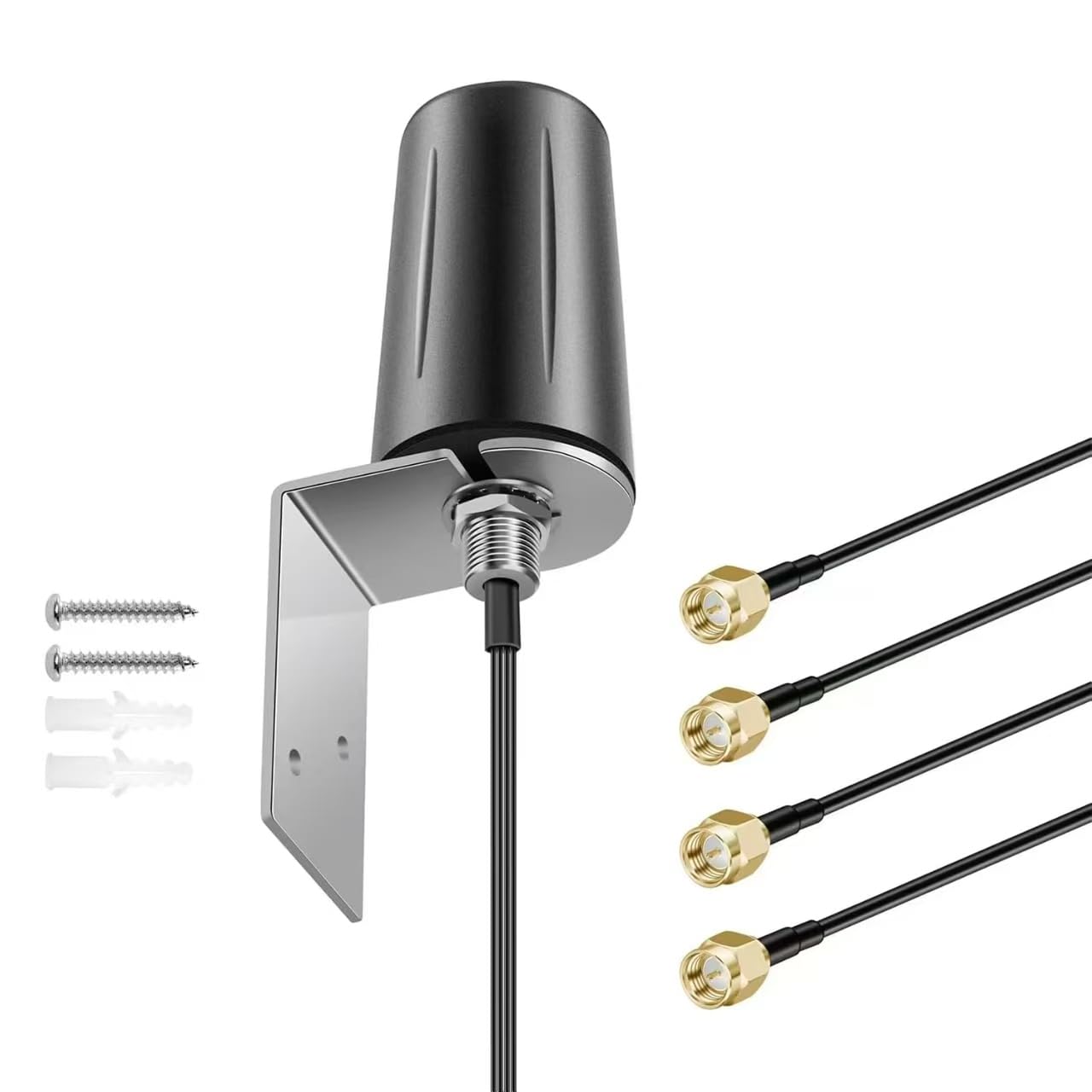
How To Choose The Best 4×4 MIMO Antenna
A 4×4 MIMO antenna sounds technical, but the buying decision depends on a few straightforward numbers and your physical setup. Here is what actually matters.
Gain: The Number That Predicts Speed
Gain, measured in dBi, tells you how well the antenna amplifies the signal it receives. A higher dBi means stronger pull on distant towers — but omni-directional antennas (which cover 360 degrees) rarely exceed 5-6 dBi. For most home and RV setups, aim for 3 dBi to 5 dBi. Too low and you see no improvement; claims above 6 dBi on a compact omni are usually marketing, not physics.
Cable Quality: The Hidden Speed Killer
The cable that runs from the antenna to your router eats signal strength. Thinner cables like RG174 lose more signal per foot than thicker cables like CFD195 or LMR400. A 10-foot run on a high-loss cable can erase half the antenna’s gain. If your antenna will sit far from the router, prioritize models that use low-loss coax.
Frequency Coverage: Does It Catch Your Band?
4G LTE and 5G sub-6 GHz networks operate across a wide range — roughly 600 MHz to 6000 MHz. A good 4×4 MIMO antenna covers that whole span. Check that the antenna you pick explicitly lists support for all major US carrier bands (AT&T, Verizon, T-Mobile) and ideally worldwide frequencies if you travel.
Quick Comparison
| Model | Best For | Gain (dBi) | Frequency Range | Cable Type | Amazon |
|---|---|---|---|---|---|
| Slinkdsco 4×4 MIMO★ Best Overall | Budget home / RV upgrades | 5 dBi | 698-6000 MHz | RG174 (10 ft) | Amazon |
| Proxicast ANT-121-T44-W-02 | Rugged outdoor / commercial | 3-5 dBi | 600-6000 MHz | CFD195 low-loss (2 ft) | Amazon |
| Proxicast ANT-121-M44 | Vandal-resistant / fleet installs | 3-4 dBi | 600-6000 MHz | — (10 ft leads, SMA male) | Amazon |
In‑Depth Reviews
1. Slinkdsco 4×4 MIMO Omnidirectional Low Profile Antenna
The budget-friendly starter that delivers massive speed jumps when your router and placement play along.
This omni-directional antenna (it pulls signals from all 360 degrees) covers a broad 698-6000 MHz range — that means it reaches every major US carrier for both 4G and 5G bands — and claims a 5 dBi gain, the highest of the three picks here. That extra gain translates to a stronger pull on distant towers, which helps explain the wild swings in owner reports: buyers see real speed explosions (one went from 120-200 Mbps to 610 Mbps with a T-Mobile gateway) while others saw single-digit percentage bumps. The catch is the thin RG174 cable, which loses signal noticeably over its 10-foot run, so the antenna needs to sit near your router for best results.
The consensus among owners is that value for money is its strongest point, and installation is straightforward thanks to the wall-mount bracket and labeled SMA male connectors (SMA male has a center pin that fits into your router’s SMA female port). The mixed feedback on signal strength (22 mentions) suggests this antenna is more sensitive to placement than the pricier options — you will need to find an open spot high up, ideally near a window or under an eave. It works best with hardware that genuinely supports 4×4 MIMO; older modems may show only a modest gain. Compared to the Proxicast ANT-121-T44-W-02, its thinner cable eats up some of that 5 dBi gain advantage, so in a long-run install the Proxicast may actually deliver stronger signal to your router.
Where It Shines
- 5 dBi gain — highest raw pull of the three antennas here
- Huge real-world speed leaps reported with compatible T-Mobile gateways
- Easy wall-mount install with clear wire labeling
The Trade-Offs
- RG174 cable loses signal quickly; ideal placement limited by 10-foot run
- Performance is highly placement-dependent — some found no improvement
- Mixed reliability: some owners say internal antenna outperformed it
Reach for this if: you want an affordable entry into 4×4 MIMO and have a clear outdoor mounting spot near your router.
Look elsewhere if: your router sits far from the window or you need guaranteed results on a commercial-grade install. That is the territory of the Proxicast ANT-121-T44-W-02.
2. Proxicast 4×4 MIMO Low Profile Vandal Resistant Antenna (ANT-121-T44-W-02)

The compact powerhouse that saved one owner a month by restoring full 5G service.
This Proxicast antenna packs four isolated omni-directional elements covering 600-6000 MHz with 3-5 dBi gain. The real story here is the low-loss CFD195 coax cable, which loses far less signal than the thinner RG174 cable used by the Slinkdsco pick — a critical advantage when your antenna must sit far from the router. Buyers report dramatic turnarounds: one buyer in a weak signal area restored 5G service to 400-500 Mbps down and 30 Mbps up, replacing a Starlink connection.
Build quality is the standout. The IP67 weatherproof rating (it is sealed against dust and can survive brief immersion in water) means you can mount it on a roof, a fleet vehicle, or inside a NEMA enclosure without worry. At 16 ounces it is noticeably heavier than the 8.8-ounce ANT-121-M44, and the 2-foot factory cable is short — you will likely need extension cables (SMA female to male) for a permanent outdoor install.
The Owner Verdict: “Small and powerful” is how buyers describe it — several doubled their cellular speeds in commercial van and RV setups. The one complaint is that internal antennas sometimes work better in ideal signal areas, reinforcing that this antenna is designed for marginal-signal rescue, not signal improvement where reception is already good.
Best for: commercial vehicles, ATMs, RV roofs, or any spot that needs a weather-sealed permanent antenna that can handle harsh conditions.
Not ideal if: you need a longer integrated cable or you are in a strong signal area where an indoor antenna already suffices. For a cheaper try-first option, the Slinkdsco makes more sense.
3. Proxicast Vandal Resistant 4×4 MIMO Antenna (ANT-121-M44)

A vandal-proof design that sits barely over 3 inches tall — but performance is hit-or-miss without a proper metal ground plane.
This model shares the same core 600-6000 MHz frequency coverage and four isolated MIMO elements as its Proxicast sibling above, but in a taller 3.2-inch form factor and a lighter 8.8-ounce body. The key difference: it includes four 10-foot SMA male coax leads already attached, saving you the cost of extension cables for many rooftop installations. The manufacturer specifies that this antenna works best when mounted through a flat metal surface — that metal sheet acts as a ground plane that reflects signals back into the elements.
Owner feedback is genuinely split here. Some report solid improvements to 5G home internet performance, while others saw worse speeds than their router’s internal antennas — one measured ping jumping from 60ms to 147ms and download dropping from 80 Mbps to 43 Mbps after installing this unit. The common thread is that buyers who mounted it with a proper metal ground plane fared better than those who used the included bracket alone. This is a more finicky install than either the Slinkdsco or the Proxicast ANT-121-T44-W-02, both of which perform well on a simple bracket mount.
What Works
- Full 4×4 MIMO with 10-foot leads included — saves on extension costs
- Vandal-resistant materials suit unattended public or fleet installations
- Compatible with all major US and worldwide 4G/5G carriers
The Challenges
- Requires a flat metal ground plane for optimal performance; bracket-only mounting often disappoints
- Some owners mention worse signal than stock internal antennas
- Price is higher than the results many experienced
Choose this if: you have a metal roof, vehicle roof, or NEMA enclosure to mount it through and want a built-in 10-foot cable assembly.
skip it if: you need a simple bracket mount on wood or plastic — the performance gap will frustrate you. The Slinkdsco is the simpler budget option for that scenario.
Understanding the Specs
Gain (dBi)
Gain measures how efficiently the antenna concentrates radio energy in a given direction. A 5 dBi antenna provides a gain of 5 dBi, compared to a 3 dBi antenna’s gain of 3 dBi. For omnidirectional antennas (which send and receive in a full 360-degree circle), 3-5 dBi is the practical balance. Higher dBi numbers on compact antennas are often misleading because the omni pattern can’t physically squeeze into a smaller housing without sacrificing coverage area.
Cable Loss (dB per foot)
Every foot of coax cable between your antenna and router subtracts signal. Thin RG174 cable loses about 0.6-0.8 dB per foot at cellular frequencies — a 10-foot run costs you 6-8 dB of your antenna’s gain. Low-loss CFD195 or LMR400 has lower loss, so the Proxicast ANT-121-T44-W-02 preserves more of its 3-5 dBi gain than the Slinkdsco with its RG174 cable. If your antenna sits more than 6 feet from the router, low-loss cable is the difference between a working upgrade and a waste of money.
Frequency Range (MHz)
Wireless carriers use many different frequency blocks. Lower frequencies (600-900 MHz) travel farther and penetrate walls better, while higher frequencies (1700-6000 MHz) carry more data but need a clearer path. A 4×4 MIMO antenna that covers 600-6000 MHz captures every major LTE and 5G sub-6 band used in North America and most of the world. An antenna that starts at 698 MHz, like the Slinkdsco, still catches most bands but misses the lowest 600 MHz band used by T-Mobile for long-range 5G.
4×4 MIMO vs 2×2 MIMO
MIMO stands for Multiple-Input Multiple-Output — it uses multiple antennas to send and receive separate data streams simultaneously. A 2×2 antenna has two elements and can handle two data streams. A 4×4 has four elements and can handle four streams, which increases the theoretical peak data rate in good signal conditions. Your router or modem must also support 4×4 MIMO (look for four antenna ports) to benefit; using a 4×4 antenna on a 2×2 router still helps with raw signal collection but you lose the speed multiplication advantage.
FAQ
Will any 4×4 MIMO antenna work with my T-Mobile or Verizon 5G home internet gateway?
Do I need a 4×4 MIMO antenna if my router is only 2×2 MIMO?
How long do these outdoor antennas last in rain and snow?
Can I install a 4×4 MIMO antenna on an RV while traveling?
Why did my speed get worse after installing an external antenna?
What is the difference between SMA male and SMA female connectors, and which do I need?
How high should I mount the antenna for best results?
Can I use a 4×4 MIMO antenna indoors?
Is a 4×4 MIMO antenna worth it if I already have a good cellular signal?
Final Thoughts: The Verdict
Across the board, the 4×4 mimo antenna winner is the Slinkdsco 4×4 MIMO because it pairs the highest 5 dBi gain with an approachable price that makes upgrading your home or RV internet a low-risk experiment. If you need a weatherproof antenna for a commercial fleet vehicle, ATM, or permanent outdoor deployment, grab the Proxicast ANT-121-T44-W-02 for its IP67 durability and low-loss cable. And for a vandal-resistant screw-mount installation through a metal roof or enclosure, the Proxicast ANT-121-M44 is worth considering — just be prepared to provide a proper ground plane to open up its full potential.
How We Picked
We do not accept paid placement. Every pick is matched to a real buyer and a real use-case; we do not hands-on test units.
Sources & Methodology
Specifications: manufacturer listings and product documentation. Review insights: verified customer reviews, as of July 2026. Pricing: not shown on this page (it changes often); check the current price via the retailer link.
As an Amazon Associate, KitchPrep earns from qualifying purchases. This does not affect which products we feature.
Related Guides
