
Specs are compiled from manufacturer listings and verified buyer reviews and can change over time — please confirm the key details on the product page before buying.
Your sump pump is the only thing standing between your basement and a flood, but when a storm knocks out the power, that pump becomes a useless plastic bucket. A backup generator for a sump pump keeps the water moving when the grid goes dark — and picking the right one means the difference between a dry basement and a costly cleanup.
I’m Mohammad Maruf — the founder and writer behind KitchPrep. This guide is built by comparing the manufacturers’ published specifications and the patterns across verified customer reviews, so you get each pick’s real strengths and trade-offs instead of marketing spin.
if you need a battery-powered inverter that kicks in silently or a water-driven system that runs on your home’s pressure, finding the right best backup generator for a sump pump depends on matching the power output and runtime to your pump and your local weather risks.
Our Picks at a Glance


How To Choose The Best Backup Generator for a Sump Pump
The right backup system for your sump pump depends on three things: how much power your pump draws at start-up, how long you need it to run without grid power, and if you want a battery-based system or a water-powered unit that needs no electricity at all. Here is what to focus on.
Wattage and Starting Surge
A sump pump motor draws significantly more power in the first second of starting up — often two to three times its running wattage. A 1/3 horsepower pump might run on 600 watts but need over 1,500 watts to get the motor spinning. That is why a 1500W backup unit is the practical minimum for a single pump, and 2000W gives you margin for a second pump or longer duty cycles.
Battery Compatibility and Charging Speed
Most backup inverters require a separate 12V deep-cycle battery (AGM or LiFePO4 types are best). The built-in charger’s amperage rating determines how fast your battery recharges after an outage — a 20A or 25A charger restores a 100Ah battery far faster than a 5A unit, which matters if storms hit back-to-back. Some units offer selectable charging modes for different battery chemistries, which protects battery lifespan.
Pure Sine Wave vs Modified Sine Wave
Pure sine wave inverters produce clean AC power that is identical to grid electricity. Sump pump motors run cooler, quieter, and more reliably on pure sine wave power, and it also protects any sensitive electronics connected to the backup (alarms, controllers). Modified sine wave inverters are cheaper but can cause motor hum, overheating, or premature pump failure.
Water Powered as an Alternative
A water-powered backup sump pump uses your home’s municipal water pressure to create suction and pump water out of the pit. These units require no battery, no inverter, and no generator — they work as long as the city water stays on. The trade-off is higher water usage during operation and dependency on municipal water pressure, which can vary.
Quick Comparison
| Model | Best For | Power Output | Battery Charger | Weight | Amazon |
|---|---|---|---|---|---|
| PumpSpy 1500W★ Best Overall | Best Overall Balance | 1500W / 12.5A | Trickle Charge | 10.5 lb | Amazon |
| VIOPUMPO 2500WPremium Pick | Top-Rated Premium | 2500W | Built-in 25A | — | Amazon |
| OLTEANP 2500WHigh-End Power | High-End Power & Remote | 2500W | Built-in 25A | — | Amazon |
| Basement Sentry | Compact Plug-and-Play | 12V Pump / 29 GPM | Built-in Charger | 9.9 lb | Amazon |
| Miumoon 1500W | Budget 1500W Workhorse | 1500W / 13.6A | Built-in 20A | 9 lb | Amazon |
| Cantonape 2000W | Entry-Level 2000W | 2000W | Built-in 20A | — | Amazon |
| VEVOR 2000W | Fast Charging Value | 2000W | Built-in 20A | 12.28 lb | Amazon |
| QWUAV 2000W | Smart Screen Monitoring | 2000W | 3-Stage Charger | 10.9 lb | Amazon |
| Miumoon 2000W | 30A Fast Charging | 2000W | Built-in 30A | 12 lb | Amazon |
| Basepump RB750 | No Electricity Needed | 15 GPM @ 15 ft lift | N/A (Water Powered) | 6 lb | Amazon |
In‑Depth Reviews
1. PumpSpy 1500W Sump Pump Battery Backup System
Our pick — 4.5★ from 350+ verified ratings; the strongest balance of quality and price.
The quiet workhorse that earned its reputation one dry basement at a time.
This is the pick that wins on sheer owner enthusiasm — the crowd favorite for a reason. It delivers a stable pure sine wave 120 VAC output at 1500 Watts and can power two primary sump pumps at the same time, as long as their combined current stays under 12.5 Amps. That means you can have your main pump and a secondary pump both running off one unit, which is rare at this price tier.
Owners rave about compatibility — it is the most-praised feature — and the ease of installation comes a close second. The unit trickle-charges a separate 12V deep-cycle battery (sold separately) and switches to battery power instantly when the grid goes down. Buyers report that with a second battery wired in parallel, the system ran for 48 hours without the voltage dropping below 12.1V, which is the kind of real-world endurance that turns a storm from a crisis into an inconvenience. At 10.5 pounds, it is noticeably lighter than many 2000W units, and its aluminum enclosure is built to last.
The main trade-off is that the included battery cables are short, so you may need to buy longer ones depending on where you mount the unit relative to the battery. Also, the noise level gets mixed feedback — some owners find the fan audible when it kicks on, though most say it is quieter than the older inverter it replaced.
What Wins Owners Over
- Compatibility praised most by far — 52 owners single it out
- Pure sine wave output protects pump motor and electronics
- Runs two pumps simultaneously under 12.5A total
What to Know Before Buying
- Battery cables are short; plan for longer runs
- Fan noise is noticeable to some, fine to most
Your best bet if: you want a proven pure-sine-wave system that can handle two pumps and has a massive owner community backing its reliability.
Reconsider if: you need a ready-to-run system with zero assembly — you will need to supply and connect a deep-cycle battery (12V AGM recommended).
2. VIOPUMPO 2500W Sump Pump Battery Backup System
Nearly flawless ratings and enough power to run a 3/4 HP pump for hours on end.
This is the top-rated unit in the entire category — owners describe it as “super simple” and “great value” in the same breath. It outputs a clean, grid-like 2500 Watts of pure sine wave power, which is enough headroom to handle the starting surge of even a 3/4 HP sump pump without breaking a sweat. The built-in 25A battery charger supports fast charging for deep-cycle lithium, AGM, and other battery types, and it includes overcharge protection to extend your battery’s life.
The high-definition LCD remote control is a standout — it lets you monitor battery voltage, power draw, and charge status from a distance, so you don’t have to walk down to the basement to check on it. Owners confirm the inverter switches instantly from AC to DC when the power cuts, and one buyer of a 3/4 HP pump found that after a 3-minute run, the battery had only dropped to 98%, estimating 5-6 hours of continuous runtime. That kind of efficiency comes from the pure sine wave output, which lets the motor run cooler.
The one knock is that the instructions are a little unclear — a few owners needed a YouTube video to get through the initial setup. But once wired, it is reliably silent and “just works” during outages.
Your verdict: the highest-rated system (4.8 stars across a solid base) for anyone who wants maximum power, remote status monitoring, and a unit that pairs easily with a deep-cycle battery.
skip it if: you want the simplest possible setup with crisp instructions — this one takes a little patience the first time.
3. OLTEANP 2500W Sump Pump Battery Backup System
Three-in-one smart unit that handles your pump and then some.
This is the “inverter, charger, and transfer switch in one box” that sums up the premium experience. Its 2500W pure sine wave output is rated specifically for sump pumps, but owners have successfully run a 400W furnace and 100W of internet gear alongside the pump. The built-in 25A smart charger supports LiFePO4, AGM, Gel, and Flooded deep-cycle batteries, with selectable charging modes to tune battery lifespan — not just a one-size-fits-all trickle.
The wired remote LCD controller is a nice touch: you mount it wherever convenient and get real-time battery voltage, load status, and operating mode. During an outage, the relay click transition happens without disturbing connected electronics. One caveat that several owners mention: after a full battery drain, the inverter defaults to “off” when AC power returns and needs a manual power-on. That is a small but important thing to remember if you are away from home during a storm.
Standout feature: the 25A smart charger with multi-chemistry compatibility — charges a depleted battery fast and prolongs its service life. If you plan to use LiFePO4 batteries, this is the most friendly charger of the bunch.
Heads up: the manual-recovery-after-drain behavior means you should pair this with a battery large enough to cover your longest expected outage.
4. Miumoon 1500W Primary Sump Pump Backup System

The 1500W unit that backs itself with a 20A charger and a proven track record.
This is the value-conscious choice that still delivers serious performance. It runs at 1500 Watts with a max current of 13.6 Amps, which is slightly higher than the PumpSpy (12.5A) — meaning it has a touch more headroom for running dual pumps if needed. The built-in 20A battery charger is a real upgrade over simple trickle chargers: it fast-charges a variety of battery types and includes overcharge protection. Owners confirm it works with both LiPo and lead acid batteries, and the switch on the unit lets you set the discharge limit (50% for lead acid, full for LiPo) to preserve battery health.
Performance is the most-praised aspect, with owners reporting it has run for nearly two years without a hiccup, clicking on instantly when the power goes out. The LCD display shows operating status, and the aluminum enclosure is built for basement conditions. At 9 pounds, it is the lightest inverter in this roundup, which makes wall mounting simpler.
The trade-off is that the manual could be clearer on the battery type switch settings — some owners needed to experiment to get the best charging behavior. Also, it does not come with a remote display panel.
Strong Points
- 20A charger charges batteries much faster than trickle systems
- Compatible with both LiPo and lead acid with adjustable discharge
- Lightest unit at 9 lb — easy to mount on wall
Considerations
- No remote display — you have to walk to the unit to see status
- Manual could be clearer on battery switch settings
Reach for this if: you want a fast-charging, lightweight 1500W system at a reasonable cost and are comfortable with a little manual reading.
Look elsewhere if: you absolutely need a remote monitor or find tiny-button configurations frustrating.
5. QWUAV 2000W Sump Pump Battery Backup System
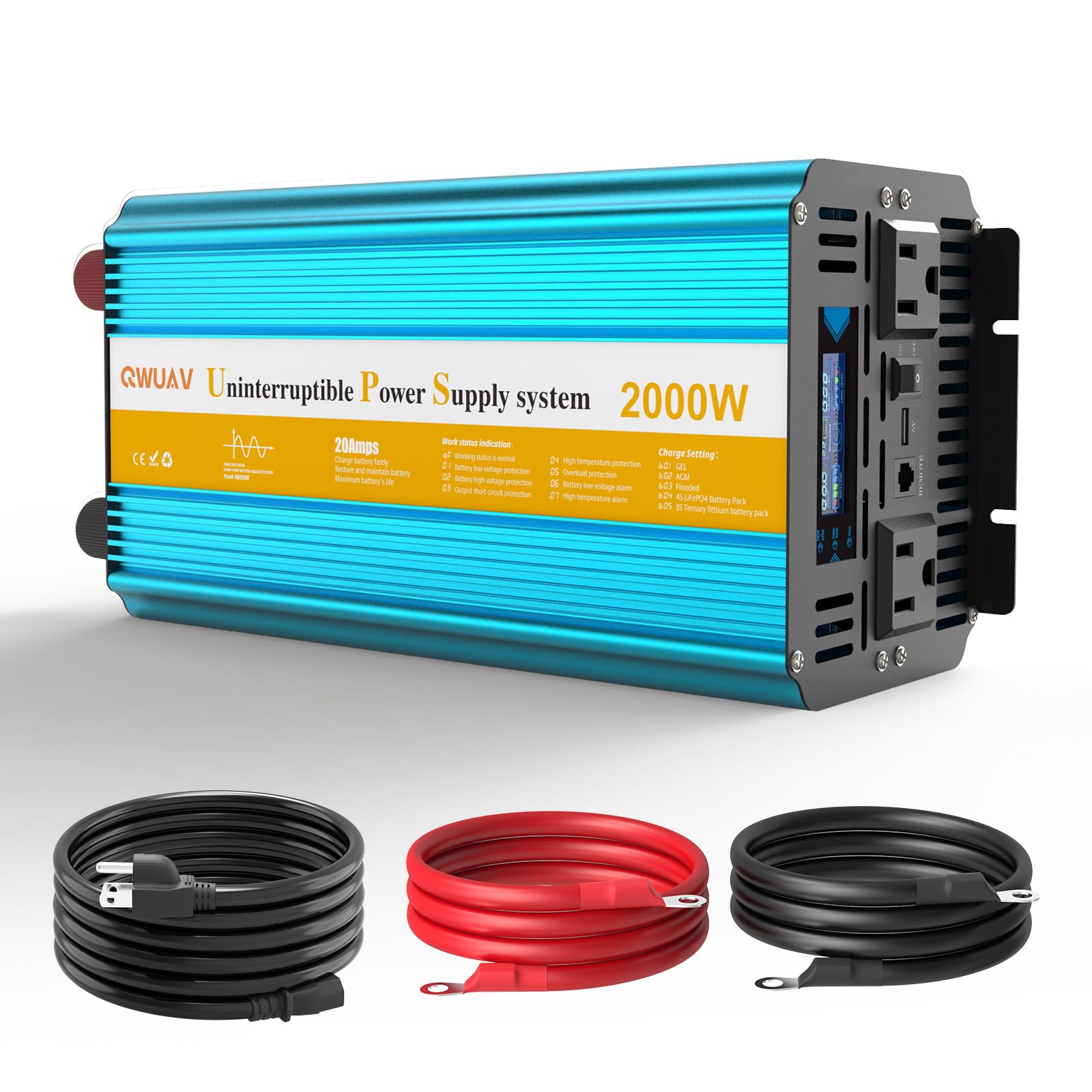
A 2000W unit that lets you tweak voltage, frequency, and battery type right on the screen.
This one stands apart because of its advanced chipset and smart screen. Unlike most systems where you are stuck with preset values, this inverter lets you manually adjust output frequency, voltage, and choose between different battery modes (AGM, LiFePO4, etc.) from the LCD panel. That is a serious advantage if you plan to switch battery chemistries down the line or want to tune the charging profile for a specific brand of deep-cycle battery.
It delivers 2000 Watts of pure sine wave power with a three-stage intelligent charging mode that ensures fast charging without damaging the battery. Owners describe it as “very easy to attach to the sump pump” — installed in minutes. The all-aluminum, scratch-resistant body with thickened terminals and all-copper wire fittings feels durable, and the smart fan runs quietly most of the time. A few owners noted that some of the on-screen menus can be confusing, but once you set it up, you rarely need to touch it again.
The only recurring downside is that the fan can run almost continuously in certain modes, but in a basement that is rarely a problem.
The big advantage: user-adjustable output settings give you control that no other unit in this price range offers. If you are the type who wants to tune your setup, this is your system.
6. VEVOR 2000W Sump Pump Battery Backup System

The VEVOR 2000W delivers fast charging and a clear display at a crowd-pleasing price point.
VEVOR’s entry into this category is built around speed and visibility. Its 20A charging current can top up a 100AH battery in about 5 hours — the maker claims at 20A versus a 5A charger — which matters when storms come in waves. The high-definition LCD screen paired with LED indicator lights shows voltage, power level, battery level, and system status at a glance.
Power reliability is what owners praise most, and the auto-switchover to inverter power during an outage works instantly. The unit includes multiple safety protections (overload, short circuit, overcharge, overheat, and a physical circuit breaker). At 12.28 pounds, it is one of the heavier units, which is partly due to its sturdy internal cooling system. A handful of owners reported a bad unit from the start — a risk with any electronics, though VEVOR’s customer service response was reportedly inconsistent for those cases.
Where It Shines
- 20A fast charger replenishes a 100AH battery in ~5 hours
- Clear LCD display with LED indicators for easy monitoring
- Strong owner consensus on power reliability
Room for Improvement
- Heavier than comparable 2000W units
- Quality control on initial units is mixed — worth checking on delivery
Go with this one if: fast battery replenishment is your priority and you like a big, readable display with LED alerts.
Think twice if: you want the lightest possible unit or need a system with a flawless out-of-box track record.
7. Cantonape 2000W Sump Pump Battery Backup System
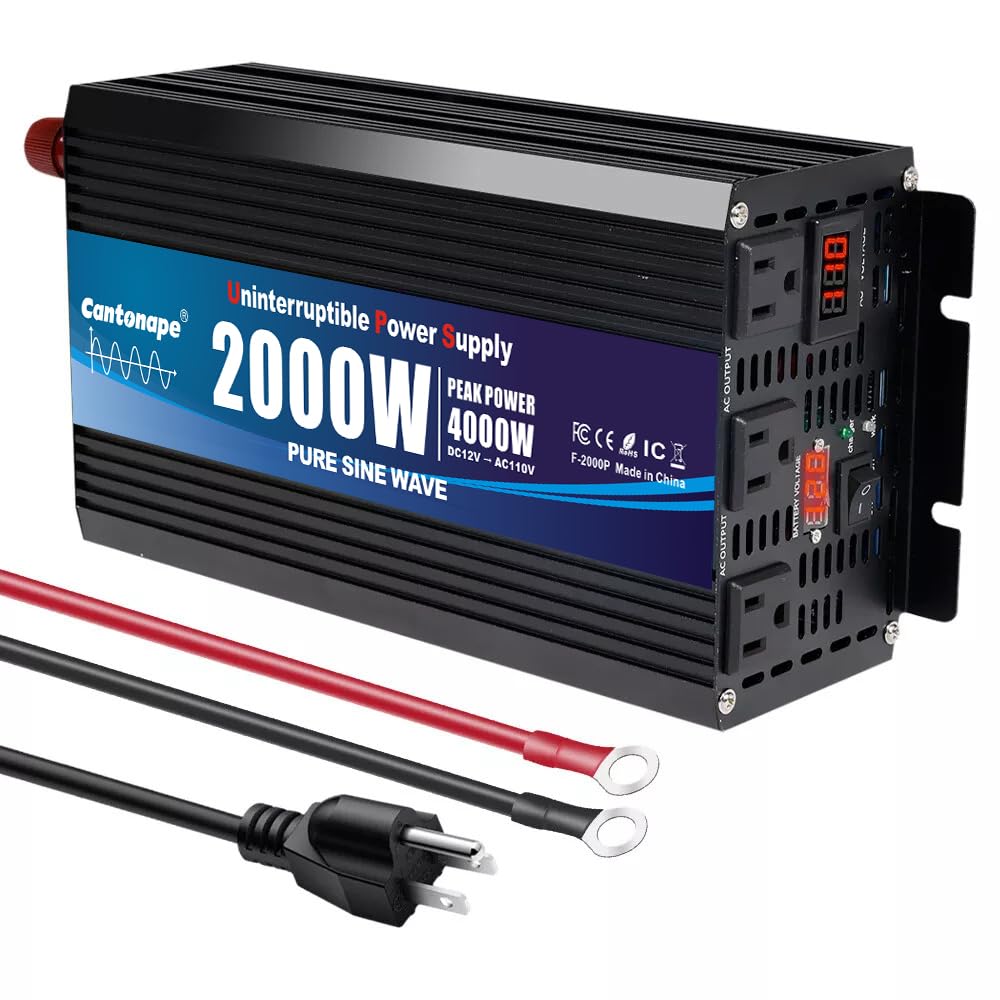
2000 watts of pure sine wave backup at a price that undercuts most 1500W units.
If you want the biggest wattage for the smallest spend, the Cantonape delivers. It outputs 2000 Watts of pure sine wave power — enough for a 1/3 HP pump with plenty of headroom — and features three AC outlets so you can plug in additional devices like a phone charger or a light. The built-in 20A battery charger supports fast charging for AGM, Gel, and flooded batteries.
Owners praise its reliability, and one buyer with a Zoeller sump pump confirmed it switched instantly during a power loss test. The LED display shows AC voltage and battery voltage in real time. The biggest catch is the manual: the print is tiny and the instructions are sparse. One owner found the manual mentions a car charger but no connector is included. That said, it is priced more like a 1500W system while delivering 2000W of capacity.
The honest take: if you are comfortable with simple wiring (positive/negative cables to a battery, plug in the pump) and don’t need a detailed manual, this is the best pure-wattage-to-dollar value on the list. The 12-month warranty gives you coverage for the first year.
8. Miumoon 2000W Primary Sump Pump Backup System
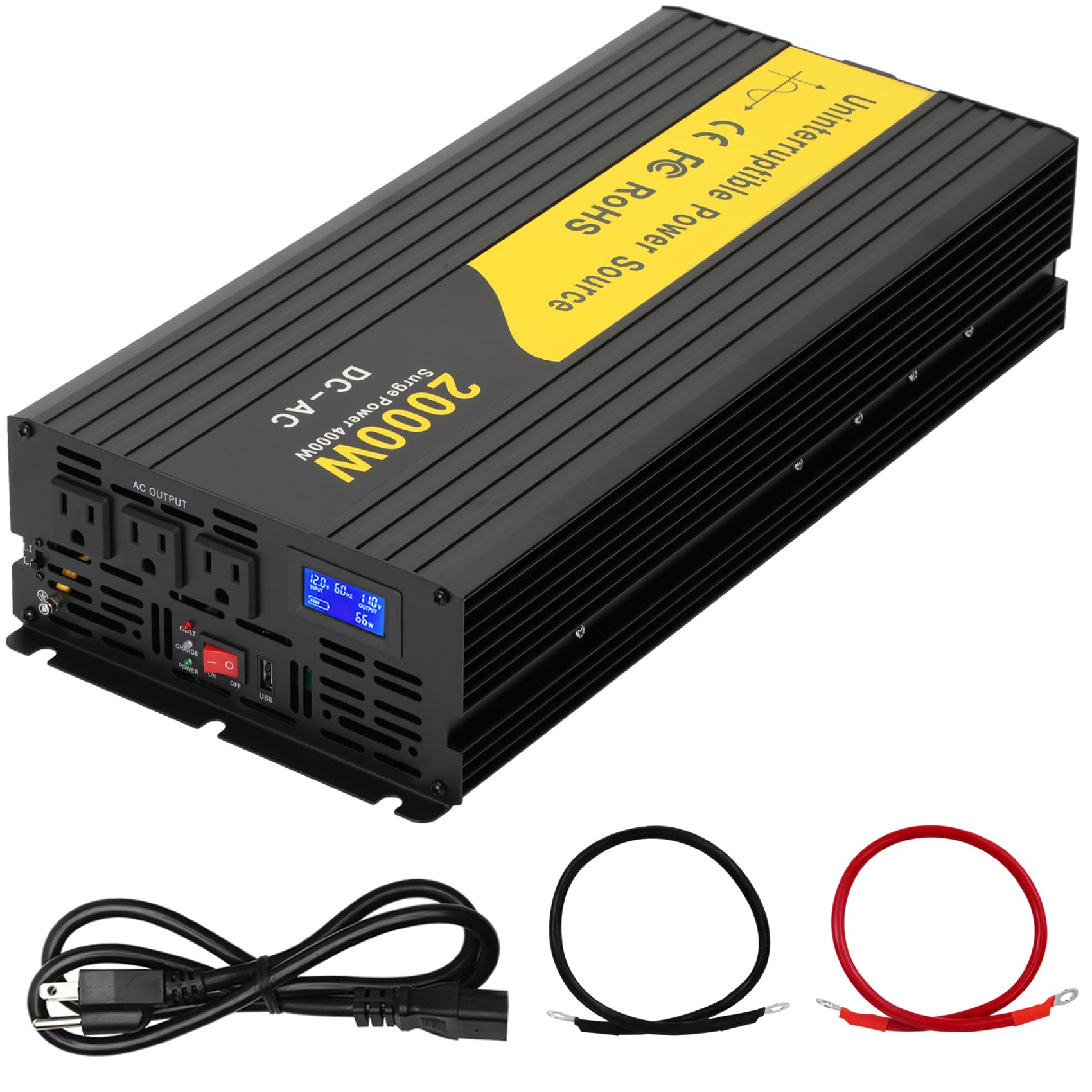
A 30A built-in charger — the fastest in the lineup — means your battery is always ready sooner.
Miumoon’s step-up 2000W model packs a 30A charger, which is the highest amperage among all the units here. That translates directly to faster recharge times: a depleted 100AH battery gets back to full significantly quicker than with a 20A system, which is critical when storms hit back-to-back. The unit also has an LCD display that shows real-time wattage draw — owners appreciate seeing exactly what their pump is pulling under load.
The system runs two pumps easily and switches over smoothly when AC power drops. Owners note the build quality is good and the unit is silent during normal operation. The honest caveat is that installation instructions are mixed in quality: some owners found the wiring diagram confusing. An occasional unit failed after 6 months, and the company was reportedly unreachable for warranty support in those isolated cases.
Fast Charge Benefits
- 30A charger recharges batteries faster than any other unit here
- Shows real-time wattage draw on the LCD screen
- Silent operation with smooth power switching
What to Watch
- Instructions need improvement — expect to look up a video
- Long-term support reputation is unproven
Choose this if: you value the fastest possible battery recharge and want to see your pump’s exact power consumption on the display.
pass on it if: easy-to-read instructions and rock-solid customer support matter more to you than raw charge speed.
9. Basement Sentry Automatic Emergency Backup Sump Pump System

A dedicated 12V backup pump that installs alongside your main unit — no inverter needed.
This is a different approach: instead of an inverter that powers your existing pump during an outage, the Basement Sentry is a complete 12V DC backup pump system that sits in your sump basin alongside the primary 115V pump. It includes the pump, controller, alarm system, battery charger, float switch, and battery box. The flow rate is 29 gallons per minute, which is solid for a backup.
Owners find it easy to install with detailed instructions, and the high-water alarm is a nice safety net. The biggest complaint is that the rubber connections to the PVC can deteriorate over time — owners mention they fail at around the two-year mark and recommend inspecting them annually. The green “OK” light on some units also failed. But when it works, it provides genuine parallel protection.
The setup: you supply a deep-cycle battery (sold separately) and install the backup pump in the basin. The main pump handles normal duty; this one only activates when power is lost. It is a simpler, more contained system than an inverter, but the PVC connection quality is the weak point.
10. Basepump RB750 Water Powered Backup Sump Pump

The one backup that doesn’t care if the power is out — it runs on your city water pressure.
This is the most unique pick in the list: the Basepump RB750 uses your home’s municipal water pressure to create suction and pump water out of the sump pit. No battery, no inverter, no generator, no charger to monitor. It connects to your existing discharge pipe and includes a 9-volt battery-powered water alarm with an 85 dB siren that sounds when water rises to a dangerous level.
Performance is the top praise — customers note it empties the sump pit at a rate comparable to their electric pump when water pressure is strong. Installation takes anywhere from 2.5 hours (plumber) to 8 hours (DIY with research), and it works with Radon Sealed systems. The water-powered design means no moving parts to wear out, so long-term maintenance is minimal. The honest check is that it uses more water during operation (around 1 gallon of city water removes several gallons from the pit), and the flow rate of 15 GPM at a 15-foot lift is lower than a standard electric pump.
Unique Advantages
- Works indefinitely during a power outage — no battery can die
- No moving parts means minimal maintenance or repairs
- Includes 85 dB high-water alarm for extra safety
Real Trade-Offs
- Requires good municipal water pressure to work well
- Uses water during operation — higher water bills during prolonged use
- Flow rate (15 GPM) is lower than a typical electric primary pump
Ideal for: homeowners with reliable city water pressure who want a zero-maintenance, non-electric backup that works as long as the water does.
Not for: anyone on a well pump system (which also needs power) or in areas with low municipal water pressure.
Understanding the Specs
Pure Sine Wave vs Modified Sine Wave
The waveform of the AC power matters for your pump’s motor. Pure sine wave produces a smooth, grid-like electrical signal that lets the pump motor run at its designed efficiency — it stays cooler, quieter, and faces less electrical stress. Modified sine wave inverters produce a stepped signal that can cause audible motor hum, excess heat buildup, and over time, premature pump motor failure. Every unit on this list uses pure sine wave for a reason: your sump pump’s life depends on it.
Battery Charger Amperage
The built-in charger’s amperage rating (20A, 25A, or 30A) determines how quickly your battery recharges after the system runs during an outage. A 20A charger can refill a 100AH battery in about 5-6 hours from a deep discharge. A 30A charger does it in about 3-4 hours. If you live in an area where storms come back-to-back in a single season, a higher amperage charger means your backup is ready to go again sooner. Trickle chargers (2-5A) are too slow for rapid cycling but are gentler on battery longevity when the system just sits idle.
Starting Surge vs Running Watts
Every sump pump motor needs a surge of power — often 2-3 times its running wattage — during the first half-second of starting up. A 1/3 HP pump might run at 600 watts but briefly spike over 1500 watts at startup. Your backup inverter must be rated high enough to handle that peak without tripping its overload protection. That is why a 1500W unit is the practical minimum for a single 1/3 HP pump, and 2000W gives you reliable margin plus the ability to power additional devices.
Water Powered Backup
Water-powered backup pumps use a Venturi effect: high-pressure city water flows through a nozzle inside the pump housing, creating suction that pulls water from the sump pit. These systems require no electricity, no battery, and no inverter, making them the most reliable long-term backup for power outages. The trade-offs are water usage (approximately 1 gallon of city water removes 2-3 gallons of sump water) and dependency on sufficient municipal water pressure — well pump users cannot use this approach.
FAQ
Do I need a backup generator for my sump pump if I already have a whole-home generator?
How long does a battery backup run my sump pump during a power outage?
Can I use a regular car battery for my sump pump backup system?
Will a 1500W backup run my 1/2 HP sump pump?
What battery type is best for a sump pump backup system?
Can I connect multiple batteries to my sump pump backup inverter?
What is the difference between a sump pump backup inverter and a standard UPS?
Can I install a sump pump backup system myself?
Will a sump pump backup system work with a septic pump or effluent pump?
How often should I test my sump pump backup system?
Final Thoughts: The Verdict
For most basements, the backup generator for a sump pump that hits a strong balance of proven reliability, pure sine wave output, and owner satisfaction is the PumpSpy 1500W — it has earned its position as the most trusted unit for good reason. If your pump is on the larger side (1/2 HP or dual-pump setup) and you want the highest owner ratings in the category, the VIOPUMPO 2500W delivers premium power with a remote monitor. And for anyone who wants a completely power-independent solution that never needs a battery, the Basepump RB750 water-powered backup is the smartest long-term investment around.
How We Picked
We do not accept paid placement. Every pick is matched to a real buyer and a real use-case; we do not hands-on test units.
Sources & Methodology
Specifications: manufacturer listings and product documentation. Review insights: verified customer reviews, as of July 2026. Pricing: not shown on this page (it changes often); check the current price via the retailer link.
As an Amazon Associate, KitchPrep earns from qualifying purchases. This does not affect which products we feature.
Related Guides
