
An RV fridge is not “just a fridge.” It’s a tiny climate-control system that has to keep food safe while your rig shakes down washboard roads, bakes in a sun-blasted parking lot, and sits at a campsite that’s never perfectly level. And unlike a house refrigerator, an off-grid RV unit doesn’t get unlimited power and perfect airflow—it has to earn every degree of cooling.
If you’re shopping for a 2 way rv refrigerator, you’re already thinking like a pro. You’re not only choosing a box with shelves—you’re choosing: (1) how you’ll power it when hookups disappear, (2) how you’ll vent the heat it creates, and (3) how much “forgiveness” it has when real life gets messy (heat waves, dust, uneven ground, propane line quirks, and that one door that almost seals).
This guide is written from the angle most buyers wish they had before clicking “Add to Cart:” what owners discover after the first week, what installers learn after the third retrofit, and what matters when you’re trying to keep milk cold without turning your trip into a troubleshooting hobby.
I’m not going to waste your time with fluffy spec-sheet comparisons. Instead, we’ll focus on the hidden deal-breakers: venting strategy (the “chimney effect”), how long these fridges realistically take to pull down to temp, why some thermostat dials feel like three settings not four, what “reversible door” really means in the field, and how to avoid the most common regret: buying a unit that technically fits… but runs hot, needs more clearance, or can’t breathe.
Below are 13 standout options—from full-size off-grid workhorses to compact 3‑way minis for pop-ups and weekend rigs—organized in the order that makes the most sense for real needs (and real budgets), not just marketing.
How to Choose the Right 2 Way RV Refrigerator
A dual‑power RV refrigerator is a lot like a small engine: it needs fuel, airflow, and the right operating conditions. Pick the wrong one (or install it the wrong way) and you’ll blame the fridge—when the real problem is heat buildup, poor venting, or a rig that’s just out of level enough to make absorption cooling struggle.
1. Start with your “rig life” profile (this decides everything)
Most buyers fit into one of these real-world categories. Identify yours first, then choose a unit that matches it.
- The hookup weekender: You’re mostly on shore power, and propane is your backup for travel days and quick stops.
- The boondocker: Propane is your main power source. You want reliability, simple controls, and predictable fuel use.
- The off-grid cabin owner: You care about storage, quiet operation, and steady performance for days at a time.
- The small‑rig minimalist: Space is tight. You need compact dimensions, a door that clears cabinetry, and enough cooling for essentials.
- The “mobile kitchen” user (food truck / outdoor prep): You need stable temps, easy organization, and a setup that handles frequent door openings.
2. Understand the power modes without getting tricked by them
“Two-way” usually means the refrigerator can run on AC electric (typical shore power) and propane. That’s the sweet spot for off-grid living because propane can run quietly for long stretches without chewing through your batteries.
Some models in this guide are three‑way (AC + propane + 12V DC). Here’s the honest truth that owners learn fast: 12V mode is convenient, but it can be deceptively power-hungry. In many setups, 12V is best treated as a “keep it stable while driving” option—useful for travel days, not a long-term boondocking plan unless your electrical system is built for it.
So your decision isn’t “2-way vs 3-way.” It’s:
- Do you want propane as your main engine? Choose a unit praised for stable propane cooling and easy ignition.
- Do you want DC flexibility? Choose a 3-way only if you have the wiring (and battery strategy) to support it.
- Do you want simplicity? Many long-time off-grid users prefer fewer modes and fewer electronics—because fewer things become mysteries later.
3. Venting is not a “nice-to-have.” It’s the performance multiplier.
Absorption refrigerators create heat to make cold. That sounds backwards until you remember: they use a heat source (propane flame or electric heater) to drive a cooling cycle. The heat has to go somewhere, and if it can’t escape, your “fridge problem” becomes a “hot engine bay” problem.
Here’s the mental model: you want a chimney effect. Cool air enters low, hot air exits high, and the airflow is guided so it passes over the hot components instead of short-circuiting around them.
- Lower intake ventilation: Feeds the cooling unit with fresh air.
- Upper exhaust ventilation: Lets heat leave the compartment and keeps temps from stacking up behind the fridge.
- Baffles / airflow guidance: Forces air to move where it matters (this is why “clearance” specs exist).
- Hot-climate support: In real heat, a small vent fan can be the difference between “fine” and “why is my lettuce soft?”
If you’re replacing a previous RV refrigerator, don’t assume the existing vent setup is correct or complete. Many “it cools poorly” complaints are fixed by airflow tuning rather than a replacement unit.
4. Leveling is not perfection—it’s “close enough” with discipline
Absorption cooling is sensitive to tilt. You don’t have to live on a laser-leveled slab, but you do need to respect that a fridge that runs too far off level can cool poorly and, over time, may be more prone to issues.
In real life, the best strategy is simple:
- Level first, then cool: If possible, get your rig stable before turning the fridge on for a long run.
- Don’t “park crooked and hope” in high heat: Heat + poor venting + tilt is the trifecta that makes these units look weak.
- Use a consistent thermostat routine: Many owners find that “medium” is the real sweet spot, not max or minimum.
5. Learn the hidden sizing reality: cooling hardware steals space
This is a buying-guide detail that saves people from disappointment. Absorption units often have a larger “backside” footprint than you expect because the cooling assembly sits behind the box. That means:
- Depth can surprise you: A fridge that “fits” on paper may need extra space from the wall for airflow and heat safety.
- Interior volume is usable volume, not promised volume: Door bins, crisper design, and shelf geometry matter as much as cubic feet.
- Freezer shape matters: A top freezer can be great for ice and frozen essentials, but some people would rather have all fridge space. If you’re that person, prioritize a model with a freezer layout you’ll actually use.
6. Real-world quality markers that owners mention again and again
When you read reviews like a technician, patterns pop. These are the markers that separate a “good” unit from a frustrating one:
- Door seal and hinge alignment: Even a small gap can bleed cold air and make performance feel inconsistent.
- Ignition behavior: A reliable ignition routine (and easy re-lighting) matters more than a fancy panel.
- Heat management: Owners mentioning “runs hot in the back” are giving you an airflow clue, not just complaining.
- Shipping survival: These are heavy appliances. Units that arrive dented or misaligned can still work, but you want packaging and build that holds up.
- Support responsiveness: When something is fixable (like a fuse, a setting, a vent tweak), a good support experience saves weeks of stress.
Quick Comparison: 13 2 Way RV Refrigerator Picks
Use this table to narrow down the models that match your space and power style. Then jump to the full reviews for the details that actually determine happiness: heat behavior, door sealing, ignition quirks, and what owners learn after the first month.
On smaller screens, swipe or scroll sideways to see the full table.
| Model | Power style | Real-world strength | Best match | Amazon |
|---|---|---|---|---|
| Superior Propane LP Off‑Grid Refrigerator 10 Cu Ft | 2‑way (LP + 110V) | Sturdy “cabin-grade” build + simple controls + quiet operation | Off-grid cabins and RVers who want a serious, dependable mid‑large unit | Amazon |
| SMETA Propane Refrigerator 14.1 Cu Ft (Full Size) | 2‑way (LP + 110V) | Biggest storage and quiet absorption cooling for family-sized needs | Large off-grid kitchens, cabins, garages, and “store real groceries” setups | Amazon |
| SMETA 9.4 Cu Ft Propane Refrigerator (Up Freezer) | 2‑way (LP + 110V) | Quiet, efficient cabin fridge feel—owners praise steady cooling once vented well | Mid-size off-grid homes and RV kitchens wanting more space without full-size bulk | Amazon |
| Smad 9.3 Cu Ft Propane Refrigerator with Freezer | 2‑way (LP + 110V) | Generous door storage + quiet performance that works for short-to-medium off-grid trips | Couples and small families who want mid-size capacity in a manageable footprint | Amazon |
| Techomey 6.1 Cu Ft Propane Refrigerator with Freezer | 2‑way (LP + 110V) | Owners love how cold it can run—excellent “learn the dial” performance | RVers/cabin users who want strong cooling and don’t mind planning venting carefully | Amazon |
| RecPro RV Refrigerator 6.3 Cu Ft (Stainless) | 3‑way (LP + 110V + 12V) | Flex power strategy + premium look; strong choice for moving rigs | Travel trailers/5th wheels wanting a multi-source setup for driving + camping | Amazon |
| Smad 6.1 Cu Ft Off‑Grid Propane Refrigerator (Classic) | 2‑way (LP + 110V) | One of the most “field‑tested” styles: owners share long-term dialing + tank routines | Boondockers who want predictable propane life and don’t mind a learning curve | Amazon |
| Smad 6.1 Cu Ft Off‑Grid Propane Refrigerator (Newer Listing) | 2‑way (LP + 110V) | Quiet, simple, and practical—good “measure, install, chill” approach | Cabins, garages, and RV kitchens wanting straightforward dual-power use | Amazon |
| Smad 1.4 Cu Ft 3‑Way Propane Fridge (Compact) | 3‑way (LP + 110V + 12V) | Popular “drop‑in replacement” size for older pop‑ups and tiny rigs | Pop-up campers and small trailers replacing a tired legacy fridge | Amazon |
| Smad 2.1 Cu Ft 3‑Way Caravan Fridge (Compact) | 3‑way (LP + 110V + 12V) | Versatile weekend fridge; propane mode is the star for many campers | Weekend rigs wanting flexible power options in a small footprint | Amazon |
| SMETA 2.1 Cu Ft 3‑Way Freezerless Fridge (Compact) | 3‑way (LP + 110V + 12V) | Ultra-quiet “tabletop-style” off-grid cooler for simple storage | Small spaces: under-counter installs, campervans, outdoor kitchens | Amazon |
| 3‑Way Off‑Grid RV Refrigerator 2.1 Cu Ft (Built‑In style) | 3‑way (LP + 110V + 12V) | Door lock + protective frame helps prevent spills during travel | People who want a small built‑in unit for trucks, trailers, or compact kitchens | Amazon |
| SMETA 1.4 Cu Ft 3‑Way Mini Propane Fridge (40L) | 3‑way (LP + 110V + 12V) | Smallest footprint option—works best when venting is planned correctly | Tight installs where size is the #1 constraint (and you can test immediately) | Amazon |
In‑Depth Reviews: 13 2 Way RV Refrigerator Models That Actually Work Off‑Grid
Now we’ll go fridge by fridge. I’m going to talk like an installer and an owner—not a brochure: how these units behave when it’s hot, what setup mistakes cause the most frustration, and what owner feedback reveals about long-term satisfaction.
1. Superior Propane LP Gas Off‑Grid Refrigerator (10 Cu Ft) – The “Cabin‑Grade” Workhorse That Feels Built to Last

If you want a refrigerator that feels like it was designed for remote living first (and convenience second), this Superior model is a strong “buy it, install it, forget it” candidate. Owners consistently describe it as sturdy and efficient—the kind of appliance you put in a cabin, an off‑grid house, or a serious RV kitchen when you’re done playing around with finicky cooling.
What I like most here is the simplicity of the operating concept. A lot of off‑grid frustration comes from “mystery electronics” and unclear status. This unit’s style leans toward straightforward controls and predictable behavior. That matters because absorption refrigeration isn’t fast-cooling by nature; it rewards stable conditions, good airflow, and patient pull-down time.
The other reason it earns “best overall” is balance. The capacity feels like a real upgrade from the common 6-ish cubic-foot class, without jumping to a giant full-size footprint that many RV kitchens can’t accommodate. It’s a sweet spot for people who want real grocery storage, a workable freezer, and a refrigerator that doesn’t try to be clever—just steady.
The honest limitation? Like most absorption units, performance depends heavily on airflow and ambient temperature. Owner feedback suggests it’s happiest when it can breathe well and doesn’t live in extreme heat without help (shade, venting discipline, and airflow support). If you treat it like an engine bay—keep the “back side” ventilated—it rewards you with quiet, consistent cooling.
Why you’ll like it
- Sturdy, confidence-inspiring build – Owners describe it as solid and “appliance-grade,” not flimsy.
- Great off-grid match – Quiet absorption style and propane flexibility fits remote cabins and boondocking routines.
- Roomy without being gigantic – A strong middle ground between small RV fridges and full-size monsters.
- Simple workflow – Less guesswork, less fiddling, more “set it and live.”
Good to know
- Heat management matters—plan ventilation like it’s part of the purchase, not an afterthought.
- Like most absorption fridges, it rewards patience: pre-cooling and stable conditions beat constant dial twisting.
- It’s heavy and substantial; plan delivery handling and placement carefully.
Ideal for: off-grid cabins, RVers who want more capacity than the “standard RV fridge class,” and anyone prioritizing sturdy simplicity over flashy features.
2. SMETA Propane Refrigerator 14.1 Cu Ft – Big‑Family Storage With Quiet Off‑Grid Cooling
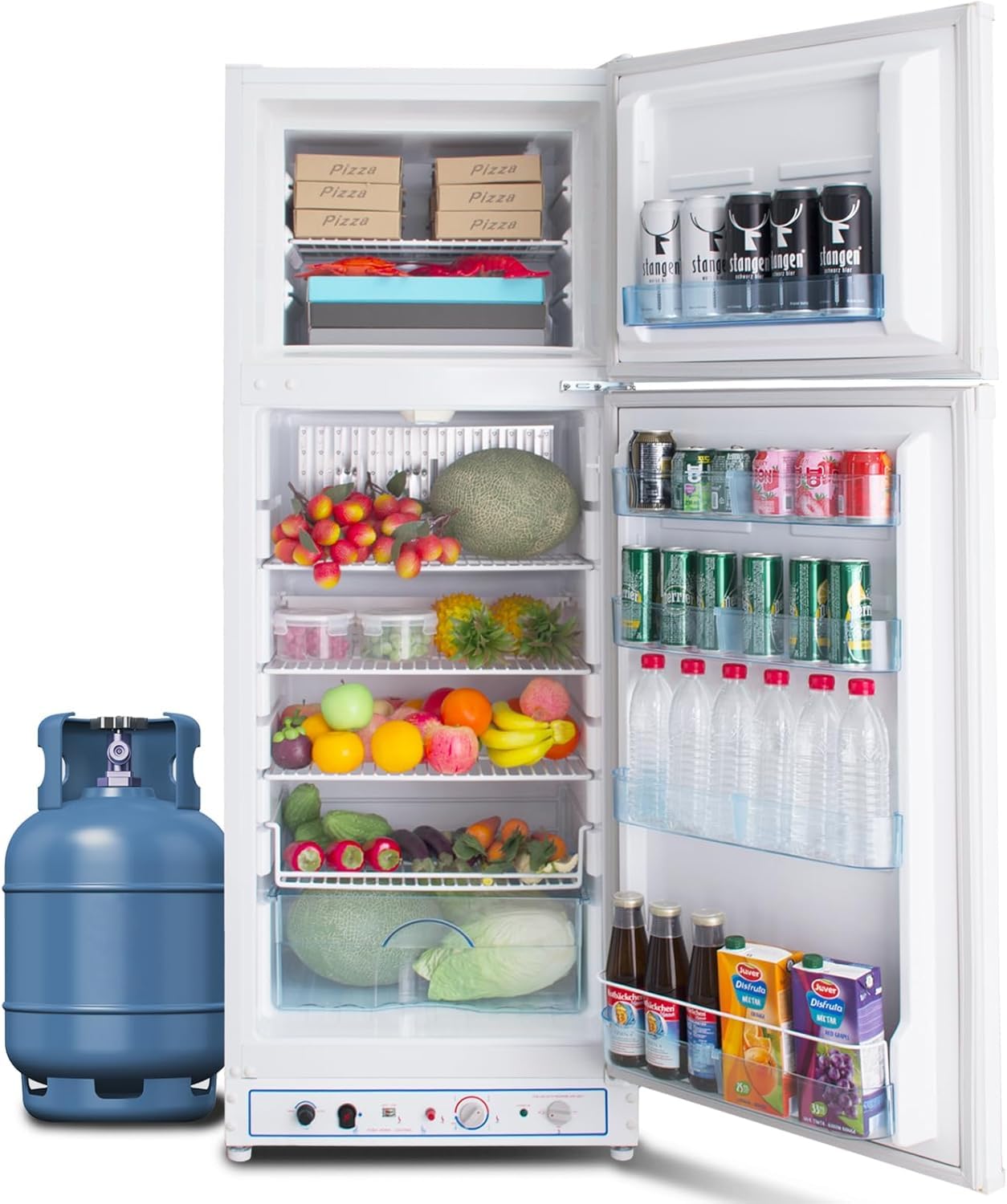
This is the pick for people who are done living out of a tiny fridge. If you’re feeding a family, hosting at a cabin, or just want a real grocery rhythm off‑grid, the SMETA 14.1 class is appealing for one reason: it gives you space that feels like a normal home refrigerator—while still offering propane flexibility.
Owners talk about two things that matter more than you’d expect: first, the quietness (absorption cooling is naturally silent), and second, the “spaciousness feels real.” That’s not just cubic feet—it’s how shelves, door storage, and the freezer layout cooperate with actual food. When people say “I finally have room,” that’s the friction disappearing.
Here’s the expert angle: big absorption fridges are only as good as their heat escape route. A large unit creates a lot of heat in the back compartment. That means your install has to respect airflow clearances and ventilation strategy. When owners mention they keep flammables away from the back area, they’re not being dramatic— they’re acknowledging that propane absorption systems have a hot zone, and your job is to keep that zone safe and breathing.
This is also the kind of fridge that rewards stable living. If you’re in a fixed cabin, garage, or off‑grid kitchen where you can plan venting properly, it can feel fantastic. If you’re in a cramped RV cabinet with questionable venting and no room to breathe, you might be better served with a slightly smaller unit that can be installed “right.”
Why it’s a monster upgrade
- Full-size storage – This is the “stop playing Tetris” refrigerator class.
- Quiet off-grid cooling – Great for cabins, guest houses, and RVers who hate compressor noise.
- User-friendly organization – Multiple shelves, door storage, and a dedicated freezer layout.
- Front controls feel practical – Easier to monitor and adjust compared with rear-only access designs.
Good to know
- This is big and heavy—delivery handling and placement planning matter.
- It needs proper ventilation clearances; treat airflow like part of the appliance, not optional.
- If you don’t need a freezer, you may wish the whole box were fridge space—this model is freezer-on-top.
Ideal for: off-grid families, large cabins, and RV kitchens with the space (and venting setup) to support a full-size absorption refrigerator.
3. SMETA 9.4 Cu Ft Propane Refrigerator – Quiet, Efficient Cooling With a “Get the Venting Right” Personality

Think of the SMETA 9.4 as the “serious cabin fridge” for people who don’t need full-size, but do want real storage. Owner feedback often reads like this: heavy and well-built, easy to connect and light, and quiet enough that you forget it’s running. That’s exactly what a good absorption unit should feel like—present when you need it, invisible when you don’t.
The most useful owner detail is the ventilation talk. When a reviewer mentions venting outside with an exhaust pipe and monitoring temperatures, they’re pointing to the core truth: these units don’t just cool… they manage heat. If you create a path for heat to exit (and keep intake air available), cooling stabilizes and stays consistent. That’s the difference between “it works flawlessly” and “it’s not worth it.”
This model is also a great example of why you should read reviews for “shipping survival” clues. Some owners report dents, dings, and door alignment issues. That doesn’t automatically mean the fridge won’t cool—but it does mean you should inspect early, check that the door seals evenly, and make sure hinges are aligned. A small door gap is basically a slow leak of cooling performance.
When dialed in, this size class can be the best blend of capacity and install reality. It’s large enough to store meaningful groceries, but not so large that it demands a total kitchen rebuild in many setups.
Why it’s a smart step-up
- Quiet and efficient – Owners describe stable cooling once installed with good airflow.
- Mid-size sweet spot – More room than the common 6-ish class without full-size bulk.
- Good organization potential – Shelves and door storage make it easier to live with day to day.
- Off-grid friendly personality – “Set it, keep it ventilated, live your life.”
Good to know
- Inspect door seal and alignment early; small gaps matter.
- Expect heat output behind the fridge; plan airflow and clearance accordingly.
- Shipping damage reports mean you should keep packaging until you confirm fit and function.
Ideal for: off-grid cabins, RV kitchens wanting a meaningful capacity upgrade, and buyers who will take venting seriously from day one.
4. Smad 9.3 Cu Ft Propane Refrigerator – The Practical Mid‑Size for Couples and Small Families
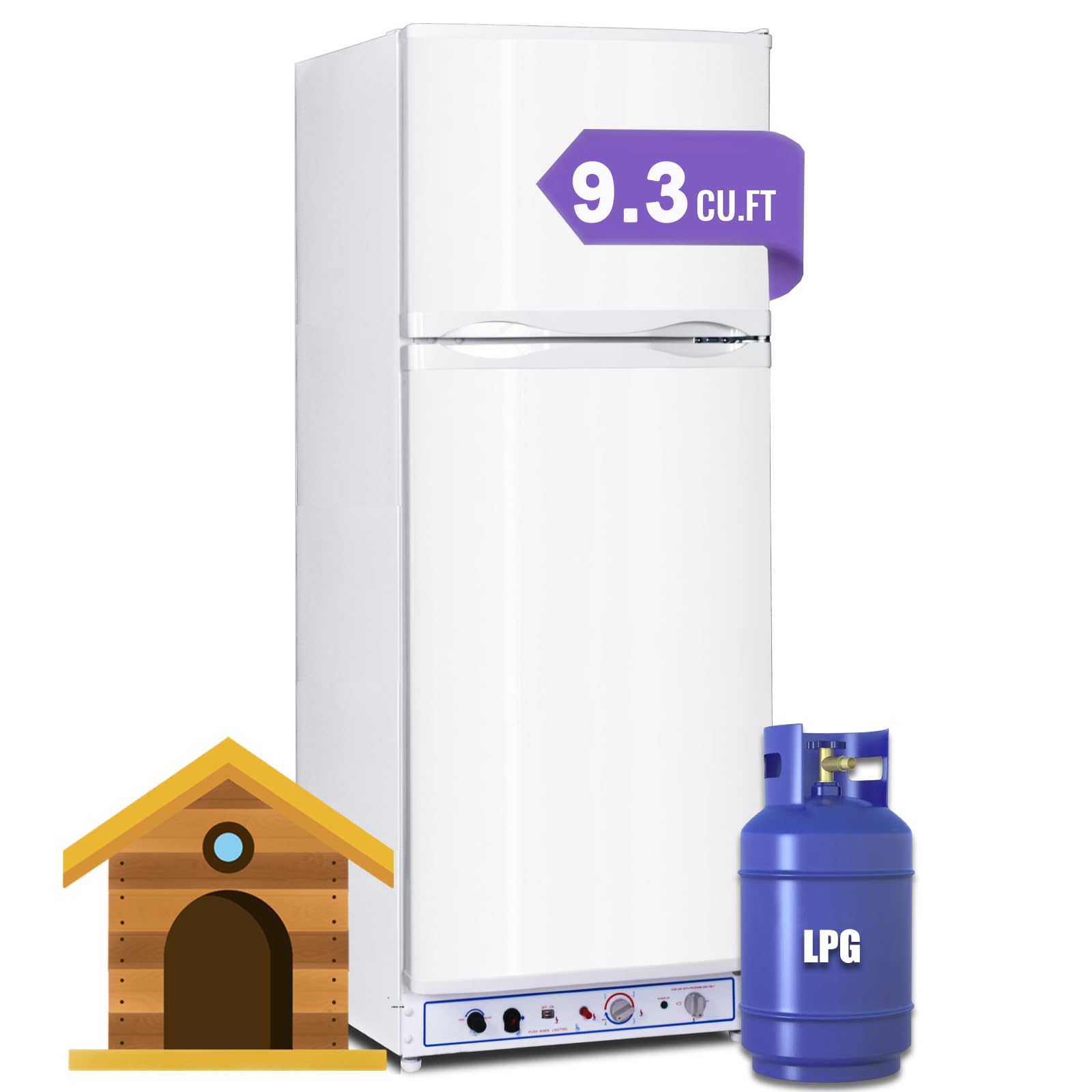
The 9-ish cubic-foot class is where a lot of off-grid users land after living with smaller fridges. It’s big enough to stop feeling cramped, but not so large that you’re forced into a full-size kitchen footprint. That’s why this Smad 9.3 has a very “practical upgrade” vibe.
In owner-style feedback, two details stand out: door storage and fit reality. People often mention loving the door bins and freezer space, and they also talk about measuring carefully—sometimes even warning that packaging dimensions can look different from the unit itself. That may sound minor, but it’s actually a pro move: with heavy appliances, you want to know it fits before you destroy the box.
Performance-wise, the comments you want to see are “it gets very cold,” “retains the cold,” and “whisper quiet.” Those are classic absorption wins when installation and venting are decent. The capacity is still “mid-size,” so if you’re feeding a crowd for a week, you’ll want the full-size tier. But for a couple or a small family, this is often plenty—especially if your fridge use is more “fresh basics + drinks” than “warehouse groceries.”
The pro-level tip is to treat the thermostat like a calibration tool, not a volume knob. On many absorption units, the dial isn’t perfectly linear. Owners commonly report that the sweet spot is somewhere in the middle, and once you find it, stability improves dramatically.
Why it works for real life
- Mid-size capacity feels livable – Enough space for real groceries without full-size demands.
- Door storage is genuinely useful – Makes daily access easier and reduces “shelf Tetris.”
- Quiet operation – A major win for cabins, small spaces, and light sleepers.
- Simple controls – Less complexity can mean fewer headaches later.
Good to know
- Measure your install space carefully and keep the box until you confirm fit and function.
- Expect a learning curve with temperature settings; “max cold” isn’t always the best setting.
- Like all absorption units, airflow and heat escape determine how impressive it feels.
Ideal for: couples, small families, and off-grid users who want a meaningful upgrade from small RV fridges without going full-size.
5. Techomey 6.1 Cu Ft Propane Refrigerator – “Runs Super Cold” Performance If You Plan Venting Right

If your priority is “I want my fridge to actually get cold,” the Techomey feedback is encouraging. Owners repeatedly describe it as super cold once they learn the settings. That’s an important nuance: a powerful absorption fridge can be almost too cold if you crank it and forget it. So this isn’t a set-to-max kind of unit—it’s a “find your sweet spot and enjoy stability” unit.
The most valuable “expert” detail in the reviews is the venting reality. Some owners point out that venting fumes from the flue pipe is treated as necessary in the manual and that figuring out how to vent (and what ducting to use) can be confusing if you’ve never installed one. That’s not a downside of Techomey specifically—it’s the nature of propane absorption appliances. But it’s a buying decision you should make eyes open.
Another real-world theme is shipping and returns. With heavy off-grid appliances, some owners report delivery damage and then feel stuck because returning is a big hassle. That’s why I recommend a simple routine: inspect immediately, check door alignment and seals, and do a basic “does it cool?” test early—before you commit to a permanent install.
When installed well, this model class can be an excellent match for small cabins and RV kitchens. It’s large enough to be useful, small enough to be realistic, and strong enough to keep temps where you want them—provided you treat airflow as part of the system.
Why owners like it
- Very strong cooling – Many owners describe it as impressively cold once dialed in.
- Quiet operation – A major win for sleeping areas, cabins, and small homes.
- Good day-to-day usability – Shelves, lighting, and the freezer layout feel practical.
- Dual-power flexibility – Easy to live with when switching between shore power and propane.
Good to know
- Venting planning matters—know your exhaust/airflow approach before installing.
- Some owners mention shipping damage; inspect early and confirm door seal alignment.
- It may look larger in photos than it feels in the cabin—measure the usable shelf reality, not just the exterior.
Ideal for: cabin and RV users who want strong cold performance and are willing to do the “grown-up” work of ventilation planning.
6. RecPro RV Refrigerator 6.3 Cu Ft (110V / 12V / Propane) – The “Travel Day + Campsite” Strategy Pick

This RecPro earns its spot because it matches how many RVers actually travel: shore power at home or in parks, propane when you’re off-grid, and a 12V option for specific scenarios. That’s a powerful setup when you understand what each mode is meant to do—and when your wiring is ready for it.
Owner feedback includes an extremely useful “real fix” story: a unit that appeared dead out of the box was solved by checking the two fuses on the control board, and replacing a blown fuse restored operation. That kind of detail matters because it tells you two things: (1) some issues are fixable without a full return, and (2) you should do an early functional test while you still have the packaging and time to react.
Another recurring theme is wiring expectations. Multiple owners emphasize that the fridge may require dedicated 12V hookups and that some installs are smoother if you treat the 12V side as a properly planned circuit rather than an afterthought. If you’re installing into a fifth wheel or travel trailer, that planning step can be the difference between “quiet, perfect size, love it” and “why won’t it power up?”
When it’s installed correctly, owners praise quiet operation on AC power, solid fit, and the overall RV-friendly size. It’s a very “right tool for the job” unit—especially if you’re the kind of traveler who wants options and doesn’t want a fridge to be the limiting factor on where you can camp.
Why it’s a strong RV pick
- Multi-power flexibility – Useful for travel days, hookups, and propane-based off-grid camping.
- Quiet operation on AC – Owners frequently describe it as impressively quiet once running.
- Good RV size class – Practical capacity without pushing into full-size space demands.
- Fixable issues exist – Real owners report simple troubleshooting (like a fuse) solving “dead on arrival” panic.
Good to know
- Plan 12V wiring properly; some installs require dedicated DC lines before the unit will behave as expected.
- Shipping damage is always possible with heavy appliances—inspect immediately and test early.
- As with all absorption setups, your venting and clearance work is part of performance.
Ideal for: RVers who want a flexible power strategy and are willing to do a clean, correct install (especially on the 12V side).
7. Smad 6.1 Cu Ft Off‑Grid Propane Refrigerator – The One Owners Document for Years (Because It Changes Their Setup)

This is the fridge style that off-grid people write diary‑length reviews about. And that’s a compliment, not a joke. When you see an owner posting multi‑month and multi‑year updates, what you’re really seeing is this: the fridge becomes a foundational part of their off-grid system, so they care enough to document it.
The most valuable real-world learning: absorption thermostats can behave like “three real settings” instead of a perfectly smooth scale. Owners report that the high setting can freeze items in the fridge compartment, while the lowest can be too warm—meaning the practical sweet spot is usually the middle. Once they discover that, the experience changes from “frustrating” to “boringly stable.”
The propane management detail is also gold: running a tank until it’s empty can make re-lighting harder because the line needs time to purge and refill. Owners who keep a consistent routine—swapping tanks before they run dry—report easier re-ignition and less stress. That’s the kind of living-with-it detail you don’t get from a spec sheet.
Now the honest side: not every story is perfect. There are negative experiences too—some owners report failures after extended use, and some report door reversal or sealing issues when changing hinge side. That doesn’t automatically disqualify it, but it does tell you what to check: door seal alignment, support responsiveness, and the “don’t install it permanently until you’ve tested it” rule.
If you want a fridge that is deeply off-grid compatible and you’re the kind of person who enjoys dialing in a system (not fiddling endlessly, but doing a smart initial calibration), this one can be incredibly satisfying.
Why off-grid owners love it
- Real-world proven – Owners run these for long periods and document actual routines and results.
- Silent operation – A huge quality-of-life win in small cabins and trailers.
- Propane-first friendly – Great if propane is your main energy plan and shore power is occasional.
- Stable when dialed in – Once you find the middle setting sweet spot, day-to-day life gets easy.
Good to know
- Thermostat behavior isn’t always linear—expect a short learning curve to avoid freezing or spoiling.
- Door reversal can be tricky on some units; check for seal gaps if you reverse hinge direction.
- Test early and thoroughly before a permanent install, especially if returning would be difficult.
Ideal for: boondockers and off-grid users who want a proven absorption fridge and appreciate real owner “how to live with it” knowledge.
8. Smad 6.1 Cu Ft Off‑Grid Propane Refrigerator (Newer Listing) – Simple, Quiet, and “Measure First” Friendly

This is the “I just want a quiet dual-power fridge that does the job” pick. Owners who buy this class usually have a clear goal: replace a smaller unit, gain useful storage, and keep food cold in a cabin or RV without needing grid dependence. And the feedback that matters most shows up early: arrived in good shape, fits the measured space, door storage is useful, freezer is practical, and the unit runs whisper-quiet.
The smartest owner warning is about shipping box measurements versus the actual fridge. That sounds like trivia until you realize it’s about returns. If you’re fitting a fridge into a tight space, the moment you see confusing packaging dimensions, you should pause, verify, and keep the box intact until you’re sure. This is one of those “experience-coded” tips that only appears in real reviews.
Performance notes trend positive when users run it for a few cycles: it gets cold, it retains cold, and propane use is described as reasonable for the category. That’s what you want in a unit designed for off-grid living: stable cooling without noise.
The best way to love this fridge is to treat it like a system, not a gadget: pre-cool it before loading, don’t overload the back wall with items that block internal airflow, and keep the rear heat escape path clean. If you do those basics, this “simple” model becomes a very satisfying, low-drama appliance.
Why it’s easy to live with
- Quiet operation – A consistent owner highlight, especially for cabins.
- Useful storage layout – Door bins and freezer space feel practical for everyday food.
- Simple controls – Less tech can mean fewer mysteries when you’re off-grid.
- Good “replace a smaller fridge” fit – Many buyers use it as a clear upgrade path.
Good to know
- Measure carefully and keep the packaging until you confirm fit and function.
- Like all absorption units, performance depends on venting and heat escape—don’t ignore clearances.
- Capacity can feel “tight but workable” depending on how you shop; use bins and organization to maximize it.
Ideal for: RV kitchens, cabins, and garages needing a quiet dual-power refrigerator with a practical layout and low daily hassle.
9. Smad 1.4 Cu Ft 3‑Way Propane Fridge – The Pop‑Up Camper “Drop‑In” Upgrade That Feels OEM‑Like

Small rigs have a different set of priorities: fit, door swing, and “does it cool without drama.” This 1.4 cu ft Smad is frequently bought as a replacement for older pop‑up camper fridges, and that’s why it’s valuable: it’s designed to solve a very specific real-world pain—an aging legacy unit that’s weak, unreliable, or dead.
Owner feedback highlights exactly what you want to hear in this category: it drops into the space with only minor cabinetry adjustments, the temperature control works, and propane performance feels efficient. One of the most interesting “real life” comments is about the flame visibility— owners mention a bright blue flame that’s easy to see, which helps confidence during setup and troubleshooting.
Here’s the expert perspective: compact absorption fridges are extremely sensitive to install correctness because the margins are small. A tiny unit doesn’t have “extra cooling headroom” to overcome blocked airflow or poor clearance. So your goal is to keep the install clean: leave the recommended air gaps, don’t suffocate the back side, and treat the venting path like it matters (because it does).
The biggest downside in this category is not performance—it’s shipping and documentation. Some owners report dents or missing manuals. That’s why I like to treat these mini fridges like “test gear” first: verify ignition, verify cooling on your chosen power mode, verify door seal, then commit to a permanent mount.
Why it’s a great small-rig fix
- Replacement-friendly size – A common “drop‑in” class for pop-ups and older camper fridges.
- 3-way flexibility – Useful for hookups, propane camping, and certain travel setups.
- Simple, practical cooling – Owners report it performs well when installed correctly.
- Fits tight spaces – Great when cabinetry and clearance are non-negotiable constraints.
Good to know
- Inspect for shipping dents and confirm you have documentation early.
- Small units demand correct venting; “almost” correct can feel weak.
- Capacity is intentionally limited—think essentials, not full grocery runs.
Ideal for: pop‑up campers, tiny travel trailers, and anyone replacing an older compact fridge with a modern, multi-power alternative.
10. Smad 2.1 Cu Ft 3‑Way Caravan Fridge – Versatile Camping Cooler With Real-World Quirks to Know

This is a classic compact camping fridge style: small footprint, multi-power options, quiet absorption operation, and a temperature range designed for refrigerated basics (drinks, dairy, produce) rather than deep freezing. Owners who love it tend to use it exactly that way: weekend trips, stable propane cooling, and simple “it just works” behavior once it’s set up.
The most honest owner feedback also includes the quirks. Several campers note the obvious but important truth: 12V can drain a battery fast. That’s not a defect; it’s the physics of heating elements. So the smart strategy is to treat 12V as situational and propane as the long-run hero.
There are also mixed comments about packaging and shipping handling. Some people report flimsy packaging or delivery damage, and a few describe AC cooling as weaker than expected while propane is okay. That spread usually points to three factors: installation airflow, ambient heat, and unit-to-unit variation. The practical advice is simple: test on each mode you plan to use, in conditions similar to your real use, before you “build it in.”
If you want a compact fridge for a travel trailer that’s easy to install and quiet, this can be a strong fit—especially if propane is your main plan. But it’s not the kind of product you should learn on at the campsite. A short driveway test makes the whole experience easier.
Why campers buy it
- Multi-power versatility – Useful across hookups, off-grid propane use, and certain travel scenarios.
- Quiet absorption cooling – Great for small rigs and sleeping areas.
- Compact footprint – Fits where larger fridges can’t.
- Fast enough for weekend routines – Works well for “pre-cool, load, camp” usage.
Good to know
- 12V mode can be battery-hungry; propane is typically the long-run winner.
- Packaging/shipping experiences vary; inspect early and test before a permanent install.
- Some users report limited temp control on LP; plan to find a stable “middle” routine.
Ideal for: weekend rigs, small trailers, and campers who want a compact, quiet fridge and will primarily rely on propane for sustained cooling.
11. SMETA 2.1 Cu Ft 3‑Way Freezerless Fridge – A Space-Saving “Under‑Counter” Style for Simple Off‑Grid Cooling
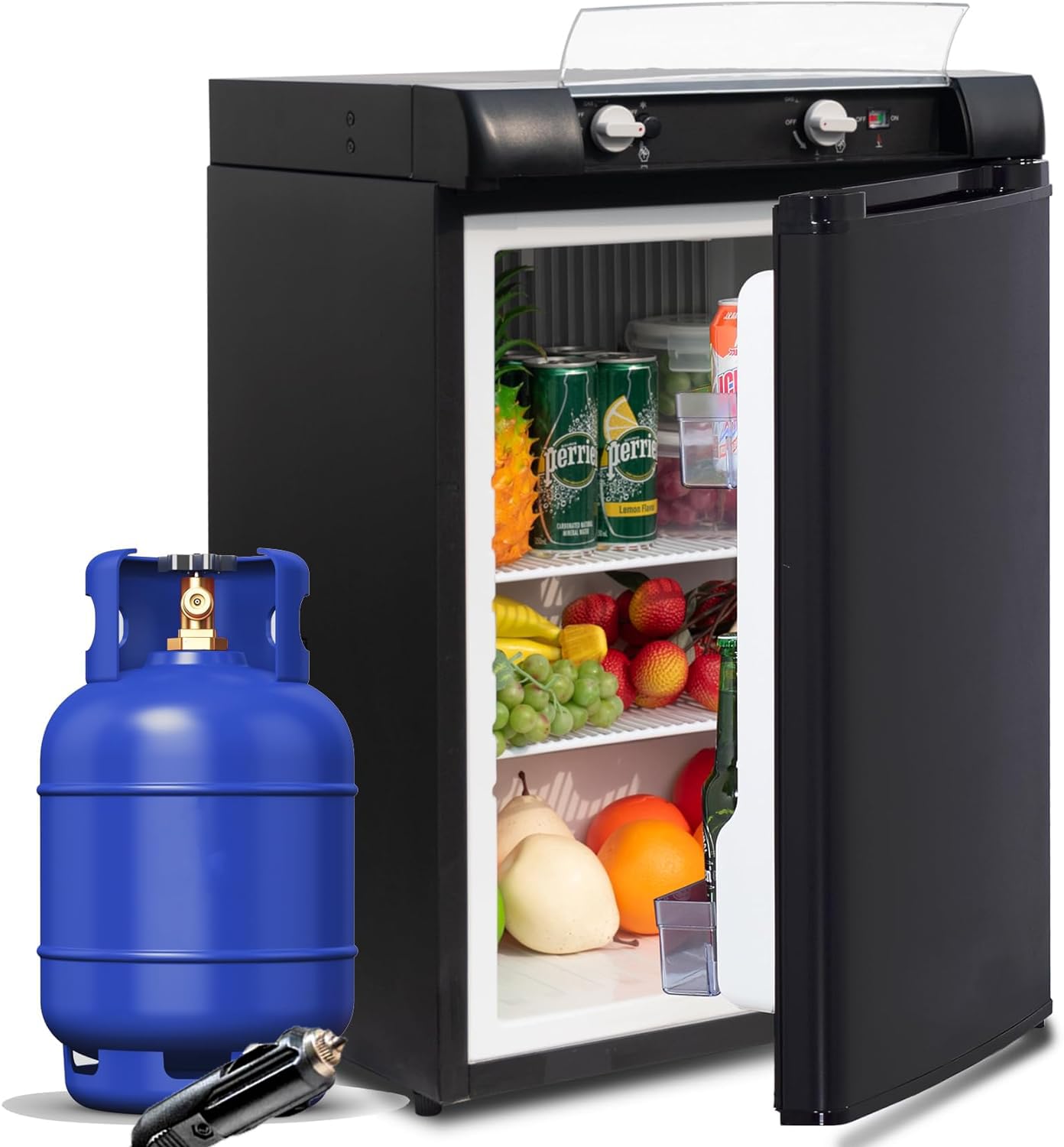
Some buyers don’t need a freezer at all—they want a compact refrigerator that keeps produce crisp, drinks cold, and milk safe, without demanding a full kitchen footprint. That’s where a freezerless 2.1 cu ft absorption fridge can shine, especially in vans, small campers, and under‑counter installs.
This SMETA’s appeal is the “simple and quiet” promise: absorption cooling with minimal noise, removable shelves, and a control panel designed to help you choose your power mode and temperature. It’s also marketed toward off-grid users who value low maintenance (no compressor wear), which is a fair advantage of absorption designs when they’re installed correctly.
Here’s the expert guidance for this category: compact absorption fridges are airflow-sensitive. If you tuck it into a tight cabinet with no intake/exhaust strategy, it may cool slowly or struggle in warm weather. If you give it room to breathe (and keep the back area from becoming a heat trap), it tends to behave much better. That’s why planning your placement matters as much as the purchase.
If your goal is a small “cold box” for the road—something you can rely on without listening to compressor cycling—this is the type of unit that can make small‑space living feel easier. Just treat ventilation as a requirement, not a suggestion.
Why it’s a smart compact option
- Freezerless simplicity – More usable fridge space for drinks and fresh food.
- Quiet operation – Great for tight living spaces and night use.
- Compact footprint – Works for under‑counter installs and small rigs.
- Flexible organization – Removable shelves and crisper-style storage help daily use.
Good to know
- Performance depends heavily on airflow—avoid “sealed box” cabinetry installs.
- Like most small absorption units, it’s built for refrigeration temps, not deep freezing.
- With fewer visible long-term stories, your early testing period is important before final mounting.
Ideal for: campervans, small trailers, and outdoor kitchens needing quiet refrigeration in a compact space—especially if you don’t need a freezer.
12. 3‑Way Off‑Grid RV Refrigerator 2.1 Cu Ft – Compact Built‑In Style With Travel‑Friendly Door Security
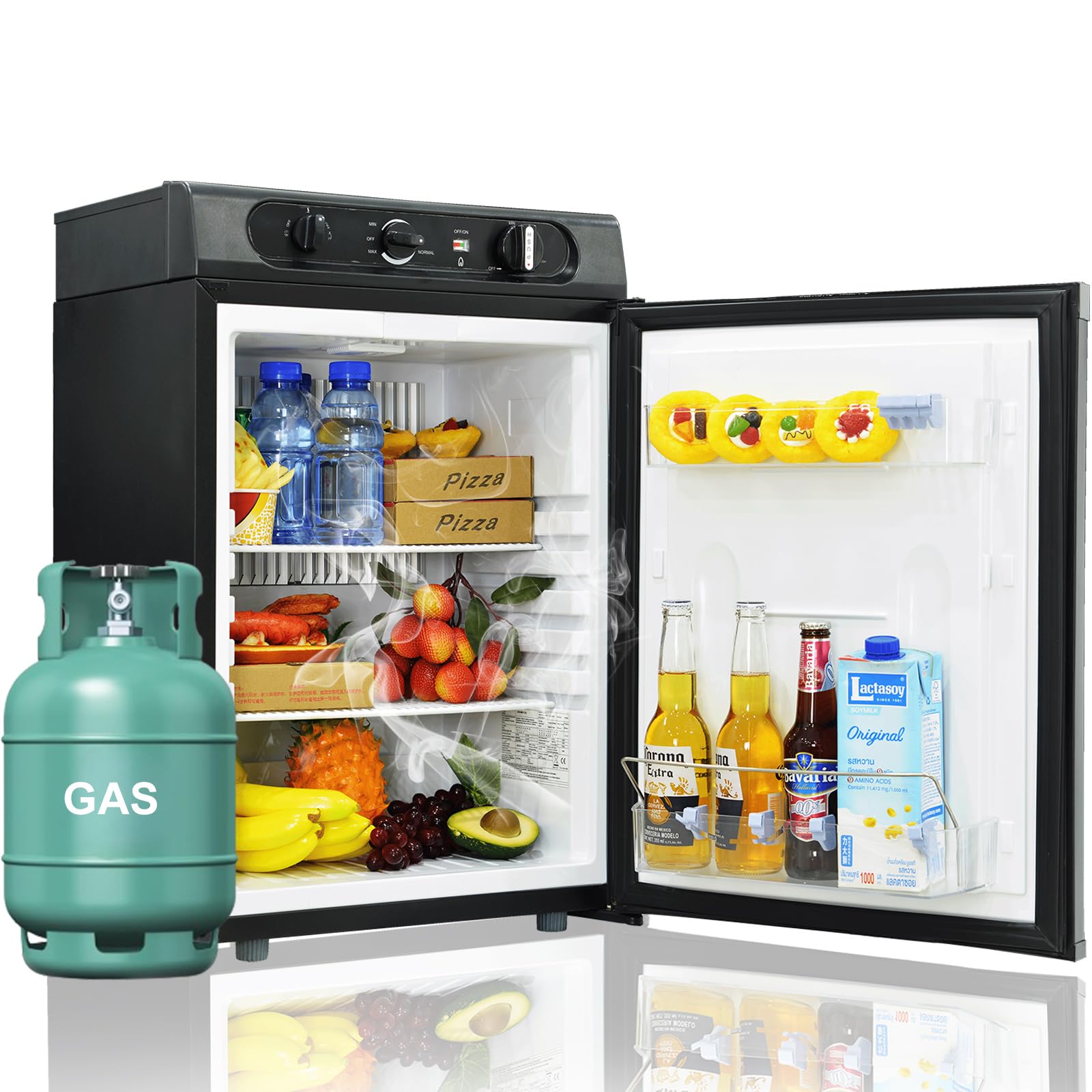
If you’ve ever opened your RV fridge after a bumpy road and found items shifted, spilled, or launched, you already know why a door lock matters. This compact 2.1 cu ft class includes a travel-oriented door design: a lock and protective frame that aim to keep the door secure and contents stable while moving. That’s a genuinely practical feature for tiny rigs, semi-truck installs, and compact trailers.
The power story here is classic 3‑way flexibility: propane for off-grid, AC for hookups, and 12V for certain travel situations. The key is to match your expectations to the temperature range these units typically target: refrigerated storage, not “deep freezer” performance. If your goal is safe food storage and cold drinks on the road, this class can do the job.
From an expert point of view, the biggest success factor is still airflow. A “built‑in” style install can accidentally trap heat if the cabinet is too sealed. So if you choose this model, treat the cabinet like a vented compartment: air needs to enter and heat needs to leave. The door lock keeps the front stable; your venting strategy keeps the cooling stable.
If your use case is travel-heavy and you want a compact unit with a “moving rig mindset,” this one is worth a look—especially if door security is high on your pain-point list.
Why it’s travel-friendly
- Door lock + protective frame – Helps prevent spills and surprise door openings while moving.
- Compact built-in potential – Designed for small spaces and tight installs.
- 3-way flexibility – Useful across hookups, propane camping, and select 12V scenarios.
- Good for “cold basics” – A practical size for drinks, produce, and daily essentials.
Good to know
- Built-in installs can trap heat—plan intake/exhaust airflow before mounting.
- Expect refrigeration temps, not deep-freeze power.
- If your rig is vibration-heavy, check mounting stability and door seal alignment during early tests.
Ideal for: travel-heavy small rigs and semi-truck/trailer installs where door security and compact footprint matter as much as cooling.
13. SMETA 1.4 Cu Ft 3‑Way Mini Propane Fridge (40L) – Tiny Space Saver With “Test Early” Importance

When size is the absolute constraint—tiny cabin, micro-camper, tight under-counter space—this 1.4 cu ft class is often the only practical option. And that’s exactly why it’s on this list: sometimes you don’t need more features; you need a fridge that physically fits.
But in owner feedback, this category also shows the most variability. Some users report that the unit performs well across power options. Others report propane ignition problems or unpleasant odors that suggest venting/exhaust integration wasn’t handled the way it should be. That’s not meant to scare you—it’s meant to focus you on the real success factor: these units need a correct exhaust/airflow plan, and they need early testing.
Here’s the expert lens: small absorption fridges have tight thermal margins. If the exhaust path is half-engineered (or your cabinet traps heat), you’ll notice problems quickly: slow cooling, odd smells, inconsistent temps. The solution is not always “return the fridge.” Sometimes it’s “fix the ventilation and the install.” But you want to discover that during your testing window, not after it’s permanently built in.
If you truly need the smallest footprint and you’re willing to treat the install with respect—clearances, venting, and immediate function testing—this can be a useful tool. Just don’t buy it expecting it to behave like a household compressor mini-fridge without any installation discipline.
Why it’s on the list
- Very small footprint – Fits where larger units simply can’t.
- 3-way flexibility – Useful if you want options across propane, AC, and DC.
- Quiet absorption operation – Great when it’s installed correctly and ventilated properly.
- Good “second fridge” potential – Can work as a drink/overflow fridge in tight off-grid setups.
Good to know
- Owner experiences vary—early testing is especially important in this size class.
- Venting/exhaust planning is critical; a sealed cabinet can create odor and heat issues.
- Usable storage is limited; treat it as essentials-only.
Ideal for: extremely tight installs where size is non-negotiable, and buyers who will test immediately and plan ventilation carefully.
How Absorption RV Refrigeration Actually Works (and Why Venting + Leveling Decide Everything)
Most buyer frustration comes from one mismatch: people expect an off-grid absorption fridge to behave like a home compressor fridge. But they’re different machines with different rules. Once you understand the rule set, you can predict which units will feel “amazing”… and which will feel disappointing in your specific rig.
What absorption fridges are great at
- Silent operation – No compressor cycling means they’re ideal for small spaces and quiet cabins.
- Propane-based long runs – Propane can power steady cooling without demanding a massive battery bank.
- Stable, consistent temps – When properly installed and ventilated, they can maintain fridge-safe temperatures reliably.
- Off-grid independence – You’re not trapped by shore power availability.
This is why absorption designs remain a favorite for off-grid living: they trade “fast cooling” for “quiet, flexible energy.” But that trade only pays off when you respect the installation needs.
The three “performance multipliers” owners forget
- Pre-cooling time – These units often need hours to pull down to stable temps. Turn it on early and let it settle.
- Ventilation – Heat must exit. A good vent path makes an average fridge feel great.
- Leveling discipline – You don’t need perfection, but you do need “reasonable level” for stable absorption flow.
If you want a fridge that cools fast and doesn’t care about tilt, a 12V compressor fridge is often the better tool. If you want quiet and propane flexibility, absorption is your friend—just play by its rules.
What makes a fridge feel “weak” (even if it isn’t)
- Hot air trapped behind the fridge – The cooling unit is trying to shed heat but can’t, so interior temps creep up.
- Blocked internal airflow – Overpacking against the rear fins/walls reduces cooling effectiveness.
- Thermostat dial misunderstanding – Many dials are not linear; “max” can freeze items and “min” can spoil them.
- Tank/ignition routine issues – Letting propane run dry can make re-lighting harder and more frustrating.
- Door seal gaps – A tiny misalignment can leak cold and make the fridge “work harder” with worse results.
Field tips that fix most complaints
- Give it a clean vent path – Think “chimney effect”: intake low, exhaust high, guided airflow in between.
- Set it, then measure – Use a simple fridge thermometer and adjust once per day, not once per hour.
- Pre-cool the food – Loading warm groceries forces the fridge to fight uphill.
- Shade matters – Parking so the fridge side is shaded can noticeably improve performance in heat.
- Keep the back clean – Dust and debris reduce heat transfer; clean periodically for long-term stability.
When you eliminate heat traps and stabilize your routine, absorption fridges stop feeling “temperamental” and start feeling dependable.
FAQ: Buying and Living With an Off‑Grid RV Refrigerator
Do I need a 2-way model, or should I buy a 3-way?
How long should I run the fridge before loading food?
Why do people keep talking about venting?
My campsite isn’t level. Is that a deal-breaker?
What’s the #1 mistake people make after buying?
How do I know if a “reversible door” is actually reversible?
Final Thoughts: Buy the Fridge That Matches Your Power Reality
The “best” off-grid refrigerator is the one that fits your rig, matches your power plan, and stays stable because your venting and leveling strategy supports it. If you choose based on real-life behavior—heat management, door seal reliability, and owner routines—you’ll get a fridge that feels calm instead of complicated.
Here’s the easiest way to choose from this guide:
- Want the best overall balance of capacity, sturdiness, and off-grid simplicity? Start with the Superior Propane 10 Cu Ft Off‑Grid Refrigerator. It’s the “cabins and serious RV kitchens” sweet spot.
- Need full-size storage for family life off-grid? Go for the SMETA 14.1 Cu Ft Propane Refrigerator. It’s the capacity king—best when you have the space and proper ventilation setup.
- Want a mid-size upgrade that stays quiet and efficient when vented correctly? Consider the SMETA 9.4 Cu Ft or the Smad 9.3 Cu Ft if you want more room without full-size bulk.
- Want a strong “cold performance” fridge in a standard RV-friendly size? The Techomey 6.1 Cu Ft is a great pick if you’re willing to plan venting seriously and learn the thermostat sweet spot.
- Need a multi-power RV strategy (including 12V capability)? The RecPro RV Refrigerator 6.3 Cu Ft is a flexible option for travel days + campsite life—just plan your wiring and test early.
- Replacing a small pop-up fridge or working with tiny cabinetry? Start with the Smad 1.4 Cu Ft 3‑Way or the Smad 2.1 Cu Ft Caravan Fridge for compact, trailer-friendly installs.
The best purchase is the one you’ll still feel good about after the first hot weekend and the first bumpy drive. Pick the 2 way rv refrigerator that matches how you actually camp—hookups or boondocking, tiny rig or cabin kitchen, minimal fuss or multi-mode flexibility— and you’ll get the one thing every RVer wants: food that stays cold without you thinking about it.
