
Specs are compiled from manufacturer listings and verified buyer reviews and can change over time — please confirm the key details on the product page before buying.
When the power dies in the middle of a downpour, your basement becomes a race against time — and a battery powered sump pump is the one thing standing between a dry floor and thousands in damage. The right pick depends on three things you can actually measure: how much water the backup moves per hour (GPH, or gallons per hour), how high it can push that water (head height, the vertical distance it can lift water), and how long it will run on a single charge.
I’m Mohammad Maruf — the founder and writer behind KitchPrep. This guide is built by comparing the manufacturers’ published specifications and the patterns across verified customer reviews, so you get each pick’s real strengths and trade-offs instead of marketing spin.
A combo kit pairs a strong AC primary pump for daily drainage with a DC backup that kicks on the second your electricity drops, so nothing gets left to chance. The picks below sort by how they handle real outages, and every one earns its slot in a best battery powered sump pump lineup.
Our Picks at a Glance


How To Choose The Best Battery Powered Sump Pump
Picking a battery powered sump pump is easier once you separate the facts that matter from the ones that just sound technical. Focus on these three numbers and you will out-perform most buyers before you ever click add to cart.
Flow Rate And Head Height
Flow rate is measured in gallons per minute (gpm) or gallons per hour (GPH) — it tells you how fast the pump empties your basin. Head height is how many vertical feet the pump can push water uphill through your discharge pipe. Both numbers matter together: a pump rated at 85 gpm in the basin may only move 51 gpm once it has to lift water 10 feet through a discharge line. Always check the pump’s rating at your actual head height, not just at zero feet.
Combo Kit Or Standalone Backup
A combo kit includes both a strong AC primary pump for everyday drainage and a DC battery backup that runs when power cuts out. A standalone backup is just the secondary — you keep your existing primary pump and add the battery safety net on top. Combo kits cost more upfront but install in one shot and guarantee the two pumps work as a matched set. Standalone backups are cheaper and easier to add to a system you already trust.
Battery Type And Maintenance
Sealed AGM and maintenance-free lead-acid batteries need no water checks — you set them in the box and forget them for years. Traditional wet-cell batteries require topping up with distilled water roughly every six months and last around three to four years. Both work, but sealed is the safer choice if you know you will not remember to check fluid levels.
Quick Comparison
| Model | Best For | Type | Flow Rate | Max Lift | Amazon |
|---|---|---|---|---|---|
| Wayne WSS30VN Combo System★ Best Overall | Whole-basement flood defense | Combo (AC + DC backup) | 85 gpm | 10 ft | Amazon |
| Basement Watchdog Special CONNECT (BWSP)Best for Tight Pits | Small pits with WiFi upgrade path | Backup only (DC) | 8.33 gpm | 10 ft | Amazon |
| Zoeller 507-0005 Basement SentryBest Zoeller Match | Zoeller system owners adding backup | Backup only (DC) | — | — | Amazon |
| Wayne ESP25n Backup Pump | Value backup for existing primary | Backup only (DC) | 45 gpm | 10 ft | Amazon |
| Liberty Pumps 441 | Tight sump pits needing a compact backup | Backup only (DC) | — | — | Amazon |
| Basement Watchdog DFK961 Combo | First-time combo buyers wanting simplicity | Combo (AC + DC backup) | 62 gpm | 22 ft | Amazon |
| Basement Watchdog CITE-33 Combo | Compact pits with dual-float reliability | Combo (AC + DC backup) | 73.3 gpm | 10 ft | Amazon |
| Zoeller Aquanot 508 | Premium standalone backup build quality | Backup only (DC) | 40 gpm | — | Amazon |
| Basement Watchdog CITS-50 Big Combo | High-capacity pumps for larger basements | Combo (AC + DC backup) | 73.3 gpm | 25 ft | Amazon |
| Westinghouse WH50BBU | Stainless construction in a compact kit | Combo (AC + DC backup) | 87 gpm | 30 ft | Amazon |
| Wayne WSS30VN + WSB1275 Battery Bundle | One-click kit with battery included | Combo (AC + DC backup) | — | — | Amazon |
In‑Depth Reviews
1. Wayne WSS30VN Preassembled Primary & Battery Backup Sump Pump Combo System
Our pick — over 4.5★ from 800+ verified ratings; the strongest balance of quality and price.
The combo that empties a full basin in seconds — and does it while the neighborhood sits dark.
If your basement floods the moment the grid hiccups, this is the system worth anchoring your whole plan around. It pairs a 1/2 HP primary pump that moves 85 gpm with a DC backup rated to clear 5,100 GPH — or hold up to 10,000 gallons on one battery charge. That headroom matters most in the first thirty minutes of an outage, when the water is still rising and your sump basin is filling faster than a trickle backup can keep up with. It fits 16-inch or larger sump basins, arrives preassembled, and drops in without drilling a weep hole.
The build is heavy at 44 pounds, and that weight is a good sign here — it means cast-iron components and a motor tested to 1 million cycles, not flimsy plastic. Owners consistently report two things: the primary pump runs close to whisper quiet, and the preassembled unit installs in about 15 minutes with basic tools. The system runs a 12-volt backup, and the required WSB1275 75 AH battery is sold separately, so factor that in before you commit.
What wins people over is combination performance combined with reliability — the DC backup has been reported to empty an 18”x30” sump in about 30 seconds against 7 feet of head, running all day and night on a 100Ah AGM battery (a sealed lead-acid battery that does not need water added). Buyers report: “DC backup excels—empties 18″x30″ sump in ~30s against 7ft head, ran all day/night on 100Ah AGM.” The honest catch is battery life, which draws mixed feedback — some owners mention failures after roughly six months, and the built-in charger performs best with a sealed battery rather than an unsealed one. Treat the battery as a component you may need to replace and you will stay ahead of it.
The Strong Points
- Pumps 85 gpm primary with 5,100 GPH backup capacity
- 1 million cycle tested, 3-year warranty, US-assembled
- Preassembled drop-in install in roughly 15 minutes
- Fits 16” or larger sump basins
Worth Knowing
- Battery required but not included
- 44-pound weight makes solo handling awkward
- Mixed reports on battery longevity
Best for: Anyone running a finished basement who wants a complete primary-plus-backup system installed in one session.
Think twice if: You plan to skip the battery purchase — this kit needs it to deliver the backup protection you are paying for.
2. Basement Watchdog Special CONNECT Battery Backup Sump Pump System (BWSP)
Compact enough to slip into a narrow pit, smart enough to warn you before trouble starts.
If your sump basin is cramped or you already have a primary pump you trust, this backup earns its keep without demanding more floor space. It measures 9″L x 5″W x 7.63″H — noticeably more compact than the Wayne combo’s 13.5″ x 9″ x 15.5″ footprint — so it fits pits that larger systems simply will not enter. The pump itself is rated to move 2,500 GPH at 0 feet of lift and 1,730 GPH at 10 feet, which keeps water levels down during outages rather than trying to beat your primary pump at its own game.
The thoughtful part is the control panel. It lights up with a warning and tells you exactly what is wrong, and a sensor monitors battery fluid levels so you are not caught off guard mid-storm. Add the WiFi module, sold separately, and you get one-way text and email alerts for power loss, pump runs, and high water levels — enough to know something happened without being able to trigger the pump remotely. Copper-wound motor construction and a thermoplastic housing round out the internals, and the whole unit weighs just 12 pounds, which makes maneuvering it into a low pit far easier than the 44-pound alternatives.
Reliability is the headline here — owners describe it doing exactly what it promises, with long service before needing a swap. The one consistent gripe is that the control unit itself is the failure point: the pump and electronics hold up, but the charging circuit eventually gives out. Long-term owners repeatedly report the pump itself lasting about eight years before the control unit needed replacement. Factor in two years of warranty coverage rather than assuming the control box will outlast the pump, and you will walk in with the right expectations.
Space you are buying back: A 9-inch-long pump that leaves room for your primary pump to breathe inside the same basin.
The upgrade path: Buy the CONNECT module later to add remote alerts without replacing the whole system.
Ideal for: Small or narrow sump pits and anyone wanting a backup that can be upgraded to alert you remotely.
Not the one if: You need the pump itself to outpace heavy inflow — this is a level-keeper, not a high-capacity competitor.
3. Zoeller 507-0005 Basement Sentry Battery Backup Pump
The long-haul backup built to outlive your primary pump — and keep working after it fails.
Zoeller owners are a particular breed: they buy the pump, then they buy the next one eleven years later. That is the reputation this backup slot is filling. It carries a self-contained 10-amp battery recharger that handles its own maintenance automatically, a low-voltage float switch designed for reliability, and a lock strap on a noncorrosive polyethylene battery case. Peak lift data is not published, so check that against your discharge setup before ordering — but the build quality speaks for itself.
Installation is more involved than the preassembled combos — you supply the battery and the pump separately, plus a check valve if you want a quiet one. Owners commonly pair it with a deep cycle marine battery and a proper quiet check valve rather than the supplied unit, which several call below standard. That is not a defect — it is an honest upgrade path that most buy-in buyers end up taking anyway. The new control box design features a smaller charger with a front-panel display and text alert capability, a meaningful step up from the older bulky units.
What impressed the most seasoned owners is the system’s long-term dependability — the predecessor model routinely ran a decade or more. And the brand loyalty runs deep, with owners reporting they replaced a pump originally installed in 1997. The catch worth flagging: in a shallow pit, the supplied check valve can be too wide for the float to clear cleanly, so plan on replacing it or working around it at install time. The noncorrosive polyethylene case and lock strap mean you will not be fighting corrosion either.
Where It Earns Trust
- 10-amp self-contained recharge system
- Noncorrosive polyethylene battery case with lock strap
- Low-voltage float switch for reliable activation
- Long-term Zoeller dependability with 10+ year replacement cycles
The Catch
- Pump and battery sold separately
- Supplied check valve can be too wide for tight pits
- Replacement owners often upgrade the float and valve anyway
Pick this if: You want a proven long-cycle backup and are comfortable sourcing your own battery and check valve.
Skip if: You want a plug-and-play single-box purchase — this is a system, not an all-in-one kit.
4. Wayne ESP25n 12 Volt Battery Back Up Sump Pump
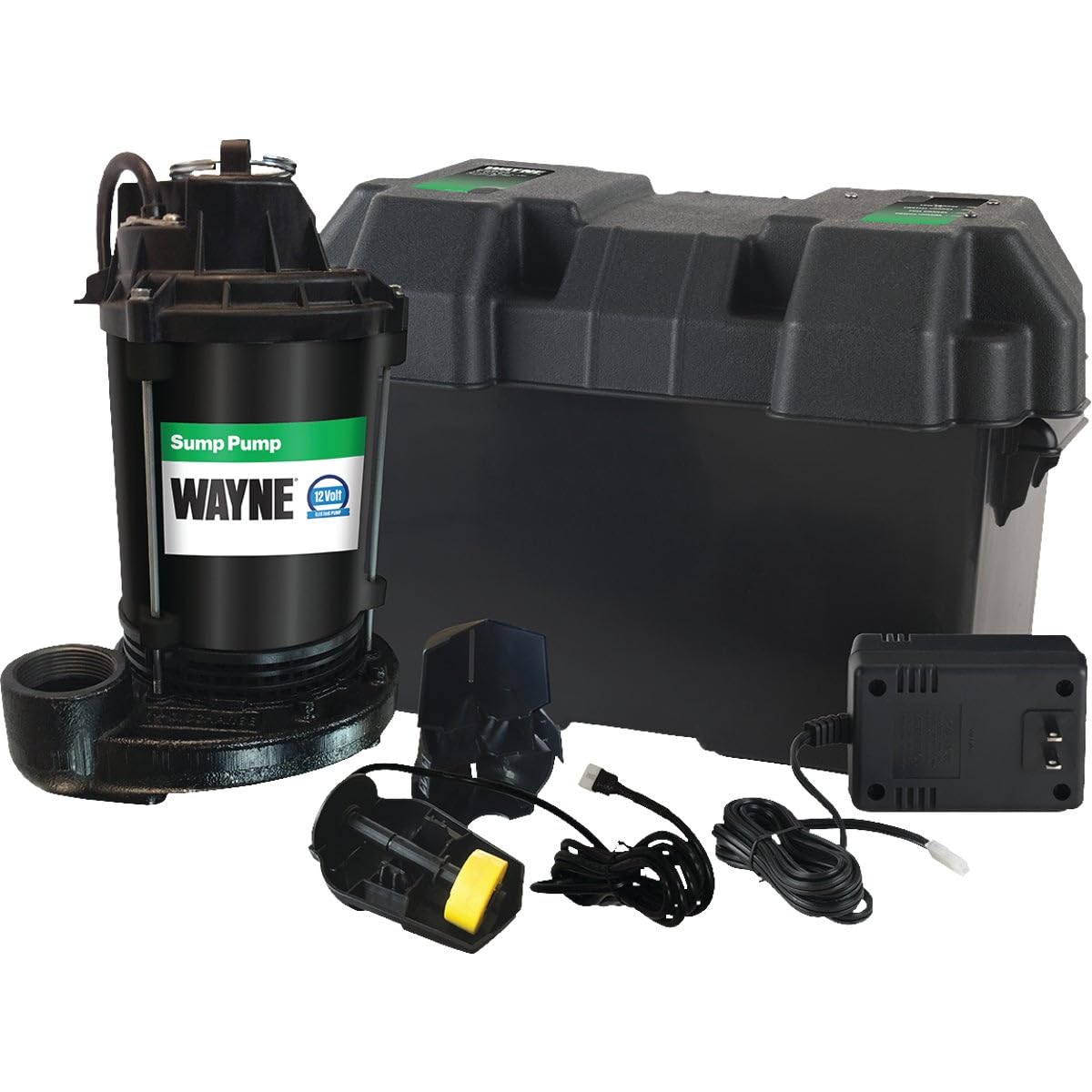
The straightforward backup pump that keeps water moving when your primary quits on you.
You already have a primary pump holding the line through normal rain. What you need is a safety net. This is that net — 45 gpm of backup capacity, up to 2,700 GPH, and the ability to lift water 10 feet, all in a package that runs on a standard 12-volt deep cycle battery. The WSB1275 75 AH battery is required but not included, and the epoxy-coated steel housing with cast-iron base means it survives in the pit rather than rusting around it.
The design touches are what make it worth the shelf space. The protective battery case includes an LED display and audible alarm so you always know if there is a problem, and the thermopolymer impeller resists corrosion while keeping water moving efficiently. The reed float switch activates reliably and the unit fits sump basins 14 inches or larger in diameter. Assembly takes roughly 20 to 30 minutes with a Y-joint pipe and check valve — not quite the 15-minute drop-in of a preassembled combo, but close enough for a competent DIYer.
Customers note days of runtime per charge during outages, and value for the price is the most-praised trait. A few mention rust appearing on the housing after less than two months, so inspect the unit when it arrives and consider a light coat of protective grease if your pit runs humid. Weighing 13.5 pounds, it is one of the easier backups to wrangle into position — noticeably lighter than the 44-pound combo systems.
What it really delivers: Days of runtime on a single deep-cycle charge, with waterproof-style electronics and a protective battery case that reports its own status.
Where it falls short: Rust resistance on the housing is a known occasional weak point — one to watch in damp basement environments.
Choose this when: You want serious backup capacity on a moderate budget and are willing to provide your own battery.
Look elsewhere if: Your pit is smaller than 14 inches across — this pump needs the space.
5. Liberty Pumps 441 Battery Back-Up Emergency Sump Pump System

A quiet submersible backup that punches above its weight the moment the grid goes dark.
Liberty Pumps built its reputation on commercial-grade equipment, and this 12-volt submersible backup carries that DNA into a package that fits a 10″W x 13″H space. It uses a mercury-free automatic switch — no toxic heavy metals, no float sticking — and comes with the full kit: pump, control panel, battery box, and 12-volt charger. Only the battery is your responsibility. The submersible design means it runs quieter than float-style pumps and sits fully contained in the basin.
The real proof comes from owners who let it sit dormant for months, then needed it in an emergency. Owners repeatedly report reliability after long standby periods — one backup sat idle 21 months, then cycled alongside the primary pump for 2.5 hours through torrential rain. Owners of 120-volt Zoeller primary pumps have noted this 12-volt backup moves water at something approaching the speed of their main pump, which is high praise for a battery-powered unit.
The honest limitation is that this system feels lighter and less substantial than heavier cast-iron combos — some find it less confidence-inspiring in the hand even though it performs well in the pit. One unit arrived with a damaged controller housing, and installation in an 18-inch basin requires some planning because there is no support stand included — builders have solved that with a homemade PVC stand. The battery box is your other consideration; the pump does not ship with one that locks, so you will want a secure spot for the battery itself.
Why It Works
- Mercury-free automatic switch with no sticking risks
- Submersible and quiet in operation
- Reliable after extended standby periods
- Compact 10″W x 13″H footprint
The Fine Print
- Feels lighter and less substantial than cast-iron systems
- No support stand included — large basins may need a custom solution
- Battery not included
The fit: Smaller sump basins where floor space is tight and noise matters.
The mismatch: Pits wider than 18 inches where a bigger, heavier pump would handle layout more naturally.
6. Basement Watchdog DFK961 1/3 HP Combination Sump Pump with Battery Backup

Preassembled on arrival, so a first-timer can be protected in an hour without touching a pipe wrench.
If you have never installed a sump pump before, this is the one that walks you through it. It arrives fully preassembled — primary pump, backup pump, floats, controller, all in one unit — and drops into the basin with minimal plumbing knowledge. The 1/3 HP primary pump is rated to move 3,100 GPH at a 10-foot lift and 3,700 GPH at 0 feet, while the backup moves 1,000 GPH at 10 feet of head and 2,000 GPH at zero.
Two things stand out for the first-time buyer. The primary pump uses a permanent split capacitor (PSC) motor, which is a design that draws less power during operation and quietly chips away at your electric bill compared to older shaded-pole motors. The second is the monitoring controller, which runs 24 hours a day, sounds an alarm, illuminates a warning light, and tells you exactly what is wrong when something needs attention. That kind of plain-English guidance is the difference between a pump you trust and a pump you worry about.
Owners have validated performance through multi-day rain events — one reviewer noted it running nonstop for five days of rain and pumping fast enough to gouge a hole in yard mulch. Weighing 18.5 pounds, it is heavier than a standalone backup but noticeably lighter than the 27-pound combos in this price tier. The one repeated complaint is price — some owners consider the value-for-money ratio a mixed bag. Also note the occasional report of shipment damage, so inspect the packaging on arrival before you install.
The plain-English controller: Instead of a cryptic beep, you get a warning light and a description of what to fix — genuinely useful when you are standing in a wet basement at 2 a.m.
The upgrade you might want: Some owners pair it with a second water-driven pump for triple redundancy, which is overkill for most homes but appealing for very high water tables.
Go with this if: You want the easiest possible combo install and value a friendly control panel over raw peak flow.
Look past it if: You are chasing the highest possible GPH numbers — mid-tier flow is what this one offers.
7. Basement Watchdog CITE-33 Combo Preassembled Primary & Battery Backup Sump Pump System

Dual floats on both pumps, preassembled in one box, and compact enough for a 12-inch pit.
The trickiest part of any sump system is the float switch (a sensor that turns the pump on when water rises) — if it sticks, the pump does not run, and your basement pays the price. This combo solves that by putting dual float switches on both the primary and backup pumps, effectively giving you four separate activation points instead of the usual two. In a basin where one float might get jammed by debris, the second takes over. The primary pump moves 62 GPM (3,720 GPH) at 0 feet of lift, dropping to 51 GPM (3,100 GPH) at 10 feet, while the backup moves 42 GPM (2,500 GPH) at 0 feet and 25 GPM (1,500 GPH) at 10 feet.
The compact 11.75″L x 8.75″W x 18″H footprint fits basins as small as 12 inches in diameter. A 0.4-amp charger is compatible with the Basement Watchdog maintenance-free AGM standby battery (BW-27AGM), which is a sealed design that needs no fluid checks. The 1/3 HP copper-wound PSC motor is built for long life and lower running costs than older shaded-pole designs. Weighing 27 pounds, it is easy enough to maneuver into position, and the whole thing arrives preplumbed — the installer just connects it to the discharge pipe.
What wins people over is how well the preassembled package translates to a low-stress install — owners repeatedly describe the process as straightforward, with clear instructions for the electrical, battery, and control module connections. The honest trade-off is durability, which draws mixed feedback. Some units run four to five years before needing replacement; others fail sooner. Since a sealed AGM battery is required to keep the backup pumping through outages, plan on budgeting for that battery replacement cycle.
The Design Edge
- Dual floats on both pumps — 4x the activation protection
- Compact 12-inch basin clearance
- Preplumbed with one pipe connection to make
- 0.4-amp charger works with maintenance-free AGM battery
What to Plan For
- Durability reports range from multi-year to much shorter
- Requires the BW-27AGM sealed battery, sold separately
- Some reviewers point out mixed value for the price tier
Made for: Compact sump pits where float reliability is the whole ballgame.
skip it if: You have a wide basin and want a bigger safety margin on flow rate — this is mid-tier on capacity.
8. Zoeller 508-0005 Aquanot 508 Battery Back-Up System
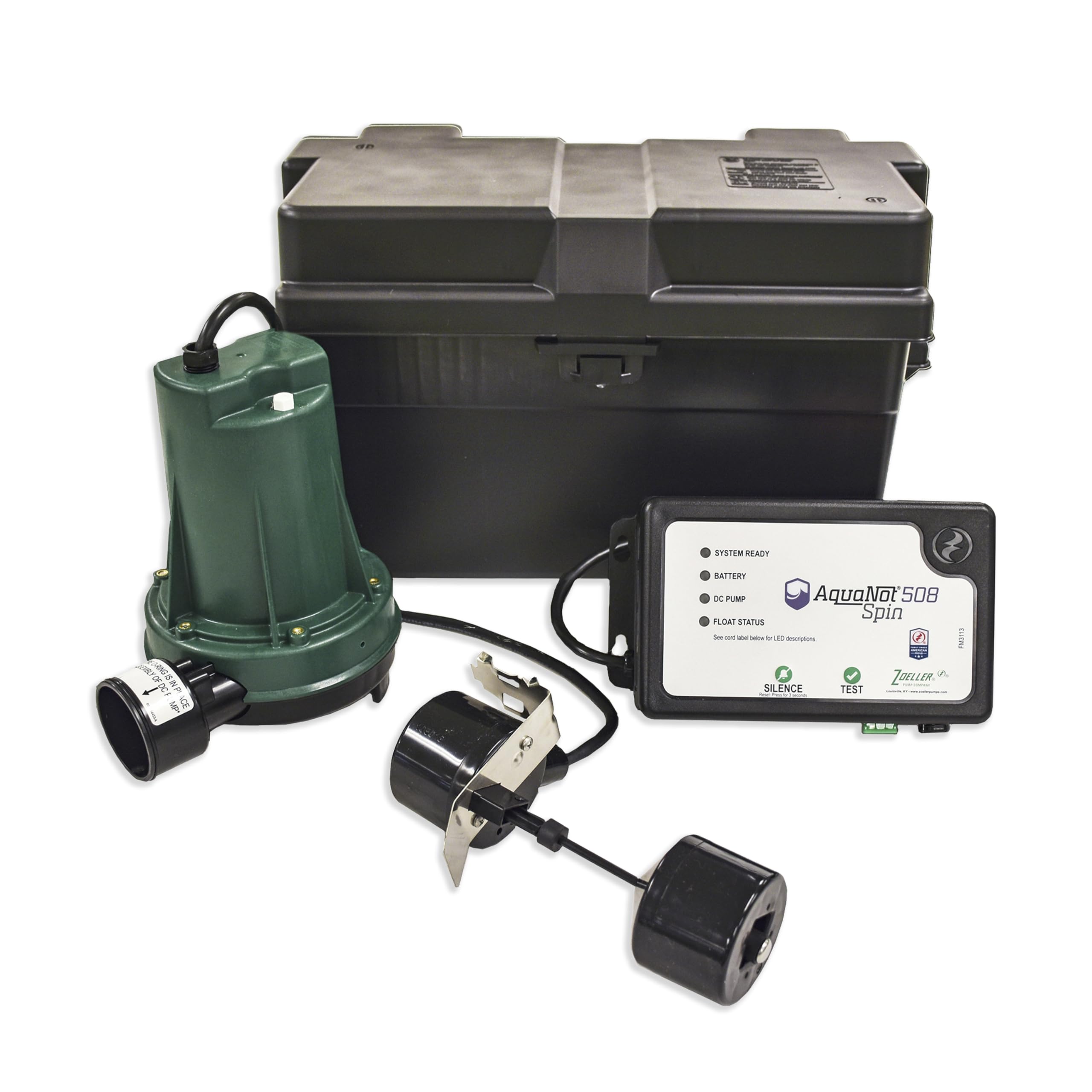
Hand-built and tested — the backup for owners who already trust a Zoeller primary pump.
The Aquanot 508 is what happens when a company that makes the primary pump also builds the backup. It shares the same DNA — a noncorrosive 12-volt pump construction, an integrated check valve, and a quick-disconnect discharge that saves you from reworking the plumbing. The aluminum seal pocket and cooling plate are working components, not marketing trim: they manage heat around the motor so the pump runs cooler during extended cycles. Each unit is hand built and 100% tested in the USA, and it weighs 10.5 pounds — one of the lightest backups in this list.
Owners consistently praise the build quality and the clarity of the instructions. This fits standard 18-inch sump wells without overcrowding a primary pump already in the basin, and it works with both regular and maintenance-free backup batteries. The built-in relief hole and flapper valve save you from buying those small parts separately. For anyone with a Zoeller M53 or similar primary pump, the integration is smooth — the two units are designed to work as a pair.
The honest caveats are worth stating clearly. The controller is a basic unit without optional dry-contact alarm integration (a feature that lets you connect an external alarm), and one of the recurring gripes is that the instructions do not spell out the vent hole placement between the primary check valve and the backup — several owners have had to work around that on their own. A small number of units in the field experienced early controller failures, which changes the value equation for people installing multiple systems professionally. The 3-year extended warranty only applies if you pair it with a Zoeller Aquanot battery, so read the warranty terms before purchase.
Where the money goes: Integrated check valve, quick-disconnect discharge, aluminum cooling plate — component-level build that shows up in service life, not on a spec sheet.
Who should weigh this carefully: High-volume installers, since the controller reliability pattern is the one contested area.
The right buyer: An owner already running a Zoeller primary pump who wants a matched backup built to the same standard.
The wrong buyer: Anyone installing five or more units professionally — the controller reliability pattern is the weak link here.
9. Basement Watchdog Big Combo CONNECT CITS-50 WiFi-Capable Sump Pump System

The half-horsepower combo that handles serious inflow and lets you monitor from your phone.
If you have ever woken up wondering whether your sump pump ran during the night — this is the system that answers the question. The CITS-50 pairs a 1/2 HP primary pump rated at 73 GPM (4,400 GPH) at zero feet of lift with a backup pump rated at 48 GPM (2,890 GPH) at zero feet. Add the BW-WiFi2 CONNECT module, sold separately, and the system sends real-time alerts via text, email, push notification, or the free Basement Watchdog app. That upgrade path is what makes this pick different from the older combos in this list.
The unit is preassembled and preplumbed with copper-wound PSC motor construction for lower long-term energy use. It fits both maintenance-free AGM and wet-cell batteries, and — this is the standout feature — you can connect two batteries in parallel for double the runtime during extended outages. Rather than a single-battery ceiling, the system scales with your risk tolerance. Weighing 27 pounds, it is manageable for a two-person install, and the check valves come pre-installed so you are not doing plumbing work on top of the electrical.
The pattern owners repeat most is easy installation, a quiet primary pump, and years of reliability from the same product family. The mixed feedback lands on durability — some shoppers say failures sooner than expected, which is note given the combined price tag. Also worth knowing: the battery cables are short enough that some owners replace them with longer versions, and the display back on the controller does not sit flush, which makes wall-mounting on brick a custom project. The anti-siphon weep hole sprays a brief stream of water when the backup fires — normal behavior, just not documented in the manual.
Where It Leads
- Half-horsepower primary at 4,400 GPH — the highest capacity combo in this list
- WiFi upgrade path for real-time alerts on power, pump, and battery
- Supports two batteries in parallel for extended runtime
- Preassembled and preplumbed with dual floats and built-in check valves
Worth Accounting For
- WiFi module sold separately
- Short battery cables sometimes replaced by owners
- Display mounting on brick requires custom work
Built for: Large basements with high water tables where you want both the highest flow rate and remote monitoring.
Not for: Anyone in a narrow pit or on a tight upgrade budget — the WiFi module adds cost on top of the base unit.
10. Westinghouse WH50BBU 1/2 HP Sump Pump with Battery Backup Capability
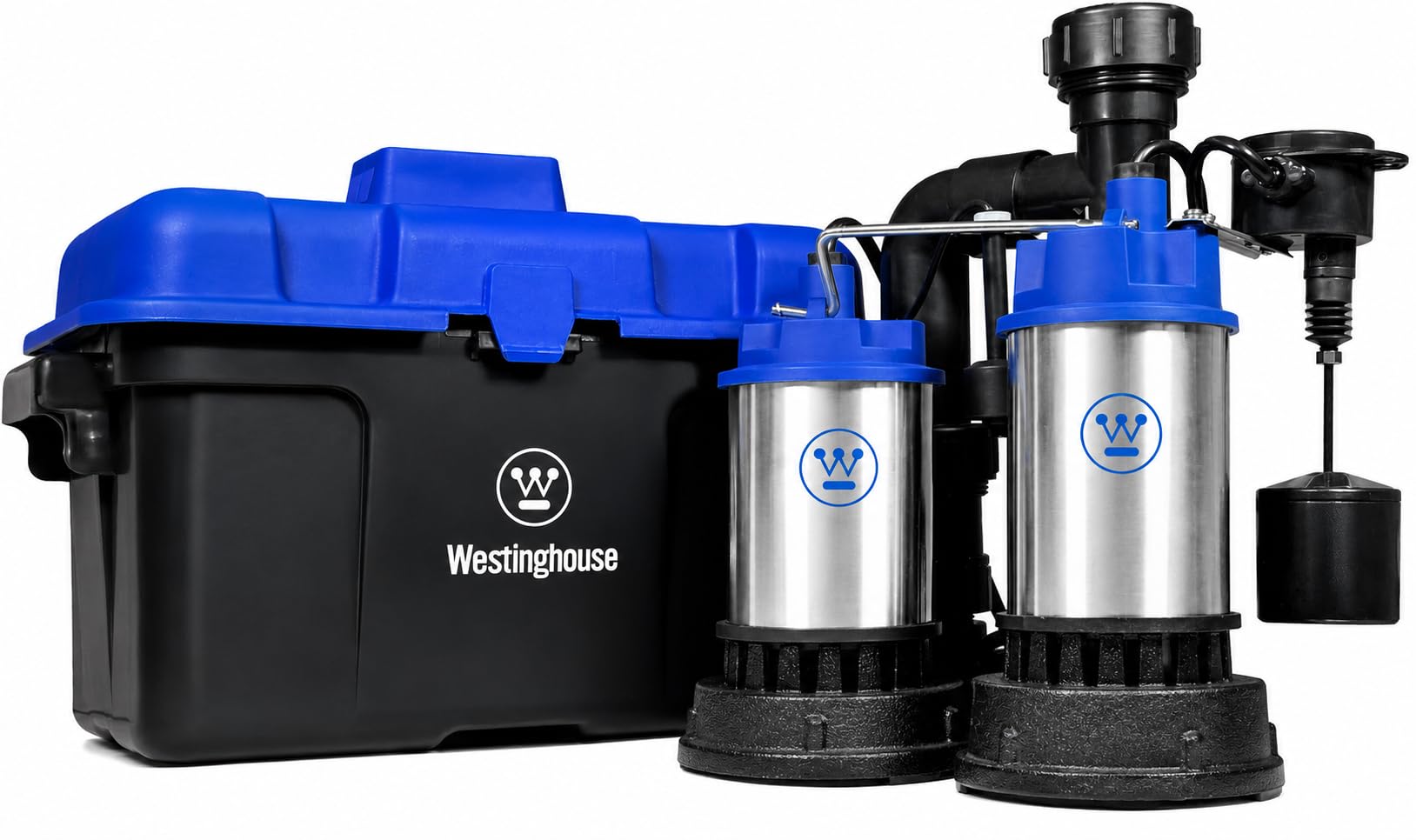
Stainless steel housings on both pumps, a top-suction intake, and a 30-foot lift rating up the discharge line.
This is what a modern combo looks like when the manufacturer decides to use stainless steel instead of the plastic housing common in cheaper kits. Both the AC primary and the DC backup pump have corrosion-resistant stainless steel construction, and the whole unit fits smaller footprints than traditional cast-iron combos. The 1/2 HP primary pump is rated at 87 gpm, and the system’s maximum lift height of 30 feet is the highest in this list — useful if your discharge pipe has to climb a long vertical run before it exits the house.
The motor design pays attention to cooling and lifespan. A PSC (permanent split capacitor) motor includes thermal overload protection, lubricated ball bearings, and a sealed shaft, meaning fewer moving parts exposed to grit and moisture. The motor is encased in dielectric oil to improve cooling efficiency. And the intake sits at the top of the pump — a design that helps prevent airlock (a condition where a pocket of air blocks water from entering) and reduces debris buildup so water flows consistently.
What wins people over on this unit is the quality of the build in hand — the metal construction feels substantial, and owners repeatedly note it is heavy, solid, and not a cheap plastic unit. Buyers report the pump empties a large pit in roughly 10 seconds, and the two separate floats — one per pump — activate independently. It weighs 14.4″L x 9.3″W x 15″H in size — compact enough for tight pits despite the metal housing. The honest catch is that some buyers wish the battery came bundled at a discount rather than being a separate purchase, and longevity is not yet established given the shorter track record of this model. For a bigger-picture look at the value calculation in a battery powered sump pump, see the Verdict section below.
what separates it
- Stainless steel housings on both pumps resist corrosion
- Top suction intake prevents airlock and reduces debris buildup
- 30-foot maximum lift height — highest in this list
- PSC motor with thermal overload protection and sealed shaft
Worth Noting
- Battery sold separately and not bundled
- Newer model with shorter longevity track record
- Compact build may feel tight in very large basins
Pick this if: You want stainless steel construction and the highest lift rating in this list for a long vertical discharge run.
Look elsewhere if: You insist on a battery-included kit — you will pay extra to source a compatible 12V battery.
11. Wayne WSS30VN Combo System + WSB1275 Sealed Battery Bundle
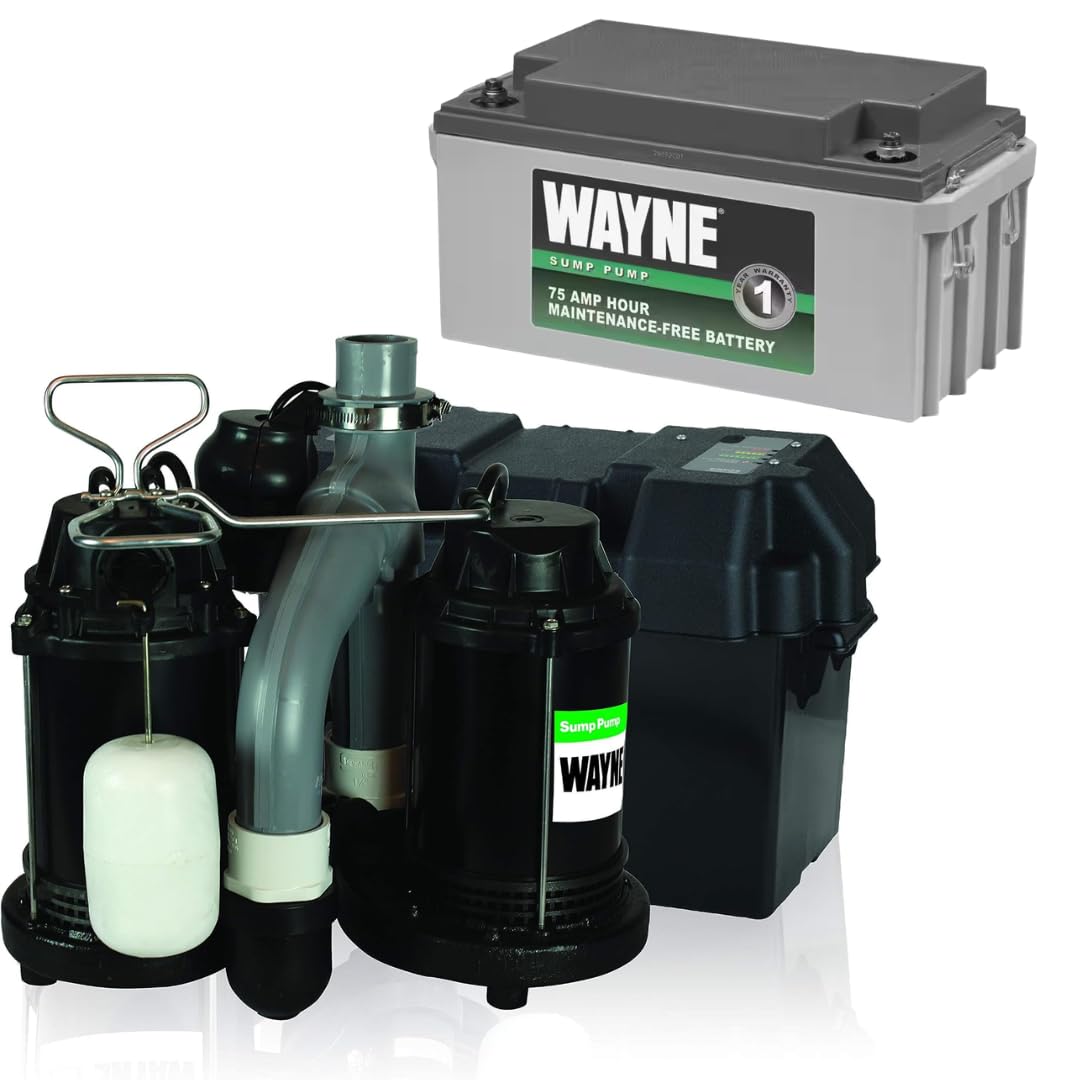
The same Wayne combo, with the battery already in the box — no separate order, no wrong-model guess.
The single biggest mistake first-time buyers make is ordering a battery backup system and forgetting the battery, or ordering the wrong size. This bundle eliminates the problem by pairing the Wayne WSS30VN combo system with the WSB1275 sealed lead-acid battery in a 12V/75Ah capacity (12 volts, 75 amp-hours — a measure of how much energy it stores). If you have already decided the Wayne combo is the right system — and it holds its own against anything else here — buying the bundle is the honest answer to “what do I need to finish the job?”
The battery itself is a maintenance-free sealed unit that arrives fully charged with carry handles. You do not mix acid, do not top up water, and do not worry about vapors — the sealed lead-acid chemistry is the safer match for a basement installation. If you have ever owned a wet-cell battery backup, you know the black rubber cap and the distilled-water routine. This eliminates that entirely. And the Wayne WSS30VN combo it is paired with still carries its full spec sheet: 0.5 HP primary pump, 5,100 gallons per hour backup capacity, and the ability to move up to 10,000 gallons on a single battery charge.
The preassembled design installs in 15 minutes or less with no weep hole drilling necessary, and it fits sump basins 16 inches or larger. Owners consistently rate it for the quiet whisper-level operation and the genuine confidence that comes when you know the power failing does not mean the basement flooding. Weighing in at 44 pounds for the combo alone, expect a heavier total package once the battery is included — plan on two people for install and post-install lifting. The Wayne WSS30VN primary pump carries a 3-year manufacturer warranty, which is shorter than some competitors offer but worth noting.
The bundle advantage: You get the matched battery without having to research which one fits — the guesswork is removed.
The durability caveat: One owner flagged the primary pump’s warranty as shorter than the predecessor model’s, and some buyers wish the manufacturer extended it on a premium-tier system.
The easy choice for: First-time buyers who want the full solution shipped in one box.Look past it if: You already have a compatible 12V battery — the standalone combo saves you the bundle premium.
Understanding the Specs
Flow Rate & Head Height
Flow rate is how many gallons per minute the pump moves at zero lift — essentially a best-case number. Head height is how high the pump can push water vertically through the discharge pipe. Both numbers drop as the other goes up, so a pump rated 3,100 GPH at 0 feet might only move 2,150 GPH once it is lifting water 10 feet. Always match the pump’s spec at your actual lift, not at zero. Look for the pump’s stated flow at both 0-foot and 10-foot benchmarks when comparing.
Backup vs. Combo Configuration
A combo kit ships with both a primary AC pump and a DC battery backup in one preassembled unit — one install, one warranty, one set of matched floats. A standalone backup pump assumes your existing primary pump is worth keeping and adds only the second layer of protection. Combo kits cost more but guarantee the two pumps work together. Standalone backups are cheaper and easier to retrofit. Neither is safer — the right answer depends on how much you trust your current primary pump.
Battery Type: Sealed AGM vs. Wet-Cell
Sealed AGM and maintenance-free batteries arrive charged and need no fluid checks — you set them in the case and forget them for years. Traditional wet-cell batteries demand a distilled-water top-up roughly every six months and typically run three to four years before needing replacement. Both work, but sealed AGM is the lower-maintenance path. If you already own a wet-cell setup, the pump systems here generally accept both as long as the voltage and amp-hour rating match.
Float Switches & Activation Reliability
The float switch is the part that tells the pump water is rising. A bad float switch is the single most common reason a backup fails to fire. A dual-float design uses two independent switches on the same pump, so if one is blocked by debris the other activates. A mercury-free electronic switch (like the one in the Liberty Pumps 441) eliminates the mechanical float entirely by using a sensor panel. Whichever design you pick, test the switch manually at least once a season.
FAQ
How long does a battery backup sump pump run during an outage?
Do I need a combo kit or just a backup pump?
What battery size works with a 12-volt backup sump pump?
Will a battery backup sump pump fit in a small sump basin?
How do I test a battery backup sump pump without a real outage?
Can I install a battery backup sump pump myself?
Is a sealed AGM battery better than a wet-cell battery for a sump pump?
How high can a battery backup sump pump lift water?
What is the difference between a battery backup sump pump and a water-powered backup?
Should I add a WiFi module to my battery backup sump pump?
Final Thoughts: The Verdict
For most homes, the best battery powered sump pump pick is the Wayne WSS30VN Combo System. It walks through every box on the checklist: 85 gpm primary performance, a 5,100 GPH battery backup, one million cycles of tested durability, and a 15-minute install that a first-timer can finish in an afternoon. The mix of performance and installation feedback from owners is what earned it the top slot, and the preassembled design means it is running before the next storm arrives. Add the required 75 AH battery to complete the setup.
If your sump pit is just under 14 inches across, the Basement Watchdog Special CONNECT is your match — the compact backup that fits where bigger combos cannot, with a WiFi upgrade path if you want alerts on your phone. And if you are running a Zoeller primary pump and want a backup built to the same standard, the Zoeller Aquanot 508 is the pick that pairs best with what you already own.
One honest nudge before you decide: a battery powered sump pump is a system, and the weakest link is always the battery itself. Whichever pump you choose, plan for a replacement battery every few years, sealed AGM if your budget allows, and test the backup float once a season. Do that, and the confidence you paid for stays real — not just a printout in the manual.
How We Picked
We do not accept paid placement. Every pick is matched to a real buyer and a real use-case; we do not hands-on test units.
Sources & Methodology
Specifications: manufacturer listings and product documentation. Review insights: verified customer reviews, as of September 2026. Pricing: not shown on this page (it changes often); check the current price via the retailer link.
As an Amazon Associate, KitchPrep earns from qualifying purchases. This does not affect which products we feature.
Related Guides
