
Specs are compiled from manufacturer listings and verified buyer reviews and can change over time — please confirm the key details on the product page before buying.
If you are building a soft wash rig, the pump is the part that decides whether your day goes smoothly or ends in a driveway full of half-rinsed siding. You need steady pressure at the wand, enough flow to keep a wide spray pattern, and a body that shrugs off bleach and surfactant instead of corroding from the inside out. Every pick below runs on 12-volt DC power — not household AC, not gas — so they drop straight onto a trailer battery or ATV charging system. The list walks you through what separates a pump that survives a season from one that quits mid-job.
I’m Mohammad Maruf — the founder and writer behind KitchPrep. This guide is built by comparing the manufacturers’ published specifications and the patterns across verified customer reviews, so you get each pick’s real strengths and trade-offs instead of marketing spin.
Three numbers decide whether a pump keeps up with your job: flow in gallons per minute (GPM — how much liquid moves per minute), shut-off pressure in PSI (pounds per square inch — the push behind the spray), and how high the pump can pull water on its own. Get those three right and your 12v soft wash pump matches your tank and wand instead of fighting them. Spraying a roof, a driveway, or a fence line all come down to the same three specs.
Our Picks at a Glance


How To Choose The Best 12V Soft Wash Pump
A soft wash pump is a 12-volt diaphragm pump that pushes diluted cleaning chemicals through a hose and wand at low pressure. It is not a pressure washer. Instead of blasting water at thousands of PSI, a soft wash pump delivers a steady stream at 60 to 100 PSI so the chemical does the cleaning work. That distinction matters because the wrong pump for your setup will either starve your spray bar or burn itself out trying to keep up.
Match the flow rate to your spray tip count
Flow rate is measured in GPM, or gallons per minute. A single wand tip needs less flow than a wide spray bar with multiple tips. If your pump cannot supply enough GPM, your spray pattern will collapse into a weak, uneven stream. Look at your nozzle setup first, then pick a pump rated for that demand. A pump that runs at its rated flow without straining will outlast one that is constantly maxed out.
Check the shut-off pressure against your hose length
Shut-off pressure, measured in PSI, is the maximum pressure the pump builds before its internal switch cuts the motor. Longer hose runs and higher elevation both eat into that pressure by the time water reaches your wand. For two-story work, you want headroom above what your nozzle actually needs. A pump rated for 70 PSI gives you more usable pressure at the tip than one rated for 60 PSI when you are pushing water uphill.
Understand self-priming height before you mount the tank
Self-priming height is how far below the pump your tank can sit and still feed properly, measured in feet of suction lift. If your tank is mounted low on a trailer but the pump sits up top, you need enough lift to bridge that gap. A pump rated for 10 feet of suction handles more mounting positions than one rated for 6 feet. Match this number to your actual rig layout, not a best-case scenario.
Look at the diaphragm and valve materials
The diaphragm is the flexible membrane inside the pump that moves water, and the valves are the one-way gates that control flow direction. Both come in different materials, and some handle bleach and harsh chemicals better than others. Santoprene, Viton, and Geolast are common diaphragm materials that resist chemical breakdown. If you run sodium hypochlorite regularly, these material specs matter more than any marketing claim.
Quick Comparison
| Model | Best For | Flow Rate | Shut-off Pressure | Self-Priming Lift | Amazon |
|---|---|---|---|---|---|
| SEAFLO 33 Series Washdown Kit★ Best Overall | RV, boat, and marine deck washing | 3.0 GPM | 70 PSI | 6 feet | Amazon |
| Ebusin 12V Diaphragm PumpTop Performer | High-flow soft wash on a budget | 5.5 GPM | 60 PSI | 10 feet | Amazon |
| Pumpoasis NYB Sprayer PumpMost Versatile | Farm spraying and garden irrigation | 3.5 GPM | 60 PSI | 10 feet | Amazon |
| TWERE EF5500-BOX Pump | Two-story soft wash reach | 6.5 GPM | 70 PSI | 10 feet | Amazon |
| Ceelpeopar 5.5GPM Sprayer Pump | Quiet weed spraying on ATVs | 5.5 GPM | 60 PSI | 8 feet | Amazon |
| Jeogejin 6.5GPM Sprayer Pump | Adjustable-pressure commercial spraying | 6.5 GPM | 70 PSI | 8 feet | Amazon |
| Pumpoasis 5.4GPM Sprayer Pump | Spray boom rigs and wide coverage | 5.4 GPM | 60 PSI | 10 feet | Amazon |
| DEEKOOL EF5500-BOX Pump | Soft wash systems on 50-gallon tanks | 5.5 GPM | 60 PSI | 8 feet | Amazon |
| Fimco High-Flo HFP-2.2 | ATV and lawn tractor spot spraying | 2.2 GPM | 100 PSI | — | Amazon |
In‑Depth Reviews
1. SEAFLO 33 Series Washdown Deck Wash Pump Kit
Our pick — over 4★ from 250+ verified ratings; the strongest balance of quality and price.
The complete kit that turns any boat or RV into a washdown station in one afternoon
For boat owners and RVers who want a washdown station without hunting for fittings, hose, and a nozzle separately, this SEAFLO kit arrives as one box. The pump itself runs on 12-volt DC power and moves 3.0 GPM (gallons per minute — how fast water flows through the hose) at a 70 PSI shut-off pressure. That PSI figure is what pushes water through the included 25-foot coiled hose and out the trigger nozzle with enough force to rinse mud and salt off a deck. The 70 PSI rating beats the 60 PSI on the Ebusin and DEEKOOL pumps above — 70 PSI versus 60 PSI — which means more usable pressure at the nozzle when you are spraying at an angle.
What makes this kit easier than building from parts is what comes in the box: the pump, a 25-foot UV-protected coiled hose, a trigger spray nozzle, quick-connect fittings, a 50-mesh inlet strainer, and two half-inch barbed fittings. The self-priming design pulls water from up to 6 feet below the pump, so it works with a deck-mounted tank or a below-deck freshwater source. The EPDM valves and Santoprene diaphragm inside are built to handle both freshwater and saltwater, which is rare at this flow rate. Rubber mounting feet cut down on the vibration that normally rattles through a boat hull.
You get a real trade-off here, but a manageable one. At 3.0 GPM (gallons per minute), this pump moves enough water to wash a deck, yet it is lighter than the 5.5 GPM and 6.5 GPM options lower on this list — so if you run a wide spray bar on a soft wash rig, look at the Ebusin or TWERE instead. Buyers report the install is quick and the pressure is strong, and turning a live well bait box into a wash station is a popular use. Switch the pump off when the spray gun is not in use; leaving the switch on with the gun closed can overheat the pump during long idle stretches. The four-year warranty is the longest on this list by a wide margin.
Where this pump earns its keep
- Entire washdown kit ships in one box — pump, 25-foot coiled hose, trigger nozzle, strainer, and fittings all included
- 70 PSI shut-off pressure delivers strong reach through the included hose, and the pressure switch starts and stops the pump the moment you squeeze or release the trigger
- EPDM valves and Santoprene diaphragm handle both freshwater and saltwater without corroding
- 4-year manufacturer warranty gives you the longest coverage window on this list
Where it falls short
- 3.0 GPM flow is lower than the 5.5 and 6.5 GPM pumps here — not the right pick for wide spray bars
- Leaving the switch on with the trigger closed during idle can overheat the motor over time
- The hose fitting on the outlet side runs a slightly unusual size, so some buyers swap in their own clamp
Made for boat and RV owners: if you want a complete, pre-matched washdown kit with the longest warranty here and don’t need high flow, this is the one box to order.
Look elsewhere if: your rig runs a multi-tip spray bar or you push bleach through a soft wash system — the higher-flow pumps below serve that job better.
2. Ebusin 12V Diaphragm Water Pump, 5.5 GPM, 60 PSI
High flow on a mid-range budget, with the suction power to pull from a low-mounted tank
If you run a soft wash rig off a trailer-mounted tank, the number that decides your day is flow rate — and this Ebusin pump delivers 5.5 GPM at 60 PSI. That is 83% more flow than the SEAFLO 33 Series above, which tops out at 3.0 GPM. More flow means a wider spray pattern stays full instead of collapsing into a weak stream, so you cover more siding per pass. The pump also self-primes from up to 10 feet below, compared to the SEAFLO’s 6-foot suction lift — a 67% deeper pull that gives you far more freedom in where you mount the tank relative to the pump.
The practical setup is simple. A 6-foot, 20-amp power cord is already wired on, so you connect to your battery, drop the pickup into the tank, and spray. The fiberglass-reinforced polypropylene manifold holds a half-inch MNPT port that follows standard RV installation patterns, which means it drops into most existing tank setups without modification. The thermally protected motor shuts itself down if it gets too hot and restarts once it cools, which protects against burnout during long runs. The diaphragm and manifold materials resist corrosion from bleach and surfactant mixes, and the pump ships with a three-year warranty.
Longevity depends on one habit: flushing. A buyer who ran small soft wash jobs on a 25-gallon tank reported the pump held up for about a year before it started passing water but stopped dispensing — and pointed to insufficient flushing as the likely cause. That is not a defect; it is a maintenance reminder. Flush the pump with fresh water after every job, even soap-only runs, and it will last far longer. A few owners also note the pressure switch needs a hex-head tweak to stop the pump from cycling on and off too rapidly. It is a five-minute adjustment that smooths out the flow.
The value math: 5.5 GPM at a mid-range price is the highest flow-per-dollar on this list, and one owner reported the pump paid for itself across three two-story soft wash jobs.
The honest catch: it needs a deliberate post-job flush routine and a quick pressure-switch adjustment — skip either and you shorten its life.
Reach for this if: you want maximum flow without stepping up to a premium price, and your tank sits low enough that a 10-foot suction pull solves a mounting problem.
Think twice if: you want a set-and-forget pump — the Ebusin rewards owners who flush it after every use.
3. Pumpoasis 12V Sprayer Pump, 3.5 GPM, 60 PSI
A farm-first pump built to swap straight into an existing sprayer without rewiring anything
Farmers and landscapers who already run a 25-gallon sprayer will recognize this Pumpoasis pump as a direct replacement. The pressure is adjustable from 0 to 60 PSI, so you can dial it to the job: low pressure for delicate foliage, higher pressure for fence lines. A 10-amp draw and 3.5 GPM flow keep it in the range most single-wand sprayers need.
What sets the build apart is the internal hardware. The all-copper motor resists the heat that comes with long spray sessions, and the rubber base keeps vibration and noise down. The included inlet filter blocks debris from entering the pump, which protects the diaphragm from grit. It ships with both half-inch and three-quarter-inch hose adapters, so it fits a wide range of hose setups. The manufacturer states the pump is designed for an over 15-year service life, and the built-in overheat protection backs that up by cutting the motor when it gets hot and restarting it automatically once it cools.
The one thing to know is that thermal protection is a feature, not a flaw — but it does kick in during heavy, continuous use. Owners describe it as a pump that carries a steady 60 PSI through a spray bar and works well with a hand wand, and the minority who mention heat cycling say it cools down and restarts quickly. If you run long, uninterrupted spray sessions, give it air flow and short breaks. A few buyers mentioned the package arrived without mounting screws, so set aside your own hardware before the install day. At 3.5 GPM, it will not keep pace with a multi-tip spray boom the way the higher-flow pumps will.
Why the chemicals crowd likes it: the chemical-resistant diaphragm handles Roundup and bleach-based mixes, and the built-in inlet filter is a small detail that saves the pump from grit damage.
A straight answer: pick this Pumpoasis if you are replacing a dead pump in an existing agricultural or garden sprayer and want a drop-in fit without changing your tank or hose.
Not the pick if: you spray wide areas with a multi-tip boom — the 3.5 GPM flow will not feed a large spray bar.
4. TWERE EF5500-BOX 12V Sprayer Pump, 6.5 GPM, 70 PSI
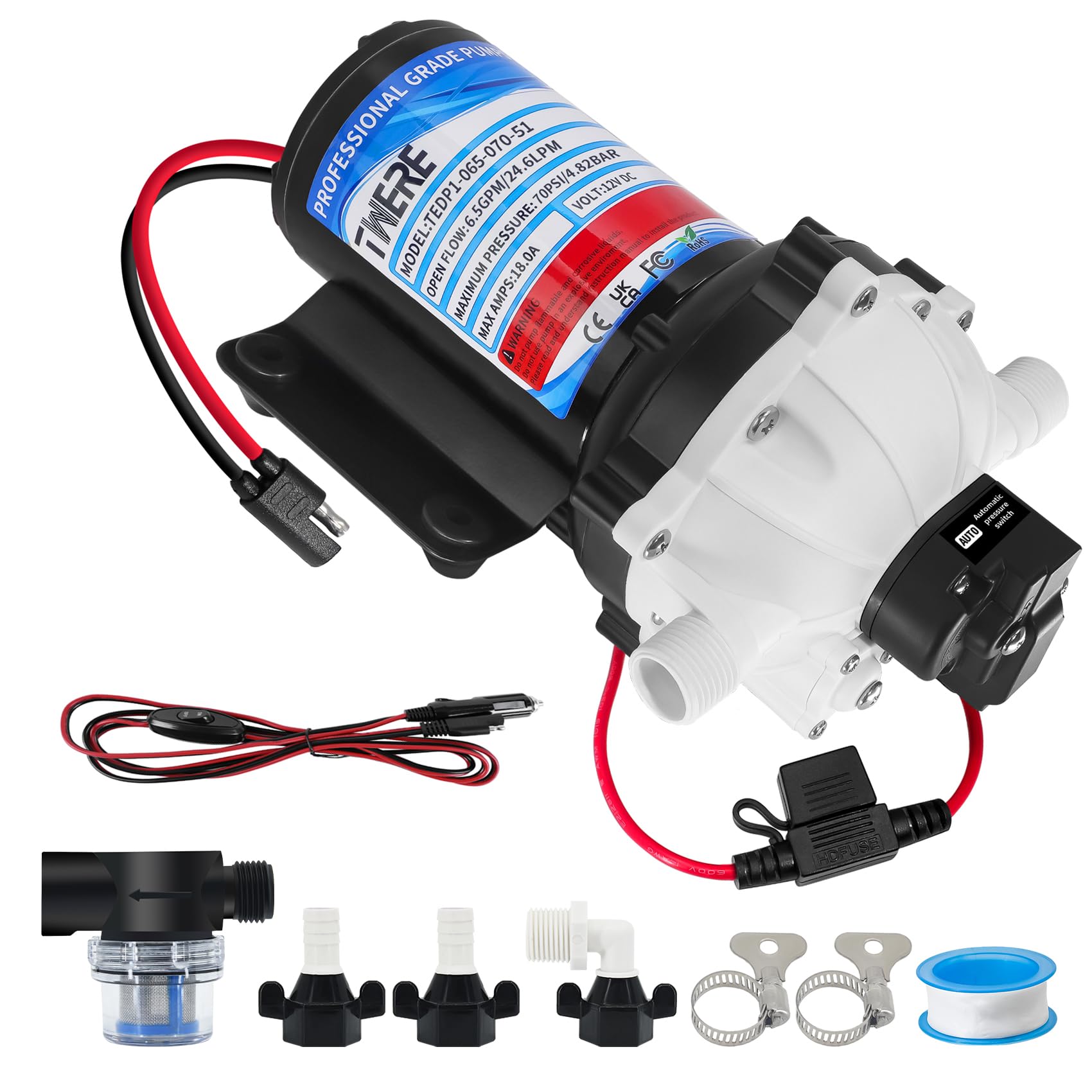
The high-flow, high-pressure play for two-story soft wash work and commercial-sized tanks
When you need to move a lot of chemical fast and push it up to a second story, flow and pressure both matter — and this TWERE pump brings 6.5 GPM at 70 PSI to the table. That is the highest flow rate on this list and puts it well past the 5.5 GPM Ebusin and the 3.0 GPM SEAFLO. The 70 PSI matches the SEAFLO’s shut-off pressure but at more than double the flow — 6.5 GPM versus 3.0 GPM. The result is more volume at the wand, which is what actually cleans siding once you add chemical. Self-priming reaches 10 feet, so a low-mounted tank is no problem.
The setup and protection features are designed for convenience. The pump ships with a 6-foot, 20-amp power cord and accessories — hose barb adapters, a pressure switch, and a strainer — so you can connect it to hoses and filters without a trip to the hardware store. The thermally protected motor shuts down if it overheats and restarts on its own. Fiberglass-reinforced polypropylene manifolds with half-inch MNPT ports follow the standard installation pattern for most spray tanks, making it a drop-in for common 12-volt diaphragm pump layouts. The manufacturer backs it with a two-year warranty.
Check one installation detail before you buy. Several owners found the pump underperformed at first, not because of a defect, but because their pickup tube collapsed under suction — once they swapped in a rigid tube, the pump delivered its full 70 to 80 PSI and roughly 6.5 GPM. Make sure your pickup line is stiff enough to hold up under the pump’s pull. A few buyers also noted the included 14-gauge cable looks light for the pump’s draw and recommended thicker wire for long runs. Owners who mount it on a proper soft wash system with a rigid pickup consistently report it climbs to two stories with ease.
What pushes it to the front
- 6.5 GPM is the highest flow on this list — strong enough to feed a spray bar or dual wand
- 70 PSI shut-off pressure reaches two stories when paired with a rigid pickup tube
- Self-primes 10 feet, so it works with a low-mounted tank
- Arrives with the cord, adapters, pressure switch, and strainer needed to start
What to watch
- Needs a rigid pickup tube — a collapsing soft line starves the pump and makes it look weak
- Included cable runs on the light side for long wiring runs at this draw
- Durability judgments are still early, so long-term performance is unproven
Built for: anyone running a large soft wash rig who needs maximum flow to reach two stories and cover ground quickly on big tanks.
skip it if: your rig only feeds a single low-volume wand — you would be paying for flow you never use.
5. Ceelpeopar 12 Volt Sprayer Pump, 5.5 GPM, 60 PSI
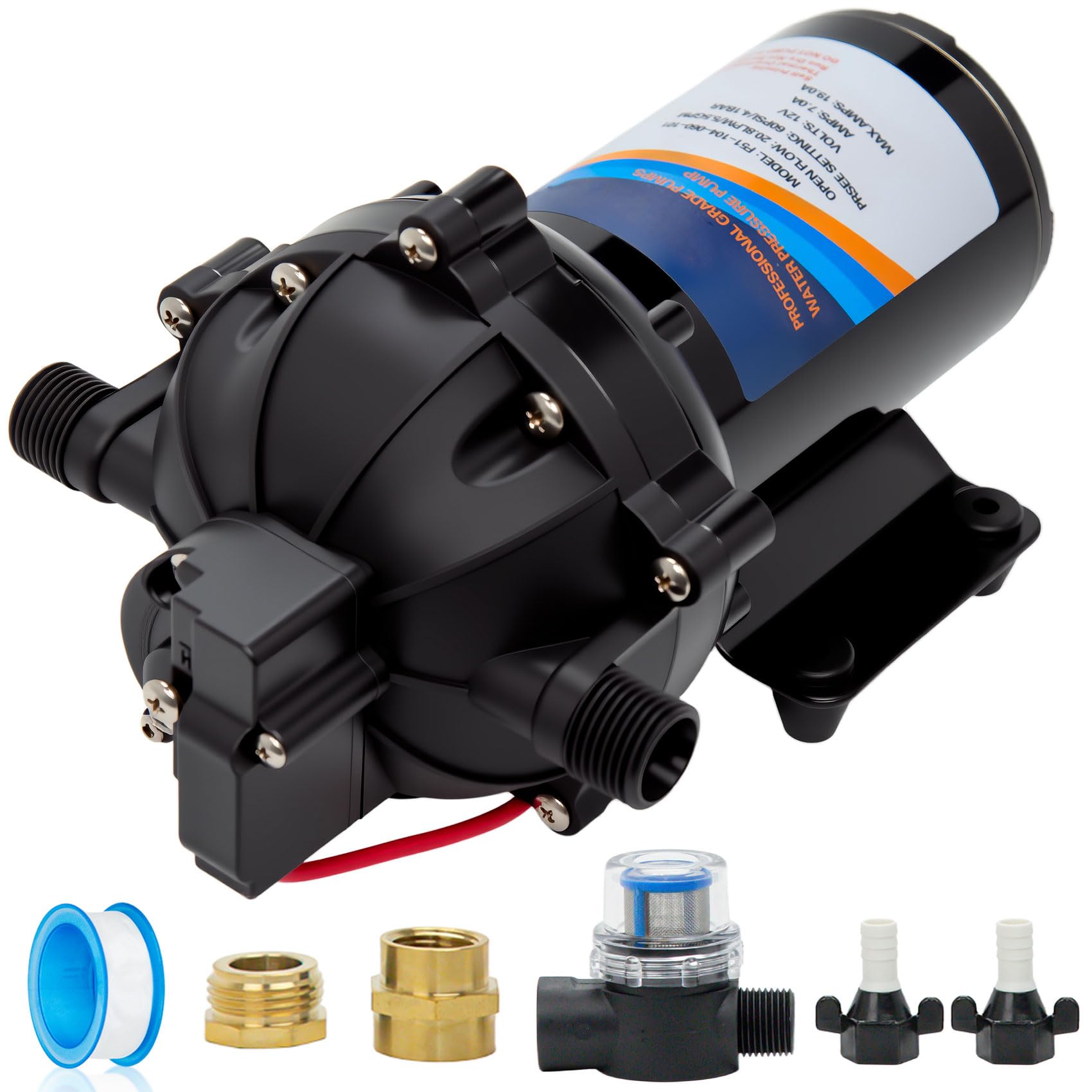
The rig upgrade ATV owners choose when they want strong output without the racket
Weed spraying from an ATV or UTV is noisy, dusty work, and a pump that clatters away under the seat just makes the day worse. This Ceelpeopar pump runs on 12-volt DC power and delivers 5.5 GPM at 60 PSI, matched to the Ebusin on flow but with a vibration-dampening rubber base that keeps the mechanical noise down. An all-copper motor and fiberglass-reinforced polypropylene manifold let it push bleach and other harsh chemicals through the system.
The control features are what make it easy to live with on a working rig. The built-in pressure switch shuts the pump off automatically when you are not spraying, which saves battery and stops the pump from dry-running when the tank empties. An inlet filter keeps debris out of the internal components, protecting the diaphragm from the grit that collects in field tanks. The manifold carries half-inch NPT ports with both a half-inch barb and a three-quarter-inch garden hose adapter included, so it drops into standard sprayer tanks and most existing setups. The manufacturer states the pump is built for an over 10-year service life.
Owners who run dual-pump rigs — mounting two of these on a UTV to cover more ground — consistently report strong pressure and quieter operation than their previous pumps. A rare buyer reported low pressure on arrival, but that reads like an out-of-box unit issue rather than a design flaw. The realistic expectation is that this pump does its best work on a weed-spraying or light soft wash setup, not as the heart of a high-volume commercial roofing rig. Set your rig up with the right nozzle for 5.5 GPM and it will keep pace all day.
Noise and power together: the rubber-damped base plus the automatic shut-off make this one of the least annoying pumps to run for long spray sessions on a moving vehicle.
Who should grab it: ATV, UTV, and side-by-side owners who want high flow and quiet running in one unit and value the stress-free return policy.
Where it stops being ideal: very large tanks paired with a multi-tip boom, where its 60 PSI ceiling and 5.5 GPM flow will feel stretched.
6. Jeogejin 12 Volt Sprayer Pump, 6.5 GPM, 70 PSI
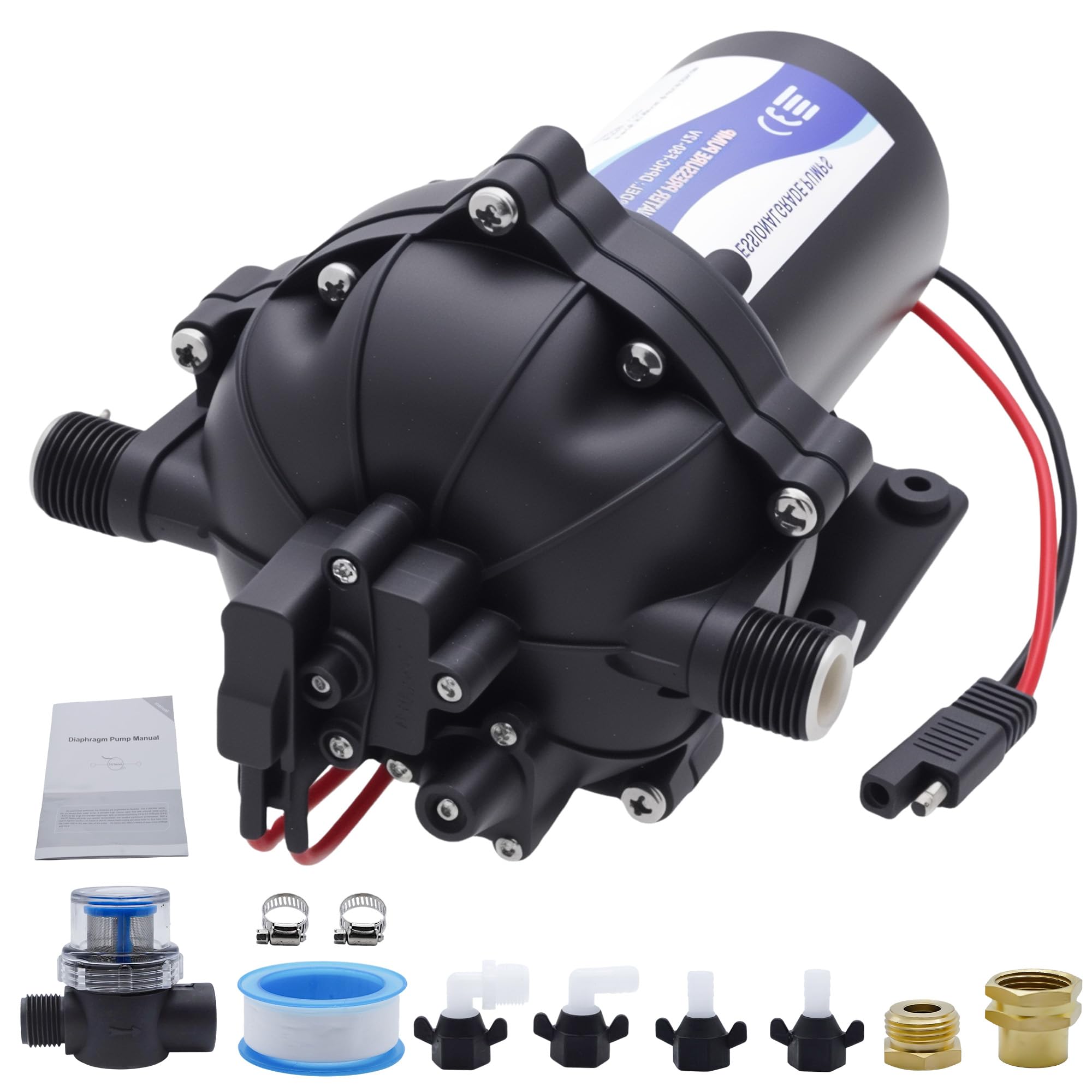
Dial-in pressure control up to 100 PSI for operators who fine-tune every spray job
Most pumps on this list lock you into a single shut-off pressure. This Jeogejin unit is different: its pressure switch is adjustable across a 40 to 100 PSI range, so you can tune output to the job instead of the other way around. Combined with 6.5 GPM flow, it is built for users who want commercial-grade flexibility from a single pump. Self-priming reaches up to 8 feet.
The five-chamber diaphragm design with a pure copper motor is the standout internal feature. More chambers mean smoother, more continuous output with less pulsing than simpler diaphragm designs. The pump body is glass-fiber reinforced polypropylene, chosen for chemical resistance against bleach-based cleaners. It handles both dry-run and thermal overload protection, so the motor is guarded against burnout, and shock-absorbing rubber bases cut vibration and noise. The half-inch NPT connection ships with a half-inch barb fitting and a three-quarter-inch garden hose adapter for wide compatibility. A built-in filter on the intake protects the internals from debris.
Here is what a careful buyer should weigh. Some owners mention the pump delivers less flow than the 6.5 GPM label suggests, and a few had units arrive with a faulty pressure switch or cut out after running hot. Those are the honest limits of a pump with fewer verified reviews behind it than the top picks. On the mounting side, the included fittings cover connection needs, but there are no mounting hole dimensions published — measure your existing bracket before ordering, because the footprint may not match an older pump exactly. If you want the adjustable range and can handle a fit check, the flexibility is worth it.
The reason it earns a slot
- Adjustable 40-100 PSI range lets you dial pressure for different jobs instead of accepting a fixed rating
- 100 PSI is the highest maximum pressure on this list
- Five-chamber diaphragm and pure copper motor deliver smooth, continuous output
- Handles bleach-based chemicals with a glass-fiber reinforced polypropylene body and dry-run protection
What a careful buyer weighs
- Some customers note the actual flow falls short of the 6.5 GPM label
- Mounting hole dimensions are not published, so verify your bracket fits before ordering
- Fewer verified reviews than the leading picks here — durability is less established
The right buyer: an operator who wants to tune pressure from job to job and needs a 100 PSI ceiling, and who is comfortable checking bracket measurements before install.
The wrong buyer: anyone who wants the longest track record of reliability without any fit-checking — the more established pumps above are the safer call.
7. Pumpoasis 12V Sprayer Pump, 5.4 GPM, 60 PSI
The high-volume option for wide boom setups that need steady feed across many tips
Run a broad spray boom with seven tips and you need flow, not finesse — and this Pumpoasis pump is aimed squarely at that job. The 5.4 GPM flow and 60 PSI rating put it in the same territory as the Ebusin and Ceelpeopar, but the use case is different: it is built to keep a wide boom fed evenly. Self-priming reaches 10 feet, matching the deepest suction on this list, and the pressure is adjustable from 0 to 60 PSI with an automatic shutoff. A 10-amp draw and the all-copper motor with an integrated leak-proof structure round out the build.
The plumbing compatibility is broad. The pump ships with both a half-inch barb and a three-quarter-inch garden hose adapter, and the built-in inlet filter blocks impurities before they reach the diaphragm. The manufacturer rates the pump for an over 15-year design life with overheat protection that stops the motor for cooling and restarts it automatically. The rubber base keeps operation quiet and stable, and the chemical-resistant diaphragm is designed to handle Roundup and similar liquids alongside fresh water. For spray boom operators, the steady feed is the whole point.
Two honest caveats belong here. Some reviewers point out the pump stops working partway through a 15-gallon tank, and others report both good and poor durability — so reliability on this specific unit is genuinely mixed in early feedback. The second caveat is operational: the instructions themselves warn that if you run it on-off-on-off constantly, you can shorten its life. One owner solved that by installing a circulating line, which lets the pump run steady instead of cycling. If your rig supports a recirculation loop, this pump rewards you for it. Buy it for its feed capability, keep the return line in mind, and compare against the Ebusin if rock-solid reliability is your top priority.
A setup note that changes the outcome: the pump performs far better on a rig with a circulating return line — a loop that sends unused water back to the tank. The difference between a pump that cycles and one that runs steady is a design choice, not luck.
Works best for: spray boom operators and wide-coverage rigs who can support a circulating line and want a mid-range pump built to feed many tips.
Choose another if: you want the simplest, most predictable single-wand setup — this one rewards a more involved plumbing layout and shows mixed reliability without it.
8. DEEKOOL EF5500-BOX 12V Sprayer Pump, 5.5 GPM, 60 PSI
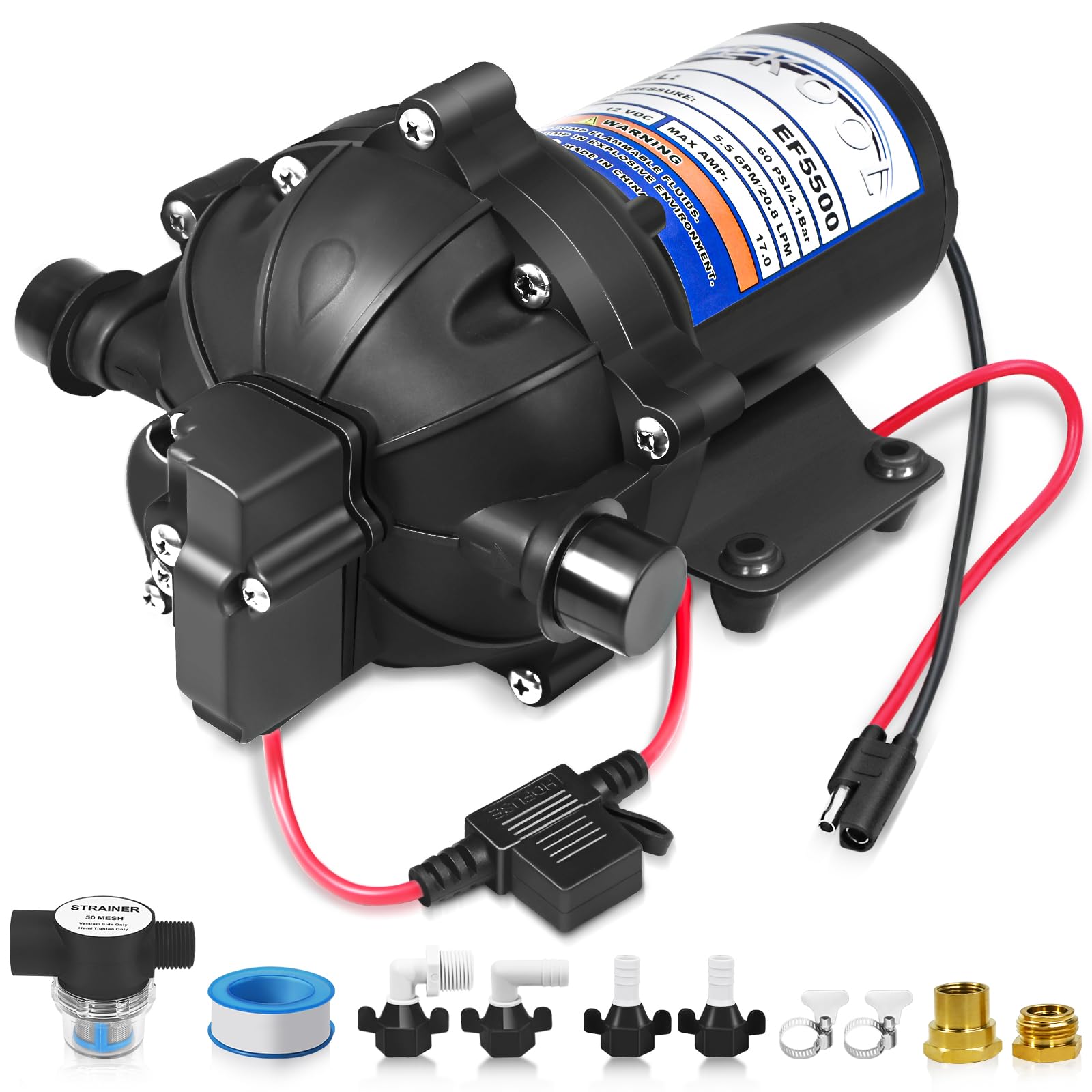
A steady soft wash workhorse that lets you build a roof rig from parts and save a bundle
If you have priced a pre-built soft wash system and choked, hear this: the same core pump that powers those rigs is often a 12-volt diaphragm unit like this one. This DEEKOOL pump delivers 5.5 GPM at a 60 PSI pressure switch and self-primes up to 8 feet. It runs a 6-foot, 20-amp power cord and is designed for the everyday soft wash job — siding, decks, fences, and light roofing wash. The pressure switch keeps a steady flow and starts and stops automatically as you spray, so the pump is not running flat out when the trigger is closed.
The internals follow the familiar recipe: a durable diaphragm set built for chemical corrosion resistance, an all-copper motor, and an integrated leak-proof design. The rubber base keeps vibration and noise down so it does not rattle the whole trailer. One feature worth calling out is short-term idling tolerance — the pump can handle brief idle periods without the motor burning out, which takes some of the anxiety out of operating it. Thermal overload protection adds a second safety net by stopping the motor before it overheats. Because each pump is factory-tested, a small amount of water may remain in the unit when it arrives — that is inspection residue, not a defect.
The honest caveat is reliability consistency. Shoppers say both good and disappointing experiences: some rig it up and find it works exactly like the roof-washing tutorials, while others see it shut down with heavy use in hot weather, only restarting after a cooldown. Running it near its 60 PSI ceiling on a hot day with long continuous bursts is where it is most likely to kick out. Keep your spray bursts a little shorter in the heat, use the automatic start-stop to your advantage, and it behaves. It is a strong pick for a DIY soft wash build where a bit of patience pays off.
Where it shines: for a DIY soft wash rig, the short-term idle tolerance and automatic start-stop make the pump forgiving to operate while you learn your spray rhythm.
Where the expectations should sit: it is not a bulletproof commercial unit — long, hot, continuous runs are the conditions most likely to trigger its thermal shutoff.
Great for: DIY soft washers building their first rig who want a 5.5 GPM pump with a forgiving idle tolerance and automatic start-stop control.
Not for: a commercial operation running continuous high-demand spray in high heat, where the thermal cutout will test your patience.
9. Fimco High-Flo HFP-2.2 Pro Series 12V Diaphragm Sprayer Pump

A commercial-grade workhorse built for oil-based chemicals and demanding spot spraying
This Fimco High-Flo is the premium pick on the list, and it earns that spot by targeting a different job than the soft wash crowd. It delivers 2.2 GPM at a 100 PSI maximum pressure — the highest pressure rating here, but at the lowest flow. That combination is exactly what spot spraying and on-demand diluted chemical application need: high pressure to reach a target precisely, low flow to conserve mix. The pump is designed for ATV and lawn tractor mounting, where a compact footprint and dependable output matter more than sheer volume.
The materials are where the premium price lives. The Geolast diaphragm is engineered to resist oil-based chemicals and resist oil swell — a durability feature you will not find on the bleach-focused soft wash pumps above. The body resists harsh oil-based chemicals with surfactants, making it a fit for agricultural sprays that the standard diaphragm pumps are not built to handle. It is round-up ready, self-priming, and pairs a heavy-duty motor to deliver what the maker describes as years of dependable use. If your chemical mix includes oil-based products, this is the pump on the list designed for it.
Do not buy this expecting a fast-fill soft wash rig. At 2.2 GPM it will not keep pace with the 5.5 or 6.5 GPM pumps when you need volume for a wide spray pattern — it is built for precision, not speed. The power source is listed as AC/DC, so double-check it matches your setup before ordering. Owners who run it on Roundup sprayers report good pressure and an easy install, and describe it as a dependable workhorse for spot spraying. If your chemicals are oil-based or your rig is an ATV spot sprayer, this is the one built to survive them.
Why it is the premium pick
- 100 PSI max pressure is the highest on this list for precise spot spraying
- Geolast diaphragm resists oil-based chemicals and oil swell — a material spec the bleach-focused pumps lack
- Round-up ready and self-priming for agricultural spot spraying
- Heavy-duty motor built for ATV and lawn tractor mounting
Where it is not the right call
- 2.2 GPM flow is the lowest here — it will not feed a wide soft wash spray pattern
- Power source is listed as AC/DC, so confirm it fits your 12-volt rig before buying
- Fewer buyer reviews on record than the leading picks, so long-term data is thin
The specialty choice: reach for this Fimco if your chemicals are oil-based or you spot-spray from an ATV and want a diaphragm rated to resist oil swell.
Pick a different pump if: you need volume for a soft wash rig — the higher-flow pumps above are the better match for that job.
Understanding the Specs
Flow Rate (GPM)
GPM stands for gallons per minute, and it measures how fast the pump moves liquid through your hose. A higher GPM means more water reaches your nozzle, which keeps a wide spray pattern full instead of thinning out. Match GPM to your spray tip count: more tips need more flow. The pumps on this list range from 2.2 GPM for precision spot spraying up to 6.5 GPM for large soft wash rigs, so pick the flow that fits your nozzle setup rather than the biggest number available.
Shut-off Pressure (PSI)
PSI stands for pounds per square inch, and the shut-off pressure is the maximum pressure the pump builds before its internal switch stops the motor. Higher PSI helps push water up sloping ground, up to second-story height, or through a long hose where friction eats into the pressure. The pumps here span 60 PSI to 100 PSI. A 70 PSI pump gives you more usable pressure at the tip for two-story work than a 60 PSI one, while 100 PSI on a lower-flow pump suits precise spot spraying. Match PSI to how high and how far you spray.
Self-Priming Height (Suction Lift)
Self-priming height is how far above the water level the pump can sit and still pull liquid up into itself, measured in feet of suction lift. If your tank is mounted low and your pump sits higher, you need enough lift to bridge the gap. The pumps here range from 6 feet to 10 feet of lift. Choose a pump whose priming height covers your actual rig layout with some margin, because a pump that strains to prime will run hot and wear faster.
Diaphragm and Valve Materials
The diaphragm is the flexible membrane that pushes liquid through the pump, and the valves are the one-way gates that keep it flowing in one direction. Their material decides which chemicals the pump can survive. Santoprene, EPDM, Viton, and Geolast each resist different chemical families. Pumps rated for bleach and surfactant mixes use materials chosen to resist corrosion from those cleaners, while a Geolast diaphragm is picked for its resistance to oil-based chemicals and oil swell. Always match the material to the liquids you plan to run through the pump.
FAQ
What PSI do I need for a two-story soft wash job?
Can I run bleach through these soft wash pumps?
How high can a 12V pump pull water from a tank mounted low on a trailer?
Why does my soft wash pump keep cycling on and off?
Will a 12V diaphragm pump overheat and shut down during long runs?
Do I need a rigid pickup tube for these pumps?
What is the difference between a soft wash pump and a pressure washer?
Can these pumps handle oil-based chemicals or just bleach?
How long should a 12V soft wash pump last?
What GPM do I need for a spray bar with multiple tips?
Are these pumps safe to run dry for a moment?
Final Thoughts: The Verdict
For most soft wash setups, the winner is the SEAFLO 33 Series Washdown Deck Wash Pump Kit — the crowd favorite at 4.2 stars across nearly 300 owners — because it arrives as a complete, pre-matched kit with the longest warranty here and a 70 PSI rating that handles RV, boat, and light soft wash work without hunting for parts. If you want maximum flow for a large soft wash rig, grab the TWERE EF5500-BOX at 6.5 GPM for two-story reach. And if your priority is the strongest flow-per-dollar on a mid-range rig, the Ebusin 12V Diaphragm Pump is the one to reach for — just be ready to flush it after every job. Whichever you choose, match the GPM to your spray tips, and the PSI to how high you spray.
How We Picked
We do not accept paid placement. Every pick is matched to a real buyer and a real use-case; we do not hands-on test units.
Sources & Methodology
Specifications: manufacturer listings and product documentation. Review insights: verified customer reviews, as of September 2026. Pricing: not shown on this page (it changes often); check the current price via the retailer link.
As an Amazon Associate, KitchPrep earns from qualifying purchases. This does not affect which products we feature.
Related Guides
