
Specs are compiled from manufacturer listings and verified buyer reviews and can change over time — please confirm the key details on the product page before buying.
If you are hanging baseboards, casing, or cabinet trim, the fastest way to ruin a board is a hammer and a bent finishing nail. An 18 gauge brad nailer (a trim gun that shoots thin 18 gauge nails) drives the nail straight into the wood so the head sinks just below the surface. That leaves a pinhole you fill with a dab of putty instead of a split board you have to replace. Match the gun to your compressor’s output and your job size: a 2-inch-max gun covers door casing and baseboard, while a 2-1/8-inch gun reaches through a thicker header.
I’m Mohammad Maruf — the founder and writer behind KitchPrep. This guide is built by comparing the manufacturers’ published specifications and the patterns across verified customer reviews, so you get each pick’s real strengths and trade-offs instead of marketing spin.
Some of these guns sink a 2-inch brad through oak without a second thought, while others top out short of the long nails a thick header needs. Every model below has been checked against the real spec sheet and the owner feedback that follows it, so you can spot which one fits your bench, your compressor, and your trim. Read on for the full rundown of the 18 gauge brad nailer picks, ranked by nail range, depth control, and weight.
Our Picks at a Glance


How To Choose The Best 18 gauge brad nailer
Before you compare models, get two things straight: what length brads your trim actually needs, and what air supply you already own. Everything else — depth control, jam release, trigger style — is refinement on top of those two basics.
Match the nail range to your thickest board
An 18 gauge brad nailer only shoots the nail lengths it is built to accept, and that range sits on the spec sheet as something like 5/8-inch up to 2-inch or 5/8-inch up to 2-1/8-inch. If your project is thin door casing and small trim, a 2-inch maximum is plenty. But if you are fastening a thicker header or building furniture, the extra sixteenth of an inch on a 2-1/8-inch gun means you can reach through the full joint instead of falling short and leaving the top layer loose. Check your thickest stock first, then buy a gun whose top end clears it.
Sort out your air supply before you buy
These are pneumatic tools, which means they run on compressed air from a separate compressor rather than a battery or wall plug. A small pancake or 2-gallon tank is fine for trim and repair work, while a larger 20-gallon tank keeps a big baseboard run moving without waiting for the pump to catch up. The gun itself specifies an operating pressure — Arrow’s PT18G, for example, is built to run between 60 and 100 PSI (pounds per square inch, the air pressure the tool needs) — and too little pressure is the single most common reason a brad stays proud of the surface instead of sinking in.
Decide how much depth control you need
Depth-of-drive adjustment is the feature that sets the nail head just under the wood so you can fill it and move on. A tool-free dial lets you tweak that setting on the fly between a soft pine casing and a dense maple rail. A gun with a fixed or awkward depth system will fight you on mixed materials, and that shows up fast in the reviews of the models that skimped on it.
Quick Comparison
| Model | Best For | Nail Range | Weight | Depth Adjustment | Amazon |
|---|---|---|---|---|---|
| 18GA 2IN Brad Nailer Kit★ Best Overall | All-round trim and shop use | 5/8″ to 2″ | 1.2 lb | Tool-free | Amazon |
| Arrow PT18GBest for Tight Corners | Tight spaces and small jobs | 5/8″ to 2″ | 3.5 lb | Fixed (two settings) | Amazon |
| CRAFTSMAN CMPBN18KBuilder’s Pick | Furniture assembly and quick jobs | 18 gauge | 4.4 lb | Tool-free | Amazon |
| DeWalt DWFP12233 | Precision placement in hard wood | 5/8″ to 2-1/8″ | 16 oz | Tool-free | Amazon |
| Metabo HPT NT50A5 | Long trim runs and reupholstery | 5/8″ to 2″ | 2.9 lb | Tool-free dial | Amazon |
| BOSTITCH SB-2IN1 | Brads and staples from one tool | 18 gauge brads and staples | 2.8 lb | Adjustable guide | Amazon |
| SENCO FinishPro 18MG | Daily cabinet and trim work | 5/8″ to 2-1/8″ | 4 lb | Tool-free | Amazon |
| SENCO FinishPro 25XP | Heavy trim and hardwood flooring | 5/8″ to 2-1/8″ | 2.7 lb | Tool-free | Amazon |
In‑Depth Reviews
1. 18GA 2IN Brad Nailer Kit
Our pick — over 4.5★ from 650+ verified ratings; the strongest balance of quality and price.
The featherweight that sinks a 2-inch brad through oak without dragging your wrist down.
Here is the number that reframes this whole list: this Porter-Cable weighs just 1.2 pounds, and the CRAFTSMAN CMPBN18K next to it tips the scale at 4.4 pounds. That gap is the difference between holding a gun up for a full afternoon of crown molding and setting it down every ten minutes to rest your forearm. It drives 18 gauge nails from 5/8-inch all the way to 2-inch, covers everything from thin door casing up to a two-inch brad, and it keeps you working because the whole thing weighs about as much as a loaded staple gun.
The jam story is the real reason it landed on top. Buyers report it fires smoothly straight from the start, and the tool-free jam release lets you pop a stuck nail out without hunting for an Allen key. The depth-of-drive wheel has detents, which means you can feel each click as you set the head just below the surface of your pine or poplar trim. One owner pushed it through 1,100 square feet of flooring work and kept going, which tells you it handles a real project, not just a single doorframe. A maintenance-free motor rounds it out, so you are not topping up oil and risking a stain on the work surface you just sanded.
The honest trade-offs are small but worth knowing. It runs on an air compressor, so you need a tank and hose on site. One owner found the adjustment wheel finicky, and the plastic barrel tip can snap off on a rough nail run — neither kills the output, and neither showed up as a pattern. The included brads are also just a 100-count starter set meant for indoor use, so plan on buying better fasteners for anything that lives outside. A 3-year limited warranty backs the tool.
What owners keep coming back for
- Just 1.2 pounds — light enough to hold all day without fatigue
- Zero-jamming operation right from the start, owners mention
- Tool-free depth wheel and tool-free jam release for quick adjustments
- Drives 5/8-inch to 2-inch 18 gauge brads, covering trim and light assembly
- Ships with a carrying case and ¼-inch fitting
Where it makes you work a little
- Requires a separate air compressor and hose
- The adjustment wheel can be fussy to dial in
- The plastic barrel tip can pop off during hard nailing
- Included brads are a thin 100-count indoor starter set
Reach for this if: you want the lightest, most forgiving all-rounder for trim, shelving, and cabinet work, and you already own a compressor.
Look elsewhere if: you need a battery-powered gun, because this one only runs on air.
2. Arrow PT18G Gauge Oil-Free Pneumatic Brad Nailer
The oil-free gun that squares up to base molding, sheetrock, and even metal studs.
What wins people over here is raw driving power paired with a body that does not need oil. It is a pneumatic 18 gauge brad nailer built for trim and interior molding, and it fires Arrow brad nails of all sizes — 5/8-inch, 3/4-inch, 1-inch, 1.5-inch, and 2-inch. One owner’s line captures the punch it brings: “Excellent, drove 2 inch braid at 100psi thru base molding, sheetrock. and into metal stud.” That is the kind of job where a weak gun stalls halfway and leaves you driving the nail home with a hammer anyway.
Because the motor runs without oil, you skip the maintenance step that trips up a lot of pneumatic tools, and you never risk an oil slick ruining the finish you just sanded. The exhaust cover lets you steer the outgoing air away from your face, which matters when you are crouched under a bottom cabinet. There is a low nail indicator window on the side-load magazine so you can see when you are down to the last few brads and avoid a dry fire, and a contact safety feature requires the nose to touch the surface before it fires. It runs on most air compressors and is rated for use between 60 and 100 PSI (pounds per square inch, the air pressure the tool needs).
Accuracy at the nose is where it takes a step back. The depth system is basic — two settings on a plastic clip that you need a screwdriver to move, and the nail sits only barely below the work surface. One owner noted it can struggle at an angle, which is a real limitation if you are shooting into a beveled joint. There is also no plastic case in the box, though the original packaging holds up for storage, and it weighs 3.5 pounds, so it is not the lightest option against the 1.2-pound Porter-Cable above.
The driving verdict: it earns its place on power and oil-free convenience, and it clears the 2-inch molding jobs that choke cheaper guns.
What gives it pause: if you rotate between pine and maple all day, that two-position depth clip will send you reaching for a screwdriver far too often.
the balance for you: small wood projects and trim work where you want maximum punch from a gun that never needs oiling.
Skip it when: you need fine depth control across mixed hardwoods and softwoods.
3. CRAFTSMAN Brad Nailer, 18GA, Pneumatic Nail Gun (CMPBN18K)
A no-oil workhorse for furniture assembly and the quick jobs that never seem to end.
If your projects are flat-pack furniture, box builds, and the odd bit of trim, this is built for exactly that lane. It runs an oil-free motor, which means no lubricating the tool between uses and no oil carryover staining the surface — a convenience that owners call out as a genuine time-saver for quick jobs or long stretches of work. A tool-free jam release clears a stuck brad without tools, and a tool-free depth-of-drive adjustment sets the nail heads where you want them. It arrives with a ¼-inch air fitting and a carrying case, and it takes a 1/4-inch air connection straight from the start.
Where it trips some people up is the heft. At 4.4 pounds it is the heaviest gun on this list against the 1.2-pound Porter-Cable, which is a real consideration when you are holding it overhead for crown molding. Owners still describe it as not too bulky and able to reach relatively tight spaces, so the weight is more of an all-day fatigue factor than a reach problem. One buyer’s take after a couple of weeks of use sums up the response: “I’ve been working with it a couple of weeks now and it is really responsive to my needings.”
The mismatch to watch is manual style. The owner’s manual says no tool oil is needed, which is convenient, but the manual itself is thin on the finer points of setup. One buyer opened the box after a month and found a dead unit, though that reads as a single fluke rather than a trend across the model. For a beginner who just needs furniture assembled and a couple of door casings hung, the simplicity outweighs the gripes.
The consistent take: careful buyers get accurate, repeatable fastening on furniture and shelving projects, and the oil-free motor keeps the workflow clean.
One thing to handle: the same responsive trigger that owners praise will outrun a small compressor if you fire faster than it can recharge.
Best matched to: the furniture builder and home-repair user who wants a reliable, low-fuss 18 gauge nailer without a learning curve.
Think twice if: you plan to hold the gun overhead for long stretches, because 4.4 pounds adds up.
4. DeWalt 18 Gauge Precision Point Brad Nailer (DWFP12233)

A smaller nose and zero contact-trip push make it the accurate one in hard wood.
This is the pick for anyone who has ever fought to line up a nail in a corner. DeWalt fits a smaller nose than its other nailers and, in a real shift from most guns, you do not have to push the contact trip against the surface to fire it. That means you can see exactly where the brad will land before you squeeze the trigger, which is why one owner had no trouble driving 3/4-inch brads easily. It drives 18 gauge brads from 5/8-inch up to 2-1/8-inch — that top end reaches a sixteenth of an inch further than the 2-inch Porter-Cable — so a slightly thicker joint is still within reach.
The precision carries into the materials. Customers note it drives brads even into hard wood and functions very smoothly, with a good feel in the hand. A selectable trigger lets you switch between sequential fire for one careful placement at a time and contact actuation for rapid runs along a long stretch of trim, so the same tool covers a delicate cabinet door and a fast baseboard line. A tool-free jam release clears misfires, the depth-of-drive setting is adjustable without tools, and an adjustable belt hook keeps the gun on your hip between passes.
Two things to plan around. At 16 ounces it is a touch heavier than the 1.2-pound Porter-Cable, though still light enough for most work. And a maintenance-free motor keeps you from staining the surface, but the manual does not spell out every depth trick, so give yourself a few test shots on scrap before you commit to a finished piece.
Why precision people choose it
- Precision Point nose lets you see the exact nail placement
- No contact-trip compression needed to fire
- Drives 5/8-inch to 2-1/8-inch 18 gauge brads
- Selectable trigger switches sequential and contact actuation
- Adjustable belt hook keeps it close at hand
Small things to weight in
- 16 ounces, slightly heavier than the lightest pick on the list
- Depends on a separate air compressor
- Fewer published buyer critiques to scan than some rivals
Made for you if: clean, visible nail placement in dense or finished wood is your priority and you want the flexible trigger options.
Not the one for: someone chasing the absolute lightest gun, since the 1.2-pound Porter-Cable wins on weight.
5. Metabo HPT Brad Nailer, Pneumatic, 18 Gauge, NT50A5

The 2.9-pound pro gun with an aluminum magazine that resists the jams plastic invites.
The standout here is the high-grade aluminum magazine, which is a durability and jam-resistance move that plastic-bodied guns cannot match. It accepts 5/8-inch up to 2-inch 18 gauge brads, which is the same working range as the lighter Porter-Cable and Arrow guns, and it weighs 2.9 pounds, sitting comfortably between the 1.2-pound featherweight and the 4.4-pound CRAFTSMAN. Build quality is the thing owners bring up again and again — as one review page puts it, this is “real professional quality” with a body that is “aluminum, not plastic.”
Where it earns its long-run stripes is in the control features. A selective actuation switch lets you flip between bump fire and sequential fire, so you can rapid-fire a whole baseboard and then switch to single placement for a cabinet face. A reload indicator on the magazine warns you when you are down to your last brads so you avoid blank drives, and the integrated air duster blows dust off the work surface as you go. The narrow nose piece and short center height get the gun into hard-to-reach corners and tough angles where a bulkier tool would not fit.
There is one recurring mixed signal in the feedback: reliability performs well for many owners but a share of them run into issues, so this is a gun to buy for its features rather than treat as bulletproof. It is also not a 2-in-1, meaning it will not shoot staples, and there is no carrying case in the box — just a tool bag. A 5-year warranty backs it, the most generous coverage on this list.
What sets it up front: a pro-preferred trim gun with an aluminum magazine, a 5-year warranty, and controls that suit a full renovation.
The catch to keep in mind: it fires brads only, so a job that calls for staples means reaching for a second tool.
Pick this one if: you are a pro or serious DIYer running long trim stretches and want a durable aluminum-magazine body with an ambidextrous belt hook.
Pass on it if: you need one tool that does brads and staples.
6. BOSTITCH Brad Nailer 18 Gauge / Narrow Crown Stapler, 2-in-1 (SB-2IN1)
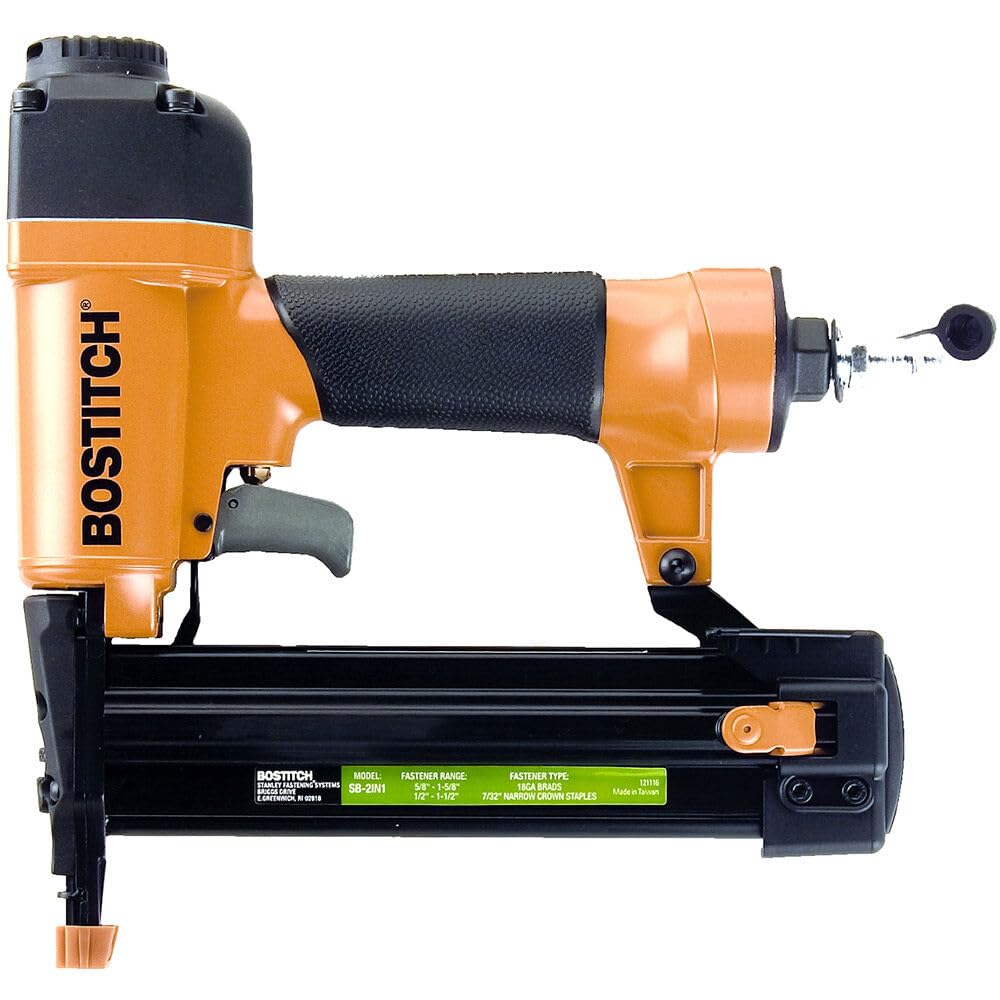
One tool that switches between 18 gauge brads and narrow crown staples.
This is the versatile oddball of the group: it drives both 18 gauge brads and narrow crown finish staples from the same body, so a build that mixes nails and staples does not force you to buy or carry a second gun. It holds a full strip of up to 2,000 fasteners, and owners lean on that range — several call out how useful it is to have staples and small nails available in one tool. An adjustable depth guide sets each fastener where you want it, and the exhaust is tool-free adjustable so you can steer the outgoing air away from your face.
Two things in the feedback are worth knowing going in. One owner wished it could shoot 2-inch brads, which tells you the brad range tops out shorter than the 2-inch guns above, so a thick header is off the menu. And the reliability picture is mixed: some owners run it happily as both a stapler and a brad nailer, while others hit it shooting a couple of staples and then quitting. The owner’s manual is also thin — it does not cover fastener sizing, loading, or depth adjustment, so you learn the setup by feel.
The kit itself is generous when it arrives complete, packing a nailer, a ¼-inch air fitting, a carrying case, an extra no-mar tip, and a bottle of oil. One buyer did find the advertised sample nails and staples missing from the box, so open it and check before the return window closes. At 2.8 pounds it sits on the lighter side for its twin-function build.
The pair you get: brads and narrow crown staples in one pneumatic gun makes it a genuine space-saver for a small shop.
The split to weigh: reliability draws both steady fans and occasional trouble, so treat it as a tool that wants a patient hand on the magazine.
Worth grabbing if: your projects mix trim nails and staples and you would rather own one tool than two.
Something better exists if: you need to drive full 2-inch brads, which this one falls short of.
7. SENCO FinishPro 18MG, 2-1/8-Inch 18-Gauge Brad Nailer (ProSeries)

A magnesium-bodied pro gun that fires 2-1/8-inch brads and shrugs off a floor drop.
Weight is the headline, and it comes from the construction: the main body is magnesium, which keeps this durable tool light enough to hold for extended use without your arm quitting first. Owners put it to work on chair rail, baseboards, cabinetry, and furniture repair, and the whole package is built around control — a selectable trigger flips between fire modes, a tool-free depth adjust sets the heads, and a rotatable belt hook keeps it on your hip. It fires 18 gauge straight strip brads from 5/8-inch up to 2-1/8-inch, matching the DeWalt and Senco 25XP on the long end.
Where this gun proves itself is hard wood. One owner ran 440 feet of finger-joint pine baseboard at 70psi with 1¾-inch 18 gauge brads, and the gun took every nail without a jam. Another notes it holds quality that feels higher than the big-box store brands. The oil-free motor keeps the work surface clean from carryover, the exhaust ring rotates so you can angle the air away, and a swivel air connector helps in tight spaces.
The honest caveats centre on long-term durability and a couple of ergonomic quirks that show up in the feedback. A small share of reviewers point out the plastic magazine slide wearing out over months of heavy use, and one pro found the dry-fire when the magazine runs empty annoying. It is also the priciest gun on this shortlist, so it makes sense as a buy-it-once tool for someone whose income depends on it, less so for a weekend warrior. The plastic magazine slide is the compromise to be aware of given the magnesium body around it.
What the cabinet pros rate
- Magnesium body keeps it light and durable for extended use
- Fires 5/8-inch to 2-1/8-inch 18 gauge straight strip brads
- Jam-free runs through hundreds of feet of baseboard, shoppers say
- Oil-free motor protects the finished surface
- Selectable trigger, swivel plug, adjustable rear exhaust
What to keep an eye on
- Priciest gun on the list — a pro-tier spend
- Plastic magazine slide can wear with heavy daily use
- No dry-fire lockout when the magazine empties
- The belt hook can dig into your hand on some grips
Built for you if: you finish-carpenter day in and day out and want a magnesium-body gun with the reach for 2-1/8-inch brads.
The value question: if you only hang a doorframe twice a year and long-run durability is not a concern, the lighter Porter-Cable delivers similar results for far less.
8. SENCO FinishPro 25XP Pneumatic Brad Nailer

The 2.7-pound hardwood driver with a belt hook and an on-tool ruler built in.
For a floor installer, the value here is capacity and hardness handling. The magazine holds 110 nails, which means fewer reload stops across a long plank run, and it is built to drive both slight and medium headed 18 gauge brads from 5/8-inch up to 2-1/8-inch. One owner used it to install hardwood flooring and reported it drives a 2-inch brad straight into hardwood and countersinks it cleanly. The operating pressure spans 70 to 120 PSI, and the body runs a sequential trigger for controlled single shots.
The little extras are what separate it from a generic gun. There is an on-tool ruler for quick material measurements without reaching for a tape, a belt hook for fast access between planks, and a no-mar pad to protect the surface you are nailing into. It is oil-free, so no carryover reaches the work, and it weighs 2.7 pounds — the lightest of the Senco picks and just a whisker under the 2.8-pound BOSTITCH. An owner with 30-plus years in construction rates it against Makita and Metabo/Hitachi brads specifically because it is the one that accepts nails up to 2-1/8-inch.
Two quirks are worth flagging. There is no dry-fire lockout, so an empty magazine fires a dud when you reach for the next nail. And the belt hook is a clip-on piece rather than an attached one, so it can go missing if you are not careful. Neither is a dealbreaker, but for a heavy-trim or flooring job built around a fast rhythm, both are small interruptions worth knowing about before you buy.
The heavy-trim verdict: a 110-nail magazine, a 5/8-inch to 2-1/8-inch range, and 2.7 pounds of oil-free gun make it a flooring and trim specialist.
Hold onto this: the clip-on belt hook is loose in the box, so it wants a pocket when the gun is stowed.
Right for the job if: you install hardwood flooring or run heavy trim and want the extra nail capacity plus the built-in ruler and no-mar pad.
Not the one for: anyone who needs a dry-fire lockout, since it fires on an empty magazine.
Understanding the Specs
Nail range (5/8-inch to 2-inch vs 5/8-inch to 2-1/8-inch)
The nail range on the box tells you the shortest and longest brads a gun will accept, and it is the single spec that decides whether a model can finish your biggest joint. A gun that tops out at 2-inch covers standard door casing, baseboard, and small trim. A gun that reaches 2-1/8-inch can push through a slightly thicker layer of material, which is why models like the DeWalt DWFP12233 and the SENCO FinishPro 25XP list the longer number. Shorter than the shortest figure, or longer than the longest, and the nail will not seat properly — you get a proud head or a jam, not a finish.
Operating pressure (PSI) and depth-of-drive
PSI measures the air pressure pushing each brad, and it has a real-world effect on how cleanly the head sinks. The Arrow PT18G is built to run between 60 and 100 PSI, while the SENCO FinishPro 25XP operates from 70 to 120 PSI. Too little pressure leaves the head proud of the surface; too much can overdrive it and dent the wood. That is where depth-of-drive adjustment comes in — a tool-free dial lets you fine-tune how far the head seats, so you can switch from soft pine to dense maple without hammering the nail in by hand. Fixed or awkward depth systems are the most common complaint in the budget tier.
FAQ
Do I need an air compressor to run an 18 gauge brad nailer?
What is the difference between an 18 gauge brad nailer and a 16 gauge finish nailer?
Can an 18 gauge brad nailer drive a 2-inch brad into hardwood?
Why do some guns need oil and others do not?
What does tool-free depth adjustment actually do?
Are there any 18 gauge brad nailers that also shoot staples?
How do I stop brads from shooting proud of the surface?
What is the difference between a sequential and a bump-fire trigger?
Do these nailers come with a carrying case?
Can a brad nailer replace a hammer and nails for trim work?
Final Thoughts: The Verdict
For most people working through trim, shelving, and cabinet projects, the Porter-Cable 18GA 2IN Brad Nailer Kit is the one to grab — at 1.2 pounds it is light enough to hold all day, it fires 5/8-inch to 2-inch brads without jamming, and it has the reviews and the jam-free reputation to prove it holds up. If you want the extra reach that a 2-1/8-inch brad gives you, the DeWalt DWFP12233 adds that sixteenth of an inch plus a smaller nose for precise placement. And if your projects mix nails and staples, the BOSTITCH SB-2IN1 saves you from buying two guns. Whichever fits your workbench, match the nail range to your thickest board and pick a gun with tool-free depth control.
How We Picked
We do not accept paid placement. Every pick is matched to a real buyer and a real use-case; we do not hands-on test units.
Sources & Methodology
Specifications: manufacturer listings and product documentation. Review insights: verified customer reviews, as of September 2026. Pricing: not shown on this page (it changes often); check the current price via the retailer link.
As an Amazon Associate, KitchPrep earns from qualifying purchases. This does not affect which products we feature.
Related Guides
