
Specs are compiled from manufacturer listings and verified buyer reviews and can change over time — please confirm the key details on the product page before buying.
If you want a floor that shrugs off muddy paws, office chairs and spilled juice, the enemy is fuzz, not color. Berber lives or dies on its loop pile — the small uncut loops that stand up to traffic instead of matting down. This guide covers five real Berber options, from peel-and-stick tiles you press down yourself to a full 9-by-12 area rug that anchors a whole living room.
I’m Mohammad Maruf — the founder and writer behind KitchPrep. This guide is built by comparing the manufacturers’ published specifications and the patterns across verified customer reviews, so you get each pick’s real strengths and trade-offs instead of marketing spin.
Picking berber carpet flooring usually depends on one worry: will it crease, and will the color match the screen? Below you will see which tiles install in minutes, which pile heights (how tall the fibers stand) suit basements, and how to dodge those two surprises.
Our Picks at a Glance

How To Choose The Best Berber Carpet Flooring
Berber is not a brand and it is not a color. It is a construction style built from loop pile — yarn woven into tight uncut loops instead of sheared flat. Those loops are what stop fibers from matting and make spills sit on the surface long enough to wipe up.
Loop Pile and Pile Height
Pile height is the thickness of the carpet surface, measured in inches. A low pile like 0.07 inches feels firm underfoot and slides under doors, while 0.24 inches feels noticeably softer and hides small floor imperfections better. Lower pile means easier vacuuming and less crushed fiber over time.
Fiber Type
Most Berber today is polyester (often PET, the same family as recycled bottles), polypropylene, or nylon. Polyester resists stains well and stays colorfast; nylon costs more but tends to be denser and springier. Check the backing too — polypropylene and PVC backings handle moisture far better than a plain latex base.
Tiles Versus a Solid Rug
Tiles give you modular repair: damage one square and you swap one square. A single large area rug gives you one continuous surface with no seams to line up. For a basement that floods or a room with odd angles, tiles usually win. For a finished living room, one rug reads cleaner.
Quick Comparison
| Model | Best For | Construction | Pile Height | Coverage | Amazon |
|---|---|---|---|---|---|
| Mohawk Basics 24″ x 24″ Berber (Loop pile)★ Best Overall | Basements and offices | Textured loop, PET fiber | 0.07 inches | 96 sq ft per carton (24 tiles) | Amazon |
| Garland Rug Classic Berber Area RugLargest Coverage | Living room anchor | Machine made, polypropylene | 0.3 inches | 9 by 12 feet | Amazon |
| Rehert Carpet Tiles 20″ x 20″ Berber | Renters and small spaces | Peel & stick, polypropylene | 0.24 inches | 32 sq ft per box (12 tiles) | Amazon |
| IncStores 1/4 Inch Thick Berber Self Adhesive Carpet Tiles | Entryways and trade show floors | Peel & stick, polyester | 1/4 inch | 60 tiles, 12″ x 12″ each | Amazon |
| Mohawk Advance 24″ x 24″ Berber (Loop pile) | High-traffic rooms | Textured heathered loop, nylon | 0.11 inches | 96 sq ft per carton (24 tiles) | Amazon |
In‑Depth Reviews
1. Mohawk Basics 24″ x 24″ Berber (Loop pile), 0.07″ Pile Height, Carpet Tile, PET Fiber, Earth Tone Color, (24 Tiles)
Our pick — 4.5★ from 300+ verified ratings; the strongest balance of quality and price.
The crowd favorite — a 0.07-inch PET loop tile that turns bare basement concrete into a finished floor in an afternoon.
Start here if you have a cold, unfinished basement or a home office that needs a surface in a hurry. Each tile is 24 by 24 inches, a carton covers 96 sq ft across 24 tiles, and the textured loop pile sits at just 0.07 inches tall. That sliver of pile is the whole point — it means doors clear it, chairs roll over it, and a vacuum glides instead of chewing.
The fiber is PET, a stain-resistant polyester, layered over an EcoFlex Matrix backing that shrugs off spills and water-extraction cleaning. Two install routes exist: glue down, or a FlexLok floating floor — though the FlexLok tabs and adhesive are sold separately, so factor that in. What wins people over is the tile quality; installation confidence runs a close second, since no special tools are needed and scissors do most of the cutting.
The honest caveat is thinness. Owners comparing this to the Mohawk Advance find the same 24-by-24 footprint, and the pile height gap is small — the Garland rug sits at 0.3 inches against this 0.07 inches, which shows how much softer a thick rug feels. If you want plush underfoot, this is not it. What it is: a moisture-proof PET tile that suits kids and pets, backed by a 10 Year Limited Wear Warranty plus a 10 Year Limited Stain Resistance Warranty.
What earns it the top spot
- 96 sq ft of coverage per carton from 24 tiles at 24″ x 24″ each
- Impervious to moisture damage from spills and water extraction cleaning
- 10 Year Limited Wear and 10 Year Limited Stain Resistance warranties
- No special tools needed — scissors cut it along the back guidelines
Where it asks you to compromise
- 0.07-inch pile is firm, not soft — one buyer found it thinner than anticipated
- FlexLok tabs and adhesive are purchased separately
Reach for this if: your priority is a fast, moisture-proof basement or office floor you can repair tile by tile.
Think twice if: you want deep cushion underfoot — that calls for a thick area rug instead.
2. Garland Rug Classic Berber Area Rug, 9 by 12-Feet, Earth Tone
One 9-by-12-foot machine-made polypropylene rug that covers a whole living room with no seams.
This is the option for someone who does not want seams, grid lines or puzzle pieces. At 144″ L x 108″ W it spans a full 9 by 12 feet, so it covers a whole living room in one piece. At 30 pounds it stays put — compare that to the Mohawk Basics tile at 1.5 pounds, and you feel why this one lies flat and heavy on its own.
Polypropylene (a synthetic fiber that resists wear) keeps it looking good underfoot, and a rubber back adds grip so it does not slide on hard floors. It is USA-made and machine made, and the 0.3-inch thickness is the softest surface in this group — roughly four times the pile height of the tile picks, which is what you want if bare feet matter more than bulletproof durability. Care is simple: vacuum regularly, spot clean, and skip the beater-bar vacuum (the spinning brush bar) to protect the fibers. It is not machine washable.
What holds it back: color and creasing. The shade leans darker in person than on screen, and because larger sizes ship folded in a box, temporary creases are common. The fix is to roll the rug in the opposite direction and let it rest a day or two before unrolling.
Where it shines: matching a dog-friendly, slip-resistant surface to a bigger room without laying a single tile.
Takes top marks if: you have one large room and want a single, weighty Berber rug with a rubber-grip back.
Better skipped if: you need stain-proof modular repair or cannot tolerate a break-in window for fold creases.
3. Carpet Tiles, Carpet Squares, Office Carpet Tiles Removable, Carpet Tile Flooring for Basement, 20″ x 20″ Berber (Loop Pile), Gradient Black, 0.24″ Pile Height (12 Tiles)
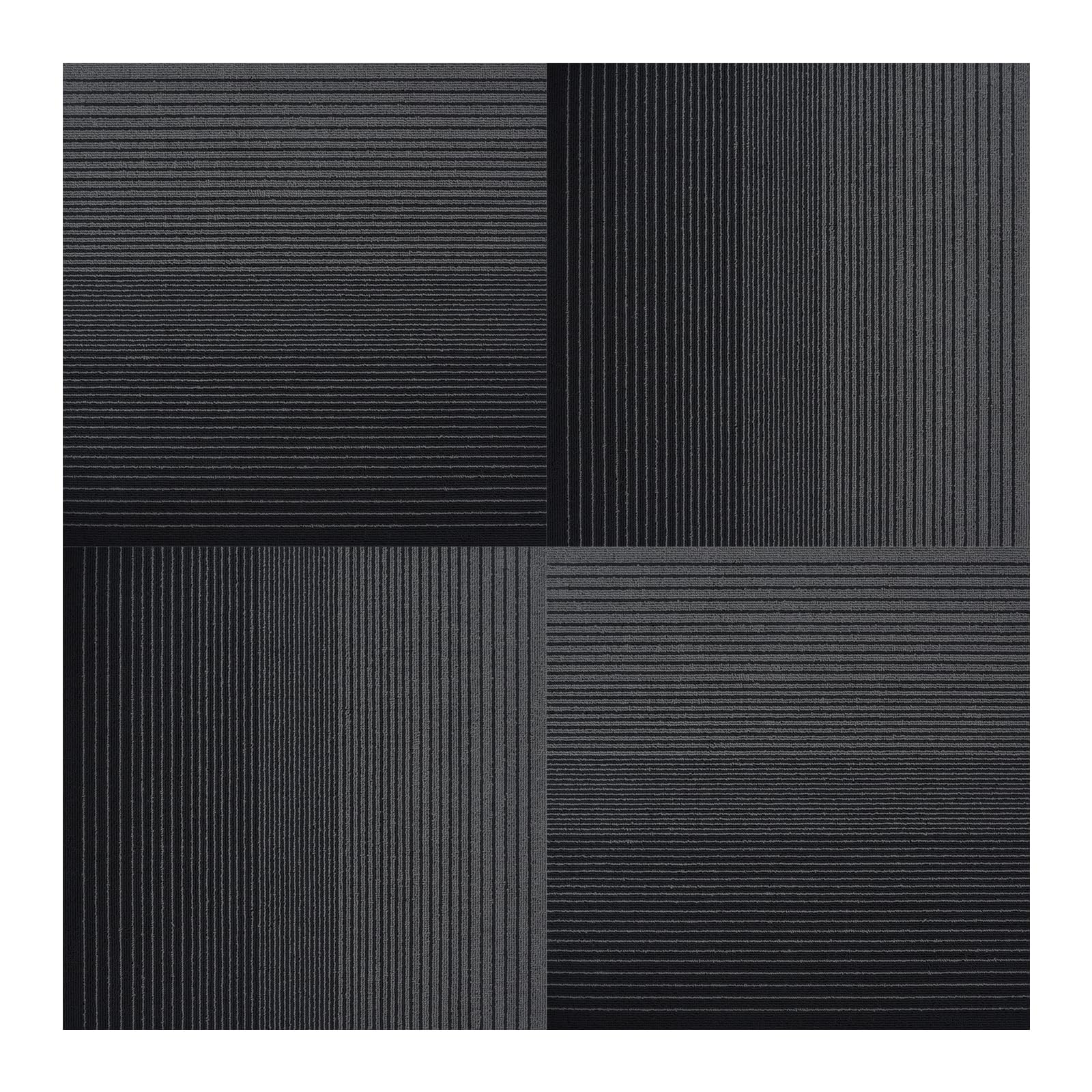
A peel-and-stick 20-by-20 Berber tile you can lift back up the day the lease ends.
Peel-and-stick is the entire pitch here, and it solves the renter’s real problem: nothing permanent gets nailed or glued to a floor you do not own. A PVC base with included adhesive handles installation, no tools or contractor required. Each tile is 20 by 20 inches, each box covers 32 sq ft across 12 tiles, and the loop pile measures 0.24 inches — noticeably plusher underfoot than the 0.07-inch Mohawk Basics tile.
Dense polypropylene construction makes it elastic, stain-resistant and tough against chair drags, dropped items and spills. Gradient black does double duty: it disguises seams and covers small layout mistakes, which matters when you are learning as you go.
The catch to plan around: only the small border squares carry adhesive, so edges can slide unless you add 4-inch carpet tape as a hold-down. On uneven concrete, every bump telegraphs through. Dense loop pile also means low cushion — one reviewer noted it is “not plush,” and sharp edges still need a knife to finish.
Why it still wins renters: single tiles swap out in seconds, so cat damage or a coffee stain never means replacing the whole floor.
Pick this one if: you rent, want a temporary basement or playroom floor, and value being able to lift it and change the layout.
Look elsewhere if: you need a permanently glued, guaranteed-nonslip surface across a large area.
4. IncStores 1/4 Inch Thick Berber Self Adhesive Carpet Tiles | Commercial Carpet Tiles for Basement, Classroom, and Trade Show Floor Protection | Stone Beige, 60 Pack

Sixty 12-by-12 peel-and-stick polyester Berber squares, built to cover a lot of floor fast.
Buy this when you need volume, not polish. Each tile is 12″ L x 12″ W, and the set runs to 60 tiles, so it scales to entryways, classrooms and trade show booths with quick peel-and-stick coverage. The self-adhesive backing means no separate glue purchase, and staying power is where this pick earns its reputation — a buyer who shipped the set in three batches reported every batch’s color matched, and a 100 sq ft closet went from tired to finished in a couple of hours.
what separates it from the Rehert tiles is the adhesive strategy: this one relies on a glue backing on every square rather than a few connector tabs, which helps larger continuous runs stay put. The polyester Berber loop (a woven, low-pile surface) handles foot traffic, and Berber fuzz at the edges cleans up with a carpet knife trim and a vacuum.
The honest trade-off: hand this to a perfectionist and they will grumble. Tiles vary slightly in size, so a flawless grid of seams is not realistic, and the glue can let go on certain subfloors — pulling up during vacuuming months later with no residue to blame. Warm, dry, clean surfaces hold best.
Fair verdict: treat it as affordable, replaceable flooring where one bad tile is a two-minute swap, not a finished-luxury material.
Suits you if: you are covering a broad, low-stakes area — mudrooms, classrooms, temporary show floors — and want the most tiles for the least fuss.
Pass if: you need factory-perfect seams and an adhesive bond that never lifts on a tricky subfloor.
5. Mohawk Advance 24″ x 24″ Berber (Loop pile), 0.11″ Pile Height, Carpet Tile, Nylon Fiber, Carbon Color, (24 Tiles)

A 0.11-inch nylon Berber tile built for rooms that never get a quiet moment.
For the room that gets hammered — a sunroom, a busy office, the path between the back door and the kitchen — the material here is the upgrade. Nylon rather than PET (two synthetic fibers; nylon is the tougher of the two), in a textured heathered loop, at 0.11 inches of pile. That is a touch taller than the Mohawk Basics tile at 0.07 inches, and both share the same 24 by 24 inch footprint and 96 sq ft per carton across 24 tiles, so the trade-up buys denser fiber, not more floor.
Design flexibility is the selling point: it resists stains, soil and crunching, and wipes clean after spills. It takes the same two install routes as its sibling — glue down or FlexLok floating floor — with those tabs and adhesive sold separately. And the warranties are a step up: a Lifetime Limited Wear Warranty and Lifetime Static, against the Basics model’s 10 Year Limited Wear coverage.
If your room sees ordinary, light use, that premium is money you may never need to spend.
And the reality check: nylon Berber is not a plush carpet, and one buyer was disappointed to find it “wafer thin” compared with the photos, noting the color also differed from the listing. Order a full-sized sample first — this is the pattern for every tile in this whole category, but it matters most on a premium purchase.
Made for you if: the room is high-traffic and you want nylon durability plus lifetime wear and static warranties.
Not worth it if: you are carpeting a low-traffic space and the staple PET-grade tile already covers it.
Understanding the Specs
Pile Height
Pile height is measured from the backing up to the top of the loops, quoted in inches. Lower numbers — think 0.07 inches or 0.11 inches — mean a firm surface that clears doors and resists crushing. Taller pile such as 0.24 inches or an area rug at 0.3 inches feels softer underfoot and covers small floor dips, but it matts faster in hallways.
Fiber and Backing
PET and polypropylene are the common stain-resistant synthetics; nylon costs more and stays springier longer. Backing decides moisture behavior: PVC, polyolefin and fiberglass blends resist spills better than plain latex, which is why tiles built for basements advertise moisture resistance as a headline feature.
FAQ
Can Berber carpet tiles be installed over uneven concrete floors?
How do I stop Berber carpet tiles from sliding?
Will a thick Berber area rug shed or pill over time?
What is the difference between loop pile and cut pile carpet?
How do I clean Berber carpet flooring?
Are Berber carpet tiles pet-friendly?
How much flooring coverage do I need to order?
Is Berber carpet good for basements?
How do I install self adhesive carpet tiles?
Do I need to buy extra tape or adhesive separately?
Final Thoughts: The Verdict
For most people searching for berber carpet flooring, the smart purchase is the Mohawk Basics 24″ x 24″ Berber Carpet Tile — it turns a cold basement into a usable room, covers 96 sq ft per carton, resists moisture, and can be repaired one tile at a time. If you want nylon durability for a truly high-traffic room, step up to the Mohawk Advance Berber Carpet Tile. And if you would rather lay one heavy, machine-made rug with a rubber-grip back, the Garland Rug Classic Berber Area Rug is the one to reach for. Whichever you choose, order a sample first — color differs from screen on nearly every pick here.
How We Picked
We do not accept paid placement. Every pick is matched to a real buyer and a real use-case; we do not hands-on test units.
Sources & Methodology
Specifications: manufacturer listings and product documentation. Review insights: verified customer reviews, as of September 2026. Pricing: not shown on this page (it changes often); check the current price via the retailer link.
As an Amazon Associate, KitchPrep earns from qualifying purchases. This does not affect which products we feature.
Related Guides
